Get 50% OFF All Premium 3D & STL Models!

In the dynamic world of 3D visualization, few subjects captivate the eye quite like a meticulously rendered automobile. The sleek curves, the interplay of light on polished surfaces, the subtle distortion through glass – these elements combine to evoke a sense of realism that can make a digital image indistinguishable from a photograph. At the heart of this visual magic lies the sophisticated handling of reflections and refractions. For 3D artists, game developers, and automotive designers, understanding how to master these optical phenomena is not just a technical skill; it’s an art form that transforms good renders into breathtaking ones.
This comprehensive guide from 88cars3d.com will delve deep into the principles and practical techniques required to create stunningly realistic reflections and refractions in your 3D car models. We’ll explore everything from the foundational physics of light interaction to advanced shader creation, environmental lighting setups, and crucial optimization strategies for both high-fidelity renders and real-time applications like game engines and AR/VR. Whether you’re aiming for a photorealistic showcase or a performant game asset, prepare to unlock the secrets behind truly captivating automotive visualization.
The journey to realistic reflections and refractions begins with a solid grasp of Physically Based Rendering (PBR) workflows. PBR materials are designed to mimic how light behaves in the real world, providing a much more predictable and consistent result across various lighting conditions compared to older, artistic-driven shading models. The core concept revolves around the conservation of energy and the microfacet theory, which describes how surface irregularities influence light scattering.
Key PBR maps are the bedrock of these materials, each playing a critical role in defining how a surface reflects and refracts light. The Albedo or Base Color map defines the intrinsic color of a surface without any lighting information. The Metallic map distinguishes between metallic and dielectric (non-metallic) surfaces, instructing the renderer how to interpret reflections. For metals, the albedo color influences the reflection color, while for dielectrics, reflections are typically achromatic. The Roughness map dictates the microscopic imperfections on a surface, directly controlling the sharpness or blurriness of reflections. A low roughness value results in mirror-like reflections, while high roughness scatters light, leading to diffuse reflections. The Normal map adds fine surface detail without requiring additional geometry, influencing how light bounces off the simulated bumps and grooves. Lastly, the Opacity map (often combined with a Transmission or Alpha channel) controls transparency and subsequently, refraction.
Historically, two main PBR workflows emerged: Metallic-Roughness and Specular-Glossiness. While both aim for physical accuracy, the Metallic-Roughness workflow has become the industry standard, favored by most modern renderers and game engines. In this model, you primarily define whether a material is metallic or non-metallic using a grayscale Metallic map (0 for dielectric, 1 for metallic). The Roughness map then dictates the scattering of light. The Specular-Glossiness workflow, on the other hand, uses a Specular map to define the color and intensity of reflections, and a Glossiness map (inverse of roughness) to control sharpness. While you might still encounter legacy assets using Specular-Glossiness, focusing on Metallic-Roughness will provide the most efficient and compatible results for contemporary automotive rendering.
Roughness is paramount for defining the character of reflections. Imagine a perfectly polished chrome bumper versus a brushed aluminum trim. The chrome has extremely low roughness, yielding crisp, undistorted reflections. The brushed aluminum, however, has higher roughness in specific directions (anisotropy), causing reflections to stretch and blur along the brushed grain. Accurately painting or generating roughness maps is crucial. Similarly, the Index of Refraction (IOR) is a critical parameter for transparent materials like glass, water, or car paint clear coats. IOR determines how much light bends when passing through a material. For car glass, a common IOR value is around 1.52. Incorrect IOR values can lead to physically inaccurate light bending, making glass appear fake or plastic-like. Understanding and correctly applying these values – typically found in physics reference tables – is vital for achieving convincing refractions.
Automotive paint is a complex material, often requiring a layered shader approach to truly capture its depth and realism. A typical car paint shader consists of several layers: a base coat (the primary color), metallic flakes (for shimmer), and a glossy clear coat (for reflections and protection). The clear coat is arguably the most important, as it’s responsible for the pristine, mirror-like reflections that define a high-quality car render. These layered effects combine to create the distinctive look of car paint, which shifts and glints under different lighting conditions. Achieving this depth means meticulously controlling each layer’s properties, from its color and metallic response to its roughness and clear coat attributes.
In renderers like 3ds Max with Corona or V-Ray, Blender with Cycles, or Maya with Arnold, you’ll typically build your car paint using a physically accurate shader. For instance, in Blender’s Cycles or EEVEE, the Principled BSDF shader is a robust starting point. You would define the base color, metallic value (often 0 for the base color, with metallic flakes handled separately), and a low roughness value for the underlying paint. Then, a dedicated “Clearcoat” and “Clearcoat Roughness” parameter within the Principled BSDF shader can be used to simulate the clear coat layer, setting its roughness to a very low value for a mirror-like finish. Advanced users might layer multiple Principled BSDFs using a Mix Shader, with masks controlling where each layer is visible, allowing for intricate paint effects and subtle wear and tear.
The clear coat is where the magic of automotive reflections truly happens. It acts as a transparent, highly reflective layer over the base paint. The reflections off this layer are predominantly Fresnel-driven, meaning their intensity increases significantly at grazing angles. This is why a car looks glossier when viewed from a steep angle. Furthermore, many car paints and metallic finishes exhibit anisotropy. This occurs when a surface has microscopic grooves or a directional grain (like brushed metal or certain metallic paint types), causing reflections to stretch or blur in a specific direction. For example, if you observe the paint on a car, you might notice reflections elongate perpendicular to the direction of the car’s body lines. To simulate this, you’d typically use an Anisotropic shader component or dedicated parameters within a PBR shader, along with a tangent map to define the direction of the anisotropy. Controlling the strength and rotation of this anisotropy is key to capturing the unique look of different paint finishes and metallic accents on your 3D car models.
Adding metallic flakes or pearlescent particles beneath the clear coat significantly enhances realism. These tiny reflective elements catch the light, creating a sparkling effect that changes with the viewing angle. You can achieve this procedurally using noise textures and color ramps in your shader network, or by utilizing specialized flake normal maps. For instance, a Musgrave texture node in Blender Cycles, combined with a Color Ramp and fed into a Bump or Normal Map node, can simulate flakes. The density and size of these flakes, along with their color variation, can dramatically alter the appearance of the paint. Another subtle but crucial detail is the “orange peel” effect, a slight, uneven texture on the clear coat resulting from the painting process. This can be simulated with a very subtle noise texture plugged into the normal input of your clear coat shader, adding a touch of imperfection that enhances believability. Pay attention to references: if you’re modeling a classic car, the orange peel might be more pronounced than on a modern luxury vehicle. Fine-tuning these details can elevate your automotive renders from good to exceptional, showcasing the high standards found in models on platforms like 88cars3d.com.
Automotive glass is not a monolithic surface but a complex interplay of multiple layers, varying thicknesses, and intricate curvatures, especially in windshields and compound headlight lenses. To achieve convincing refractions, it’s essential to model glass as a true volumetric object, not just a thin plane. This means ensuring your 3D car models have actual thickness for all glass elements, allowing light to realistically pass through and refract multiple times. The curvature of the glass plays a significant role in how light is bent and distorted. Simple flat glass will not yield the same dynamic visual effects as a curved windshield. Furthermore, internal reflections within the glass layers, often seen as subtle colored fringes, contribute significantly to realism. Absorption also needs consideration; real glass isn’t perfectly transparent and will absorb some light, especially if tinted. This absorption can be simulated by coloring the volume scattering or absorption within the glass shader.
For windshields and side windows, consider modeling them as distinct inner and outer layers, or at least giving them substantial thickness. This allows for accurate internal reflections and better light interaction. In your shader, use a glass BSDF (like the Glass BSDF in Blender’s Cycles or a similar material in V-Ray/Corona). Crucially, set the Index of Refraction (IOR) accurately. For standard glass, an IOR of approximately 1.52 is a good starting point. For tinted windows, you’ll want to introduce a subtle absorption color. Instead of just coloring the glass, use a volume absorption node (in Cycles) or the absorption color parameter in other renderers. This ensures that the tint darkens as light passes through more material, just as it would in reality. Headlight and taillight lenses are even more complex, often featuring intricate internal patterns designed to diffuse and direct light. These require detailed modeling of the internal reflectors and diffusers, with separate glass shaders applied to the outer lens, ensuring that the light refracts through these sculpted surfaces realistically.
Caustics are light patterns created by light being focused or reflected off a curved surface, like the mesmerizing patterns you see under water or through a glass object. While incredibly realistic, rendering true caustics is computationally expensive and can dramatically increase render times. For high-end architectural visualization or product shots, renderers like Cycles or V-Ray can compute caustics, but you might need to enable specific settings and increase sampling. In Blender 4.4’s Cycles, ensure that “Caustics” are enabled under Light Paths in the Render Properties panel if you wish to compute these directly (check the official Blender 4.4 documentation for specific settings: Blender Light Paths). For real-time applications or faster renders, artists often employ techniques to “fake” caustics. This can involve projecting textured light or using clever shader tricks with alpha masks and blurred reflections to create the illusion of focused light patterns. While not physically accurate, these methods can provide a convincing aesthetic without the heavy computational overhead, making them ideal for game assets or AR/VR experiences where performance is critical.
Reflections and refractions are not solely determined by the material properties of your 3D car models; they are profoundly influenced by the surrounding environment and lighting. A stunning car render relies heavily on a compelling environment to reflect, whether it’s a sterile studio setup or a vibrant outdoor scene. The choices you make for your environment directly dictate the fidelity and believability of your reflective surfaces. Without a rich and varied environment to reflect, even the most perfectly calibrated car paint will appear dull and lifeless.
High Dynamic Range Images (HDRIs) are indispensable tools for achieving realistic lighting and reflections. An HDRI is a panoramic image that captures the full range of light intensities in a real-world environment. When used as an environment map, it essentially wraps your scene in a realistic light source, providing both diffuse illumination and accurate reflections. Beyond HDRIs, strategic placement of direct light sources such as area lights, spot lights, or even mesh lights (lights created from emission-enabled geometry) is essential. The interaction between these direct lights and the indirect illumination provided by the HDRI creates a nuanced and believable lighting scenario, highlighting the contours and form of the vehicle.
Setting up an HDRI is a straightforward yet impactful step. In most 3D software, you’ll load an HDRI into your world or environment settings. In Blender, for example, you would navigate to the World Properties, change the Surface type from ‘Background’ to ‘Environment Texture’, and then open your HDRI file. The resolution of your HDRI directly impacts the sharpness and detail of your reflections. For high-quality renders, using 8K or even 16K resolution HDRIs is recommended to avoid pixelated or blurry reflections. Different HDRIs evoke different moods and provide varied reflections: a studio HDRI will offer clean, soft box reflections, ideal for showcasing car paint in a controlled environment, while an overcast outdoor HDRI will provide soft, diffuse reflections. Experiment with various HDRIs to find the one that best complements your car model and desired aesthetic, ensuring that the environment reflected in the paint and glass is both interesting and realistic.
While HDRIs provide global illumination, specific light sources are crucial for sculpting the car’s form through reflections. Area lights are excellent for simulating large light sources like studio softboxes or natural skylight, creating soft, even reflections. Spotlights can be used to emphasize particular details or create sharp, focused highlights. Mesh lights (e.g., a plane with an emission material in Blender Cycles) are versatile for creating custom light shapes and reflections. When positioning lights, consider the “rule of three” lighting setup (key, fill, and rim light) to define shape and separation. A strong rim light, positioned behind and slightly to the side of the car, can create a dazzling highlight along the edges, separating the vehicle from the background and emphasizing its silhouette. Experiment with light intensity, color temperature, and size to achieve the desired effect. The goal is to create a dynamic interplay of light and shadow that enhances the car’s aesthetic and showcases the quality of its automotive rendering.
Creating photorealistic reflections and refractions is one thing; making them perform efficiently in real-time environments like Unity or Unreal Engine is another. Game developers and AR/VR professionals demand stunning visuals without compromising frame rates. This requires a strategic approach to optimization, where every polygon, texture, and shader instruction is carefully considered. While offline renderers can brute-force complex light calculations, real-time engines rely on a combination of pre-baked data and clever approximations to deliver visual fidelity within strict performance budgets. When sourcing game assets, especially detailed vehicles from marketplaces such as 88cars3d.com, it’s vital to consider their inherent optimization for real-time applications.
Key optimization techniques include leveraging reflection probes, using efficient Screen Space Reflections (SSR), implementing Level of Detail (LODs) for objects based on their distance from the camera, and optimizing shader complexity. The goal is to strike a balance between visual quality and computational cost, ensuring your car models look exceptional whether viewed up close or from a distance, and whether they are being rendered offline or interactively in a game. This often involves making smart compromises without sacrificing the overall aesthetic.
In game engines, reflection probes are essential for capturing environmental reflections. These “cameras” capture the surrounding environment and bake it into a cubemap, which is then applied to reflective surfaces. For static environments, you can bake these probes once, significantly reducing real-time computational load. Dynamic reflection probes can capture moving elements but are more expensive. Screen Space Reflections (SSR) are another powerful technique that computes reflections using only the information visible on the screen. SSR is great for local reflections (e.g., a car reflecting the road directly beneath it) but has limitations: it cannot reflect objects outside the camera’s view. A common practice is to use a hybrid approach: reflection probes for general environmental reflections and SSR for detailed, localized reflections, offering a good balance of performance and visual quality for AR/VR and game scenarios. This combined strategy ensures that both distant and close-up reflections maintain a high level of fidelity.
Complex shaders, especially those with many layers or intricate procedural networks, can be performance bottlenecks in real-time. Optimizing shaders involves simplifying calculations, reducing the number of texture lookups, and leveraging shader features efficiently. For instance, combining multiple PBR maps (e.g., metallic, roughness, and ambient occlusion) into a single texture atlas can reduce draw calls and memory usage. Texture atlasing involves packing multiple smaller textures onto one larger texture sheet, which is then mapped across different parts of the model. This is especially beneficial for car interiors or engine parts where many small textures might be used. Efficient UV mapping is also crucial here; well-organized UV layouts facilitate better texture compression and reduce wasted space on texture atlases. When designing textures for real-time, consider resolutions like 2K or 4K for primary surfaces, with lower resolutions for less prominent details, to balance visual quality with VRAM consumption. Regularly profiling your scene’s performance in your target engine will help identify and address any shader-related bottlenecks.
Even with perfectly modeled, textured, and lit 3D car models, the journey to a truly photorealistic render isn’t complete without post-processing and compositing. These crucial steps allow artists to refine the raw render, add atmospheric effects, correct colors, and introduce subtle imperfections that mimic the look of real-world photography or cinematography. Think of post-processing as the digital darkroom where you apply the final polish, transforming a technically accurate render into an emotionally resonant image. This stage offers an immense amount of creative control, enabling you to guide the viewer’s eye and enhance the overall impact of your automotive rendering.
Compositing involves combining various render passes (also known as AOV, or Arbitrary Output Variables) that provide separate components of the final image, such as diffuse color, reflections, refractions, shadows, and depth information. By manipulating these passes individually, artists gain granular control over every aspect of the image, allowing for non-destructive adjustments and advanced effects that would be difficult or impossible to achieve in a single render. For instance, in Blender, you can utilize the Compositor (accessible via the Compositing workspace) to combine render layers and apply various effects. The Render Layers Node in Blender 4.4 is particularly useful for bringing in separate render passes, and the broader Blender Compositing section of the manual details a wide array of nodes for color correction, filtering, and mixing.
Render passes are your secret weapon in compositing. Instead of rendering a single image, you can output multiple image layers, each containing specific lighting or material information. For car renders, essential passes include:
By separating these elements, you can, for instance, adjust the intensity of reflections without altering the base color, or fine-tune the glass refraction without re-rendering the entire scene. In compositing software like Photoshop, Nuke, or Blender’s native Compositor, you combine these passes using various blending modes and nodes to reconstruct the final image and apply targeted adjustments.
To truly emulate the look of real camera footage, consider adding subtle, optically accurate effects in post-processing.
The key to these effects is moderation. Overuse can quickly make a render look artificial. Experiment and use reference images to guide your choices, ensuring that each effect contributes positively to the realism and artistic vision of your final automotive render.
Achieving realistic reflections and refractions in your 3D car models is a multifaceted process that demands technical understanding, artistic sensibility, and a keen eye for detail. We’ve journeyed from the foundational principles of PBR materials, emphasizing the critical roles of roughness and IOR, to the intricate art of crafting multi-layered automotive paint shaders and convincing glass. We’ve explored how environmental lighting, particularly HDRIs, and strategic light placement can dramatically elevate your reflections, and discussed crucial optimization techniques for real-time performance in game engines and AR/VR applications. Finally, we delved into the power of post-processing and compositing, where render passes and subtle camera effects provide the ultimate control and final polish.
Mastering these techniques will undoubtedly set your visualization work apart. The pursuit of realism in 3D art is a continuous learning curve, filled with experimentation and refinement. We encourage you to apply these insights to your own projects, practice diligently, and observe the real world around you for inspiration. Remember, a truly realistic render isn’t just about technical perfection; it’s about capturing the essence of light and material interaction in a way that resonates with the viewer. When you’re ready to take your automotive projects to the next level, explore the vast collection of high-quality, meticulously crafted 3D car models available on 88cars3d.com, perfect for integrating into your next stunning render or interactive experience.
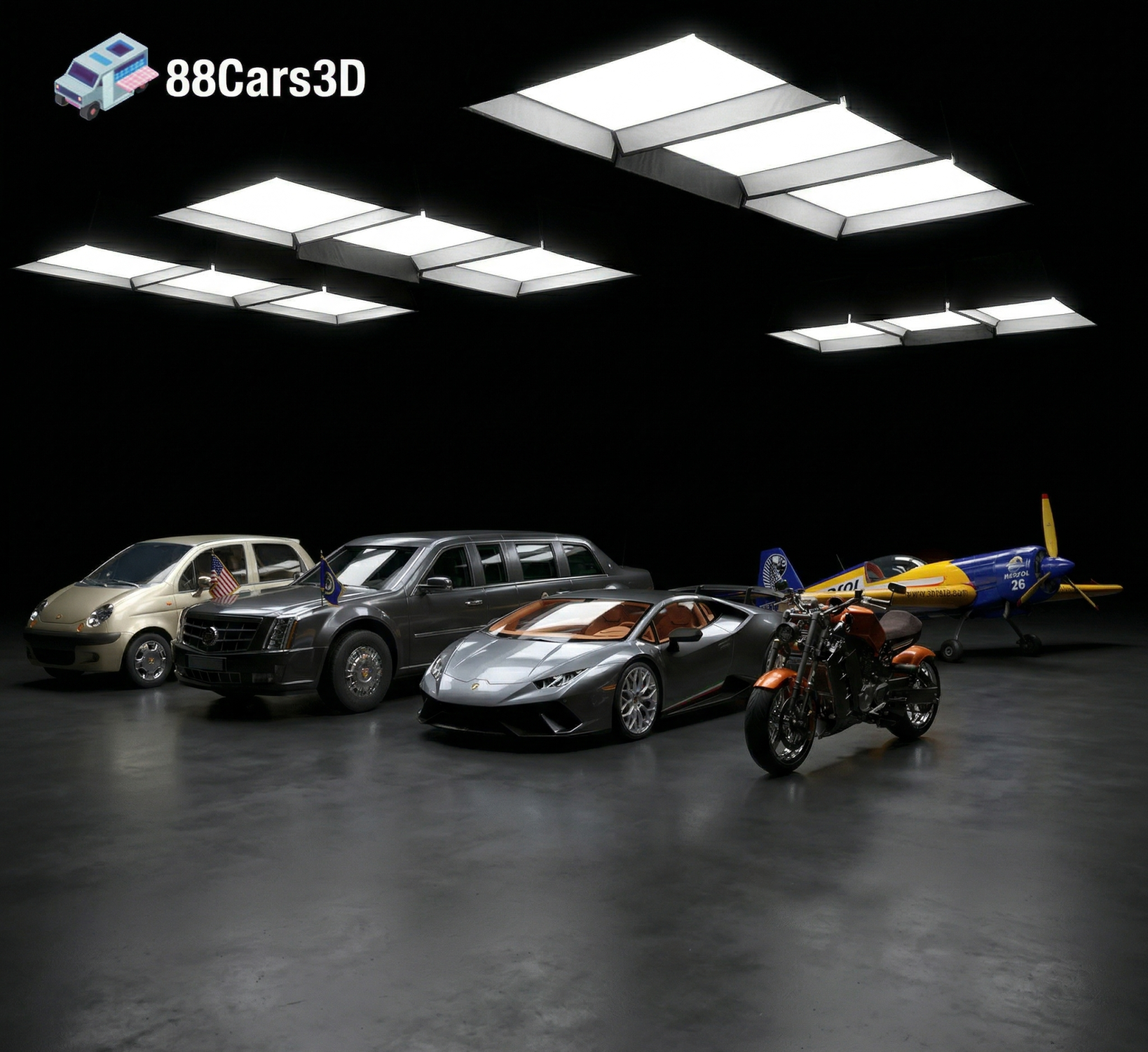
Texture: Yes | Material: Yes | 3D Printable: Yes. Download the Ultimate Creators’ Showcase featuring 5 premium 3D models: Lamborghini Huracan, ZAV Concept Motorcycle, Sukhoi SU-26, Presidential Limousine, and Daewoo Damas. Optimized for 4K CGI rendering and 3D printing. Save massive with this exclusive multi-category bundle!
Price: $99.99

Texture: Yes | Material: Yes | 3D Printable: Yes. Download the Italian Thoroughbreds Bundle featuring 5 iconic 3D models: Lamborghini Huracán Performante, Ferrari 458 Italia, Lamborghini Urus, Diablo SV, and Maserati GT. Optimized for 4K rendering and 3D printing (STL included). Save 50% with this ultimate Italian vehicle collection.
Price: $199.99

Download the Elite Future Mobility Bundle featuring 4 highly optimized 3D models: Tesla Model S, Avatr 11, Li L9, and Zoox Robotaxi. Perfect for ArchViz, Smart City renders, and game dev. Optimized for Unreal Engine and Blender. Includes .fbx, .obj, and .max formats.
Price: $99

🚗 5 Iconic German Cars (BMW M4 G82, M5 CS, X3, 1 Series & Mercedes E-Class). ✅ Optimized for ArchViz: Ready for Corona & V-Ray. 💰 Save €71 with this limited-time collection! 🚀 Instant Download after purchase.
Price: $119

Download the Extreme Off-Road & Survival 3D Models Bundle! Includes the Brabus 800 Adventure, Dodge Ram Bigfoot, Spec Truck, and a Caravan. Save over €210 on this premium 4-in-1 off-grid vehicle pack for ArchViz and game development.
Price: $149.99

Download the Heavy Duty & Commercial Logistics 3D Models Bundle! Includes the Ford Sterling, Caterpillar CT680, Mercedes Citaro Bus, and Vito Van. Save over €130 on this massive, game-ready 4-in-1 industrial vehicle pack.
Price: $109.99

Download the Ultimate Custom Motorcycles 3D Models Bundle. Includes a Custom Chopper, Ducati 916 Café Fighter, Harley XR1200X, and BMW K100. Perfect premium props for luxury ArchViz garages. Save over €250 today!
Price: $159.99

Download the ultimate JDM Street Racing 3D Models Bundle! Includes the Nissan GT-R, Toyota Supra, Mazda RX-7, Lancer Evo IX, and Honda NSX. Save big on this highly optimized, game-ready 5-in-1 Japanese legend car pack.
Price: $129.99

Download the ultimate American Muscle & Cinematic Classics 3D Models Bundle! Includes the Dodge Charger ’68, Mustang Eleanor GT500, Camaro Z28 ’79, and a custom ’69 Mustang. Save over €240 on this game-ready, premium 4-in-1 pack.
Price: $149.99

Download the Everyday City Traffic 3D Models Bundle. Includes the VW Golf, Kia Picanto, Hyundai Tucson, Toyota Yaris, and a DHL Ford Transit Van. Save big on this 5-in-1 pack, perfectly optimized for realistic ArchViz streets and game traffic.
Price: $99.99

