Get 50% OFF All Premium 3D & STL Models!

The roar of an engine, the screech of tires as a car drifts around a corner, the precise weight transfer under heavy braking – these are the hallmarks of a truly immersive automotive experience. For developers in game design, automotive visualization, and simulation, recreating these complex dynamics in real-time is a paramount challenge. Unreal Engine, with its powerful Chaos Physics system, offers an unparalleled toolkit for achieving stunningly realistic vehicle physics, transforming static 3D models into interactive, high-fidelity driving machines.
This comprehensive guide is designed for Unreal Engine developers, 3D artists, and automotive enthusiasts eager to push the boundaries of real-time vehicle simulation. We’ll embark on a journey from preparing your high-quality 3D car models to fine-tuning every aspect of vehicle dynamics, leveraging Unreal Engine’s advanced features like Chaos Physics, Blueprint scripting, and optimization techniques. Whether you’re building a photorealistic automotive configurator, a thrilling racing game, or a cutting-edge driving simulator, understanding these principles is crucial. Get ready to put the pedal to the metal and unlock the full potential of vehicle physics in Unreal Engine.
Before a vehicle can hit the virtual road, its 3D model must be meticulously prepared. The quality and structure of your asset directly impact the fidelity and performance of its physics simulation. Sourcing high-quality 3D car models is the first critical step, as they often come with clean topology, PBR materials, and proper UV mapping, reducing setup time significantly. Platforms like 88cars3d.com offer a wide selection of production-ready car models, optimized for Unreal Engine, which can serve as an excellent starting point.
When acquiring a 3D car model, pay close attention to its polygon count, mesh structure, and material setup. For optimal performance and realism, models should ideally have:
* **Clean Topology:** Quads are preferred, minimal non-manifold geometry.
* **Realistic PBR Materials:** Properly textured with Albedo, Normal, Roughness, Metallic, and Ambient Occlusion maps.
* **UV Mapping:** Non-overlapping UVs for texture application and lightmap generation.
* **Logical Hierarchy:** Separate meshes for the body, wheels, interior, and any destructible parts.
High-quality assets from reputable sources ensure a smoother transition into Unreal Engine and fewer headaches during the physics setup phase.
The vehicle’s mesh needs to be structured in a way that Unreal Engine’s physics system can interpret correctly. Crucially, the main body mesh should be a Skeletal Mesh, allowing for individual wheel movement and suspension articulation.
* **Root Bone and Hierarchy:** Ensure your car model has a proper bone hierarchy. Typically, a root bone at the vehicle’s center (often slightly below the chassis) with child bones for each wheel is ideal. The vehicle body should be skinned to the root bone.
* **Collision Meshes:** For accurate physics, simple collision meshes are often better than complex, high-poly ones. You can use simplified convex hulls or even automatically generated primitive shapes within Unreal Engine. For complex shapes like the car body, a series of simple collision primitives or a `UCX_` prefixed collision mesh (if exporting from DCC software) is recommended. Avoid using per-poly collision on the main vehicle body for performance reasons; it’s generally only suitable for static, complex environment meshes.
* **Scale and Orientation:** Ensure your model is exported at a realistic scale (e.g., 1 unit = 1cm in Unreal Engine) and with a consistent forward (X-axis) and up (Z-axis) orientation. Incorrect scale can lead to unpredictable physics behavior.
Unreal Engine’s Chaos Physics system is a robust and highly performant physics engine that underpins much of the engine’s dynamic interactions, including vehicle simulation. The Chaos Vehicle component provides a comprehensive framework for creating realistic car dynamics, replacing the legacy PhysX system. It allows for detailed configuration of engine, transmission, suspension, and tire properties. For a detailed overview of Chaos Physics, refer to the official Unreal Engine documentation at https://dev.epicgames.com/community/unreal-engine/learning.
The process begins by creating a new Blueprint Class and selecting `VehiclePawn` as the parent class. Inside this Blueprint, you’ll find the `ChaosVehicleMovementComponent`, which is the heart of your vehicle’s physics.
1. **Skeletal Mesh Assignment:** Drag your prepared Skeletal Mesh into the Blueprint’s Components tab and assign it as the root component, or a child of the `ChaosVehicleMovementComponent`. Ensure the correct root bone is selected.
2. **Wheel Setup:** The `ChaosVehicleMovementComponent` has a `Wheel Setup` array. For each wheel, you need to define:
* **Bone Name:** The name of the wheel bone from your Skeletal Mesh.
* **Wheel Radius:** The radius of the wheel, influencing ride height and contact.
* **Wheel Width:** The width of the tire, affecting friction calculations.
* **Wheel Location:** Offset from the wheel bone, defining the contact point with the ground.
* **Steering Angle:** Maximum steering angle for front wheels.
* **Axle Type:** Front, Rear, or Center (for special configurations).
This initial setup ensures the physics system correctly identifies and interacts with each wheel.
These components are crucial for defining how your vehicle generates power and transfers it to the wheels.
* **Engine:**
* **Torque Curve:** This is perhaps the most critical setting, defining the engine’s output torque at different RPMs. Use a `CurveFloat` asset to create a realistic torque curve based on real-world vehicle data.
* **Max RPM:** The engine’s redline, where it shifts gears or limits power.
* **Idle RPM:** The engine’s RPM when no throttle is applied.
* **MOI (Moment of Inertia):** Influences how quickly the engine revs up and down.
* **Transmission:**
* **Gear Ratios:** Define the ratio for each forward and reverse gear. Lower ratios mean more torque but lower speed, and vice-versa.
* **Final Drive Ratio:** Multiplies all gear ratios.
* **Automatic vs. Manual:** Configure shift up/down RPMs for automatic transmissions.
* **Differential:**
* **Differential Type:** Choose between types like `Limited Slip`, `Open`, or `Locked`, each affecting how power is distributed between wheels, particularly important for off-road or performance vehicles.
Properly tuning these parameters is essential for capturing the distinct feel of different vehicles, from a sluggish family sedan to a high-performance sports car.
The magic of realistic vehicle physics lies in the subtle interplay of suspension, tire friction, and the vehicle’s mass distribution. Achieving authentic handling requires meticulous adjustments and iterative testing. This is where your understanding of real-world automotive engineering principles truly shines.
The suspension system dictates how the vehicle reacts to bumps, corners, and weight shifts.
* **Springs:**
* **Spring Rate (K):** How stiff the spring is. Higher values mean stiffer suspension, less body roll, but potentially harsher ride. Measured in N/cm.
* **Spring Max/Min Length:** Defines the total travel range of the suspension.
* **Preload:** Initial compression of the spring.
* **Dampers:**
* **Damping Rate (Compression/Rebound):** How quickly the spring compresses and extends. Critical for controlling oscillations. Compression damping resists spring compression, while rebound damping resists spring extension. Measured in Ns/cm.
* **Suspension Trace Length:** Defines how far the wheel raycast travels downwards to detect the ground. Crucial for accurate ground contact.
* **Suspension Force Offset:** Moves the point where suspension force is applied along the wheel’s axis.
* **Anti-Roll Bar:** Simulates a real-world anti-roll bar, which reduces body roll during cornering by connecting opposing wheels. This is implemented per axle.
Careful tuning of these parameters can create everything from a soft, comfortable ride to a firm, track-focused suspension.
Tires are the only contact point between the car and the ground, making their properties paramount to handling.
* **Tire Data Asset:** Unreal Engine uses `TireConfig` assets to define tire characteristics.
* **Friction Scale:** Multiplies the friction coefficient of the surface the tire is on.
* **Friction Curve:** A `CurveFloat` that defines the tire’s lateral and longitudinal friction coefficients as a function of slip angle/ratio.
* **Peak Slip:** The slip value at which maximum friction is achieved.
* **Max Friction:** The maximum friction coefficient.
* **Restitution:** How much energy is returned on impact (affects bouncing).
* **Braking and Handbrake Strength:** Directly controls the force applied to the brakes. A higher value means stronger braking. For the handbrake, you’ll usually apply it only to the rear wheels.
Experimenting with different friction curves can simulate various tire compounds, from slippery budget tires to grippy racing slicks, drastically altering the vehicle’s handling characteristics during acceleration, braking, and cornering.
The `Mass` and `Center of Mass` (COM) properties of your vehicle have a profound impact on its dynamics.
* **Vehicle Mass:** Defined in the `ChaosVehicleMovementComponent`. A realistic mass value (e.g., 1500 kg for a typical sedan) is essential.
* **Center of Mass Offset:** You can adjust the COM relative to the vehicle’s origin. Moving the COM lower improves stability, while shifting it forwards or backward influences weight transfer during acceleration and braking. A slightly lower and more centralized COM generally leads to more predictable and stable handling. Visualizing the COM in the editor (using the `Draw Debug` options) is invaluable during tuning.
Beyond the core vehicle dynamics, truly immersive vehicle simulations incorporate advanced interactions with the environment and provide visual feedback for collisions and damage. This elevates the experience from a basic drive to a truly interactive world.
Different surfaces react differently to tires. Unreal Engine allows you to define custom physics materials for various ground types.
* **Physical Materials:** Create `Physical Material` assets (e.g., `PM_Asphalt`, `PM_Dirt`, `PM_Ice`).
* **Friction Properties:** Within each `Physical Material`, adjust `Friction` and `Restitution` values. `Friction` determines how much grip tires have, while `Restitution` affects how bouncy interactions are.
* **Assigning to Surfaces:** Apply these `Physical Materials` to the static meshes in your environment.
* **Chaos Vehicle Integration:** The `ChaosVehicleMovementComponent` can query the physical material of the surface it’s driving on and adjust tire friction accordingly. This allows for realistic transitions between asphalt, gravel, snow, or mud, providing a dynamic driving experience. You can multiply the `TireConfig` friction by the `Physical Material` friction to get a combined effect.
Achieving satisfying drift mechanics requires a combination of tire tuning, differential settings, and precise input.
* **Tire Friction Curve:** For drifting, you want a friction curve that has a distinct “peak” and then a drop-off, allowing the tires to lose grip predictably when exceeding a certain slip angle.
* **Differential Type:** A `Locked` or `Limited Slip` differential (especially in the rear) can make it easier to initiate and maintain a drift by ensuring both driven wheels receive power.
* **Handbrake:** Implementing a handbrake typically involves applying a strong braking force to the rear wheels (or all wheels) via Blueprint when the handbrake input is activated. This locks the wheels, making it easier to break traction and initiate a slide. Adjusting the handbrake strength in the `ChaosVehicleMovementComponent` is key.
While full soft-body deformation is computationally intensive for real-time, you can simulate vehicle damage effectively.
* **Skeletal Mesh Damage:** For simpler damage, separate meshes for panels (hood, doors, bumpers) can be driven by a skeletal mesh that deforms based on impact force.
* **Swapping Meshes:** For more significant damage, you can swap out parts of the mesh with pre-damaged versions or dynamically hide/show elements.
* **Niagara Particle Systems:** Use Niagara to simulate sparks, smoke, and debris on impact. Trigger these effects via Blueprint based on collision events (`OnComponentHit`).
* **Physics Constraints:** For detachable parts (e.g., a bumper breaking off), use physics constraints that can be “broken” under sufficient force, allowing the detached part to become a separate physics object.
Blueprint visual scripting is Unreal Engine’s powerful tool for adding interactivity, logic, and polish to your vehicle experience. It allows you to connect user input, visual feedback, and custom game logic to the underlying physics system without writing a single line of C++ code.
The first step in any interactive vehicle is to map player input to vehicle controls.
* **Input Actions:** Define `Input Actions` (e.g., `MoveForward`, `Steer`, `Handbrake`) in your Project Settings under `Input`.
* **Event Graph:** In your Vehicle Blueprint’s `Event Graph`, use `Input Action` and `Input Axis` events to trigger actions.
* **Controlling the Vehicle:**
* **Throttle/Brake:** Use the `SetThrottleInput` and `SetBrakeInput` nodes on the `ChaosVehicleMovementComponent`, usually driven by the `MoveForward` axis value.
* **Steering:** Use the `SetSteeringInput` node, driven by the `Steer` axis value.
* **Handbrake:** On `Input Action Handbrake Pressed`, use `SetHandbrakeInput` to true; on `Released`, set to false.
* **Gear Shifting:** For manual transmissions, you can implement gear up/down logic based on input events and engine RPM.
Providing players with real-time feedback enhances immersion and control.
* **UMG (Unreal Motion Graphics):** Create a `Widget Blueprint` for your HUD.
* **Binding Data:** In the Widget Blueprint, bind text blocks or progress bars to functions in your Vehicle Blueprint that return relevant data.
* **Speedometer:** Get `GetForwardSpeed()` from `ChaosVehicleMovementComponent` and convert units (e.g., cm/s to km/h or mph).
* **RPM Gauge:** Get `GetEngineRotationSpeed()` and normalize it for a UI widget.
* **Gear Display:** Get `GetCurrentGear()` from `ChaosVehicleMovementComponent`.
* **Fuel/Damage/Other Info:** Implement custom variables and logic in your Vehicle Blueprint to track these stats and expose them to the HUD.
Dynamic camera systems and immersive audio are vital for a complete driving experience.
* **Camera Setup:**
* **Spring Arm Component:** Attach a `Spring Arm` component to your Vehicle Blueprint, set its `Target Arm Length` and `Lag` properties.
* **Camera Component:** Attach a `Camera` component to the end of the `Spring Arm`.
* **Camera Views:** Use Blueprint logic to switch between different camera views (e.g., chase cam, bumper cam, interior cam) based on player input. `SetViewTargetWithBlend` is excellent for smooth transitions.
* **Audio Integration:**
* **Engine Sound:** Use an `Audio Component` attached to the vehicle. Pitch and volume can be dynamically controlled based on engine RPM and throttle input, creating a realistic engine note using `SetFloatParameter` on the sound cue.
* **Tire Squeal:** Trigger specific `Sound Cues` (e.g., `ACX_TireSqueal`) when tire slip values exceed a certain threshold. Vary pitch and volume based on slip severity.
* **Impact Sounds:** On collision events, play appropriate impact sound effects based on impact force and material.
Blueprint scripting allows for granular control over these elements, bringing your vehicle to life.
Achieving photorealistic graphics and complex physics simulations in real-time demands careful optimization. Vehicle physics, especially with multiple cars, can be computationally intensive, so balancing fidelity with performance is crucial.
Level of Detail (LODs) are essential for maintaining performance, especially when vehicles are viewed from a distance.
* **Automatic LOD Generation:** Unreal Engine can automatically generate LODs for Skeletal Meshes, reducing polygon count and material complexity at farther distances.
* **Manual LOD Creation:** For critical assets, manually creating LODs in your DCC software and importing them provides greater control over simplification and ensures visual quality.
* **Hierarchical LODs (HLODs):** For large environments containing many static vehicle assets (e.g., parked cars in an urban scene), HLODs can further optimize rendering by grouping distant meshes into single draw calls. While Chaos vehicles are primarily Skeletal Meshes, static cars in the environment should leverage this.
These settings directly impact the accuracy and performance of the physics simulation.
* **Physics Sub-stepping:** Found in `Project Settings > Physics > General`. Increasing the `Max Substep Delta Time` and `Max Physics Frame Rate` improves the accuracy of physics calculations by performing multiple simulation steps per frame, which is vital for fast-moving objects like vehicles to prevent tunneling or inaccurate collisions. However, higher sub-steps come with a performance cost.
* **Collision Complexity:** For your vehicle’s Skeletal Mesh, it’s generally best to use simplified collision primitives (capsules, spheres, boxes) or a `Convex Hull` rather than `Use Complex as Simple` (per-poly collision). Per-poly collision is highly accurate but very expensive for moving objects. Your wheel collision should typically be a sphere or capsule.
* **Physics Asset:** Optimize the vehicle’s `Physics Asset` by minimizing the number of bones that have collision bodies and constraints. Only bones essential for physics (like wheels, chassis) need collision.
While Nanite primarily optimizes static meshes and Lumen handles global illumination, understanding their interaction with dynamic vehicles is important.
* **Nanite:** Your main vehicle mesh will typically be a Skeletal Mesh, which does not directly support Nanite. However, the environment in which your vehicle operates – roads, buildings, props – can heavily leverage Nanite for massive polygon counts without significant performance drops. This allows you to create highly detailed worlds for your realistic vehicles.
* **Lumen:** Unreal Engine’s real-time global illumination system, Lumen, works seamlessly with dynamic objects. As your vehicle moves through the environment, Lumen accurately calculates real-time reflections and indirect lighting, making the vehicle and its interactions with the environment incredibly photorealistic. Ensure your materials are set up for Lumen’s needs (e.g., proper emissive properties, metallic/roughness values).
The powerful vehicle physics capabilities within Unreal Engine extend far beyond traditional gaming. From professional automotive design to virtual reality training, the engine is a versatile platform for numerous cutting-edge applications. When sourcing automotive assets for these diverse applications, marketplaces such as 88cars3d.com provide high-quality, pre-optimized models that significantly streamline development.
Unreal Engine is a dominant force in interactive automotive visualization.
* **Dynamic Material Swaps:** Use Blueprint to allow users to change paint colors, wheel types, and interior trims in real-time. This can be integrated with PBR materials to show realistic reflections and surface properties.
* **Interactive Environments:** Place the vehicle in various environments (e.g., showroom, city street, off-road track) that users can cycle through.
* **Door/Trunk Openers:** Animate doors, hoods, and trunks using `Sequencer` or simple Blueprint `SetRelativeRotation` nodes, triggered by user interaction.
* **Driving Experience:** Incorporate the realistic physics setup discussed, allowing users to take the configured vehicle for a virtual test drive, further enhancing the immersive experience.
Unreal Engine is at the forefront of virtual production, and realistic vehicles are often central to these workflows.
* **Sequencer:** Use Unreal Engine’s non-linear cinematic editor, `Sequencer`, to animate vehicles along paths, control camera movements, and choreograph complex scenes with realistic physics. You can record live physics simulations directly into Sequencer tracks.
* **LED Wall Integration:** For in-camera VFX, vehicles can be placed on a physical stage in front of LED walls displaying Unreal Engine environments. The vehicle’s physics and movement can be synchronized with the background plate, allowing for real-time adjustments and realistic interactive lighting.
* **Cinematic Quality:** Leverage Lumen for global illumination, Nanite for environment detail, and high-fidelity 3D car models to produce stunning, photorealistic automotive cinematics that are virtually indistinguishable from real-world footage.
Bringing realistic vehicle experiences to Augmented Reality (AR) and Virtual Reality (VR) presents unique optimization challenges.
* **Performance Budget:** AR/VR typically requires very high and stable frame rates (e.g., 90 FPS per eye), demanding aggressive optimization.
* **LODs and Draw Calls:** Maximize the use of LODs for vehicles and environment meshes. Reduce draw calls by combining static meshes where possible.
* **Texture Streaming:** Optimize texture resolutions and utilize texture streaming to manage memory usage.
* **Collision Simplification:** Prioritize minimal collision complexity for all physics objects to keep calculations light.
* **Stereoscopic Rendering:** Account for the performance overhead of rendering two views. Ensure your vehicle physics remain stable and predictable even under fluctuating frame rates.
For AR/VR, the goal is often to provide an interactive, immersive experience, so the physics must not only be realistic but also consistently performant to prevent motion sickness and maintain presence.
Creating realistic vehicle physics in Unreal Engine is a nuanced blend of technical configuration, artistic intuition, and iterative refinement. From the foundational steps of model preparation and `ChaosVehicleMovementComponent` setup to the intricate tuning of engine curves, suspension, and tire friction, every detail contributes to the immersive experience. We’ve explored how Blueprint empowers interactive controls, HUD elements, and dynamic camera systems, while optimization techniques ensure your high-fidelity simulations run smoothly in real-time.
By mastering the Chaos Vehicle system, understanding the impact of physical materials, and leveraging advanced features like Nanite and Lumen for environmental realism, you can craft virtual driving experiences that are captivating and authentic. Whether your goal is a hyper-realistic driving simulator, an engaging automotive configurator, or cinematic virtual production, Unreal Engine provides the tools. Start with high-quality 3D car models, like those available on 88cars3d.com, and apply the principles outlined in this guide. The road to exceptional vehicle physics in Unreal Engine is challenging but incredibly rewarding – now, go build your ultimate driving machine!
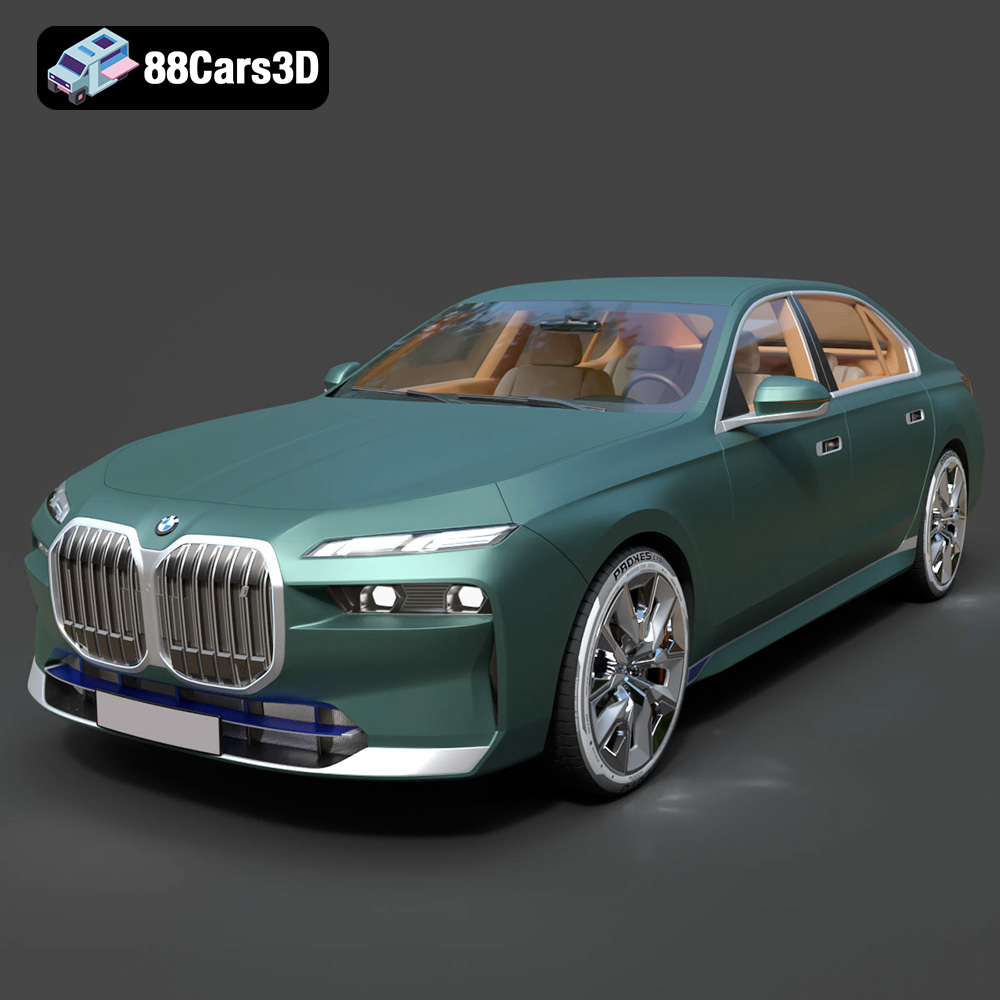
Texture: Yes | Material: Yes Download the ultra-high-detail BMW i7 (2023) 3D Model (4.14M Triangles). Features the illuminated kidney grille, split crystal headlights, fully modeled Theatre Screen interior, and monolithic luxury styling. Perfect for ArchViz, VFX, and cinematic rendering. Includes .blend, .fbx, .obj, .glb, .stl, and .max formats.
Price: $19.99
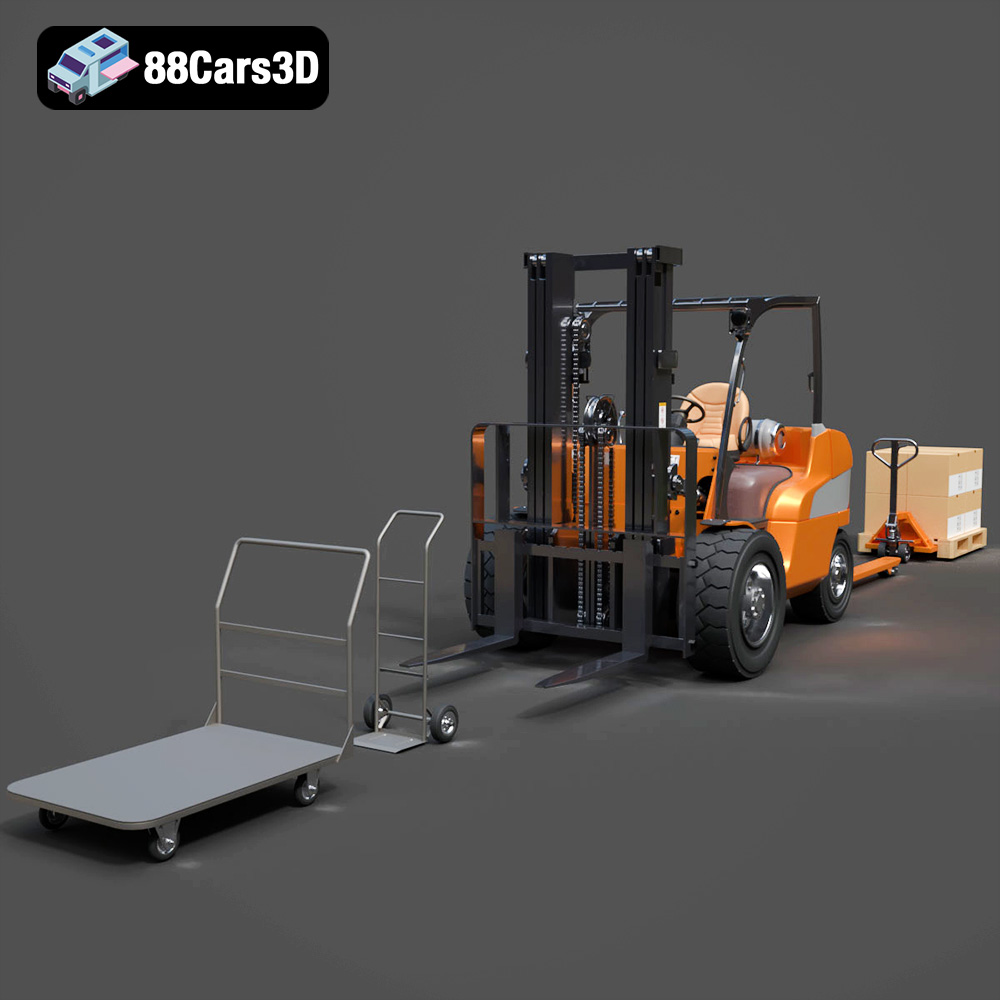
Texture: Yes | Material: Yes Download the highly detailed CAT Manual Loader & Warehouse Carts Kit 3D Model (2.4M Triangles). Features a macro-detailed hydraulic pallet jack, heavy-duty forks, and transport carts. Perfect for industrial ArchViz, factory rendering, and logistics simulations. Includes .blend, .fbx, .obj, .glb, .stl, and .max formats.
Price: $19.99
Texture: Yes | Material: Yes
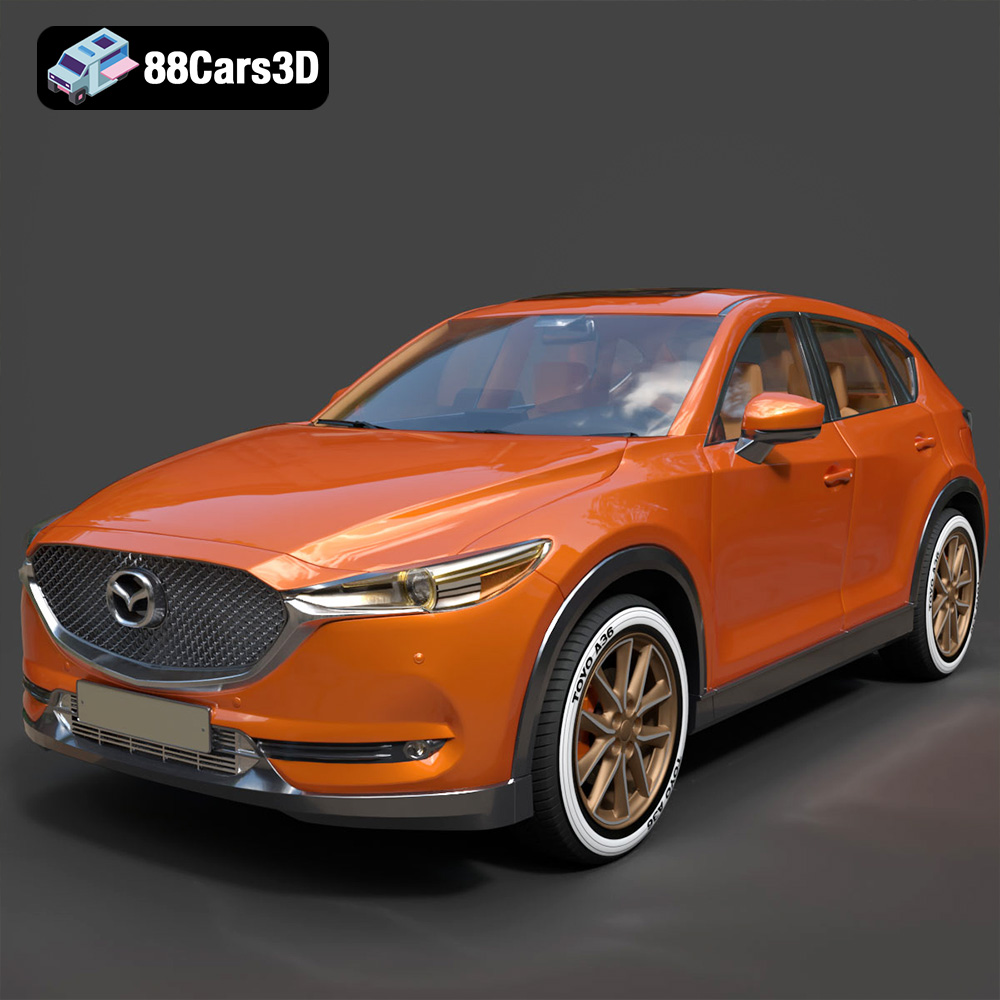
Download the highly optimized Mazda CX-5 2014 3D Model (294k Triangles). Features the dynamic Kodo design language, signature grille, and a clean interior. Perfectly balanced for ArchViz, background traffic, and game development. Includes .blend, .fbx, .obj, .glb, .stl, and .max formats.
Price: $19.99
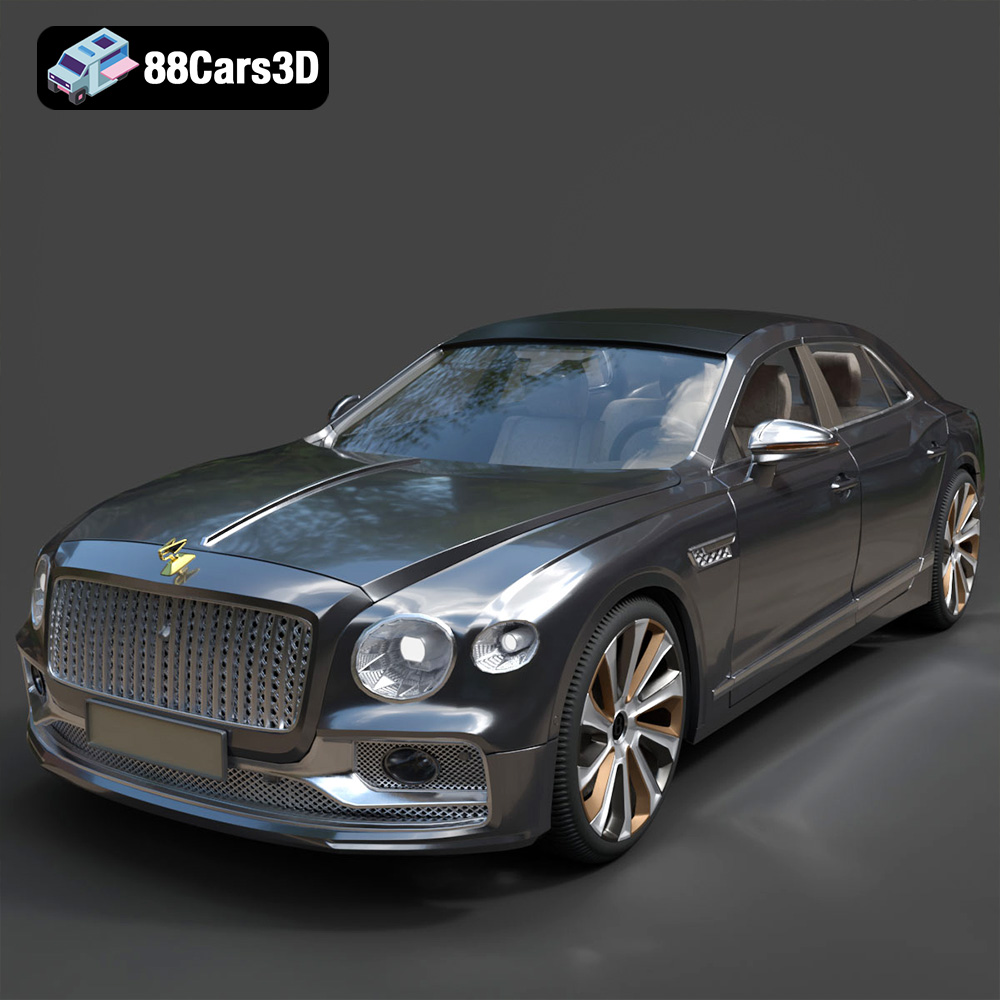
Texture: Yes | Material: Yes Download the ultra-high-detail Bentley Flying Spur Mulliner 2022 3D Model (2.94M Triangles). Features the bespoke Double Diamond grille, a fully modeled diamond-quilted interior, and exquisite luxury styling. Perfect for high-end ArchViz, VFX, and cinematic rendering. Includes .blend, .fbx, .obj, .glb, .stl, and .max formats.
Price: $19.90
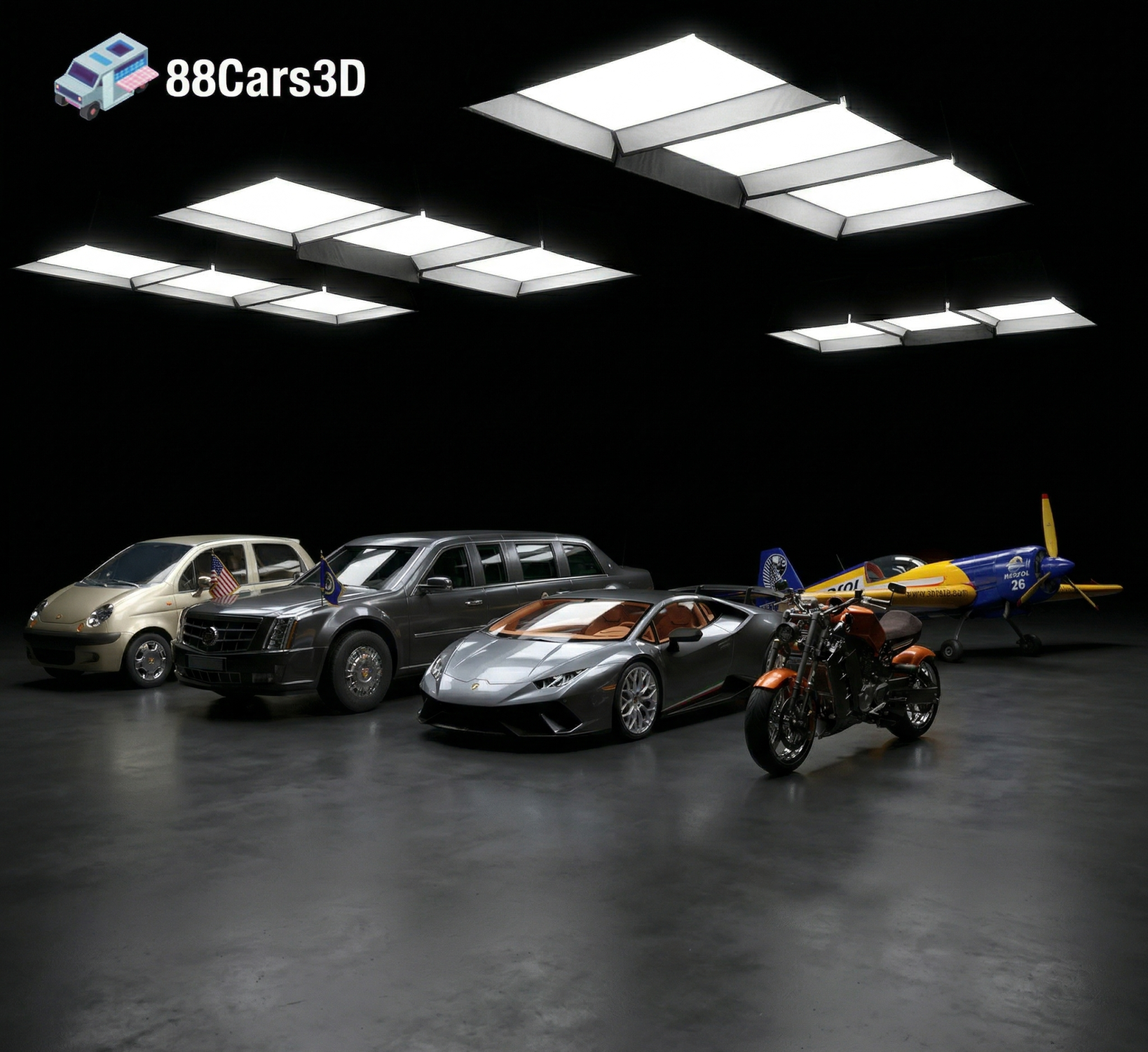
Texture: Yes | Material: Yes | 3D Printable: Yes. Download the Ultimate Creators’ Showcase featuring 5 premium 3D models: Lamborghini Huracan, ZAV Concept Motorcycle, Sukhoi SU-26, Presidential Limousine, and Daewoo Damas. Optimized for 4K CGI rendering and 3D printing. Save massive with this exclusive multi-category bundle!
Price: $99.99

Texture: Yes | Material: Yes | 3D Printable: Yes. Download the Italian Thoroughbreds Bundle featuring 5 iconic 3D models: Lamborghini Huracán Performante, Ferrari 458 Italia, Lamborghini Urus, Diablo SV, and Maserati GT. Optimized for 4K rendering and 3D printing (STL included). Save 50% with this ultimate Italian vehicle collection.
Price: $199.99

Download the Elite Future Mobility Bundle featuring 4 highly optimized 3D models: Tesla Model S, Avatr 11, Li L9, and Zoox Robotaxi. Perfect for ArchViz, Smart City renders, and game dev. Optimized for Unreal Engine and Blender. Includes .fbx, .obj, and .max formats.
Price: $99

🚗 5 Iconic German Cars (BMW M4 G82, M5 CS, X3, 1 Series & Mercedes E-Class). ✅ Optimized for ArchViz: Ready for Corona & V-Ray. 💰 Save €71 with this limited-time collection! 🚀 Instant Download after purchase.
Price: $119

Download the Extreme Off-Road & Survival 3D Models Bundle! Includes the Brabus 800 Adventure, Dodge Ram Bigfoot, Spec Truck, and a Caravan. Save over €210 on this premium 4-in-1 off-grid vehicle pack for ArchViz and game development.
Price: $149.99

Download the Heavy Duty & Commercial Logistics 3D Models Bundle! Includes the Ford Sterling, Caterpillar CT680, Mercedes Citaro Bus, and Vito Van. Save over €130 on this massive, game-ready 4-in-1 industrial vehicle pack.
Price: $109.99

