Get 50% OFF All Premium 3D & STL Models!

The pursuit of photorealism in real-time rendering has long been the holy grail for 3D artists, game developers, and visualization professionals. For automotive visualization, where every reflection, every subtle shadow, and every glint of light defines the perceived quality and realism of a vehicle, this pursuit is paramount. Traditional methods for achieving Global Illumination (GI) – the simulation of how light bounces off surfaces and indirectly illuminates a scene – often involved baking lightmaps, a time-consuming and inflexible process. This limitation severely hampered dynamic scenes, interactive experiences, and rapid design iteration.
Enter Lumen, Unreal Engine’s groundbreaking fully dynamic Global Illumination and Reflections system. Introduced with Unreal Engine 5, Lumen represents a paradigm shift, enabling artists to achieve stunningly realistic lighting that reacts instantly to changes in geometry, materials, and light sources. This means dynamic day-night cycles, interactive material swaps on vehicles, and rapid iterations on lighting setups are no longer a monumental challenge but a seamless part of the workflow. For professionals leveraging high-quality 3D car models from platforms like 88cars3d.com, mastering Lumen is essential to unlock the full visual potential of their automotive projects, whether for game development, virtual production, or high-end product visualization. In this comprehensive technical deep dive, we’ll explore Lumen’s inner workings, its integration with premium automotive assets, optimization strategies, and advanced techniques to elevate your Unreal Engine visualization projects.
Global Illumination (GI) is the advanced lighting algorithm responsible for simulating how light behaves in a real-world environment, encompassing phenomena like indirect lighting, color bleeding, and diffuse interreflection. Without GI, scenes appear flat and unrealistic, lacking the nuanced interplay of light and shadow that our eyes expect. Historically, real-time GI has been a monumental challenge due to its computational intensity. Previous solutions often relied on pre-calculated lightmaps, which are efficient at runtime but entirely static, or simpler, less accurate screen-space techniques. This presented a significant hurdle for dynamic environments and interactive applications, especially in fields like automotive visualization where precise lighting defines a product’s appeal.
Lumen revolutionizes this by providing a robust, fully dynamic GI solution designed for next-generation consoles, high-end PCs, and virtual production environments. It intelligently combines several techniques to approximate real-world light bounces, delivering high-quality indirect lighting and reflections without the need for manual lightmap baking. This dynamism is crucial for automotive configurators where a user might change a car’s paint color, open a door, or drive the vehicle into a different environment, all while expecting instant, physically accurate lighting reactions. Understanding Lumen’s foundational principles is the first step towards harnessing its power for your projects.
At its core, Global Illumination simulates how light, once emitted from a source, interacts with all surfaces in a scene, not just directly, but also indirectly. Imagine a red car parked in a white garage. The red paint will subtly reflect red light onto the white walls and ceiling, a phenomenon known as “color bleeding.” Similarly, areas not directly hit by a light source will still receive illumination from light bouncing off other surfaces – this is indirect lighting. GI is also responsible for realistic ambient occlusion, where occluded areas appear darker due to less indirect light reaching them. These subtle details are what differentiate a believable, immersive scene from a sterile, computer-generated one. For automotive projects, accurate GI means showcasing the intricate curves and luxurious finishes of a vehicle with unparalleled realism, making the difference between a good render and an outstanding one.
Lumen employs a hybrid approach, combining software ray tracing against various scene representations to provide real-time GI and reflections. The primary components are:
This intelligent combination ensures that Lumen delivers impressive visual quality across diverse scene complexities while striving for optimal performance. You can delve deeper into Lumen’s technical specifications and system requirements on the official Unreal Engine documentation.
Integrating Lumen into your Unreal Engine project is straightforward, though understanding its configuration options is key to achieving desired results and performance. First, ensure your project settings are configured correctly:
Edit > Project Settings.Engine > Rendering, locate the Global Illumination and Reflections categories.Global Illumination Method to Lumen.Reflection Method to Lumen.Hardware Ray Tracing if your target platform supports it, as Lumen can utilize it for higher quality reflections and GI, though it’s not strictly required.Once enabled in Project Settings, Lumen’s behavior is primarily controlled via the Post Process Volume in your scene. Add a Post Process Volume (or select an existing one) and navigate to the Lumen Global Illumination and Lumen Reflections sections. Key settings to adjust include:
Experimentation with these settings is crucial. Start with conservative values and incrementally increase them while monitoring performance using console commands like stat gpu and stat lumen.
The visual fidelity of any automotive visualization hinges not only on the lighting system but fundamentally on the quality of the 3D assets themselves. When sourcing automotive assets from marketplaces such as 88cars3d.com, you’re acquiring models specifically designed for high-performance rendering environments like Unreal Engine. These models feature meticulously crafted clean topology, realistic PBR materials, and optimized UV mapping, which are all critical factors for Lumen to accurately interpret and illuminate. Improperly prepared models can lead to visual artifacts, incorrect light bounces, or significant performance bottlenecks, even with a powerful system like Lumen.
Integrating these premium models effectively requires a workflow that respects both the asset’s inherent quality and Lumen’s specific requirements. This section will guide you through preparing and optimizing your high-quality car models to ensure they fully benefit from Lumen’s dynamic global illumination, resulting in breathtakingly realistic automotive scenes.
When you import a 3D car model from 88cars3d.com, it will typically be provided in formats like FBX or USD, ready for Unreal Engine. The key steps for preparation are:
Generate Missing Collision if you need physics interaction, and critically, check Build Adjacency Buffer if you plan to use Hardware Ray Tracing or specific rendering features.Nanite > Enable Nanite. Adjust the Nanite Settings > Fallback Relative Error if necessary to control the polycount at distant views.Generate Mesh Distance Fields is enabled in your Project Settings (Engine > Rendering > Global Illumination). If it was disabled, enable it and restart the editor. Then, for each static mesh, confirm that Generate Mesh Distance Field is checked in its Mesh Editor window (Details Panel > Build Settings). You can visualize the generated Distance Fields via Show > Visualize > Mesh Distance Fields in the viewport to ensure they accurately represent your car’s geometry. Poorly generated or missing distance fields will lead to incorrect or missing GI.Lumen’s accuracy is directly proportional to the quality and physical correctness of your materials. Physically Based Rendering (PBR) materials, which are standard for assets from 88cars3d.com, define how light interacts with a surface based on real-world properties. Lumen interprets these properties to calculate accurate light bounces and reflections.
Pay close attention to these parameters in your Unreal Engine Material Editor. Even a slight misconfiguration, such as an incorrect roughness value for car paint, can drastically alter how Lumen renders reflections and indirect light, diminishing the photorealism of your valuable 88cars3d.com assets.
While Lumen is designed for performance, complex automotive scenes can still push system limits. Optimization isn’t just about reducing polygons; it’s about intelligent asset management and Lumen-specific considerations:
Fallback Relative Error to simplify the mesh more aggressively for views where high detail isn’t perceptible. For critical components like the main body panels, keep the error low.Build Settings > Distance Field Resolution Scale, you can adjust the resolution of the generated distance field for individual static meshes. For small or simple props, you might lower this to save memory and processing for Lumen, but for the main car body, keep it at 1.0 or higher for accurate GI.By judiciously applying these optimization techniques, you ensure that your premium 88cars3d.com car models render beautifully and efficiently, making the most of Lumen’s real-time GI capabilities.
Once your high-quality 3D car models from 88cars3d.com are imported and optimized, the next step is to master Lumen’s lighting workflow to achieve cinematic-quality visuals. Lumen’s dynamic nature allows for unparalleled flexibility, moving beyond the constraints of static lighting. This opens up possibilities for intricate lighting setups, dynamic environment changes, and highly realistic reflections that capture the true essence of automotive design. Understanding how Lumen interacts with various light sources and Unreal Engine’s rendering features is crucial for crafting compelling and believable scenes.
The beauty of Lumen lies in its ability to respond instantly to changes. Adjust a light’s intensity, move it, change its color, or even swap out the entire environment, and Lumen will recalculate indirect lighting and reflections in real-time. This iterative design workflow significantly accelerates the creative process for automotive designers and visualization artists, allowing for rapid experimentation and refinement of lighting moods and product presentation.
Lumen truly shines in dynamic lighting setups, which are invaluable for automotive visualization:
Remember that Lumen prioritizes performance, so while it’s dynamic, very small or dim lights might have less impact on GI compared to larger, brighter sources. Always use the Lumen Scene visualization (Show > Visualize > Lumen Scene) to understand how Lumen is interpreting your lighting setup.
Lumen doesn’t replace all other lighting features; rather, it augments them, providing the indirect lighting component. It works in conjunction with:
Cast Shadows is enabled.Cast Ray Traced Shadow is enabled for accurate shadowing from the Sky Light.For more details on integrating these lighting elements, refer to the comprehensive lighting documentation on the official Unreal Engine learning portal.
Lumen handles reflections dynamically, offering a significant leap in realism over traditional screen-space reflections. For highly reflective surfaces like car paint, glass, and chrome (common on 88cars3d.com models), Lumen’s reflections are critical:
IOR (Index of Refraction) values (around 1.5 for automotive glass) and roughness. For advanced glass effects, you might consider using specific rendering features like Ray Traced Translucency if Hardware Ray Tracing is enabled.By carefully orchestrating direct light sources with Lumen’s indirect calculations and leveraging its reflection capabilities, you can achieve a level of visual fidelity that brings your 88cars3d.com automotive assets to life in stunning, cinematic detail.
While Lumen offers incredible visual fidelity out-of-the-box, achieving truly production-ready results, especially in complex automotive scenes, requires a deeper understanding of its advanced features and a disciplined approach to performance optimization. High-fidelity 3D car models, with their intricate geometry and sophisticated materials, can be demanding. This section focuses on leveraging Lumen’s full potential while maintaining acceptable frame rates, exploring its synergy with Nanite, debugging tools, and crucial optimization strategies.
The goal is always to balance visual quality with performance. For interactive automotive configurators, a smooth user experience is critical. For cinematic renders, maximum quality is often prioritized. Lumen provides a rich set of controls and visualizations to help artists make informed decisions, ensuring that the visual impact is maximized without sacrificing interactivity or exceeding target hardware specifications.
Nanite and Lumen are two of Unreal Engine 5’s most transformative technologies, and they work incredibly well together. Nanite allows artists to import and render incredibly high-polygon models – often directly from CAD or high-poly sculpting software – without traditional LOD constraints or significant performance penalties. For 3D car models from 88cars3d.com, this means you can use assets with millions of polygons for the car body, interior, and engine bay, preserving every curve and detail.
How do they synergize? Lumen’s software ray tracing, especially for reflections and close-up GI, can directly query Nanite meshes. This means that the fine geometric details preserved by Nanite are accurately reflected and indirectly illuminated by Lumen. This combination results in:
To ensure optimal synergy, always enable Nanite for your primary car meshes. You can monitor Nanite’s performance and Lumen’s interaction using the stat nanite and stat lumen console commands, checking for any performance bottlenecks related to overdraw or mesh complexity that might impact Lumen’s ray tracing.
Lumen is powerful, but it’s not without its performance considerations. It’s crucial to understand how to diagnose and optimize its impact:
stat gpu: Provides a general overview of GPU performance, highlighting Lumen’s contribution to frame time.stat lumen: Offers detailed statistics specific to Lumen, breaking down its cost into various components like surface cache updates, ray tracing, and final gather. This is your primary tool for diagnosing Lumen performance.r.Lumen.HardwareRayTracing.Culling.Distance: Adjusts the distance at which Lumen switches from software to hardware ray tracing for reflections (if HRT is enabled).r.Lumen.ScreenProbeGather.MaxRayDistance: Controls the maximum distance Lumen traces rays for indirect lighting. Reducing this can save performance but might reduce the reach of GI.Show > Visualize menu, Lumen provides several powerful visualization modes:
Shader Complexity view mode (Show > Visualize > Shader Complexity) to identify expensive materials. Simplify where possible, or use Material Layers for complex car paint shaders efficiently.To maintain smooth frame rates while pushing visual boundaries with Lumen, consider these strategies:
Final Gather Quality, Lighting Detail, and Probe Hierarchy Resolution. These have a direct impact on the quality-to-performance ratio.Distance Field Resolution Scale in the Static Mesh Editor.Screen Percentage in the Post Process Volume can recover significant performance, albeit at a cost to overall visual sharpness.By meticulously combining these techniques, you can fine-tune your Unreal Engine projects, ensuring your high-fidelity 88cars3d.com car models shine with Lumen’s dynamic GI without compromising critical performance targets for your specific application.
The true power of Lumen extends beyond static renders; it empowers the creation of highly interactive and immersive automotive experiences. From configurators that allow real-time customization to virtual production sets that blend digital and physical worlds, Lumen’s dynamic global illumination is a cornerstone for delivering unparalleled realism. For professionals working with 88cars3d.com models, these interactive capabilities are vital for demonstrating product features, engaging audiences, and streamlining design reviews.
The ability to instantly react to user input or environmental changes—be it a new paint color, opening a door, or adjusting the time of day—without needing to re-bake lighting, fundamentally transforms what’s possible in real-time automotive visualization. This section explores how Lumen facilitates these advanced interactive workflows, leveraging Unreal Engine’s powerful tools like Blueprint and Sequencer.
Unreal Engine’s Blueprint visual scripting system is the perfect companion for Lumen, enabling artists and designers to create complex interactive behaviors without writing a single line of code. For automotive configurators or interactive demos, Blueprint allows you to:
Set Material node targeting a specific mesh component (e.g., the car body) to apply a new Material Instance. Lumen handles the rest.Set Vector Parameter Value on the material instance to increase the emissive strength.These dynamic behaviors, driven by Lumen, allow for highly engaging and informative automotive experiences that truly highlight the quality and design of your 88cars3d.com models.
Virtual Production (VP), particularly with LED volume stages, is transforming filmmaking and visual effects. Lumen plays a critical role here by providing real-time, accurate global illumination for both the digital foreground assets (like your 3D car models) and the background plates displayed on the LED wall. This leads to seamless integration and unparalleled realism:
Lumen significantly reduces the need for complex lighting setups and costly post-production adjustments, making virtual production workflows more efficient and visually convincing. It allows for creative freedom and on-set iteration previously unimaginable.
Unreal Engine’s Sequencer is a powerful multi-track editor for creating cinematic sequences, animations, and interactive cutscenes. When combined with Lumen, it unlocks incredible possibilities for automotive cinematics:
The ability to iterate on lighting and visual effects in real-time within Sequencer, thanks to Lumen, drastically streamlines the production of high-quality automotive marketing renders, trailers, and architectural visualizations. It empowers artists to achieve their creative vision with unprecedented speed and fidelity, making every frame count.
Lumen marks a pivotal moment in real-time rendering, but like any cutting-edge technology, it continues to evolve. Its implications for the future of interactive experiences, especially within the demanding realms of Augmented Reality (AR) and Virtual Reality (VR) for automotive applications, are profound. While Lumen currently offers unparalleled visual quality on high-end platforms, adapting it for diverse hardware and emerging technologies presents both exciting opportunities and unique challenges. Understanding these considerations is crucial for future-proofing your Unreal Engine projects and staying at the forefront of automotive visualization.
The automotive industry is rapidly embracing AR/VR for everything from design review and sales configurators to virtual test drives and training simulations. The demand for physically accurate lighting in these immersive environments is higher than ever, as even minor visual discrepancies can break immersion. Lumen’s ongoing development aims to address these needs, pushing the boundaries of what’s possible in real-time GI across a broader spectrum of devices.
Unreal Engine’s development team is continuously refining Lumen, optimizing its algorithms, and expanding its capabilities. We can anticipate future updates to include:
Keeping an eye on official Unreal Engine documentation and release notes will be essential to leverage these advancements. The aim is to ensure Lumen remains at the forefront of real-time GI, continually raising the bar for visual realism in applications ranging from cinematic automotive showcases to interactive training tools.
Integrating Lumen into AR/VR automotive applications presents specific challenges, primarily related to performance and target hardware. AR/VR experiences demand extremely high and consistent frame rates (e.g., 90 FPS per eye) to prevent motion sickness and maintain immersion. Lumen, being a computationally intensive system, can struggle to meet these stringent requirements on all devices:
Workarounds and Strategies for AR/VR:
Screen Percentage in the Post Process Volume and leverage upscaling technologies like AMD FidelityFX Super Resolution (FSR) or NVIDIA DLSS (if supported by hardware) to render at a lower resolution and reconstruct a higher-resolution image.Max Bounces, Reflection Resolution, and Quality Settings.Affect Global Illumination flag on their static mesh components, if the visual impact is negligible.The goal is to provide a compelling AR/VR experience while respecting hardware limitations. As mobile and standalone VR hardware becomes more powerful, Lumen’s full capabilities will gradually become more accessible to these platforms.
To ensure your automotive visualization projects remain relevant and adaptable to future Unreal Engine updates and emerging technologies:
By adhering to these best practices, you equip your automotive visualization projects to evolve with Unreal Engine, ensuring your beautiful 3D car models from 88cars3d.com continue to shine with the most advanced real-time rendering technologies.
Lumen represents a seismic shift in real-time rendering, fundamentally changing how we approach lighting and realism in Unreal Engine. For the demanding field of automotive visualization, where precision and aesthetic fidelity are paramount, Lumen’s dynamic global illumination and reflections are transformative. It empowers artists and developers to bring high-quality 3D car models from marketplaces like 88cars3d.com to life with unprecedented realism, facilitating everything from interactive configurators and cinematic showcases to cutting-edge virtual production.
We’ve embarked on a technical journey, exploring Lumen’s core mechanics, its synergistic relationship with Nanite, and crucial strategies for optimizing performance without sacrificing visual quality. We’ve seen how Blueprint unleashes interactive dynamism, and how Sequencer allows for cinematic storytelling. While challenges remain, particularly in the performance-sensitive realm of AR/VR, the ongoing evolution of Lumen promises an even brighter future for immersive automotive experiences.
The key takeaway is clear: embracing Lumen is no longer optional for those seeking the pinnacle of real-time realism in Unreal Engine 5. It demands a thoughtful approach to project setup, asset preparation, and iterative optimization. By investing the time to master Lumen, you’re not just creating stunning visuals; you’re future-proofing your skills and projects, unlocking new creative possibilities, and delivering experiences that truly captivate. Experiment with its settings, utilize its powerful debugging tools, and let your 88cars3d.com automotive assets shine under the brilliance of dynamic global illumination. The road to real-time photorealism is paved with Lumen, and the journey has only just begun.
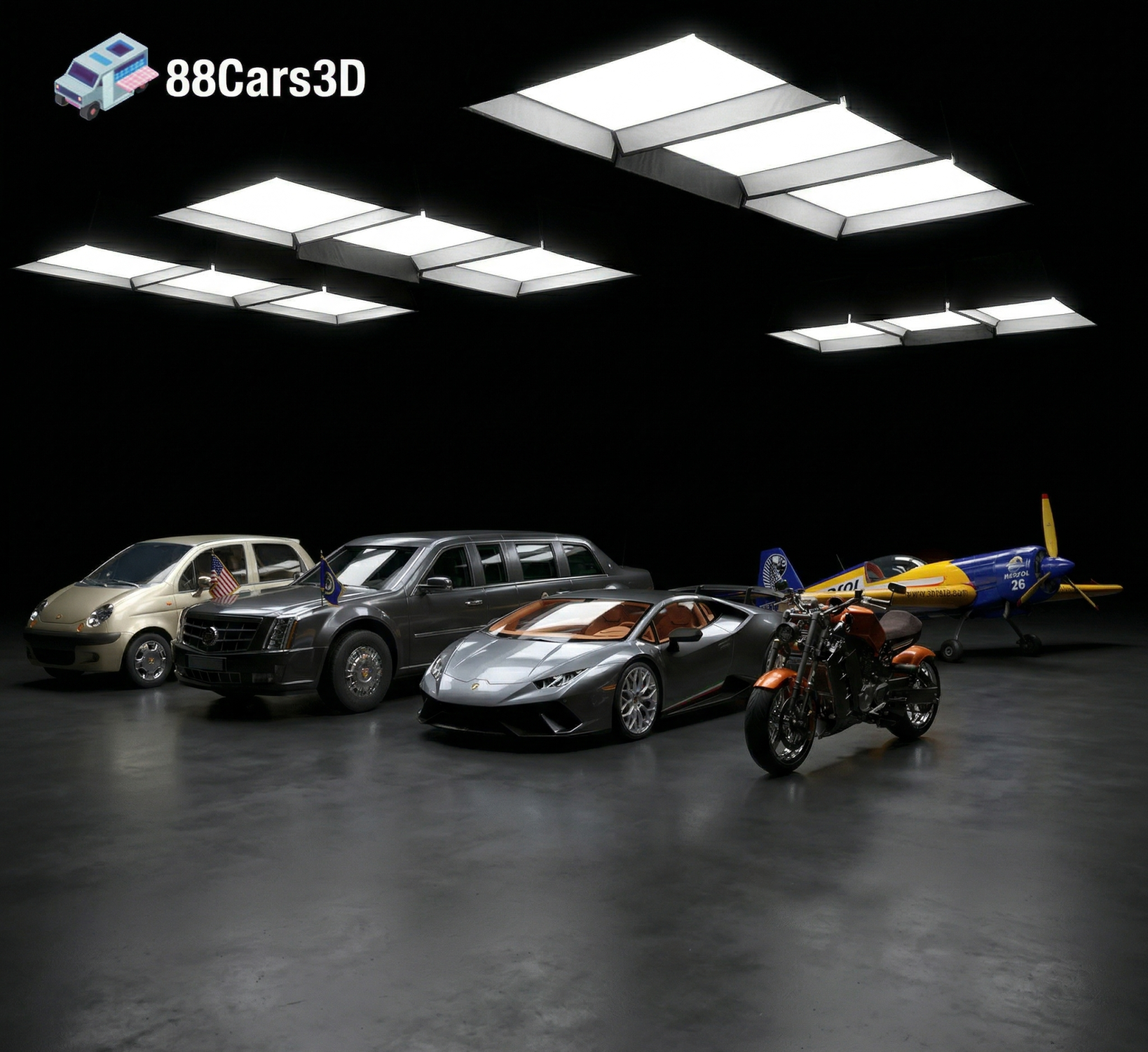
Texture: Yes | Material: Yes | 3D Printable: Yes. Download the Ultimate Creators’ Showcase featuring 5 premium 3D models: Lamborghini Huracan, ZAV Concept Motorcycle, Sukhoi SU-26, Presidential Limousine, and Daewoo Damas. Optimized for 4K CGI rendering and 3D printing. Save massive with this exclusive multi-category bundle!
Price: $99.99

Texture: Yes | Material: Yes | 3D Printable: Yes. Download the Italian Thoroughbreds Bundle featuring 5 iconic 3D models: Lamborghini Huracán Performante, Ferrari 458 Italia, Lamborghini Urus, Diablo SV, and Maserati GT. Optimized for 4K rendering and 3D printing (STL included). Save 50% with this ultimate Italian vehicle collection.
Price: $199.99

Download the Elite Future Mobility Bundle featuring 4 highly optimized 3D models: Tesla Model S, Avatr 11, Li L9, and Zoox Robotaxi. Perfect for ArchViz, Smart City renders, and game dev. Optimized for Unreal Engine and Blender. Includes .fbx, .obj, and .max formats.
Price: $99

🚗 5 Iconic German Cars (BMW M4 G82, M5 CS, X3, 1 Series & Mercedes E-Class). ✅ Optimized for ArchViz: Ready for Corona & V-Ray. 💰 Save €71 with this limited-time collection! 🚀 Instant Download after purchase.
Price: $119

Download the Extreme Off-Road & Survival 3D Models Bundle! Includes the Brabus 800 Adventure, Dodge Ram Bigfoot, Spec Truck, and a Caravan. Save over €210 on this premium 4-in-1 off-grid vehicle pack for ArchViz and game development.
Price: $149.99

Download the Heavy Duty & Commercial Logistics 3D Models Bundle! Includes the Ford Sterling, Caterpillar CT680, Mercedes Citaro Bus, and Vito Van. Save over €130 on this massive, game-ready 4-in-1 industrial vehicle pack.
Price: $109.99

Download the Ultimate Custom Motorcycles 3D Models Bundle. Includes a Custom Chopper, Ducati 916 Café Fighter, Harley XR1200X, and BMW K100. Perfect premium props for luxury ArchViz garages. Save over €250 today!
Price: $159.99

Download the ultimate JDM Street Racing 3D Models Bundle! Includes the Nissan GT-R, Toyota Supra, Mazda RX-7, Lancer Evo IX, and Honda NSX. Save big on this highly optimized, game-ready 5-in-1 Japanese legend car pack.
Price: $129.99

Download the ultimate American Muscle & Cinematic Classics 3D Models Bundle! Includes the Dodge Charger ’68, Mustang Eleanor GT500, Camaro Z28 ’79, and a custom ’69 Mustang. Save over €240 on this game-ready, premium 4-in-1 pack.
Price: $149.99

Download the Everyday City Traffic 3D Models Bundle. Includes the VW Golf, Kia Picanto, Hyundai Tucson, Toyota Yaris, and a DHL Ford Transit Van. Save big on this 5-in-1 pack, perfectly optimized for realistic ArchViz streets and game traffic.
Price: $99.99

