Get 50% OFF All Premium 3D & STL Models!

The world of 3D automotive design is a fascinating blend of art and engineering, where every curve, reflection, and material tells a story of precision and passion. For professionals working on everything from photorealistic renders to real-time game assets, the foundational choice between 3D scanning and manual 3D modeling for creating car parts is a pivotal one. Each methodology offers unique advantages and presents distinct challenges, influencing everything from project timelines and budget to the final quality and versatility of the digital asset. Understanding when to deploy which technique, or even how to combine them, is crucial for achieving optimal results in a rapidly evolving industry.
In this comprehensive guide, we will embark on a deep dive into the technical intricacies of both 3D scanning and manual modeling in the context of automotive design. We’ll explore their respective workflows, dissect the challenges, and highlight best practices for topology, UV mapping, PBR material creation, rendering, and game engine optimization. Whether you’re a seasoned 3D artist, a game developer striving for performance, an automotive designer seeking accuracy, or simply curious about the craft, this article will equip you with the knowledge to make informed decisions and elevate your automotive 3D projects to new heights.
Manual 3D modeling, often referred to as traditional modeling, is the bedrock of digital asset creation. For automotive applications, this process typically involves constructing a 3D model from scratch using specialized software, meticulously defining every polygon and vertex. This method offers unparalleled creative control and is often preferred for conceptual designs, highly optimized game assets, or situations where no physical reference exists. The core of manual automotive modeling revolves around achieving impeccable surface continuity and efficient mesh topology.
The majority of high-quality automotive models are created using Sub-D (Subdivision Surface) modeling, a technique that relies on low-polygon cage meshes which are then smoothed by the software into complex, curvilinear surfaces. This approach allows artists to control complex shapes with a relatively small number of control points, making adjustments efficient and predictable. The key lies in maintaining impeccable topology – the arrangement of polygons and edge loops – which dictates how the surface deforms and reflects light. For car bodies, edge flow must meticulously follow the design lines and creases, ensuring that reflections travel smoothly across panels without unsightly pinches or distortions.
Software like 3ds Max, Maya, and Blender are industry staples for this work. In Blender, for example, artists leverage tools like the Bevel modifier to create sharp, controlled edges necessary for car panels, while maintaining quad-dominant topology, which is ideal for subdivision surfaces. Detailed information on Blender’s modeling tools and modifiers can be found in the official documentation at https://docs.blender.org/manual/en/4.4/. A typical high-end render model might target a polygon count of 500,000 to 2 million triangles, with an emphasis on distributing polygons evenly to capture fine details without excessive density in flat areas. Hard surface modeling principles are paramount here, ensuring that panels fit together perfectly, and crucial details like panel gaps are accurately represented with controlled edge loops.
The manual modeling workflow often begins with referencing technical drawings or blueprints (orthographic views) and photographic references. These images are imported into the 3D software as image planes, acting as precise guides for tracing and sculpting the car’s form. Artists start with basic primitives or splines (like Bezier curves in Blender) to establish the primary shapes, then gradually refine them, adding details and ensuring dimensional accuracy. This iterative process involves constantly checking proportions, surface continuity, and light reflections, often using temporary shader setups or studio HDRI environments.
While incredibly powerful, manual modeling is inherently time-consuming and demands a high level of skill, patience, and a keen eye for automotive design. Replicating complex real-world imperfections or highly organic shapes can be particularly challenging and lengthy. However, the result is a perfectly clean, optimized, and artistically controlled mesh that is highly versatile for various applications, from animated sequences to tightly constrained game engine environments. This precision allows for total creative freedom, making it the go-to choice for original concepts or when absolute control over every polygon is non-negotiable.
3D scanning represents a paradigm shift in capturing existing physical objects directly into the digital realm. For automotive parts, this technology offers an expedited and highly accurate method for creating digital twins of real-world components, proving invaluable for reverse engineering, historical preservation, or creating assets based on tangible prototypes. It bypasses the manual creation process, leveraging specialized hardware to record geometric data.
The process of 3D scanning involves using various technologies to collect data points from the surface of a physical object. Common types of scanners suitable for automotive parts include laser scanners, which project a laser line or dot pattern and calculate depth based on deformation; structured light scanners, which project specific light patterns (like stripes) and analyze their distortion; and photogrammetry, which uses multiple overlapping photographs to reconstruct 3D geometry and texture. High-end industrial laser and structured light scanners can achieve impressive accuracy, often down to tens of micrometers, capturing intricate details like bolt threads, subtle curvatures, and stamped markings with remarkable fidelity.
The output of a 3D scan is typically a point cloud – millions of individual data points in 3D space – which is then converted into a dense triangle mesh. This raw mesh, often millions or tens of millions of polygons, is a direct representation of the scanned object’s surface. The primary benefits of scanning are speed and accuracy in capturing highly complex, organic, or intricate geometries that would be exceedingly difficult or time-consuming to model manually. It’s particularly useful for OEM parts, aftermarket components, or recreating damaged sections for repair and restoration, providing an almost photographic geometric record of the original item.
Raw scan data, while accurate in geometry, is rarely production-ready. It often contains noise, holes (due to occlusions during scanning), extraneous geometry, and an extremely high, irregular polygon count. The post-processing phase is critical and often as labor-intensive as manual modeling itself. Software suites like Geomagic Wrap, ZBrush, and MeshLab are used to clean, repair, and optimize this data. Tasks include noise reduction, outlier removal, hole filling, and merging multiple scans into a single watertight mesh. Decimation is also a key step, reducing the polygon count of the initial dense mesh while attempting to preserve as much detail as possible. However, even after decimation, the mesh topology remains triangulated and highly irregular, making it unsuitable for animation, deformation, or clean UV mapping without further refinement.
The inherent challenge with scan data lies in its unoptimized, often triangulated mesh structure. While perfect for static, high-resolution visualization of specific parts or reverse engineering, it poses significant hurdles for applications requiring animation, real-time performance, or clean surface textures. This leads directly to the necessity of retopology, a process where a new, clean, quad-based mesh is created over the dense, often messy, scan data. Without proper retopology, a scanned car model would be extremely difficult to rig, animate, or apply high-quality, efficient PBR textures to, due to the chaotic UV layout and poor deformation properties of the raw mesh.
Regardless of whether a car part originates from a 3D scan or manual modeling, effective topology and UV mapping are non-negotiable for high-quality rendering, game engine performance, and realistic texturing. These two elements form the backbone of any production-ready 3D asset.
For scan data, retopology is the critical intermediate step that transforms a high-polygon, triangulated, and often irregular mesh into a clean, quad-dominant, and animatable surface. The goal is to create a new mesh with an efficient polygon count and well-defined edge loops that follow the underlying surface features of the scanned object. This process is paramount for several reasons: it allows for clean UV unwrapping, facilitates smooth deformation during animation, significantly reduces polygon count for game engine optimization, and enables the creation of efficient, high-quality PBR textures.
Artists often manually retopologize in software like 3ds Max, Maya, Blender (using tools like the Shrinkwrap modifier and snapping options, see Blender docs for details), or dedicated retopology applications like TopoGun and ZBrush’s ZRemesher. The technique involves drawing new quad polygons over the high-res scan, focusing on creating edge loops that define natural creases, hard edges, and areas of curvature. For a car door, for instance, edge loops would follow the panel gaps, window frames, and character lines. While automatic retopology tools exist, they often require significant manual cleanup for complex automotive surfaces, as maintaining perfect edge flow for reflections and deformation is crucial. For hero assets, polygon counts after retopology might range from 150,000 to 300,000 triangles for a full car, balancing detail preservation with efficiency.
UV mapping is the process of flattening the 3D surface of a model into a 2D space, allowing a 2D texture image to be applied accurately. For manually modeled car parts, UVs are often planned from the outset, leading to cleaner, more organized layouts. For retopologized scan data, UV unwrapping becomes a careful exercise in preserving texel density and minimizing distortion. Key strategies for automotive surfaces include:
Proper UV mapping minimizes texture stretching, optimizes texture memory usage, and allows for the creation of intricate PBR materials that truly bring the automotive surface to life. Without clean UVs, even the best PBR textures will appear distorted or pixelated.
The visual fidelity of any 3D car model, whether scanned or manually created, hinges on the quality of its materials and shading. Physically Based Rendering (PBR) has become the industry standard, accurately simulating how light interacts with surfaces based on real-world physics, resulting in incredibly realistic renders.
PBR materials rely on a set of standardized maps to define a surface’s properties: Albedo (or Base Color) for diffuse color, Metallic for reflectivity (0 for dielectric, 1 for metallic), Roughness for microscopic surface irregularities, and Normal Maps for adding surface detail without increasing polygon count. Other maps like Ambient Occlusion, Height, and Opacity further enhance realism.
For car paint, the PBR setup is often layered and complex. A typical car paint shader involves:
Other materials, such as chrome, glass, rubber, and leather, each require their unique PBR configurations. Chrome, for example, is a highly metallic material with very low roughness. Glass requires accurate IOR, transmission, and often a subtle tint. Rubber typically has high roughness and a dark albedo, while leather involves intricate normal maps for grain and varying roughness. Software like Substance Painter is invaluable for texturing and baking these PBR maps, while 3ds Max’s Physical Material, Blender’s Principled BSDF (detailed in the Blender 4.4 documentation), and other render engines’ native PBR shaders allow for complex network creation.
Achieving photorealism in automotive rendering requires not just excellent materials but also sophisticated lighting and environment setups. Popular renderers include Corona Render, V-Ray, Cycles (Blender’s native renderer, explored in the official documentation), and Arnold.
Through meticulous material creation and thoughtful rendering setups, a 3D car model can transcend mere geometry to become a truly convincing and visually stunning digital asset.
While high-fidelity renders prioritize visual realism above all else, game engine optimization demands a delicate balance between graphical quality and performance. For both manually modeled and scanned/retopologized car assets, preparing them for real-time environments like Unity and Unreal Engine involves specific strategies to ensure smooth frame rates and efficient resource utilization.
One of the most critical optimization techniques is the creation of Level of Detail (LOD) models. Instead of rendering a single, high-polygon model at all distances, LODs involve creating several versions of the same asset, each with a progressively lower polygon count. When the car is close to the camera, the highest detail model is rendered; as it moves further away, the engine automatically switches to a lower-polygon version, significantly reducing the computational load. A typical game-ready car might have 3-5 LODs, ranging from 100,000-150,000 triangles for LOD0 down to a few thousand for LOD3 or LOD4. The specific polygon budget varies greatly depending on the target platform (PC, console, mobile) and the game’s overall polycount budget.
Draw calls are another major performance consideration. Each time the game engine has to tell the GPU to draw an object, it’s a draw call. Reducing the number of draw calls is paramount. This can be achieved by:
For platforms like 88cars3d.com, game-ready assets are often provided with pre-configured LODs and optimized materials, ensuring they are drop-in ready for popular engines like Unity and Unreal Engine. These engines also offer built-in tools for LOD generation, material instancing, and performance profiling to fine-tune asset integration.
Augmented Reality (AR) and Virtual Reality (VR) applications impose even stricter performance requirements than traditional games. Low latency and high frame rates are essential to prevent motion sickness and provide an immersive experience. This translates to aggressive polygon budgets (often under 50,000-80,000 triangles for a hero car), highly optimized textures, and minimal draw calls. For AR/VR, every polygon and every material property counts.
File format compatibility is also crucial for seamless integration across different platforms and engines. Common formats for 3D car models include:
When sourcing models from marketplaces such as 88cars3d.com, checking for the availability of these optimized formats and LODs is crucial for smooth integration into real-time projects. The ability to switch between formats or easily convert them often determines the versatility of a 3D asset across different applications.
Beyond traditional rendering and game development, 3D car models find crucial applications in areas like 3D printing and high-end marketing visualization, each demanding specific technical considerations and preparation.
3D printing translates a digital 3D model into a physical object layer by layer. For a 3D car model, preparing it for printing requires a distinct set of rules compared to screen-based applications. The fundamental requirement is a “watertight” or “manifold” mesh – meaning the model has no holes, internal geometry, or intersecting faces, essentially forming a completely enclosed volume. Non-manifold edges or faces will cause errors during slicing and printing.
For very complex car models, it’s often necessary to slice them into multiple printable parts, which are then assembled after printing. This requires careful planning of cutting planes and interlocking joints in the 3D software.
High-end visualization, often for marketing, advertising, or concept presentation, demands the absolute pinnacle of visual quality. In these scenarios, the constraints of game engines are lifted, allowing for extremely detailed geometry, complex shader networks, and exhaustive rendering times to achieve photographic realism. Both meticulously manually modeled cars and highly retopologized, production-ready scanned assets are ideal for this application.
Marketplaces like 88cars3d.com cater specifically to these needs, offering high-quality 3D car models that are ready for stunning marketing renders and detailed visualizations. These models often come with pre-configured PBR materials, optimized UVs, and multiple file formats, ensuring artists and designers can immediately leverage them for their most demanding projects without extensive post-processing or optimization work.
The choice between 3D scanning and manual modeling for automotive parts is not a simple ‘either/or’ but rather a strategic decision informed by project requirements, budget, timeline, and the desired final output. Manual modeling offers ultimate creative control, pristine topology, and precise optimization, making it ideal for concept vehicles, highly optimized game assets, or situations where no physical reference exists. Its strengths lie in clean, animatable meshes and predictable surface control.
3D scanning, on the other hand, excels at rapidly capturing complex real-world geometry with exceptional accuracy, perfect for reverse engineering, replication, or recreating existing physical prototypes. However, raw scan data typically requires extensive post-processing and a crucial retopology phase to make it production-ready for animation, clean texturing, or game engine integration. Often, the most effective workflow involves a hybrid approach, using 3D scans to capture primary forms and intricate details, then manually retopologizing and refining the mesh to meet specific technical standards.
Ultimately, a deep understanding of topology, UV mapping, PBR materials, rendering workflows, and optimization techniques is paramount regardless of the initial creation method. By mastering these principles and thoughtfully applying the right tools and techniques—whether you’re working with manual methods or integrating high-fidelity scans—you can create stunningly realistic and performant 3D automotive assets for rendering, game development, AR/VR, 3D printing, and professional visualization. Platforms like 88cars3d.com serve as a valuable resource for artists and developers seeking high-quality, pre-optimized 3D car models that are ready for diverse applications, bridging the gap between intricate design and practical implementation.
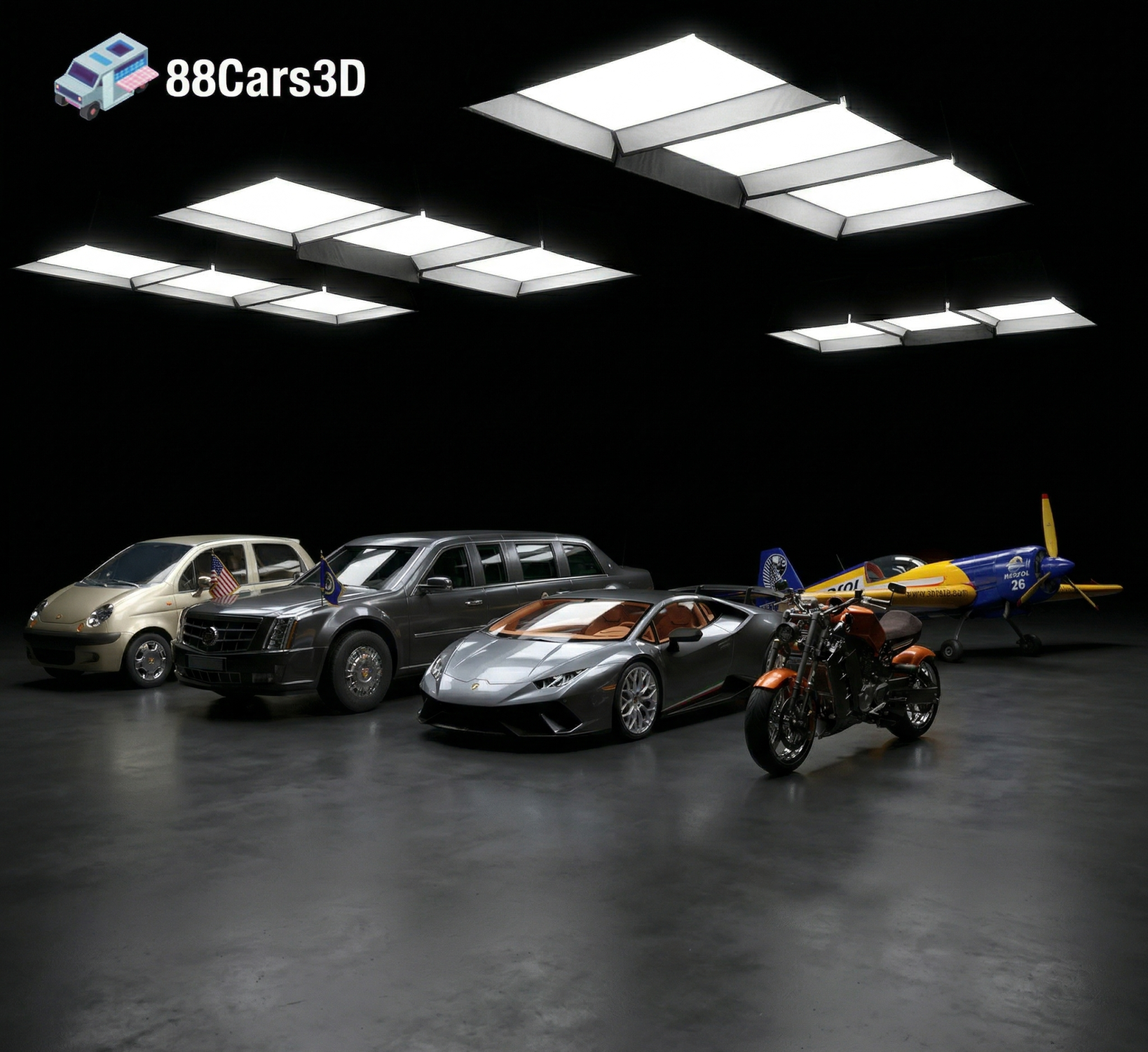
Texture: Yes | Material: Yes | 3D Printable: Yes. Download the Ultimate Creators’ Showcase featuring 5 premium 3D models: Lamborghini Huracan, ZAV Concept Motorcycle, Sukhoi SU-26, Presidential Limousine, and Daewoo Damas. Optimized for 4K CGI rendering and 3D printing. Save massive with this exclusive multi-category bundle!
Price: $99.99

Texture: Yes | Material: Yes | 3D Printable: Yes. Download the Italian Thoroughbreds Bundle featuring 5 iconic 3D models: Lamborghini Huracán Performante, Ferrari 458 Italia, Lamborghini Urus, Diablo SV, and Maserati GT. Optimized for 4K rendering and 3D printing (STL included). Save 50% with this ultimate Italian vehicle collection.
Price: $199.99

Download the Elite Future Mobility Bundle featuring 4 highly optimized 3D models: Tesla Model S, Avatr 11, Li L9, and Zoox Robotaxi. Perfect for ArchViz, Smart City renders, and game dev. Optimized for Unreal Engine and Blender. Includes .fbx, .obj, and .max formats.
Price: $99

🚗 5 Iconic German Cars (BMW M4 G82, M5 CS, X3, 1 Series & Mercedes E-Class). ✅ Optimized for ArchViz: Ready for Corona & V-Ray. 💰 Save €71 with this limited-time collection! 🚀 Instant Download after purchase.
Price: $119

Download the Extreme Off-Road & Survival 3D Models Bundle! Includes the Brabus 800 Adventure, Dodge Ram Bigfoot, Spec Truck, and a Caravan. Save over €210 on this premium 4-in-1 off-grid vehicle pack for ArchViz and game development.
Price: $149.99

Download the Heavy Duty & Commercial Logistics 3D Models Bundle! Includes the Ford Sterling, Caterpillar CT680, Mercedes Citaro Bus, and Vito Van. Save over €130 on this massive, game-ready 4-in-1 industrial vehicle pack.
Price: $109.99

Download the Ultimate Custom Motorcycles 3D Models Bundle. Includes a Custom Chopper, Ducati 916 Café Fighter, Harley XR1200X, and BMW K100. Perfect premium props for luxury ArchViz garages. Save over €250 today!
Price: $159.99

Download the ultimate JDM Street Racing 3D Models Bundle! Includes the Nissan GT-R, Toyota Supra, Mazda RX-7, Lancer Evo IX, and Honda NSX. Save big on this highly optimized, game-ready 5-in-1 Japanese legend car pack.
Price: $129.99

Download the ultimate American Muscle & Cinematic Classics 3D Models Bundle! Includes the Dodge Charger ’68, Mustang Eleanor GT500, Camaro Z28 ’79, and a custom ’69 Mustang. Save over €240 on this game-ready, premium 4-in-1 pack.
Price: $149.99

Download the Everyday City Traffic 3D Models Bundle. Includes the VW Golf, Kia Picanto, Hyundai Tucson, Toyota Yaris, and a DHL Ford Transit Van. Save big on this 5-in-1 pack, perfectly optimized for realistic ArchViz streets and game traffic.
Price: $99.99

