Get 50% OFF All Premium 3D & STL Models!

In the dynamic world of real-time rendering, game development, and automotive visualization, realism is paramount. Artists and developers are constantly pushing boundaries, not just in visual fidelity but also in the tangible, interactive experiences they create. For years, realistic physics simulation and destruction were often considered luxuries, resource-intensive and complex to implement. However, with the advent of Unreal Engine’s Chaos Physics System, this paradigm has shifted dramatically.
Chaos represents a powerful, production-ready physics engine integrated directly into Unreal Engine, offering unparalleled control over everything from rigid body destruction to sophisticated vehicle dynamics. For anyone working with high-quality 3D car models – whether for adrenaline-pumping racing games, meticulous automotive configurators, or cutting-edge virtual production – understanding Chaos is no longer optional; it’s essential. This comprehensive guide will dive deep into leveraging Chaos Physics for compelling destruction and realistic simulation, transforming static automotive assets into dynamic, interactive marvels. We’ll explore project setup, meticulous model preparation (which is crucial when sourcing assets from marketplaces like 88cars3d.com), intricate destruction workflows, advanced vehicle physics, and critical optimization strategies, empowering you to create truly immersive real-time experiences.
Unreal Engine’s Chaos Physics System marks a significant evolution in real-time simulation, providing a robust and highly scalable solution for all physics-driven interactions. Before Chaos, Unreal Engine relied primarily on NVIDIA’s PhysX, an excellent system in its own right, but one that was external and often opaque in its internal workings. Chaos, developed internally by Epic Games, represents a fresh start, built from the ground up to be fully integrated, modular, and extensible within the Unreal ecosystem. This fundamental shift offers developers unprecedented control and flexibility, allowing for highly customized physics behaviors tailored to specific project needs, especially crucial for nuanced applications like automotive visualization and simulation.
At its core, Chaos is designed for high-performance rigid body dynamics, cloth simulation, destruction, and fluid dynamics. For automotive applications, its strengths in rigid body destruction and advanced vehicle physics are particularly transformative. It’s a data-driven system, meaning many of its behaviors can be configured and iterated upon directly within the editor, reducing the need for costly recompilations or external tools. This iterative workflow is invaluable when fine-tuning the impact resistance of a vehicle chassis or the subtle sway of a car’s body during a high-speed turn. The system also boasts excellent multi-threading capabilities, ensuring that physics calculations are distributed across CPU cores, leading to smoother performance even with complex simulations involving hundreds or thousands of destructible pieces.
The transition from PhysX to Chaos wasn’t just a swap of physics engines; it was a philosophical shift. PhysX, while powerful, could sometimes feel like a black box, with limited opportunities for deep customization or source-level debugging for engine users. Chaos, by contrast, is an open-source component of Unreal Engine, allowing developers to dive into its code, understand its inner workings, and even extend its functionalities if needed. This level of transparency fosters a deeper understanding and greater control over the simulation. For studios developing highly specific vehicle simulation logic, this open architecture is a game-changer. Furthermore, Chaos was built with scalability in mind, designed to handle the massive amounts of data generated by next-generation hardware and large-scale environments, a crucial factor for modern open-world games and highly detailed virtual production sets.
Chaos is structured around several key components that work in harmony to deliver comprehensive physics simulation. The primary component for destruction is the Geometry Collection, which allows you to take a static mesh and preprocess it into a collection of smaller, interconnected pieces that can break apart dynamically. Beyond destruction, Chaos utilizes various solvers for different types of simulations: a rigid body solver for general object interactions, a cloth solver for deformable fabrics, and dedicated solvers for things like vehicle dynamics, which we’ll explore in detail. Fields play a critical role, providing a way to influence physics objects dynamically through forces, damage, or spatial triggers. This modular design means you can cherry-pick and combine different Chaos features, allowing you to create tailored physics interactions for everything from a car door flying off upon impact to the detailed deformation of a crumple zone.
Before you can unleash the destructive power of Chaos, proper project setup and meticulous preparation of your 3D car models are paramount. A well-prepared asset will yield more realistic and performant destruction, preventing visual glitches and unnecessary computational overhead. This section will guide you through configuring your Unreal Engine project and preparing your high-quality automotive assets for the rigors of Chaos Physics. When beginning with a pristine automotive asset from marketplaces such as 88cars3d.com, ensure its base topology is clean and organized, as this forms the foundation for effective fracturing.
The first step involves enabling the necessary Chaos plugins within Unreal Engine. Without these active, the Chaos tools and functionalities simply won’t appear. Once activated, you’ll need to understand how your automotive models should be structured. While Chaos can fracture almost any static mesh, optimal results come from models designed with destruction in mind, or at least with good base topology. This means having proper mesh density in areas likely to fracture, and ideally, separate mesh components for parts that are intended to detach cleanly, such as doors, hoods, or bumpers. Think about how a real car breaks apart: panels might crease or detach entirely, glass shatters, and internal components might become exposed. Replicating this requires thoughtful asset preparation.
The quality of your source model directly impacts the quality of your destruction. When acquiring 3D car models, especially for detailed automotive visualization, look for assets with clean, quad-based topology and proper UV mapping. Before importing into Unreal Engine, consider these preparatory steps:
For more detailed information on model preparation and import, refer to the official Unreal Engine documentation on importing assets: https://dev.epicgames.com/community/unreal-engine/learning.
To enable Chaos, navigate to Edit -> Plugins in Unreal Engine. Search for and enable the following plugins:
After enabling, restart the editor. Once restarted, you’ll find new options in the Content Browser’s context menu (Right-click -> Physics) and within the Mesh Editor for converting static meshes to Geometry Collections. It’s also a good practice to ensure your project’s physics settings (Edit -> Project Settings -> Physics) are configured to use Chaos as the default solver. Here, you can define global settings like gravity, friction, and collision parameters that will affect all Chaos simulations in your project.
The heart of Chaos destruction lies in the Geometry Collection. This asset type allows you to take any static mesh and procedurally slice it into multiple smaller pieces, which then behave as individual rigid bodies under the influence of Chaos Physics. The process of authoring these Geometry Collections is both powerful and surprisingly intuitive, offering a wide array of parameters to control the pattern, density, and behavior of the resulting destruction. For automotive visualization and game development, this means you can dictate how precisely a car’s chassis crumples or how glass shatters, achieving highly realistic and consistent results.
Once you’ve prepared your 3D car models as outlined in the previous section, converting them to Geometry Collections is the next step. You can right-click on a static mesh in the Content Browser and select “Create Geometry Collection.” This action immediately generates a new asset that can be opened in the Geometry Collection editor. Here, you’ll be presented with various fracturing methods, each offering distinct visual and performance characteristics. Understanding these methods and their associated parameters is key to achieving believable and performant destruction for your automotive assets. Remember that good UV mapping on your original static mesh will carry over to the fractured pieces, allowing for proper texturing of both exposed and intact surfaces with your PBR materials.
Inside the Geometry Collection editor, you have several primary fracturing options:
Each method offers parameters like Min/Max Fracture Level (how many times a piece can break down), Min/Max Sites (the density of initial fracture points), and Grout/Interior Material (the material applied to the newly exposed internal surfaces). It’s crucial to experiment with these settings. For example, a car’s windshield might use a Voronoi fracture with a high Min Sites value for fine shards, while a steel chassis component might use a Clustered fracture with fewer sites and a lower Min Fracture Level to represent larger, tougher chunks. Always consider the real-world material properties of the car part you are fracturing.
Beyond the initial fracture pattern, Chaos provides powerful tools to control *when* and *how* destruction occurs:
Experimenting with these controls allows for highly realistic and nuanced destruction scenarios, ensuring your real-time rendering of automotive crashes is both visually stunning and physically plausible. For further exploration of Geometry Collections and their properties, the official Unreal Engine documentation is an excellent resource.
While Chaos excels at destruction, its capabilities extend far beyond breaking things. For automotive visualization and realistic vehicle gameplay, Chaos offers a sophisticated framework for simulating complex vehicle dynamics, encompassing everything from responsive suspensions to detailed drivetrain mechanics. This level of realism transforms 3D car models from static eye candy into interactive, believable machines, crucial for high-fidelity driving simulators, racing games, and interactive product configurators that might showcase a car’s handling characteristics.
Unreal Engine provides a dedicated Vehicle Blueprint type that leverages Chaos Physics to manage all aspects of vehicle behavior. This includes wheel setup, suspension parameters, tire friction models, engine power curves, gearbox ratios, and even aerodynamic forces. Building a realistic vehicle in Unreal Engine involves a careful balance of physics parameters, PBR material properties (especially for tire friction), and Blueprint scripting for custom controls and interactive elements. The goal is to achieve a driving experience that feels authentic and responsive, allowing users to genuinely interact with the simulated vehicle’s dynamics.
The foundation of a good driving experience lies in the suspension and tire setup. Within the Vehicle Blueprint, you’ll find a ‘Vehicle Movement Component’ (or ‘Chaos Wheeled Vehicle Movement Component’ for newer projects) where you configure each wheel:
Iterative testing is vital here. Drive your vehicle, observe its behavior, and adjust parameters incrementally. Small changes in suspension stiffness or damping can drastically alter how the vehicle feels and handles, especially at speed. For instance, too little damping will cause the car to bounce excessively, while too much damping will make it feel rigid and unresponsive over bumps.
The drivetrain defines how power is transferred from the engine to the wheels:
Integrating these advanced physics components into your Unreal Engine project allows for highly convincing automotive simulations. Remember to source high-fidelity 3D car models, such as those found on 88cars3d.com, which are designed with clean hierarchies and proper pivots, making them ideal for setting up these intricate vehicle physics.
The allure of realistic destruction and complex vehicle physics can quickly turn into a performance nightmare if not managed carefully. While Chaos is designed for scalability, integrating it effectively into a real-time rendering pipeline, particularly for demanding applications like game development and high-fidelity automotive visualization, requires a strategic approach to optimization. Excessive physics calculations, especially with numerous interacting rigid bodies, can quickly cripple frame rates. Understanding how to judiciously apply Chaos and manage its computational overhead is crucial for delivering a smooth and immersive experience.
Optimization for Chaos primarily revolves around reducing the number of active physics simulations and simplifying their complexity when they are not central to the immediate player experience. This means employing techniques like culling unseen geometry collections, carefully managing the detail level of fractured pieces, and leveraging Unreal Engine’s built-in performance tools. It’s a continuous process of profiling, identifying bottlenecks, and applying targeted solutions. Remember that every active physics object, every contact point, and every force calculation adds to the CPU’s workload, so efficiency is key.
By implementing these optimization strategies, you can harness the full power of Chaos Physics for realistic destruction and simulation without sacrificing the smooth, responsive experience expected in modern real-time rendering applications. Always profile your game or application using tools like the Unreal Engine Profiler to identify specific performance bottlenecks related to Chaos and iterate on your optimization efforts.
Beyond raw destruction, Chaos Physics empowers developers and artists to create richly interactive experiences and drive innovative workflows in fields like virtual production. The system’s deep integration with Unreal Engine’s core features, such as Blueprint, Sequencer, and Niagara, allows for seamless storytelling, dynamic environmental responses, and engaging user interactions that transcend simple physics demonstrations. For automotive visualization, this means crafting compelling narratives around vehicles, simulating real-world scenarios, or building fully customizable product configurators where every choice has a tangible, physical impact.
Imagine a dynamic car commercial where a vehicle gracefully navigates a complex environment, triggering subtle environmental interactions with Chaos, then dramatically crashes and deforms in a perfectly choreographed sequence driven by Sequencer. Or consider an interactive architectural walkthrough where elements shatter or deform based on user input, creating a sense of realism and agency. These applications highlight Chaos’s versatility not just as a simulation engine but as a fundamental tool for immersive content creation. The ability to programmatically control destruction and simulation through Blueprint opens up endless possibilities for game design and interactive real-time applications.
Blueprint visual scripting is the gateway to making Chaos Physics truly interactive. You can use Blueprint to:
By harnessing Blueprint, artists and designers without extensive coding knowledge can build complex, reactive physics systems, greatly enhancing the interactivity of their Unreal Engine projects. For more on Blueprint scripting, Epic Games’ learning resources are invaluable: https://dev.epicgames.com/community/unreal-engine/learning.
Sequencer, Unreal Engine’s multi-track cinematic editor, works seamlessly with Chaos to create breathtaking, pre-rendered or real-time rendered cinematic sequences. You can:
This integration transforms Chaos from a mere physics engine into a powerful storytelling tool, enabling artists to craft highly dynamic and visually stunning narratives around their 3D car models in a way that was previously unimaginable in real-time.
Implementing a sophisticated physics system like Chaos, especially for complex subjects like 3D car models and large-scale destruction, inevitably comes with its own set of challenges. From achieving stable simulations to managing performance and iterating on visual fidelity, developers often encounter hurdles. This section aims to provide practical solutions and share industry best practices to help you navigate these complexities, ensuring your Unreal Engine projects leveraging Chaos are robust, visually appealing, and performant. Adhering to these guidelines will save countless hours in debugging and iteration, leading to a more streamlined development process for game development and automotive visualization.
One of the most frequent challenges is the delicate balance between visual realism and computational cost. Highly detailed fractures with thousands of pieces can look incredible, but they can bring a powerful machine to its knees. Conversely, overly simplistic destruction can break immersion. The key is to find the right level of fidelity for your target platform and experience, always keeping performance in mind. Another common issue is simulation instability, where objects might unexpectedly fly off, jitter, or pass through each other. Understanding the causes of these instabilities and applying corrective measures is crucial for a polished end product.
Achieving realistic and performant Chaos Physics is rarely a one-shot process. It requires continuous iteration and refinement:
By embracing these best practices and systematically addressing challenges, you can unlock the full potential of Chaos Physics to create truly groundbreaking and immersive experiences in your Unreal Engine projects.
Unreal Engine’s Chaos Physics System has fundamentally transformed what’s possible in real-time rendering, particularly for fields like automotive visualization and demanding game development. No longer are realistic vehicle destruction and complex dynamics an aspirational feature; they are now fully within the grasp of artists and developers. From the initial setup of your project and the meticulous preparation of your 3D car models (a process greatly aided by high-quality assets from platforms like 88cars3d.com) to mastering dynamic destruction with Geometry Collections and building intricate vehicle simulations, Chaos provides the tools to bring your automotive visions to life.
We’ve delved into the specifics of authoring fractures, controlling destruction with damage thresholds and fields, and configuring advanced vehicle mechanics like suspensions, drivetrains, and aerodynamics. Crucially, we’ve emphasized the importance of optimization strategies – managing complexity with cull distances and instancing, and ensuring stability with physics substeps and the asynchronous scene. Finally, we explored how Chaos integrates seamlessly with Unreal Engine’s powerful ecosystem, leveraging Blueprint for custom interactive events and Sequencer for breathtaking cinematics, opening doors for innovative virtual production workflows.
The journey to mastering Chaos Physics is one of continuous learning and iteration. By understanding its core principles, embracing best practices, and diligently debugging, you can create truly immersive and believable experiences. Whether you’re crafting the next generation of racing games, designing hyper-realistic automotive configurators, or pushing the boundaries of virtual production, Chaos Physics is an indispensable tool in your Unreal Engine arsenal. Start experimenting today, build compelling interactions, and witness your 3D car models shatter, crumple, and drive with unprecedented realism.
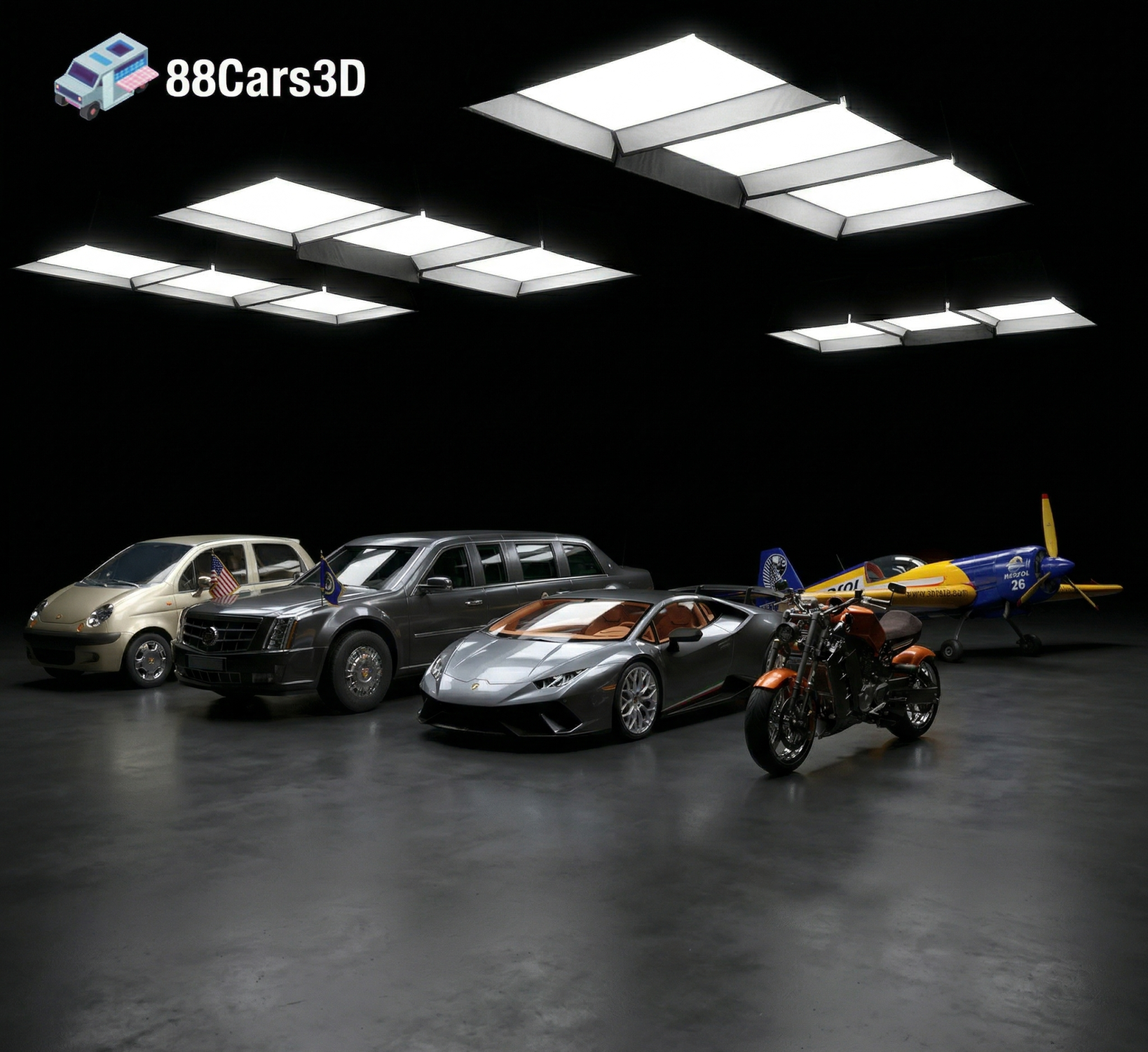
Texture: Yes | Material: Yes | 3D Printable: Yes. Download the Ultimate Creators’ Showcase featuring 5 premium 3D models: Lamborghini Huracan, ZAV Concept Motorcycle, Sukhoi SU-26, Presidential Limousine, and Daewoo Damas. Optimized for 4K CGI rendering and 3D printing. Save massive with this exclusive multi-category bundle!
Price: $99.99

Texture: Yes | Material: Yes | 3D Printable: Yes. Download the Italian Thoroughbreds Bundle featuring 5 iconic 3D models: Lamborghini Huracán Performante, Ferrari 458 Italia, Lamborghini Urus, Diablo SV, and Maserati GT. Optimized for 4K rendering and 3D printing (STL included). Save 50% with this ultimate Italian vehicle collection.
Price: $199.99

Download the Elite Future Mobility Bundle featuring 4 highly optimized 3D models: Tesla Model S, Avatr 11, Li L9, and Zoox Robotaxi. Perfect for ArchViz, Smart City renders, and game dev. Optimized for Unreal Engine and Blender. Includes .fbx, .obj, and .max formats.
Price: $99

🚗 5 Iconic German Cars (BMW M4 G82, M5 CS, X3, 1 Series & Mercedes E-Class). ✅ Optimized for ArchViz: Ready for Corona & V-Ray. 💰 Save €71 with this limited-time collection! 🚀 Instant Download after purchase.
Price: $119

Download the Extreme Off-Road & Survival 3D Models Bundle! Includes the Brabus 800 Adventure, Dodge Ram Bigfoot, Spec Truck, and a Caravan. Save over €210 on this premium 4-in-1 off-grid vehicle pack for ArchViz and game development.
Price: $149.99

Download the Heavy Duty & Commercial Logistics 3D Models Bundle! Includes the Ford Sterling, Caterpillar CT680, Mercedes Citaro Bus, and Vito Van. Save over €130 on this massive, game-ready 4-in-1 industrial vehicle pack.
Price: $109.99

Download the Ultimate Custom Motorcycles 3D Models Bundle. Includes a Custom Chopper, Ducati 916 Café Fighter, Harley XR1200X, and BMW K100. Perfect premium props for luxury ArchViz garages. Save over €250 today!
Price: $159.99

Download the ultimate JDM Street Racing 3D Models Bundle! Includes the Nissan GT-R, Toyota Supra, Mazda RX-7, Lancer Evo IX, and Honda NSX. Save big on this highly optimized, game-ready 5-in-1 Japanese legend car pack.
Price: $129.99

Download the ultimate American Muscle & Cinematic Classics 3D Models Bundle! Includes the Dodge Charger ’68, Mustang Eleanor GT500, Camaro Z28 ’79, and a custom ’69 Mustang. Save over €240 on this game-ready, premium 4-in-1 pack.
Price: $149.99

Download the Everyday City Traffic 3D Models Bundle. Includes the VW Golf, Kia Picanto, Hyundai Tucson, Toyota Yaris, and a DHL Ford Transit Van. Save big on this 5-in-1 pack, perfectly optimized for realistic ArchViz streets and game traffic.
Price: $99.99

