Get 50% OFF All Premium 3D & STL Models!

The quest for photorealism in digital content has always driven innovation in computer graphics. For automotive visualization, where precision, material fidelity, and aesthetic appeal are paramount, this pursuit is even more critical. Enter Real-Time Ray Tracing in Unreal Engine – a game-changer that has elevated the visual quality of interactive experiences to unprecedented levels. Gone are the days when stunning, physically accurate reflections, refractions, and global illumination were confined to offline renders. Today, artists and developers can harness the power of ray tracing to create automotive showcases that are virtually indistinguishable from reality, all within the interactive confines of Unreal Engine.
This comprehensive guide delves into the transformative capabilities of Real-Time Ray Tracing, specifically tailored for the demanding world of automotive visualization. We’ll explore how to set up your Unreal Engine projects, master PBR materials, optimize performance, and leverage advanced lighting techniques to bring your 3D car models to life. Whether you’re designing the next concept car, developing an immersive marketing experience, or building a next-gen racing game, understanding these techniques is crucial. Prepare to unlock a new dimension of visual fidelity and empower your automotive projects with the unparalleled realism that only real-time ray tracing can deliver.
Real-Time Ray Tracing represents a paradigm shift from traditional rasterization, which approximates light interactions. Instead, ray tracing accurately simulates the physical behavior of light, tracing individual rays from the camera into the scene and calculating their bounces, refractions, and reflections. For automotive visualization, where surfaces are often highly reflective, metallic, or transparent, this accuracy is not just a luxury but a necessity for achieving true photorealism. The way light interacts with a car’s sleek paintwork, the intricate reflections on its chrome rims, or the subtle distortions through its glass windshield fundamentally defines its visual appeal. Without the precise calculations of ray tracing, these details often fall short of real-world expectations.
A car’s exterior is a symphony of complex surfaces designed to catch and reflect light in specific ways. Traditional rasterization struggles to accurately render these interactions across an entire scene, often relying on screen-space effects or pre-baked lightmaps that break down in dynamic environments. Ray Traced Reflections (RTR) in Unreal Engine provide pixel-perfect mirror reflections on polished surfaces, capturing the surrounding environment with incredible fidelity, including other ray-traced objects. This is crucial for metallic paints, chrome accents, and polished glass. Similarly, Ray Traced Translucency delivers physically accurate refractions through windows and headlights, allowing the environment to distort realistically as seen through the material. Beyond direct lighting, Ray Traced Global Illumination (RTGI) simulates how light bounces and illuminates a scene indirectly, adding crucial soft shadows and color bleeding that ground the car within its environment. Imagine a car parked indoors; RTGI accurately calculates how light from a window bounces off the floor and subtly illuminates the car’s underside, creating depth and realism that screen-space solutions simply cannot match. This level of detail is paramount when presenting high-fidelity 3D car models, such as those available on platforms like 88cars3d.com, ensuring they look their absolute best.
Unreal Engine provides a comprehensive suite of ray tracing features that can be selectively enabled and configured to achieve desired visual outcomes and performance targets. The key components include:
* **Ray Traced Global Illumination (RTGI):** Provides highly realistic indirect lighting, calculating how light bounces off surfaces to illuminate other parts of the scene. This is vital for ambient lighting, subtle color casts, and overall scene believability.
* **Ray Traced Reflections (RTR):** Generates physically accurate reflections on metallic, glossy, and wet surfaces, capturing the entire scene’s geometry and lighting, not just what’s visible on screen.
* **Ray Traced Shadows (RTS):** Produces precise, soft, and area-aware shadows that accurately represent the light source’s size and distance. This eliminates artifacts often seen with traditional shadow mapping and adds significant depth.
* **Ray Traced Ambient Occlusion (RTAO):** Computes context-aware ambient occlusion, providing subtle shading in crevices and corners where objects are close together, enhancing contact shadows and visual grounding.
* **Ray Traced Translucency:** Renders physically accurate refractions and reflections for transparent and translucent materials like glass, water, and car headlights, contributing to a truly immersive visual experience.
Each of these features can be individually controlled and fine-tuned, allowing artists to balance visual quality with performance demands. Understanding their individual strengths and how they interact is key to mastering real-time ray tracing in Unreal Engine.
Embarking on a real-time ray tracing project in Unreal Engine requires careful preparation, starting from your hardware and extending to fundamental project settings. The underlying technology demands specific hardware capabilities and project configurations to unlock its full potential. Successfully preparing your environment is the first critical step toward achieving stunning automotive visualizations.
To leverage Real-Time Ray Tracing, your system must meet specific hardware criteria. At the core, you’ll need a GPU that supports hardware-accelerated ray tracing, such as NVIDIA’s RTX series (20-series, 30-series, 40-series) or AMD’s Radeon RX 6000 series and newer (RDNA 2 architecture or later). Ensure your graphics drivers are up-to-date, as new driver versions often include performance optimizations and bug fixes for ray tracing. The operating system also plays a role; Windows 10 (version 1809 or later) or Windows 11 is required, as Unreal Engine’s ray tracing implementation relies on DirectX 12 (DX12) or Vulkan API.
Once your hardware and OS are ready, you can configure your Unreal Engine project.
1. **Launch Unreal Engine** and open your project.
2. Navigate to **Edit > Project Settings**.
3. Under the **Engine** category, select **Rendering**.
4. Scroll down to the **Ray Tracing** section.
5. Enable the **Ray Tracing** checkbox. This will prompt you to restart the editor.
6. While in the Rendering settings, ensure that **Hardware Ray Tracing** is enabled.
7. Verify that your **Default RHI (Rendering Hardware Interface)** is set to **DirectX 12** or **Vulkan** in the `Windows` or `Linux` (depending on your OS) section under `Platforms`.
After restarting, your project is technically enabled for ray tracing. However, this is just the foundational step. You’ll then need to enable individual ray tracing features (GI, Reflections, Shadows, etc.) through console variables or Post Process Volume settings, which we’ll discuss further. For more detailed instructions on enabling ray tracing, consult the official Unreal Engine documentation at https://dev.epicgames.com/community/unreal-engine/learning.
Even with ray tracing enabled, the quality of your output heavily depends on the quality of your input assets and scene setup. When sourcing automotive assets from marketplaces such as 88cars3d.com, you often benefit from models already prepared with clean topology and proper UVs, which are crucial for optimal ray tracing performance and visual fidelity.
* **Clean Geometry:** Ray tracing interacts with every polygon. Excessively complex or messy geometry (e.g., non-manifold edges, flipped normals, overlapping faces) can lead to visual artifacts or performance bottlenecks. Ensure your 3D car models have clean, optimized topology. Models leveraging **Nanite** (Unreal Engine’s virtualized geometry system) can handle incredibly high polygon counts with efficiency, but fundamental mesh integrity remains important for material definition and accurate light interaction.
* **Proper UV Mapping:** High-quality UV mapping is essential for textures to display correctly and for lightmaps (if using baked lighting components) to function without issues. For ray tracing, precise UVs ensure that details like normal maps and metallic textures align perfectly, contributing to realistic reflections and refractions.
* **Consistent Material Setup:** Physically Based Rendering (PBR) materials are the backbone of photorealism. Ensure all your car model materials are set up correctly with accurate Base Color, Metallic, Specular, Roughness, and Normal maps. This consistency is vital for ray tracing to correctly interpret how light interacts with different surfaces, from glossy paint to matte plastic.
* **Lumen Integration:** Unreal Engine 5’s default global illumination and reflection system, Lumen, works incredibly well with hardware ray tracing. By default, Lumen uses software ray tracing, but when hardware ray tracing is enabled, Lumen can leverage it for more accurate and performant results, especially for high-detail geometry. Ensure Lumen is enabled in your Project Settings (Engine > Rendering > Global Illumination, Reflections) and configured appropriately for your scene’s scale and dynamic range.
Careful preparation of your scene and assets lays the groundwork for breathtaking ray-traced automotive visualizations, allowing the engine to shine without impedance.
The visual fidelity of a ray-traced car model hinges significantly on the quality and accuracy of its PBR (Physically Based Rendering) materials. Ray tracing thrives on physically accurate data, making proper material calibration paramount. Every surface, from the car’s lustrous paint to its delicate interior fabrics, must be configured to respond realistically to light, shadows, and reflections. This section delves into the specifics of creating and fine-tuning these critical materials within Unreal Engine’s Material Editor.
Automotive paint is notoriously complex, often featuring clear coats, metallic flakes, and subtle depth. Recreating this accurately in real-time requires a nuanced approach to PBR values.
* **Car Paint (Clear Coat):** This is typically achieved using a layered material approach.
* **Base Layer:** Represents the underlying paint color and metallic flakes. The `Base Color` will be the primary hue, while the `Metallic` value should be set high (e.g., 0.8-1.0) to simulate the metallic particles. The `Roughness` here can be relatively low (e.g., 0.2-0.4) for a polished metallic look.
* **Clear Coat Layer:** This is often a separate layer that sits on top, providing the characteristic glossy finish. In Unreal Engine, you can use the `Clear Coat` and `Clear Coat Roughness` inputs on the Material node. Set `Clear Coat` to 1 and `Clear Coat Roughness` to a very low value (e.g., 0.05-0.1) for a highly reflective, protective layer. You can also use a `Clear Coat Normal` map to add subtle imperfections if desired.
* **Flakes:** For truly advanced paint, you can introduce a subtle normal map or even a custom shader that simulates metallic flakes beneath the clear coat, adding an extra layer of sparkle when light hits the surface at certain angles.
* **Chrome and Anodized Finishes:** These are essentially variations of highly reflective metals.
* **Chrome:** `Metallic` should be 1.0, and `Roughness` should be extremely low (e.g., 0.01-0.05). The `Base Color` will typically be a bright grey (e.g., RGB 0.9,0.9,0.9) to reflect light neutrally.
* **Anodized Metal:** This involves a colored metallic surface. `Metallic` should be 1.0, `Roughness` can be slightly higher than chrome (e.g., 0.1-0.3), and the `Base Color` will be the desired anodized hue (e.g., a rich blue or red).
* **Glass:** For car windows and windshields, `Metallic` should be 0.0. `Specular` is typically 0.5. The `Roughness` should be very low (e.g., 0.0-0.1) for clean glass. Critically, set the `Blend Mode` to `Translucent` and connect an `Opacity` value (usually 0.1-0.3 for tinted glass). For physically accurate refractions with Ray Traced Translucency, ensure you correctly set the `Refraction` input or leverage the `Thin Translucency` material option for simplified but effective glass rendering. The Index of Refraction (IOR) for glass is approximately 1.5, which Unreal Engine’s ray tracing will utilize when enabled.
When importing 3D car models, especially high-quality assets from reputable sources like 88cars3d.com, ensure their PBR texture maps (Base Color, Normal, Metallic, Roughness, AO) are correctly assigned and scaled within Unreal Engine to immediately benefit from ray tracing’s visual fidelity.
While exteriors grab immediate attention, the interior and intricate lighting elements of a car demand equal attention to detail. Subsurface Scattering (SSS) is a crucial material property for achieving realism in these areas.
* **Interior Materials (Leather, Plastics, Fabrics):** Materials like leather seats, soft-touch plastics on the dashboard, and certain fabric upholsteries don’t just reflect light from their surface; a portion of the light penetrates the material, scatters internally, and exits at a different point. This gives them a characteristic softness and depth that pure diffuse or specular models cannot replicate. In Unreal Engine, you can enable SSS by setting the `Shading Model` in your material to `Subsurface Profile` or `Two Sided Foliage` (for very thin objects). You’ll then create and assign a `Subsurface Profile` asset, which defines parameters like scattering color, extinction distance, and falloff. This subtle effect significantly enhances the realism of interior components, preventing them from looking “flat.”
* **Headlights and Taillights:** Modern car lights often feature complex lenses and internal reflectors. Ray Traced Translucency with an accurately defined IOR is essential for the outer lens. For the inner housing, you might use highly reflective metals for reflectors, and for the actual light-emitting elements, you can combine emissive materials with SSS for plastic diffusers or LED covers. A common technique involves modeling the light source realistically within the housing and letting ray-traced reflections and refractions handle the complex light bounces. For the inner plastic elements, SSS can prevent them from looking like simple solid blocks, allowing light to subtly diffuse through them, especially when the headlights are off, catching ambient light. Using emissive materials coupled with actual point or spot lights within the headlight mesh (ensuring they contribute to Lumen and Ray Traced GI) is key to making them look authentic both when off and on.
By meticulously calibrating your PBR materials and strategically employing features like SSS and clear coats, you enable ray tracing to render your automotive assets with unparalleled depth and authenticity.
Lighting is the soul of any compelling visual, and in automotive visualization, it’s particularly critical for highlighting form, material, and detail. Real-Time Ray Tracing in Unreal Engine, combined with advanced lighting setups, allows for an unprecedented level of control and fidelity, creating environments where cars truly shine. This section explores how to leverage Unreal Engine’s powerful lighting tools to their fullest with ray tracing enabled.
Unreal Engine 5 introduced Lumen as its primary dynamic global illumination and reflections system, and it works synergistically with hardware ray tracing to deliver stunning results. Lumen provides real-time indirect lighting that reacts instantly to changes in direct lighting, geometry, or material properties, making it ideal for interactive automotive showcases.
* **Lumen Configuration:** Ensure Lumen is enabled in your Project Settings (Engine > Rendering > Global Illumination, Reflections). Key settings in your Post Process Volume for Lumen include:
* **Lumen Scene Detail:** Controls the resolution of the Lumen scene representation. Higher values capture more detail but cost performance.
* **Lumen Global Illumination:** Set to `Lumen` for dynamic GI.
* **Lumen Reflections:** Set to `Lumen` for dynamic reflections that leverage Lumen’s scene data.
* **Ray Tracing Mode (under Lumen Global Illumination):** Set this to `Hit Lighting for Reflections` or `Hit Lighting for Global Illumination` if you want Lumen to use hardware ray tracing for final gather calculations, providing more accurate light bouncing off complex surfaces like car bodies.
* **Benefits with Ray Tracing:** When hardware ray tracing is active, Lumen can perform more accurate ray queries, especially for complex concave shapes and high-detail meshes. This results in cleaner indirect illumination, less light leaking, and more precise color bleeding, all of which are vital for rendering a car’s nuanced forms.
* **RTGI (Legacy Option):** While Lumen is the preferred modern solution, pure Ray Traced Global Illumination (RTGI) can still be enabled directly for specific scenarios or if not using Lumen. You can enable it via the Post Process Volume (`Global Illumination > Method > Ray Traced`) and control its `Samples Per Pixel` and `Max Bounces`. For most new projects, Lumen’s comprehensive approach is recommended, often leveraging hardware ray tracing internally for enhanced quality.
Ray Traced Reflections (RTR) and Ray Traced Shadows (RTS) are perhaps the most visually impactful ray tracing features for automotive visualization, dramatically enhancing realism.
* **Ray Traced Reflections (RTR):**
* Enable RTR in your Post Process Volume (`Reflections > Method > Ray Traced`).
* **Samples Per Pixel:** Controls the smoothness of reflections. Higher values (e.g., 4-8) reduce noise but increase cost. Denoisers play a crucial role here.
* **Max Bounces:** Determines how many times a ray reflects. For most automotive scenes, 1-2 bounces are sufficient for primary reflections, with higher values adding subtle secondary reflections but impacting performance.
* **Screen Percentage:** Allows you to render reflections at a lower resolution for performance gains.
* **Culling:** Set `Reflections > Max Ray Distance` to cull reflections beyond a certain range, optimizing performance for distant objects that don’t need high-fidelity reflections.
* For highly reflective car surfaces, RTR will capture the entire scene, including other ray-traced objects and lights, providing a level of realism impossible with screen-space reflections.
* **Ray Traced Shadows (RTS):**
* Enable RTS for individual light sources (Directional Light, Spot Light, Point Light) by setting their `Shadow Map Method` to `Ray Traced Shadows`.
* **Samples Per Pixel:** Similar to reflections, this controls shadow quality and smoothness. Higher values reduce noise and artifacting, especially for soft shadows.
* **Max Ray Distance:** Optimize by limiting how far shadows are traced.
* **Source Radius (for Point/Spot Lights) and Source Angle (for Directional Lights):** These parameters directly control the softness of the ray-traced shadows, accurately simulating the physical size of the light source. Larger sources produce softer, more realistic penumbras.
* RTS excels at creating precise contact shadows under the car, around wheels, and in intricate crevices, grounding the vehicle firmly in its environment and adding significant depth.
* **HDRI Sky Lights:** A crucial element for realistic environmental lighting. Use a high-dynamic-range image (HDRI) in a `Sky Light` actor. When `Cast Ray Traced Shadow` is enabled on the Sky Light, it contributes highly realistic ambient occlusion and environment reflections via ray tracing, dramatically improving the car’s integration into the scene. For interiors, consider using sphere or mesh lights to simulate studio lighting setups, ensuring they are also configured for ray-traced shadows and contribute to Lumen’s GI.
By skillfully combining Lumen’s dynamic GI with precise Ray Traced Reflections and Shadows, you can craft a lighting environment that makes your 3D car models appear breathtakingly real, capturing every nuance of their design.
While Real-Time Ray Tracing delivers unparalleled visual quality, it is also computationally intensive. Achieving a smooth, interactive experience, especially at higher resolutions or in AR/VR contexts, necessitates rigorous optimization. Balancing visual fidelity with performance is a key challenge, and Unreal Engine provides a suite of tools and techniques to help artists and developers strike that balance effectively.
Unreal Engine’s Nanite virtualized geometry system has revolutionized handling extremely high-polygon assets, and it plays a vital role in optimizing ray-traced scenes. Traditionally, high-poly car models would cripple performance, but Nanite efficiently renders cinematic-quality assets in real-time.
* **How Nanite Works with Ray Tracing:** When a Nanite mesh is rendered with ray tracing, Unreal Engine typically generates a fallback mesh or uses a proxy representation for ray queries. However, with recent improvements, Nanite meshes are increasingly supported directly by hardware ray tracing for features like Lumen and reflections, leading to more accurate results without the need for manual LODs for ray tracing. Nanite intelligently streams and processes only the necessary detail, minimizing the data sent to the GPU, making it possible to feature incredibly detailed 3D car models (like those from 88cars3d.com with millions of polygons) in real-time ray-traced environments.
* **Benefits for Automotive Assets:** Car models are often highly detailed. Nanite allows artists to import CAD data or sculpted models with immense geometric complexity directly into Unreal Engine without extensive polygon reduction. This means pristine panel gaps, intricate interior details, and smooth curves are preserved, directly benefiting ray-traced reflections and shadows which thrive on accurate geometry.
* **Considerations:** While Nanite is powerful, it currently has some limitations, such as not fully supporting dynamic primitive transformations in all ray tracing contexts, or certain complex material features like two-sided foliage. Always test how specific material setups and dynamic elements on Nanite meshes interact with your ray tracing settings. For transparent or translucent parts like windows, it’s often best to disable Nanite to ensure correct sorting and refraction, as these effects rely on traditional rendering pipelines for accuracy.
Even with Nanite handling high-poly static meshes, traditional optimization techniques remain crucial for dynamic objects, translucent geometry, and fine-tuning ray tracing quality.
* **Level of Detail (LODs):** For non-Nanite meshes (e.g., small props, character models, complex particle systems) and translucent geometry, manual LODs are still essential. Generate lower-polygon versions of meshes that swap in at increasing distances from the camera. This reduces the number of triangles processed for objects further away.
* **Culling:**
* **Distance Culling:** For individual lights, ray-traced reflections, and shadows, define a `Max Ray Distance` to prevent tracing rays beyond a relevant range. This saves computational power for elements that aren’t visually impactful at a distance.
* **Frustum Culling:** Unreal Engine automatically culls objects outside the camera’s view frustum, but ensure unnecessary objects are not placed far outside the scene boundaries.
* **Console Variables (CVars):** These are powerful tools for fine-tuning ray tracing quality and performance at runtime. Access them via the console (`~` key).
* `r.RayTracing.GlobalIllumination.SamplesPerPixel [X]`: Controls the quality/noise of RTGI. Lower for performance, higher for quality. (e.g., 1-4)
* `r.RayTracing.Reflections.SamplesPerPixel [X]`: Adjusts reflection quality. (e.g., 1-8)
* `r.RayTracing.Reflections.MaxBounces [X]`: Sets the number of reflection bounces. (e.g., 1-2)
* `r.RayTracing.Shadows.SamplesPerPixel [X]`: Controls shadow quality. (e.g., 1-8)
* `r.RayTracing.Shadows.MaxRayDistance [X]`: Limits shadow ray distance.
* `r.RayTracing.Shadows.Enable [0/1]`: Globally enable/disable ray-traced shadows.
* `r.Lumen.HardwareRayTracing [0/1]`: Toggle hardware ray tracing for Lumen.
* Experiment with these variables to find the optimal balance for your project.
Ray tracing, especially at lower sample counts for real-time performance, often introduces visual noise. Denoisers are critical for smoothing out this noise without incurring massive performance hits from excessively high sample counts.
* **Built-in Denoisers:** Unreal Engine integrates advanced denoisers (like NVIDIA’s OptiX Denoiser, if supported by your GPU, or its internal denoiser) for global illumination, reflections, and shadows. These algorithms analyze the noisy output and intelligently remove speckles, producing a cleaner image. Ensure they are active and configured through your Post Process Volume.
* **Temporal Anti-Aliasing (TAA):** TAA is also crucial as it leverages information from previous frames to smooth out noise and jagged edges, working synergistically with denoisers to provide a stable, high-quality image.
* **Screen Space Effects as Fallbacks:** While ray tracing is superior, screen-space global illumination (SSGI) and screen-space reflections (SSR) can serve as performance fallbacks for less critical areas or specific performance targets. They are significantly cheaper but lack the full scene awareness of ray tracing.
* **Other Post-Processing:** Standard post-processing effects like Bloom, Exposure, Color Grading, and Vignette are still essential for cinematic look development and can enhance the perceived realism of your ray-traced automotive scenes. Always evaluate their impact on performance and adjust accordingly.
Through a combination of Nanite’s geometric efficiency, strategic LOD and culling, precise console variable tuning, and intelligent use of denoisers and post-processing, you can achieve stunning ray-traced automotive visualizations that run smoothly in real-time.
The fusion of Unreal Engine’s real-time rendering capabilities and hardware-accelerated ray tracing has unlocked a plethora of real-world applications for automotive professionals. Beyond static renders, these technologies enable dynamic, interactive experiences that push the boundaries of design, marketing, and training. Let’s explore some key applications and workflow tips for leveraging ray tracing in your automotive projects.
One of the most impactful applications of real-time ray tracing in automotive visualization is the development of interactive configurators. These tools allow potential buyers or designers to customize a car in real-time, instantly seeing changes reflected with photorealistic accuracy.
* **Enhanced Realism:** With ray tracing, users can change paint colors, wheel designs, interior materials, and lighting environments, seeing how each choice impacts realistic reflections, shadows, and overall aesthetic. A metallic paint choice will accurately reflect the virtual studio lights and environment, while a leather interior will show subtle subsurface scattering and reflections, all rendered instantly. This level of fidelity creates a highly immersive and persuasive experience, bridging the gap between digital representation and physical product.
* **Blueprint for Interactivity:** Unreal Engine’s Blueprint visual scripting system is the perfect tool for building these configurators. You can create nodes that:
* Swap material instances (e.g., for paint colors, seat fabrics).
* Change static mesh components (e.g., for different wheel designs, spoilers).
* Control light sources and environmental HDRI changes.
* Trigger animations (e.g., opening doors, rotating the camera).
* **Workflow Tip:** Organize your car model’s materials into Master Materials with parameters exposed as Material Instances. This allows Blueprint to easily modify colors, roughness, or metallic properties without recompiling shaders. For asset management, ensure your 3D car models, like those available on 88cars3d.com, are structured with separate material slots for different components (body, wheels, glass, interior), enabling granular control via Blueprint.
* **Performance Considerations:** While ray tracing is beautiful, configurators often need to run on a wider range of hardware. Implement quality settings (e.g., toggle ray tracing features, lower sample counts) that users can adjust. Consider baking some static lighting elements where possible to offload dynamic ray tracing in less critical areas.
Real-time ray tracing is also a cornerstone of modern virtual production (VP) workflows and high-fidelity cinematic rendering in Unreal Engine.
* **Virtual Production with LED Walls:** In virtual production, physical sets are augmented or replaced by large LED screens displaying photorealistic 3D environments. When a real car (or actor) is placed in front of these screens, the reflections on its surfaces, especially its shiny exterior, must accurately match the virtual world displayed on the LED wall. Ray tracing makes this possible by generating real-time reflections of the virtual environment onto the physical car (via live camera tracking and compositing), seamlessly blending the physical and digital. This allows filmmakers to capture final-pixel footage in-camera, reducing post-production time and cost.
* **Sequencer for Cinematic Content:** Unreal Engine’s Sequencer is a powerful non-linear cinematic editor. With ray tracing enabled, artists can render stunning cinematics of their automotive designs with unparalleled visual quality.
* **Workflow Tip:** Use Sequencer to choreograph camera movements, animate car components (e.g., doors opening, suspension compression), and sequence material changes.
* Leverage Cine Cameras for realistic depth of field and filmic controls.
* For cinematic rendering, you can temporarily increase ray tracing sample counts and bounces to achieve higher quality output, as performance is less critical than for real-time interactive experiences. The Movie Render Queue (MRQ) offers advanced rendering settings, including multi-pass rendering, outputting EXR files, and superior anti-aliasing for the cleanest cinematic results.
* **High-Fidelity Renders:** For marketing materials or design reviews, Sequencer allows for direct high-resolution, ray-traced renders of concept cars or production models, bypassing traditional offline rendering pipelines and delivering visuals of comparable quality much faster.
Bringing ray-traced automotive experiences to Augmented Reality (AR) and Virtual Reality (VR) presents a significant technical challenge due to the extremely high frame rate (typically 90fps or higher per eye) required to prevent motion sickness.
* **Potential:** Imagine walking around a life-size, ray-traced model of a car in AR, seeing it realistically reflected on your office floor, or sitting inside a concept car in VR, with every surface rendered with stunning fidelity. Ray tracing can deliver this ultimate immersion.
* **Challenges and Optimization:** Currently, full real-time ray tracing in VR/AR at required frame rates is extremely demanding, even for high-end hardware.
* **Prioritize:** Carefully choose which ray tracing features are essential. Ray Traced Shadows or Reflections might be enabled only for primary light sources or the most critical surfaces, while global illumination might rely on Lumen’s software path or a highly optimized baked solution.
* **Resolution and Foveated Rendering:** Render at lower resolutions or utilize foveated rendering (where only the central gaze point is rendered at full resolution) to save GPU resources.
* **Aggressive Optimization:** Maximize Nanite usage, reduce CVar sample counts to their absolute minimum, and aggressively cull objects.
* **Future Prospects:** As hardware continues to evolve and Unreal Engine’s optimization techniques become more sophisticated, full ray tracing in AR/VR will become increasingly viable. For now, it’s about making smart compromises to deliver the best possible experience within current hardware limitations.
The integration of real-time ray tracing into Unreal Engine has truly democratized photorealism for automotive professionals. By understanding these applications and workflow tips, you can push the boundaries of what’s possible in design visualization, marketing, and interactive experiences.
Real-Time Ray Tracing in Unreal Engine has fundamentally transformed the landscape of automotive visualization, elevating the bar for photorealism and immersion in interactive experiences. We’ve journeyed through the intricacies of setting up your Unreal Engine project, mastering PBR materials to accurately represent everything from lustrous car paint to intricate interior details, and leveraging advanced lighting techniques with Lumen and precise ray-traced effects. We also explored crucial optimization strategies, including the strategic use of Nanite and console variables, to ensure your stunning visuals run smoothly.
The power of ray tracing extends far beyond pretty pictures; it empowers interactive configurators, seamlessly integrates into virtual production workflows, and opens new frontiers for cinematic rendering. The ability to render physically accurate reflections, refractions, and global illumination in real-time means that every curve, every material, and every lighting condition on a 3D car model can be showcased with unprecedented fidelity.
For artists and developers committed to delivering the highest quality automotive content, embracing these advanced techniques is no longer optional – it’s essential. By continuously refining your workflows and leveraging high-quality assets like those optimized for Unreal Engine on 88cars3d.com, you can create experiences that not only captivate but also inform and inspire. The future of automotive visualization is here, and it’s rendered in real-time, with rays of light guiding every pixel to perfection. Now is the time to dive in and unlock the full potential of your next automotive masterpiece.
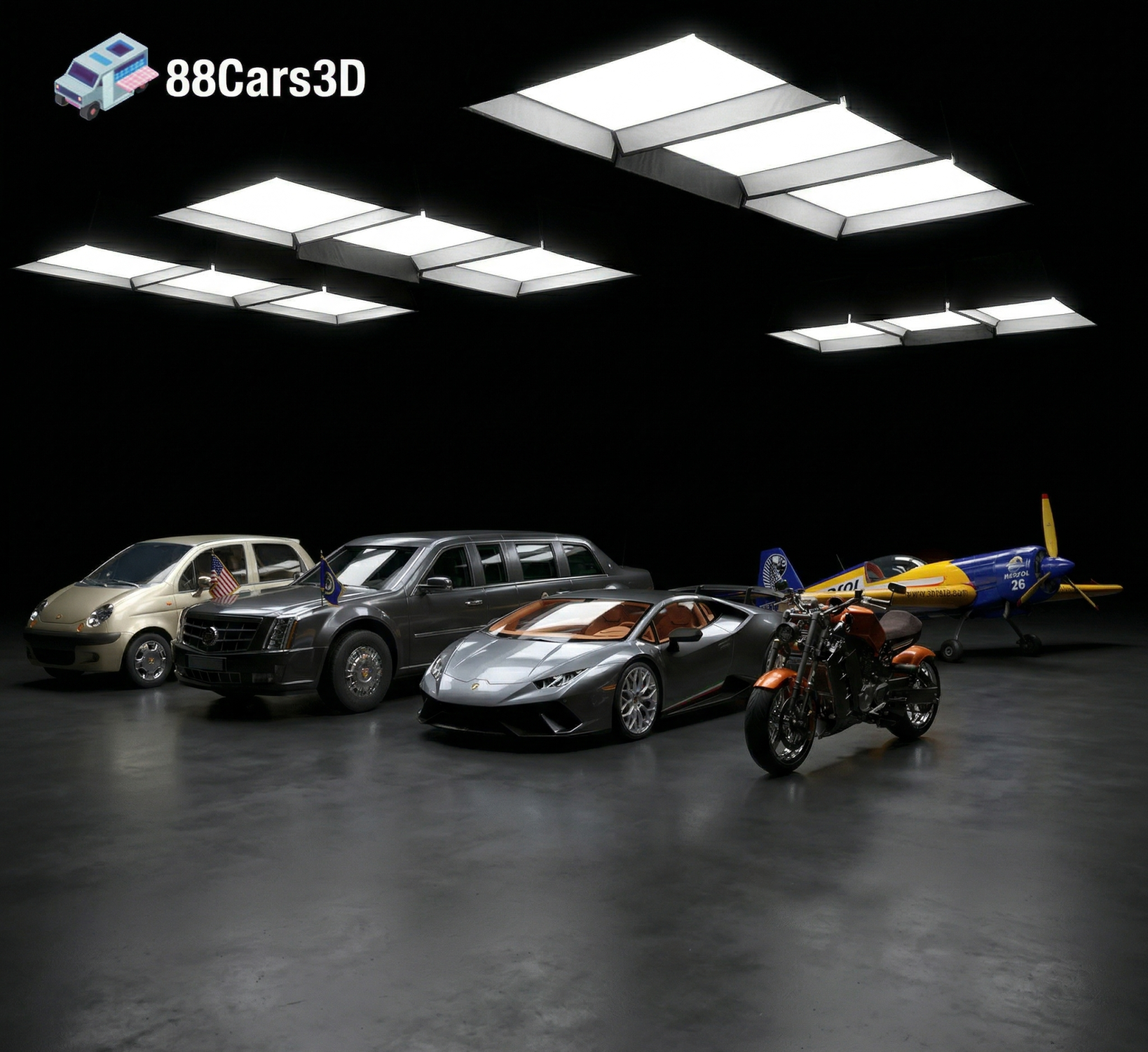
Texture: Yes | Material: Yes | 3D Printable: Yes. Download the Ultimate Creators’ Showcase featuring 5 premium 3D models: Lamborghini Huracan, ZAV Concept Motorcycle, Sukhoi SU-26, Presidential Limousine, and Daewoo Damas. Optimized for 4K CGI rendering and 3D printing. Save massive with this exclusive multi-category bundle!
Price: $99.99

Texture: Yes | Material: Yes | 3D Printable: Yes. Download the Italian Thoroughbreds Bundle featuring 5 iconic 3D models: Lamborghini Huracán Performante, Ferrari 458 Italia, Lamborghini Urus, Diablo SV, and Maserati GT. Optimized for 4K rendering and 3D printing (STL included). Save 50% with this ultimate Italian vehicle collection.
Price: $199.99

Download the Elite Future Mobility Bundle featuring 4 highly optimized 3D models: Tesla Model S, Avatr 11, Li L9, and Zoox Robotaxi. Perfect for ArchViz, Smart City renders, and game dev. Optimized for Unreal Engine and Blender. Includes .fbx, .obj, and .max formats.
Price: $99

🚗 5 Iconic German Cars (BMW M4 G82, M5 CS, X3, 1 Series & Mercedes E-Class). ✅ Optimized for ArchViz: Ready for Corona & V-Ray. 💰 Save €71 with this limited-time collection! 🚀 Instant Download after purchase.
Price: $119

Download the Extreme Off-Road & Survival 3D Models Bundle! Includes the Brabus 800 Adventure, Dodge Ram Bigfoot, Spec Truck, and a Caravan. Save over €210 on this premium 4-in-1 off-grid vehicle pack for ArchViz and game development.
Price: $149.99

Download the Heavy Duty & Commercial Logistics 3D Models Bundle! Includes the Ford Sterling, Caterpillar CT680, Mercedes Citaro Bus, and Vito Van. Save over €130 on this massive, game-ready 4-in-1 industrial vehicle pack.
Price: $109.99

Download the Ultimate Custom Motorcycles 3D Models Bundle. Includes a Custom Chopper, Ducati 916 Café Fighter, Harley XR1200X, and BMW K100. Perfect premium props for luxury ArchViz garages. Save over €250 today!
Price: $159.99

Download the ultimate JDM Street Racing 3D Models Bundle! Includes the Nissan GT-R, Toyota Supra, Mazda RX-7, Lancer Evo IX, and Honda NSX. Save big on this highly optimized, game-ready 5-in-1 Japanese legend car pack.
Price: $129.99

Download the ultimate American Muscle & Cinematic Classics 3D Models Bundle! Includes the Dodge Charger ’68, Mustang Eleanor GT500, Camaro Z28 ’79, and a custom ’69 Mustang. Save over €240 on this game-ready, premium 4-in-1 pack.
Price: $149.99

Download the Everyday City Traffic 3D Models Bundle. Includes the VW Golf, Kia Picanto, Hyundai Tucson, Toyota Yaris, and a DHL Ford Transit Van. Save big on this 5-in-1 pack, perfectly optimized for realistic ArchViz streets and game traffic.
Price: $99.99

