Get 50% OFF All Premium 3D & STL Models!

Few vehicles in history command the universal affection and recognition of the Volkswagen Transporter T1. More than just a van, the iconic “Microbus” or “Split Window Bus” of 1950 embodies an era of freedom, adventure, and ingenious design. Its distinctive silhouette and cultural significance make it a perpetually sought-after subject for artists, developers, and enthusiasts alike. In the realm of digital creation, a high-quality 3D model of such a legend is not just an asset; it’s a gateway to recreating history, crafting immersive experiences, and pushing the boundaries of visualization.
This article delves into the intricacies of integrating premium 3D car models into professional pipelines, focusing on the exceptional Volkswagen Transporter T1 1950 3D Model available on 88cars3d.com. We’ll explore its technical advantages, practical applications across various industries—from stunning automotive rendering to dynamic game assets—and uncover how a meticulously crafted digital twin can elevate your projects to new heights, whether on screen or through the tangible output of 3D printing.
The versatility of a 3D model often hinges on its supported file formats. Each format caters to specific software, engines, or end-use applications, offering unique advantages for professionals in automotive rendering, game development, and more. The Volkswagen Transporter T1 1950 3D Model exemplifies this versatility by providing a comprehensive suite of formats, ensuring maximum compatibility and utility across diverse workflows.
The .blend format is Blender’s native file type, offering a complete and editable scene with all materials, textures, lighting, cameras, and animation data preserved. For artists heavily invested in the Blender ecosystem, this is the most direct and powerful way to access the model. It allows for immediate modifications, custom shader development, and integration into existing Blender projects without any loss of data fidelity during conversion. This format is ideal for detailed automotive rendering and animation tasks where full artistic control is paramount.
.fbx (Filmbox) is a proprietary file format developed by Autodesk, widely recognized as a robust interchange format across various 3D software and game engines like Unreal and Unity. It efficiently transfers 3D models, animations, cameras, and even some material properties. Its strength lies in its ability to maintain hierarchies, rigging, and animation data, making it the go-to choice for importing 3D car models into real-time environments for game development or virtual production. The .fbx format is crucial for building complex scenes and ensures that the Volkswagen Transporter T1 can seamlessly move from design to interactive experiences.
The .obj (Wavefront OBJ) format is a simple, universal 3D data format that defines geometry (vertices, normals, texture coordinates, and faces). While it doesn’t store animation or scene data, its widespread support makes it incredibly reliable for basic mesh transfer between virtually any 3D software. For tasks focused purely on static geometry or where custom material setup is preferred in the target application, .obj is an excellent choice. It’s a foundational format for ensuring cross-software compatibility for 3D car models.
.glb (GL Transmission Format Binary) is the binary version of glTF, a royalty-free specification for the efficient transmission and loading of 3D scenes and models by applications. It’s quickly becoming the standard for 3D content on the web, AR (Augmented Reality), and VR (Virtual Reality) platforms due to its compact size and efficiency. A .glb version of the Volkswagen Transporter T1 is perfect for deploying interactive models on websites, integrating into mobile AR apps, or showcasing products in virtual showrooms, offering a balance of visual quality and performance.
.stl (Stereolithography) is the most common file format for 3D printing. It represents a 3D model as a series of connected triangles (a triangular mesh) without color or texture information. For physical manifestations of digital designs, the .stl format is indispensable. The Volkswagen Transporter T1’s availability in .stl format means enthusiasts can transform the digital icon into tangible scale models or collectibles, ready for FDM or resin printing, offering a new dimension of engagement with 3D car models.
The .ply (Polygon File Format or Stanford Triangle Format) is another format for storing 3D data, particularly useful for scanned data and models with complex mesh properties. It can store not just geometry but also color, transparency, and normal information per vertex or face. While less common for everyday interchange than .fbx or .obj, .ply is valuable in scientific, engineering, and CAD workflows where precision mesh data and additional attributes are critical, allowing for robust analysis or reverse engineering of the T1’s form.
The inclusion of an .unreal file (or an Unreal Engine-optimized .fbx package) signifies a model specifically prepared for the Unreal Engine. This often means pre-configured materials, proper scale, collision meshes, and optimized geometry, saving considerable time for game developers and real-time visualization artists. For creating immersive environments or high-fidelity simulations with the Volkswagen Transporter T1, this format streamlines the entire integration process, making it a true plug-and-play game asset.
Similar to .blend for Blender, the .max format is Autodesk 3ds Max’s native project file. It contains the entire scene data, including geometry, materials, lighting, cameras, animations, and render settings. For artists using 3ds Max for high-end automotive rendering and complex animation sequences, the .max file provides the fullest control and the least amount of setup, ensuring that the Transporter T1 model is immediately ready for advanced production work.
This comprehensive array of formats ensures that regardless of your software of choice or your project’s demands, the Volkswagen Transporter T1 1950 3D Model from 88cars3d.com offers unparalleled flexibility and readiness for use.
Creating a truly authentic 3D model of an iconic vehicle like the Volkswagen Transporter T1 requires a meticulous eye for detail and a deep understanding of automotive design principles. This 3D model excels in capturing the essence of the 1950 “Split Window Bus,” transforming a nostalgic memory into a usable digital asset.
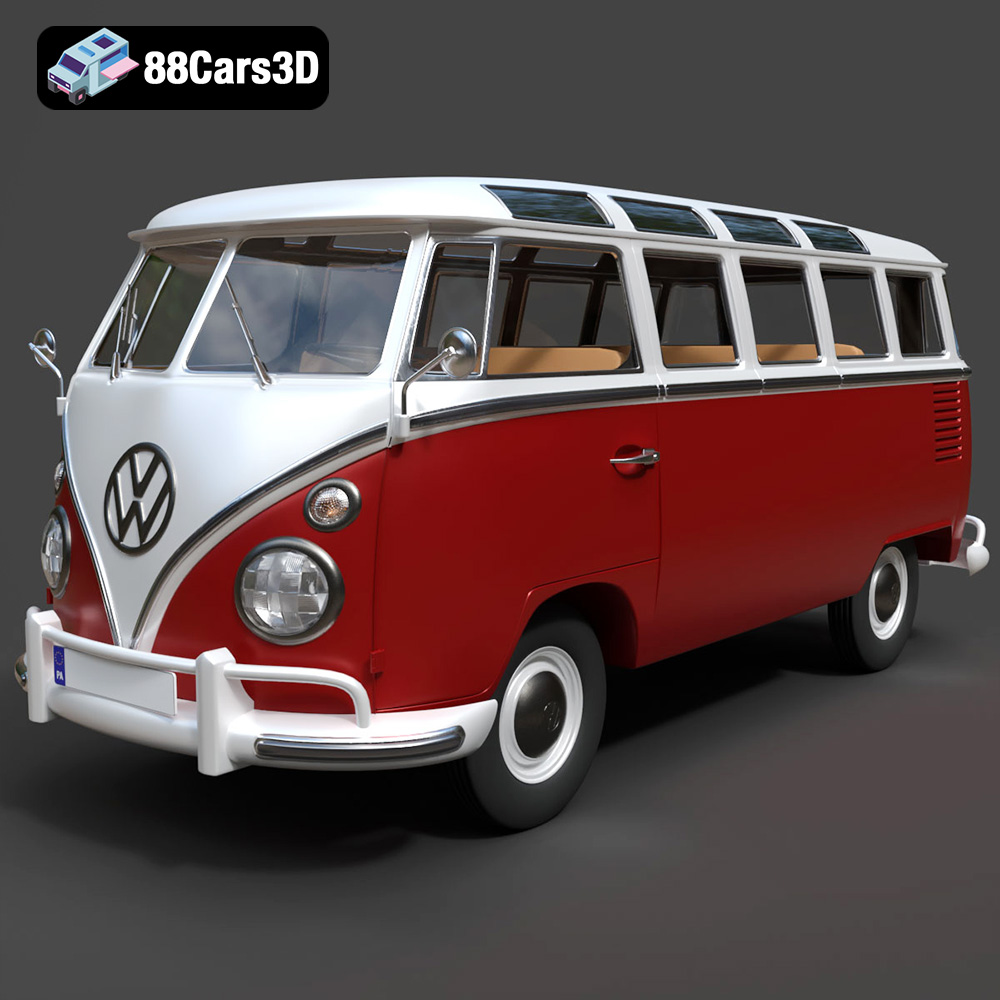
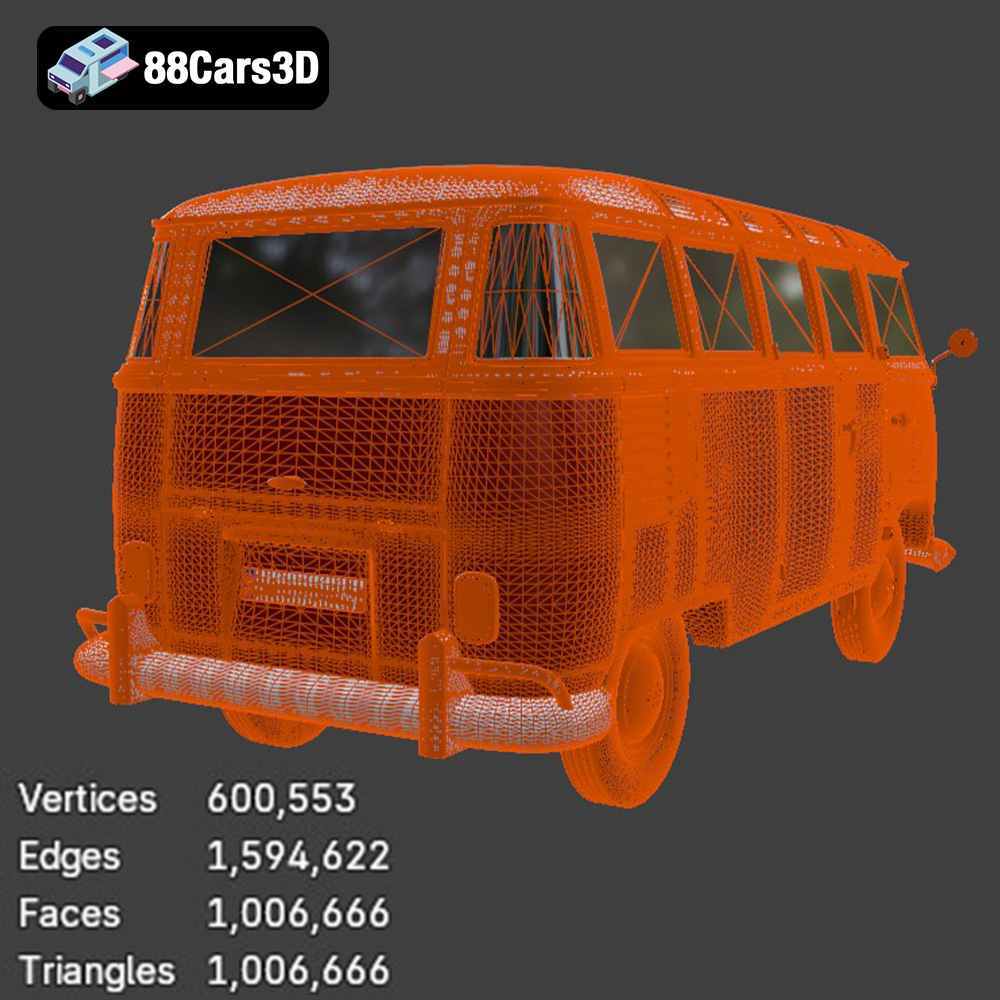
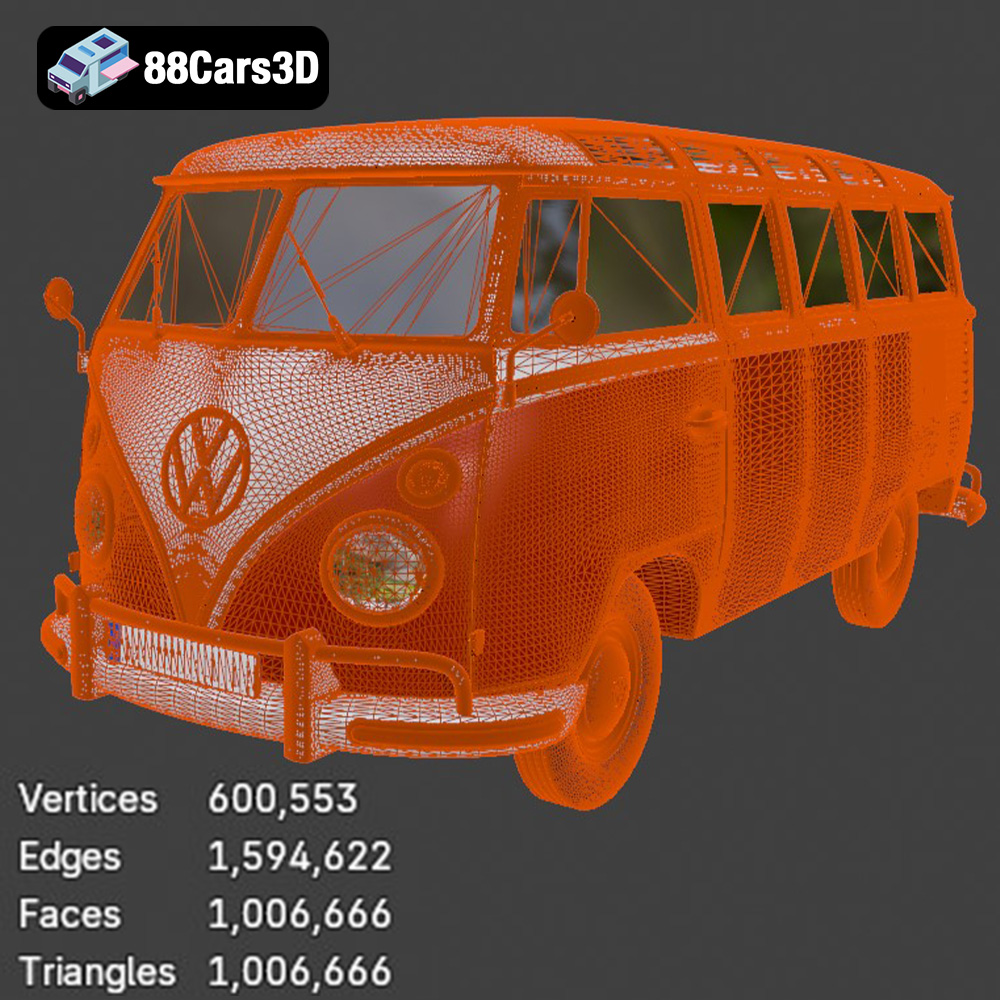
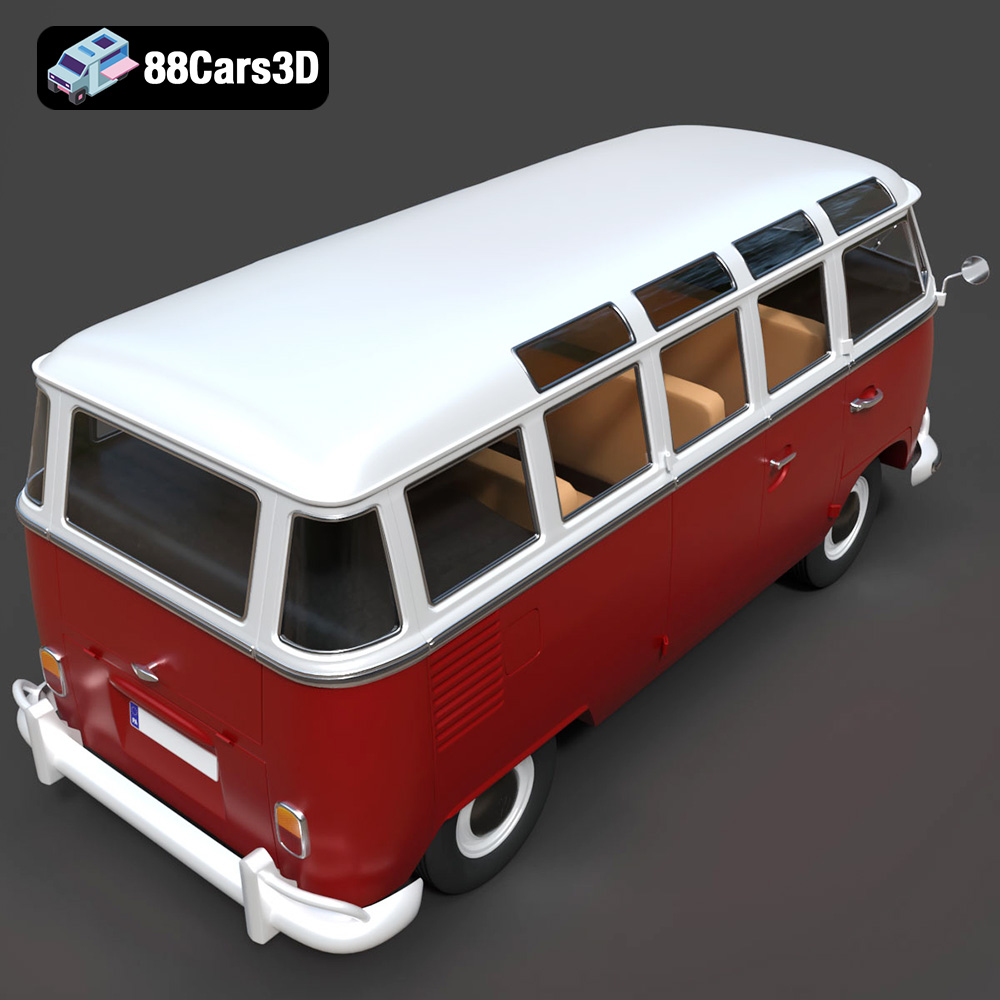
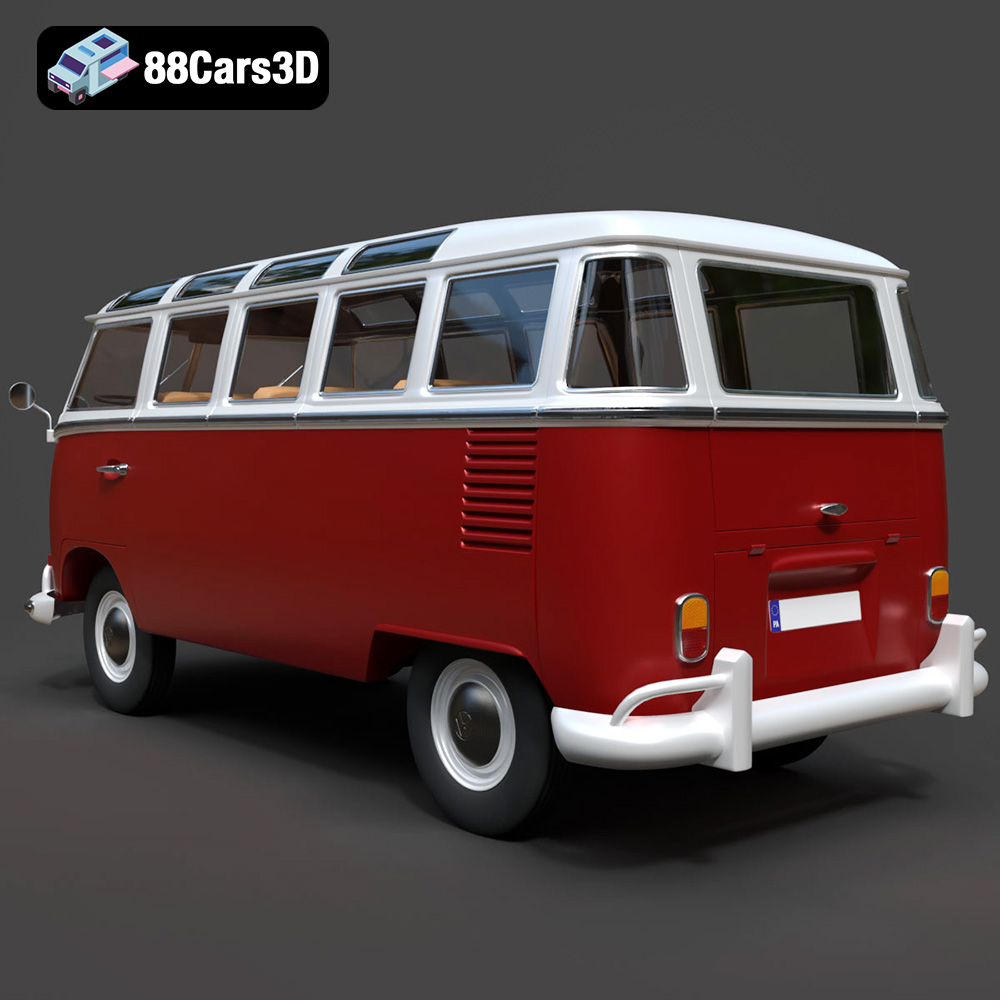
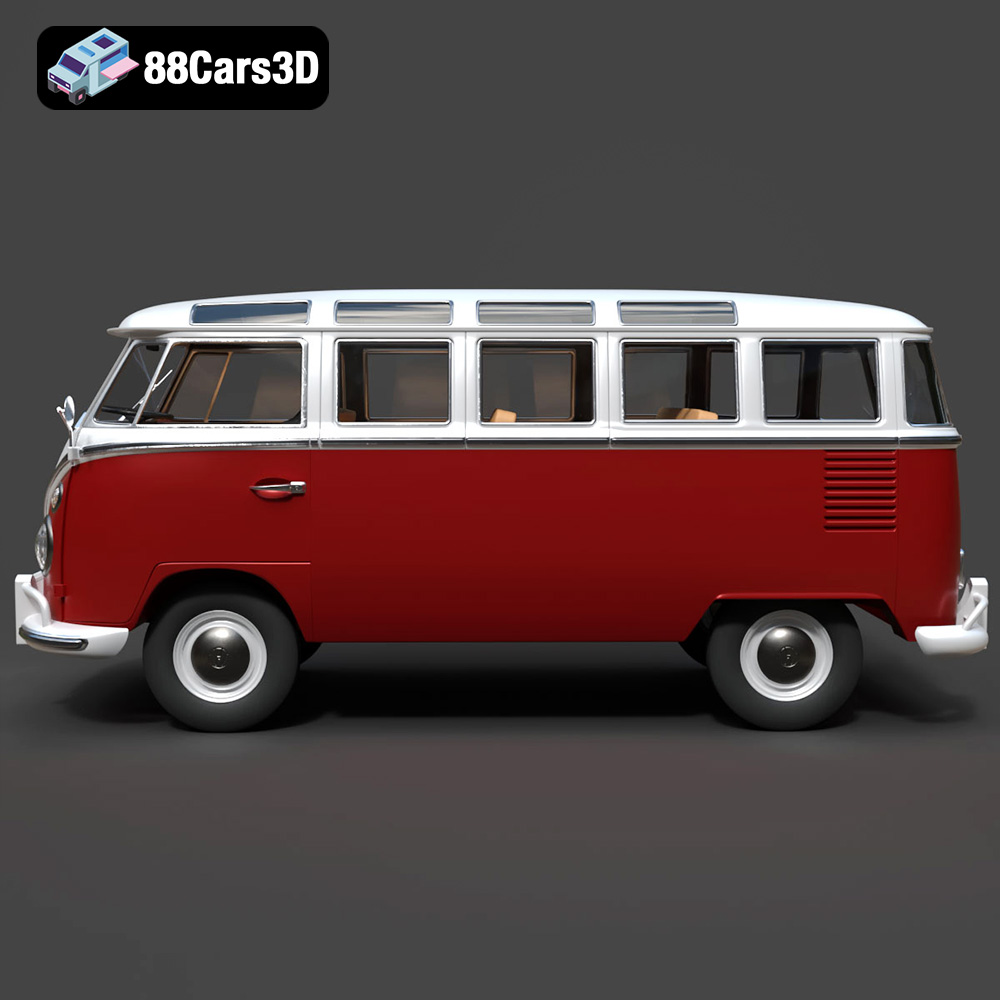
The immediate appeal of the Volkswagen Transporter T1 lies in its distinct exterior, and this 3D model delivers with remarkable accuracy. From the iconic rounded body shape to the signature split front windshield, every curve and panel reflects the original design with precision. The model includes the detailed front emblem and the unique V-shaped body panel styling that immediately identifies it as the early T1. Realistic round headlights, chrome bumpers, and accurately modeled wheels with classic hubcaps and tire profiles complete the look, ensuring that the digital model is instantly recognizable and visually faithful to its real-world counterpart. The clean quad-based geometry is a significant technical advantage, providing a solid foundation for smooth subdivision and rendering, crucial for high-quality automotive rendering.
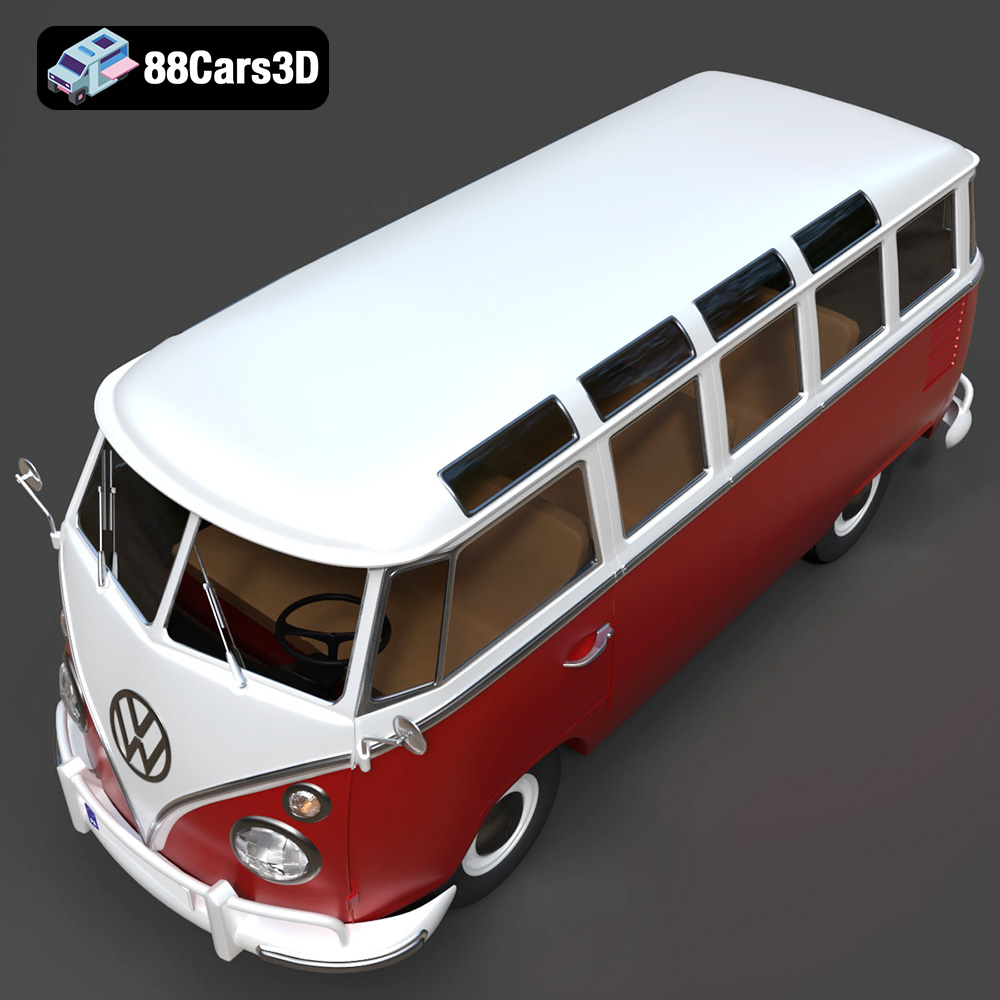
While the exterior captures the public imagination, the interior completes the illusion of authenticity. This 3D model features a minimalist dashboard layout, perfectly consistent with the 1950 design ethos of utility and simplicity. Details such as the steering wheel and a simple gauge cluster are faithfully reproduced. The front bench seat and the versatile rear cargo/passenger space are modeled to provide a convincing interior view, whether for fly-through animations or interactive experiences. Interior panels and structural framing are represented, ensuring a complete and believable environment. The optimized interior mesh is particularly beneficial for real-time applications and close-up renders, making it suitable for both game development and high-fidelity visualizations, contributing significantly to its value as a robust game asset.
The true power of a meticulously crafted 3D model like the Volkswagen Transporter T1 lies in its seamless integration into diverse professional workflows. This isn’t just a static image; it’s a dynamic tool ready for immediate deployment across various creative fields.
For studios specializing in automotive rendering and product visualization, time is money, and quality is non-negotiable. The Volkswagen Transporter T1 1950 3D Model, with its clean topology, real-world scale, and detailed features, acts as a perfect foundation. Artists using 3ds Max or Blender can effortlessly import the model (via .max, .blend, or .fbx) and dive straight into crafting stunning visuals. Imagine the T1 bathed in golden hour light on a pristine beach, or showcased in a minimalist studio setting. The model’s proper hierarchy for wheel rotation and separate doors and hood panels allow for sophisticated animations, from a simple static shot to a dynamic scene of the van driving or opening its doors for a product reveal. Material customization, like applying classic two-tone paint schemes or specific vintage decals, becomes a straightforward process, enabling quick iterations for marketing campaigns, advertisements, or historical presentations.
In the fast-paced world of game development and interactive experiences, having a production-ready game asset is invaluable. The Volkswagen Transporter T1 model is optimized with an efficient polygon count without sacrificing visual fidelity, making it ideal for real-time environments. Its compatibility with major game engines, particularly highlighted by the inclusion of the .unreal format (or an optimized .fbx), means developers can integrate it directly into projects for titles ranging from retro open-world adventures to period-based simulations. Proper hierarchy for animation translates directly to in-game functionality, allowing for realistic vehicle physics, door animations, and environmental interaction. Furthermore, for AR/VR applications, this model serves as a prime candidate for virtual classic car exhibitions or interactive retro showcases, where performance and visual quality must be meticulously balanced.
The utility of high-quality 3D car models extends far beyond digital screens. The availability of the Volkswagen Transporter T1 1950 3D Model in .stl format opens up a fascinating avenue for physical creation, allowing enthusiasts and professionals to bring the iconic van into the tangible world through 3D printing.
The journey from a digital 3D model to a physical object begins with proper preparation. The .stl format, while standard for 3D printing, requires a ‘manifold’ mesh – a watertight, solid geometry without holes or intersecting faces – to ensure a successful print. This 3D model is designed with this principle in mind, making it ready for slicing software. When preparing the Volkswagen Transporter T1 for printing, scale is a critical consideration. The recommended scales of 1:24, 1:32, 1:18, or 1:12 offer flexibility for different display purposes, from miniature collectibles to larger, more detailed scale models. Each scale demands careful attention to layer height and wall thickness to capture the intricate details of the T1’s body, headlights, and bumpers. Supports are often required for overhangs and intricate features like bumpers, mirrors, and wheel arches, and smart print orientation (like printing the body upside-down for a smoother roof surface) can significantly improve the final quality and reduce post-processing time.
Successful 3D printing is as much about the print settings as it is about the model itself. For the Volkswagen Transporter T1 1950, a layer height between 0.12–0.18 mm will strike a good balance between detail and print speed for FDM printers, while wall thicknesses of 2–3 mm ensure structural integrity for the printed model. An infill of 15–25% is usually sufficient for strength without excessive material use. Printing wheels separately allows for better detailing and easier painting. Once the printing is complete, post-processing elevates the raw print to a display-worthy piece. This typically involves sanding to smooth layer lines, applying a primer to create an even surface for paint, and then meticulously applying a classic two-tone paint finish, evocative of the T1’s original charm. An optional clear coat can add durability and a professional sheen. This process transforms the digital 3D car model from 88cars3d.com into a unique, handmade collectible, a testament to both digital artistry and manufacturing.
The true value of a versatile 3D asset like the Volkswagen Transporter T1 1950 3D Model from 88cars3d.com lies not just in its inherent quality but in the limitless creative possibilities it unlocks. It serves as a robust starting point, ready for extensive customization and deployment in diverse real-world scenarios.
The beauty of working with a high-fidelity 3D model is the ability to adapt it to specific artistic visions or project requirements. Beyond the fundamental accuracy, the Volkswagen Transporter T1 is ripe for customization. Digital artists can experiment with classic two-tone paint schemes, creating various vintage looks. Imagine adding period-appropriate accessories: surfboards strapped to a roof rack for a beach scene, or even modifying the interior to reflect a camper conversion for a travel-themed visualization. Custom vintage decals and branding can transform the generic T1 into a specific historical vehicle or a unique advertising prop. Furthermore, adjusting lighting setups can dramatically alter the mood, transporting the T1 from a sunny beach environment to a bustling urban street or a dramatic studio spotlight, making each render uniquely tailored for automotive rendering and marketing.
The versatility of the Volkswagen Transporter T1 1950 3D Model allows it to seamlessly integrate into various professional applications, showcasing its immediate impact. Consider a game development studio creating a retro-themed open-world game set in the 1960s; this T1 model serves as a perfectly authentic game asset, populating the digital streets with a recognizable icon. For an advertising agency tasked with a nostalgic marketing campaign, the model can be rendered into print ads, animated commercials, or interactive web experiences, saving countless hours compared to building the model from scratch. In the realm of AR/VR, imagine a virtual museum exhibit where users can walk around, examine, and even “enter” the 1950 T1, learning about its history and design. Educators could utilize it for historical automotive demonstrations or engineering presentations, offering a visual aid that transcends static images. Each of these scenarios benefits immensely from the high-quality, pre-made model, accelerating production and ensuring visual excellence. The investment in such detailed 3D car models from a reliable source like 88cars3d.com directly translates to efficiency and higher project quality.
The Volkswagen Transporter T1 1950 is more than a vehicle; it’s a cultural touchstone, a symbol of an era that continues to inspire. In the digital age, this legacy is expertly preserved and expanded through exceptional 3D car models. The Volkswagen Transporter T1 1950 3D Model stands as a testament to meticulous digital craftsmanship, offering a high-fidelity representation of this iconic van for a multitude of applications.
Whether your passion lies in crafting breathtaking automotive rendering, developing immersive game assets, creating interactive AR/VR experiences, or bringing tangible scale models to life through 3D printing, this model provides the precision, versatility, and technical advantages required by professionals. Its comprehensive file formats ensure seamless integration into virtually any pipeline, empowering artists and developers to focus on creativity rather than foundational modeling tasks. Elevate your projects and capture the enduring spirit of the Microbus with this outstanding asset. Discover this and many other premium 3D car models by visiting 88cars3d.com today.
The Volkswagen Transporter T1 1950 3D Model is a detailed digital recreation of the iconic first-generation Type 2 van produced by Volkswagen. Known as the “Microbus” or “Split Window Bus,” the 1950 T1 is a symbol of post-war industrial design and became a cultural icon throughout the 1950s and 1960s. This 3D model accurately captures the rounded body shape, split front windshield, rear-mounted engine layout, and minimalist utility design that made the T1 famous. Designed with clean topology and realistic proportions, it is ideal for rendering, animation, classic automotive visualization, game development, and AR/VR applications. Perfect for retro city scenes, vintage marketing visuals, travel-themed environments, and collectible vehicle showcases.
$9.99
.arvr
.blend
.car3dmodel
.classicvan
.fbx
.gameasset
.glb
.max
.microbus
.obj
.ply
.rendering
.simulation
.stl
.transportert1
.unreal
.vehicleasset
.vintagevehicle
.volkswagen
.vwbus