Get 50% OFF All Premium 3D & STL Models!

In the dynamic world of 3D visualization, automotive design stands as a pinnacle of technical artistry and precision. From exhilarating racing simulations to breathtaking cinematic renders and interactive configurators, the demand for high-fidelity 3D car models is constant and ever-evolving. Professionals across industries – game developers, architectural visualizers, marketing agencies, and even product designers – rely on meticulously crafted digital assets to achieve their creative and commercial goals.
Today, we delve into the intricate process of creating and utilizing such assets, highlighting how a truly exceptional 3D model can elevate any project. Our focus will be on an exemplar of digital craftsmanship: the Ferrari 450 Italia 2013 3D Model, available on 88cars3d.com. This model isn’t just a digital representation; it’s a testament to the blend of technical accuracy and aesthetic detail required to bring an iconic supercar to life in the virtual realm. From its sculpted aerodynamic body to its premium interior layout, this asset offers unparalleled versatility for various applications, proving itself an indispensable tool for serious 3D artists and developers.
The versatility of a 3D model often hinges on the file formats it supports. Each format is designed with specific use cases, compatibility, and technical advantages in mind. Understanding these distinctions is crucial for seamless integration into your workflow, whether you’re working in a DCC (Digital Content Creation) application, a game engine, or preparing for 3D printing. The Ferrari 450 Italia 2013 3D Model exemplifies this versatility by offering a comprehensive suite of industry-standard formats. Let’s explore them in detail:
The .blend format is Blender’s native file type. It encapsulates an entire Blender scene, including the mesh geometry, materials, textures, lighting, cameras, animation data, and even physics simulations. This makes it incredibly powerful for artists working within Blender, providing full editability. When you acquire a .blend file like that for the Ferrari 450 Italia, you’re getting a fully rigged and textured scene, ready for immediate modification, rendering with Cycles or Eevee, or further development. For those committed to Blender’s robust ecosystem, this format offers the most flexibility for customization and advanced artistic expression.
.fbx (Filmbox) is arguably the most widely adopted interchange format in the 3D industry, especially prevalent in game development. Developed by Autodesk, it supports geometry, materials, textures, animations, and skeletal data. Its strength lies in its ability to transfer complex scene data between different software applications (like 3ds Max, Maya, Blender, ZBrush) and real-time engines such as Unreal Engine and Unity. For the Ferrari 450 Italia 3D Model, the .fbx version is optimized for real-time pipelines, ensuring that the model’s clean topology and material assignments translate effectively into game environments, often with embedded textures and PBR (Physically Based Rendering) material setups.
The .obj (Wavefront OBJ) format is a simple, universal 3D geometry definition file format. It’s an excellent choice for cross-software compatibility when primarily concerned with mesh data. An .obj file stores vertex positions, UV coordinates, normals, and face information. Material definitions are typically handled by a companion .mtl (Material Template Library) file. While it doesn’t support animation or rigging, its widespread compatibility makes it a reliable fallback for importing geometry into virtually any 3D software. For the Ferrari 450 Italia, the .obj provides a clean, raw mesh structure, ideal for artists who prefer to rebuild materials or use it as a base for sculpting or retopology in a different application.
.glb (GL Transmission Format Binary) is the binary version of glTF, a royalty-free specification for the efficient transmission and loading of 3D scenes and models by applications. It’s becoming the “JPEG of 3D” due to its optimization for web-based applications, augmented reality (AR), and virtual reality (VR). A single .glb file can contain mesh data, materials, textures, animations, and skeletal information, making it very self-contained and easy to deploy. The Ferrari 450 Italia in .glb format is perfect for embedding in websites for interactive views, developing AR apps where users can place the car in their real environment, or creating VR showrooms with minimal loading times.
.stl (Stereolithography) is the de facto standard file format for 3D printing. It represents a 3D model as a collection of unconnected triangular facets, defining only the surface geometry of an object without color, texture, or other CAD attributes. While simple, its ubiquity ensures compatibility with almost every slicing software and 3D printer. The Ferrari 450 Italia 3D Model’s availability in .stl format means it’s ready to be transformed into a physical collectible scale model. The model’s manifold geometry and attention to wall thickness are crucial for successful 3D printing, ensuring structural integrity and detail capture, as specified in the product’s printing guidelines.
.ply (Polygon File Format or Stanford Triangle Format) is another format for storing 3D data, particularly useful for high-resolution scan data, CAD applications, and scientific visualization. It can store not only geometry but also color, transparency, texture coordinates, normals, and even confidence values for each vertex or face. While less common for general DCC work than .fbx or .obj, its ability to carry rich data makes it valuable for specialized automotive engineering visualization or analysis where precision and detailed attribute storage are paramount. For the Ferrari 450 Italia, a .ply export could be utilized in specific industrial design or reverse engineering workflows.
While not a standalone file format in the traditional sense, the term .unreal often refers to assets specifically packaged and optimized for direct import into Unreal Engine. This typically involves .fbx files correctly scaled, triangulated, and with PBR materials already set up or easily convertible to Unreal’s material system (e.g., using Datasmith or direct FBX import with specific naming conventions for textures). An .unreal designation implies that the Ferrari 450 Italia 3D Model has undergone specific preparation to ensure it drops into an Unreal project seamlessly, leveraging the engine’s advanced rendering capabilities for real-time environments, racing simulators, and high-fidelity cinematic sequences.
Similar to .blend for Blender, .max is the native project file for Autodesk 3ds Max. It contains all scene information, including geometry, materials, textures, lighting, cameras, animation, modifiers, and plugin data. For artists working in 3ds Max, the .max file for the Ferrari 450 Italia provides the ultimate level of control and editability. It allows for advanced rendering with V-Ray or Corona, complex animation setups, and integration with other Autodesk products. It’s the most robust option for comprehensive customization within a 3ds Max-centric pipeline.
The availability of the Ferrari 450 Italia 2013 3D Model in these diverse formats on 88cars3d.com significantly broadens its applicability, ensuring that professionals can find the exact file type needed for their specific project requirements.
Creating a photorealistic 3D car model is an intricate dance between artistic interpretation and technical accuracy. It begins with capturing the essence of the vehicle, in this case, the aggressive styling and track-inspired engineering of the Ferrari 450 Italia 2013. Every curve, vent, and panel must be meticulously recreated to convey the vehicle’s dynamic presence.
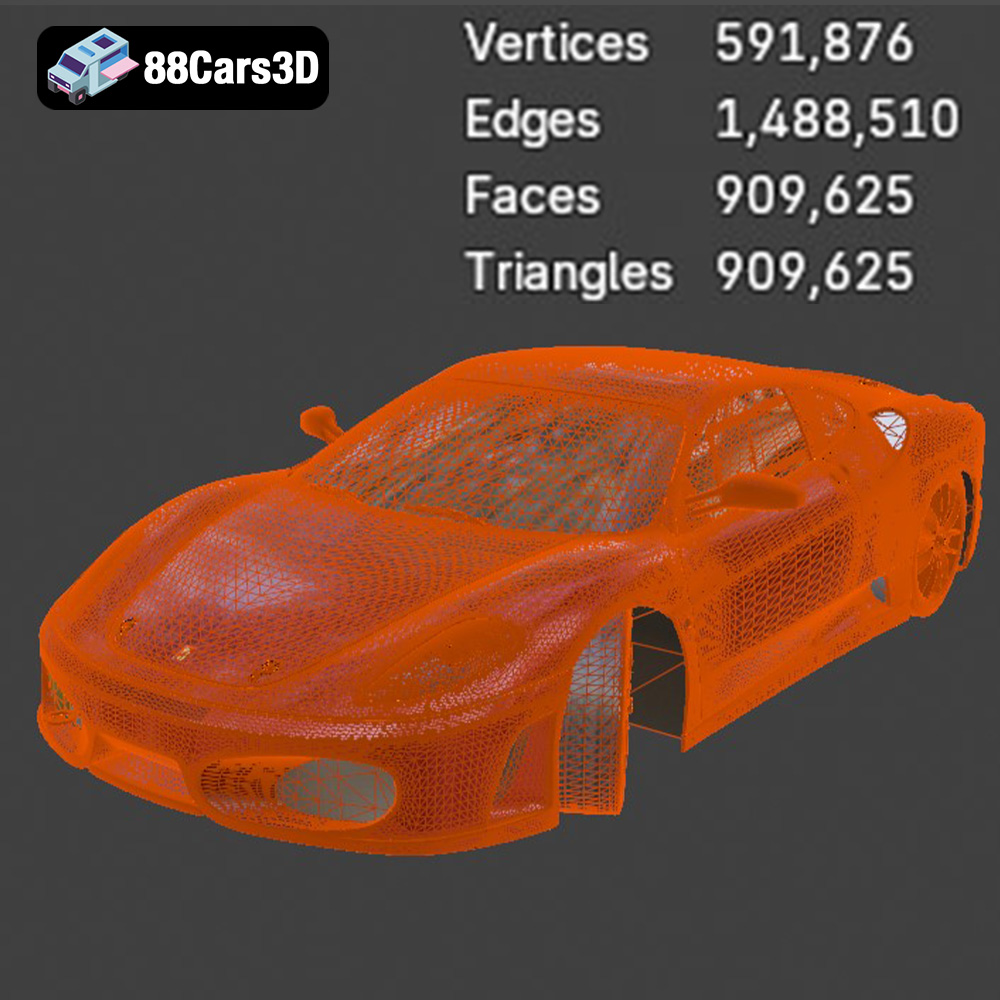
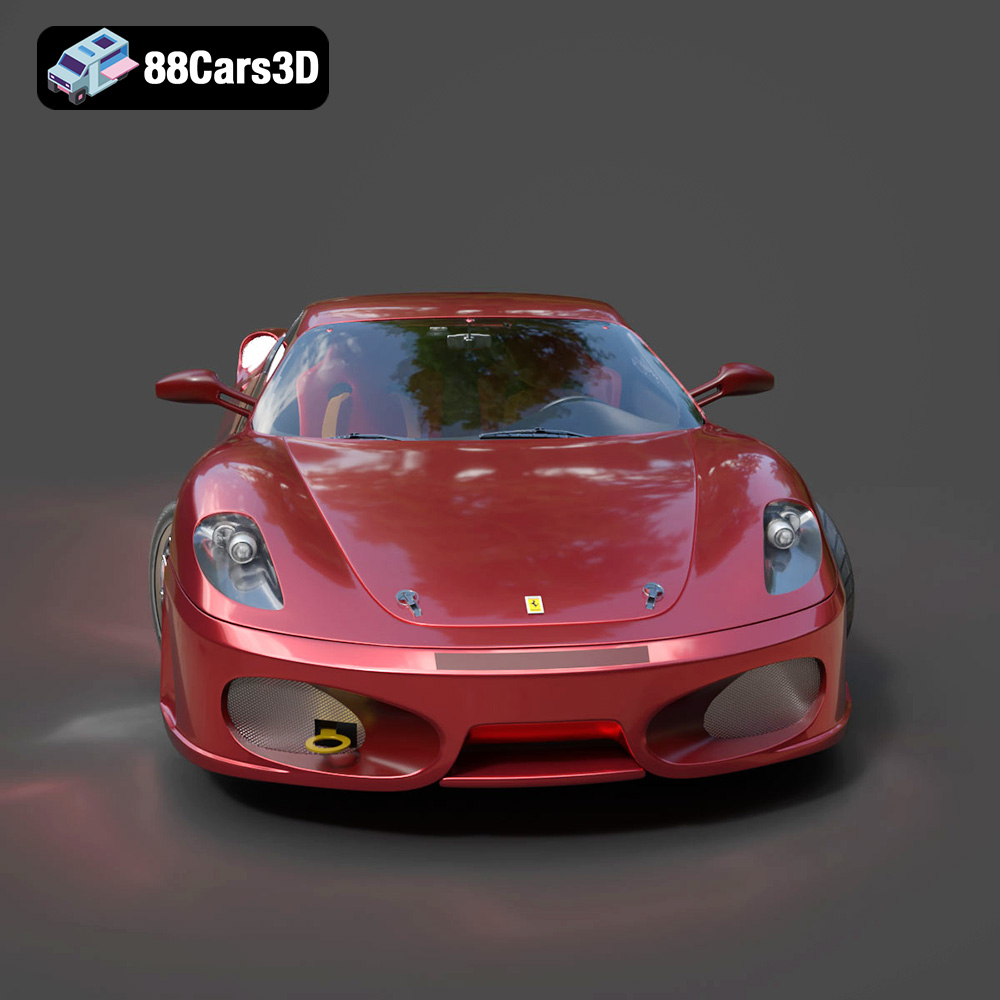
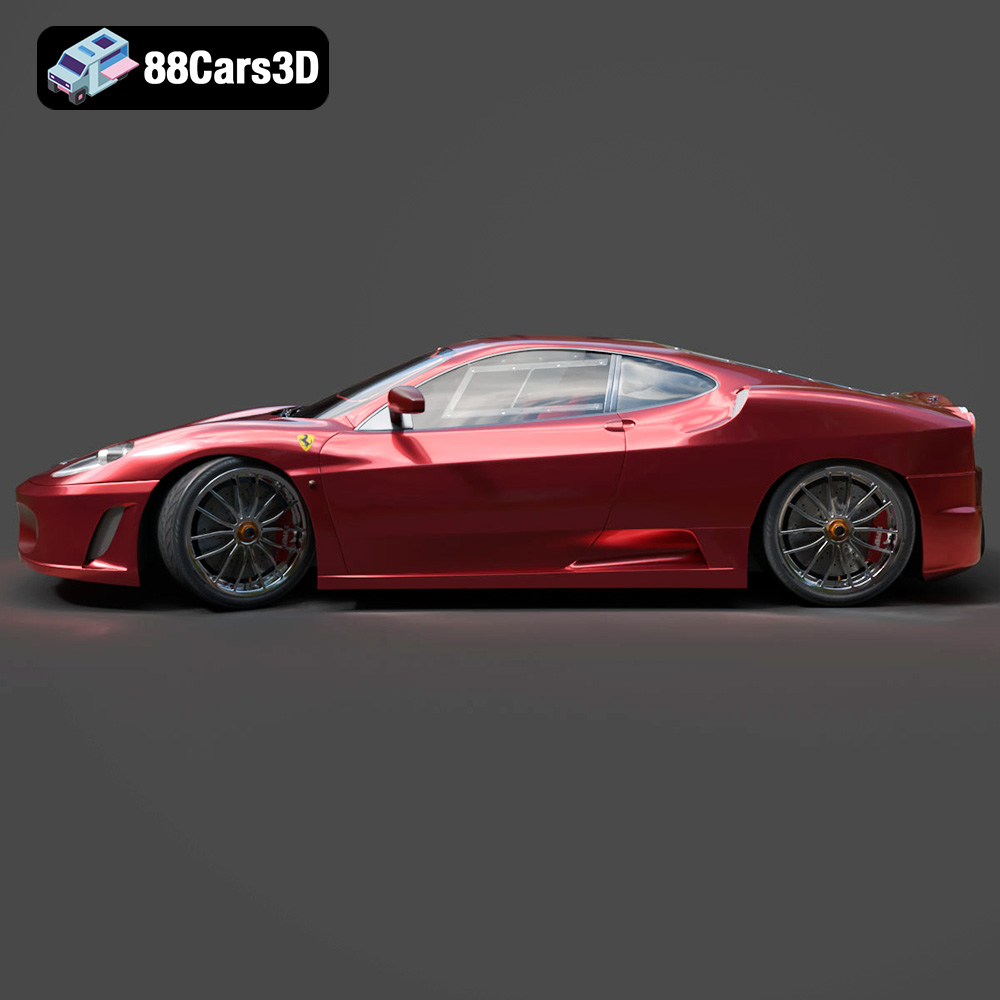
The exterior of a supercar like the Ferrari 450 Italia is a symphony of aerodynamics and aesthetic appeal. A high-quality 3D model, such as the one from 88cars3d.com, begins with accurate blueprint matching to ensure correct proportions. Details like the signature front fascia, side air intakes, and the distinctive quad exhaust system are not merely modeled; they are engineered into the digital asset. This involves precise polygon modeling, ensuring clean topology – a crucial aspect that dictates how well the model deforms during animation and how cleanly it renders. The high-detail alloy wheels, complete with brake calipers and discs, further enhance the realism, allowing for close-up shots that hold up under scrutiny.
While often overlooked in external renders, a detailed interior is vital for comprehensive automotive rendering, AR/VR experiences, and first-person game perspectives. The Ferrari 450 Italia 2013 3D Model excels here, featuring a meticulously modeled dashboard, digital instrument cluster, and the iconic sport steering wheel with paddle shifters. Racing-style bucket seats, the center console, and intricate control panel detailing complete the immersive experience.
Once a high-quality 3D car model like the Ferrari 450 Italia is acquired, the next step is integrating it into various professional pipelines. This involves specific workflows for rendering breathtaking visuals or optimizing for interactive game environments.
For cinematic quality renders, 3ds Max and Blender are prime choices, especially when leveraging renderers like V-Ray, Corona, or Cycles. The Ferrari 450 Italia 2013 3D Model, with its .max and .blend formats, is perfectly suited for these environments. The clean and well-organized mesh structure, combined with real-world scale accuracy, ensures that artists can immediately focus on lighting and camera work rather than fixing geometry issues.
Game development demands a delicate balance between visual fidelity and performance. The Ferrari 450 Italia 3D Model, with its optimized polygon flow and .fbx / .unreal formats, is built to meet these requirements. Importing into Unreal Engine or Unity involves specific steps to ensure optimal performance and visual quality.
The utility of a high-quality 3D model extends far beyond traditional screen-based rendering. Modern technologies like 3D printing, Augmented Reality, and Virtual Reality open up exciting new avenues for interaction and physical manifestation.
The inclusion of the .stl format, along with detailed 3D print settings, makes the Ferrari 450 Italia 2013 3D Model a prime candidate for physical production. This allows enthusiasts and professionals to create tangible scale models, prototypes, or unique collectibles. The detailed guidance provided on 88cars3d.com, including recommended scales and print parameters, is invaluable.
Augmented Reality (AR) and Virtual Reality (VR) are revolutionizing how we interact with digital content. For the automotive industry, this means interactive car configurators, virtual showrooms, and immersive driving simulations. The .glb format, optimized for web and real-time deployment, positions the Ferrari 450 Italia 3D Model perfectly for these applications.
The true mark of a professional 3D car model lies in its technical advantages. It’s not just about looking good, but about performing efficiently across diverse platforms and being flexible for future modifications. The Ferrari 450 Italia 2013 3D Model sets a high standard in this regard.
A “clean and well-organized mesh structure” is fundamental. This means:
This attention to topology ensures the model is not only beautiful but also robust and easy to work with for artists and developers.
Accuracy in 3D modeling goes beyond visual appeal; it extends to real-world scale. The Ferrari 450 Italia 3D Model is built to exact proportions, making it compatible with existing environments and physical simulations without tedious resizing. Furthermore, the “proper pivot setup for steering and wheel rotation” is a small but critical detail. Correct pivot points for interactive elements like doors, wheels, and steering components save countless hours in animation and rigging, allowing for immediate and accurate movement.
Compatibility with major 3D software platforms and engines is a non-negotiable requirement for professional assets. The extensive range of file formats (.blend, .fbx, .obj, .glb, .stl, .ply, .unreal, .max) ensures that the Ferrari 450 Italia 2013 3D Model can be seamlessly integrated into virtually any pipeline. Beyond technical compatibility, the model offers robust customization options:
Choosing the right source for 3D assets is as important as the assets themselves. 88cars3d.com distinguishes itself as an online marketplace committed to providing high-quality 3D car models that meet professional standards across various industries. The Ferrari 450 Italia 2013 3D Model is a prime example of the meticulous attention to detail and technical robustness offered.
When you acquire a model from 88cars3d.com, you’re not just purchasing files; you’re investing in a reliable foundation for your creative endeavors. The clear product descriptions, detailed technical specifications, and comprehensive file format support simplify the selection process, ensuring you get exactly what you need for your project, whether it’s for game assets, automotive rendering, or even 3D printing.
In a rapidly evolving digital landscape, investing in assets that are both current and future-proof is essential. The Ferrari 450 Italia 2013 3D Model, with its clean topology, optimized geometry, and multi-format compatibility, is designed for longevity. It can be easily adapted for next-generation rendering techniques, integrated into emerging AR/VR platforms, or utilized for cutting-edge simulations. This means your initial investment continues to yield returns as technology advances, reducing the need for constant re-work or asset replacement.
Professionals understand that time is money. Leveraging pre-made, high-quality 3D car models allows studios and individual artists to accelerate their production pipelines, freeing up valuable resources to focus on creative storytelling, innovative gameplay mechanics, or compelling marketing narratives. The value proposition of an asset like the Ferrari 450 Italia 2013 3D Model from 88cars3d.com lies not only in its stunning visual appeal but also in its inherent efficiency and adaptability.
The journey from concept to a fully realized 3D automotive masterpiece is complex, demanding both artistic flair and rigorous technical execution. The Ferrari 450 Italia 2013 3D Model stands as a shining example of what a high-quality digital asset can achieve, offering unparalleled detail, technical versatility, and extensive compatibility for a myriad of professional applications.
Whether you are a game developer crafting the next-generation racing title, an advertising agency aiming for cinematic-grade automotive rendering, an AR/VR innovator building immersive experiences, or an enthusiast keen on 3D printing a collectible supercar, this model provides the robust foundation you need. Its comprehensive file format support – from editable Blender and 3ds Max scenes to game-ready FBX and Unreal assets, and even 3D printable STL – ensures seamless integration into virtually any workflow.
By prioritizing clean topology, real-world scale, and optimized geometry, this model empowers creators to focus on innovation and artistry, rather than wrestling with technical limitations. Explore the possibilities and elevate your projects with premium 3D car models by visiting 88cars3d.com today. The Ferrari 450 Italia awaits to drive your creative vision forward.
The Ferrari 450 Italia 2013 3D Model is a high-detail digital recreation of the iconic mid-engine Italian supercar engineered for performance, precision, and aerodynamic excellence. Known for its aggressive styling and track-inspired engineering, the 450 Italia delivers a perfect balance of speed, luxury, and driving dynamics. This 3D model accurately represents the vehicle’s sculpted aerodynamic body, signature front fascia, side air intakes, quad exhaust system, detailed alloy wheels, and premium interior layout. Designed with clean topology and real-world proportions, it is ideal for rendering, animation, simulation, game development, and AR/VR automotive visualization. Perfect for racing scenes, showroom presentations, cinematic renders, configurators, automotive advertising, and driving simulations.
$9.99
.450italia
.arvr
.automotive
.blend
.car3dmodel
.fbx
.ferrari
.gameasset
.glb
.italiansupercar
.max
.obj
.ply
.racingcar
.rendering
.simulation
.sportsCar
.stl
.supercar
.unreal