Get 50% OFF All Premium 3D & STL Models!

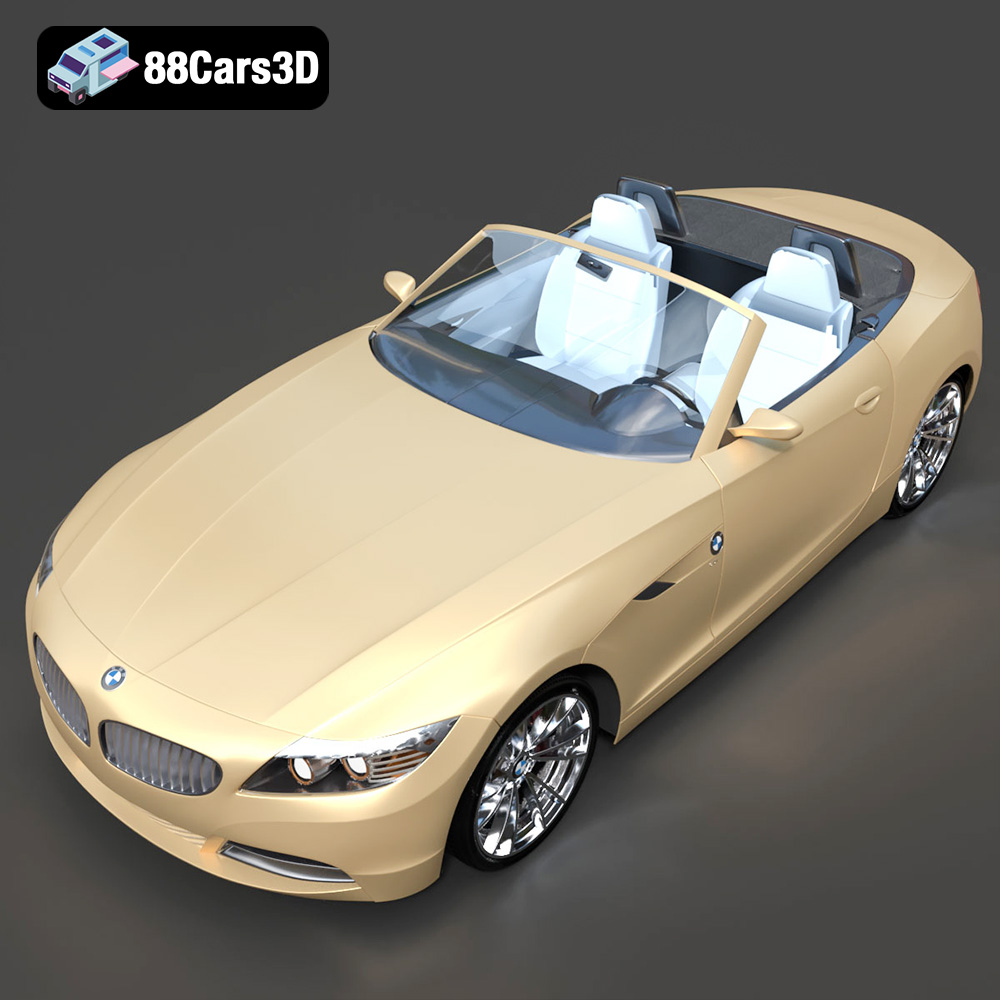
The BMW Z4, a symbol of open-top driving pleasure and sporty elegance, can now grace your desk or become a centerpiece of your collection thanks to the power of 3D printing. This blog post will guide you through the entire process of 3D printing the BMW Z4 3D Model, available on 88cars3d.com, from selecting the right materials to achieving a showroom-worthy finish. Whether you’re a seasoned 3D printing enthusiast or a newcomer to the world of additive manufacturing, this comprehensive guide will equip you with the knowledge and techniques needed to bring this iconic roadster to life.
The BMW Z4 3D Model, with its intricate details and smooth curves, can be successfully printed using various 3D printing technologies. However, the best choice depends on the desired level of detail, size, and budget.
* Pros: FDM is the most accessible and affordable 3D printing technology. It’s ideal for creating larger models and offers a wide range of filament options, including PLA, ABS, PETG, and more.
* Cons: FDM printers may struggle to capture the finer details of the Z4 model, such as the intricate grille or the small interior components. Layer lines can also be visible on the final print, requiring post-processing to achieve a smooth finish.
* Considerations: If you’re using an FDM printer, opt for a smaller layer height (0.1-0.15mm) to improve detail resolution.
* Pros: Resin printing offers exceptional detail resolution and smooth surface finishes, making it perfect for capturing the nuances of the BMW Z4 3D Model. It’s ideal for smaller-scale models and intricate parts.
* Cons: Resin printers typically have a smaller build volume than FDM printers, which might require splitting the model into multiple parts for printing. Resins can also be more expensive than filaments.
* Considerations: Resin printing requires proper ventilation and safety precautions, as resins can be harmful. Post-processing steps like washing and curing are also necessary.
Choosing the right file format is crucial for ensuring a smooth 3D printing experience. The BMW Z4 3D Model available on 88cars3d.com includes a variety of file formats, each with its own strengths and weaknesses. Understanding these formats will help you select the best one for your needs.
The .stl (Stereolithography) file format is the workhorse of 3D printing. It represents the surface geometry of a 3D object as a collection of triangles, forming a mesh. This simplicity makes it universally compatible with virtually all 3D printing software and hardware. However, the .stl format only stores information about the object’s shape; it doesn’t include color, texture, or material properties.
For 3D printing the BMW Z4, the .stl format is your go-to choice. Slicing software readily accepts .stl files, allowing you to define printing parameters like layer height, infill density, and support structures. The quality of the mesh is critical for a successful print. A higher triangle count results in a smoother surface but also increases file size and processing time. The .stl files from 88cars3d.com are optimized to strike a balance between detail and printability. If you encounter any issues with the .stl file, such as non-manifold geometry (gaps or overlaps in the mesh), most slicing software includes tools to automatically repair these errors. However, if major issues arise, using MeshMixer or Netfabb is recommended for more robust repairs before bringing the model into your slicer.
The .obj (Wavefront Object) format is another popular choice for 3D models, particularly when color and texture information are important. Unlike .stl, .obj files can store color data, texture coordinates, and material properties, allowing for more visually rich models. However, not all 3D printers support color printing, and the .obj format can be more complex to process than .stl.
The .ply (Polygon File Format) is designed for storing 3D data acquired from scanning devices. It can represent surface geometry, color, and other properties with high precision. While .ply is excellent for preserving detail, it’s not as widely supported by 3D printing software as .stl or .obj.
The .blend file is the native format for Blender, a free and open-source 3D creation suite. This format allows for complete editing of the BMW Z4 model before printing. You can modify the geometry, add details, or even create custom variations of the design. However, you’ll need Blender installed on your computer to work with .blend files. Before 3D printing, you must export the model from Blender in a printable format like .stl.
The .fbx (Filmbox) format is primarily used for exchanging 3D data between different software applications, especially in game development and animation. It supports geometry, textures, materials, and animation data. While some slicing software can import .fbx files, they are generally not the preferred format for 3D printing due to their complexity.
The .glb (GL Transmission Format Binary) is designed for efficient delivery and loading of 3D models, particularly in web and mobile applications. It supports geometry, textures, and animations, making it suitable for augmented reality (AR) previews. While .glb is not directly used for 3D printing, it can be helpful for visualizing the model before committing to a physical print.
Similar to .blend, .max files are the native format for 3ds Max, a professional 3D modeling and animation software. This format allows for extensive modifications to the BMW Z4 model. However, you’ll need a 3ds Max license to open and edit .max files. Before 3D printing, export the model as an .stl file.
Before sending the BMW Z4 3D Model to your printer, you’ll need to prepare it using slicing software. This software converts the 3D model into a series of instructions that your printer can understand.
* Popular Options: Cura, PrusaSlicer, Simplify3D, and Chitubox (for resin printing) are popular choices.
* Features to Consider: Support generation, infill control, layer height adjustment, and advanced settings for fine-tuning print quality.
* Orientation: As the product description suggests, orient the body of the Z4 upside-down for a smoother roof and hood finish. This minimizes the need for supports on these visible surfaces.
* Supports: Supports are crucial for overhangs like mirrors, open roof edges, and the underbody. Use automatic support generation in your slicing software, but manually adjust them to minimize material usage and improve surface quality. Consider using tree supports, which are easier to remove and leave fewer marks.
* Recommended Scale: The product description suggests scales of 1:24, 1:18, 1:12, and 1:10. Choose a scale that suits your printer’s build volume and your desired level of detail.
* Splitting the Model: For larger scales, you may need to split the model into multiple parts to fit within your printer’s build volume. Use the included .blend, .fbx or .max files to edit the model to create clean splitting planes.
The right 3D printing parameters are crucial for achieving a successful print. These settings control the printer’s behavior and influence the final product’s quality, strength, and appearance.
* FDM: 0.1-0.18mm is recommended for a good balance between detail and print time.
* Resin: 0.025-0.05mm for highly detailed prints.
* 15-30%: Provides sufficient strength without excessive material usage. Increase infill for areas that require more support, such as the chassis or wheel mounts.
* FDM: 40-60mm/s is a good starting point. Reduce speed for intricate details.
* Resin: Follow the resin manufacturer’s recommendations.
* FDM: Varies depending on the filament. PLA typically prints at 200-220°C, while PETG requires 230-250°C.
* Resin: Not applicable.
The choice of material greatly impacts the final appearance and functionality of your 3D printed BMW Z4.
* Pros: PLA is biodegradable, easy to print, and available in a wide range of colors. It’s a good choice for beginners and decorative models.
* Cons: PLA is not as strong or heat-resistant as other materials.
* Pros: PETG is stronger and more heat-resistant than PLA. It also offers good layer adhesion and a glossy finish.
* Cons: PETG can be more challenging to print than PLA.
* Pros: ABS is strong, heat-resistant, and impact-resistant. It’s a good choice for functional parts.
* Cons: ABS requires a heated bed and proper ventilation, as it emits fumes during printing.
* Pros: Resin offers exceptional detail and smooth surface finishes.
* Cons: Resin can be brittle and requires post-processing steps.
Post-processing is essential for removing support structures, smoothing surfaces, and adding the finishing touches to your 3D printed BMW Z4.
* Carefully remove support structures using pliers, a hobby knife, or specialized support removal tools.
* Sand the model with progressively finer grit sandpaper to smooth out layer lines and imperfections. Start with 220 grit and work your way up to 400, 600, and even 800 grit for a super smooth finish. Wet sanding can help minimize dust.
* Apply a primer coat to fill in any remaining imperfections and provide a smooth surface for painting. Use multiple light coats for best results.
* Use acrylic paints or automotive-grade paints to achieve a realistic finish. Apply multiple thin coats and allow each coat to dry completely before applying the next. Consider using stencils or masking tape to create intricate details.
* Apply a clear coat to protect the paint and add a glossy finish.
Even with careful preparation, 3D printing can sometimes present challenges. Here are some common issues and their solutions:
* Cause: Uneven cooling or poor bed adhesion.
* Solution: Use a heated bed, apply an adhesive like glue stick or hairspray to the bed, and ensure proper ventilation.
* Cause: Filament oozing from the nozzle during travel moves.
* Solution: Reduce printing temperature, increase retraction settings, and increase travel speed.
* Cause: Poor layer adhesion.
* Solution: Increase printing temperature, reduce printing speed, and ensure proper bed adhesion.
* Cause: The first layer is too squished.
* Solution: Increase Z offset, reduce first layer temperature, reduce initial layer flow.
The print time and material cost will vary depending on the size of the model, the printing parameters, and the material used. However, here are some rough estimates:
* Print Time: 10-30 hours for a 1:24 scale model.
* Material Cost: $5-$20 for a 1:24 scale model.
Keep in mind that these are just estimates. It’s always a good idea to do a test print of a small section of the model to get a more accurate estimate of print time and material cost.
The BMW Z4 3D Model is a premium digital recreation of the iconic two-seat roadster developed by BMW. Known for its sporty proportions, long hood, short rear deck, and dynamic performance styling, the Z4 embodies precision engineering and modern roadster design.
$9.99
3D printing the BMW Z4 3D Model from 88cars3d.com is a rewarding project that combines the thrill of additive manufacturing with the iconic design of a classic roadster. By carefully selecting your printing technology, preparing your model with precision, and fine-tuning your printing parameters, you can create a stunning replica that captures the essence of the BMW Z4. Remember to take your time with post-processing to achieve a professional finish. With patience and attention to detail, you’ll be able to proudly display your 3D printed BMW Z4, a testament to your skills and the power of 3D printing.
.arvr
.blend
.bmw
.car3dmodel
.convertible
.fbx
.gameasset
.glb
.max
.obj
.ply
.rendering
.roadster
.simulation
.sportsCar
.stl
.unreal
.vehicleasset
.z4
automotive3d