Get 50% OFF All Premium 3D & STL Models!

In the dynamic world of 3D visualization, the demand for exceptionally detailed and accurate automotive models continues to accelerate. From breathtaking cinematic sequences to immersive game environments and precise architectural visualizations, the quality of a vehicle asset can make or break a project’s realism. Professionals across industries seek not just a model, but a digital counterpart that embodies the intricate design, structural integrity, and nuanced presence of its real-world inspiration. This pursuit of perfection is particularly crucial when dealing with iconic vehicles, where every curve, panel gap, and material finish contributes to its recognizable identity.
Today, we’re diving deep into the technical intricacies and creative potential offered by such premium assets, exemplified by the remarkable Cadillac US Presidential State Car 3D Model. This isn’t merely a vehicle; it’s a digital monument to executive authority and engineering prowess, meticulously recreated to serve a multitude of professional applications. Whether you’re an automotive renderer aiming for photorealism, a game developer building a compelling open world, or an AR/VR creator crafting immersive experiences, understanding the foundational elements of these models is key to unlocking their full potential. Let’s explore the ecosystem of high-quality 3D car models and discover how specialized assets like the Presidential State Car elevate digital storytelling and simulation.
Creating a truly convincing 3D car model is an intricate balance of artistic vision and rigorous technical execution. It requires a profound understanding of automotive design, material science, and computational geometry. High-fidelity models are not just about visual appeal; they are built with a structural integrity that supports complex animations, realistic physics, and detailed customization.
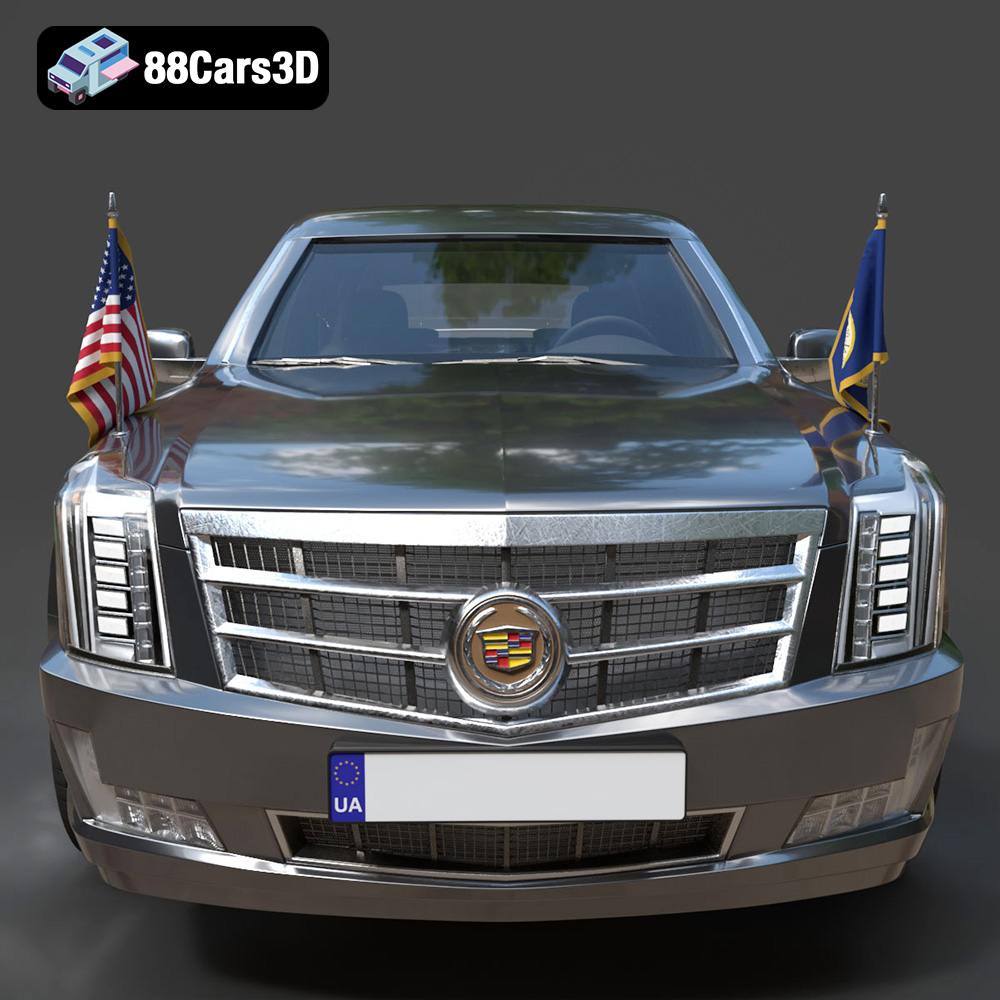
The foundation of any exceptional 3D car model lies in its topology and scale. A clean, well-optimized mesh is paramount, ensuring smooth subdivisions, efficient rendering, and predictable deformation during animation. For a model like the Cadillac US Presidential State Car 3D Model, this means capturing the exact long-wheelbase armored limousine proportions, the subtle curves of its reinforced body structure, and the precise dimensions of elements like the signature luxury front grille and LED headlight detailing. Real-world scale accuracy is not merely a convenience; it’s a technical requirement for seamless integration into diverse scenes, whether for a sprawling urban game environment or a photorealistic architectural visualization. Models with proper pivot setups for steering and wheel rotation are essential for any animated sequence or interactive simulation, allowing for dynamic and believable vehicle movement.
Beyond the raw geometry, it’s the materials and textures that truly breathe life into a 3D vehicle. Modern rendering pipelines heavily rely on Physically Based Rendering (PBR) workflows, which demand meticulously crafted texture maps (Albedo, Roughness, Metallic, Normal, Ambient Occlusion, etc.) that accurately simulate how light interacts with different surfaces. For a vehicle of such formal presence, the gloss black exterior finish, the appearance of thick armored windows, and the subtle glint of chrome trim must be rendered with impeccable realism. The Cadillac US Presidential State Car 3D Model, with its optimized mesh and material-ready design, ensures that these details translate into stunning visuals, suitable for cinematic close-ups and high-resolution scenes. Understanding UV mapping – the process of flattening a 3D model’s surface to a 2D image for texture application – is also critical. Clean, non-overlapping UVs are vital for preventing texture stretching and maximizing texture resolution, contributing significantly to the model’s overall visual fidelity.
Navigating the diverse landscape of 3D file formats can be daunting, but choosing the right one is crucial for project compatibility, workflow efficiency, and achieving desired output. Each format has its strengths, optimized for specific applications ranging from real-time engines to 3D printing and professional content creation. The Cadillac US Presidential State Car 3D Model offers a comprehensive suite of formats, ensuring broad compatibility across various platforms and pipelines.
The .blend file format is native to Blender, the powerful open-source 3D creation suite. When you acquire a .blend file, you’re getting a fully editable Blender scene, complete with the model’s geometry, materials, textures, lighting, cameras, and even animation data. This format is ideal for users who primarily work within Blender, offering maximum flexibility for customization, rigging, animation, and rendering directly within the software. For instance, if you wanted to adjust the interior color schemes or modify the lighting configuration of the Presidential State Car, the .blend file provides all the native data to do so seamlessly.
.fbx (Filmbox) is one of the most widely adopted proprietary file formats for 3D content exchange, developed by Autodesk. It excels in transferring not just mesh data, but also animation, rigging, materials, textures, and even camera and lighting information between different 3D software and game engines. This makes it ideal for pipelines involving Unreal Engine, Unity, and other real-time applications where preserving animation and hierarchy is important. The .fbx version of the Cadillac model would be your go-to for importing into a game engine, as it retains the proper pivot setup for steering and wheel rotation.
.obj (Wavefront OBJ) is a universal, open-standard format that has been around for decades. It’s renowned for its simplicity and wide compatibility, primarily storing geometry data (vertices, normals, UVs) and referencing external .mtl (material) files for basic material properties. While it doesn’t typically store animation or rigging data, its robustness makes it excellent for cross-software compatibility, serving as a reliable intermediary for raw mesh transfer. If you need to bring the Cadillac model into virtually any 3D package for static rendering or further sculpting, .obj is a solid choice.
.glb (GL Transmission Format Binary) is an increasingly popular format, especially optimized for AR, VR, and browser-based display. It packages 3D model data, textures, and animations into a single, self-contained binary file, making it incredibly efficient for web-based interactive experiences. It’s perfect for showcasing the Cadillac US Presidential State Car in a virtual showroom or an augmented reality application on a mobile device.
.stl (Stereolithography) is the de facto standard for 3D printing. It represents a 3D model as a series of connected triangles, defining only the surface geometry without color, texture, or material information. While simple, its ubiquity makes it essential for physical output. The Cadillac US Presidential State Car 3D Model‘s inclusion of an .stl format means it’s ready for conversion and printing at various scales (e.g., 1:32, 1:24, 1:18), allowing for tangible display-scale models.
.ply (Polygon File Format or Stanford Triangle Format) is another precision mesh format commonly used for storing 3D scanner data, CAD models, or for analysis. It can store not only geometry but also color, transparency, and other properties per vertex or face. It offers more flexibility than .stl for complex data but is less universally supported than .obj or .fbx for general interchange.
The .unreal format signifies an asset specifically prepared and optimized for direct import and use within Unreal Engine, often referring to a Uasset or an FBX tailored for Unreal’s import settings. This means the model is likely structured to leverage Unreal’s material system, LODs (Levels of Detail), and collision settings, providing an engine-ready asset for real-time environments. This dramatically streamlines the workflow for game developers working on security simulations or official convoy scenarios.
Finally, .max is the proprietary file format for Autodesk 3ds Max, a leading software in architectural visualization, automotive rendering, and animation. Like .blend, it stores the complete scene data, including geometry, modifiers, materials, lighting, cameras, and animation. For professionals using 3ds Max, having the Cadillac model in its native .max format ensures full editability and control over every aspect of the project for high-end rendering and animation tasks.
In the realm of 3D, rendering is where raw geometry and textures transform into breathtaking photorealistic images. For automotive projects, this process demands meticulous attention to detail, from the reflections on polished surfaces to the subtle interplay of light and shadow. A high-quality 3D car model, such as the Cadillac US Presidential State Car 3D Model, serves as the perfect canvas for achieving stunning visual results.
Effective lighting is the cornerstone of realistic automotive rendering. Environment maps (HDRI) are crucial for capturing complex real-world lighting information, providing accurate reflections and global illumination. Imagine placing the Presidential State Car in a diplomatic motorcade scene; the reflections of the surrounding buildings and sky on its gloss black exterior are critical for believability. Studio lighting setups, using area lights and reflectors, are equally important for showcasing design details, highlighting the signature Cadillac grille or the reinforced body structure. Understanding how to use key lights, fill lights, and rim lights to define form and add drama is an art in itself. Furthermore, incorporating atmospheric effects like fog or dust can add depth and mood, enhancing the narrative of your visual project.
The realism of a vehicle’s surface properties goes beyond simple color. Advanced shaders, often PBR-based, accurately simulate how light interacts with different materials. The metallic flake in car paint, the subtle texture of rubber tires, the distinct reflections from armored glass, and the luxurious sheen of interior leather all require carefully calibrated material parameters. For the Cadillac US Presidential State Car 3D Model, this translates to accurately portraying the metallic sheen of its body, the specific reflectivity of its thick armored window representation, and the nuanced textures of its executive rear seating configuration. Subsurface scattering can be employed for translucent elements, while anisotropic reflections are vital for the brushed metals often found on high-end vehicles. These details are what elevate a good render to an exceptional one, making the digital model indistinguishable from its physical counterpart.
Even the most perfectly rendered image benefits from a layer of post-production. This phase involves color grading, exposure adjustments, adding depth of field, motion blur, and subtle lens effects like flares or chromatic aberration. Software like Adobe Photoshop or DaVinci Resolve can be used to refine the raw render passes, enhancing contrast, correcting color imbalances, and integrating the vehicle into its background seamlessly. For cinematic productions featuring the Presidential State Car, post-production is where the final polish is applied, ensuring that the visual impact is maximized and that the vehicle sits naturally within its environment, contributing to the overall story or message.
In the fast-paced world of game development, AR/VR, and real-time simulations, performance is just as critical as visual fidelity. Integrating complex 3D car models requires strategic optimization to maintain smooth frame rates and immersive experiences without compromising detail. High-quality assets, like those found on 88cars3d.com, are built with these considerations in mind.
Game engines demand efficient models. While high-poly models are excellent for cinematic renders, real-time applications often require a balance. Techniques like Level of Detail (LOD) are crucial, where lower-polygon versions of the model are swapped in when the vehicle is further from the camera. This ensures that the engine only renders necessary detail, boosting performance significantly. For a model like the Cadillac US Presidential State Car 3D Model, its optimized polygon flow is a significant advantage, ensuring it can be used for modern city simulations or security operations games without overburdening the system. Efficient UV mapping and texture packing also play a vital role in minimizing draw calls and memory usage, making the asset suitable for large-scale open-world environments where multiple vehicles might be present.
For any interactive or animated vehicle, proper rigging is fundamental. This involves creating a hierarchical skeletal structure that allows for realistic movement of wheels, steering components, suspension, and doors. The Cadillac US Presidential State Car 3D Model explicitly highlights separate wheels and steering components for animation, along with a proper pivot setup for steering and wheel rotation. This is indispensable for creating believable driving mechanics in a game or complex cinematic sequences in an animation. Physics-based animation can further enhance realism, allowing the vehicle to react dynamically to terrain and collisions, adding depth to security simulations or motorcade visuals.
Unreal Engine offers a robust pipeline for integrating 3D car models. Utilizing the .fbx format is standard, allowing for the transfer of mesh, materials, and skeletal animations. Once imported, artists can leverage Unreal’s powerful material editor to create realistic PBR shaders, taking advantage of the model’s high-quality textures. Custom collision meshes are often created to accurately define the vehicle’s physical boundaries, critical for interactive gameplay. Blueprints can then be used to add complex vehicle functionalities, from engine sounds and headlight toggles to advanced driving physics and AI behaviors. The availability of a dedicated .unreal file format for the Presidential State Car further streamlines this process, providing an engine-ready asset that reduces setup time and accelerates development for immersive motorcade simulations and interactive executive vehicle demonstrations.
The utility of 3D models extends far beyond digital screens. With the advent of accessible 3D printing technologies, these virtual assets can be transformed into tangible, physical objects. This opens up new avenues for collectibles, educational tools, rapid prototyping, and display models, making assets like the Cadillac US Presidential State Car 3D Model incredibly versatile.
While the .stl format is universally recognized for 3D printing, preparing a model for physical output often involves more than just exporting the file. For FDM (Fused Deposition Modeling) printers, wall thickness, print orientation, and the need for support structures are critical considerations. Resin (SLA/DLP) printers, known for their finer detail, require similar attention but can capture smaller features more accurately. The product description for the Cadillac model provides specific 3D Print Settings, recommending scales like 1:32, 1:24, or 1:18, along with layer height (0.10–0.18 mm), wall thickness (1.5–2.5 mm), and infill (20–30%). It also specifies that supports are required for delicate features like mirrors, flag mounts, and bumper overhangs, and that the body should be printed angled for a smooth finish, with wheels printed separately. Adhering to these guidelines ensures a successful print, whether you’re creating a miniature car for a tabletop display or a larger automotive collectible.
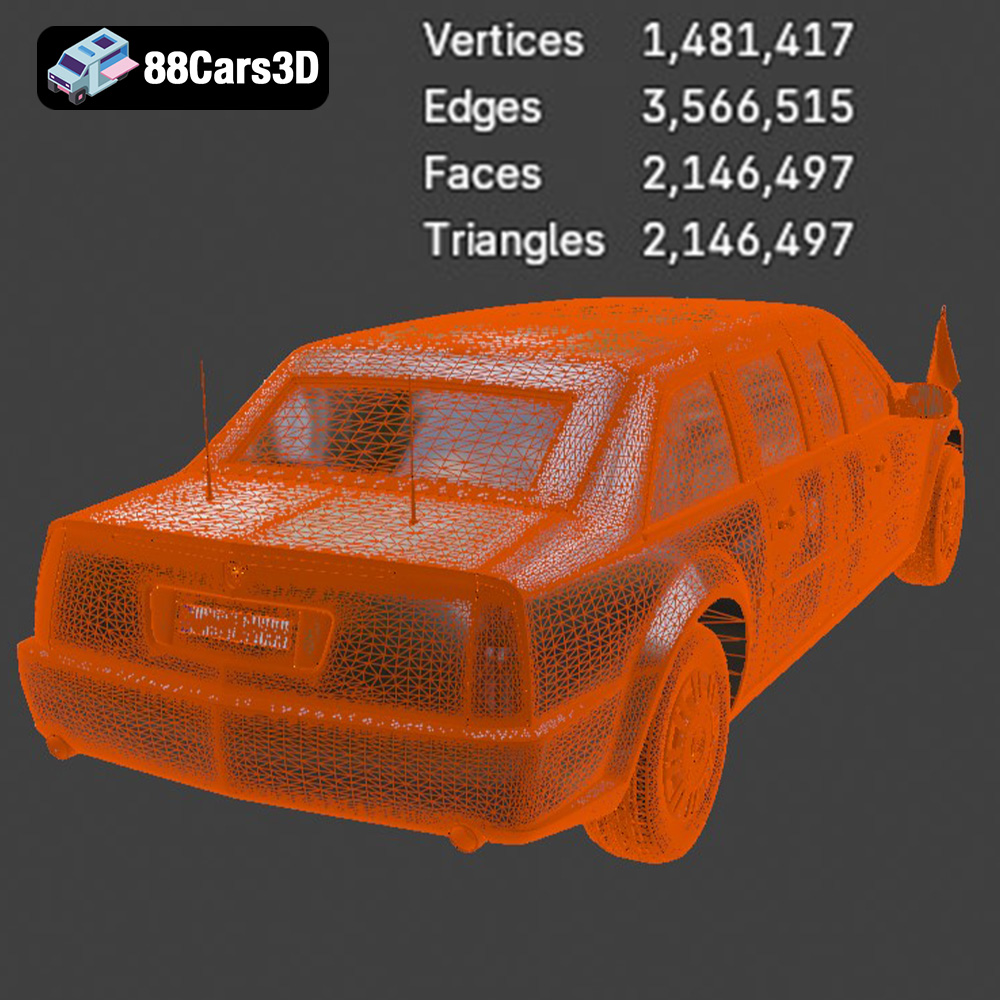
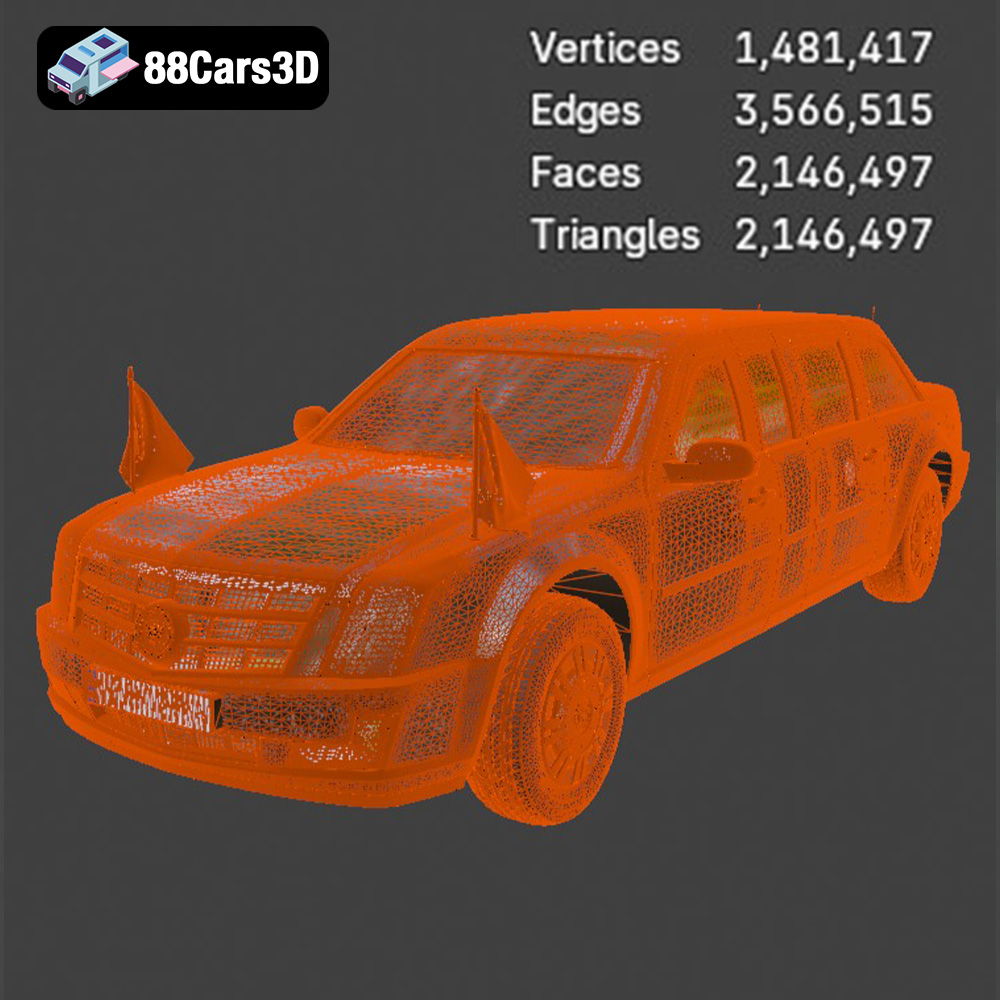
The chosen scale for 3D printing significantly impacts the level of detail that can be faithfully reproduced. Smaller scales, like 1:43, might necessitate combining intricate features, while larger scales, such as 1:18, allow for astonishing realism, capable of showcasing the executive rear seating configuration or the detailed dashboard layout. The clean and well-organized mesh structure of the Cadillac US Presidential State Car 3D Model is crucial here, as it translates cleanly into manifold geometry required for successful printing. Manifold geometry ensures that the model has a completely closed surface without any holes or intersecting faces, which is essential for the printer to understand what is solid and what is empty space.
Once a 3D print is complete, the journey to a display-worthy model often continues with post-processing. This can involve support removal, sanding to smooth layer lines, applying primer to create an even surface, and then painting with desired colors. For the Presidential State Car, the suggested post-processing includes sanding, primer, gloss black paint, and chrome trim detailing. This level of care can transform a raw 3D print into a stunning, high-fidelity replica, suitable for automotive enthusiasts and collectors alike. The ability to customize the exterior trim finish, configure flag placement, or adapt interior color schemes, as outlined in the model’s customization options, further enhances the creative possibilities for physical assets.
The Cadillac US Presidential State Car 3D Model stands as a testament to precision 3D modeling, offering a digital asset that is as historically significant as it is technically proficient. This model encapsulates not just a vehicle, but a symbol of power and advanced security, making it invaluable for projects requiring an authentic representation of executive transportation.
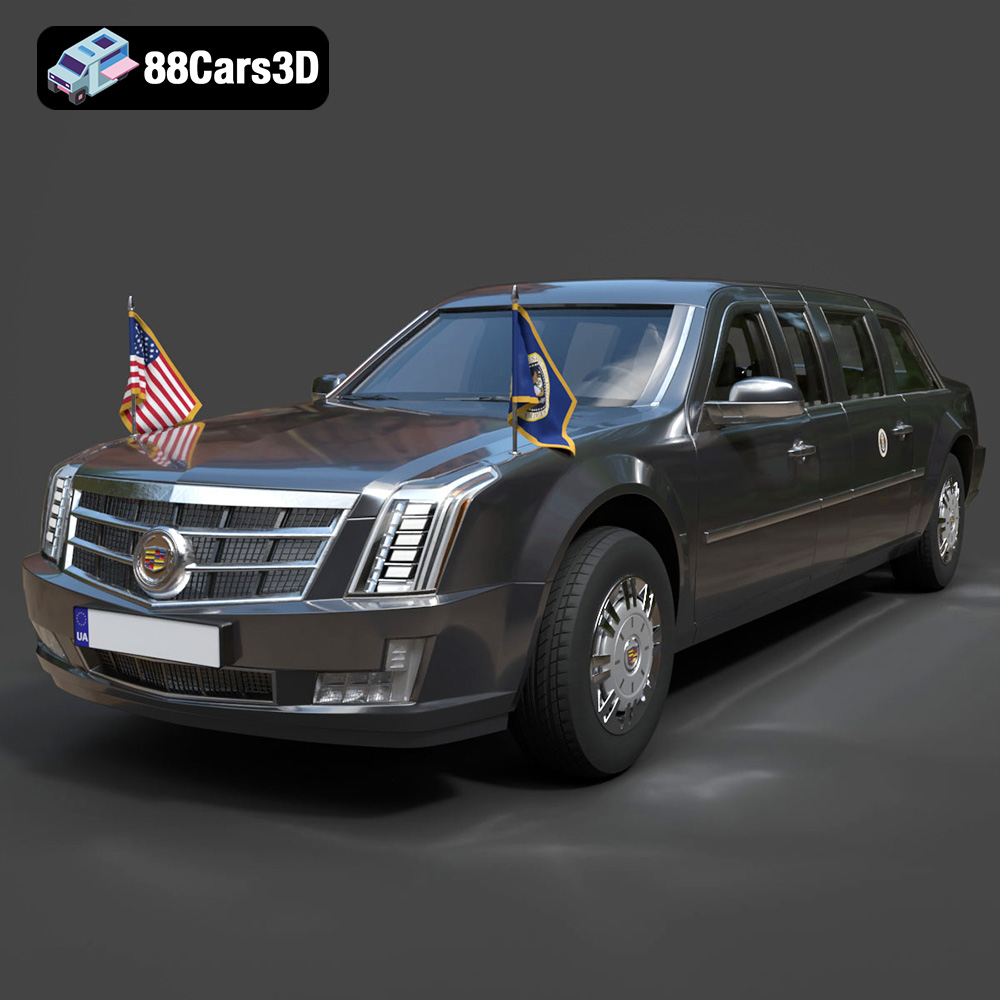
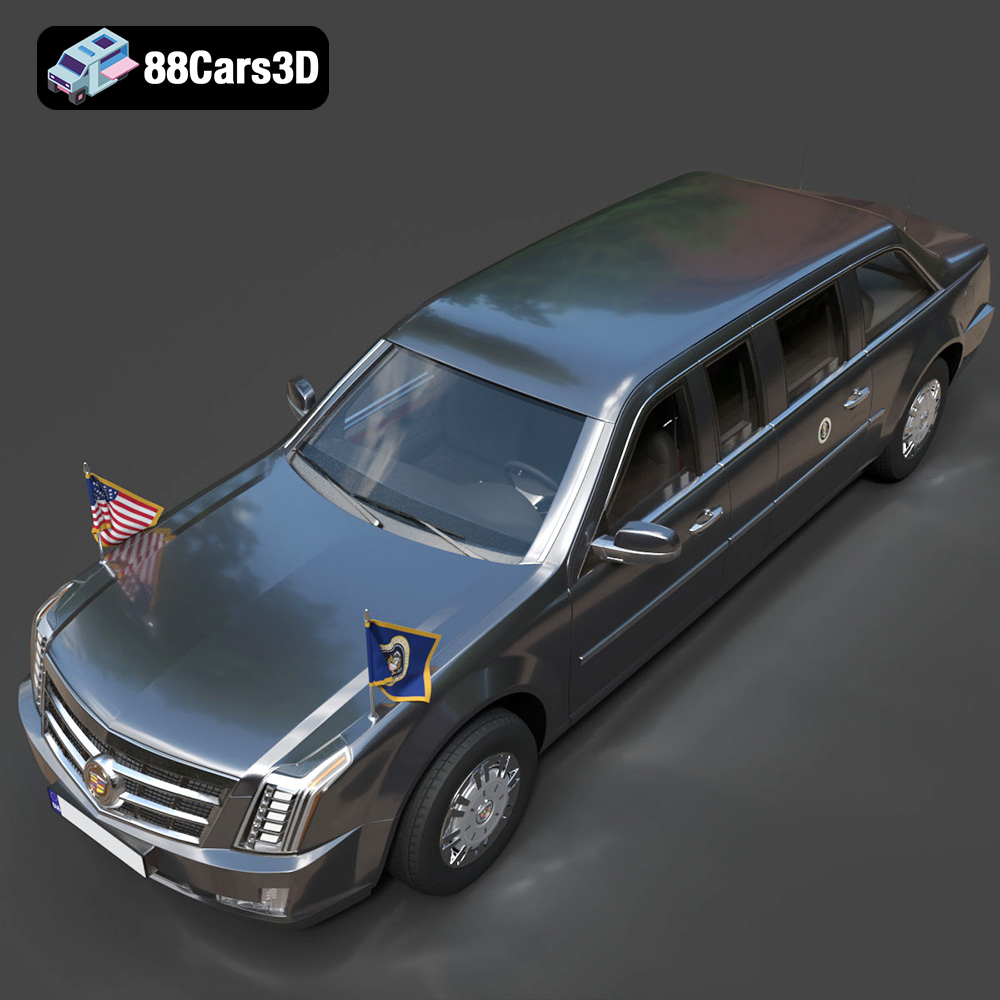
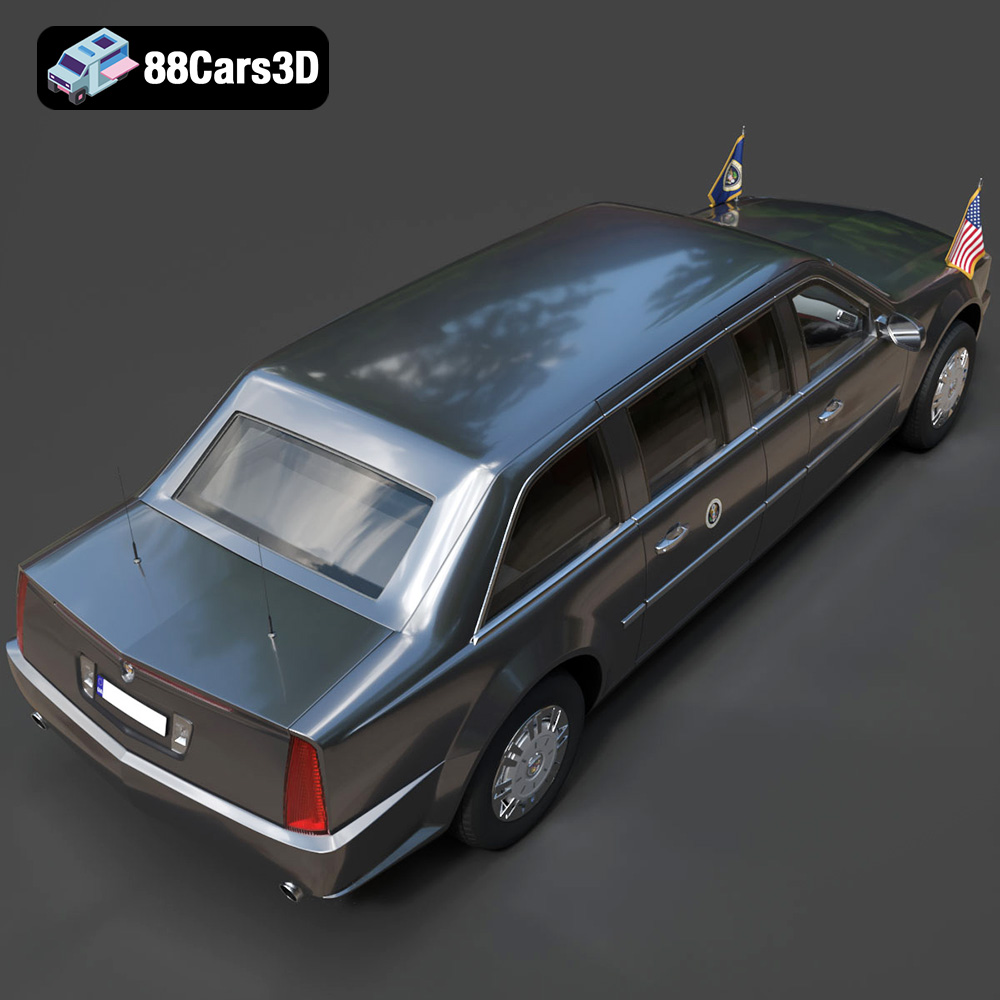
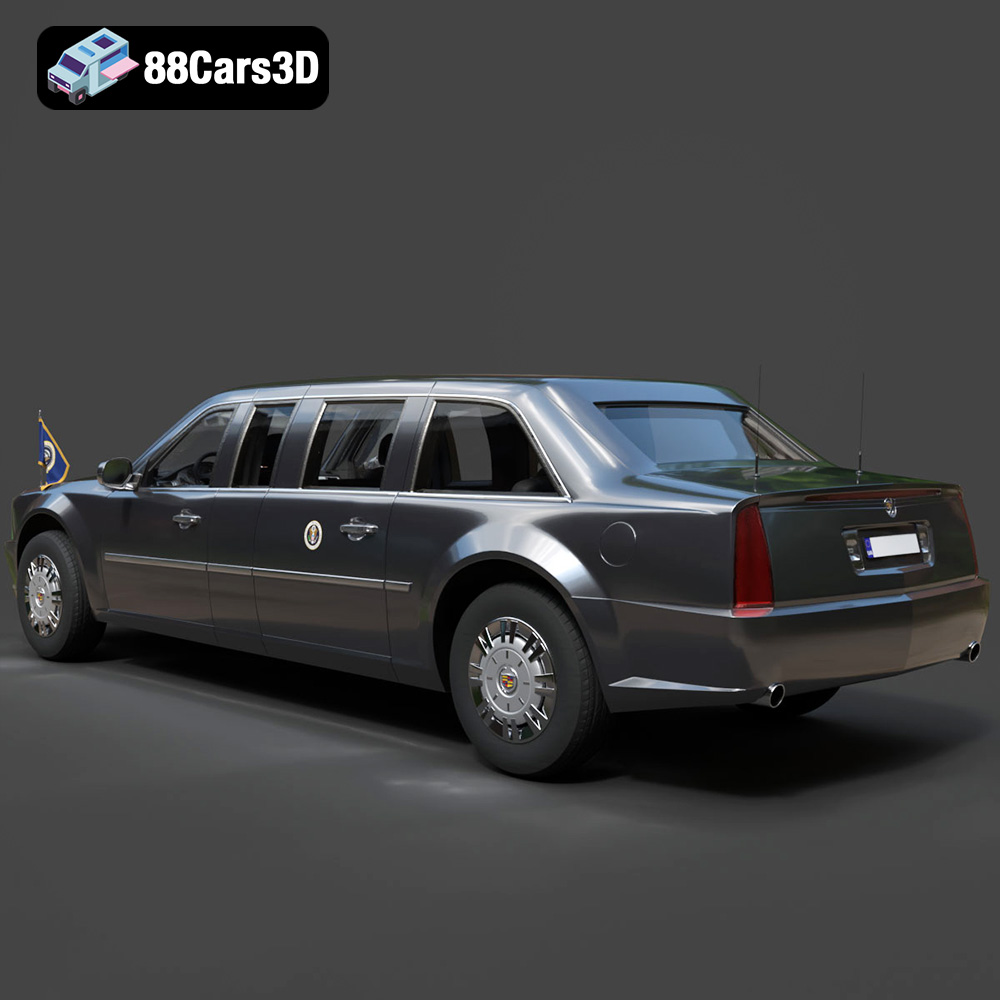
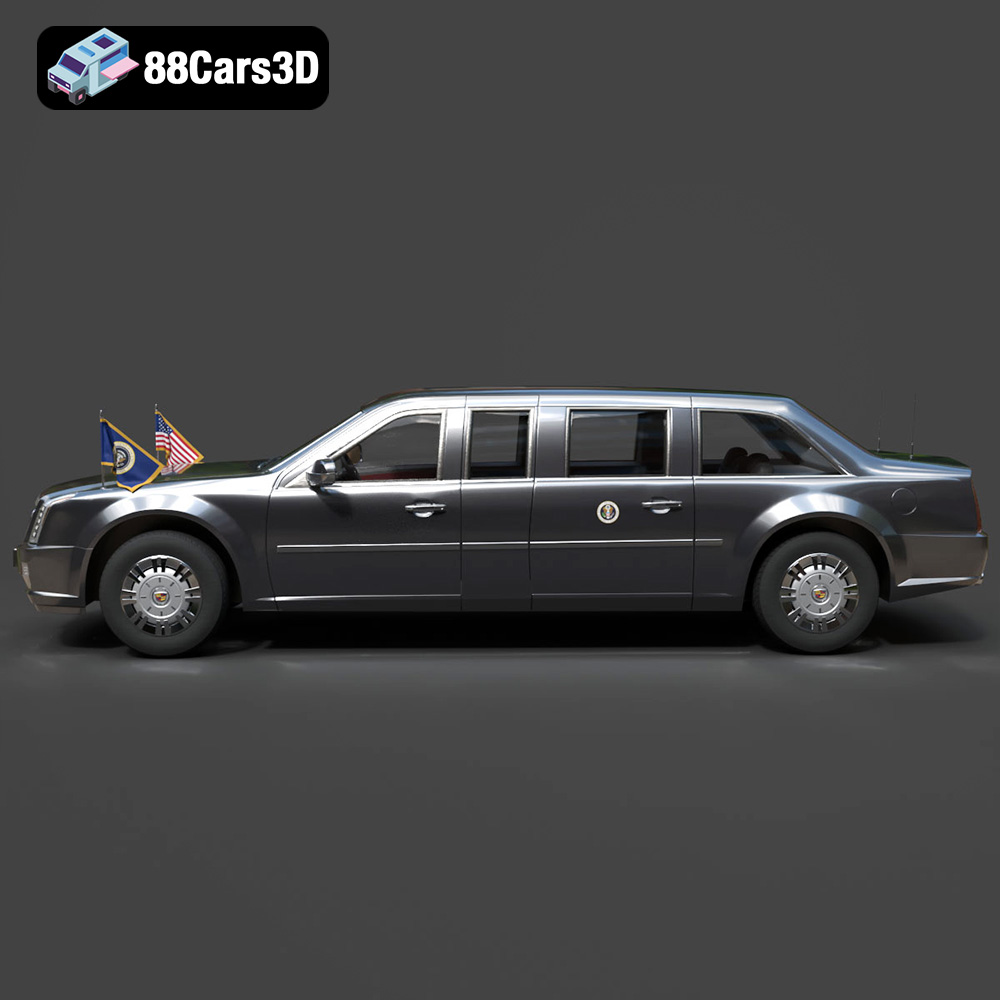
Every aspect of the Presidential State Car’s exterior has been meticulously recreated. The model captures the accurate long-wheelbase armored limousine proportions, immediately conveying its formidable presence. From the signature luxury front grille and LED headlight detailing to the reinforced bumper and body structure styling, no detail is overlooked. The thick armored window representation and presidential flag mounts on the front fenders are instantly recognizable features, enhancing the model’s authenticity for government scenes and official motorcade visuals. Furthermore, the heavy-duty wheel and tire design, coupled with the extended rear cabin configuration, complete the imposing silhouette. The inclusion of separate wheels and steering components for animation underscores its readiness for dynamic simulations and cinematic sequences, allowing for precise control over motion.
While the exterior commands attention, the interior of the Presidential State Car is where executive comfort meets strategic functionality. The 3D model features an executive rear seating configuration, complete with partition detailing between the driver and rear cabin. A premium dashboard and control layout, reinforced interior door structure, and detailed trim and seating geometry provide a comprehensive view of its sophisticated interior. This level of detail ensures that the model is suitable for cinematic close-ups and high-resolution scenes, allowing for immersive interior shots. The customization options, such as adjusting the exterior trim finish, configuring flag placement, modifying lighting configurations, adding license plate variations, and adapting interior color schemes, provide creators with unparalleled flexibility to tailor the model to specific project needs, whether for a historical recreation or a hypothetical security simulation.
The technical advantages of the Cadillac US Presidential State Car 3D Model are designed to streamline professional workflows. Its clean and well-organized mesh structure, combined with real-world scale accuracy, ensures seamless integration into any 3D environment. The proper pivot setup for steering and wheel rotation makes it production-ready for animation and game development. Optimized polygon flow guarantees both performance and realism, a crucial balance for real-time applications and high-fidelity rendering. This model’s suitability for cinematic close-ups and high-resolution scenes means it can withstand the scrutiny of demanding visual effects pipelines. Crucially, its compatibility with major 3D software platforms and engines, thanks to the wide array of included file formats (.blend, .fbx, .obj, .glb, .stl, .ply, .unreal, .max), makes it a truly versatile asset for any professional toolkit, readily available on 88cars3d.com for your next project.
The availability of such a high-quality, technically sound 3D car model simplifies complex productions, allowing artists and developers to focus on creative storytelling rather than basic asset creation. It’s a prime example of how premium digital assets can accelerate workflows and elevate the overall quality of any visualization, simulation, or interactive experience.
The world of 3D modeling for automotive design, rendering, and game development is driven by a constant pursuit of realism and technical excellence. High-quality 3D car models are the bedrock of this industry, serving as versatile assets for everything from cinematic productions and immersive AR/VR experiences to detailed simulations and tangible 3D prints. Understanding the nuances of mesh topology, material crafting, optimization techniques, and the appropriate use of various file formats is essential for any professional navigating this landscape.
The Cadillac US Presidential State Car 3D Model exemplifies the pinnacle of these professional-grade assets. Its meticulous detailing, from the reinforced armored exterior to the sophisticated executive interior, combined with its robust technical advantages and broad file format compatibility, makes it an invaluable resource for a diverse range of applications. Whether you’re a seasoned artist seeking to populate a photorealistic scene, a game developer building an engaging real-time environment, or a designer creating physical prototypes, this model provides the quality and flexibility needed to bring your vision to life. Investing in such meticulously crafted 3D models not only streamlines your workflow but also significantly enhances the overall impact and professionalism of your projects. Explore this and many other premium 3D car models available at 88cars3d.com, and elevate your digital creations to the next level.
The Cadillac US Presidential State Car 3D Model is a high-detail digital recreation of the armored limousine used for official United States presidential transportation. Built for maximum security, ceremonial presence, and executive authority, the Presidential State Car represents one of the most advanced and recognizable government vehicles in the world. This 3D model captures the extended limousine proportions, reinforced body structure, signature Cadillac grille styling, heavy-duty doors, armored glass appearance, presidential flag mounts, custom lighting elements, and formal black exterior finish. Designed with clean topology and real-world scale accuracy, it is ideal for rendering, animation, simulation, game development, and cinematic political environments. Perfect for government scenes, official motorcade visuals, cinematic productions, historical recreations, and security simulations.
$9.99
.armoredlimousine
.arvr
.automotive
.blend
.cadillac
.car3dmodel
.executivevehicle
.fbx
.gameasset
.glb
.governmentvehicle
.luxurylimo
.max
.obj
.ply
.presidentialcar
.rendering
.simulation
.statecar
.stl
.unreal