Get 50% OFF All Premium 3D & STL Models!

In the exhilarating realm of 3D modeling, few subjects capture the imagination quite like the hypercar. These machines are not merely vehicles; they are rolling sculptures of engineering marvel, designed to push the boundaries of performance and aesthetics. For 3D artists, game developers, automotive designers, and visualization specialists, accurately recreating such iconic vehicles is both a challenge and a necessity. It requires an intricate understanding of form, function, and the subtle nuances that define a legendary automobile.
Among the pantheon of modern hypercars, the Porsche 918 Spyder stands as a titan. As one-third of the automotive world’s modern “Holy Trinity,” alongside its contemporaries, the 918 Spyder carved its legacy by brilliantly merging a high-revving naturally aspirated V8 with advanced dual electric motors, pioneering hybrid performance in a breathtaking package. Its sleek lines, innovative top-exit exhausts, and aggressive stance make it a dream subject for any digital artist. Capturing its essence in a digital format, ready for a myriad of applications from cinematic renders to real-time game engines, is no small feat.
This is precisely where meticulously crafted 3D car models like the Porsche 918 Spyder (With Detachable Roof) 3D Model from 88cars3d.com become indispensable. Such an asset isn’t just a collection of polygons; it’s a foundation for countless creative endeavors. It offers a level of detail and optimization that allows professionals to integrate it seamlessly into complex projects, saving countless hours of modeling work while ensuring visual fidelity. From its signature detachable Targa-style roof panels, allowing for dynamic open-air configurations, to its perfectly optimized topology, this model is engineered for peak performance across diverse digital environments.
Navigating the diverse landscape of 3D applications and engines requires a fundamental understanding of file formats. Each format is designed with specific use cases, compatibilities, and technical advantages in mind. When acquiring a premium 3D car model, such as the Porsche 918 Spyder from 88cars3d.com, knowing which format to choose is crucial for an efficient workflow.
The .blend file is the native format for Blender, a powerful open-source 3D creation suite. When you receive a .blend file, you’re getting a fully editable Blender scene, complete with materials, textures, lighting, cameras, and even animation data. This format is ideal for users deeply integrated into the Blender ecosystem, allowing for immediate modification, rendering with Cycles or Eevee, and leveraging Blender’s extensive toolkit for rigging or sculpting. It provides the highest degree of flexibility for customization within Blender itself, making it perfect for artists who want to dissect the model, learn its construction, or adapt it extensively.
.fbx (Filmbox) is arguably the most widely adopted proprietary file format for 3D data exchange, developed by Autodesk. It excels at transferring entire scenes, including meshes, materials, textures, animations, and rigs, between different 3D software and game engines like Unreal Engine and Unity. Its strength lies in its ability to encapsulate complex data while maintaining compatibility across major platforms. For real-time pipelines, .fbx is often the go-to choice due to its robustness in preserving animation data and hierarchical structures, ensuring smooth integration into game development environments.
.obj (Wavefront OBJ) is a universal format renowned for its simplicity and wide cross-software compatibility. It primarily stores geometric data (vertices, normals, texture coordinates, and faces) and can reference external material files (.mtl) for basic shading information. While .obj doesn’t typically store animation or rigging data, its widespread support makes it an excellent choice for straightforward mesh import into almost any 3D application. It’s particularly useful when you need a clean mesh to work with, free from scene-specific data, making it a reliable fallback for cross-platform asset transfer.
.glb (GLB format, a binary form of glTF) is an increasingly important format optimized for efficient transmission and loading of 3D scenes and models in web browsers, AR, and VR applications. It’s a “self-contained” format, embedding all necessary textures and data directly within the single file. This makes .glb incredibly convenient for sharing 3D models online, integrating them into web applications, or deploying them in mobile AR/VR experiences where file size and quick loading times are paramount. Its PBR (Physically Based Rendering) material support ensures consistent visual quality across compatible platforms.
.stl (STereoLithography) is the de facto standard format for 3D printing. It represents a 3D model as a series of connected triangles, defining only the surface geometry without color, texture, or material information. For designers and hobbyists looking to bring the Porsche 918 Spyder into the physical world as a scale model, an .stl file is essential. It requires the mesh to be “manifold” – watertight and without holes or self-intersections – to ensure a successful print. The provided Porsche 918 Spyder 3D model, with its clean topology, is well-suited for conversion to .stl.
.ply (Polygon File Format) is another format for storing 3D data, particularly useful for scanned data and models with complex mesh attributes. It can store various properties for each vertex (like color, normal vectors) and face (like texture coordinates), making it a format often used in scientific and engineering applications, CAD, and precise geometric analysis. While less common for general 3D asset exchange, its ability to store detailed mesh data makes it valuable for specific precision-oriented workflows.
The .unreal format signifies an asset that has been specifically packaged and optimized for direct import and use within Unreal Engine. This often means pre-configured materials, textures, collision meshes, and sometimes even blueprints or animations. An .unreal file represents a highly optimized, engine-ready asset, streamlining the workflow for game developers and real-time visualization artists by reducing the need for extensive post-import setup within Unreal Engine itself. This direct integration capability offers significant time savings and ensures the asset performs optimally in the engine.
Finally, the .max file is the native format for Autodesk 3ds Max, a leading software for 3D modeling, animation, and rendering in architectural visualization, product design, and cinematic production. Similar to .blend, a .max file contains the complete scene, including geometry, materials, lighting, cameras, and animation. It provides full editability within 3ds Max, allowing professionals to leverage its robust modeling tools, powerful renderers like V-Ray and Corona, and intricate animation capabilities for high-end automotive rendering and animation projects.
The availability of such a comprehensive array of formats for the Porsche 918 Spyder 3D model on 88cars3d.com underscores its versatility, ensuring that artists and developers can integrate this exceptional asset into virtually any professional pipeline.
Automotive rendering is an intricate discipline, demanding a keen eye for detail, mastery of lighting, and a deep understanding of materials. It’s where a high-quality 3D car model truly shines, transforming from a digital mesh into a photorealistic image or animation that can captivate audiences. The Porsche 918 Spyder 3D model is built with rendering excellence in mind, offering the fidelity needed for stunning visual output.
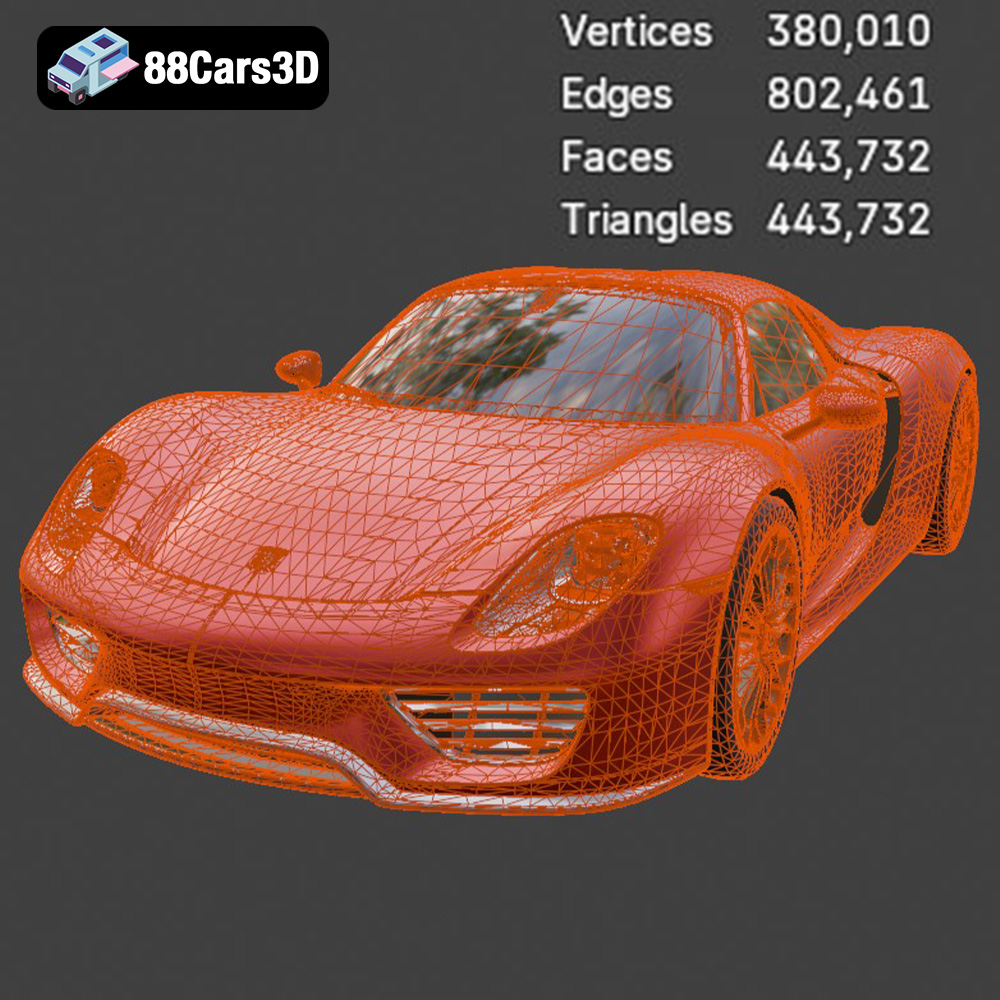
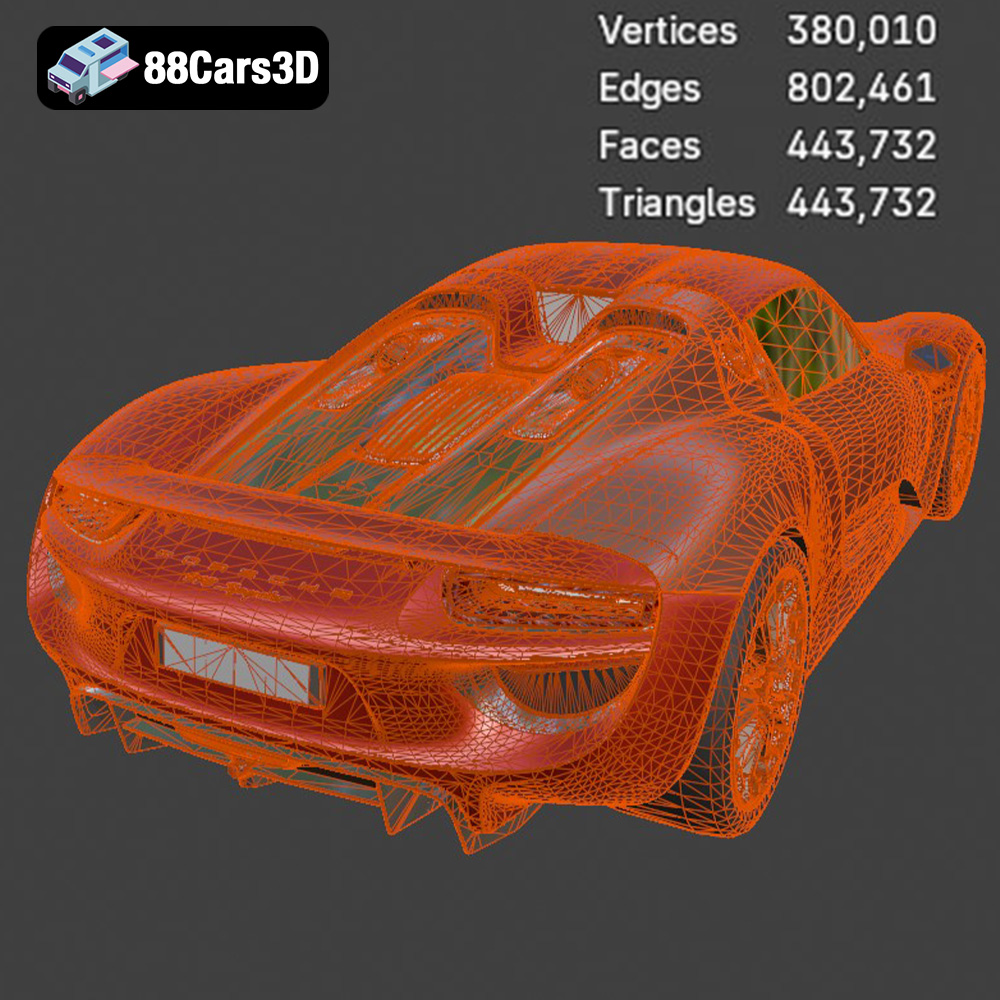
Achieving breathtaking automotive renders hinges on several key elements: the quality of the 3D model, the realism of the materials, and the artistry of the lighting. The Porsche 918 Spyder 3D model excels here with its incredibly efficient, clean mid-polygon topology of just over 443k triangles. This ‘sweet spot’ poly count ensures that the model carries enough detail for stunning close-up shots—capturing the sharp aero edges, the iconic top-exit exhaust pipes, and the intricate forged alloy wheels—without becoming overly cumbersome for high-resolution rendering. Artists using renderers like V-Ray, Corona Renderer, OctaneRender, or Blender’s Cycles can leverage this clean geometry to apply PBR materials with precision, simulating everything from the glossy sheen of Liquid Metal Silver paint to the subtle texture of Alcantara in the interior. The model’s real-world scale accuracy, based on Porsche factory dimensions, further enhances realism, ensuring that light interacts correctly with its sculpted surfaces.
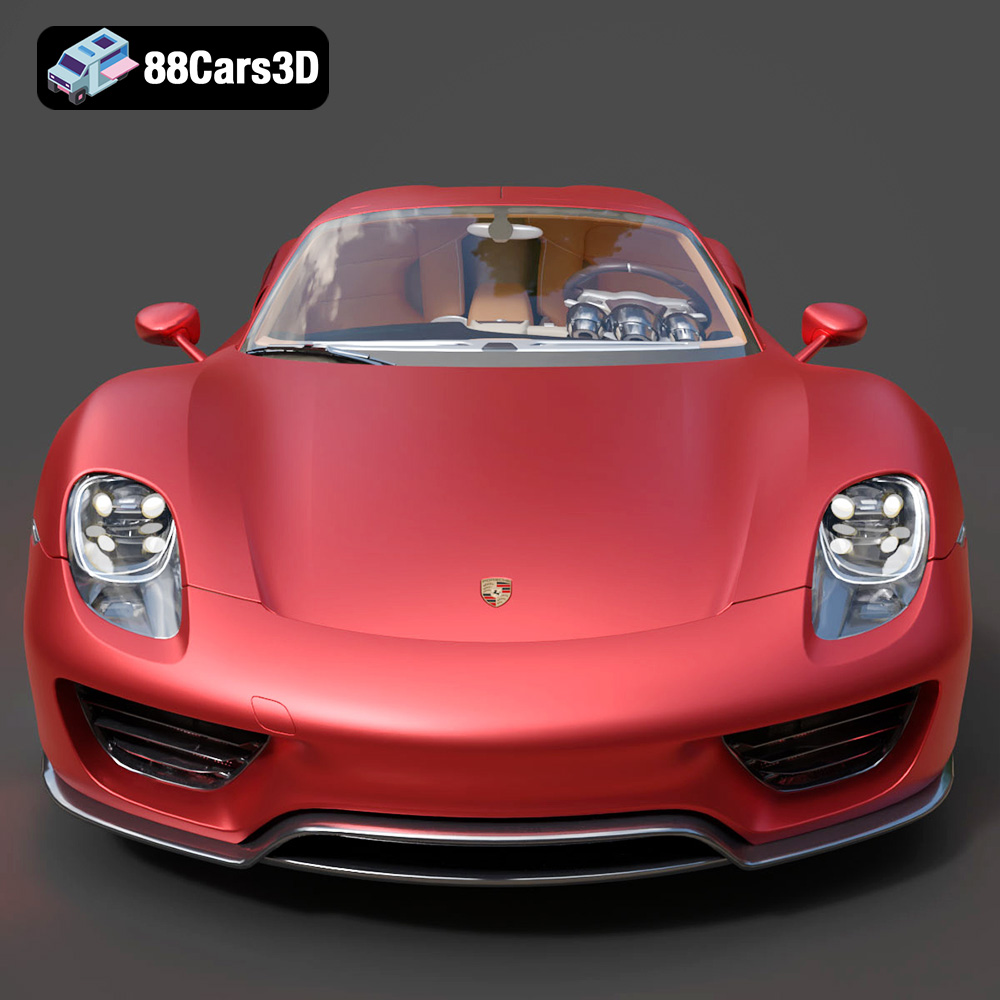
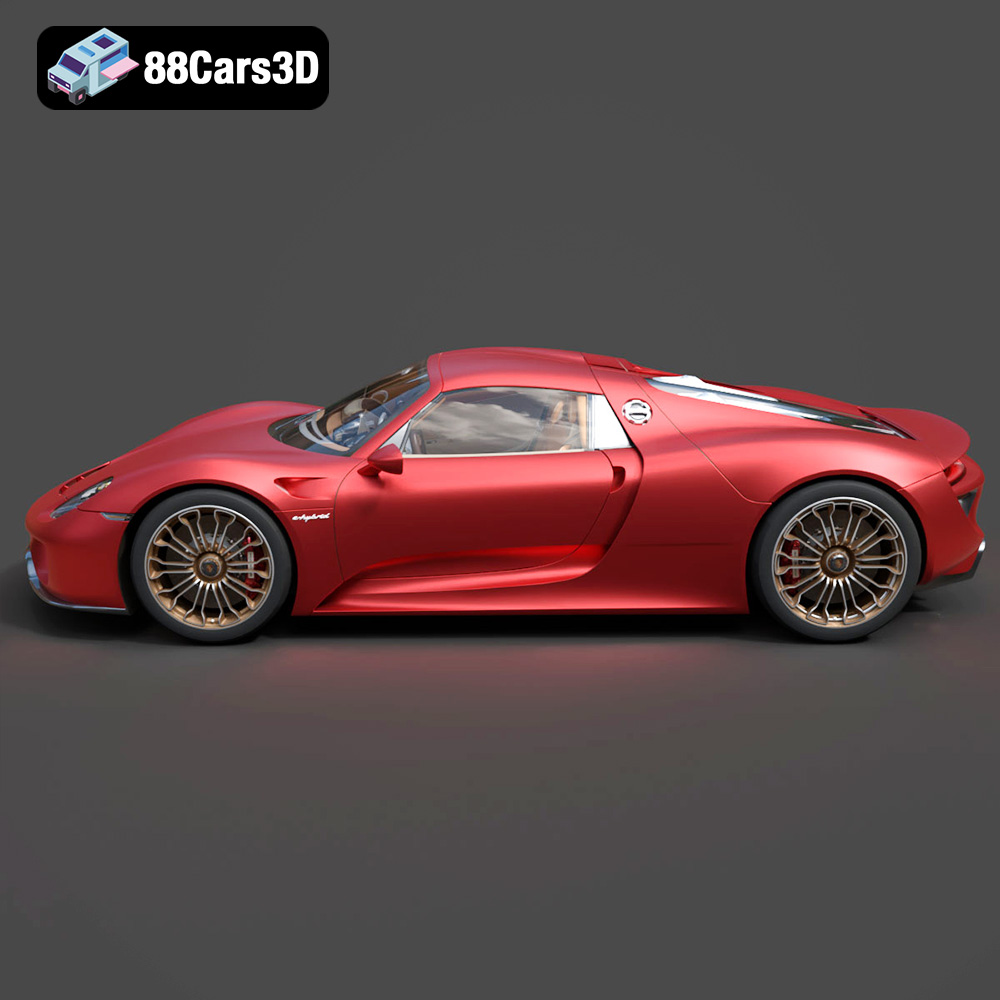
Imagine the 918 Spyder posed dramatically in a virtual studio, or racing through a hyper-realistic cityscape for a cinematic commercial. Its accurately modeled components, such as the distinct four-point LED headlights and sleek 3D taillight blades, can be individually illuminated and controlled, adding layers of realism. The detachable Targa-style roof panels are a particular boon for rendering, allowing artists to create dynamic sequences or still images that showcase both the closed-coupe track profile and the exhilarating open-air Spyder configuration, expanding creative possibilities for storytelling and presentation.
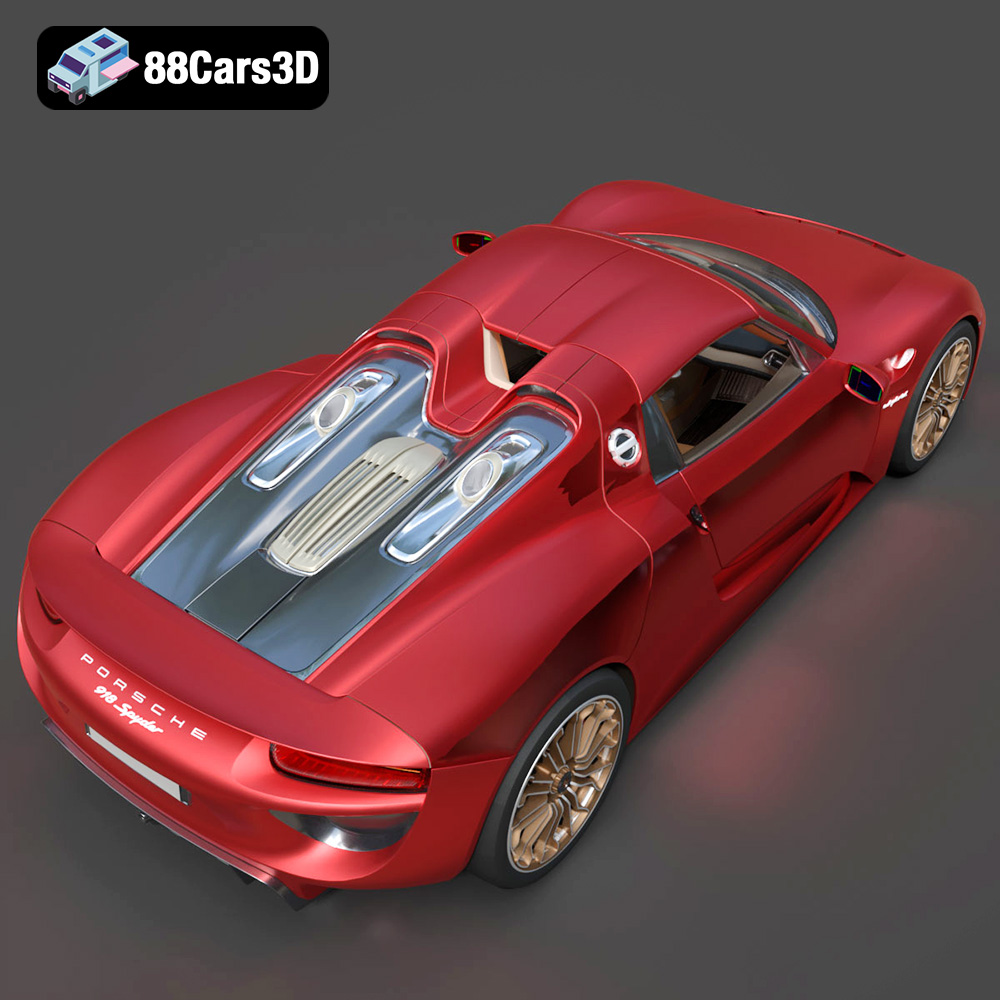
Effective lighting is paramount in automotive rendering. It defines the mood, highlights the vehicle’s form, and sells the realism. With a detailed model like the Porsche 918 Spyder, artists can experiment with sophisticated studio lighting setups—using a combination of HDRI (High Dynamic Range Image) environment maps for realistic global illumination and physical area lights for precise highlights and reflections. Emphasizing the model’s distinct features, such as the active aerodynamic rear wing or the aggressive rear diffuser, through strategic lighting can transform a good render into an exceptional one. Reflective surfaces like the paintwork, glass, and chrome trim interact with the environment, creating intricate reflections that are crucial for believability. Customization options, such as applying legendary “Weissach Package” wraps or changing exterior paint colors to match factory PTS options, can be further enhanced by tailoring the lighting to complement these aesthetic choices, whether it’s the harsh glow of a race track or the dramatic, neon-lit ambiance of a nighttime city street.
Beyond static renders, the demand for high-quality 3D car models in real-time applications—game development, augmented reality (AR), and virtual reality (VR)—has exploded. These environments require a delicate balance between visual fidelity and performance efficiency. The Porsche 918 Spyder 3D model is specifically designed to meet these stringent requirements, making it an ideal asset for interactive experiences.
For game developers, the Porsche 918 Spyder (With Detachable Roof) 3D Model is a compelling “hero” car asset. Its optimized topology, with around 443k triangles, strikes a perfect balance: detailed enough to stand as a high-end vehicle in current-gen racing games or open-world titles, yet lightweight enough to maintain smooth frame rates. The inclusion of the .fbx and .unreal file formats simplifies the import process into industry-leading engines like Unreal Engine and Unity. When importing via .fbx, developers can often bring in the mesh, basic materials, and even the pre-configured pivot setups for independent components like wheels, steering, and the detachable roof panels. This proper pivot setup is critical for rigging the vehicle, allowing for realistic wheel rotation, steering input, and animation of the roof removal sequence.
Once imported, the model’s clean geometry allows for efficient application of PBR materials, setting up complex shader networks to simulate realistic paint, glass, and carbon fiber. Collision meshes can be generated quickly, and physics assets can be configured to provide an authentic driving experience. The separate components, such as doors and roof panels, are invaluable for creating interactive elements, whether it’s opening doors in a virtual showroom or activating the roof mechanism during gameplay. This level of preparation means game developers can spend less time optimizing and more time innovating on gameplay mechanics and visual effects.
The advent of AR and VR technologies has opened new frontiers for automotive visualization, enabling interactive digital showrooms and mobile AR experiences. The Porsche 918 Spyder model is perfectly suited for these applications, thanks to its optimized poly count and the inclusion of the .glb format. The .glb format is specifically designed for efficient loading and display in web-based AR/VR environments, consolidating all model data, textures, and PBR materials into a single, compact file. This makes it ideal for showcasing the hypercar on a website, integrating it into a mobile AR app where users can place the car in their real-world environment, or creating an immersive VR showroom where potential buyers can explore the vehicle’s intricate details, both inside and out.
The model’s optimized interior geometry is tailored for a smooth first-person POV in gaming or VR, allowing users to experience the authentic driver-centric cockpit layout, complete with the sweeping elevated center console and signature sport steering wheel. This level of detail in an optimized package ensures a seamless and visually rich interactive experience without compromising performance, crucial for the fluid responsiveness required in AR/VR.
While digital visualization remains the primary domain for 3D car models, the rise of 3D printing offers an exciting avenue to bring these virtual assets into the physical world. For enthusiasts, collectors, and designers, owning a tangible, accurate scale model of an iconic vehicle like the Porsche 918 Spyder is a highly coveted experience. The Porsche 918 Spyder 3D Model is designed with 3D printability in mind, making this transition from digital mesh to physical masterpiece a seamless one.
The journey from a digital 3D model to a physical print begins with the .stl format. As mentioned earlier, .stl files define the model’s surface geometry using a mesh of triangles. The clean, well-optimized topology of the Porsche 918 Spyder 3D model ensures that it can be converted to an .stl file with ease, resulting in manifold (watertight) geometry—a critical requirement for successful 3D printing. The product description explicitly recommends scales such as 1:24, 1:18, or 1:12, which are popular choices for display-scale supercar diecast hobbyists, offering a good balance between detail and print size.
For capturing the intricate details of the 918 Spyder—such as its sharp aero edges, the unique top-exit exhaust pipes, and the delicate spokes of its lightweight forged alloy wheels—resin printing (SLA/DLP) is highly recommended over FDM (Fused Deposition Modeling). Resin printers can achieve significantly finer layer heights (0.04–0.12 mm), allowing for smoother surfaces and crisper details that FDM printers often struggle with at smaller scales. Specific print settings are provided: wall thickness (1.2–2.0 mm) and infill (15–25%) are crucial for structural integrity without excessive material usage. Supports will be necessary for complex overhangs like the side mirrors, aggressive front splitter, rear wing, and of course, the detached roof panels, ensuring geometric accuracy during the printing process. Optimal print orientation, such as printing the body angled for a smooth surface finish and the wheels/roof panels separately, also plays a significant role in print quality and ease of post-processing.
Once printed, the physical model offers a new canvas for customization. Post-processing is key to achieving a professional finish. This includes careful sanding to remove layer lines and support marks, followed by primer to create a uniform surface. The real magic happens with paint. Recreating striking Porsche factory colors like Liquid Metal Silver or Guards Red, along with the iconic Acid Green hybrid brake caliper details, brings the model to life. For those seeking unique flair, customization options like applying miniature versions of the “Weissach Package” liveries, such as the classic Martini Racing or Salzburg designs, can transform a standard print into a personalized collectible. The ability to print the roof panels separately also offers the flexibility to display the model in both coupe and Spyder configurations, further enhancing its display value. This hands-on process of physical fabrication and detailing creates a deep connection between the digital artist and the tangible outcome of their work, making 3D printing an invaluable extension of the 3D modeling workflow.
At the heart of any exceptional 3D car model lies meticulous craftsmanship and an understanding of technical necessities. The Porsche 918 Spyder (With Detachable Roof) 3D Model available at 88cars3d.com embodies these principles, offering distinct advantages that elevate professional workflows across various industries.
The technical specifications of this 3D model speak volumes about its quality: 380,010 vertices, 802,461 edges, and 443,732 faces/triangles. These numbers reflect a deliberate balance. The model is detailed enough to capture the complex aerodynamic geometry and authentic proportions of the Porsche 918 Spyder, ensuring visual authenticity even in extreme close-ups. Yet, it remains highly optimized, with a clean, quad-based topology that facilitates easy modification, UV unwrapping, and smooth subdivision if required. This “mid-poly” count is a significant advantage; it avoids the pitfalls of excessively high-poly models that can cripple real-time performance and bloat rendering times, while still providing ample detail for high-end cinematic visualization. Furthermore, the real-world scale accuracy, meticulously derived from Porsche factory dimensions, ensures that the model fits perfectly into architectural visualization scenes, engineering simulations, or product design contexts without requiring tedious scaling adjustments. Crucially, the proper pivot setup for components like steering, wheel rotation, and roof removal simplifies the rigging and animation process, saving invaluable time for animators and game developers.
The true strength of this Porsche 918 Spyder 3D model lies in its immense versatility. Its robust construction and comprehensive feature set allow it to serve multiple professional applications with equal proficiency. For film and advertising, it’s a render-ready asset for high-octane automotive commercials or dramatic product placements. For game development, it’s the ideal “hero” drivable hypercar, performant enough for current-gen racing simulators and open-world titles. In AR/VR, its optimized nature makes it perfect for interactive digital showrooms, offering immersive experiences without performance bottlenecks. Even for 3D printing hobbyists, it provides a solid foundation for creating highly detailed physical replicas. Acquiring such a pre-made, high-quality asset from a reputable source like 88cars3d.com offers significant cost-effectiveness and efficiency compared to modeling a complex vehicle from scratch. It allows studios and individual artists to allocate resources to other aspects of their projects, confident that their core automotive asset is built to professional standards.
The world of 3D visualization is constantly evolving, demanding assets that are not only visually stunning but also technically robust and adaptable. The Porsche 918 Spyder stands as a pinnacle of automotive engineering, and its digital counterpart, the Porsche 918 Spyder (With Detachable Roof) 3D Model, faithfully translates that excellence into the digital realm.
We’ve explored how this model, with its meticulously crafted geometry, accurate proportions, and innovative detachable roof feature, serves as an invaluable tool across diverse professional workflows. From achieving cinematic photorealism in automotive rendering and visualization to delivering fluid, immersive experiences in game development and AR/VR, its optimized topology and comprehensive file format support ensure seamless integration. Even in the physical domain, its print-ready design allows enthusiasts to bring this legendary hypercar to life as a tangible scale model.
For any professional seeking a premium 3D car model that offers both unparalleled visual fidelity and technical efficiency, this Porsche 918 Spyder model is an indispensable asset. It empowers artists and developers to elevate their projects, saving countless hours while guaranteeing a foundation of quality. Explore this exceptional 3D model and many more high-quality automotive assets at 88cars3d.com, and unlock new possibilities for your next creative endeavor.
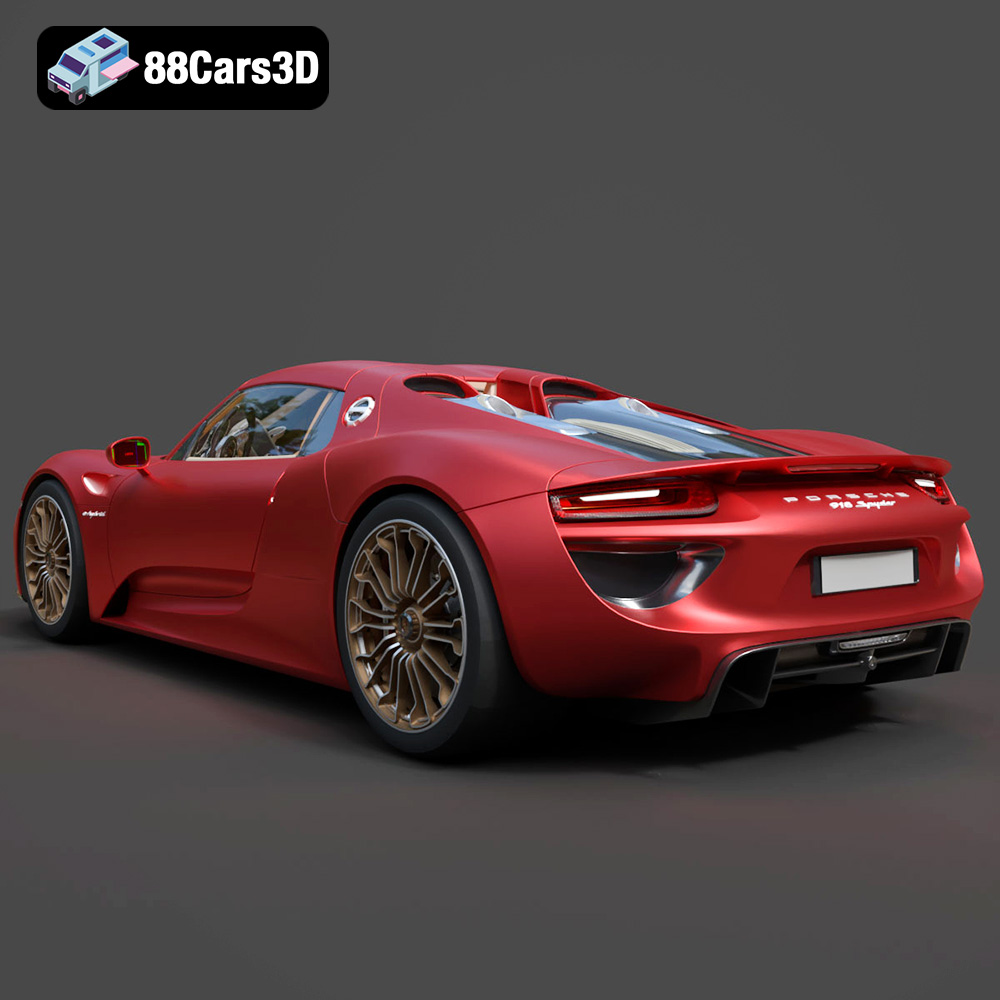
The Porsche 918 Spyder 3D Model is a breathtaking digital recreation of one of the most legendary German hypercars ever produced. Forming one-third of the automotive world’s modern “Holy Trinity,” the 918 Spyder redefined the supercar landscape by pairing a high-revving naturally aspirated V8 with advanced dual electric motors. This 3D model accurately captures the sleek, aerodynamically sculptured aesthetic of the hybrid hypercar. Most notably, this model features the signature fully detachable Targa-style roof panels, allowing you to seamlessly switch between the closed-coupe track profile and the open-air Spyder configuration. It also features the iconic top-exit exhaust pipes, four-point LED headlights, aggressive rear diffuser, and active aerodynamic rear wing. Built with an incredibly efficient, clean mid-polygon topology (just over 443k triangles), it provides flawless visual fidelity for stunning close-up automotive renders while remaining perfectly lightweight for real-time game engines.
$9.99