Get 50% OFF All Premium 3D & STL Models!

In the rapidly evolving landscape of digital visualization, the demand for hyper-realistic assets is paramount. From blockbuster game titles and immersive virtual reality experiences to breathtaking architectural visualizations and cinematic productions, the quality of 3D models directly dictates the success and impact of a project. Nowhere is this more evident than in the automotive industry, where precision, authenticity, and aesthetic appeal are non-negotiable. Creating a truly convincing digital vehicle requires an intricate blend of artistic skill and technical mastery.
Imagine being able to integrate a perfectly sculpted, dimensionally accurate replica of a beloved vehicle into your next scene, complete with every subtle curve, panel gap, and interior detail. This is the promise of premium 3D car models, and a prime example of such excellence is the BMW 1 Series 5-Door (2016) 3D Model. This asset represents the pinnacle of digital craftsmanship, offering an unparalleled foundation for a myriad of professional applications. Whether you’re an architect needing to populate a high-end visualization, a game developer crafting an open-world environment, or a filmmaker requiring realistic background traffic, understanding the nuances of such sophisticated models is crucial for elevating your work.
A truly high-quality automotive 3D model goes far beyond a mere visual representation. It’s a meticulously engineered digital asset, built from the ground up to serve specific technical and creative demands. When you examine a model like the BMW 1 Series 5-Door (2016) 3D Model, you’re not just seeing a car; you’re witnessing the culmination of countless hours dedicated to precision, optimization, and versatility.
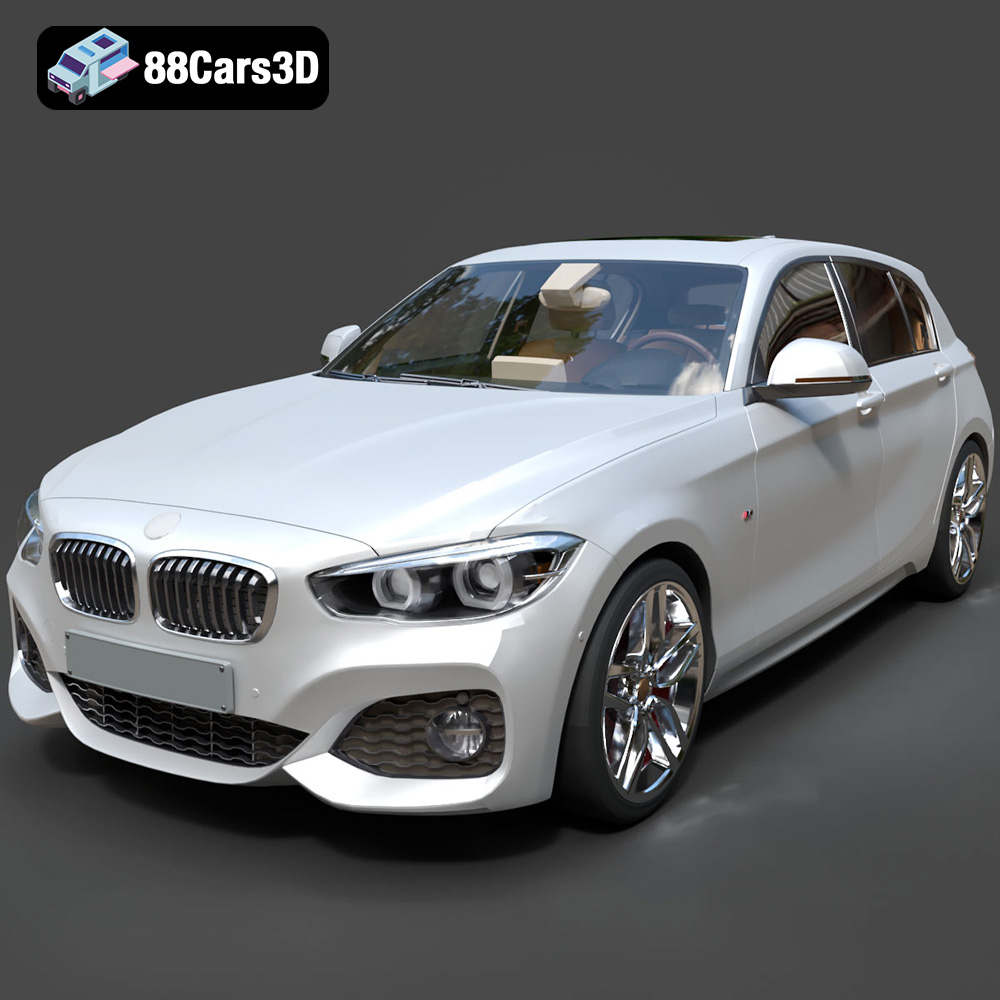
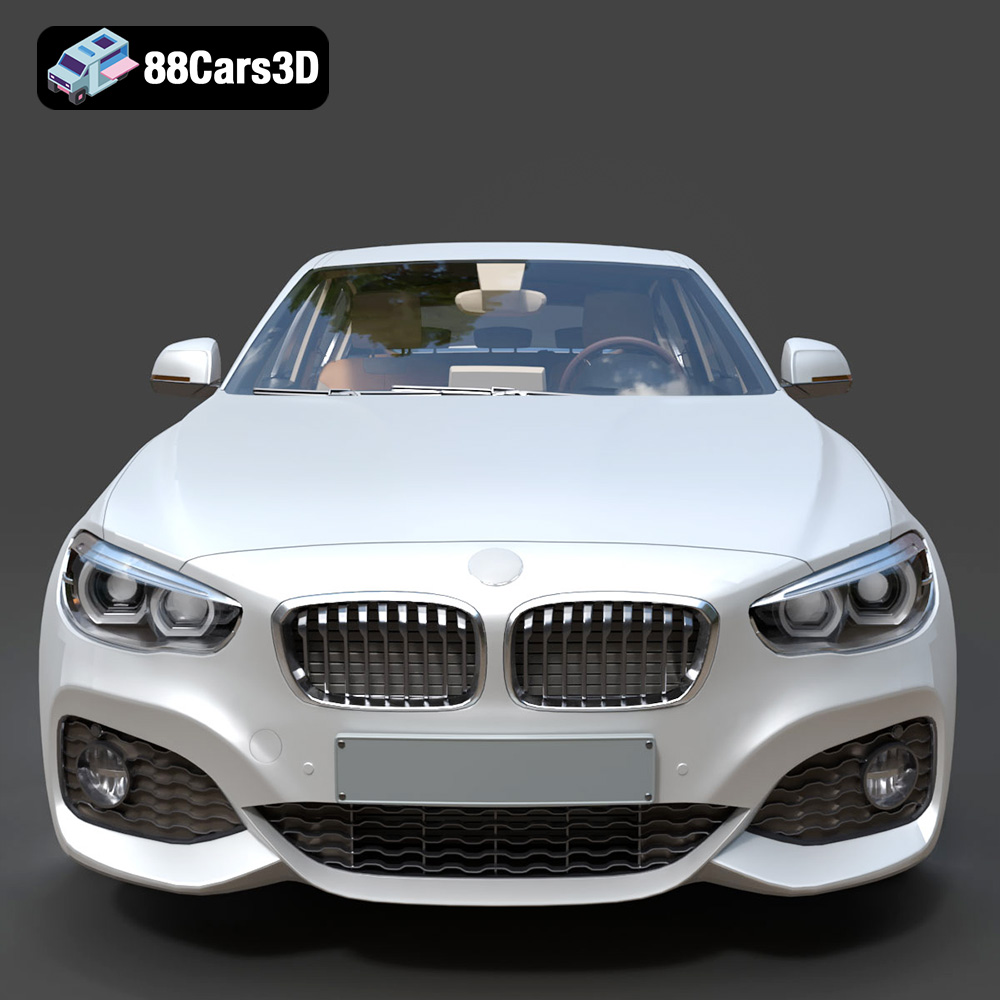
For any automotive rendering project, the level of detail is a make-or-break factor. Clients, whether in advertising, automotive design, or architectural visualization, expect photorealism. This means capturing the essence of the vehicle down to the finest elements. Think about the subtle reflections on a car’s paintwork, the intricate design of its alloy wheels, or the precise manufacturing tolerances that define its panel gaps. These details create visual credibility. The 2016 BMW 1 Series, specifically the F20 LCI generation, boasts distinctive features such as its sleeker LED headlight clusters, wider kidney grilles, and L-shaped LED taillights. A premium 3D model must replicate these nuances flawlessly to ensure the digital representation is indistinguishable from its real-world counterpart. Anything less can break the immersion and detract from the overall quality of the visualization.
The BMW 1 Series 5-Door (2016) 3D Model stands out due to its adherence to rigorous technical standards. Its “quad-heavy topology” is a critical feature, meaning the mesh is predominantly composed of four-sided polygons. This type of topology is highly desirable for clean deformation during animation, predictable subdivision for smooth surfaces, and overall mesh integrity. With approximately 1.17 million triangles (equivalent to 849,804 vertices and 1,178,498 faces/polygons), this model delivers exceptional visual fidelity. This level of detail is ideal for photorealistic close-ups, high-end architectural visualization, and automotive animations where every curve and reflection must be perfect.
Beyond the mesh, the model incorporates:
Such meticulous attention ensures that the model is not only beautiful but also highly functional for a wide range of professional workflows, compatible with major 3D software and rendering engines like V-Ray, Corona, and Arnold.
Navigating the diverse world of 3D modeling requires a solid understanding of the various file formats available. Each format serves a specific purpose, catering to different software ecosystems, project requirements, and delivery platforms. The BMW 1 Series 5-Door (2016) 3D Model from 88cars3d.com is provided in an extensive range of formats, ensuring maximum compatibility and utility for professionals across various industries. Let’s delve into the technical aspects and ideal use cases for each.
The .blend format is native to Blender, the powerful open-source 3D creation suite. It’s a comprehensive format, encapsulating not just the mesh geometry, but also materials, textures, lighting setups, animation data, physics simulations, and even custom scripts. When you download a .blend file, you’re getting a fully editable Blender scene. This is ideal for artists who primarily work in Blender, offering direct access to the model’s construction, modifiers, node-based materials, and UV unwraps. For the BMW 1 Series, the .blend file would provide the most flexibility for those looking to deeply customize the model within Blender’s robust environment.
.fbx (Filmbox) is arguably the most widely adopted proprietary file format for 3D data exchange between different software applications. Developed by Autodesk, it’s particularly strong in handling animated data, including skeletal rigs, blend shapes, and camera information, in addition to geometry, materials, and textures. Its binary nature makes it efficient for storage and loading. The .fbx format is the go-to choice for game development (Unreal Engine, Unity), film and VFX pipelines, and real-time visualization due to its robust support for complex scene data. For the BMW 1 Series, the .fbx file would be perfect for importing into Unreal Engine for game development or into 3ds Max for complex animation sequences.
The .obj (Wavefront Object) format is a universal standard for exchanging 3D geometry data. It’s a simple, text-based format that primarily defines geometry (vertices, normals, UVs, and faces) and can reference external material files (.mtl). While it doesn’t support animation or rigging, its widespread compatibility across virtually all 3D software makes it invaluable for basic mesh transfer. If you need to bring the BMW 1 Series into an obscure or specialized 3D application, .obj is often the safest bet, providing a clean geometric foundation for further work.
.glb (GL Transmission Format Binary) is the binary version of the glTF format, designed for efficient transmission and loading of 3D scenes and models by engines and applications. It’s quickly becoming the standard for 3D on the web, augmented reality (AR), and virtual reality (VR) due to its compact size and comprehensive support for physically based rendering (PBR) materials. A .glb file contains all necessary data (geometry, materials, textures, animations) in a single file, making it incredibly easy to share and deploy. The BMW 1 Series in .glb is ideal for showcasing the model in web-based configurators, AR apps, or light VR experiences where performance and ease of integration are key.
The .stl (Stereolithography) format is the de facto standard for 3D printing. It represents a 3D model as a collection of unconnected triangles, defining only the surface geometry without color, texture, or material information. While simple, its ubiquity in additive manufacturing means almost every 3D printer and slicer software supports it. The BMW 1 Series model being available in .stl makes it directly suitable for physical output, allowing creators to produce custom scale models or prototypes, as described in the 3D printing section below.
.ply (Polygon File Format) is another popular format for storing 3D data, particularly known for its ability to store properties beyond just geometry, such as color per vertex, normal information, and even transparency. It’s often used for scanned data, scientific applications, and CAD/CAM workflows where high precision and additional data attributes are crucial. While less common for general animation or rendering, the .ply format offers a robust solution for specific engineering or analysis tasks involving the BMW 1 Series model.
The .unreal format signifies an asset specifically optimized and prepared for direct integration into Unreal Engine. While often derived from .fbx, an “.unreal” file usually implies that the model has undergone specific preparation—such as proper scaling, material setup (using Unreal’s PBR workflow), collision meshes, and perhaps even LODs (Levels of Detail)—to be game-engine ready. This format significantly streamlines the workflow for Unreal developers, allowing them to drop the BMW 1 Series 5-Door (2016) 3D Model directly into their projects with minimal post-import setup, benefiting from pre-configured engine-specific optimizations.
Finally, the .max format is the native file format for Autodesk 3ds Max, a leading software in architectural visualization, animation, and game development. A .max file contains a complete 3ds Max scene, including geometry, materials, textures, lighting, cameras, animation, and render settings. It offers the most flexibility for users working within 3ds Max, allowing full access to all aspects of the BMW 1 Series model, including modifier stacks, intricate material graphs for V-Ray or Corona, and advanced animation controls. This is typically the preferred format for high-end rendering and complex scene assembly.
Providing the BMW 1 Series 5-Door (2016) 3D Model in this wide array of formats underlines its versatility and professional-grade quality, catering to virtually any professional pipeline. This comprehensive file support from 88cars3d.com ensures that users can confidently integrate this detailed automotive asset into their preferred software and workflow.
A premium 3D model, such as the BMW 1 Series 5-Door (2016) 3D Model, is designed to be a versatile workhorse across numerous professional disciplines. Its rich detail and careful construction make it an invaluable asset for various high-stakes projects.
In architectural visualization, the context and realism of a scene are paramount. A modern, premium vehicle can significantly enhance the perceived value and sophistication of a building or urban landscape render. The BMW 1 Series, with its sleek F20 LCI design, is the perfect candidate for populating modern European street scenes, upscale urban environments, or adding a touch of realism to luxury driveways. For ArchViz professionals typically working in 3ds Max with V-Ray or Corona Renderer, the provided .max and .fbx formats offer seamless integration. The model’s clean, quad-heavy topology ensures perfect subdivision, resulting in exceptionally smooth surfaces even in extreme close-ups. Artists can leverage HDR (High Dynamic Range) lighting to cast realistic shadows and reflections on the car’s body, seamlessly blending it into the virtual environment. Its accurate real-world scale makes placement effortless, contributing to believable compositions for commercial automotive pitches or high-end property marketing materials.
The gaming industry and real-time visualization sectors constantly push the boundaries of graphical fidelity. While the BMW 1 Series 5-Door (2016) 3D Model boasts a significant 1.17 million triangles, making it a “high-poly” asset, its inclusion of the .unreal and .fbx formats highlights its readiness for advanced game engines like Unreal Engine 5. With UE5’s Nanite virtualized micropolygon geometry system, such detailed assets can be rendered with unprecedented fidelity directly in real-time without the traditional performance bottlenecks. For projects targeting previous engine versions or optimized AR/VR experiences, developers would implement a robust LOD (Levels of Detail) strategy, creating lower-polygon versions for distant views. The separate doors, wheels, and steering components are game-changer for creating interactive elements, car customization systems, or even full physics-driven vehicle simulations within the engine.
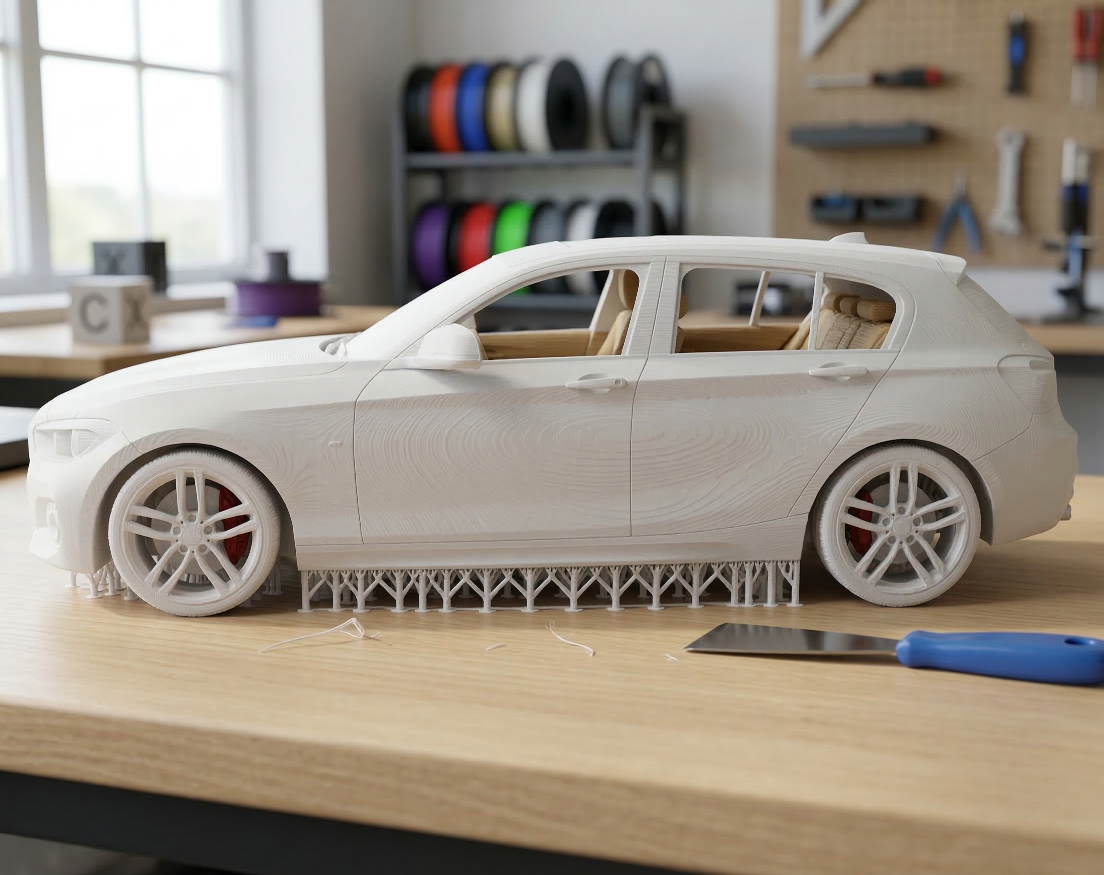
Beyond digital rendering, the proliferation of 3D printing technology has opened new avenues for bringing virtual assets into the physical world. The BMW 1 Series 5-Door (2016) 3D Model, with its meticulously crafted geometry, serves as an excellent foundation for creating tangible scale models, prototypes, or custom collectibles.
Transforming a high-poly digital model into a print-ready file involves specific considerations. The .stl format provided is crucial here, as it’s the universal language of 3D printers. The model’s “clean topology” and “manifold geometry” are essential for successful printing, ensuring that the mesh is watertight and free from errors that could cause printing failures. For optimal results, certain print settings are recommended:
These detailed guidelines ensure that enthusiasts and professionals can achieve high-quality physical replicas directly from the digital asset.
Once printed, the physical model offers a new realm of customization. Post-processing steps like sanding and priming are essential to achieve a smooth, paint-ready surface. The true magic happens with painting, where the model can be brought to life with classic BMW factory paint finishes such as Alpine White, Black Sapphire, or Estoril Blue, followed by a clear coat for a realistic sheen. Furthermore, the base model allows for extensive customization:
This fusion of digital precision and physical craftsmanship provides a unique opportunity for both collectors and hobbyists to own a tangible piece of automotive art derived directly from a professional-grade 3D model.
The inherent quality of a 3D model is rooted in its technical construction. For something as complex as an automobile, this means meticulous attention to topology, material setup, and overall efficiency. The BMW 1 Series 5-Door (2016) 3D Model exemplifies these principles.
The term “clean topology” is not just a buzzword; it’s a fundamental requirement for professional 3D assets. The BMW 1 Series model boasts a “highly organized, smooth-flowing mesh structure” that is predominantly quad-based. This ensures several critical advantages:
The technical specifications—849,804 vertices, 1,985,377 edges, and 1,178,498 faces/polygons (triangles)—indicate a high-resolution model. While this level of detail is excellent for photorealism, understanding its implications for real-time applications (like games or AR/VR) is important. As discussed, engines like Unreal’s Nanite can handle this, but traditional real-time engines might require careful LOD implementation for optimal performance across various hardware.
Beyond the mesh itself, the materials and textures applied to a 3D model are what truly bring it to life. The BMW 1 Series model comes with materials and textures, meaning it’s ready to render out-of-the-box. Professional workflows typically involve Physically Based Rendering (PBR) materials, which accurately simulate how light interacts with surfaces in the real world. This includes properties like:
The model’s compatibility with major rendering engines (V-Ray, Corona, Arnold) ensures that these PBR materials will translate accurately, producing stunning, lifelike renders. Furthermore, the option to customize exterior paint colors to match factory BMW specifications or apply M-Sport/Shadowline textures offers artists extensive creative control, allowing them to tailor the vehicle to any specific project requirement or brand aesthetic.
In the competitive world of 3D production, time is money, and quality is reputation. Sourcing high-quality 3D assets, particularly complex ones like fully detailed vehicles, is a strategic decision that can dramatically impact project timelines and final output.
Creating a highly detailed 3D car model from scratch, like the BMW 1 Series 5-Door (2016), is an incredibly labor-intensive process. It requires expert modeling, texturing, and rigging skills, often taking weeks or even months for a single artist. By acquiring a pre-made, professionally crafted asset from a marketplace like 88cars3d.com, studios and individual artists can significantly cut down on production time and costs. These models are built by experienced professionals, ensuring clean topology, real-world accuracy, and optimized file structures, all of which contribute to faster integration and superior rendering results. The value lies not just in the model itself, but in the confidence that comes with using a rigorously tested, production-ready asset.
The demand for high-quality 3D car models spans a vast array of industries. From adding a sophisticated touch to architectural visualizations, as seen with the BMW 1 Series enriching urban renders, to serving as hero vehicles or background traffic in games and cinematic productions, these assets are incredibly versatile. They are equally vital for augmented reality (AR) and virtual reality (VR) experiences, where immersive detail is critical, and even for 3D printing, enabling the creation of tangible prototypes and collectibles. 88cars3d.com understands these diverse needs, offering a curated selection of 3D car models that meet the exacting standards of professional workflows across all these sectors. The comprehensive file format support, from .blend to .unreal, further enhances this versatility, ensuring that your investment in a quality asset like the BMW 1 Series 5-Door (2016) 3D Model delivers maximum utility and impact for any project.
The digital realm thrives on precision, realism, and efficiency, especially in fields where visual fidelity is paramount. High-quality 3D car models are not merely decorative elements; they are foundational assets that empower professionals across architectural visualization, game development, film, and 3D printing to elevate their projects. The BMW 1 Series 5-Door (2016) 3D Model serves as a shining example of this commitment to excellence, offering meticulous detail, versatile file formats, and robust technical specifications that meet the demands of any professional pipeline.
From its authentic F20 LCI design and quad-heavy topology perfect for photorealistic rendering, to its readiness for game engines and suitability for intricate 3D printing, this model is a testament to the power of well-crafted digital assets. By understanding the technical nuances of file formats, integration workflows, and optimization strategies, artists and developers can unlock the full potential of such premium resources. Investing in high-grade 3D car models from trusted sources like 88cars3d.com not only saves invaluable production time but also ensures that your final output stands out with unparalleled realism and professional polish. Explore the possibilities and drive your projects forward with the finest automotive assets available.
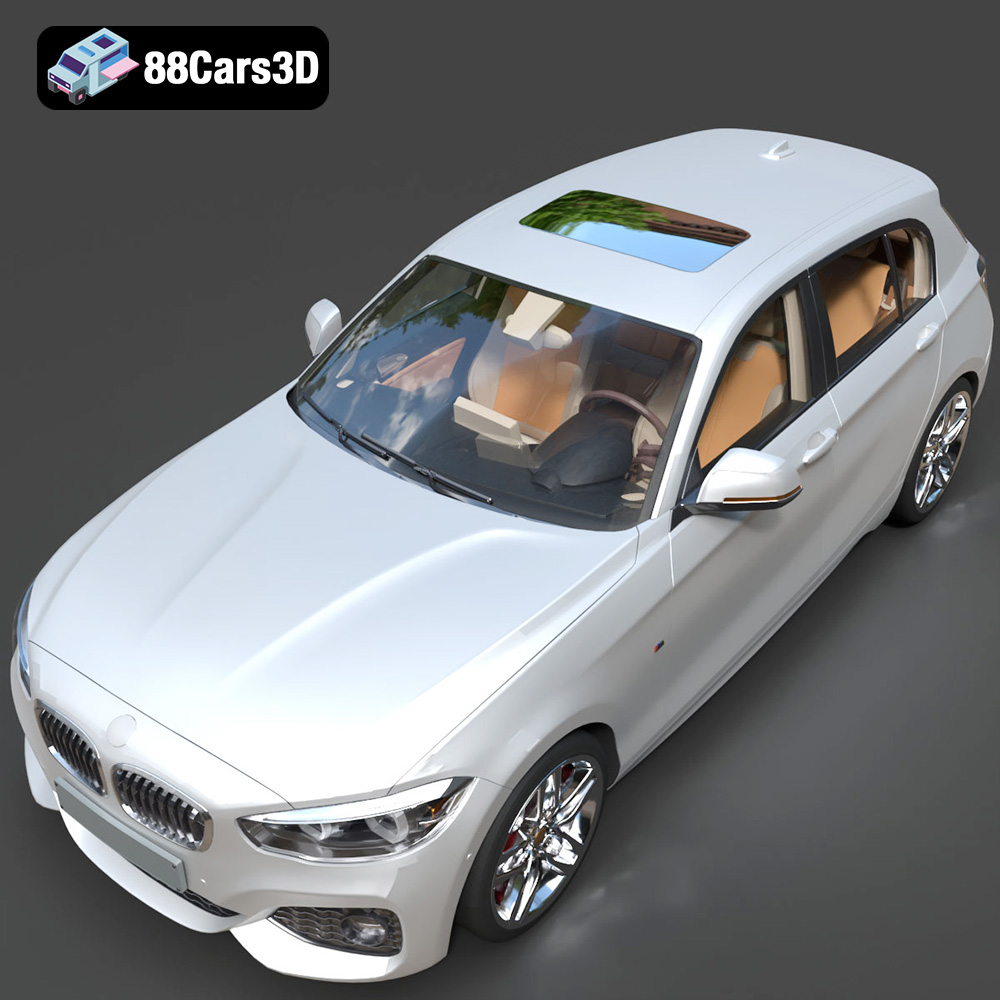
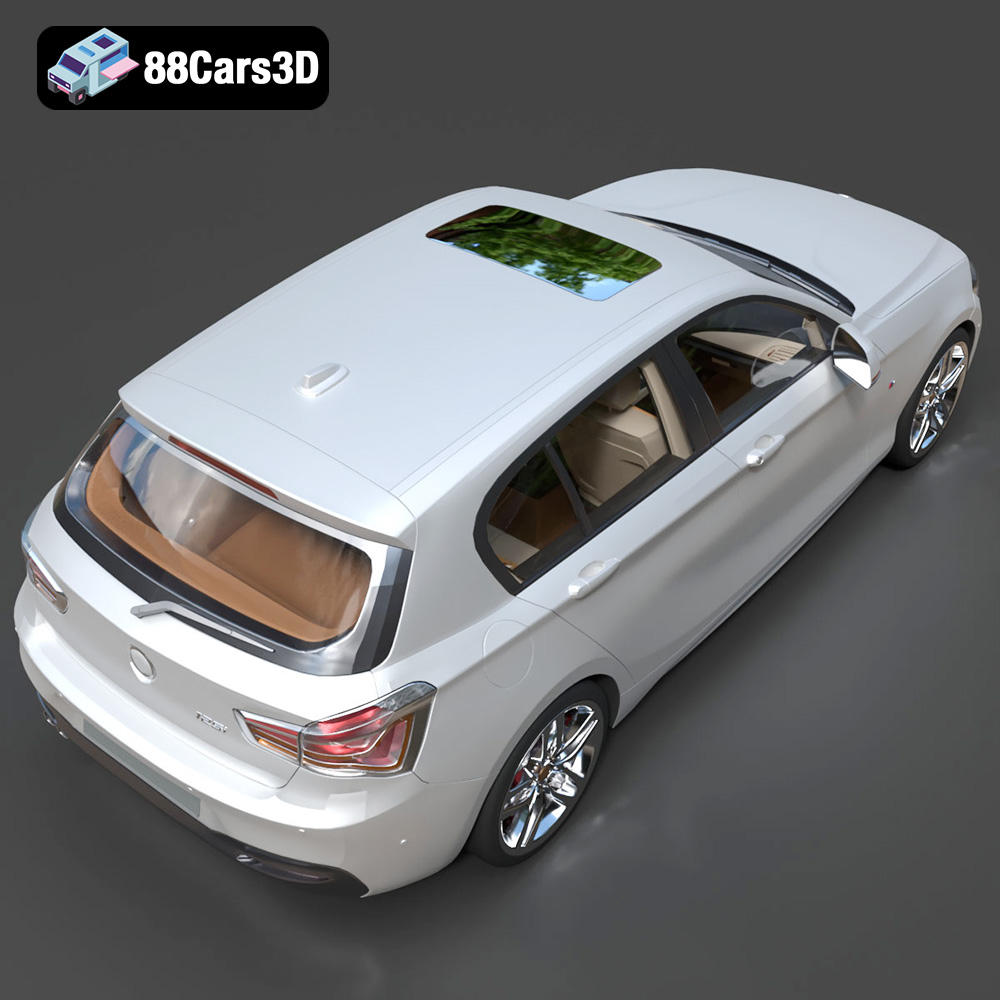
The BMW 1 Series 5-Door (2016) 3D Model is a highly accurate digital recreation of the beloved premium compact hatchback. Representing the widely praised F20 LCI (Life Cycle Impulse / facelift) generation, this model captures the unique sporty proportions, elongated hood, and rear-wheel-drive stance that made this specific 1 Series a standout in its class. This 3D model accurately reflects the modernized 2016 aesthetic, including the sleeker LED headlight clusters, the wider signature BMW kidney grilles, the distinct L-shaped LED taillights that extend into the tailgate, and the refined bumper designs. Built with incredibly clean, quad-heavy topology (approx. 1.17 million triangles), it delivers exceptional visual fidelity for photorealistic close-up rendering, high-end architectural visualization, and automotive animations. Perfect for populating modern European street scenes, upscale urban architectural renders, commercial automotive pitches, and cinematic background traffic.
$9.99
.archviz
.automotive
.blend
.bmw
.fbx
.hatchback
.obj
.rendering
.stl
1-series
2016-bmw
3d printing
car-3d-model
f20
high poly
premium-compact