Get 50% OFF All Premium 3D & STL Models!

In the world of automotive engineering, few vehicles command the presence and capability of the Ford F-150 Raptor. This apex desert predator, designed to conquer extreme off-road environments at blistering speeds, combines trophy-truck performance with an aggressive, widebody aesthetic. Its latest iteration, the 2021 model, further refines this brutal elegance, making it a dream subject for artists and developers alike.
For 3D artists, automotive designers, game developers, and visualization specialists, replicating such a complex machine with absolute fidelity is a monumental task. This is where premium 3D car models become indispensable. Imagine having a digital twin that captures every ripple of its aggressive fenders, the intricate mechanics of its Fox Live Valve suspension, and the detailed ergonomics of its cockpit. This is precisely what the Ford F-150 Raptor 2021 Ultra High-Poly 3D Model offers – an uncompromising, ultra-high-detail digital recreation engineered for the most demanding visual projects. Available on 88cars3d.com, this model is a testament to meticulous craftsmanship, providing a foundation for stunning renders, immersive game experiences, and even precise 3D prints.
When working with complex 3D car models like the Ford F-150 Raptor 2021, selecting the correct file format for your specific workflow is crucial. Each format offers unique advantages, compatibility, and technical characteristics that cater to different applications, from detailed automotive rendering to real-time game development and physical 3D printing. Understanding these nuances ensures seamless integration and optimal performance within your chosen software environment.
The Ford F-150 Raptor 2021 Ultra High-Poly 3D Model, with its extensive list of included formats, ensures that whether you’re a Blender enthusiast, a 3ds Max power user, or looking to integrate into game engines or 3D print, you have the right tool for the job. This comprehensive offering underscores the value provided by high-quality 3D car models from platforms like 88cars3d.com.
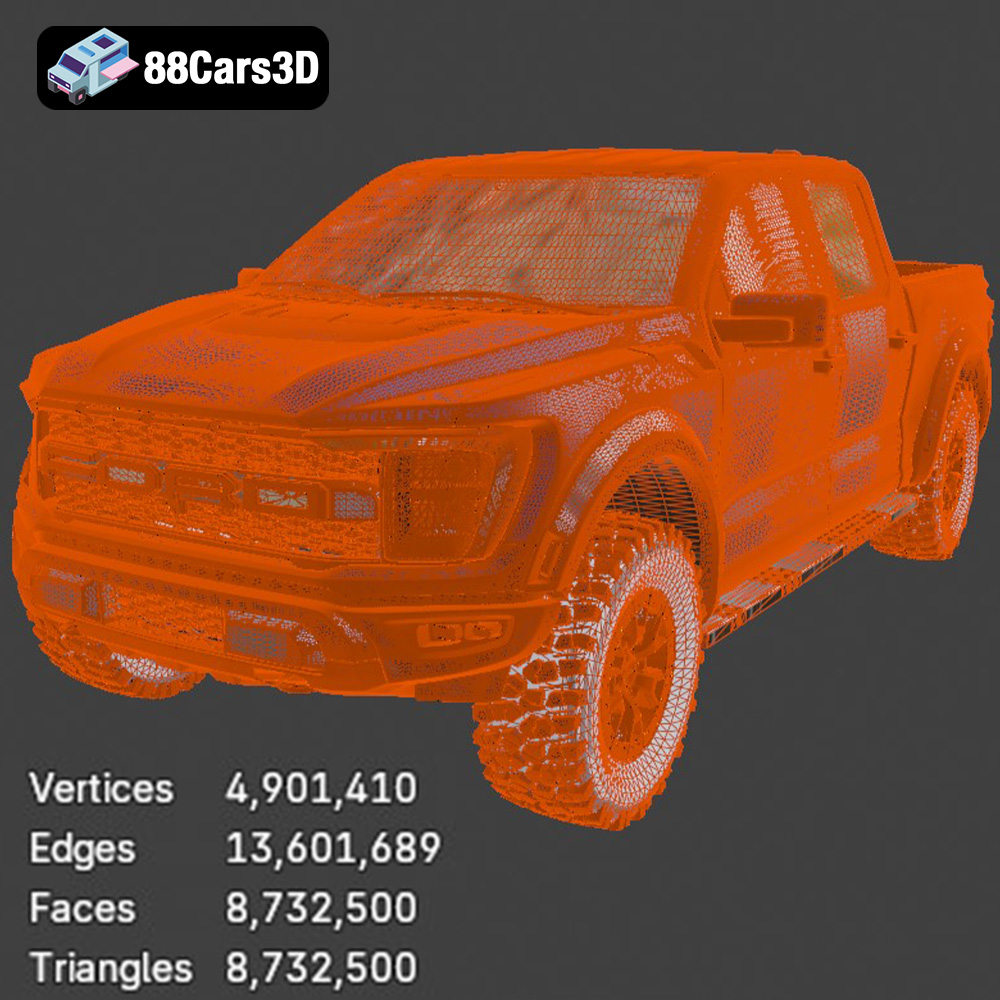
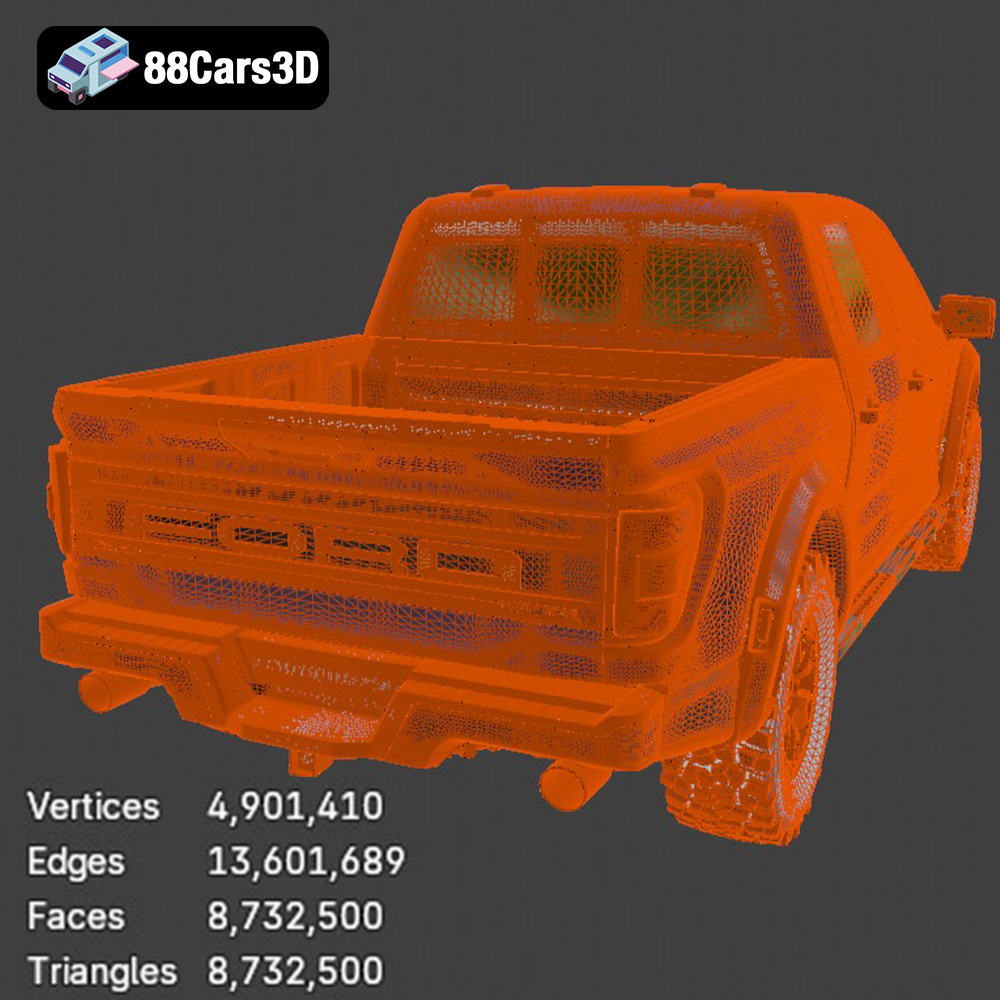
The core appeal of an ultra-high-poly model lies in its ability to deliver absolute photorealism, especially under extreme scrutiny. The Ford F-150 Raptor 2021 3D Model from 88cars3d.com exemplifies this philosophy, featuring an astounding 8.73 million triangles. This isn’t merely a number; it’s a promise of fidelity that withstands the closest macro shots and the most demanding cinematic renders.
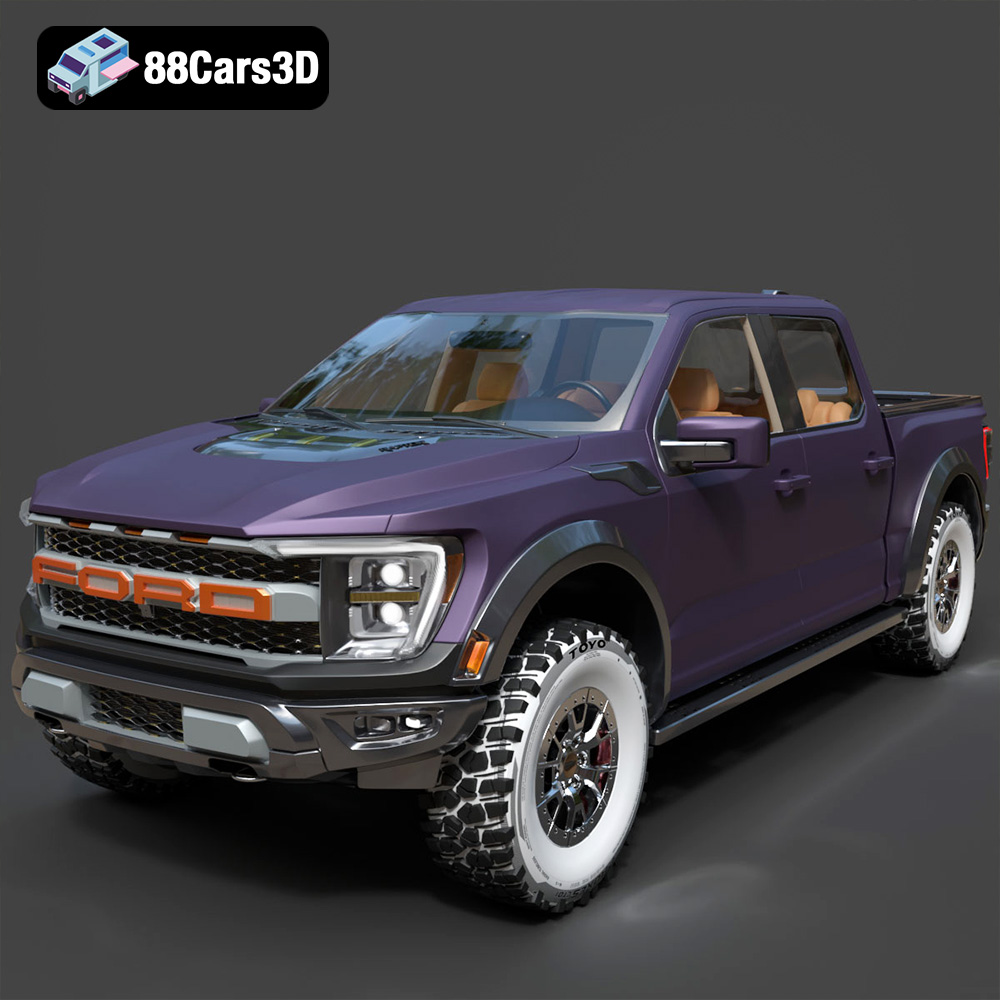
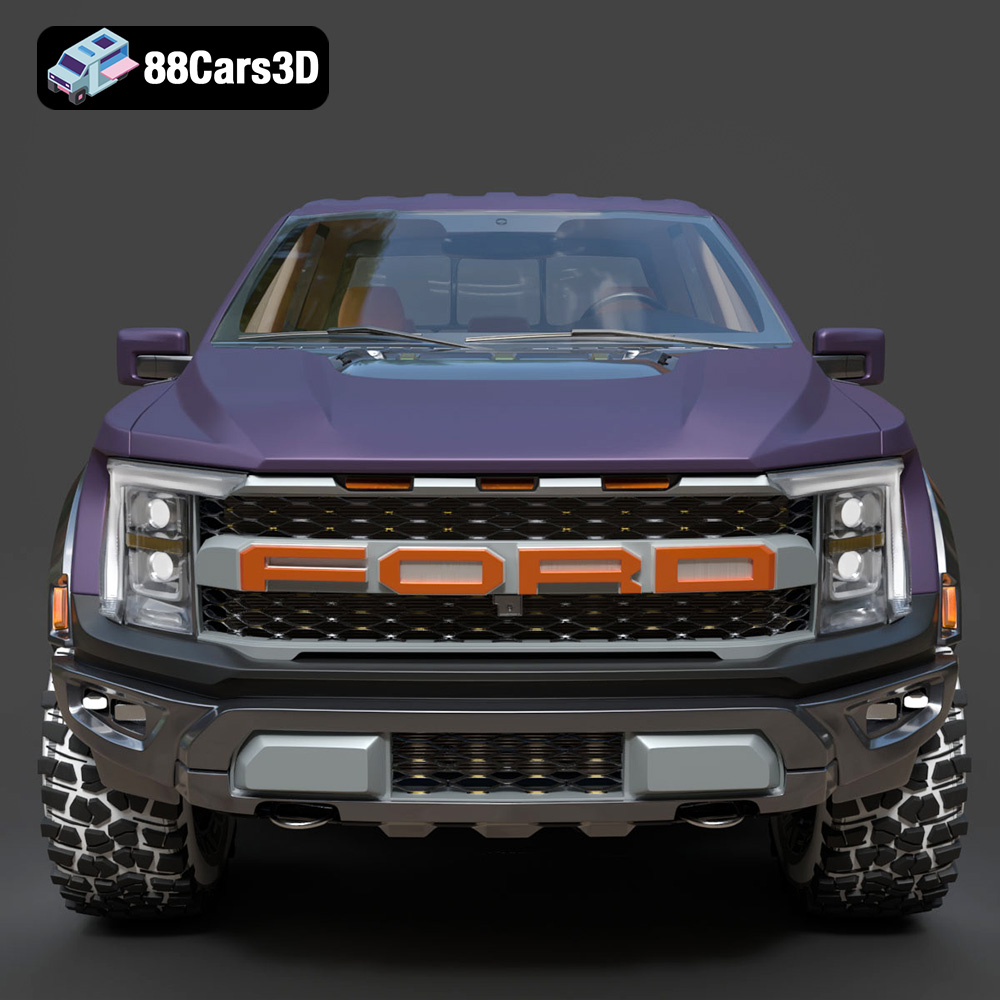
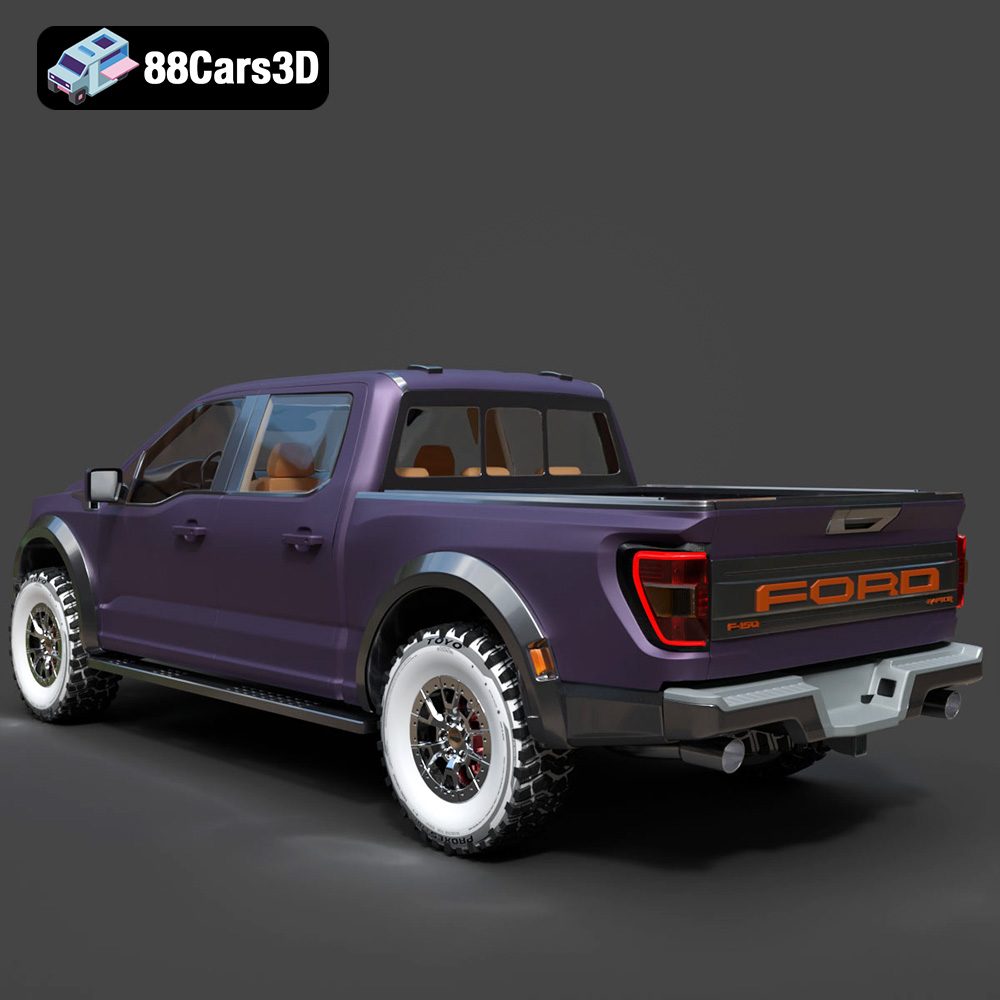
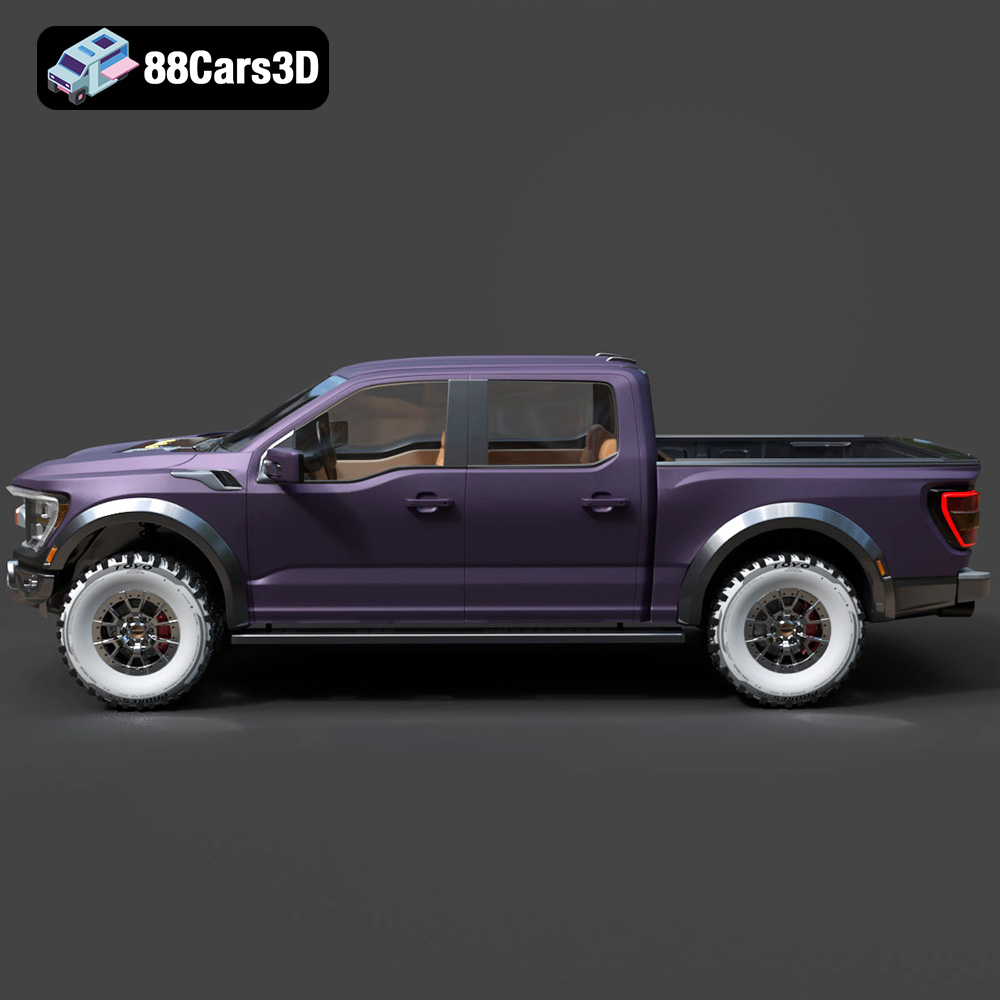
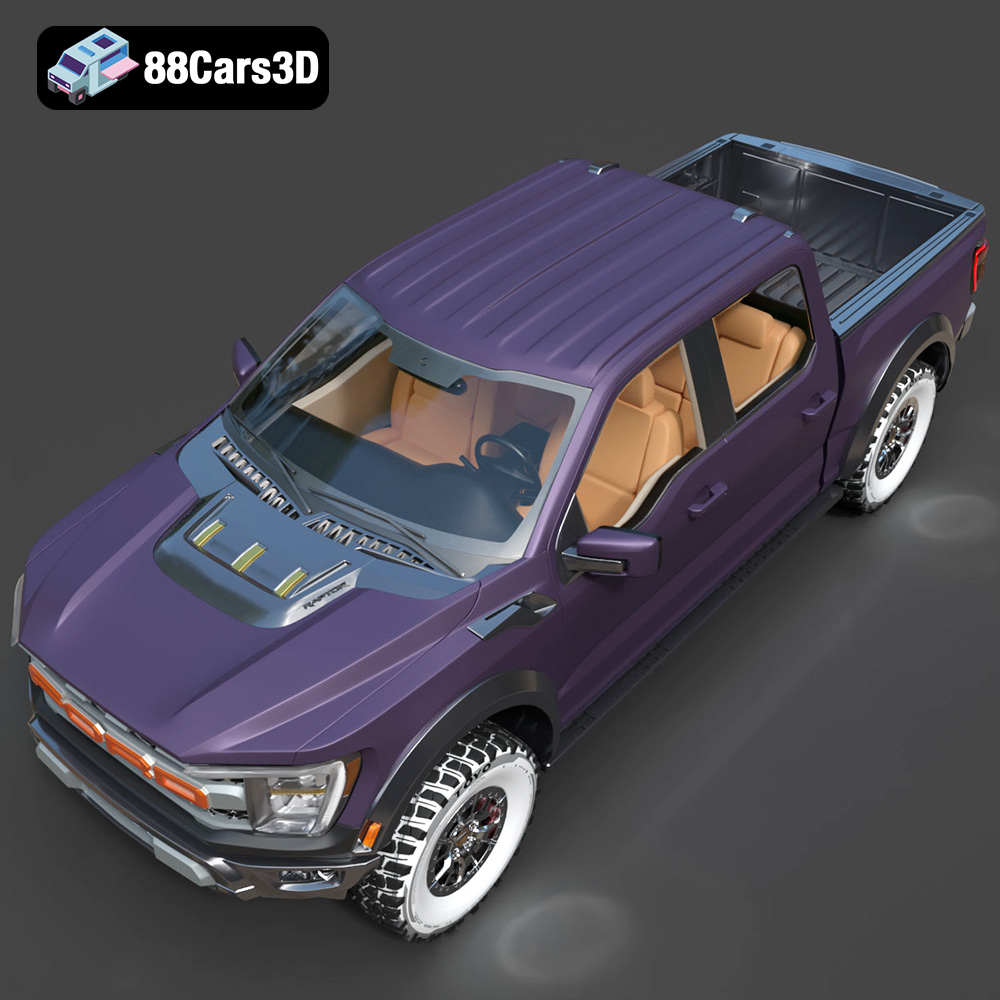
The exterior of the 2021 Raptor is a masterclass in aggressive design and functional engineering. This 3D model meticulously replicates every element. You’ll find the iconic massive blacked-out “FORD” grille, complete with integrated amber LED marker lights, that dominates the front fascia. The fighter-jet-inspired functional heat extractors on the power dome hood and side fenders are not just textures but geometrically accurate forms, allowing for precise light interplay and shadowing. The highly detailed 17-inch forged aluminum beadlock-capable wheels are accurately portrayed, wrapped in massive 37-inch BFGoodrich All-Terrain T/A KO2 tires, where even the intricate tread patterns are modeled rather than simply textured. This level of geometric detail is critical for realistic deformation and interaction with terrain in animation. Crucially, the undercarriage is fully detailed, showcasing the revolutionary five-link rear suspension, Panhard rod, and next-generation FOX™ Live Valve shocks. Separate components for wheels, steering, doors, and suspension linkages mean advanced mechanical rigging is not just possible, but encouraged, for dynamic simulations and animations.
While the Raptor is celebrated for its exterior prowess, its interior is a blend of rugged functionality and modern technology. The 3D model captures this with an authentic, driver-focused cabin layout. Artists will appreciate the highly detailed dashboard, featuring the 12.0-inch SYNC 4 digital center touchscreen and the 12.4-inch digital instrument cluster. The premium front seating geometry is meticulously mapped for either leather or the optional Recaro bucket seats with Alcantara inserts, ensuring convincing material application. The distinctive Raptor-branded steering wheel, complete with large aluminum paddle shifters and the signature race-car-style top centering mark, adds another layer of authenticity. Even the innovative fold-flat stowable gear shifter on the center console is present. This optimized interior geometry is explicitly tailored for high-resolution first-person POV renders, making it perfect for virtual tours or immersive game cutscenes.
With 4,901,410 vertices, 13,601,689 edges, and 8,732,500 faces/triangles, this model’s topology is dense beyond typical production standards. This “ultra-high-poly” nature means that virtually every detail is modeled geometry, not just bump or normal maps. This results in zero faceting, even on curved surfaces, and flawless light interaction. For automotive rendering, this translates directly to superior reflections, refractions, and global illumination, making the vehicle look physically plausible under any lighting condition. The dense mesh allows for extreme close-up magnification without any loss of fidelity, revealing the fine textures of materials and the subtle curves of the bodywork. It’s a “hero” asset, designed to be the focal point of any scene, delivering visual richness that simpler models cannot achieve.
The Ford F-150 Raptor 2021 Ultra High-Poly 3D Model isn’t just a static display piece; it’s a powerful tool designed to integrate seamlessly into diverse professional 3D pipelines. Its robust construction and detailed file format options facilitate high-end output across various rendering and animation platforms.
For high-end automotive rendering, the industry often relies on powerful engines like V-Ray, Corona Renderer, and Arnold. The Ford F-150 Raptor model is built for compatibility with these leading renderers, often coming with pre-configured material setups for optimal visual fidelity. In 3ds Max, for instance, artists can load the .max file and immediately leverage the detailed geometry with V-Ray’s physically-based lighting for hyper-realistic automotive showcases. Corona Renderer users will find its intuitive workflow complements the model’s rich detail, allowing for rapid iteration of lighting and material studies. Arnold, favored in cinematic VFX, can take advantage of the dense mesh to produce incredibly accurate global illumination and reflections, crucial for integrating the vehicle into live-action plates or creating stunning CG environments. The sheer poly count means that even minute details like tire sidewall text or grille mesh will catch light realistically, without relying on problematic normal maps that can break down under extreme close-ups or unusual angles.
The model’s intelligent segmentation—with separate components for wheels, steering, doors, and suspension linkages—makes it an animator’s dream. In 3ds Max or Blender (using the respective .max or .blend files), artists can set up complex rigs to articulate the suspension, allowing for realistic off-road vehicle dynamics. Imagine a cinematic sequence where the Raptor’s FOX Live Valve shocks compress and extend over rough terrain, with every spring and pivot point moving accurately. The proper pivot setup for steering and wheel rotation further simplifies the rigging process, enabling artists to simulate turns and drifts with ease. This attention to mechanical detail saves countless hours of modeling and rigging, letting animators focus on performance and storytelling. Such a detailed 3D car model is invaluable for automotive commercials, product demonstrations, or even action-packed short films.
The Ford F-150 Raptor model is described as the “absolute gold standard as a primary hero vehicle in commercial VFX.” This isn’t an exaggeration. In visual effects, hero assets need to stand up to extreme scrutiny, often appearing in slow motion, close-up, or interacting directly with practical effects. The model’s uncompromised detailing, from the functional heat extractors to the intricate undercarriage, ensures it holds up perfectly. VFX artists can integrate this 3D car model into live-action plates using techniques like camera tracking and HDR environment lighting, achieving seamless composites. Its high poly count eliminates the need for displacement mapping in many areas, simplifying shader networks and ensuring consistent detail across all views. For projects demanding the highest level of realism, such as high-octane cinematic off-road showcases or premium commercial advertisements, this model provides the foundational quality necessary to achieve stunning, believable results.
While the Ford F-150 Raptor 2021 Ultra High-Poly 3D Model excels in high-fidelity rendering, its versatility extends to other exciting applications. However, its significant poly count necessitates strategic considerations for real-time environments and offers unique advantages for physical manifestations.
At 8.73 million triangles, the Ford F-150 Raptor is an extremely heavy asset, generally exceeding the typical polygon budgets for standard real-time game engines or mobile/VR applications. However, this model finds its perfect home in cutting-edge engines like Unreal Engine 5, particularly when leveraging its Nanite virtualized geometry system. Nanite is designed to handle immense geometric detail, allowing artists to import and render cinematic-quality assets without manual optimization, LOD generation, or normal map baking. This means the Raptor’s full, uncompromised detail, including its intricate suspension and tire treads, can be rendered in real-time within a Nanite-enabled environment, perfect for next-generation game cinematics, high-fidelity virtual production, or interactive experiences on powerful hardware. For traditional game development, using engines without Nanite or for platforms with lower specifications, this asset would require significant manual retopology, UV remapping, and texture baking to generate a game-ready low-poly version, a process that is time-consuming but feasible given the pristine high-poly base.
The ultra-high-poly topology of this Ford F-150 Raptor 3D model makes it an absolutely incredible base for highly detailed, large-scale 3D prints. Hobbyists and professionals seeking to create custom RC crawler bodies (e.g., 1:10 or 1:8 scale) or display-scale diecast hobbyist prints will find this model exceptionally suitable. The modeled details, such as suspension springs, beadlock bolts, and grille mesh, will translate directly into physical geometry, a feat often impossible with lower-poly models that rely on texture maps for such details. For best results, resin printing is strictly recommended to capture these fine intricacies, with specific settings like 0.04–0.08 mm layer height. Extensive supports are required for complex areas like the undercarriage, FOX shocks, and mirrors, but the end result is a physically accurate, highly detailed replica. Post-processing with sanding, primer, and iconic Ford Raptor paint finishes can bring this digital masterpiece to life in the physical world.
The inclusion of the .glb format opens doors for interactive experiences in AR and VR. While the native ultra-high-poly version is too heavy for most real-time AR/VR applications, a strategically optimized derivative from this base model could be exported as .glb. This format, known for its efficiency in web and mobile contexts, allows for rapid loading and display of 3D content. Imagine an interactive showroom experience on a website, allowing users to spin, zoom, and inspect the Raptor, or an AR application that places the digital truck realistically into your physical environment. The high-fidelity source provides the perfect foundation for creating multiple levels of detail, ensuring that even the optimized AR/VR version retains the core aesthetics and recognized features of the mighty Raptor.
Investing in ultra-high-poly 3D models like the Ford F-150 Raptor 2021 from 88cars3d.com offers distinct strategic advantages for professionals. It’s not just about a higher number of polygons; it’s about unlocking levels of detail, realism, and creative flexibility that simpler assets simply cannot provide.
The primary advantage of an ultra-high-poly model is its unparalleled ability to achieve photorealism. With over 8.7 million triangles, every curve, every edge, and every intricate mechanical component of the Ford F-150 Raptor is represented by actual geometry. This eliminates the visual artifacts (faceting, stretching) that often plague lower-poly models, especially when viewed up close. For professional automotive rendering, where the expectation is indistinguishable from reality, this fidelity is non-negotiable. Reflections on paintwork, the intricate weave of tire treads, the delicate springs within the FOX shocks – all benefit from true geometric representation. This means artists can push in for extreme macro shots without compromise, showcasing the exquisite detail of the engineering, which is crucial for high-impact marketing materials and cinematic sequences.
While an ultra-high-poly model might seem daunting, it often streamlines the workflow for experienced artists. Instead of spending valuable time sculpting minute details, creating complex normal maps, or battling shading artifacts, artists can focus directly on lighting, texturing, animation, and scene composition. The model’s clean topology and proper pivot setups mean less time wrestling with technical issues and more time on creative iterations. For instance, the separate mechanical components (wheels, steering, suspension) are pre-separated and ready for rigging, bypassing a labor-intensive preparation stage. This efficiency allows studios to deliver higher quality results in shorter timeframes, making such assets a wise investment for demanding projects.
High-fidelity assets are inherently more future-proof. As rendering technologies advance, and computational power increases, these detailed models will continue to shine. With the advent of technologies like Unreal Engine’s Nanite, assets once considered too heavy for real-time are now directly usable. A meticulously modeled 3D car model like the Ford F-150 Raptor serves as an excellent master asset from which optimized versions (e.g., lower poly for specific game engines or AR/VR) can be derived without compromising the original source quality. This ensures that your digital library remains relevant and capable of meeting the demands of tomorrow’s visualization standards.
Beyond its inherent detail, a premium 3D model like the Ford F-150 Raptor 2021 offers extensive customization potential, empowering artists to tailor it precisely to their creative vision and project requirements.
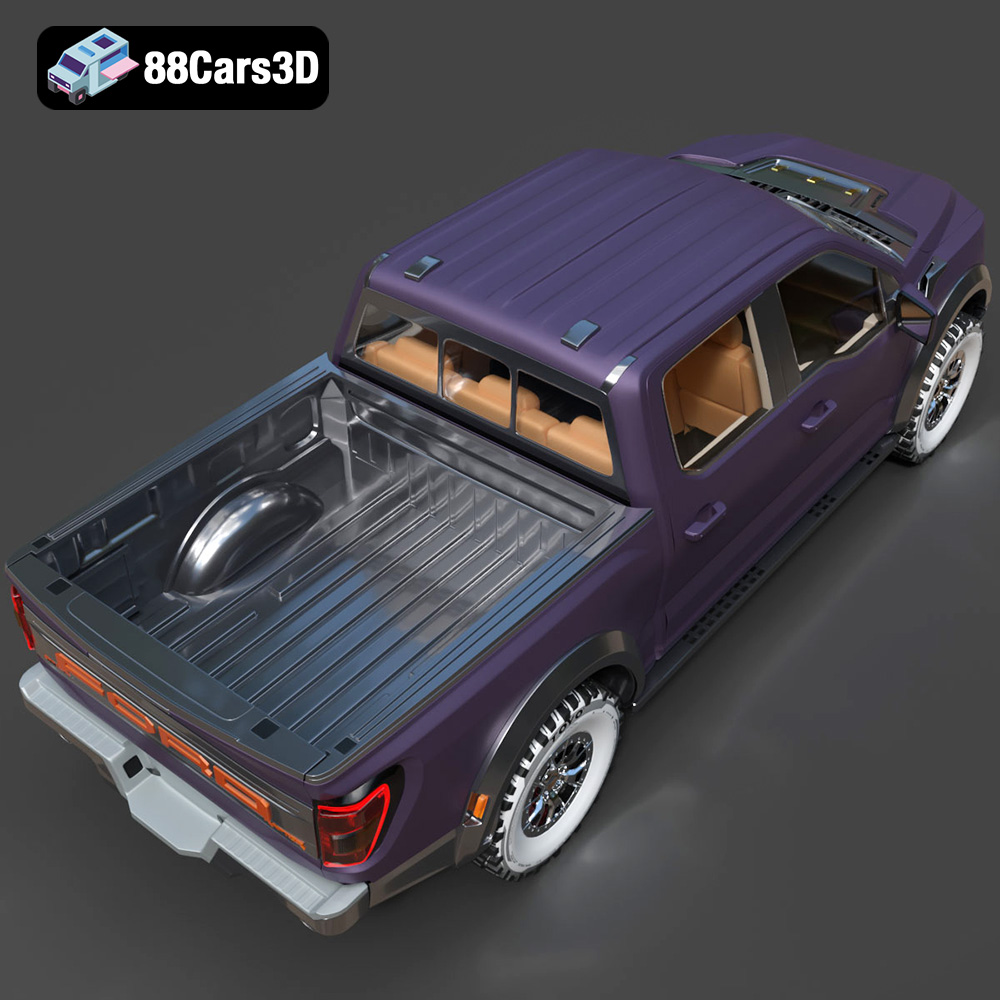
The model provides a robust foundation for extensive customization. Artists can easily apply distinctive Raptor graphics packages, such as the “37” bed side graphics or custom hood decals, to reflect various trim levels or aftermarket aesthetics. The geometry is clean enough to allow for changes to the exterior styling, configuring it to match the standard 35-inch tire setup or the extreme Raptor 37 Performance Package with its larger wheels and tires. Beyond cosmetics, the model’s detailed construction allows for potential modifications like adapting the truck bed to include the 2.0-kW Pro Power Onboard generator or a modular bed storage system, adding layers of functional realism. This flexibility makes it an invaluable asset for showcasing different product configurations or custom builds in automotive marketing and visualization projects.
The Ford F-150 Raptor’s aggressive persona is perfectly suited for dynamic environments. The model integrates flawlessly with High Dynamic Range Images (HDRIs) to create incredibly realistic lighting and reflections. Artists can adapt HDRIs for bright, dusty Baja desert environments, recreating the Raptor’s natural habitat for an epic off-road cinematic. Alternatively, moody studio lighting with precise reflections can highlight the vehicle’s design details for a premium commercial look. The model’s accurate material setups mean that reflections will behave as they would in the real world, whether it’s the metallic sheen of the paint or the matte finish of the blacked-out grille. This adaptability ensures that the Raptor can be presented in any context, from raw wilderness to polished showroom, with convincing visual fidelity.
The Ford F-150 Raptor 2021 is a triumph of modern engineering, and its digital counterpart, the Ford F-150 Raptor 2021 Ultra High-Poly 3D Model, is equally impressive. With its staggering 8.73 million triangles, meticulous detailing of both exterior and interior, and accurate mechanical components, this 3D car model represents the pinnacle of digital automotive artistry. It serves as an unparalleled hero asset for cinematic VFX, premium automotive rendering, and advanced visualization projects. While its high poly count makes it ideal for cutting-edge platforms like Unreal Engine 5 Nanite or detailed 3D printing, it also provides a robust, future-proof foundation for any project requiring absolute visual fidelity.
For professionals seeking to elevate their automotive rendering, create immersive virtual experiences, or produce stunning physical prototypes, this model offers a distinct advantage. Its comprehensive file format support, including .blend, .fbx, .obj, .glb, .stl, .ply, .unreal, and .max, ensures compatibility across diverse production pipelines. Experience the power of uncompromised detail and elevate your next project. Explore this exceptional 3D model and many other high-quality assets today at 88cars3d.com.
The Ford F-150 Raptor 2021 3D Model is an uncompromising, ultra-high-detail digital recreation of the third-generation apex desert predator. Built to conquer the harshest off-road environments at high speeds, the 2021 Raptor marries trophy-truck capability with an aggressive, jet-inspired widebody design. This 3D model meticulously captures the sheer brutality and complex engineering of the modern Raptor. It features the massive blacked-out “FORD” grille, functional heat extractors on the hood and fenders, Rigid™ LED off-road fog lamps, and dual active exhaust tips. Most importantly for a model of this caliber, the undercarriage is fully detailed, showcasing the revolutionary five-link rear suspension, Panhard rod, and next-generation FOX™ Live Valve shocks. Built with an unbelievably dense and uncompromised topology (over 8.7 million triangles), it delivers absolute photorealism. This model is engineered to hold up to the most extreme close-up macro shots of both the exterior body and the complex mechanical underbelly. Perfect for high-octane cinematic off-road showcases, premium commercial VFX, heavy-duty automotive visualization, and extreme-detail 3D printing.
$29.99
.4×4
.automotive
.blend
.fbx
.ford
.obj
.raptor
.rendering
2021-ford
3d printing
car-3d-model
f-150
f150-raptor
hero-car
high poly
off-road
pickup-truck
vfx