Get 50% OFF All Premium 3D & STL Models!

Few vehicles ignite the imagination quite like a classic American muscle car. The rumble of its engine, the bold lines, the sheer presence—it’s an era captured in steel and chrome. Among these legends, the 1969 Chevrolet Chevelle SS stands tall, a true icon of automotive design and raw power. Its aggressive styling and V8 performance cemented its place in history, making it a dream machine for enthusiasts and collectors alike.
Today, the allure of the Chevelle SS extends beyond physical showrooms and open roads. Through the power of 3D modeling, this timeless classic can be brought to life in digital realms, offering unparalleled opportunities for visualization, interactive experiences, and even tangible replicas. Imagine incorporating this automotive masterpiece into a stunning rendered scene, a thrilling game environment, an immersive AR/VR experience, or even holding a meticulously detailed 3D-printed miniature. This is precisely where a high-quality asset like the Chevrolet Chevelle SS 1969 3D Model truly shines, providing a robust foundation for a multitude of creative and professional applications.
In this comprehensive guide, we’ll delve into the technical intricacies and creative potential of utilizing such a sophisticated 3D automotive asset. We’ll explore various professional workflows, from high-fidelity rendering to real-time game integration and even the fascinating world of 3D printing. Join us as we unlock the full capabilities of this digital legend and see how it can elevate your projects.
The versatility of a 3D model often hinges on its availability in various file formats, each tailored for specific software, engines, or end-use cases. The Chevrolet Chevelle SS 1969 3D Model is exemplary in its extensive format support, ensuring seamless integration into virtually any pipeline. Understanding these formats is crucial for optimizing your workflow and achieving your project goals.
The .blend format is Blender’s native file type. It encapsulates an entire Blender project, including the 3D model, materials, textures, lighting, cameras, animation data, and even scene settings. For users deeply integrated into the Blender ecosystem, a .blend file offers maximum flexibility. You can open it directly in Blender and immediately start modifying geometry, tweaking shaders using Cycles or Eevee, setting up complex animation sequences, or optimizing the scene for specific rendering needs. The Chevelle SS provided as a .blend ensures that Blender artists can leverage the full power of their preferred software with all elements pre-configured for an optimal starting point.
As a proprietary format developed by Autodesk, .fbx (Filmbox) has become an industry standard for exchanging 3D data between different software applications. Its strength lies in its ability to store not just mesh data, but also animation, cameras, lights, and skeleton information. This makes it ideal for pipelines involving Unreal Engine, Unity, 3ds Max, Maya, and Blender, among others. When using the Chevelle SS .fbx, you can expect well-preserved hierarchies, proper pivot points for animation (like wheels and steering), and often embedded material/texture references, making it perfect for game development or complex cinematic animation sequences.
The .obj (Wavefront OBJ) format is one of the oldest and most universally supported 3D file formats. It’s a simple, text-based format primarily used for exchanging geometric data, including vertices, normals, UV coordinates, and groups of polygons. While it doesn’t typically store animation or complex material definitions (it references .mtl files for basic material properties), its strength is unparalleled cross-software compatibility. For static renders, 3D printing preparation, or when you simply need the raw mesh data of the Chevelle SS to import into an application without complex features, .obj is a reliable choice.
.glb (GL Transmission Format Binary) is rapidly gaining traction as the go-to format for efficient transmission and loading of 3D scenes and models in web and real-time applications, particularly AR/VR. It’s a binary version of glTF, combining the model data, textures, and animations into a single, self-contained file. This optimization for performance and file size makes the Chevelle SS .glb perfect for deployment in browser-based configurators, immersive augmented reality experiences on mobile devices, or virtual reality showrooms where loading speed and lightweight assets are paramount.
.stl (STereoLithography) is the undisputed king of 3D printing formats. It represents a 3D model as a series of connected triangles (a triangulated surface), defining only the surface geometry of an object without color, texture, or other CAD attributes. Its simplicity ensures compatibility with virtually all 3D printers and slicing software. The Chevelle SS provided as an .stl is specifically prepared for additive manufacturing, ensuring a “manifold” mesh (watertight with no holes or self-intersections) that translates directly into a physical object. This format is crucial for creating tangible scale models or prototypes of the classic car.
The .ply (Polygon File Format or Stanford Triangle Format) is another format that stores geometric data, similar to .obj but often with more flexibility to include properties like color, transparency, and range data (for 3D scanners). While less common than .obj for general exchange, it’s often favored in academic research, 3D scanning, and applications where precise vertex properties or mesh analysis are important. For specialized CAD workflows or detailed surface analysis of the Chevelle SS, the .ply format can be a valuable asset.
The .unreal designation implies an asset specifically prepared or packaged for direct import and optimal performance within the Unreal Engine. While not a native Unreal file extension in the traditional sense (Unreal typically imports .fbx and creates its own uasset files), its inclusion signifies a pre-optimized, engine-ready asset. This might involve optimized polygon counts, collision meshes, material setups, and pivot configurations tailored for Unreal’s rendering pipeline. The Chevelle SS in this format allows Unreal developers to hit the ground running, minimizing setup time and maximizing performance within their projects.
Similar to .blend for Blender, .max is the native project file format for Autodesk 3ds Max. It stores all scene information, including the Chevelle SS model geometry, materials, lighting, cameras, animations, and any specific 3ds Max modifiers or plugins used. For professionals using 3ds Max for architectural visualization, advanced rendering with V-Ray or Corona, or detailed automotive animation, the .max file provides the most complete and editable version of the model, allowing for deep customization and seamless integration into existing 3ds Max workflows.
By offering the Chevrolet Chevelle SS 1969 3D Model in this diverse range of formats, 88cars3d.com ensures that creators, regardless of their software preference or project requirements, have the right tools to bring this digital legend to life.
A truly exceptional 3D model goes beyond basic geometry; it captures the essence and intricate details of its real-world counterpart. The Chevrolet Chevelle SS 1969 3D Model is a testament to this philosophy, meticulously designed to replicate every curve, chrome accent, and interior element that made the original car an icon. Its technical craftsmanship ensures it’s not just visually stunning but also highly functional across various digital applications.
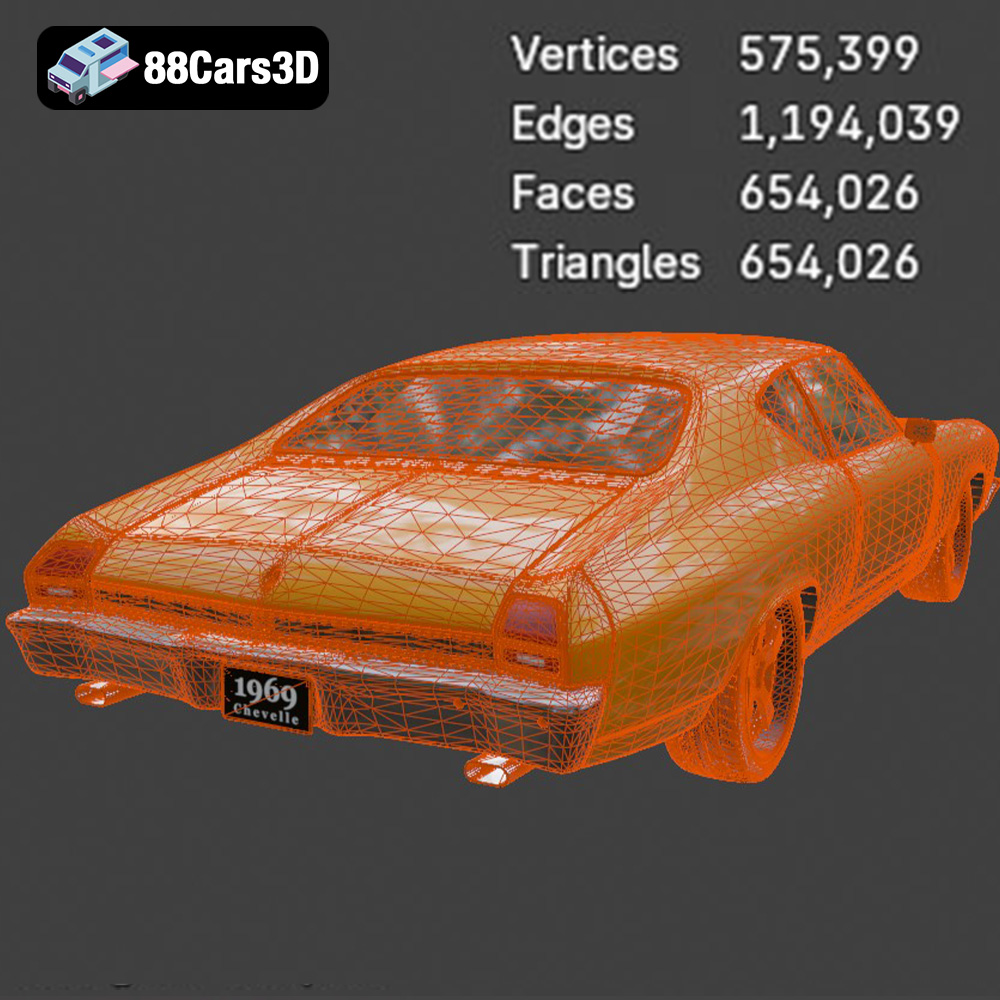
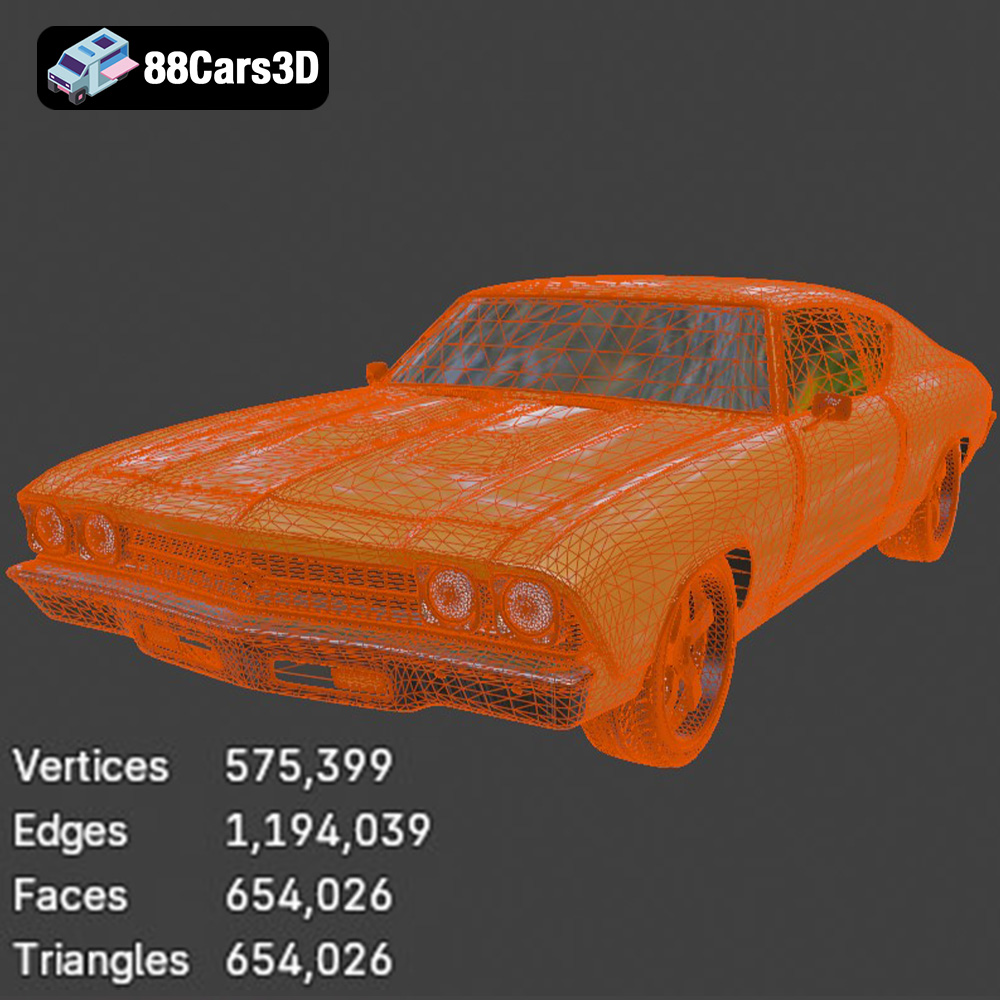
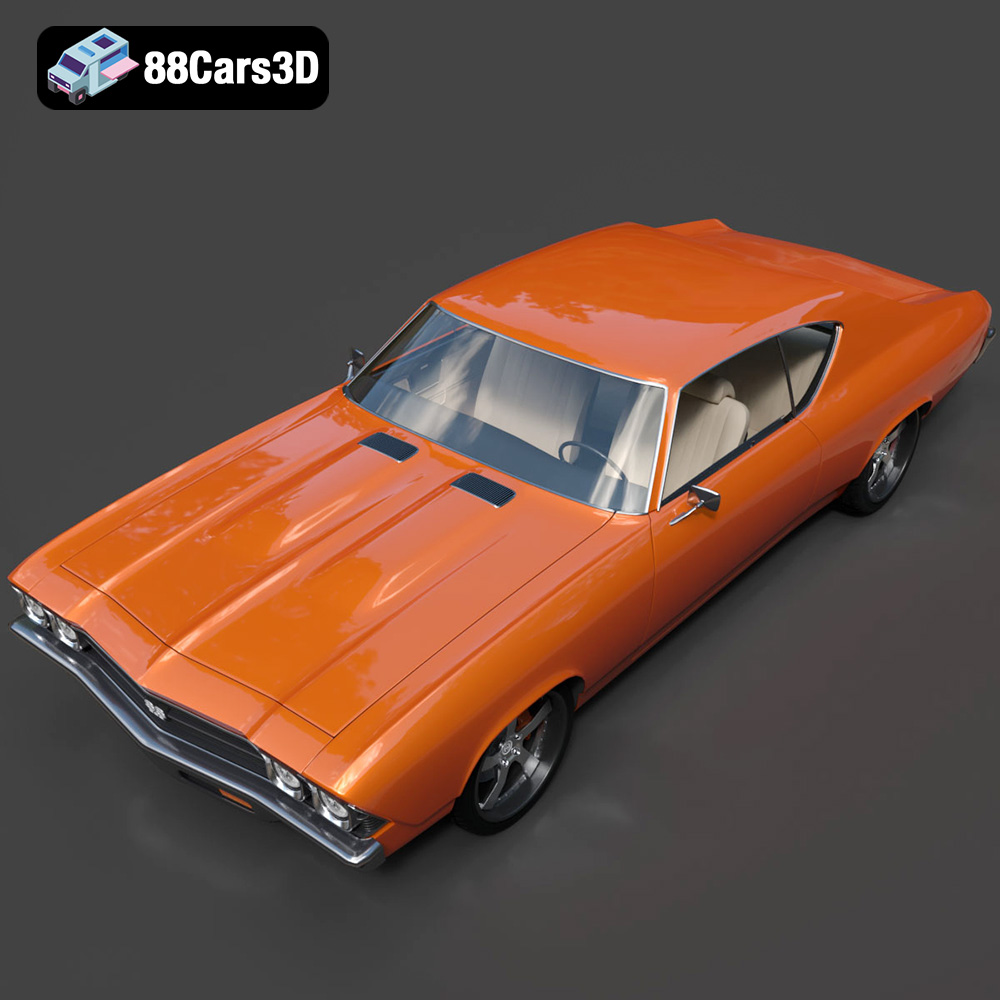
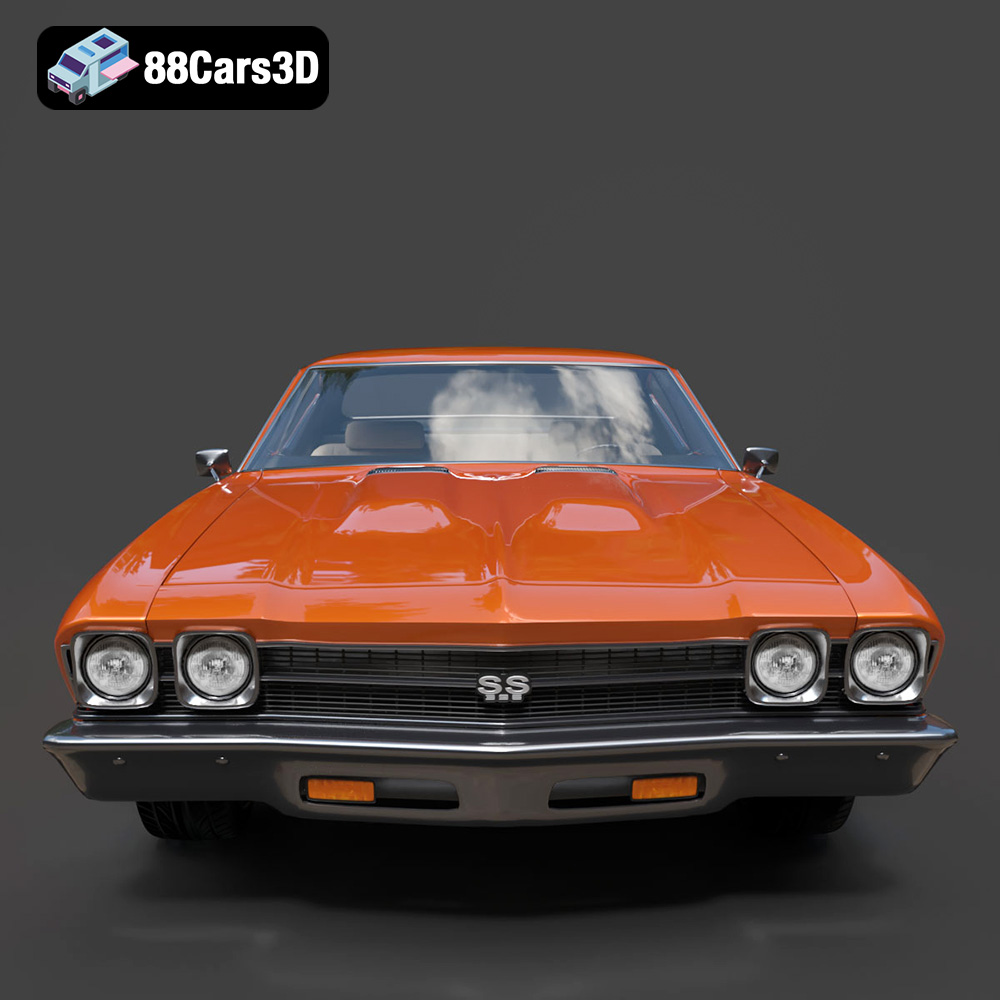
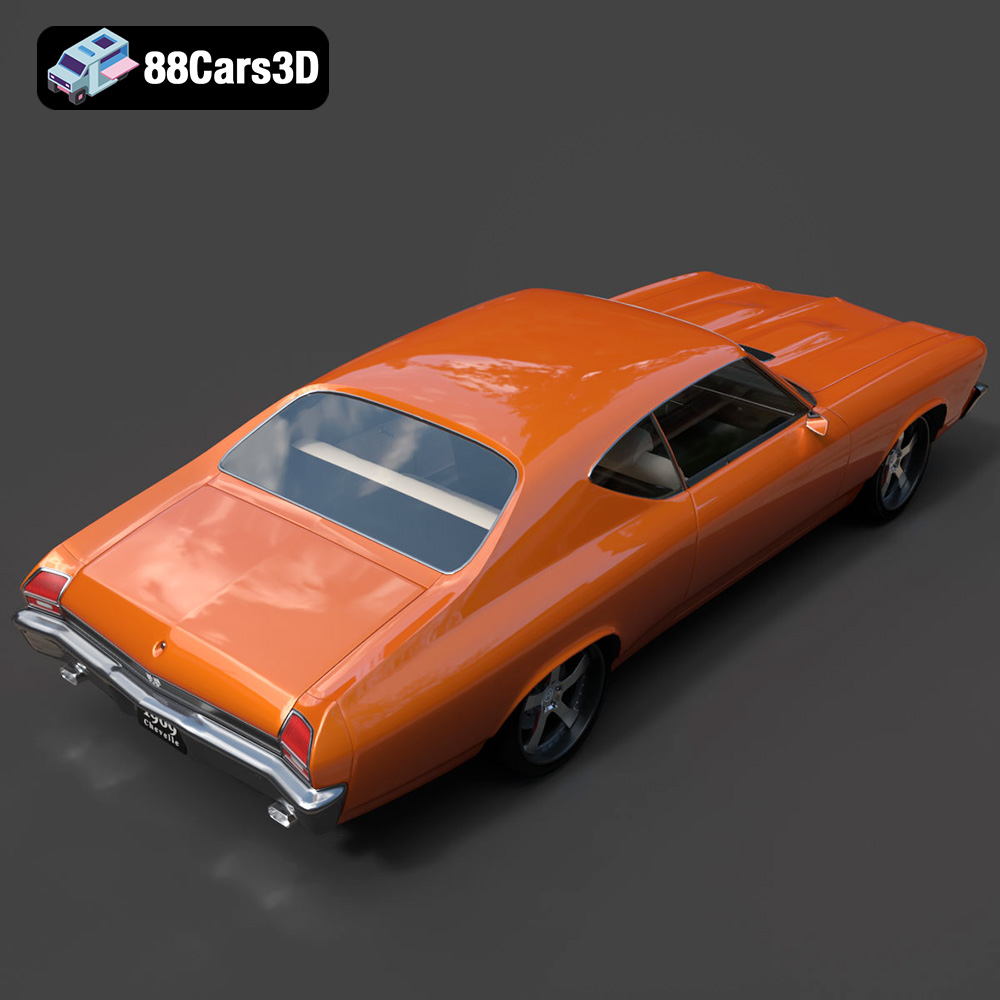
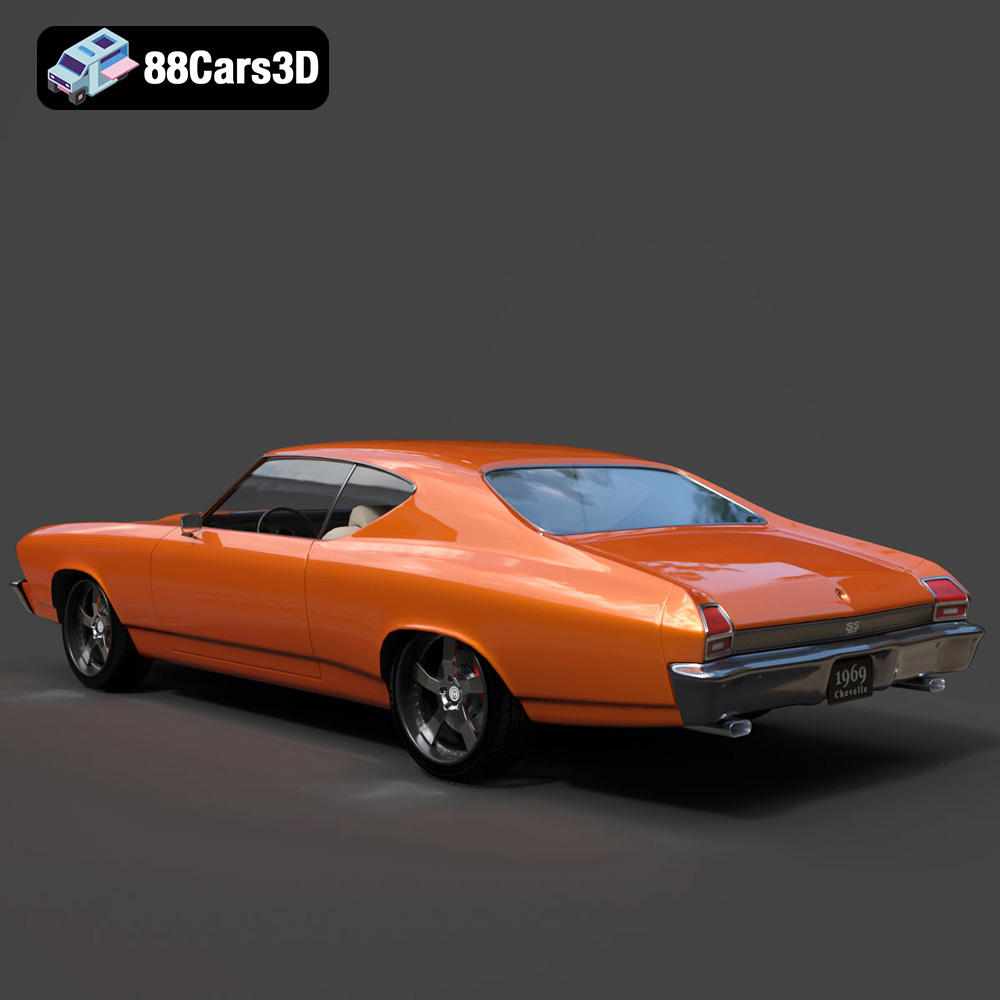
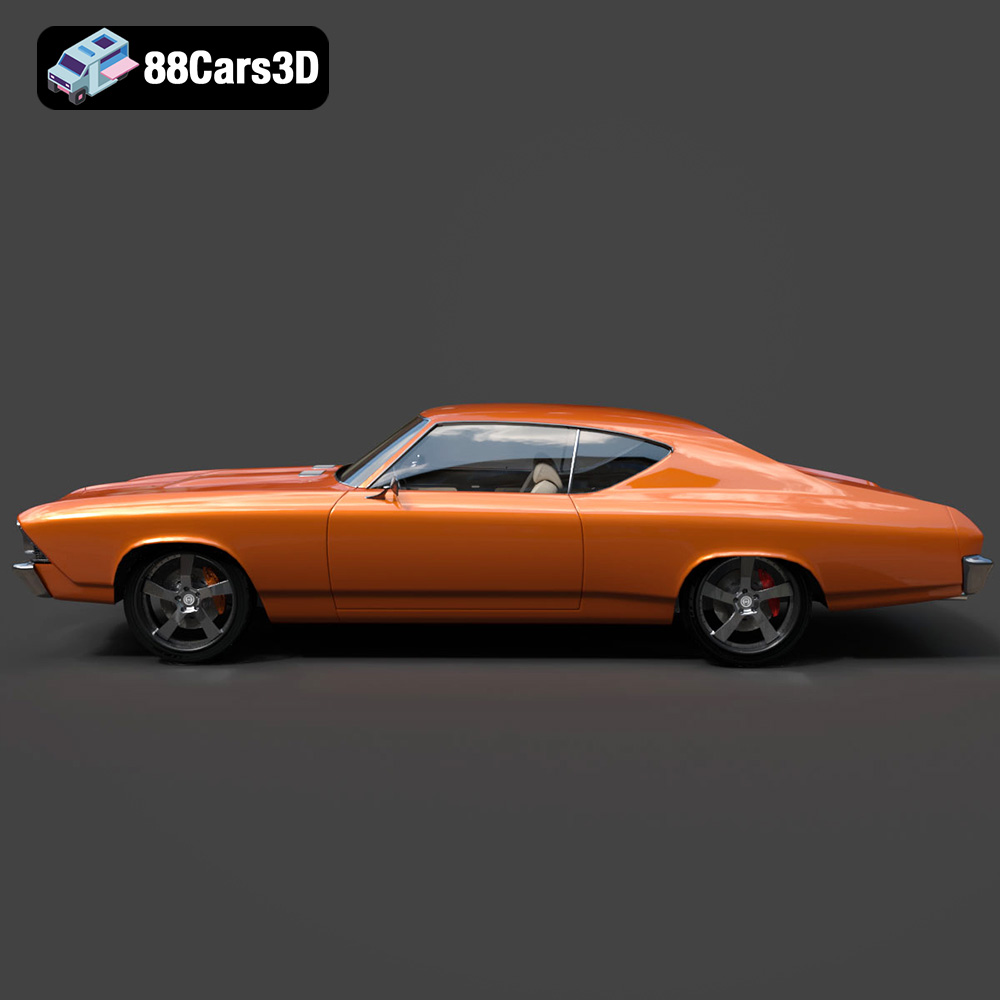
The exterior of the 1969 Chevelle SS is instantly recognizable, and the 3D model spares no effort in recreating its distinct character. The accurate body proportions, from the long hood to the short deck, are faithfully represented, giving the model its authentic muscle car stance. Key features like the detailed dual headlight front grille, chrome front and rear bumpers, and the muscular body lines are all meticulously sculpted. The model even includes the sculpted hood with optional cowl induction styling, a hallmark of the SS performance trim. Furthermore, critical details such as the SS badging and trim, classic muscle car wheels with intricate tire tread, transparent glass materials, and mirror detailing are all present, ensuring a level of realism perfect for high-fidelity automotive rendering and visualization projects. The clean topology and real-world scale accuracy mean that when this model is dropped into a scene, it immediately feels right, ready for close-up shots or integration into larger environments.
While the exterior often grabs the initial attention, a truly complete automotive 3D model must offer an equally compelling interior. The Chevelle SS 1969 3D Model’s interior is a journey back in time, featuring a vintage dashboard complete with analog gauges, a classic steering wheel design, and bucket seat geometry with visible stitching detail. The center console and gear shifter are accurately represented, along with the door panels and interior trim. This attention to internal detail is crucial for immersive experiences in AR/VR, realistic cockpit views in game development, or cinematic shots that peer into the car’s cabin. Optimized geometry ensures that even with this level of detail, the model performs efficiently in both real-time engines and high-quality rendering setups, striking a perfect balance between visual fidelity and technical performance.
Beyond aesthetics, the technical construction of a 3D model dictates its usability. The Chevelle SS model boasts a clean and well-organized mesh structure, which is fundamental for smooth subdivision, easy material assignment, and trouble-free modification. Real-world scale accuracy is maintained, ensuring consistency when integrating the model with other assets or into real-world simulations. A critical advantage for any animated vehicle is the proper pivot setup for steering and wheel rotation. This feature allows animators and game developers to effortlessly implement realistic driving dynamics without extensive re-rigging. The optimized polygon flow is a significant technical advantage, balancing visual complexity with performance efficiency, making it suitable for both high-end cinematic renders and demanding real-time applications. This robust technical foundation ensures that the model is compatible with major 3D software platforms and game engines, making it a versatile asset for any professional workflow.
The Chevrolet Chevelle SS 1969 3D Model isn’t just a static digital sculpture; it’s a dynamic asset designed to integrate seamlessly into diverse professional pipelines. Its careful construction and wide format support enable its use in everything from breathtaking visual effects to interactive simulations.
For automotive artists and visualization studios, the Chevelle SS model offers an incredible canvas for high-fidelity rendering. In a software like 3ds Max, artists can import the .max or .fbx file, leveraging powerful renderers such as V-Ray or Corona. The workflow typically begins by setting up an environment: a studio backdrop, a stylized urban street, or a scenic drive. Next, realistic lighting is crucial—this could involve HDRI (High Dynamic Range Image) maps for global illumination, coupled with targeted area lights to highlight specific curves or chrome details. Materials are then assigned using a Physical Based Rendering (PBR) workflow, ensuring that the metallic paint, polished chrome, and rubber tires react accurately to light. This involves creating complex shaders for reflections, refractions (for glass), and subtle imperfections. The clean mesh structure of the Chevelle SS allows for smooth subdivision for close-up renders, and its accurately separated components (like wheels and steering) enable dynamic poses for stunning marketing visuals or cinematic sequences.
Game developers seeking to inject classic muscle into their virtual worlds will find the Chevelle SS 3D Model an invaluable asset. Using the .fbx or the dedicated .unreal format, developers can import the model directly into engines like Unreal Engine or Unity. The process involves creating material instances based on the provided textures, ensuring the vehicle’s appearance is consistent with the game’s art style. Critical steps include setting up collision meshes for realistic physical interaction, configuring Level of Detail (LOD) models to maintain performance across different viewing distances, and integrating the pre-set pivot points into the game’s vehicle blueprint for accurate wheel rotation and steering. For an open-world driving game, the Chevelle SS can be a player’s iconic ride, while in a drag racing simulator, its authentic proportions and detail contribute significantly to immersion. The optimized polygon flow of the model is key here, ensuring smooth framerates even with multiple vehicles on screen or in demanding VR environments.
The growing fields of Augmented Reality (AR) and Virtual Reality (VR) present exciting new ways to experience classic cars. The Chevelle SS 1969 3D Model, particularly in its .glb format, is perfectly suited for these immersive applications. Imagine a virtual showroom where potential buyers can walk around the 1969 Chevelle SS, open its doors, examine the interior in 360 degrees, and even customize its paint job in real-time. For AR, the model can be placed directly into a real-world environment through a smartphone or tablet, allowing users to park a digital Chevelle in their driveway or on their desk. Developers can use frameworks like Google ARCore or Apple ARKit, combined with web-based viewers or dedicated VR applications, to create interactive experiences. The model’s clean geometry and efficient texture maps ensure smooth performance and a high level of detail, providing a truly engaging and memorable encounter with this automotive legend.
While digital visualization offers boundless possibilities, there’s a unique satisfaction in holding a physical representation of a digital design. The Chevrolet Chevelle SS 1969 3D Model goes a step further by being prepared for 3D printing, allowing enthusiasts and professionals to bring this muscle car into the real world as a collectible scale model or display piece.
The journey from digital 3D model to physical object relies heavily on the quality and preparation of the model for additive manufacturing. The .stl format is the industry standard for 3D printing, and the Chevelle SS model is carefully engineered to convert seamlessly into this format. A critical aspect is ensuring the mesh is “manifold”—meaning it’s a completely enclosed, watertight surface with no gaps, internal geometry, or overlapping faces. This allows the slicing software to correctly interpret the model and generate toolpaths for the 3D printer. Scaling is also a key consideration; the product recommends popular scales such as 1:32, 1:24, 1:18, and 1:12, giving users flexibility depending on their desired size and level of detail. Before printing, users should always perform a final check using their chosen slicing software to identify and fix any potential mesh errors, although a high-quality model like the Chevelle SS from 88cars3d.com significantly reduces this risk.
Achieving a high-quality 3D print of the Chevelle SS requires careful attention to print settings. For FDM (Fused Deposition Modeling) printers, recommended layer heights of 0.10–0.16 mm balance detail with print time, while wall thicknesses of 1.5–2.5 mm ensure structural integrity. An infill of 15–25% typically provides sufficient strength without excessive material usage. Supports are almost always necessary for complex automotive designs, especially for overhangs like side mirrors, bumper edges, and intricate undercarriage details. The recommended print orientation—body printed angled for a smooth surface finish and wheels printed separately—is crucial for minimizing visible layer lines and achieving superior detail. For even finer details, especially at smaller scales, resin (SLA/DLP) printing is often recommended, as it can achieve much thinner layers and sharper features. Once printed, post-processing is where the model truly comes to life. This involves sanding to smooth surfaces, applying a primer, and then a skillful paint job, perhaps a classic red or black with a high-gloss muscle-car finish, and meticulous chrome detailing to replicate the original vehicle’s luster.
The ability to 3D print the Chevelle SS opens up a world of creative and practical applications. Hobbyists can create stunning collectible scale models for display in their homes or offices, showcasing their passion for classic cars. Model enthusiasts can integrate these prints into elaborate dioramas, recreating iconic drag race scenes or retro urban environments. For designers and engineers, a 3D printed Chevelle can serve as a physical prototype, allowing for tangible assessment of form and proportion before larger-scale manufacturing. Educators can use these models for automotive history visualization or mechanical study projects, providing students with a hands-on learning experience. Furthermore, the capacity for customization means each printed Chevelle can be unique, reflecting individual preferences in color, trim, and even specific racing liveries, making it a truly personal and engaging project.
The true power of a versatile 3D asset like the Chevrolet Chevelle SS 1969 3D Model lies not just in its accurate representation, but in its inherent flexibility for customization. Artists and developers can go beyond a simple render or game asset to create truly unique iterations tailored to their specific vision.
With the Chevelle SS 3D Model, personalization is at your fingertips. Artists can easily change the body color to any hue imaginable—from the iconic classic red and black to deep blues, metallic finishes, or even custom pearlescent paints. The clean UV mapping and material setup facilitate adding racing stripes, SS decals, or custom graphics, allowing for the creation of unique liveries that might represent a specific race team or an individual’s dream car. Furthermore, the model’s structure allows for modification of wheel styles and tire types, enabling artists to swap out classic hubcaps for modern alloys, or street tires for drag slicks, fundamentally altering the vehicle’s character. Adjusting the ride height or configuring a drag racing setup, complete with exaggerated rake or lowered suspension, are also straightforward modifications that can be achieved with relative ease, making the model incredibly adaptable for different visual narratives.
Beyond individual vehicle customization, the Chevelle SS 3D Model excels as a central element in rich scene compositions. Its presence can define the mood and era of an entire environment. Imagine configuring sophisticated lighting for a “sunset boulevard” scene, where the low, golden light catches the Chevelle’s chrome and paintwork, evoking a nostalgic, cinematic feel. Alternatively, a stark, dramatic lighting setup in a dimly lit garage scene could highlight the car’s powerful form and suggest a sense of raw, untamed power. The separated wheels and steering components are not just for basic animation; they allow for dynamic poses that enhance storytelling—a slight turn of the wheel suggests motion, or a subtle lean in a corner implies speed. These details are crucial for creating highly believable marketing visuals, compelling animations, or immersive interactive experiences where the Chevelle SS is the star, inviting viewers and users to engage with its legendary status.
The 1969 Chevrolet Chevelle SS remains an enduring symbol of American automotive prowess and style. Through the intricate and versatile Chevrolet Chevelle SS 1969 3D Model, this legend transcends its physical limitations, offering unparalleled opportunities in the digital and even the tangible realms. From high-fidelity automotive rendering and cinematic sequences to dynamic game development and immersive AR/VR experiences, this model provides a robust, technically sound, and visually stunning foundation.
Its comprehensive file format support, including .blend, .fbx, .obj, .glb, .stl, .ply, .unreal, and .max, ensures compatibility across virtually all professional pipelines. Whether you’re a seasoned 3D artist aiming for photorealistic renders in 3ds Max, a game developer building a new racing title in Unreal Engine, an AR/VR creator crafting interactive showrooms, or a hobbyist eager to 3D print a detailed scale replica, this model is engineered to meet your demanding requirements. The meticulous attention to exterior and interior detail, combined with technical advantages like clean mesh, real-world scale, and optimized pivot setups, positions this Chevelle SS 3D model as a premium asset.
By investing in such a high-quality 3D car model, you’re not just acquiring data; you’re gaining a powerful tool to elevate your projects, inspire creativity, and accurately represent one of history’s most beloved muscle cars. Explore this exceptional model and a wide range of other high-quality 3D car models at 88cars3d.com, and start driving your digital dreams today.
The Chevrolet Chevelle SS 1969 3D Model is a high-detail digital recreation of one of the most iconic American muscle cars of the late 1960s. Known for its aggressive styling, powerful V8 performance, and bold street presence, the 1969 Chevelle SS remains a symbol of classic muscle car heritage. This 3D model accurately represents the long hood and short deck proportions, signature dual headlight front fascia, SS badging, muscular body lines, chrome bumpers, detailed grille, performance wheels, and period-correct interior layout. Built with clean topology and real-world scale accuracy, it is ideal for rendering, animation, automotive visualization, game development, and AR/VR experiences.
$9.99
.1969chevelle
.arvr
.automotive
.blend
.car3dmodel
.chevelle
.chevelless
.chevrolet
.classiccar
.fbx
.gameasset
.glb
.max
.musclecar
.obj
.ply
.rendering
.simulation
.stl
.unreal
.vintagecar