Get 50% OFF All Premium 3D & STL Models!

In the vast landscape of digital content creation, the demand for high-quality, performant 3D assets is ever-present. From the immersive worlds of video games to realistic architectural visualizations and cutting-edge AR/VR experiences, robust 3D models form the backbone of engaging digital narratives. Automotive assets, in particular, hold a special place, often serving as focal points or essential environmental elements that ground virtual realities in a sense of the familiar. Crafting these models requires a delicate balance of artistic fidelity and technical optimization, a challenge expertly met by assets found on platforms like 88cars3d.com.
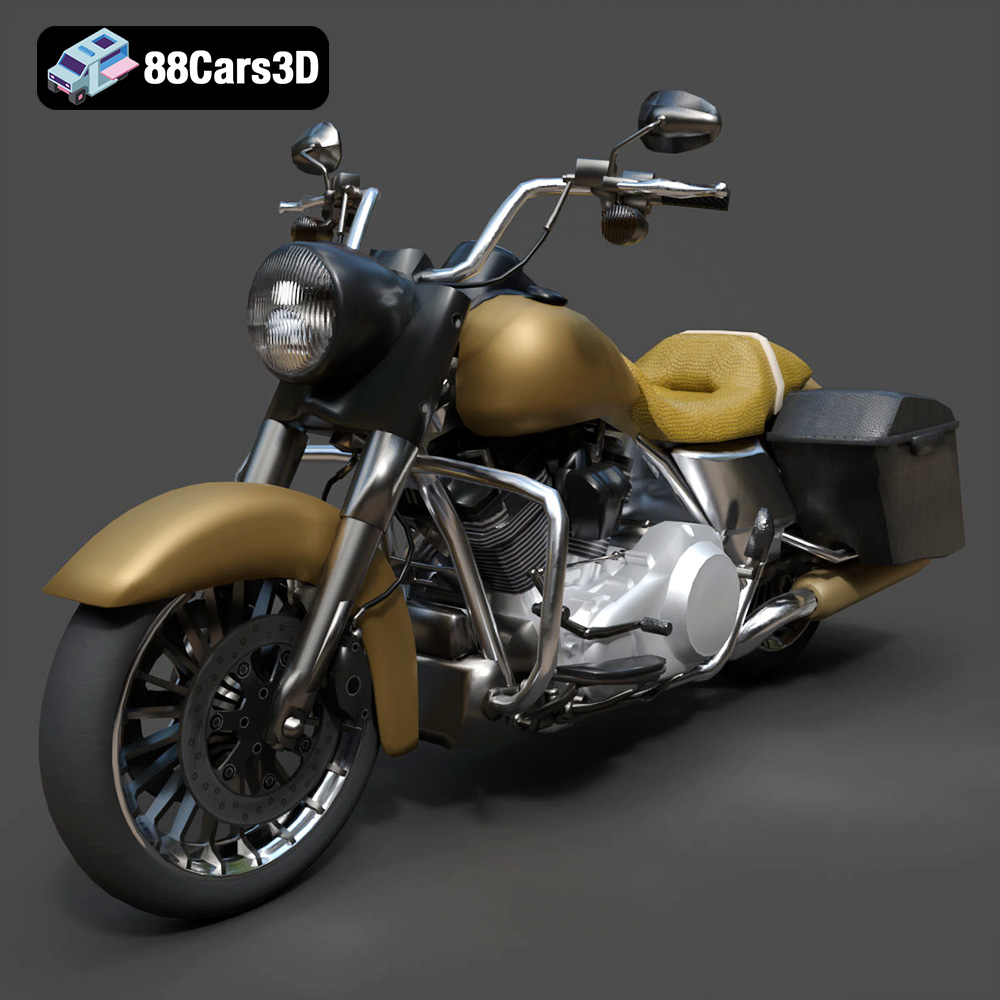
Imagine cruising through a meticulously rendered open-world game, or showcasing a product in an interactive web configurator – the seamless integration of detailed vehicles is paramount. One such exemplary asset that embodies this blend of classic aesthetics and modern optimization is the Harley-Davidson Road King 3D Model (Game-Ready). This digital recreation of an iconic American touring cruiser stands as a testament to what’s possible when technical prowess meets passionate design, offering an incredibly efficient, yet visually authentic, asset for a multitude of professional applications.
Creating compelling 3D environments, especially those featuring complex objects like vehicles, requires meticulous attention to performance. A model might look stunning in a high-resolution render, but if it bogs down a game engine or causes stuttering in a real-time application, its utility diminishes significantly. This is where the concept of “game-ready” assets becomes critical, focusing on optimized topology and efficient resource management.
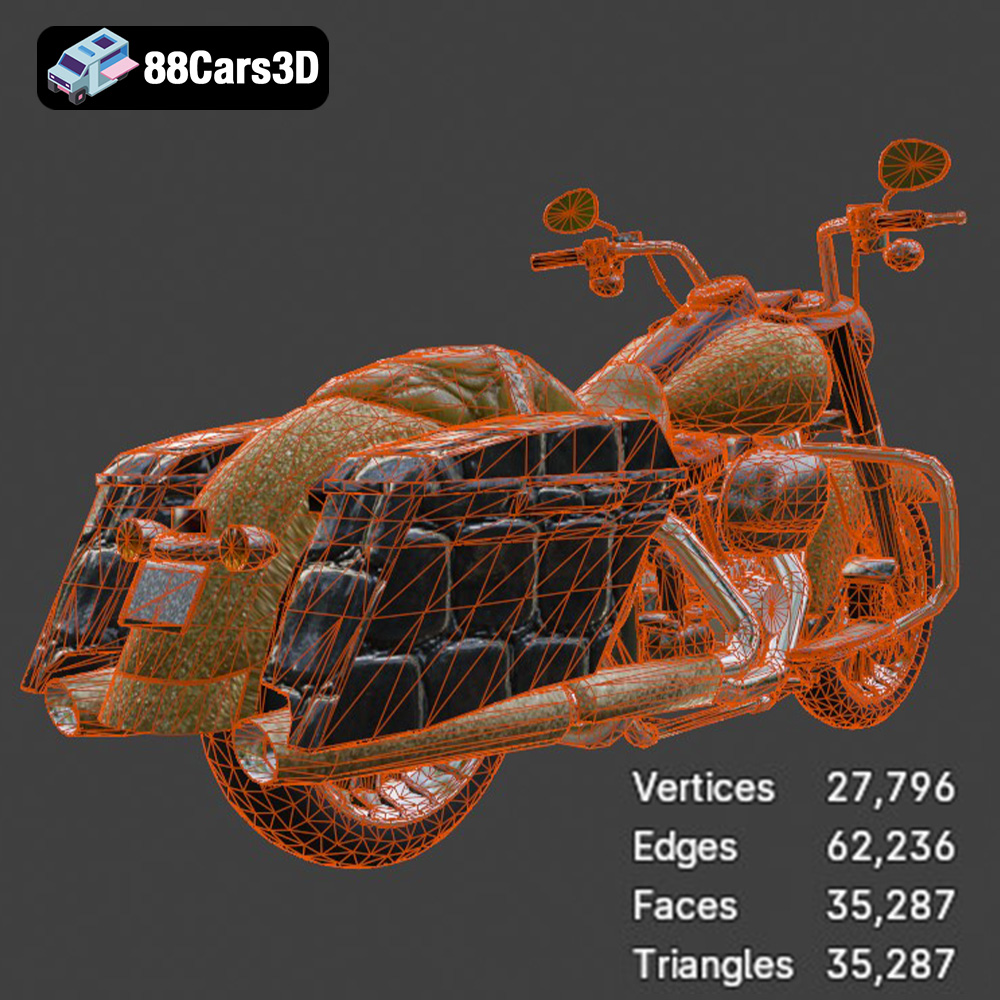
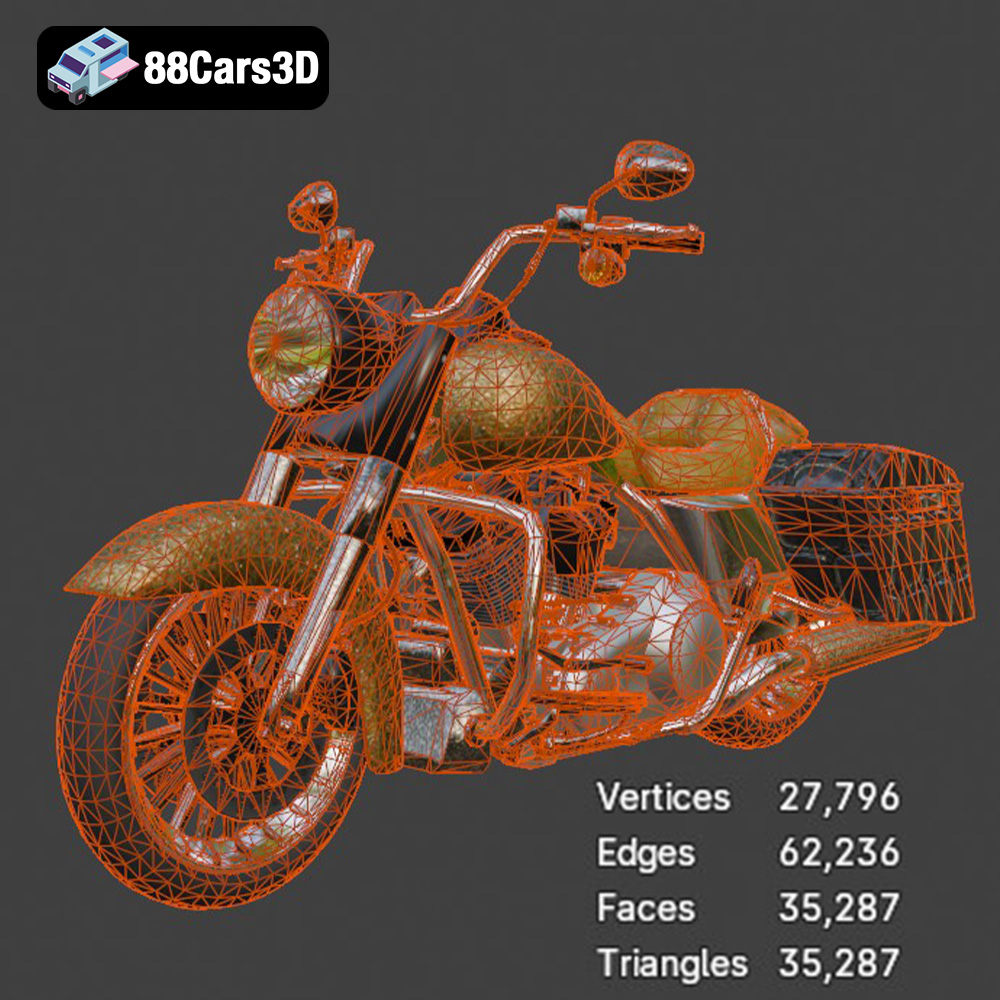
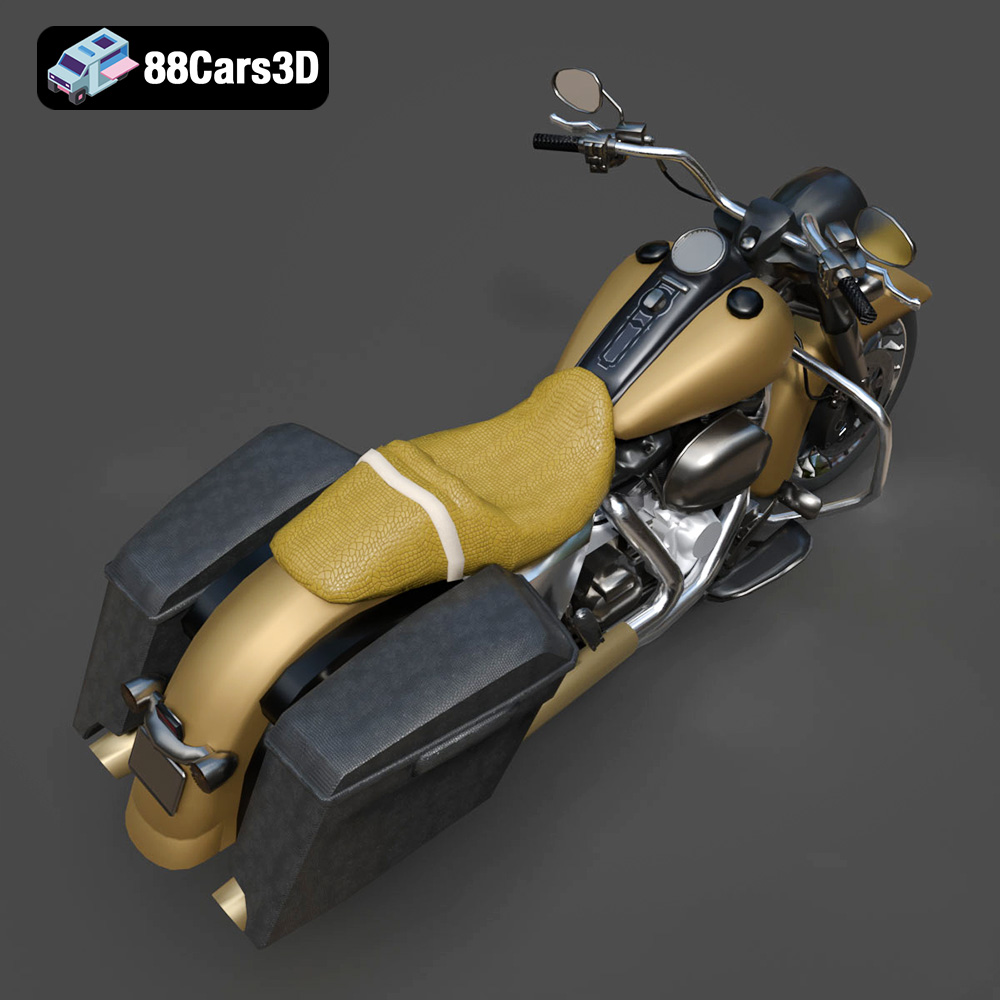
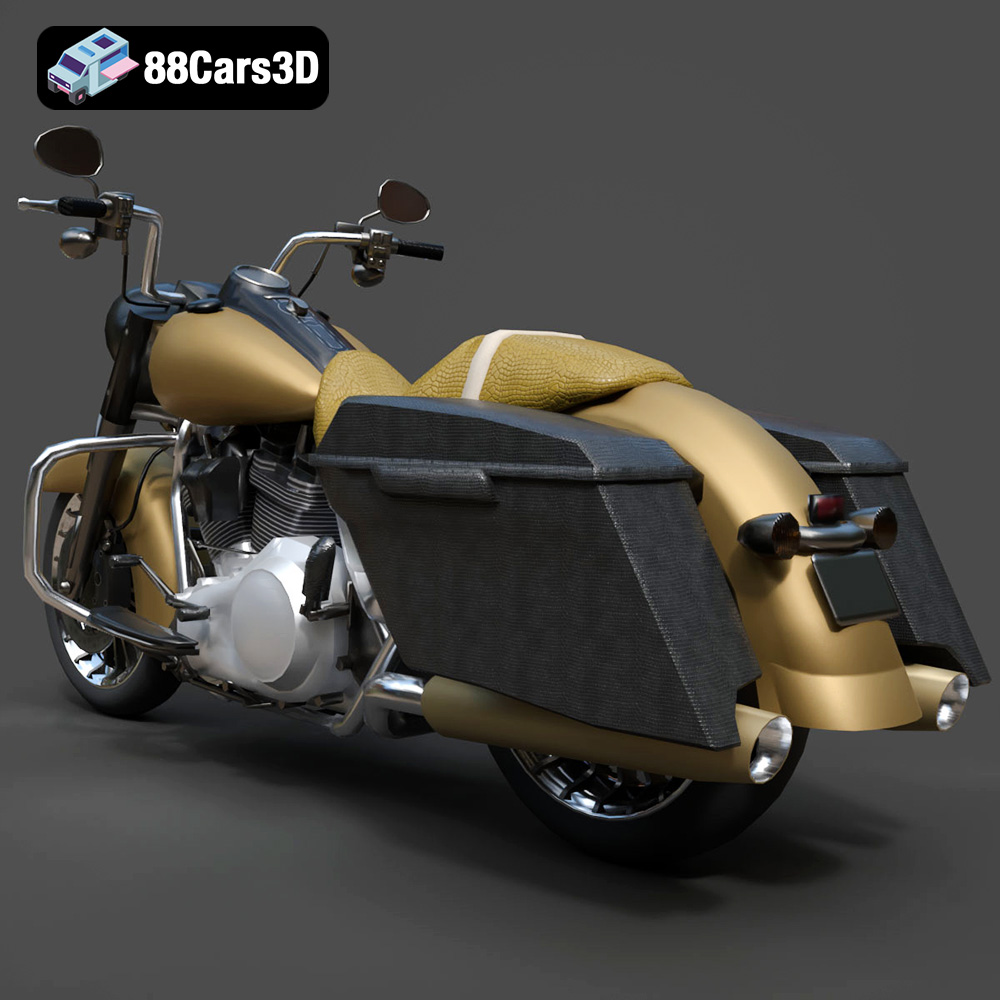
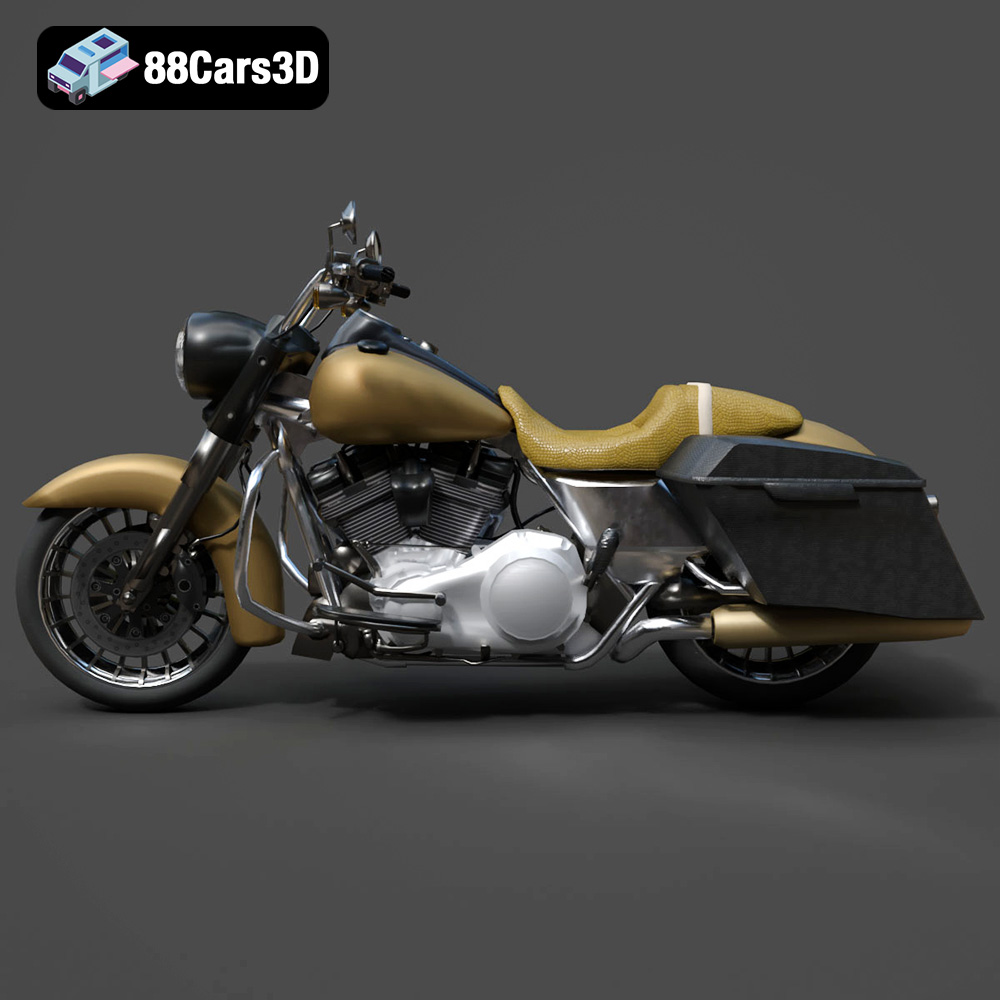
The Harley-Davidson Road King 3D Model exemplifies this principle beautifully. With a mere 35,287 triangles, it achieves the unmistakable profile and distinctive features of the Road King without imposing a heavy load on system resources. This low-polygon count is not a compromise on visual quality but rather a sophisticated engineering choice. Through clever topology and strategic UV mapping, details are preserved or cleverly suggested, ensuring the model looks excellent even in close-up scenarios or when viewed in motion.
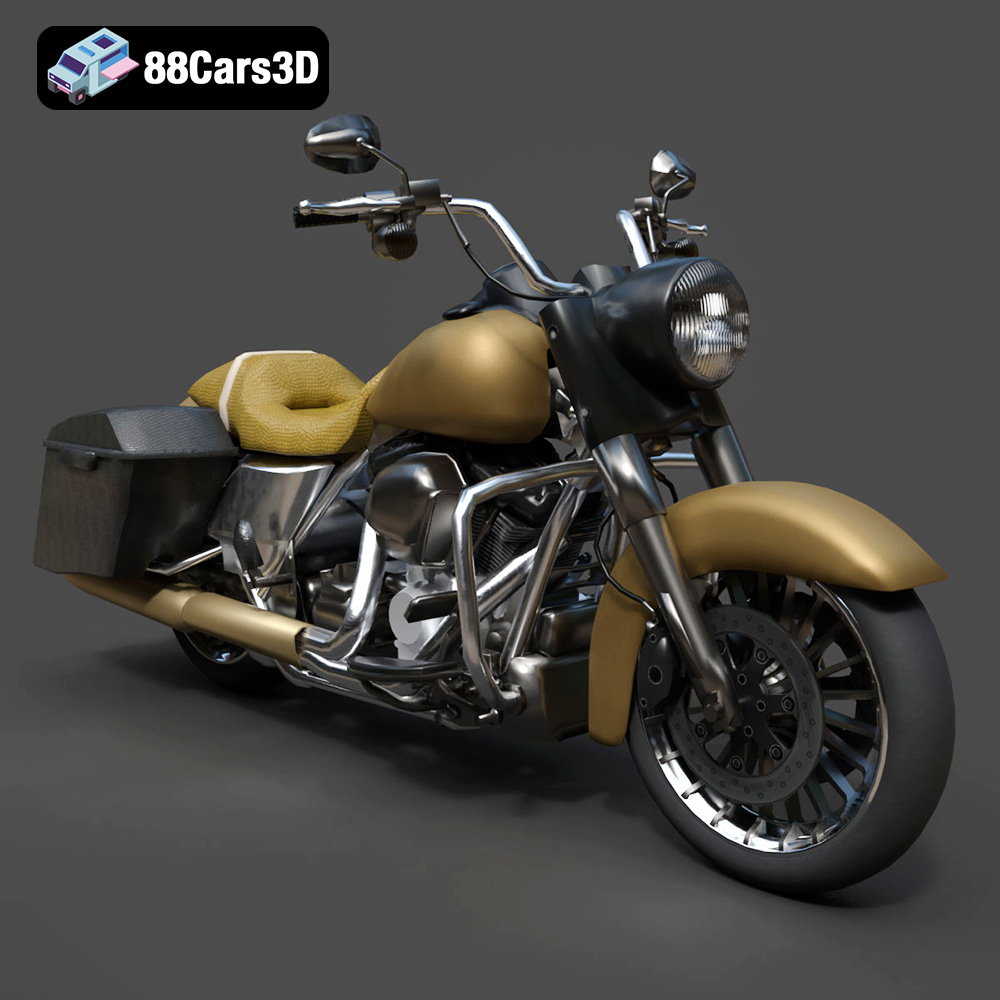
For mobile game developers, this is a massive advantage. Running dozens of vehicles simultaneously in an open-world environment demands assets that are lean and efficient. The Road King’s optimized geometry means that a virtual highway can be populated with an entire fleet of these classic cruisers, each contributing to the scene’s realism without pushing frame rates into unplayable territory. The iconic American touring cruiser proportions, the prominent V-twin engine profile, and the classic hard saddlebags are all present, rendered with an efficiency that makes it ideal for background traffic or even primary player vehicles in resource-constrained environments.
Real-time applications, including games, AR/VR experiences, and interactive web showrooms, operate under strict budget constraints for polygon count, draw calls, and texture memory. The Harley-Davidson Road King 3D Model is purpose-built to thrive in these conditions. Its low triangle count directly translates to faster rendering times and reduced GPU load. Furthermore, the intelligent separation of components like wheels and steering elements allows for efficient rigging and animation, which is essential for creating dynamic, interactive experiences without adding unnecessary complexity to the underlying mesh.
Developers using engines like Unreal Engine, Unity, or Godot can seamlessly integrate such an optimized model. The model’s clean mesh, real-world scale accuracy, and proper pivot setup (for steering, wheel rotation, and kickstand articulation) significantly reduce the setup time. This allows artists and programmers to focus on gameplay mechanics, material creation, and environmental design rather than spending precious development cycles optimizing a subpar model. This inherent efficiency ensures that the digital Road King is not just a visual treat but a genuinely robust and practical asset for modern digital production.
Navigating the diverse world of 3D content creation requires a solid grasp of the various file formats available. Each format serves a specific purpose, offering different levels of compatibility, data retention, and optimization for particular workflows. Choosing the right format for your project, whether you’re working with automotive rendering or developing game assets, is crucial for efficiency and successful pipeline integration. The Harley-Davidson Road King 3D Model from 88cars3d.com is a prime example of an asset offered in a comprehensive suite of formats, ensuring maximum flexibility.
Understanding these formats empowers creators to choose the best tool for the job, ensuring their 3D assets are not just visually appealing but also technically sound and versatile across various platforms and applications.
The creation of a successful 3D model, particularly for iconic vehicles, is a meticulous process that merges artistic interpretation with rigorous technical execution. The Harley-Davidson Road King 3D Model stands as a prime example of this synergy, capturing the essence of the real-world motorcycle while adhering to stringent optimization principles for digital performance.
The Road King is renowned for its distinctive silhouette: the large chrome headlight nacelle, the sweeping lines of its handlebars and fuel tank, and the robust V-twin engine. Replicating these features accurately, while keeping the polygon count to a remarkably low 35,287 triangles, requires experienced 3D artists. This involves a technique known as “edge flow optimization,” where polygons are strategically placed to define critical shapes and curves, rather than indiscriminately adding detail. For instance, the saddlebags are mapped for efficient texturing, meaning their UVs are laid out cleanly to allow for detailed textures to be applied without requiring excessive mesh complexity.
The exterior features listed – from the iconic American touring cruiser proportions to the optimized wheel geometry – all speak to this careful balance. Each element is modeled not just for visual recognition but for rendering efficiency. The result is a model that convincingly represents the classic Road King aesthetic, whether it’s a focal point in a mobile game or a background element in a cinematic render, without overburdening the rendering engine. This level of detail in a low-poly package is invaluable for projects that demand both visual quality and uncompromised performance.
A static 3D model, no matter how beautiful, often has limited utility in interactive media. The true power of a well-crafted automotive asset lies in its ability to be animated and respond to physics. The Harley-Davidson Road King 3D Model is engineered with this in mind. Its separate wheels and steering components are not merely detached meshes; they are specifically designed with proper pivot setups. This seemingly small detail is monumental for developers.
For example, accurately rotating wheels along their axles or articulating the steering column for realistic turning simulations requires correctly placed pivot points. The model also includes a pivot for kickstand articulation, allowing for realistic idle animations or in-game interactions. These considerations save countless hours for riggers and animators, who would otherwise have to manually prepare these elements. This makes the model truly “game-ready,” facilitating the quick implementation of physics, character interactions, and dynamic sequences, whether it’s for a virtual cross-country highway scene or a biker lifestyle mobile game.
The versatility of a well-designed 3D asset is measured by its ability to integrate seamlessly into diverse professional workflows. The Harley-Davidson Road King 3D Model, with its blend of visual appeal and technical efficiency, proves to be an exceptionally adaptable asset for numerous industries.
The primary target application for this model is game development. Its “game-ready” designation is not merely a marketing term; it reflects intrinsic design choices. Developers working in Unreal Engine or Unity, two of the most dominant game engines, will find the model incredibly easy to import and utilize. The low polygon count (35k triangles) ensures it meets the stringent performance requirements for real-time rendering, crucial for maintaining high frame rates on various platforms, including mobile devices and consoles. The included .fbx and .unreal formats streamline the import process, ensuring materials and meshes are correctly interpreted. From populating bustling open-world traffic scenarios to serving as a player’s customizable vehicle in a racing or adventure game, this model offers a robust foundation. Imagine creating GTA-style mods or a biker-themed mobile game – the Road King provides an authentic yet optimized vehicle that can be duplicated many times over without performance penalties.
The burgeoning fields of Augmented Reality (AR) and Virtual Reality (VR) demand highly optimized assets. Latency and performance are critical for a truly immersive experience. The Harley-Davidson Road King 3D Model’s efficient topology and support for formats like .glb make it an ideal candidate for AR/VR applications and interactive web experiences. Whether it’s a mobile AR app allowing users to “place” a virtual Road King in their driveway, a VR showroom where customers can explore the motorcycle up close, or an interactive web configurator on a dealership website, the model’s lightweight nature ensures smooth interaction and fast loading times. This capability extends to product visualization, enabling brands to showcase their vehicles in dynamic, engaging ways without the need for high-end dedicated hardware.
While optimized for real-time, the Road King model is also a valuable asset for offline rendering and architectural visualization. In large-scale urban or highway architectural renders, highly detailed vehicles in the background can significantly increase render times. The Road King, with its efficient geometry, offers a perfect solution for populating these scenes. It provides recognizable, authentic automotive elements that add realism and scale without being a computational burden. Furthermore, for cinematic pre-visualization or even final renders where the motorcycle might be in mid-ground or background focus, its optimized mesh, when combined with high-quality textures and lighting, can produce impressive results without the necessity of a super-high-poly model that would be overkill for its role in the scene. The versatility offered by 88cars3d.com with such models caters to a wide spectrum of creative professionals.
Beyond digital realms, the Harley-Davidson Road King 3D Model offers an exciting pathway to physical manifestation through 3D printing. Transforming a digital asset into a tangible collectible requires careful consideration of the printing process and the unique characteristics of the model.
The inclusion of the .stl format makes the Road King readily convertible for 3D printing. However, its low-poly nature, while a boon for game performance, means careful scaling is required for optimal print quality. The recommended scales of 1:32, 1:43, or 1:64 are ideal for preserving the optimized details without exposing the underlying polygon facets. Resin printing (SLA/DLP) is highly recommended for these smaller scales due to its ability to capture finer details and produce smoother surfaces compared to FDM (Fused Deposition Modeling) printers, which might struggle with the model’s subtle curves and intricate components like the engine fins or chrome headlight nacelle.
Successful 3D printing also hinges on proper preparation within the slicing software. The model’s manifold geometry ensures that there are no gaps or errors that would prevent a clean print. Supports will be necessary for overhangs such as the handlebars, the sweeping dual exhausts, and the distinctive hard saddlebags. Printing the frame angled, and wheels separately, ensures structural integrity and allows for easier support removal and post-processing, resulting in a cleaner, more accurate physical representation of the iconic cruiser.
Once printed, the physical Road King model enters the realm of post-processing, where it can truly come to life. This stage is crucial for achieving a display-worthy replica. Initial steps typically involve carefully removing supports and then sanding the model to smooth out any layer lines or imperfections, especially on a resin print. Applying a primer coat not only helps to reveal any remaining flaws but also provides an excellent base for paint adhesion. The final touch involves painting, where hobbyists can unleash their creativity. Recreating classic Harley-Davidson paint schemes, such as Vivid Black or a two-tone classic, paired with metallic silver or chrome detailing for the engine, exhausts, and headlight nacelle, will elevate the printed model from a raw plastic object to a stunning miniature collectible. This blend of digital creation and physical craftsmanship offers a unique avenue for enthusiasts and designers alike to interact with this legendary machine.
The true value of a professional-grade 3D model extends beyond its initial appearance; it lies in its adaptability and capacity for customization. The Harley-Davidson Road King 3D Model provides an excellent foundation for artists and developers to build upon, ensuring longevity and relevance in evolving projects.
The optimized geometry of the Road King serves as a perfect canvas for material and texture variations. Developers can easily apply custom classic two-tone paint schemes or opt for a more contemporary, sinister blacked-out look on the tank and fenders through material editing. The model’s efficient UV layout facilitates swapping out textures for the hard saddlebags, perhaps replacing them with a leather-textured alternative to give a different stylistic feel. This flexibility means that a single base model can be re-skinned and re-materialed to represent numerous variations, saving significant development time and resources, while adding richness and variety to a game world or visualization. It allows for quick iteration and tailoring to specific project aesthetics without needing to remodel the entire asset.
One of the most powerful techniques for enhancing low-polygon models is the use of normal maps. The Harley-Davidson Road King 3D Model is a perfect candidate for this approach. While its 35k triangle count is excellent for performance, normal maps can be baked from a high-polygon sculpt of the Road King (or generated procedurally) and then applied to this low-poly mesh. This process simulates incredibly fine details – such as panel gaps, intricate engine components, bolts, or subtle surface imperfections – without adding a single polygon. The result is a model that renders with the visual richness of a high-poly asset, yet maintains the performance benefits of a low-poly mesh. This makes the Road King incredibly versatile, capable of looking stunning in cinematic close-ups with appropriate normal maps, while remaining lean enough for background traffic in a mobile game. This adaptability ensures the asset remains relevant and impactful across a wide range of fidelity requirements for any project.
The digital frontier continues to expand, demanding increasingly sophisticated and performant assets across all mediums. From the demanding environments of game development to the intricate details required for AR/VR and compelling visualizations, the foundational quality of 3D models is paramount. The Harley-Davidson Road King 3D Model (Game-Ready) stands as a shining example of how meticulous design, technical optimization, and multi-format compatibility converge to create an invaluable resource for digital artists and developers.
Its intelligently optimized 35k triangle count, faithful recreation of an iconic American cruiser, and readiness for animation, game engines, and even 3D printing underscores a commitment to professional utility. Whether you’re a game developer seeking efficient game assets, an architect enhancing a sprawling urban render, or an enthusiast keen on a physical replica, this model provides a robust starting point. Platforms like 88cars3d.com are dedicated to providing these high-caliber 3D car models, empowering creators to build the next generation of immersive digital experiences with confidence and efficiency. Investing in expertly crafted assets like this Harley-Davidson Road King model is not just about acquiring a digital file; it’s about gaining a powerful tool that accelerates workflows and elevates creative output.
The Harley-Davidson Road King 3D Model is an incredibly optimized, game-ready digital recreation of the quintessential American touring cruiser. Stripping away the heavy fairings of other touring models, the Road King is famous for its classic, nostalgic silhouette, featuring a large chrome headlight nacelle, a prominent V-twin engine, and iconic hard saddlebags. This 3D model accurately captures the legendary highway cruiser aesthetic while being engineered with extreme efficiency in mind. Built with highly optimized, low-polygon topology (just over 35k triangles), it delivers the unmistakable Harley-Davidson profile without consuming heavy memory resources. It is the absolute perfect asset for mobile game development, open-world background traffic, GTA-style mods, and lightweight AR/VR applications. Perfect for virtual cross-country highway scenes, biker lifestyle mobile games, and optimized interactive web showrooms.
$9.99
.blend
.cruiser
.fbx
.obj
.rendering
.stl
35k-polygons
car-3d-model
game-ready
harley-davidson
low-poly
mobile-game-asset
optimized
road-king
touring-motorcycle
VR/AR