Get 50% OFF All Premium 3D & STL Models!

In the rapidly evolving landscape of 3D visualization, the demand for exceptionally detailed and versatile assets is higher than ever. From blockbuster game titles to photorealistic automotive rendering, and from immersive AR/VR experiences to precise simulation environments, the quality of a 3D model can significantly impact the final output and efficiency of a project. A truly professional 3D asset isn’t just about aesthetics; it’s about meticulously crafted geometry, accurate materials, and broad compatibility that empowers artists and developers to push creative boundaries.
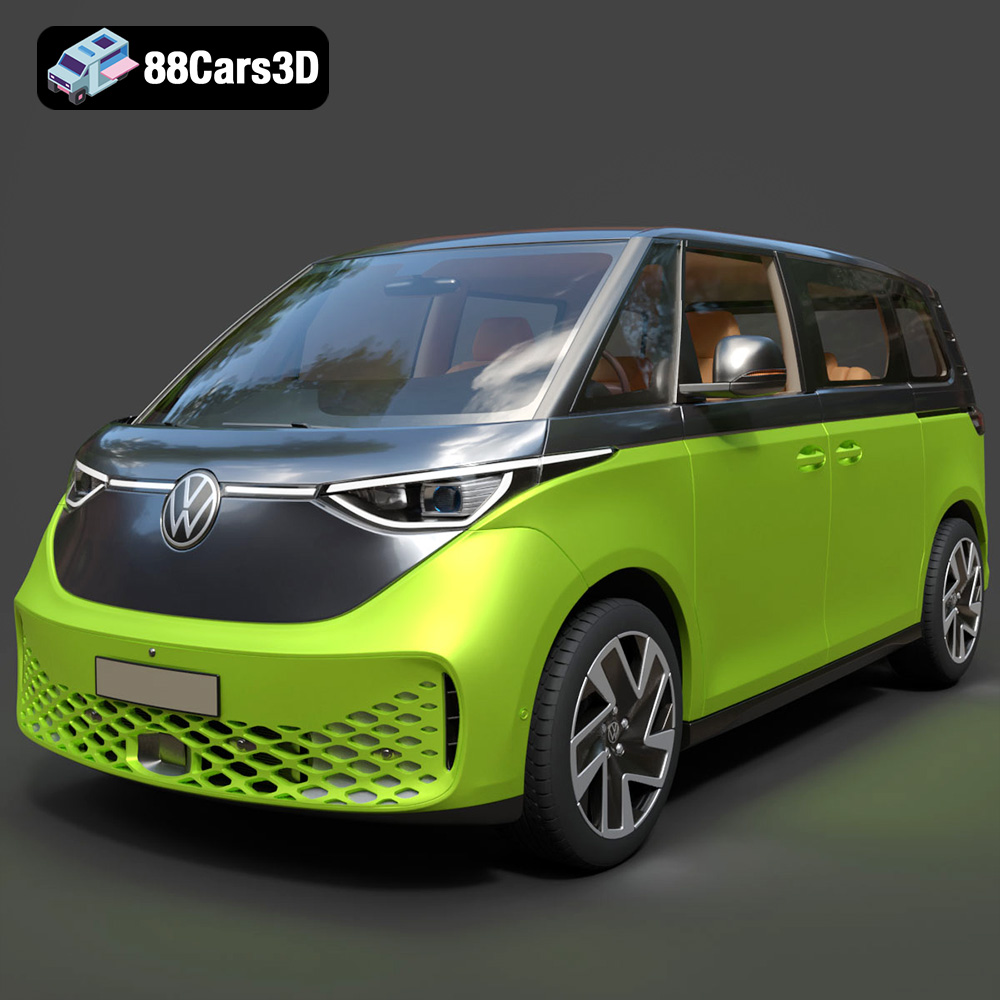
Today, we delve into the world of premium 3D car models, using a standout example to illustrate the technical prowess and practical applications of such assets: the Volkswagen ID. Buzz 2023 3D Model. This model represents a modern icon, capturing the unique design language and electric spirit of Volkswagen’s celebrated electric van. Its availability as a high-quality 3D asset transforms it from a concept vehicle into a foundational building block for a myriad of digital projects.
The real-world Volkswagen ID. Buzz is more than just a vehicle; it’s a statement, blending retro charm with futuristic technology. Recreating such a distinctive design in 3D requires an acute eye for detail and a commitment to accuracy. The Volkswagen ID. Buzz 2023 3D Model delivers on this promise, offering a comprehensively built asset that accurately recreates its unique design and modern characteristics. This isn’t just a basic shell; it incorporates key features such as clean geometry, realistic materials, and professional quality, guaranteeing accurate representations in demanding visual projects. For designers and developers, having access to such a meticulously prepared 3D car model is a game-changer.
Why is such precision critical? In professional workflows, time is money, and rework is costly. Starting with a foundation like the Volkswagen ID. Buzz 2023 3D Model means less time spent on modeling from scratch, fixing topology issues, or battling with subpar materials. The optimized mesh structure offers precise surfacing and fully modeled exterior components alongside detailed interior elements, all tailored for advanced professional workflows where accuracy is essential. Whether it’s for an automotive configurator, a new racing game, or a virtual showroom, the quality of the base 3D model dictates the potential for the entire project.
One of the most crucial aspects of acquiring and utilizing 3D assets effectively is understanding the various file formats available. Each format serves specific purposes, offers unique advantages, and caters to different stages of a 3D pipeline. The Volkswagen ID. Buzz 2023 3D Model from 88cars3d.com exemplifies this versatility by being available in a comprehensive suite of formats, ensuring maximum compatibility and utility across diverse professional applications. Navigating these options is key to streamlining your workflow and achieving your desired results.
The .blend format is Blender’s native file type. It’s far more than just a mesh container; a .blend file encapsulates an entire Blender scene. This includes all geometry, materials (with node setups), textures, lighting, cameras, animations, physics simulations, and even custom scripts. When you download the Volkswagen ID. Buzz 2023 3D Model as a .blend file, you’re getting a fully editable Blender scene with materials and often a lighting setup ready for rendering. This is ideal for artists who primarily work in Blender, allowing for direct manipulation, modification, and expansion of the model without any loss of data or conversion artifacts. It’s the most flexible option for deep customization within the Blender ecosystem.
The .fbx (Filmbox) format is an industry-standard proprietary file format owned by Autodesk, widely adopted for its excellent interoperability between 3D software and game engines. It supports not only mesh data but also materials, textures, animations, skinning, and even camera and light information. It’s particularly ideal for Unreal Engine, Unity, and real-time pipelines due to its robust support for game-ready assets. When transferring models like our ID. Buzz into a game engine, .fbx ensures that the hierarchical structure, UV maps, and basic material assignments are preserved. For those looking for an even more streamlined integration with Epic Games’ engine, the .unreal format signifies a pre-configured, engine-ready asset specifically tailored for Unreal Engine use. This often means optimized meshes, PBR materials correctly set up within the engine, and sometimes even pre-built blueprints or level setups, significantly reducing setup time for game developers.
The .obj (Wavefront OBJ) format is one of the oldest and most universal 3D file formats. It’s a simple, text-based format that primarily stores geometry (vertices, faces, UVs) and references to external material files (.mtl). Its strength lies in its widespread compatibility with virtually all 3D software, making it a reliable choice for cross-software compatibility. However, it typically does not store animation, rigging, or advanced material properties, making it more suited for static mesh transfer. The Volkswagen ID. Buzz 2023 3D Model in .obj format provides a clean base for any 3D application.
.glb (GLB/glTF Binary) is a relatively newer format that has gained immense popularity, especially for web, AR, and VR applications. It’s a compact, self-contained binary version of the glTF (GL Transmission Format), which means all geometry, materials, textures, and even animations are bundled into a single file. It’s optimized for AR, VR, and browser-based display due to its efficient loading and rendering properties, making it perfect for interactive web experiences or augmented reality apps featuring the ID. Buzz.
For physical fabrication, the .stl (Stereolithography) format is king. It represents a 3D model as a series of connected triangles, describing only the surface geometry without color or texture information. It is the de facto standard for 3D printing output and prototyping. If you intend to 3D print a miniature version of the Volkswagen ID. Buzz, the .stl file is what you’ll need.
Finally, .ply (Polygon File Format or Stanford Triangle Format) is a precision mesh format. It’s often used for scanned data, CAD, or scientific analysis due to its ability to store vertex colors, normals, and other properties beyond basic geometry. While less common for general asset exchange, it provides a detailed polygon mesh for specific analytical or high-fidelity visualization needs, ensuring precise surfacing for the ID. Buzz model.
Similar to .blend for Blender, the .max format is the native file for Autodesk 3ds Max. It contains all scene data, including geometry, modifiers, materials, textures, lighting, cameras, and animations, fully editable within 3ds Max. For studios and artists who rely on 3ds Max for architectural visualization, product rendering, or animation, the .max file of the ID. Buzz model provides the most comprehensive and flexible starting point. It allows for advanced rendering setups with V-Ray or Corona, complex animation rigging, and seamless integration into existing 3ds Max pipelines.
Understanding these formats allows professionals to select the ideal version of the Volkswagen ID. Buzz 2023 3D Model for their specific project, ensuring optimal performance and compatibility. The breadth of formats offered on 88cars3d.com highlights a commitment to providing versatile, professional-grade 3D car models for every conceivable application.
Automotive rendering stands as one of the most demanding fields in 3D visualization, where the line between a digital creation and a photograph is constantly blurred. Achieving photorealism requires not only skilled artists and powerful render engines but, fundamentally, immaculate 3D car models. The Volkswagen ID. Buzz 2023 3D Model serves as an exemplary asset for this purpose, providing the foundational quality needed for breathtaking visual outputs.
The core of photorealism lies in the accurate representation of light interaction with surfaces. This is where realistic materials and textures become paramount. A high-quality model like the ID. Buzz incorporates physically based rendering (PBR) compliant materials. This means surfaces are defined by properties such as base color (albedo), roughness, metallicness, normal maps for fine surface detail, and sometimes ambient occlusion maps. For the ID. Buzz, this translates to chrome accents that reflect light correctly, painted surfaces with appropriate clear coat reflections, realistic tire rubber, and glass that refracts light accurately. These aren’t just colors; they are complex shaders designed to mimic real-world physics, ensuring that under any lighting condition, the model will react believably.
Once you have a model with impeccable materials, the next step is to place it within a carefully crafted lighting environment. In automotive rendering, this often involves virtual studio setups with HDRI (High Dynamic Range Image) maps for realistic global illumination and a combination of targeted area lights, spotlights, and reflectors to highlight specific contours and details. Imagine placing the Volkswagen ID. Buzz 2023 3D Model within a sleek virtual showroom, its glossy finish reflecting the soft overhead lighting, or parked against a sun-drenched coastal backdrop. The precise surfacing and clean geometry of the ID. Buzz model ensure that reflections are crisp and undistorted, and shadows fall naturally, enhancing the illusion of reality. These complex lighting scenarios are made possible and look convincing only when the underlying 3D car model is of professional quality.
Consider an automotive manufacturer or advertising agency tasked with creating compelling marketing visuals for the new Volkswagen ID. Buzz. Instead of expensive physical photoshoots, they can leverage a high-fidelity 3D model. With the ID. Buzz 2023 3D Model, they can:
The cost-effectiveness and creative flexibility offered by such a detailed 3D car model are immense, making it an indispensable asset in modern automotive marketing and visualization pipelines.
Game development places a unique set of demands on 3D assets. While photorealism is a goal, it must be balanced with real-time performance, interactivity, and consistency across a vast virtual world. High-quality 3D car models, like the Volkswagen ID. Buzz 2023 3D Model, are crucial for achieving immersive gameplay, but they also require careful optimization for game engines like Unreal Engine and Unity.
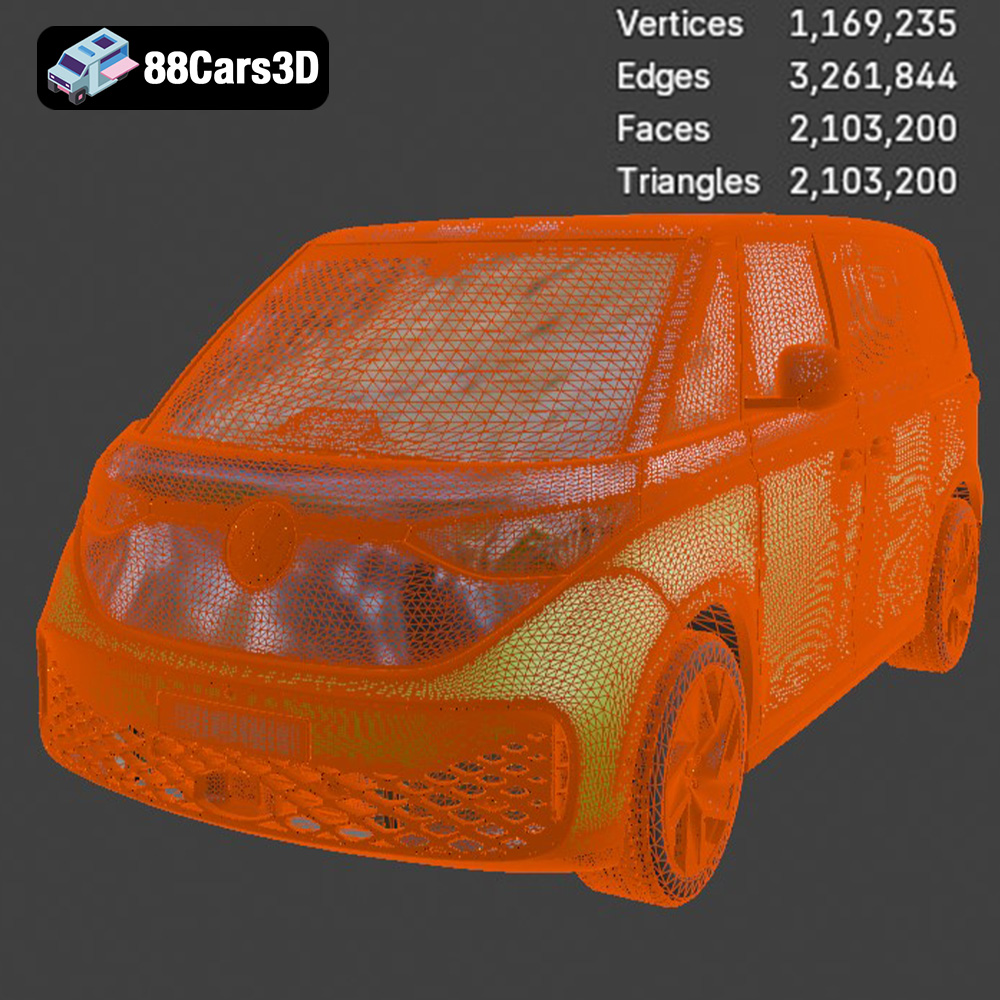
Professional 3D car models, especially those designed for rendering, can often have millions of polygons to capture every minute detail. While excellent for offline renders, this level of detail is usually too heavy for real-time game engines. The process involves creating optimized versions through techniques such as retopology, decimation, and baking. The Volkswagen ID. Buzz 2023 3D Model, being game-engine ready in formats like .fbx and .unreal, indicates that this optimization work has largely been done or the model is structured to facilitate it. This means carefully reducing polygon counts while retaining visual fidelity, generating normal maps from the high-poly mesh to capture surface details without extra geometry, and ensuring clean UV maps for efficient texture packing.
To maintain smooth frame rates in a game, sophisticated systems like Level of Detail (LOD) are employed. An LOD system generates multiple versions of a 3D car model, each with progressively fewer polygons, for different distances from the camera. When the Volkswagen ID. Buzz is close to the player, the most detailed mesh is used. As it moves further away, lower-poly versions are swapped in, significantly reducing the rendering burden. Effective LOD generation relies on a well-structured base mesh, something inherent in professionally built assets. Additionally, models for games need collision meshes (simplified representations used for physics calculations) and often specific material setups that perform efficiently in the target engine. Having an asset like the ID. Buzz available in .fbx and .unreal formats means much of this foundational work is already accounted for, saving developers countless hours.
Beyond visual fidelity, 3D car models are central to interactive experiences and simulations. In racing games, driving simulators, or virtual training modules, the physical properties, scale, and pivot points of the 3D model must be accurate. The detailed interior and exterior elements of the Volkswagen ID. Buzz 2023 3D Model allow for complex interactions, such as opening doors, turning wheels, or interacting with the dashboard. This level of detail enhances immersion, providing players with a richer, more believable experience. For developers, starting with a model that boasts such comprehensive detail and clean geometry simplifies the rigging process for animation and the setup for physics, accelerating the development pipeline for immersive game assets.
Augmented Reality (AR) and Virtual Reality (VR) are transforming how we interact with digital content, offering immersive experiences that blend the virtual with the real. For these platforms, 3D car models are not just visual elements; they are interactive objects that users can explore and engage with. The Volkswagen ID. Buzz 2023 3D Model is particularly well-suited for these cutting-edge applications, especially with formats like .glb tailored for AR/VR and web-based visualization.
In AR and VR, performance is paramount. Heavy models can cause motion sickness or stuttering, ruining the immersion. Therefore, assets need to be highly optimized while retaining sufficient visual detail. A high-quality 3D car model provides the perfect starting point for AR/VR development. The clean geometry and optimized mesh structure of the Volkswagen ID. Buzz 2023 3D Model mean that developers can easily create AR applications where users can place a virtual ID. Buzz in their driveway or VR experiences where they can “sit inside” the vehicle and explore its detailed interior. The key is balance: enough detail for realism, but optimized for smooth, real-time rendering on mobile devices or VR headsets.
The rise of WebGL and browser-based 3D frameworks has made it possible to display and interact with complex 3D models directly within a web browser, without the need for plugins. This opens up incredible possibilities for online configurators, virtual showrooms, and interactive product presentations. The .glb format, in particular, is optimized for web applications, as it bundles all necessary data (geometry, textures, materials) into a single, compact file that loads quickly. Imagine a prospective customer visiting the Volkswagen website and being able to spin the ID. Buzz 2023 3D Model, change its paint color, or even peek inside, all rendered smoothly in their browser. This level of interactive visualization significantly enhances the online shopping experience and brand engagement.
Beyond marketing, AR/VR models of vehicles like the ID. Buzz are invaluable for training and simulation. Mechanics can use AR overlays to visualize internal components during repairs, or new drivers can practice parking and maneuvering in a VR driving simulator. The detailed interior elements of the Volkswagen ID. Buzz 2023 3D Model allow for realistic interaction with virtual controls, providing a safe and cost-effective environment for training scenarios. From emergency response training to familiarizing sales staff with the vehicle’s features, the versatility of such a detailed and accurate 3D model in AR/VR extends far beyond mere aesthetics.
The true value of a professional 3D car model, such as the Volkswagen ID. Buzz 2023 3D Model, lies in its seamless integration into established technical workflows. For artists and studios, having an asset that is not only visually stunning but also technically sound can dramatically improve efficiency and project quality, regardless of the software being used.
At the heart of any high-quality 3D model is its geometry. Clean geometry means proper edge flow, efficient polygon distribution, and minimal triangulation on curved surfaces where quads are preferred. The optimized mesh structure of the ID. Buzz model ensures precise surfacing, which is critical for smooth subdivision rendering (using techniques like Catmull-Clark in 3ds Max or Blender’s Subdivision Surface modifier) and for avoiding shading artifacts. Furthermore, good geometry facilitates easier UV unwrapping, animation rigging, and mesh deformation. An asset like this reduces the need for extensive cleanup, allowing artists to focus on creative tasks rather than technical corrections.
Physically Based Rendering (PBR) has become the gold standard for realistic materials. The Volkswagen ID. Buzz 2023 3D Model comes with realistic materials, which implies a PBR workflow. This means that textures for properties like Albedo (base color), Roughness, Metallic, Normal, and potentially Ambient Occlusion are correctly created and applied. In 3ds Max, these would be set up within a V-Ray, Corona, or Arnold shader. In Blender, a similar node-based PBR setup would be used. The consistency and accuracy of these PBR textures ensure that the model looks correct under various lighting conditions, making it incredibly versatile for any rendering or real-time application.
No two projects are identical, and even a perfect 3D model may require modifications. The Volkswagen ID. Buzz 2023 3D Model, being available in editable formats like .blend and .max, provides incredible flexibility. Artists can easily:
This level of adaptability ensures that the investment in a premium 3D car model translates into long-term value across multiple projects and diverse professional pipelines. The comprehensive file format support from 88cars3d.com directly addresses these integration needs, making it a reliable resource for professional assets.
The realm of 3D modeling for automotive design, game development, and visualization is one that demands precision, versatility, and efficiency. As we’ve explored, a high-quality 3D car model is far more than just a digital representation; it’s a meticulously crafted asset that serves as the backbone for countless professional projects. The Volkswagen ID. Buzz 2023 3D Model stands as a prime example of this professional standard, offering exceptional detail, clean geometry, realistic materials, and broad format compatibility.
Whether you’re striving for photorealistic automotive rendering, building immersive game assets, crafting engaging AR/VR experiences, or driving precise simulations, this model provides the necessary foundation. Its availability in multiple industry-standard formats, from .blend and .max for comprehensive editing to .fbx and .unreal for game engines, and .glb for web and AR, ensures it seamlessly integrates into any professional workflow. This eliminates tedious manual modeling and optimization, allowing creative professionals to focus on innovation and delivering stunning results.
Investing in high-fidelity 3D car models like the Volkswagen ID. Buzz 2023 3D Model from 88cars3d.com is a strategic decision that empowers artists and developers to elevate their work, accelerate their pipelines, and achieve unparalleled levels of visual fidelity and interactivity. It’s not just about buying a model; it’s about acquiring a powerful tool that unlocks new possibilities in the digital creative space.
Discover exceptional detail with the Volkswagen ID. Buzz 2023 3D Model. This comprehensively built asset accurately recreates the unique design and modern characteristics of the celebrated electric van. It incorporates key features such as clean geometry, realistic materials, and professional quality, guaranteeing accurate representations in demanding visual projects. The optimized mesh structure offers precise surfacing and fully modeled exterior components alongside detailed interior elements. This asset is specifically tailored for advanced professional workflows where accuracy is essential. Ideal applications for this model encompass game development, offline rendering, AR/VR experiences, simulation environments, and commercial visualization.
$19.99
.arvr
.blend
.buzz
.car3dmodel
.electricvehicle
.ev
.fbx
.gameasset
.glb
.idbuzz
.max
.minivan
.obj
.ply
.rendering
.simulation
.stl
.unreal
.van
.volkswagen