Get 50% OFF All Premium 3D & STL Models!

The world of 3D modeling is a vast and intricate landscape, constantly evolving with demands for higher fidelity, greater efficiency, and seamless integration across diverse platforms. From blockbuster video games to cutting-edge architectural visualizations and even physical 3D prints, the quality and technical prowess of a 3D asset can make or break a project. Automotive models, in particular, stand as a cornerstone in this ecosystem, captivating audiences with their intricate designs and dynamic potential.
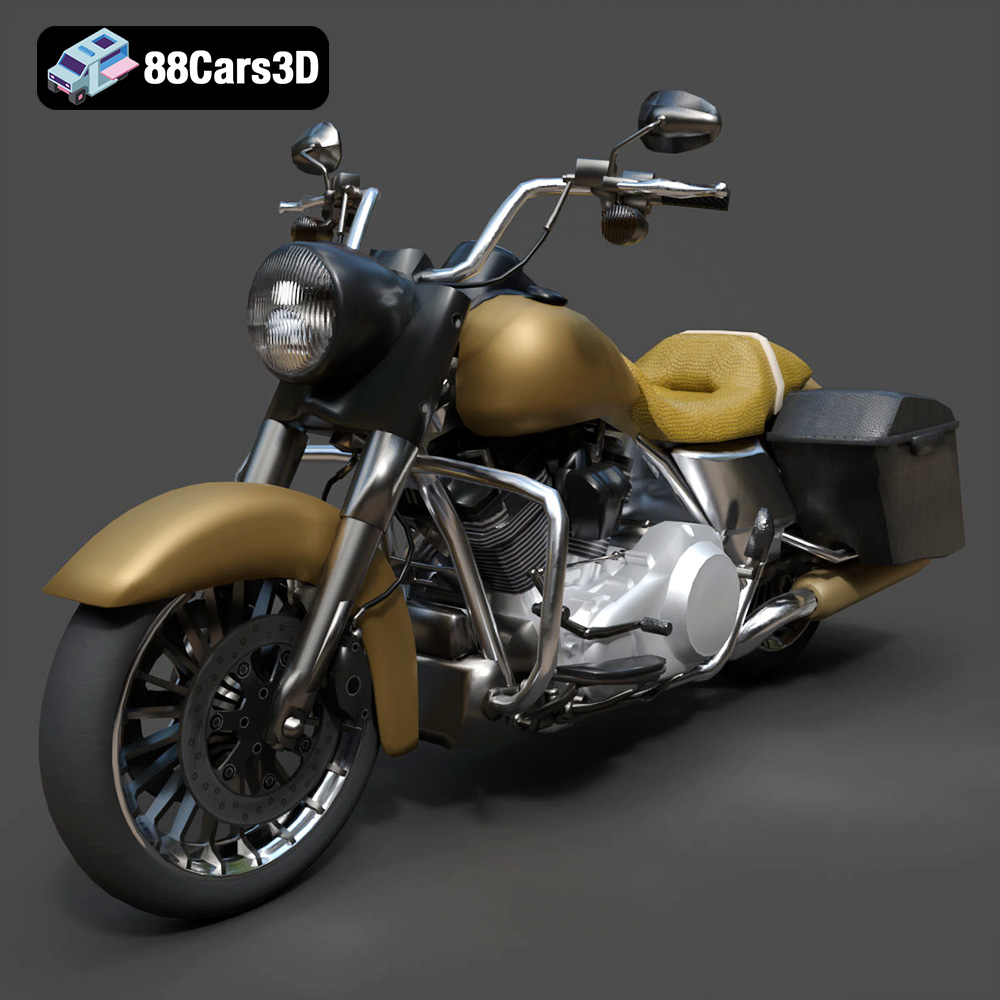
For designers, game developers, animators, and visualization artists, the pursuit of the perfect vehicle model is ongoing. It’s a delicate balance between visual accuracy, performance optimization, and flexibility. Today, we’re diving deep into an exemplary model that embodies this equilibrium: the Harley-Davidson Road King 3D Model (Game-Ready). This digital recreation of an iconic American touring cruiser isn’t just a visually appealing asset; it’s a masterclass in optimized design, offering unparalleled versatility for a multitude of professional applications.
Whether you’re populating an open-world environment, developing a mobile racing game, creating an immersive AR/VR experience, or even crafting a physical collectible, understanding the technical underpinnings of such a model is crucial. We’ll explore its meticulous design, delve into the critical technical specifications, examine how it integrates into various professional workflows, and highlight why assets like this, available on marketplaces like 88cars3d.com, are invaluable.
Before we dive into the specifics of integrating the Harley-Davidson Road King 3D Model, it’s essential to grasp the fundamental nature of 3D file formats. The choice of format dictates compatibility, feature retention, and overall utility across different software and platforms. The versatility of the Road King model is immediately apparent in the wide array of formats it supports, each tailored for specific professional needs.
.blend – Fully Editable Blender Scene with Materials: The native file format for Blender, a powerful open-source 3D creation suite. A `.blend` file is a comprehensive package, containing not just the mesh geometry but also materials, textures, lighting, cameras, animation data, and even custom scripts. For artists primarily working in Blender, this format offers maximum flexibility for further editing, rigging, or scene integration. The Harley-Davidson Road King in `.blend` format allows for direct manipulation of its low-poly topology, adjustment of UVs, and custom material assignments using Blender’s robust Eevee or Cycles render engines. It’s perfect for detailed customization or learning from its optimized structure.
.fbx – Ideal for Unreal, Unity, and Real-Time Pipelines: Developed by Autodesk, FBX (Filmbox) is a widely adopted proprietary exchange format, especially dominant in game development and animation. It’s excellent for transferring models, skeletal animations, and blend shapes between different 3D software and game engines like Unreal Engine and Unity. FBX maintains hierarchical relationships, ensuring that elements like the Road King’s separate wheels and steering components retain their pivot points and parent-child relationships for animation rigging. Its binary nature makes it efficient, though version compatibility can sometimes be a consideration. For importing into game engines, FBX is the industry standard for reliable data transfer.
.obj – Universal Format for Cross-Software Compatibility: OBJ (Wavefront Object) is one of the oldest and most universally supported 3D file formats. It’s a simple, text-based format that primarily stores geometry (vertices, normals, texture coordinates) and references material files (.mtl). While it doesn’t support animation or rigging information, its simplicity ensures near-universal compatibility across almost every 3D application, from ZBrush to Houdini. The Harley-Davidson Road King in `.obj` format serves as a robust fallback for integration into any pipeline, especially when raw mesh data is the primary concern, or for sculpting and retopology workflows.
.glb – Optimized for AR, VR, and Browser-Based Display: GLB (GL Transmission Format Binary) is the binary version of glTF, a royalty-free specification for the efficient transmission and loading of 3D scenes and models by applications. GLB bundles the entire 3D model, textures, and animations into a single file, making it incredibly streamlined for web-based 3D viewers, AR/VR applications, and mobile platforms. Its compact size and ease of parsing make it perfect for showcasing the Road King in an interactive web showroom or an augmented reality experience where quick loading times are paramount.
.stl – Suitable for 3D Printing Output: STL (Stereolithography) is the most common file format for 3D printing. It represents a 3D object as a collection of unconnected triangular facets, defining only the surface geometry without color, texture, or other attributes. For the Harley-Davidson Road King, the `.stl` format allows you to bring this digital asset into the physical realm. While low-poly models like the Road King need careful consideration for print scale and detail, the `.stl` provides the necessary manifold geometry for slicer software to prepare the model for FDM or resin printing.
.ply – Precision Mesh Format for CAD or Analysis: PLY (Polygon File Format or Stanford Triangle Format) is designed to store 3D data from 3D scanners. It supports properties such as color, transparency, texture coordinates, normals, and depth, in addition to XYZ coordinates. While less common for general 3D asset exchange, it’s valuable in scientific visualization, CAD, and situations requiring highly precise mesh information. For specialized engineering or reverse-engineering tasks involving the Road King’s geometry, the `.ply` format offers a detailed representation.
.unreal – Engine-Ready Asset for Real-Time Environments: This format signifies a specially prepared asset for direct integration into Unreal Engine. It typically implies optimized meshes, collision setups, basic material slots, and potentially even blueprint functionality, tailored for the engine’s ecosystem. The Road King’s `.unreal` variant means minimal setup time, allowing developers to drop the model straight into their projects and immediately focus on gameplay, lighting, and environmental integration without wrestling with import settings. This is a massive time-saver for game development.
.max – Editable 3ds Max Project for Animation and Rendering: The native file format for Autodesk 3ds Max, another industry-leading 3D modeling, animation, and rendering software. Similar to `.blend`, a `.max` file encapsulates the complete scene, offering full editability. For professionals whose primary workflow revolves around 3ds Max, this format provides complete control over the Road King model, from its mesh modifiers to its material graphs and animation setups. It’s ideal for high-quality rendering projects or integrating into complex architectural visualization scenes.
The provision of the Harley-Davidson Road King 3D Model in all these formats underscores its adaptability and the foresight of its creators. This comprehensive offering from 88cars3d.com ensures that virtually every professional workflow is catered to, maximizing the value and utility of the asset.
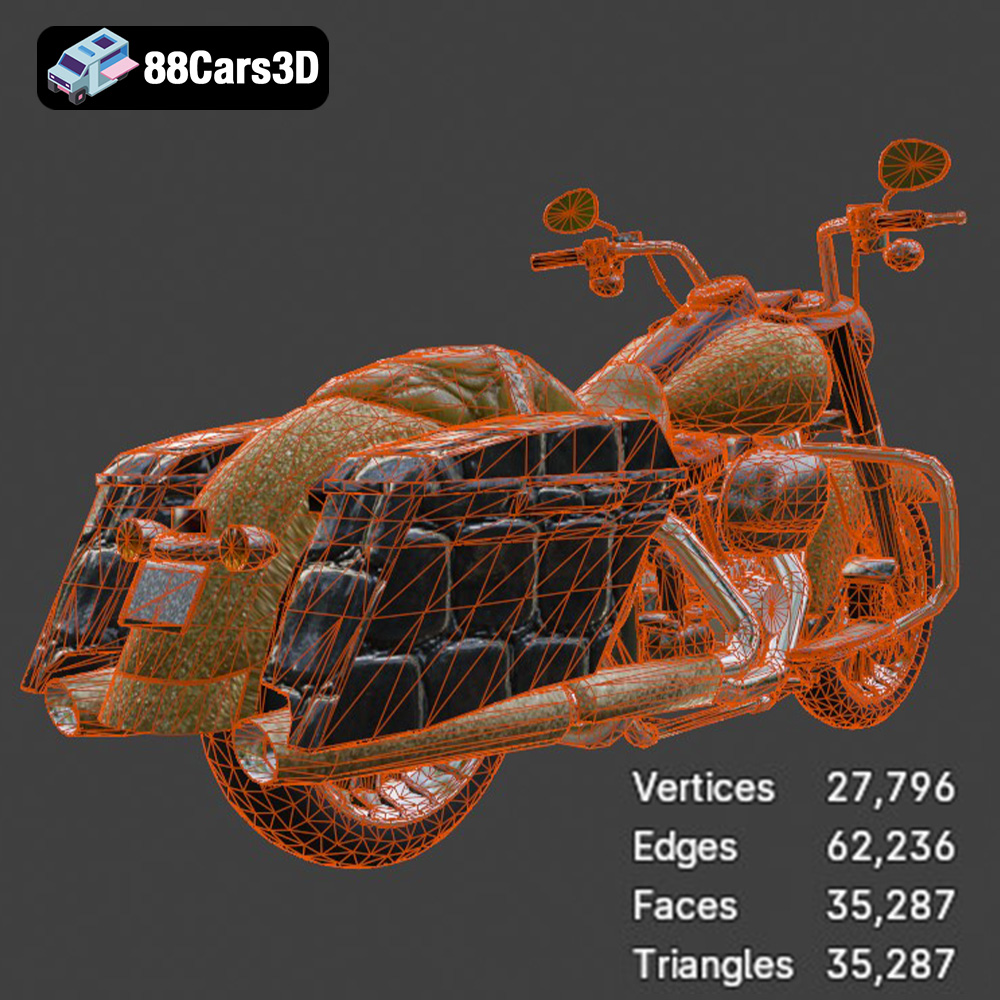
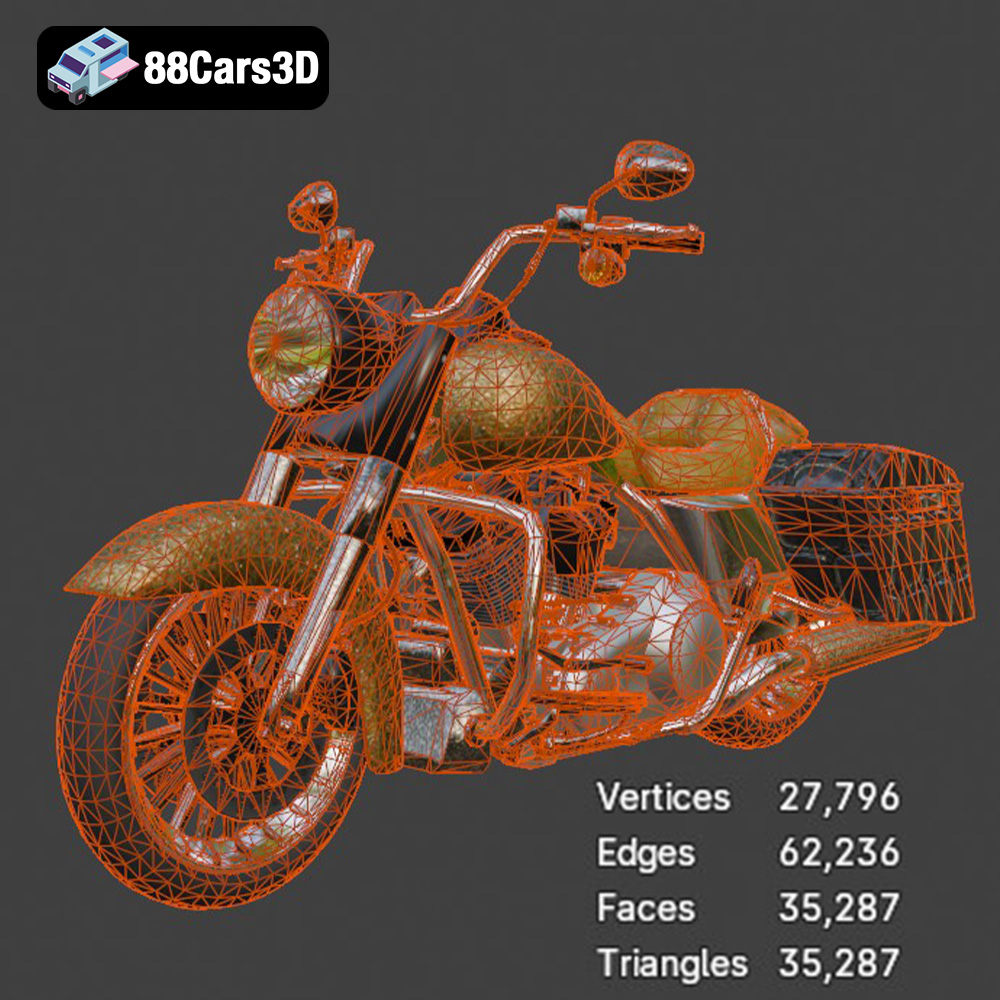
In the demanding landscape of modern 3D development, raw poly count often dictates performance. For a game-ready asset, optimization isn’t merely a suggestion; it’s a requirement. The Harley-Davidson Road King 3D Model exemplifies this principle, striking an ideal balance between visual authenticity and computational efficiency.
With just over 35,000 triangles (35,287, to be precise), 27,796 vertices, and 62,236 edges, this Road King model is engineered for peak performance. This low-polygon count is a critical advantage for several reasons:
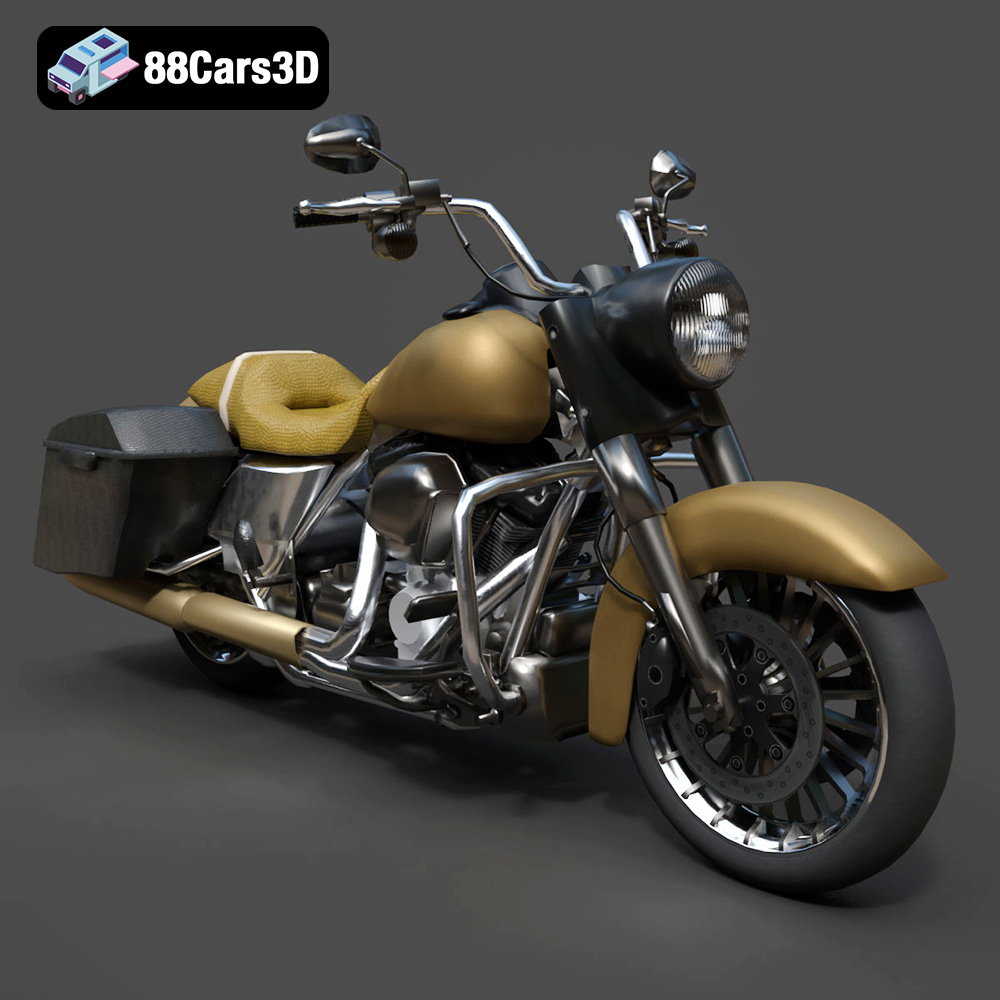
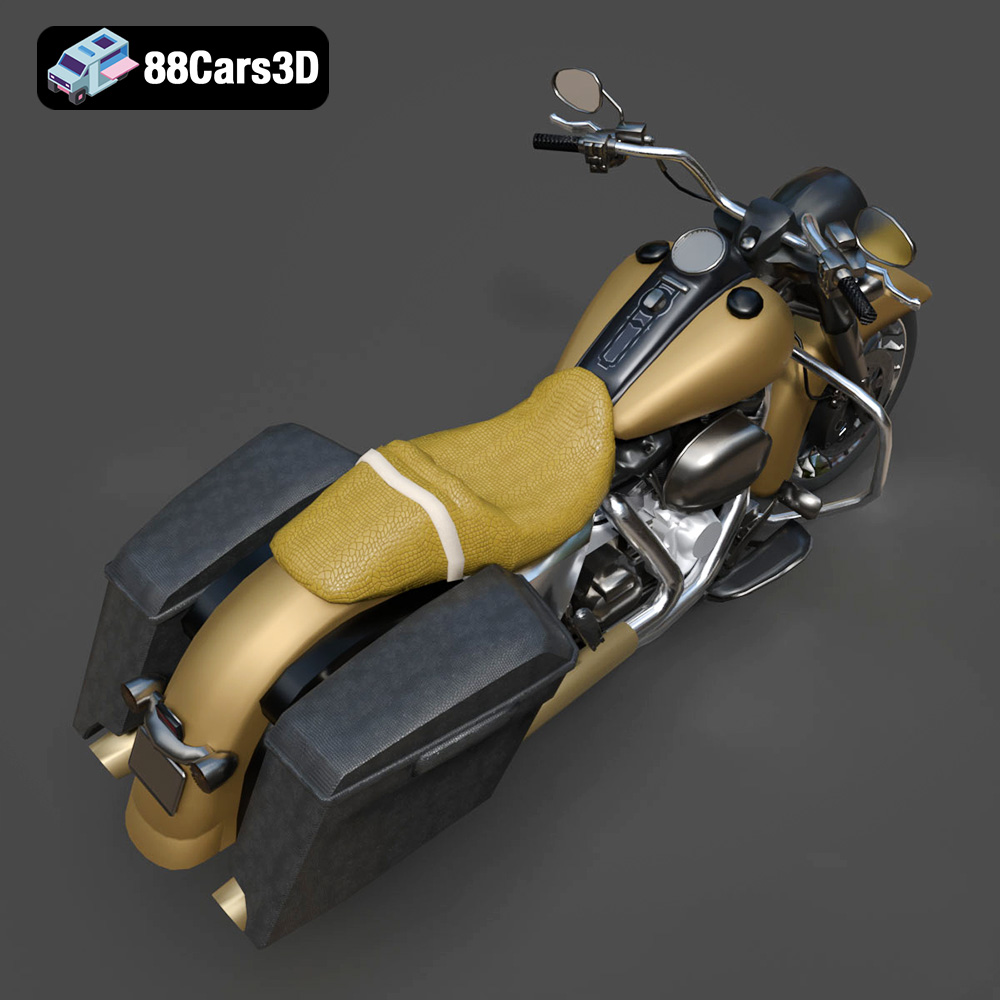
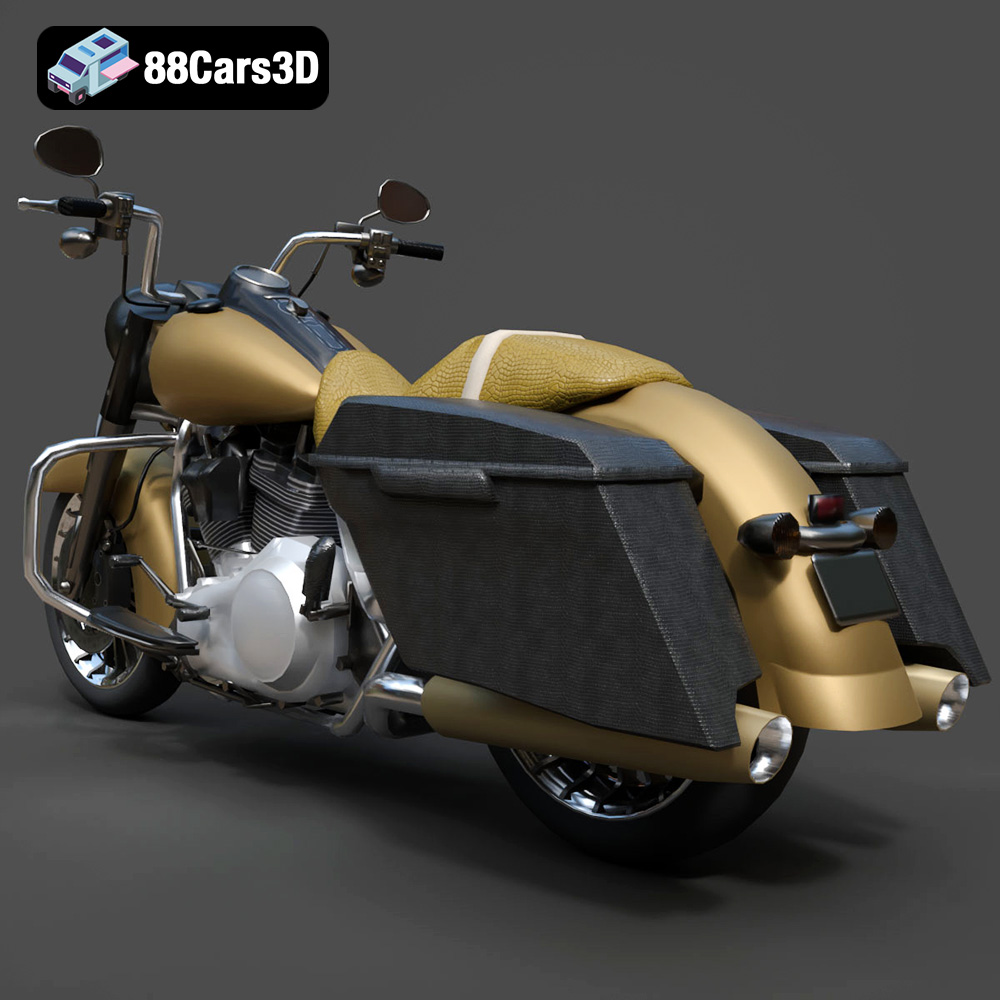
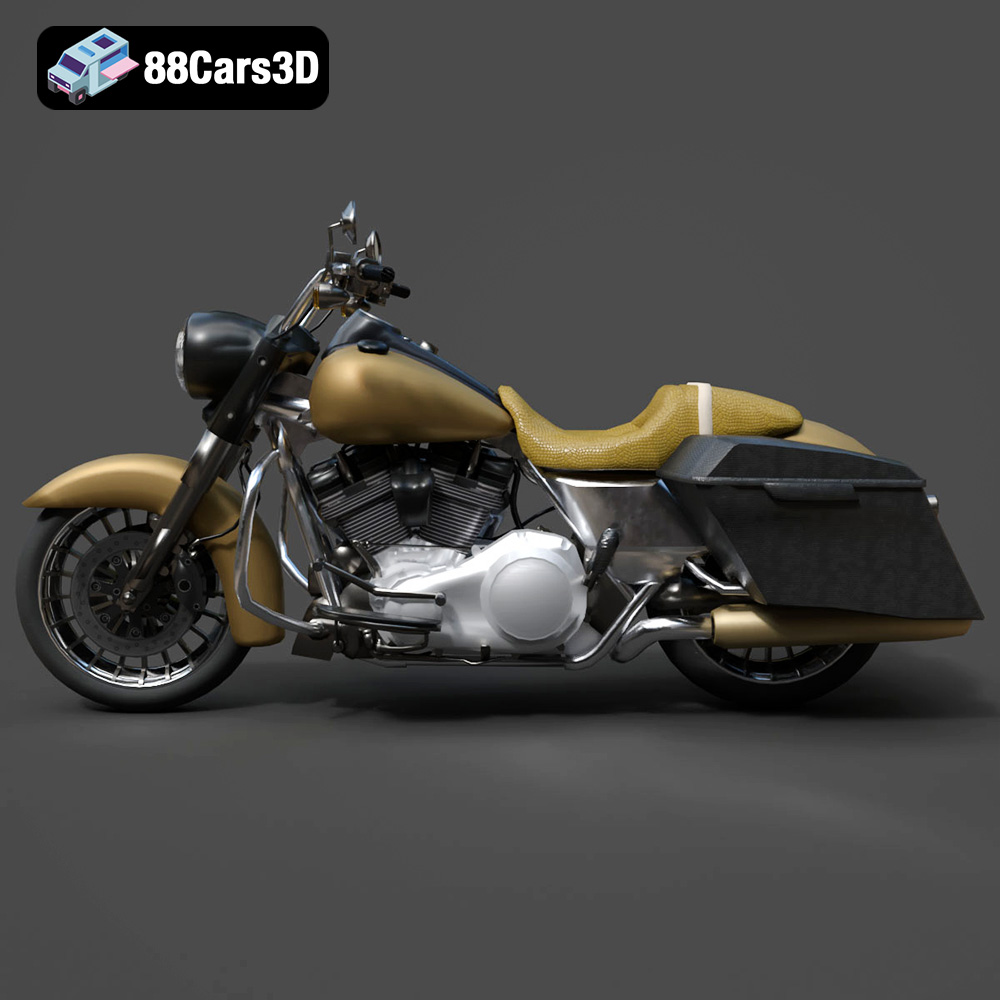
Achieving a low poly count often comes at the cost of detail, but not in this case. The Harley-Davidson Road King’s iconic silhouette, characterized by its large chrome headlight nacelle, prominent V-twin engine, sweeping dual exhaust, and hard saddlebags, is faithfully captured. This is a testament to intelligent topology, where polygons are strategically placed to define critical contours and features without unnecessary density. Details like the teardrop fuel tank, wide touring handlebars, and optimized wheel geometry are designed to look great from typical camera distances while preserving performance.
Furthermore, the model provides a perfect canvas for advanced texturing techniques. Developers can apply custom baked normal maps to simulate high-poly details onto this low-poly mesh, adding intricate scratches, bolts, or engine textures without increasing the triangle count. This approach maintains performance while delivering a high level of visual realism, making it a truly versatile game asset.
The true value of a premium 3D model lies in its seamless integration into various professional pipelines. The Harley-Davidson Road King 3D Model, with its diverse file formats and optimized structure, is designed for exactly this purpose.
For artists working with the native `.blend` or `.max` files, the possibilities for customization and high-fidelity rendering are vast. After importing the Harley-Davidson Road King, users can:
Game developers and real-time visualization specialists will find the Road King model exceptionally easy to work with in engines like Unreal and Unity, particularly with the `.fbx` and `.unreal` formats.
The utility of a 3D model isn’t confined to digital screens. The inclusion of the `.stl` format for the Harley-Davidson Road King opens up the exciting realm of 3D printing, allowing enthusiasts and professionals alike to bring this digital icon into the physical world.
While optimized for digital performance, 3D printing a low-poly model requires a thoughtful approach to achieve the best results. The product description’s recommendations are spot on:
This capability adds another layer of versatility, allowing the Road King model to serve as a physical prototype, a tabletop display piece, or even an element in a diorama, bridging the gap between digital design and tangible craft.
A truly valuable 3D asset provides a solid foundation, but also invites creativity and customization. The Harley-Davidson Road King 3D Model is designed with this in mind, offering a flexible base for artists to imprint their unique vision.
The model’s optimized topology serves as an excellent starting point for a variety of visual enhancements:
The model’s structure, with separate wheels and steering components, isn’t just for ease of rigging; it’s for creative animation. This modularity allows animators to:
This inherent flexibility transforms the Road King from a static model into a dynamic canvas, ready for any creative interpretation.
The Harley-Davidson Road King 3D Model exemplifies the broader trend in the 3D industry: the need for high-quality, versatile assets that streamline production and offer exceptional value. For professionals across various sectors, sourcing such models from platforms like 88cars3d.com offers significant advantages.
For game studios, time is money. Developing every asset from scratch is prohibitively expensive and time-consuming. Leveraging pre-optimized, game-ready 3D car models like the Road King allows teams to rapidly prototype, populate environments, and focus resources on core gameplay mechanics. Its low poly count and pre-setup pivots are a huge boon for mobile titles or large-scale open-world games where performance is paramount. The inclusion of the `.unreal` format specifically caters to the dominant game engine in the industry, minimizing setup time and accelerating integration.
In architectural visualization, vehicles are essential for grounding scenes in reality and providing scale. The Road King, while a motorcycle, serves as a compelling example. For large-scale urban renders or highway scenes, placing highly detailed, optimized 3D car models in the background can significantly enhance realism without taxing rendering resources. Similarly, for product visualization, especially within interactive web experiences or AR/VR showrooms, a model like the Road King can be configured and viewed in real-time, offering customers an immersive experience that traditional imagery cannot match.
The ability to transition from a digital asset to a physical 3D print expands the model’s utility immensely. This is particularly valuable for collectors, model makers, or even designers needing physical prototypes for presentations. The comprehensive 3D print settings provided with the Road King model ensure that even users new to 3D printing can achieve impressive results, turning virtual artistry into tangible craftsmanship.
Ultimately, the Harley-Davidson Road King 3D Model from 88cars3d.com stands as a robust, meticulously crafted asset that meets the rigorous demands of contemporary 3D production. Its balance of visual accuracy, extreme optimization, and broad format compatibility makes it an indispensable tool for any creative professional.
The journey through the technical intricacies and creative applications of the Harley-Davidson Road King 3D Model reveals a fundamental truth about effective 3D asset creation: it’s a careful dance between artistry and engineering. This model, with its iconic American touring cruiser aesthetic, is not merely a static representation but a dynamically optimized asset built for performance across a spectrum of platforms and applications.
From its incredibly efficient 35,000-triangle topology, making it a game-ready dream for mobile, AR/VR, and open-world environments, to its comprehensive suite of file formats (including .blend, .fbx, .obj, .glb, .stl, .ply, .unreal, and .max), the Road King is designed for maximum utility. We’ve seen how its modularity aids in complex animation within Blender or 3ds Max, how its optimization ensures smooth performance in Unreal Engine or Unity, and how its `.stl` variant opens doors to the exciting world of 3D printing, allowing for tangible scale models. Its capacity for extensive customization, from paint schemes to baked normal maps, empowers artists with immense creative freedom.
In an industry that constantly pushes the boundaries of realism and immersion, assets like the Harley-Davidson Road King 3D Model from 88cars3d.com prove invaluable. They embody the blend of artistic detail and technical optimization that professional workflows demand, offering a foundation upon which developers and artists can build stunning, high-performing projects. Whether you’re a seasoned game developer or a visualization artist, investing in meticulously crafted 3D car models like this is a strategic move that enhances efficiency, elevates quality, and accelerates creative output.
The Harley-Davidson Road King 3D Model is an incredibly optimized, game-ready digital recreation of the quintessential American touring cruiser. Stripping away the heavy fairings of other touring models, the Road King is famous for its classic, nostalgic silhouette, featuring a large chrome headlight nacelle, a prominent V-twin engine, and iconic hard saddlebags. This 3D model accurately captures the legendary highway cruiser aesthetic while being engineered with extreme efficiency in mind. Built with highly optimized, low-polygon topology (just over 35k triangles), it delivers the unmistakable Harley-Davidson profile without consuming heavy memory resources. It is the absolute perfect asset for mobile game development, open-world background traffic, GTA-style mods, and lightweight AR/VR applications.
$9.99
.blend
.cruiser
.fbx
.obj
.rendering
.stl
35k-polygons
car-3d-model
game-ready
harley-davidson
low-poly
mobile-game-asset
optimized
road-king
touring-motorcycle
VR/AR