Get 50% OFF All Premium 3D & STL Models!

In the dynamic world of 3D visualization, automotive design, and game development, the demand for high-quality 3D car models is ceaseless. Professionals across various sectors rely on accurately rendered vehicles to populate virtual environments, simulate real-world scenarios, and bring creative visions to life. From architectural visualizations needing realistic street scenes to game developers crafting immersive open worlds, the foundation of excellence lies in the precision and adaptability of the 3D assets.
A truly valuable 3D model transcends mere aesthetics; it embodies technical integrity, versatility across software platforms, and a deep understanding of its real-world counterpart. This is where specialized assets, like the Daewoo Damas 2 Microvan 3D Model, shine. While not a flashy supercar, the Damas 2 represents a ubiquitous and functional vehicle, a common sight that adds unparalleled realism to diverse digital projects. Its inclusion in a scene instantly grounds it in a specific cultural or economic context, often making it more impactful than a generic, high-end vehicle.
This article will delve into the technical intricacies of working with premium 3D car models, highlighting essential file formats, professional workflows, and the diverse applications these assets serve. We will examine how a meticulously crafted model, such as the Daewoo Damas 2, from marketplaces like 88cars3d.com, can elevate your projects, whether you’re aiming for photorealistic renders, immersive game experiences, or even physical 3D prints.
Choosing the correct 3D model file format is a critical decision that impacts workflow, compatibility, and the ultimate utility of your asset. Each format is designed with specific applications and software ecosystems in mind, offering unique advantages. Understanding these distinctions is fundamental for any professional working with 3D car models, ensuring seamless integration and optimal performance.
The .blend file format is native to Blender, the powerful open-source 3D creation suite. A .blend file typically contains not just the mesh data but also all scene information: materials, textures, lighting, cameras, animations, physics simulations, and even custom scripts. This makes it an incredibly comprehensive format for artists and studios working primarily within Blender. It offers full editability, allowing users to tweak every aspect of the model, from topology to shader nodes. For the Daewoo Damas 2 Microvan 3D Model, a .blend file provides the complete project file, ready for immediate use or extensive customization within Blender, making it ideal for indie developers or visualization artists who favor the software.
.fbx (Filmbox) is arguably the most widely adopted proprietary file format for 3D data exchange, especially prevalent in the game development and visual effects industries. Developed by Autodesk, FBX supports geometry, materials, textures, animations, and rigs, making it perfect for transferring animated models between different software applications like 3ds Max, Maya, Unity, and Unreal Engine. Its robust support for animation data and hierarchical structures makes it the go-to format for game assets. When you download a 3D car model in .fbx, you’re getting an optimized, ready-to-import asset that will likely preserve most of its setup across various engines and digital content creation (DCC) tools.
The .obj (Wavefront OBJ) format is a simple, universal 3D geometry definition file that has been around for decades. It stores 3D model data, including vertices, UV coordinates, normals, and polygonal faces, along with references to external material files (.mtl). Its simplicity is its strength; almost every 3D software can import and export OBJ files, ensuring cross-software compatibility. However, OBJ does not support animation, rigging, or complex scene data, making it primarily a mesh carrier. For static renders or base meshes that will be textured and rigged in another application, the .obj format of the Daewoo Damas 2 is a reliable choice.
.glb (GL Transmission Format Binary) is the binary version of glTF, a royalty-free specification for the efficient transmission and loading of 3D scenes and models by applications. GLB files package all assets (geometry, materials, textures, animations) into a single, compact binary file, making them highly optimized for web-based 3D viewing, augmented reality (AR), virtual reality (VR), and mobile applications. Its efficiency and widespread support in modern browsers and platforms make it an excellent choice for interactive product showcases or lightweight real-time experiences, perfect for a virtual tour of the Damas 2.
The .stl (STereoLithography) format is the standard for 3D printing. It represents a 3D model as a series of connected triangles, describing only the surface geometry of an object without color, texture, or other CAD attributes. While it lacks detail for rendering, its universal acceptance by 3D printers and slicing software makes it indispensable for physical fabrication. The Daewoo Damas 2 Microvan 3D Model’s availability in .stl means it can be readily prepared for manufacturing a physical scale model, offering a tangible representation of the digital asset.
.ply (Polygon File Format or Stanford Triangle Format) is another format for storing 3D data, particularly useful for scanned data, CAD applications, and scientific analysis. Like OBJ, it primarily focuses on mesh geometry but can also store properties like color, transparency, normals, texture coordinates, and even reliability information for each polygon. PLY is often chosen when high precision and detailed mesh properties are required, making it suitable for reverse engineering or direct integration into specific CAD pipelines.
The .unreal format, or more accurately, assets packaged for Unreal Engine, implies a highly optimized, engine-ready asset. This often includes not just the raw mesh but also properly configured materials, textures, collision meshes, LODs (Levels of Detail), and blueprint setups within an Unreal Engine project structure. For game developers, receiving an asset like the Daewoo Damas 2 Microvan already pre-configured for Unreal Engine saves significant development time and ensures immediate integration into real-time environments without extensive re-importing or material setup.
Similar to .blend for Blender, the .max file format is native to Autodesk 3ds Max. It contains a complete scene, including models, materials, textures, lighting, animation, and scene settings. It offers full editability within 3ds Max, making it the preferred format for professionals who use this software for high-fidelity rendering, animation, and architectural visualization. The .max file for the Damas 2 allows direct manipulation and integration into complex 3ds Max projects, leveraging all the powerful features of the software for detailed rendering and animation.
The Daewoo Damas 2 Microvan might not be a super-sleek concept car, but its significance in global urban landscapes makes it an exceptionally valuable 3D asset. This vehicle, a refined evolution of the classic kei-van, is a true workhorse, embodying practicality and efficiency. When translated into a 3D model, its utilitarian charm and distinct visual characteristics become powerful tools for digital artists and developers seeking authenticity.
The real-world Daewoo Damas 2 Microvan has carved out a unique niche as an urban staple across diverse regions, from the bustling streets of South Korea to the expansive markets of Central Asia and Eastern Europe. Its compact footprint, incredible maneuverability, and surprising cargo capacity made it the ideal choice for small businesses, delivery services, and compact passenger transport. This ubiquity makes the Daewoo Damas 2 Microvan 3D Model a fantastic choice for populating virtual scenes with vehicles that resonate with real-world experience, enhancing realism in any project it’s placed in.
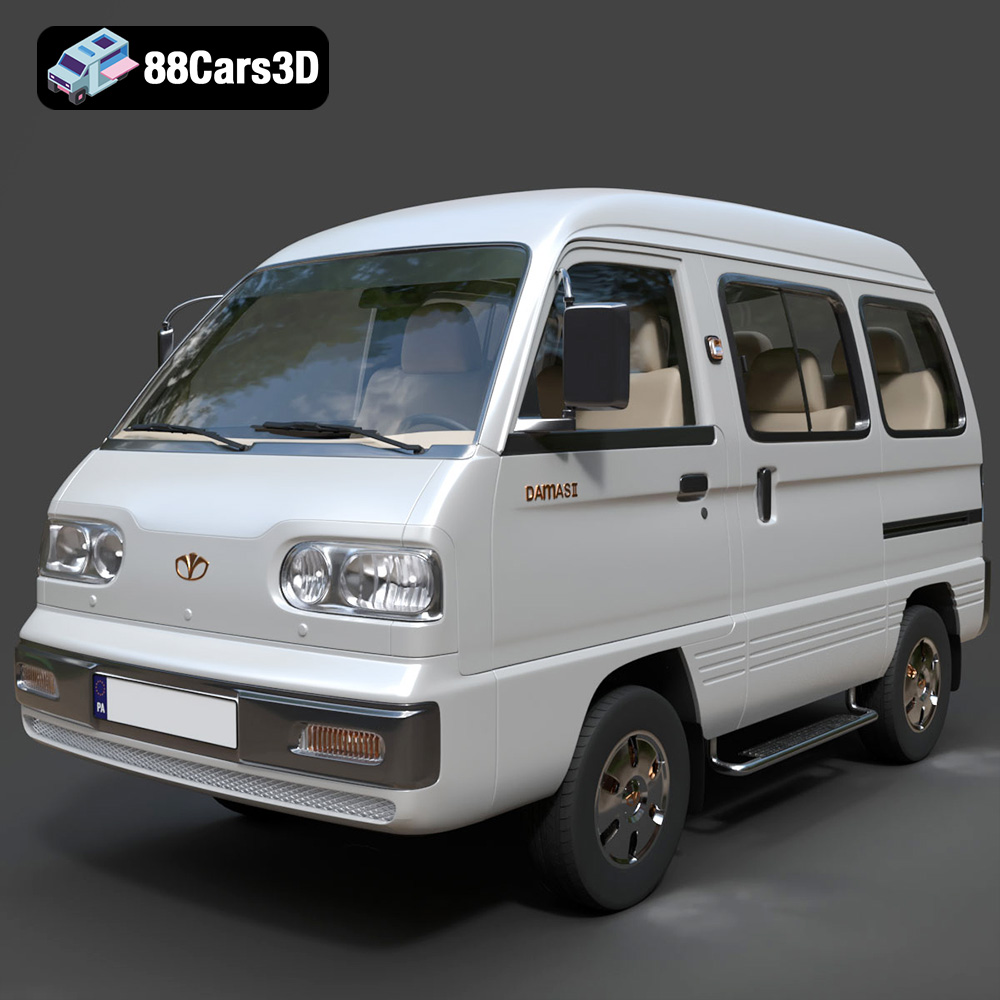
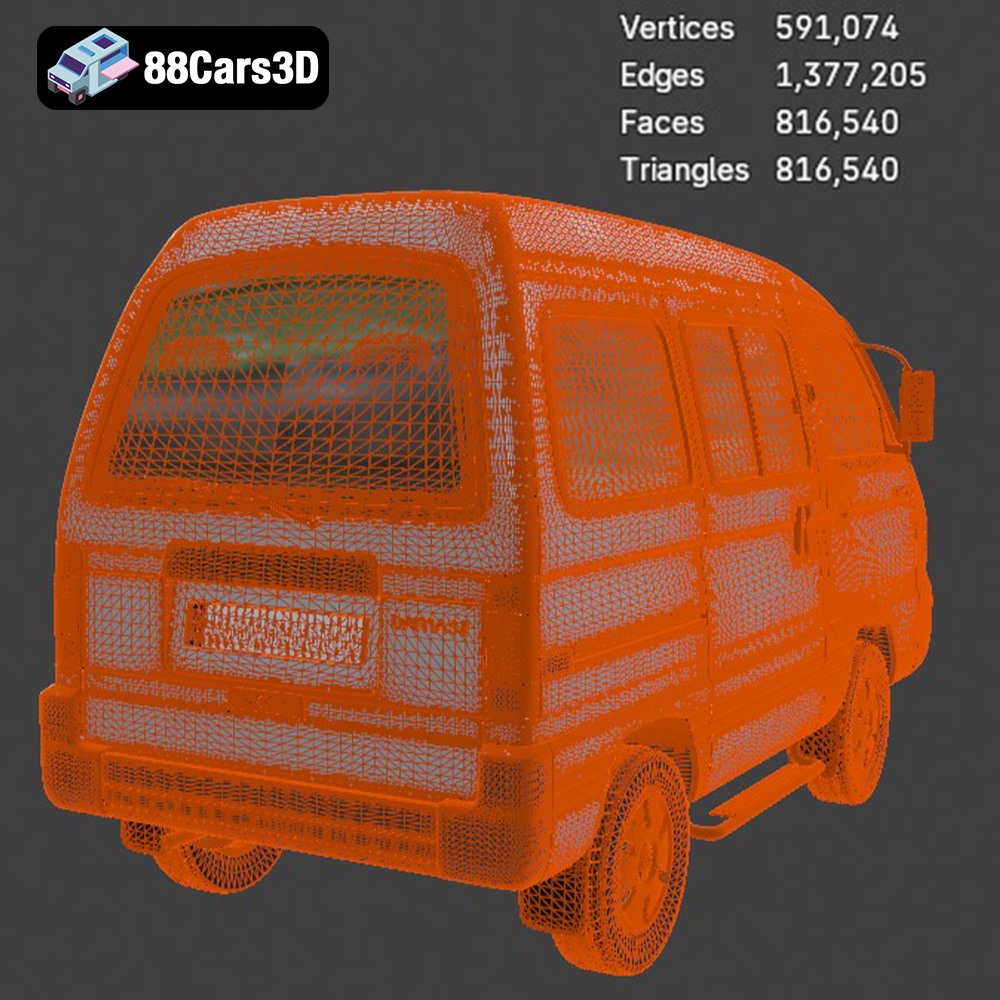
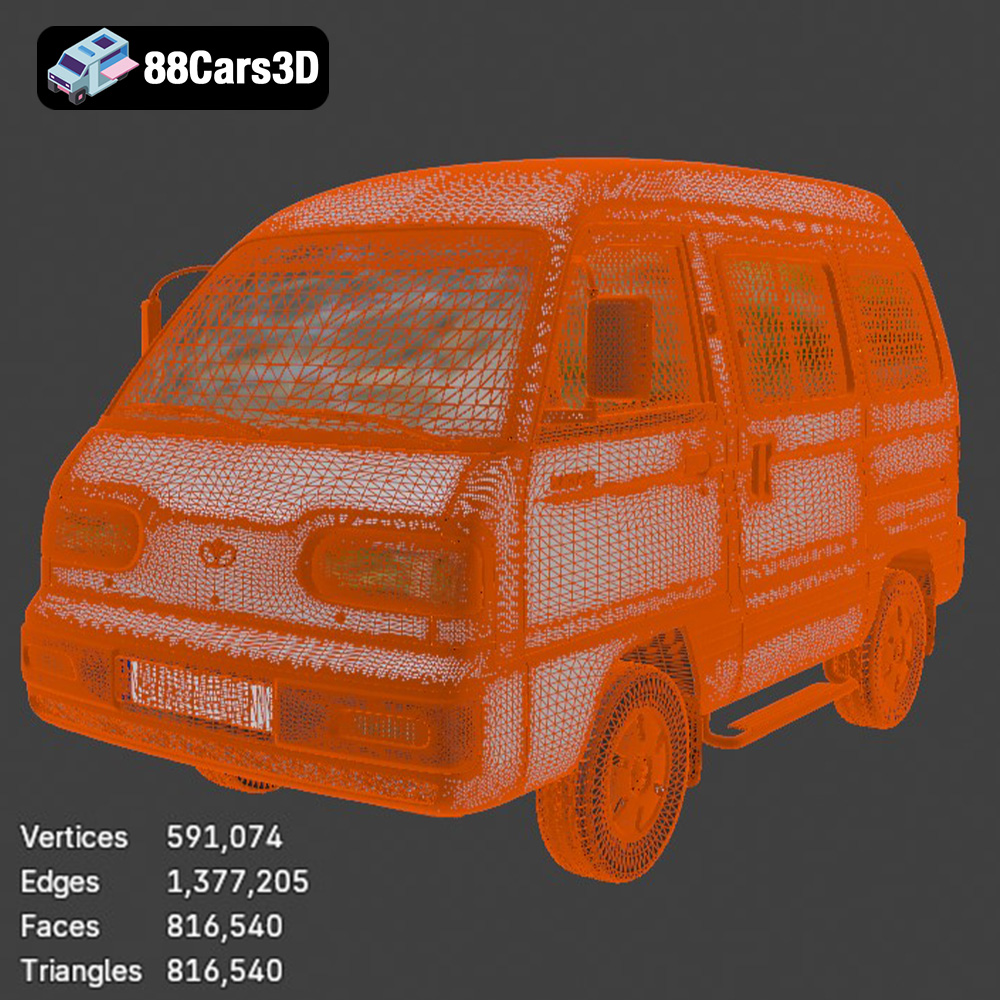
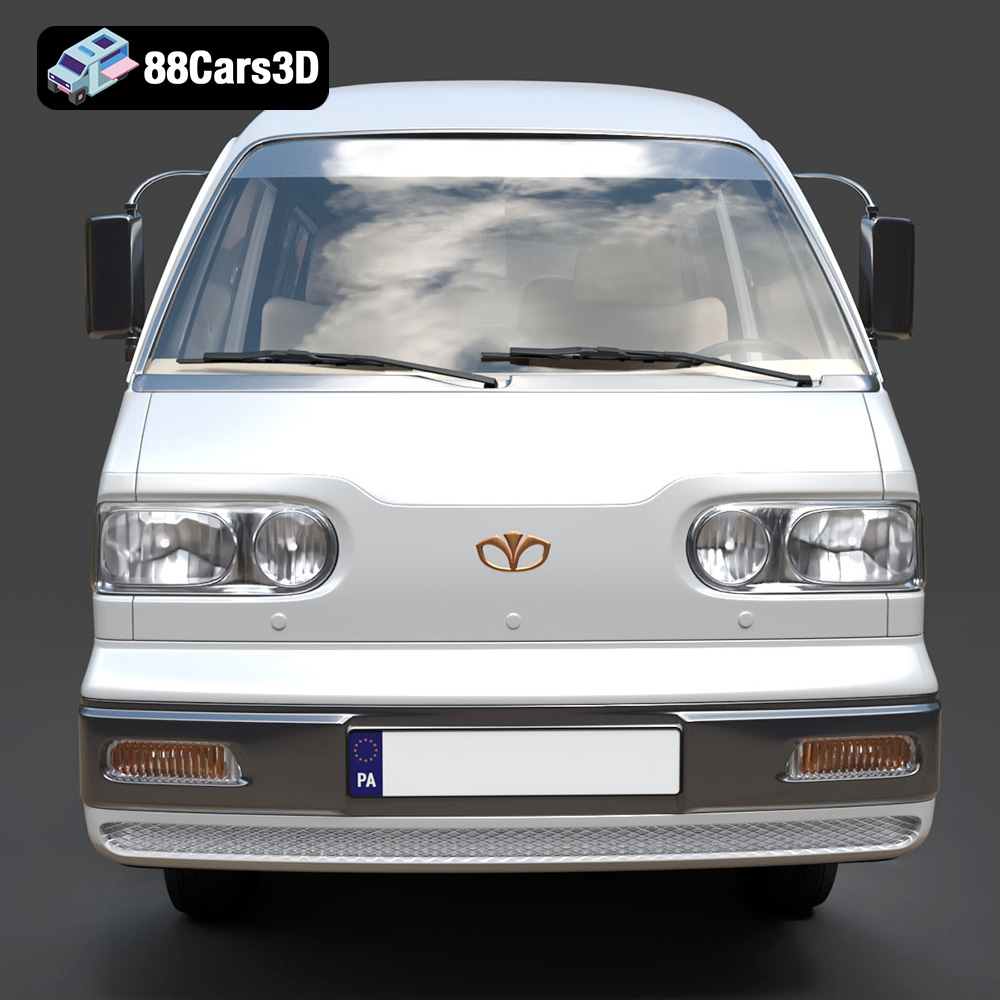
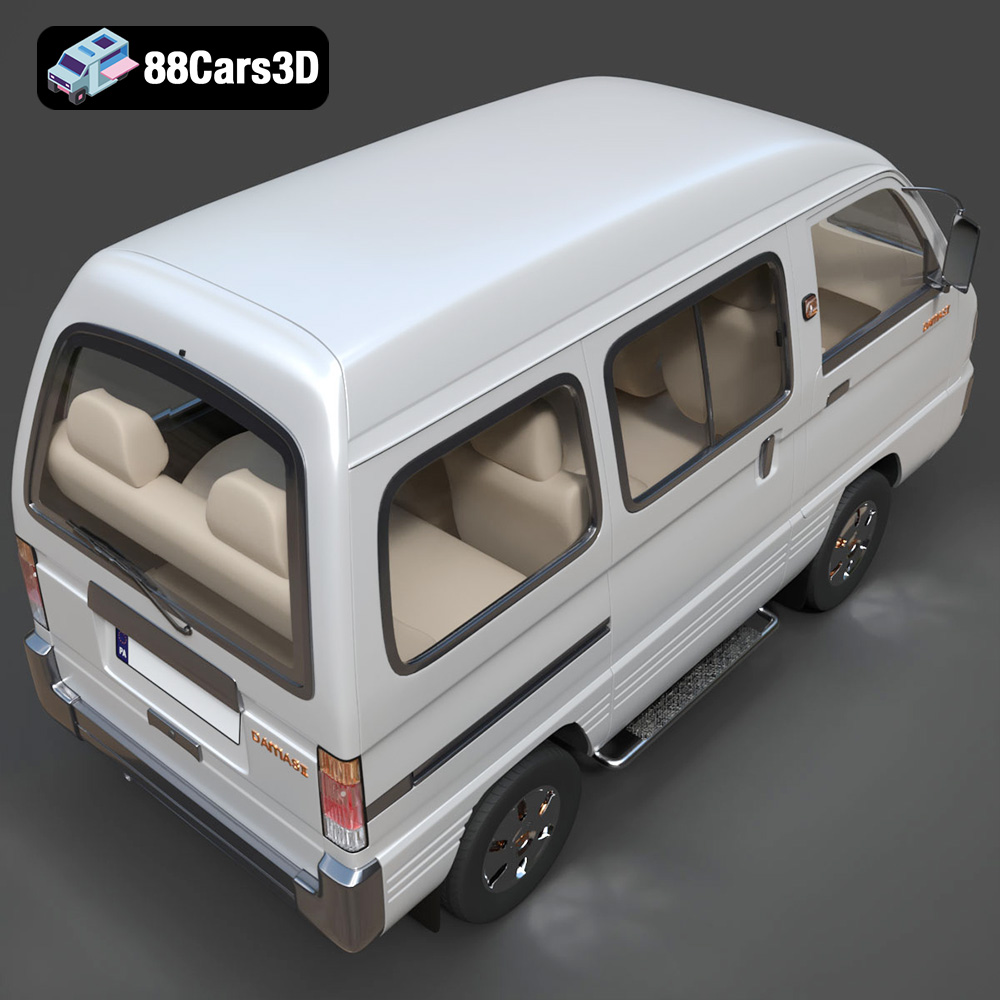
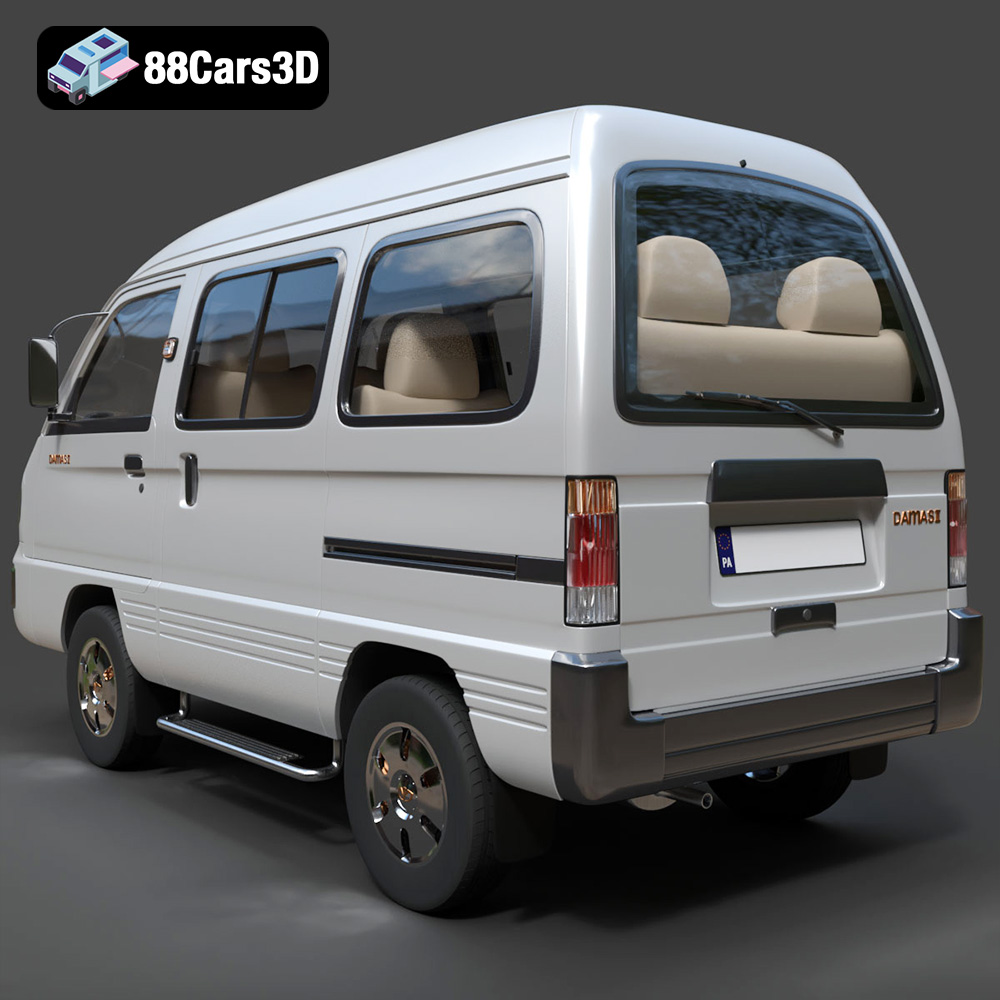
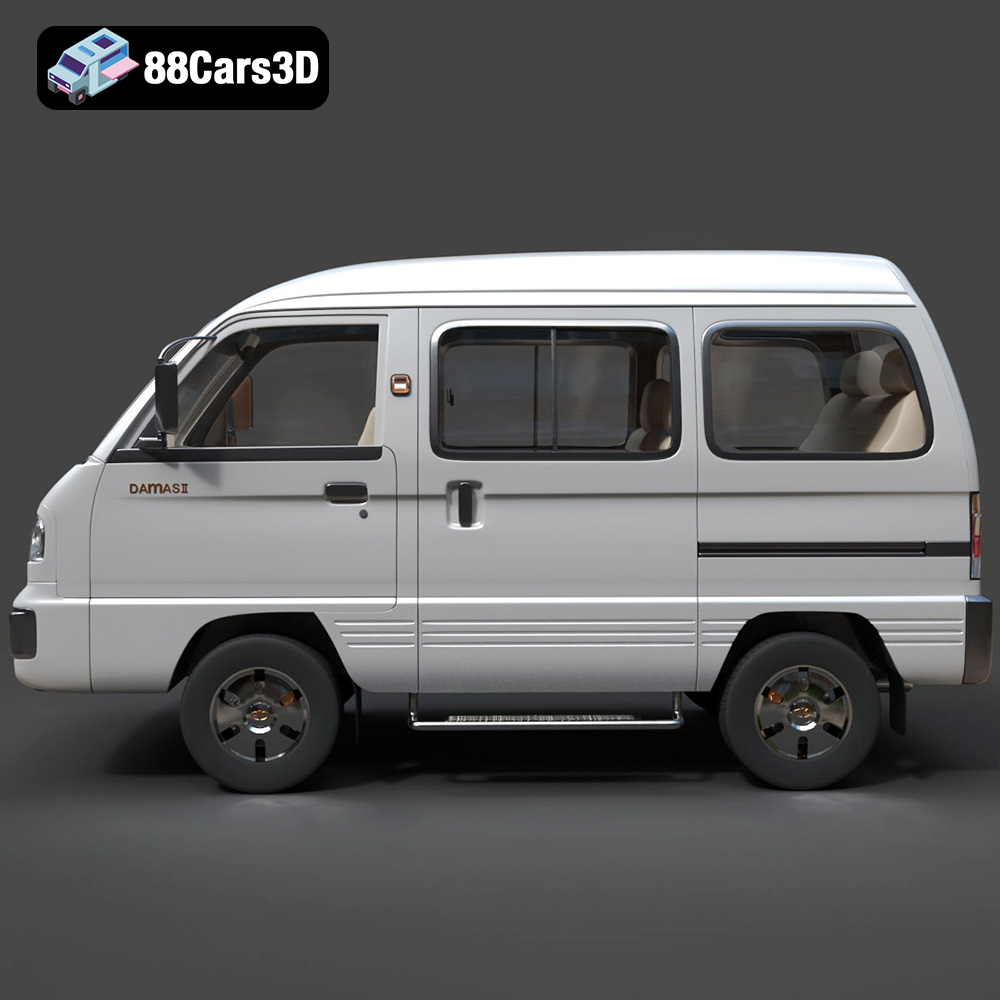
The Daewoo Damas 2 Microvan 3D Model available on 88cars3d.com captures every essential exterior detail of this iconic vehicle. From its distinctive facelifted front fascia, featuring curved headlight and indicator clusters, to its classic cabover proportions, the model is built for accuracy. Key features include the functional dual sliding rear doors and a practical rear liftgate, all meticulously modeled. The model even includes utilitarian 12-inch steel wheels with optional basic hubcaps, contributing to its authentic street presence. With a high-poly count of 954,200 vertices and 935,600 polygons, it ensures premium visual fidelity, making it suitable for close-up renders and detailed visualizations where every curve and panel needs to hold up to scrutiny. Importantly, separate components like wheels, steering elements, and doors are rigged with proper pivots, enabling realistic animation sequences for various applications.
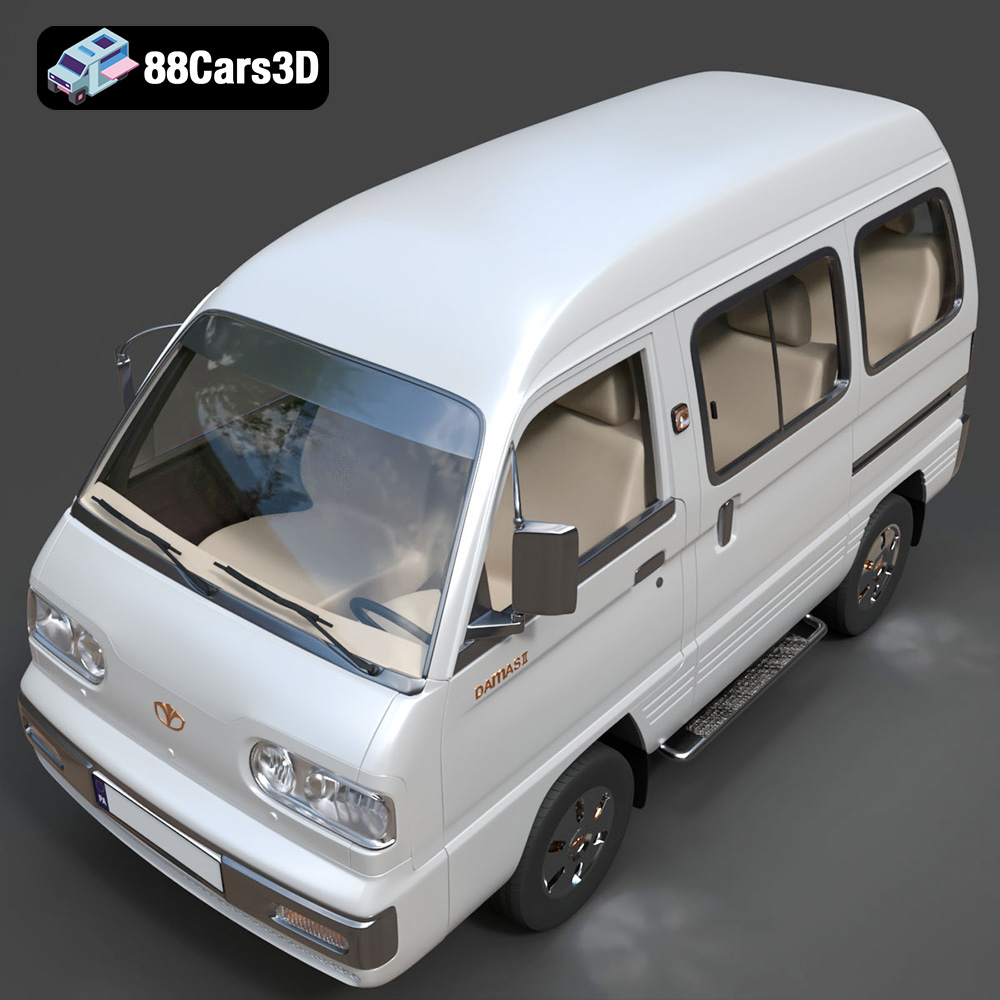
Beyond the exterior, the Daewoo Damas 2 Microvan 3D Model also offers a highly practical and accurately represented interior. The model faithfully recreates the utilitarian cabin layout, with front seats positioned over the engine, characteristic of such compact vans. The configurable rear space is available as either an empty cargo bay or with folding passenger benches, providing flexibility for different scene requirements. Details like the spartan, minimalist dashboard design, a simple two-spoke steering wheel, and an analog instrument cluster are all present, reflecting the vehicle’s affordable commercial nature. Basic cloth or durable vinyl seating textures add to the authenticity, and the optimized geometry ensures the interior is suitable for detailed close-up rendering, crucial for architectural visualizations or interactive AR/VR experiences where users might peek inside.
A high-quality 3D car model, such as the Daewoo Damas 2 Microvan from 88cars3d.com, is designed to seamlessly integrate into various professional workflows. Its robust technical specifications and comprehensive file format support ensure it can be leveraged effectively across different industries, from high-fidelity rendering to real-time game development.
For professionals specializing in architectural visualization (ArchViz), advertising, or product rendering, 3ds Max remains a cornerstone. The Daewoo Damas 2 Microvan 3D Model, available in the native .max format, provides an immediate advantage. Artists can directly open the scene, which comes with well-organized mesh structures, proper pivot setups, and potentially pre-configured materials. This streamlines the process of placing the Damas 2 into urban street scenes, commercial fleet pitches, or logistical simulations. Its real-world scale accuracy, based on factory dimensions, ensures it fits perfectly within photogrammetry-scanned environments or alongside CAD-precise architectural models, contributing to an overall sense of realism and credibility.
The game development industry demands assets that are not only visually appealing but also highly optimized for real-time performance. The Daewoo Damas 2 Microvan 3D Model, provided in .fbx and specific .unreal formats, is built with this in mind. Its high-poly mesh, while detailed, can be further optimized with LODs (Levels of Detail) within Unreal Engine, ensuring efficient rendering at varying distances. The separate wheels, steering components, and doors with proper pivots make it animation-ready for in-game physics, driving mechanics, and interactive elements. This makes it an ideal choice for populating open-world games set in diverse regions, or for creating engaging delivery simulators.
Blender’s versatility and strong community support make it a favorite among indie developers, animators, and freelance artists. The availability of the Daewoo Damas 2 Microvan 3D Model in its native .blend format is a significant benefit. This provides a fully editable scene, allowing artists to completely customize the model to suit their specific project needs. From adjusting the mesh topology to modifying materials with Blender’s powerful shader editor, the creative possibilities are vast. Its well-organized structure also means less time spent cleaning up geometry and more time on artistic refinement.
The journey of a 3D model doesn’t always end on a screen. For many enthusiasts and professionals, the ultimate goal is to bring digital creations into the physical world. The Daewoo Damas 2 Microvan 3D Model extends its utility into the realm of 3D printing, offering a tangible output for collectors, modelers, and design validation.
The inclusion of the .stl format for the Daewoo Damas 2 Microvan 3D Model means that this digital asset is ready for physical manufacturing. STL files, by their nature, describe only the surface geometry, making them the universal language for 3D printers. This allows designers to create display-scale commercial diecast models, prototypes for automotive accessories, or unique collector’s items. The precision of the original 3D model ensures that the printed version accurately reflects the distinct lines and features of the real microvan.
Successful 3D printing requires attention to specific settings, and the Daewoo Damas 2 Microvan 3D Model comes with recommended parameters to guide users. For larger scales (1:18, 1:24, 1:32), FDM (Fused Deposition Modeling) printers can be used, with suggested layer heights of 0.08–0.16 mm, wall thicknesses of 1.2–2.0 mm, and an infill of 15–25%. Supports will be necessary for overhangs like side mirrors, wipers, and wheel arches. Printing the body angled and wheels separately is recommended for a smoother surface finish and better detail. For smaller scales, especially when aiming for exquisite detail like the subtle curves of the headlights, resin (SLA/DLP) printing is highly recommended, allowing for finer layer heights (0.04–0.12 mm) and exceptional surface quality. Post-processing steps such as sanding, priming, and applying a glossy commercial paint finish (like classic white or light blue) are crucial for achieving a professional-grade physical model.
The utility of a highly detailed 3D car model like the Daewoo Damas 2 Microvan extends across a surprising array of professional and creative applications. Its specific characteristics allow for unique storytelling and technical solutions that generic models cannot provide.
The Daewoo Damas 2 Microvan is renowned for its maneuverability and efficiency in urban environments. This makes its 3D model invaluable for logistical simulations. Companies planning delivery routes in densely populated areas or researchers studying traffic flow and urban planning can use this model to represent common light commercial vehicles. Simulating fleets of Damas 2 vans can provide accurate data on vehicle performance, parking logistics, and even last-mile delivery strategies, offering a pragmatic solution for optimizing urban transport systems.
Architectural visualizations often fail to fully immerse viewers due to generic, out-of-place vehicles. The Daewoo Damas 2 Microvan 3D Model, with its strong regional identity, provides an authentic touch. When rendering a proposed development in, say, Uzbekistan or South Korea, including a fleet of Damas 2s instantly grounds the scene in reality, making it more believable and relatable to local audiences. This attention to detail elevates the overall quality of the visualization, moving it beyond a mere structural representation to a living, breathing urban tableau.
For independent game developers, budgets can be tight, but the desire for immersive, believable worlds remains paramount. The Daewoo Damas 2 Microvan 3D Model offers an affordable yet high-quality solution for populating game environments set in regions where this vehicle is prevalent. Instead of relying on fictional or generic vehicles, developers can leverage the Damas 2 to create a more authentic atmosphere, whether it’s a driving simulator, an open-world RPG, or even a narrative-driven adventure game. Its robust geometry and animation-ready components make it a versatile asset for various gameplay mechanics.
The world of 3D modeling is vast and constantly evolving, driven by the need for realism, versatility, and efficiency across diverse industries. From hyper-realistic automotive rendering to immersive game development, the foundation of any successful project lies in the quality and adaptability of its core assets. High-quality 3D car models are not just objects; they are vital components that breathe life into digital worlds, convey cultural context, and provide practical solutions for simulation and design.
The Daewoo Damas 2 Microvan 3D Model stands as a testament to this principle. While seemingly humble, its accurate representation of a widely recognized, practical vehicle offers immense value. Its detailed exterior and interior, combined with robust technical specifications and comprehensive file format support (.blend, .fbx, .obj, .glb, .stl, .ply, .unreal, .max), ensure it can be seamlessly integrated into virtually any professional pipeline. Whether you’re an architectural visualization artist, a game developer, an AR/VR content creator, or a 3D printing enthusiast, this model provides the authenticity and flexibility required to elevate your projects.
For those seeking to enrich their digital libraries with such meticulously crafted 3D car models, resources like 88cars3d.com offer an extensive collection of vehicles designed to meet the highest industry standards. Investing in quality assets like the Daewoo Damas 2 Microvan 3D Model is an investment in the realism, efficiency, and overall success of your creative and technical endeavors. Explore the possibilities and discover how the right 3D model can transform your next project.
The Daewoo Damas 2 Microvan 3D Model is a highly detailed digital recreation of the ubiquitous and practical compact commercial vehicle. Based heavily on the classic kei-van architecture but refined with a modernized, slightly more rounded front fascia, the Damas 2 became a legendary workhorse across South Korea, Central Asia (particularly Uzbekistan), and Eastern Europe. Known for its incredible maneuverability and space efficiency, it serves as the ultimate urban delivery van and compact passenger transport. This 3D model accurately represents the facelifted exterior styling, including the distinct curved headlight and indicator clusters, cabover proportions, dual sliding rear doors, and functional rear liftgate. Built with dense, clean topology for premium visual fidelity and real-world scale accuracy, it is ideal for close-up rendering, urban environment visualization, animation, game development, and AR/VR commercial fleet showcases.
$9.99
.automotive
.blend
.daewoo
.damas
.fbx
.obj
.rendering
.stl
3d printing
car-3d-model
chevrolet-damas
commercial-vehicle
damas-2
game asset
high poly
kei-van
microvan
utility-van
uzauto