Get 50% OFF All Premium 3D & STL Models!

In the illustrious history of automotive design and engineering, few vehicles command as much reverence as the Porsche 918 Spyder. This hypercar, a formidable pillar of the “Holy Trinity” that redefined performance, masterfully blends a high-revving V8 with cutting-edge electric motors. Its sleek lines, aggressive stance, and innovative detachable Targa-style roof panels represent a pinnacle of automotive artistry. But what happens when such a magnificent machine transcends the physical and enters the digital world? It becomes an indispensable asset for creators across a myriad of industries, from blockbuster game development to cinematic automotive rendering.
For 3D artists, game developers, architects, and visualization specialists, access to high-fidelity 3D car models like the Porsche 918 Spyder is not just a convenience; it’s a necessity. These digital replicas serve as the foundation for breathtaking visuals, immersive experiences, and realistic simulations. The quest for perfection in digital automotive assets often leads professionals to specialized marketplaces. One such trusted source for premium assets is 88cars3d.com, where you can find meticulously crafted models designed to integrate seamlessly into any professional workflow. The Porsche 918 Spyder (With Detachable Roof) 3D Model, in particular, stands out as an exemplary asset, offering unparalleled detail and optimization for a diverse range of applications.
The versatility of a 3D car model often hinges on the file formats it supports. Each format is engineered with specific strengths and intended use cases, making an understanding of their nuances critical for professionals. The Porsche 918 Spyder (With Detachable Roof) 3D Model from 88cars3d.com is supplied in an extensive array of formats, ensuring maximum compatibility and utility across virtually any project or software environment. Let’s delve into the technical specifics and ideal applications for each:
The .blend format is Blender’s native file type. It encapsulates an entire Blender scene, including the 3D model geometry, materials, textures, lighting, cameras, animations, physics simulations, and even custom scripts. For artists and studios deeply integrated into the Blender ecosystem, this is the preferred format. It allows for full editability, enabling intricate modifications to topology, UV mapping, material nodes, or even extending the model with new components and animations without any loss of data fidelity that can occur during format conversions. It’s ideal for projects that require ongoing development or heavy customization within Blender.
Autodesk’s .fbx (Filmbox) format is arguably the most widely adopted interchange format in the 3D industry, especially crucial for real-time applications. It excels at transferring 3D model data, including geometry, materials, textures, rigging, skinning, and animation, between different software packages. For game development, particularly for engines like Unreal Engine and Unity, .fbx is the standard. Its robust support for skeletal animations and blend shapes makes it perfect for complex rigged characters or, in this case, a vehicle with animatable components like wheels, steering, and the detachable roof. It ensures a smooth transition from a modeling package to a game engine with minimal loss of information.
The .obj (Wavefront OBJ) format is a universal, open-standard format primarily used for geometric data. It’s a simpler format compared to .fbx, focusing on vertices, faces, UV coordinates, and normals. While it doesn’t typically store rigging or animation data directly, it’s incredibly robust for mesh transfer between virtually any 3D software. Its plain text nature makes it highly readable and editable. When you need to ensure basic model geometry is accessible across a wide range of platforms without concerns for complex animations or advanced material setups, .obj is a reliable choice. It’s often used as a fallback or for models primarily intended for static rendering or import into CAD software.
.glb (GL Transmission Format Binary) is the binary version of glTF, a royalty-free specification for 3D scenes and models. It’s become the industry standard for the transmission and loading of 3D models in web applications, augmented reality (AR), and virtual reality (VR). .glb files are self-contained, packing all model data (geometry, textures, animations) into a single file, making them highly efficient for delivery over networks. For interactive digital showrooms, mobile AR experiences, or browser-based configurators featuring the Porsche 918 Spyder, .glb offers optimal performance and ease of integration, ensuring quick loading times and broad device compatibility.
The .stl (STereoLithography) format is synonymous with 3D printing. It describes only the surface geometry of a 3D object using a tessellation of triangular facets, without any color, texture, or material information. When preparing the Porsche 918 Spyder for physical fabrication, whether it’s a display-scale model or a custom part, .stl is the go-to format. Its simplicity ensures that 3D printers and slicing software can accurately interpret the mesh for manufacturing. The provided .stl for the 918 Spyder is optimized for hobbyists looking to print their own supercar scale models, ensuring manifold geometry suitable for extrusion or resin printing.
The .ply (Polygon File Format or Stanford Triangle Format) is a versatile format for storing 3D data from 3D scanners, CAD software, or other mesh-generation applications. Like .obj, it defines geometry by vertices and faces, but it can also store additional properties like color, transparency, texture coordinates, and even normal vectors per vertex or face. It’s often used in applications requiring high precision mesh data, such as scientific visualization, reverse engineering, or complex data analysis. While less common for direct game asset use, its inclusion for the 918 Spyder provides flexibility for niche applications or advanced mesh processing.
The .unreal format represents an asset specifically optimized for direct import into Unreal Engine projects. While typically .fbx is used for import, sometimes assets are prepared with specific Unreal material setups, collision meshes, or Level of Detail (LOD) groups pre-configured. This “engine-ready” designation signifies that the model is likely structured and optimized to drop into an Unreal project with minimal additional setup, allowing developers to immediately leverage its high visual fidelity and optimized topology for real-time environments. It streamlines the workflow for Unreal Engine users, bypassing many common import challenges.
The .max format is the native file type for Autodesk 3ds Max, a powerful 3D modeling, animation, and rendering software. Similar to .blend for Blender, the .max file contains the complete scene data, including all geometry, modifiers, materials (V-Ray, Corona, Arnold, etc.), lights, cameras, and animation data. For professionals working within 3ds Max, this format provides the highest level of editability and flexibility. It’s ideal for further refinement, creating complex animations, or integrating the 918 Spyder into existing 3ds Max scenes for high-end cinematic rendering or architectural visualizations, offering full control over every aspect of the digital asset.
The Porsche 918 Spyder (With Detachable Roof) 3D Model from 88cars3d.com isn’t just a collection of polygons; it’s a meticulously engineered digital twin designed for peak performance and visual fidelity. This model embodies the spirit of the original hypercar, translated with precision into a versatile digital asset.
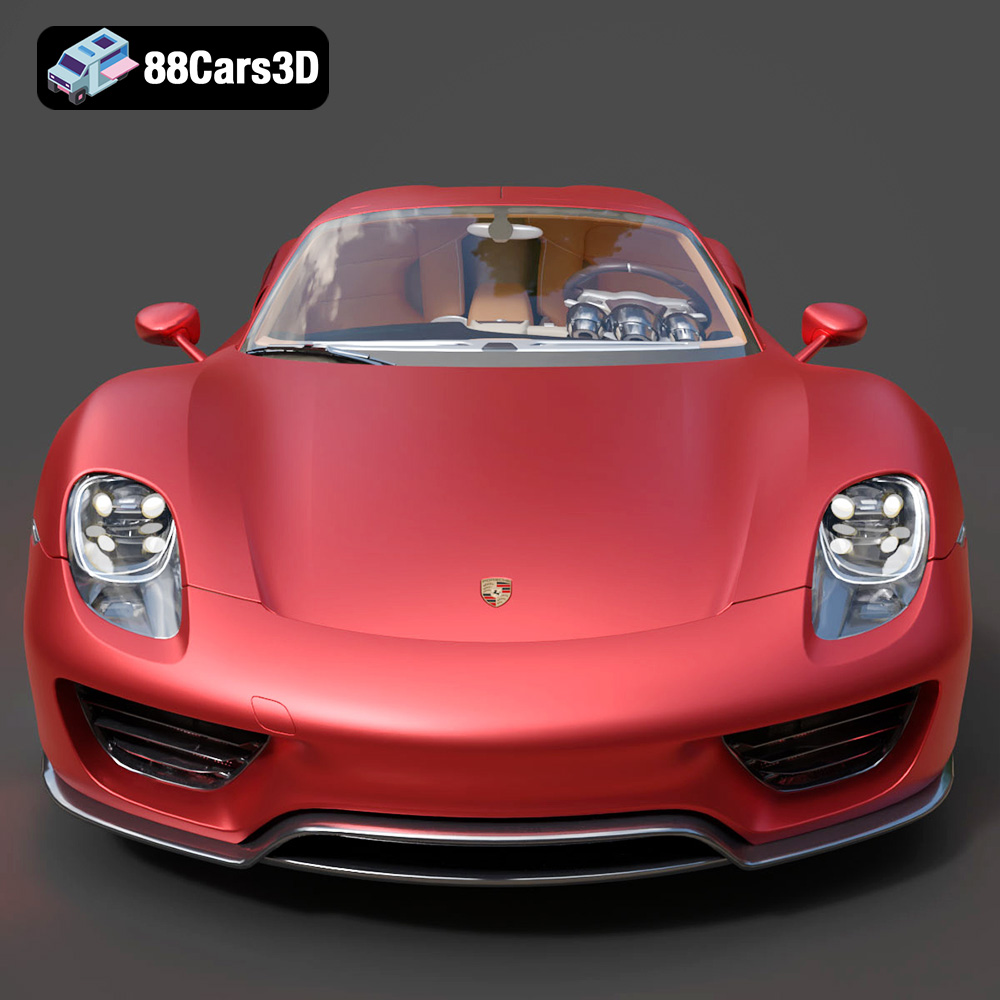
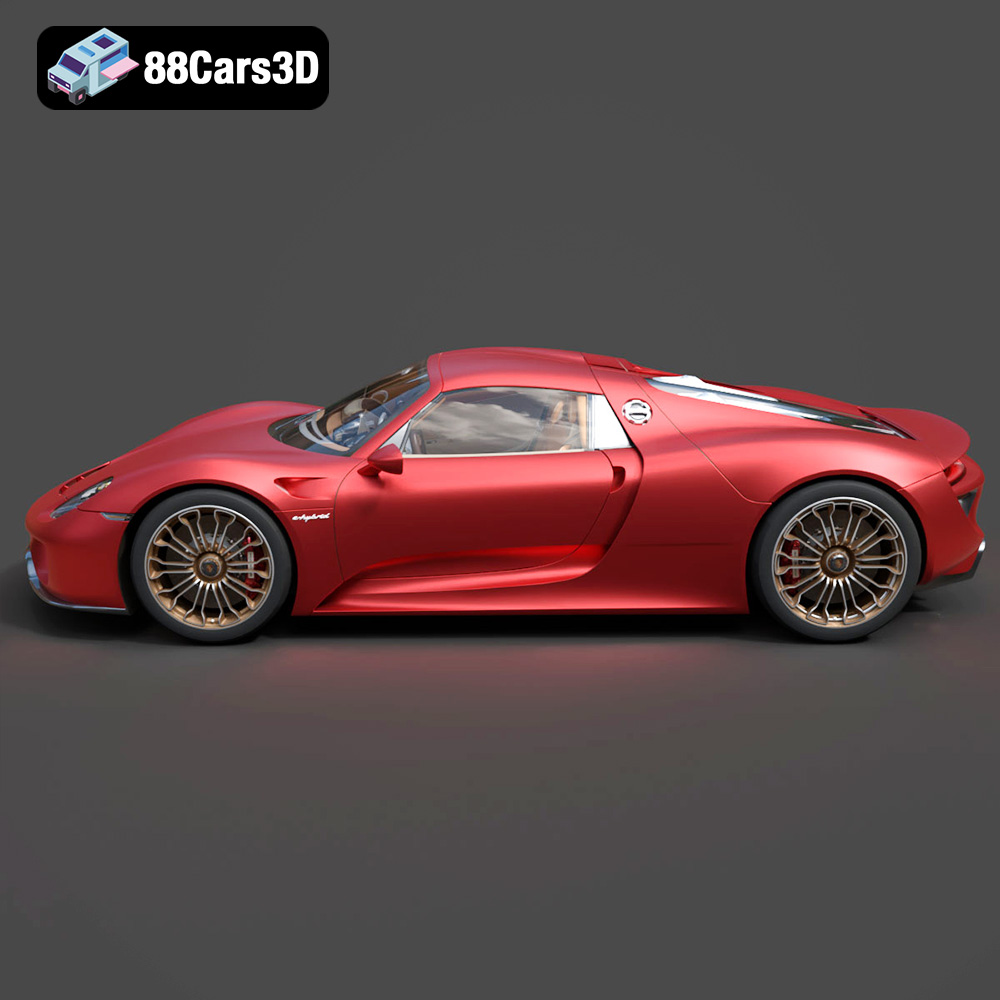
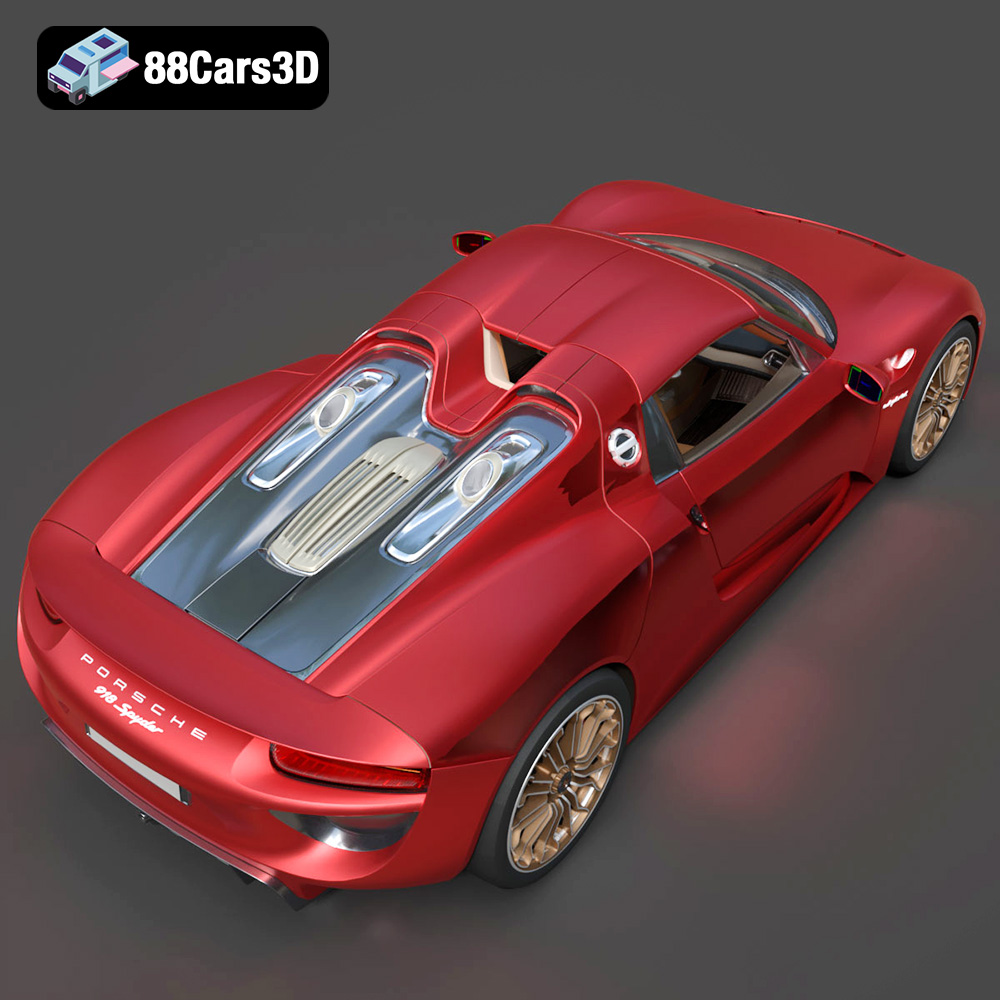
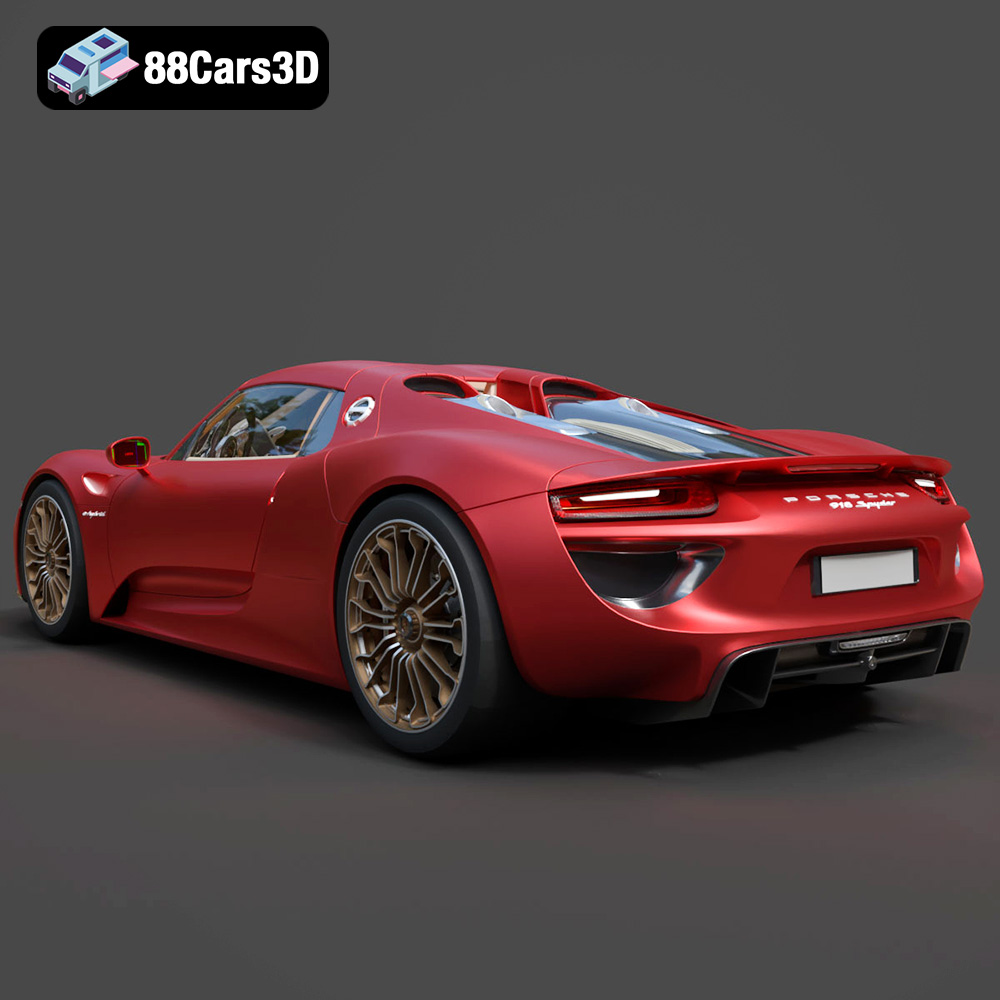
The beauty of the physical Porsche 918 Spyder lies in its iconic design and groundbreaking engineering, and this 3D model flawlessly replicates those elements. From its accurate proportions to its cutting-edge aerodynamic geometry, every curve and panel is faithfully reproduced. A standout feature is the fully detachable Targa-style roof panels, pre-configured for easy removal and animation. This allows artists to effortlessly switch between a sleek closed-coupe track profile and the exhilarating open-air Spyder configuration, adding immense flexibility for dynamic scene setups and narrative possibilities.
Beyond the roof, the model boasts other signature elements: the distinctive top-exit exhaust system mounted directly behind the engine bay, the aggressive rear diffuser, and the active aerodynamic rear wing. The intricate details extend to the lighting, with four-point LED headlights and sleek 3D taillight blades. Furthermore, the detailed lightweight forged alloy wheels, wrapped in performance tires, perfectly reveal the massive carbon-ceramic brake calipers, adding a layer of realism vital for close-up shots and high-quality automotive rendering.
No high-quality 3D car model is complete without an equally detailed interior, and the Porsche 918 Spyder does not disappoint. The authentic driver-centric cockpit layout seamlessly blends luxury materials with high-tech carbon fiber elements. The sweeping, elevated center console geometry, complete with digital displays, is accurately modeled, providing a sense of modern sophistication. Premium sport bucket seat geometry is designed to take Alcantara and leather texture mapping flawlessly, inviting artists to create stunning material renders. The signature sport steering wheel, featuring the driving mode selector dial, completes the immersive interior experience. Crucially, the interior geometry is optimized, making it tailored for a smooth first-person POV in gaming or VR applications, ensuring that players or viewers feel truly inside this legendary machine.
In the realm of 3D car models, raw polygon count isn’t the sole indicator of quality; it’s the intelligent use of topology and optimization that truly defines a professional-grade asset. The Porsche 918 Spyder (With Detachable Roof) 3D Model strikes an impressive balance, designed to be both visually stunning and computationally efficient.
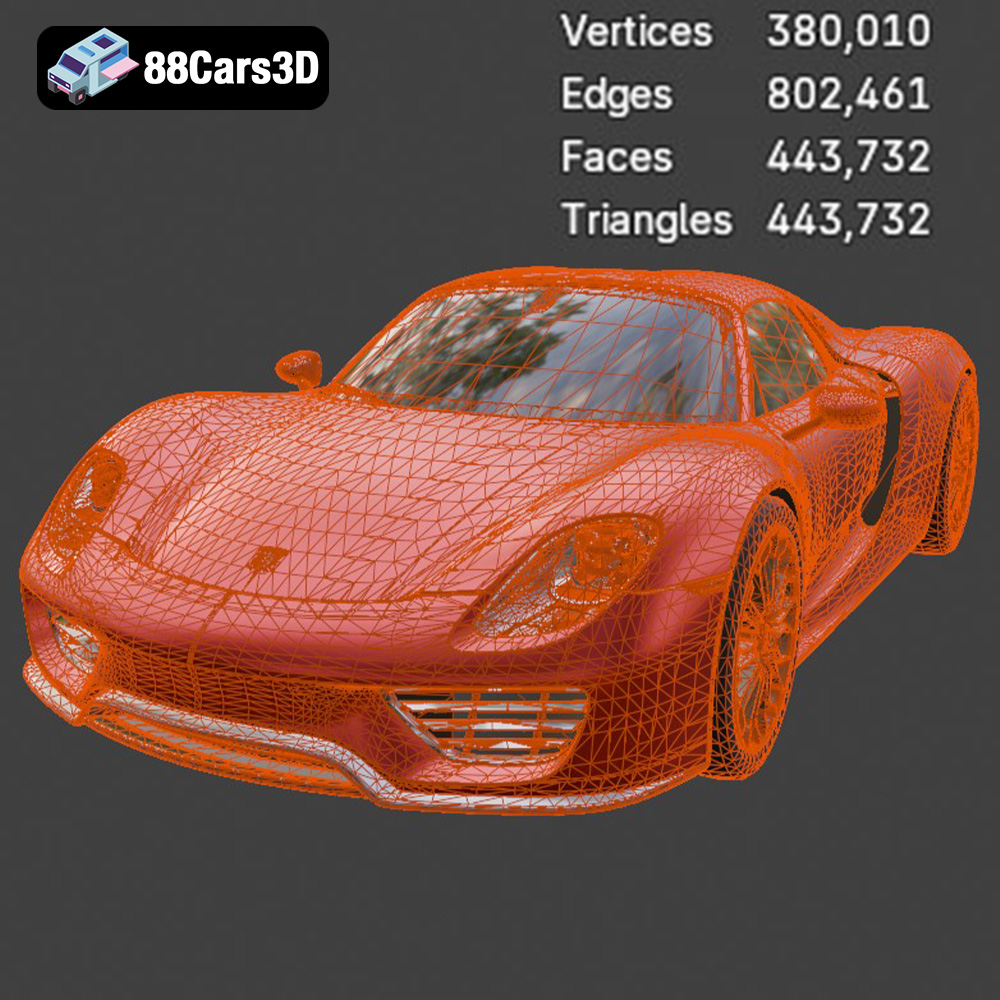
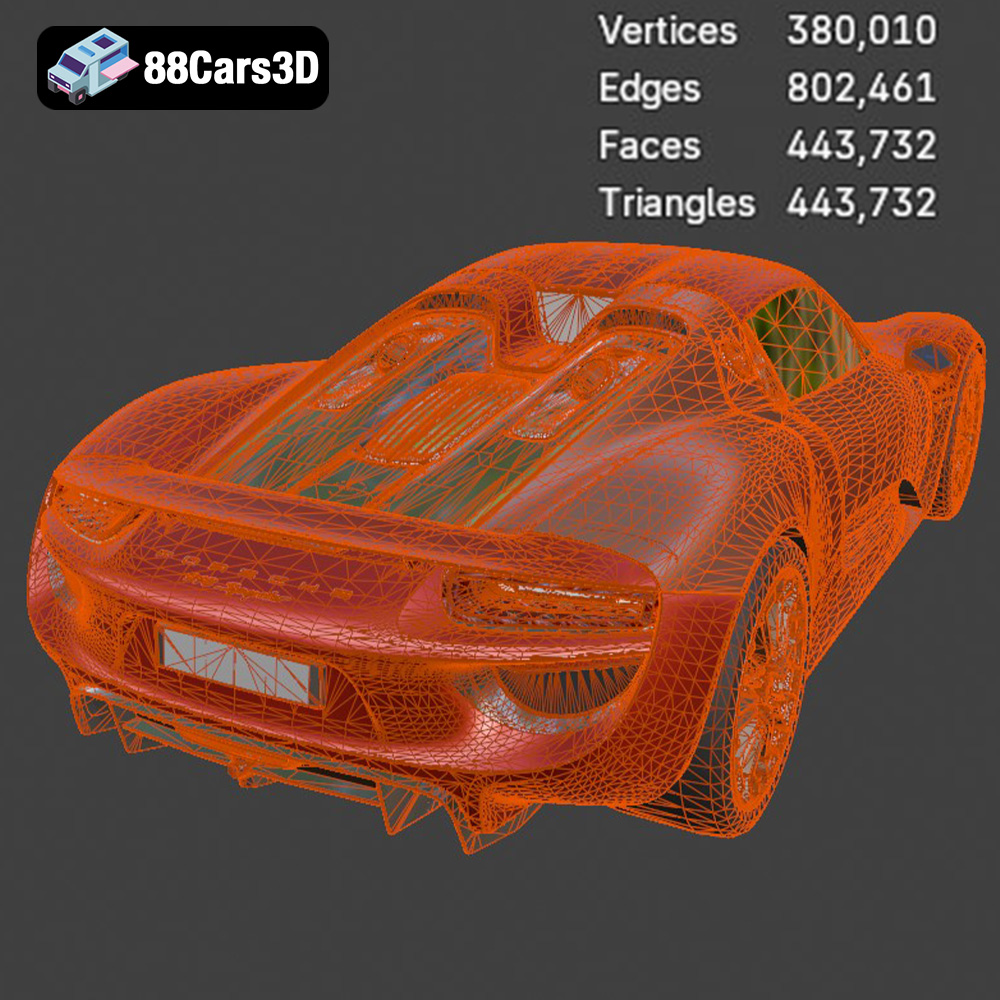
The technical specifications of this model are a testament to thoughtful optimization: 380,010 vertices, 802,461 edges, and 443,732 faces/triangles. At approximately 443k triangles, this model occupies a “sweet spot” in terms of resolution. It’s detailed enough to stand up to the most demanding high-end cinematic renders, capturing every subtle curve and panel reflection with stunning accuracy. Yet, it remains lightweight enough to serve as a “hero” car in real-time game engines like Unreal Engine or Unity, ensuring smooth frame rates without compromising visual fidelity.
A crucial advantage highlighted in the product description is its “beautifully clean, quad-based flow.” This optimized topology ensures predictable subdivision, easier UV unwrapping, and fewer rendering artifacts. Clean geometry is paramount for high-quality deformations during animation and allows for seamless integration with various rendering pipelines, making it a robust foundation for any project requiring a top-tier automotive rendering or game asset.
Accuracy extends beyond aesthetics. The Porsche 918 Spyder model is built to real-world scale, based on Porsche factory dimensions. This precision is vital for architectural visualization, VR simulations, and game development where environmental interaction and relative sizing are critical. Furthermore, the model comes with proper pivot setups for key animatable components. Separate wheels, steering components, doors, and the roof panels are all configured for realistic animation and rigging. This pre-setup significantly reduces the time and effort required for animators to bring the car to life, whether for a driving sequence, a dramatic reveal, or showcasing the roof removal mechanism.
The versatility of this Porsche 918 Spyder 3D model makes it an invaluable asset across a spectrum of creative and technical industries. Its optimized design allows it to shine in diverse applications.
For game developers, the Porsche 918 Spyder is the perfect “hero” drivable hypercar. Its mid-polygon topology is ideally balanced for current-gen racing games, offering the detail expected by players while maintaining the performance required for smooth gameplay. In open-world titles, it can serve as a high-value collectible or a unique vehicle for special missions. For driving simulators, its accurate proportions and animatable components allow for realistic physics implementation and immersive player experiences. As a pre-optimized game asset, it reduces the workload for developers, enabling quicker iteration and integration into engines like Unreal and Unity.
When it comes to automotive rendering and visualization, this 3D model truly excels. Its high visual fidelity and clean topology make it ideal for dramatic studio lighting setups, where every reflection and highlight matters. Imagine it featured in a high-octane automotive commercial, showcasing its detachable roof and aggressive lines in slow motion. It’s equally suited for modern luxury architectural renders, adding a touch of prestige and realism to virtual environments. The ability to customize paint colors, apply legendary liveries like the Weissach Package (Martini Racing or Salzburg), and adapt lighting for various moods – from neon-lit city streets to bright race track environments – provides artists with limitless creative control for stunning visuals.
The rise of augmented reality (AR) and virtual reality (VR) has opened new avenues for digital content, and the optimized poly count of the 918 Spyder model makes it an excellent candidate for interactive digital showrooms and mobile AR experiences. Imagine a customer exploring the car in full 3D from their living room, virtually detaching the roof, or stepping into the cockpit in VR. Its efficient mesh ensures that even on mobile devices or less powerful VR headsets, the model renders smoothly, providing a compelling and responsive interactive experience. This capability makes it a forward-thinking game asset for experiential marketing and innovative product showcasing.
The utility of the Porsche 918 Spyder (With Detachable Roof) 3D Model extends far beyond its digital rendering, offering extensive customization options and even the potential for physical creation.
One of the most exciting aspects of working with a high-quality 3D car model is the degree of customization it allows. With this 918 Spyder, artists can configure scenes with the roof panels securely on, or artfully placed in the virtual background to showcase the open-air Spyder profile. This dynamic flexibility enhances storytelling and visual impact. Furthermore, the model is a perfect canvas for applying the legendary “Weissach Package” wraps, such as the classic Martini Racing or Salzburg liveries, which pay homage to Porsche’s racing heritage. Changing exterior paint colors to match striking factory Paint to Sample (PTS) options, or adapting lighting for dramatic effects, from moody nighttime city streets to sun-drenched race tracks, empowers artists to create truly unique and personalized visuals.
For enthusiasts and collectors, the ability to translate a digital model into a tangible object is a significant advantage. The Porsche 918 Spyder (With Detachable Roof) 3D Model is convertible to .stl format, making it suitable for 3D printing. This opens up opportunities for creating display-scale 1:18 or 1:24 supercar diecast hobby models. The provided 3D print settings are comprehensive:
This detailed guidance makes the model accessible not just for digital artists but also for hobbyists eager to hold a physical representation of this iconic hypercar.
The true value of a professional 3D car model lies in its seamless integration into various software and engine environments. Here’s how the Porsche 918 Spyder (With Detachable Roof) 3D Model can enhance different creative pipelines.
For artists focused on achieving photorealistic automotive rendering, 3ds Max remains a powerhouse. Utilizing the provided .max file, or importing the .fbx if a specific version is preferred, offers full control. The initial steps involve setting up render-ready materials, perhaps with V-Ray or Corona Renderer, leveraging the clean UVs for accurate texture placement. Lighting is crucial; sophisticated studio HDRI environments or custom light rigs can dramatically enhance the car’s reflective surfaces. Camera angles, depth of field, and post-processing in software like Photoshop complete the cinematic look. A particular advantage of this model is the separate roof panels, which can be animated within 3ds Max to create compelling reveal shots or dynamic sequences showcasing the Spyder configuration.
Blender’s versatility makes it a favorite for indie developers. Starting with the .blend file ensures all native Blender scene data is preserved. Developers can further optimize the model if needed, perhaps by generating LODs (Levels of Detail) for performance. Materials can be quickly set up using Blender’s Principled BSDF shader for a physically based rendering (PBR) workflow, compatible with both Eevee (real-time rendering) and Cycles (path tracing). For game development, the .fbx export from Blender is robust for transferring the model, its materials (via PBR textures), and pre-rigged components into game engines. Rigging for gameplay, such as setting up wheel rotation and steering, is streamlined thanks to the model’s proper pivot points, making it an ideal game asset for rapid prototyping and production.
Unreal Engine thrives on high-quality, optimized assets, making the Porsche 918 Spyder an excellent candidate for real-time applications. Importing the dedicated .unreal file, or a carefully prepared .fbx, minimizes setup time. Developers can then leverage Unreal’s advanced material editor to create stunning physically based materials, ensuring accurate reflections and surface properties. The model’s clean topology and balanced poly count mean it can be directly integrated into car blueprints for physics simulation and drivability. The detachable roof panels can be animated and controlled via blueprints, allowing for interactive elements within a game or a VR showroom. Imagine a player pressing a button to virtually remove the roof, instantly transforming the vehicle, all thanks to the model’s inherent design for animation and interactive control.
The Porsche 918 Spyder is more than just a car; it’s a testament to engineering excellence and design innovation. Translating such an icon into a high-quality 3D car model requires an equal measure of precision, technical expertise, and artistic dedication. The Porsche 918 Spyder (With Detachable Roof) 3D Model delivers on all fronts, offering an unparalleled asset for professionals across industries.
From its meticulously replicated exterior and detailed interior to its optimized topology and extensive file format support, this model is engineered for versatility. Whether your project demands breathtaking automotive rendering, a performant game asset for the latest racing simulator, an interactive experience for AR/VR, or even a physical 3D print, this model provides the foundation for success. Its readiness for animation, customization options, and compatibility with industry-standard software like 3ds Max, Blender, and Unreal Engine make it an indispensable tool for any creative professional.
For those seeking to elevate their digital automotive projects with assets of uncompromising quality, the Porsche 918 Spyder (With Detachable Roof) 3D Model from 88cars3d.com represents an intelligent investment. It’s not just a model; it’s a gateway to creating immersive, engaging, and visually stunning experiences that capture the essence of one of the world’s most legendary hypercars.
The Porsche 918 Spyder 3D Model is a breathtaking digital recreation of one of the most legendary German hypercars ever produced. Forming one-third of the automotive world’s modern “Holy Trinity,” the 918 Spyder redefined the supercar landscape by pairing a high-revving naturally aspirated V8 with advanced dual electric motors. This 3D model accurately captures the sleek, aerodynamically sculptured aesthetic of the hybrid hypercar. Most notably, this model features the signature fully detachable Targa-style roof panels, allowing you to seamlessly switch between the closed-coupe track profile and the open-air Spyder configuration. It also features the iconic top-exit exhaust pipes, four-point LED headlights, aggressive rear diffuser, and active aerodynamic rear wing. Built with an incredibly efficient, clean mid-polygon topology (just over 443k triangles), it provides flawless visual fidelity for stunning close-up automotive renders while remaining perfectly lightweight for real-time game engines. Perfect for high-speed racing simulators, luxury automotive galleries, cinematic commercial visualizations, and AR/VR supercar showrooms.
$9.99