Get 50% OFF All Premium 3D & STL Models!

In the world of 3D visualization and interactive experiences, detail is paramount. Automotive enthusiasts and digital artists alike constantly seek assets that transcend mere representation, offering a tangible sense of power, precision, and presence. Few motorcycles encapsulate this ethos quite like the Harley-Davidson FXDR 114 – a raw, drag-inspired machine built for unapologetic muscle. Now, imagine bringing that very essence into your digital projects with uncompromising fidelity.
Today, we delve into the intricate world of high-quality 3D car models, focusing specifically on a digital masterpiece: the Harley-Davidson FXDR 114 3D Model. This isn’t just a static object; it’s a meticulously crafted digital twin designed to meet the rigorous demands of professional rendering, cutting-edge game development, immersive AR/VR experiences, and even precision 3D printing. Whether you’re a seasoned professional creating a gritty urban street scene, an indie developer integrating a hero vehicle into a new title, or a hobbyist looking to 3D print a scale model, this asset from 88cars3d.com provides an exceptional foundation.
We’ll explore the technical specifications that make this model a standout, dissect its versatility across various pipelines, and discuss how such expertly crafted assets elevate any digital project from good to extraordinary. Prepare to dive deep into the polygon counts, material setups, and workflow considerations that define the pinnacle of digital automotive artistry.
The journey of a 3D model, from creation to implementation, often involves traversing a landscape of diverse file formats. Each format serves a specific purpose, optimized for different software, engines, or end-use applications. Understanding these distinctions is crucial for anyone working with 3D car models, as it directly impacts workflow efficiency, compatibility, and the final output quality. The Harley-Davidson FXDR 114 3D Model, for instance, is provided in a comprehensive suite of formats, ensuring maximum flexibility for artists and developers.
The .blend format is the native file type for Blender, the powerful open-source 3D creation suite. When you receive a .blend file, you’re getting a fully editable Blender scene. This includes not only the mesh geometry but also materials, textures, lighting setups, camera positions, animations (if present), and any modifiers applied. For artists deeply integrated into the Blender workflow, this format offers unparalleled flexibility for customization, material tweaks, animation rigging, or scene integration. It’s the ideal choice for those who wish to delve into the model’s construction, understand its material assignments, or make significant alterations within Blender itself.
.fbx (Filmbox) is arguably the most widely adopted proprietary 3D exchange format, developed by Autodesk. Its strength lies in its ability to encapsulate not just geometry, but also animation, cameras, lights, and materials in a single, portable file. This makes .fbx the go-to format for interoperability between different 3D software packages like 3ds Max, Maya, Blender, and crucially, game engines such as Unreal Engine and Unity. For a model like the Harley-Davidson FXDR 114, an .fbx file is perfect for importing into a game development pipeline, ensuring that all transform data, pivots, and basic material assignments are preserved for engine-ready integration.
The .obj (Wavefront Object) format is a fundamental and universal standard for representing 3D geometry. It’s a plain text format that describes the vertices, faces, UV coordinates, and normals of a mesh. While it doesn’t typically store complex scene data like animations or intricate material networks, its simplicity ensures near-universal compatibility across almost every 3D application imaginable. For artists needing just the raw mesh data, perhaps for retopology, sculpting, or baking new textures, .obj is a reliable choice. It’s often paired with an .mtl (material) file, which defines basic material properties and links to texture maps.
.glb (GL Transmission Format Binary) is the binary version of glTF, a royalty-free specification for the efficient transmission and loading of 3D scenes and models by applications. It’s rapidly becoming the “JPEG of 3D” due to its optimization for web-based, AR, and VR experiences. A single .glb file can contain geometry, materials, textures, animations, and skeletal structures, all packed into a self-contained binary blob. For interactive product configurators, virtual showrooms, or browser-based real-time viewers of the Harley-Davidson FXDR 114, .glb offers superior performance and ease of deployment.
.stl (Stereolithography) is the most prevalent file format used for 3D printing. It represents a 3D model as a series of connected triangles, describing only the surface geometry of an object without color, texture, or other CAD data. Its simplicity is its strength, making it universally supported by 3D printers and slicing software. When preparing the Harley-Davidson FXDR 114 for physical creation, converting to .stl is the first step, ensuring the model’s manifold geometry is suitable for additive manufacturing, where layer by layer, the digital form takes physical shape.
.ply (Polygon File Format or Stanford Triangle Format) is another format that stores 3D data, often used for scanned 3D objects or point cloud data. It can store a variety of properties beyond just geometry, such as color, transparency, and surface normals per vertex or face. While not as common for general-purpose 3D asset distribution as .fbx or .obj, .ply is valuable in scientific, engineering, and CAD applications where precise mesh data and additional properties are critical for analysis or reverse engineering. For highly technical visualization or precise measurement, .ply can be an asset.
While not strictly a standalone file format in the same way as .fbx or .obj, the inclusion of .unreal implies an asset that has been specifically prepared and optimized for direct import or even pre-packaged as an asset bundle for Unreal Engine. This could mean pre-configured materials, collision meshes, LODs (Levels of Detail), and blueprint setups that streamline integration into an Unreal project. For game developers or architectural visualization artists using Unreal Engine, an .unreal asset significantly reduces setup time, making the Harley-Davidson FXDR 114 immediately usable in a dynamic, real-time environment.
Finally, the .max format is the native scene file for Autodesk 3ds Max, a long-standing industry leader in 3D modeling, animation, and rendering. Similar to .blend for Blender, a .max file contains the complete scene, including geometry, materials, textures, lights, cameras, animation data, and modifiers. For artists working within the 3ds Max ecosystem, this format offers the highest level of editability and allows access to the original scene setup, making it perfect for custom renders, animation sequences, or detailed modifications to the Harley-Davidson FXDR 114.
The availability of such a diverse array of formats for the Harley-Davidson FXDR 114 3D Model underscores its versatility and professional readiness, offering tailored solutions for virtually any digital project need.
Automotive rendering is an intricate blend of artistic vision and technical precision. It’s about more than just recreating a vehicle; it’s about evoking emotion, showcasing design intent, and presenting an aspirational lifestyle. High-quality 3D car models are the cornerstone of this process, providing the raw data that artists transform into breathtaking visuals. The Harley-Davidson FXDR 114 3D Model is an exemplary candidate for this demanding field, offering the detail and topology necessary for photorealistic results.
When working with a model like the FXDR 114 in render engines, the first step is often scene setup. In 3ds Max, this might involve importing the .max or .fbx file, then placing the motorcycle in a virtual studio environment. Artists would then focus on lighting, using a combination of HDRI (High Dynamic Range Image) maps for realistic global illumination and targeted area lights to highlight specific features – the gleam on the Milwaukee-Eight 114 V-Twin engine, the texture of the deep solo saddle, or the aggressive lines of the exhaust system. V-Ray or Corona Renderer are commonly used, leveraging their advanced material systems to replicate real-world surfaces – metallic paints, rubber tires, chrome accents, and leather textures.
Similarly, in Blender, the .blend or .fbx file would be imported, and artists would utilize Cycles or Eevee renderers. Cycles excels at unbiased, physically accurate rendering, allowing for nuanced light interaction with the FXDR’s complex geometry. Material creation involves setting up Principled BSDF shaders with PBR (Physically Based Rendering) texture maps (albedo, roughness, metallic, normal, ambient occlusion) to perfectly simulate the bike’s varied surfaces. The model’s optimized mid-to-high polygon topology (just under 500k triangles) means that even extreme close-ups on details like the engine cooling fins or the LED Daymaker headlamp will hold up without excessive render times, striking that critical balance between fidelity and performance.
The applications for such high-fidelity renderings are vast. Automotive manufacturers use them for pre-production visualization, allowing designers to review concepts before physical prototypes are built. Marketing agencies leverage them for lifestyle brand campaigns, creating stunning visuals for advertisements, brochures, and online content without the cost and logistical challenges of a physical photoshoot. Imagine the Harley-Davidson FXDR 114 roaring through a stylized urban backdrop, or parked dramatically under neon lights – these scenes are entirely achievable with this 3D model. Its “Perfectly Balanced Topology” ensures that whether it’s the hero shot of a magazine cover or a detailed animation sequence, the model performs optimally. From gritty street scenes to pristine studio showcases, the precision of 88cars3d.com’s models provides an invaluable asset for delivering impactful visual narratives.
The demands of modern game development, especially for current-gen consoles and PCs, are immense. Players expect photorealistic visuals, intricate details, and seamless performance. For vehicles, this means meticulously crafted game assets that not only look incredible but are also optimized for real-time interaction. The Harley-Davidson FXDR 114 3D Model, with its “manageable optimization” at just under 500k triangles, is designed to excel as a “hero” drivable vehicle in such environments.
When bringing the FXDR 114 into a powerful engine like Unreal Engine 5, the .fbx or the specific .unreal format proves invaluable. The .fbx provides robust support for importing mesh, skeletal animation, and basic materials. Once imported, the model can be further optimized. Even with its balanced polygon count, developers might implement LODs (Levels of Detail) to swap in lower-polygon versions when the bike is far from the camera, ensuring smooth framerates. Collision meshes are created to define the bike’s physical interaction with the game world, and materials are refined using Unreal’s physically based rendering system, leveraging textures (albedo, normal, metallic, roughness, ambient occlusion) to achieve stunning realism.
The “proper pivot setup for steering, wheel rotation, and kickstand articulation” is a critical advantage. This pre-configured pivot data drastically simplifies the rigging process for a drivable vehicle. Artists can quickly set up skeletal hierarchies for the wheels, handlebars, and suspension components, then integrate them with Unreal’s vehicle physics system (like Chaos Vehicles). This allows for realistic suspension compression, wheel rotation, and steering behavior, transforming a static model into a dynamic, interactive element within the game world.
For any game asset, performance is key. While the Harley-Davidson FXDR 114 boasts high detail, its triangle count is thoughtfully chosen to be manageable for a hero asset. This means developers can dedicate more processing power to other elements of the game world without sacrificing the visual quality of the main vehicle. Beyond raw polygons, factors like efficient UV mapping (essential for texture streaming), well-structured material instances, and optimized texture resolutions all contribute to a fluid gameplay experience. The “optimized geometry suitable for immersive first-person POV in gaming or VR” further highlights its suitability, ensuring that when players are in the saddle, the cockpit details—from the minimalist digital riser gauge cluster to the authentic forward foot controls—remain crisp and convincing. Such high-quality assets sourced from marketplaces like 88cars3d.com significantly reduce development time and enhance player immersion.
Beyond traditional rendering and gaming, 3D car models are driving innovation in augmented reality (AR), virtual reality (VR), and the burgeoning field of 3D printing. These technologies demand specialized assets that are both visually rich and technically prepared for their unique challenges. The Harley-Davidson FXDR 114 3D Model is remarkably versatile, catering to these advanced applications with its specific features and included formats.
AR and VR offer unprecedented ways to interact with digital objects. Imagine a virtual motorcycle showroom where prospective buyers can walk around, examine, and even “sit on” the Harley-Davidson FXDR 114 from the comfort of their home. For such high-end virtual experiences, visual fidelity is paramount. The .glb format, optimized for web and real-time VR/AR applications, plays a crucial role here, allowing for seamless streaming and rendering of the model on various devices. The model’s “high detail with manageable optimization” makes it perfect for interactive part configurators where users might swap colors (like Vivid Black or Rawhide Denim), explore engine details, or even “swap the massive 2-into-1 exhaust for custom aftermarket pipes” in real-time. This level of interactivity, driven by a robust 3D model, provides an engaging and informative user experience that transcends static imagery.
Furthermore, the “optimized geometry suitable for immersive first-person POV in gaming or VR” is a significant advantage. In VR, where the user’s perspective is directly tied to the camera, the fidelity of interior details (even for a motorcycle’s cockpit) becomes critical. The deep drag-style solo saddle geometry, forward-reaching handlebars, and digital riser gauge cluster are all rendered with enough detail to withstand close scrutiny in a head-mounted display, enhancing the sense of presence and immersion.
The ability to transform a digital model into a physical object via 3D printing opens up exciting possibilities for hobbyists and professionals alike. The Harley-Davidson FXDR 114 3D Model is “convertible to .stl format for display-scale custom motorcycle hobbyists,” making it an ideal candidate. Printing complex automotive models requires careful consideration of scale, material, and support structures.
The product description provides detailed 3D Print Settings, which are invaluable:
Post-processing, including sanding, priming, and painting with authentic colors (Vivid Black, Industrial Gray Denim, or bronze/matte metallic finishes), transforms the raw print into a stunning scale replica. This feature extends the utility of the 3D model far beyond the digital realm, enabling collectors and model builders to physically manifest their favorite designs.
The true value of a professional 3D car model lies not just in its aesthetic appeal but in its underlying technical specifications and meticulous construction. The Harley-Davidson FXDR 114 3D Model stands out due to its balanced topology, accurate scale, and thoughtful preparation for various workflows.
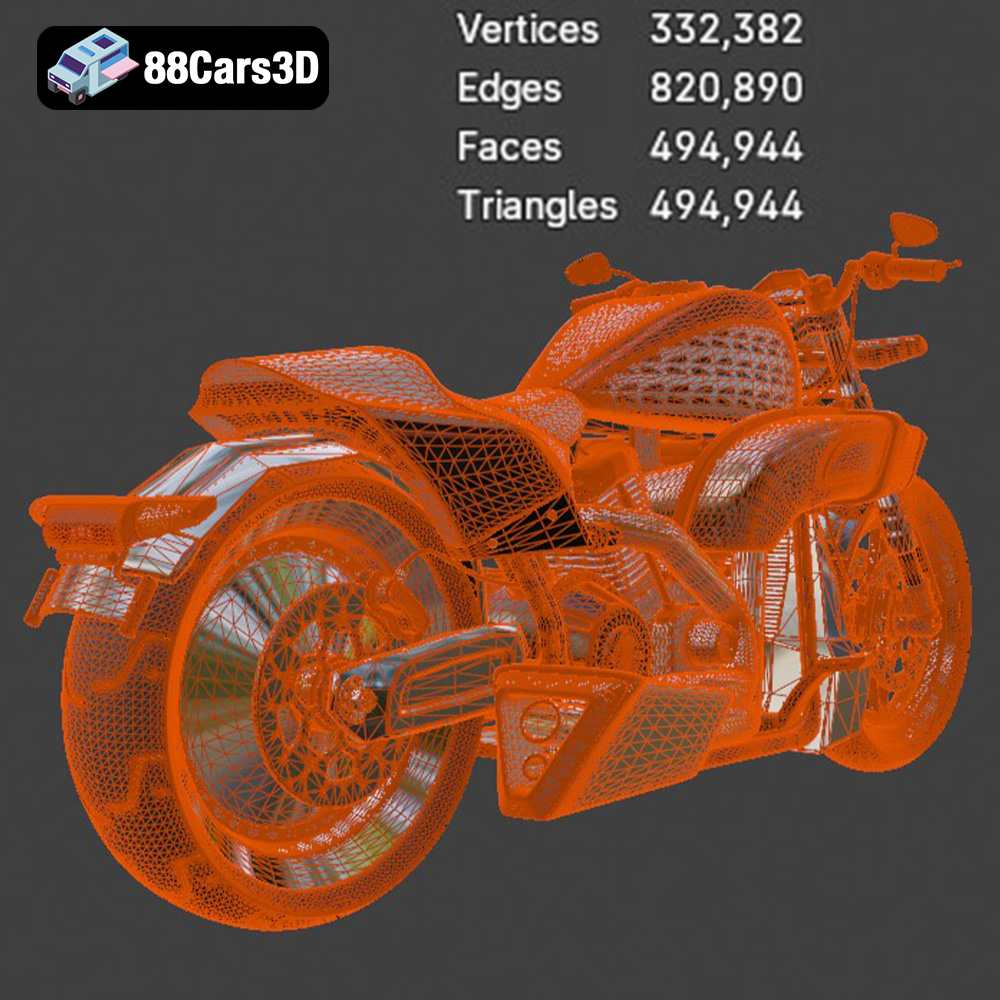
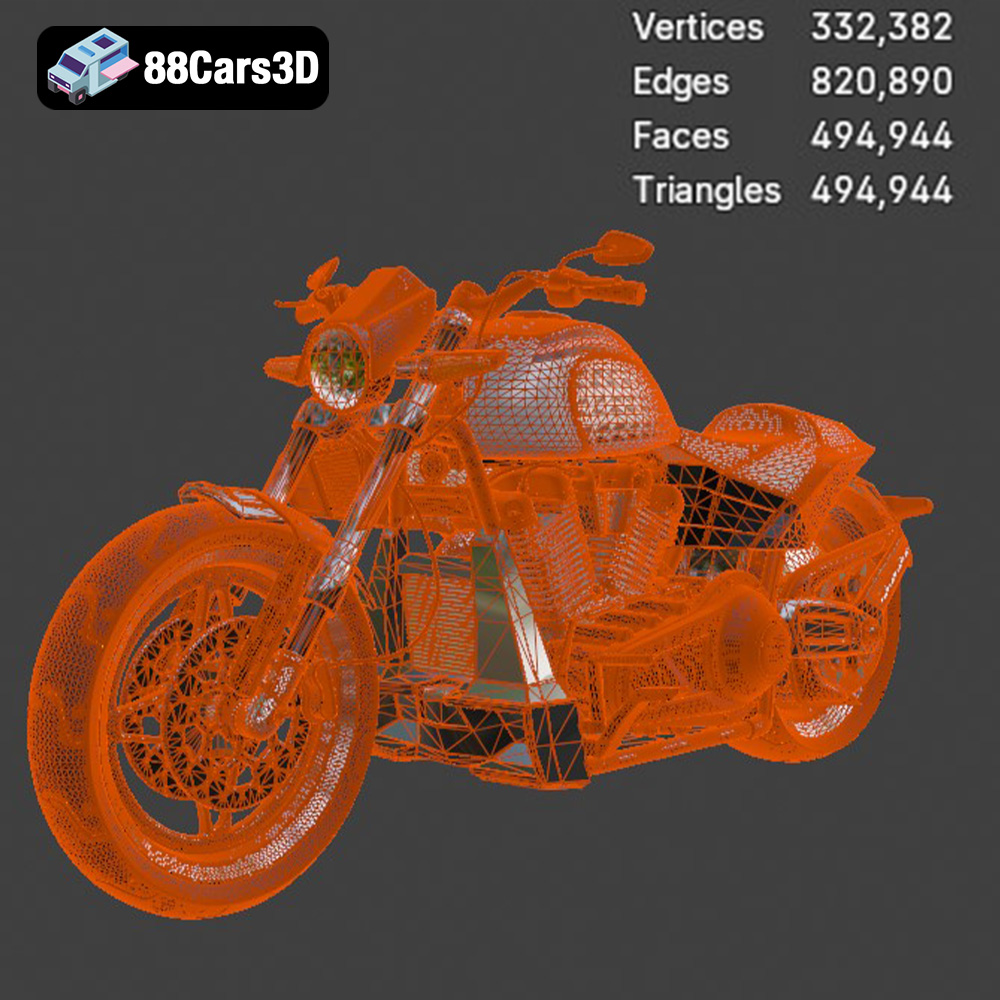
One of the most significant technical advantages of this model is its “Perfectly Balanced Topology.” With approximately 494,944 triangles (and an equal number of faces/polygons, indicating a clean triangulated mesh), 332,382 vertices, and 820,890 edges, the model strikes a crucial equilibrium. This isn’t a low-poly asset for mobile, nor is it a multi-million-polygon behemoth suitable only for film-level offline rendering. Instead, it occupies the “mid-to-high polygon” sweet spot:
This careful balance means artists and developers don’t have to spend excessive time optimizing or adding detail, receiving a model that is robust enough for high-end visualization yet agile enough for interactive applications.
Beyond the raw polygon count, several other technical considerations elevate this model:
These technical advantages underscore the fact that this Harley-Davidson FXDR 114 3D Model is not just a pretty face, but a robust and intelligently constructed asset ready for demanding professional workflows across various industries.
While a high-quality base model is essential, the ability to customize and adapt it to specific project needs is what truly unleashes its potential. The Harley-Davidson FXDR 114 3D Model offers various avenues for personalization, transforming it from a standard asset into a unique component of your digital vision.
The included customization options provide artists with the flexibility to tailor the FXDR 114 to their exact requirements:
These options demonstrate the forward-thinking design of the asset, anticipating the needs of diverse projects and providing hooks for further artistic expression.
For any professional studio, time is money. Developing a complex automotive model like the Harley-Davidson FXDR 114 from scratch is a significant undertaking, requiring hundreds of hours of skilled labor in modeling, texturing, and optimization. By acquiring a pre-made, high-quality asset from a trusted source like 88cars3d.com, studios can dramatically accelerate their production schedules. Instead of building, artists can immediately focus on:
This efficiency allows smaller teams to achieve results previously only possible for large studios, and it empowers large studios to allocate resources to even more ambitious aspects of their projects. The inclusion of multiple file formats, from .blend for deep editing to .unreal for direct engine import, further streamlines this process, catering to various pipelines right out of the box. The Harley-Davidson FXDR 114 3D Model is more than just a purchase; it’s an investment in efficiency and quality.
The journey through the technical nuances and versatile applications of the Harley-Davidson FXDR 114 3D Model underscores the critical role that meticulously crafted digital assets play in modern creative industries. From the initial conceptualization to final rendering, game integration, AR/VR experiences, and even physical 3D prints, this model demonstrates what a high-quality 3D car model can achieve.
We’ve seen how its perfectly balanced topology, just under 500k triangles, strikes an optimal balance between visual fidelity for stunning automotive rendering and performance efficiency for demanding game assets. The comprehensive suite of included file formats – .blend, .fbx, .obj, .glb, .stl, .ply, .unreal, and .max – ensures unparalleled compatibility across diverse professional workflows. The attention to detail, from the Milwaukee-Eight 114 V-Twin engine to the accurate pivot setups for animation, speaks volumes about its professional readiness.
Whether you’re developing the next-gen open-world game, creating captivating marketing visuals for a lifestyle brand, or building an immersive virtual showroom, the Harley-Davidson FXDR 114 3D Model offers a robust and adaptable solution. It’s not just a digital representation; it’s a foundation for innovation, a catalyst for creativity, and a testament to the power of precision in 3D design.
For artists and developers seeking to elevate their projects with premium 3D car models and other high-quality assets, 88cars3d.com stands as a reliable source. Explore the possibilities and unleash the full potential of your digital creations with expertly crafted models designed for the demands of today’s visual landscape.
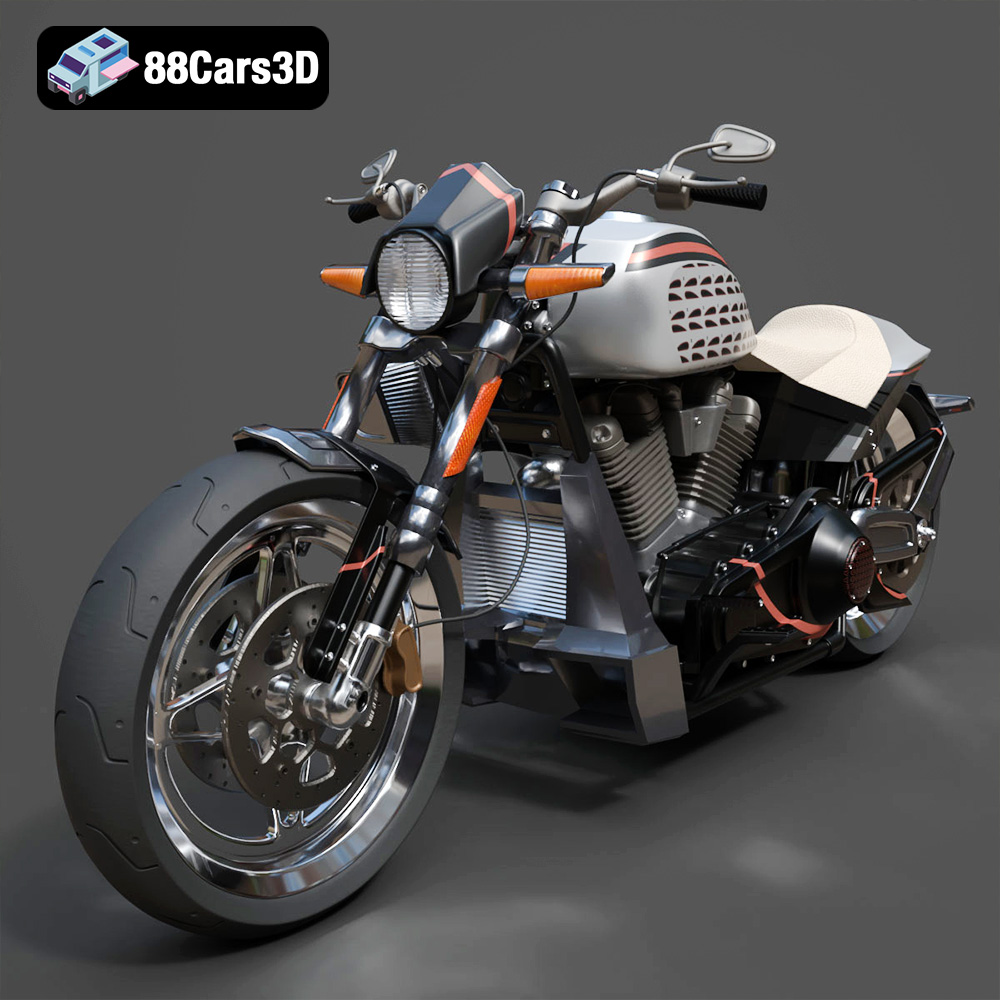
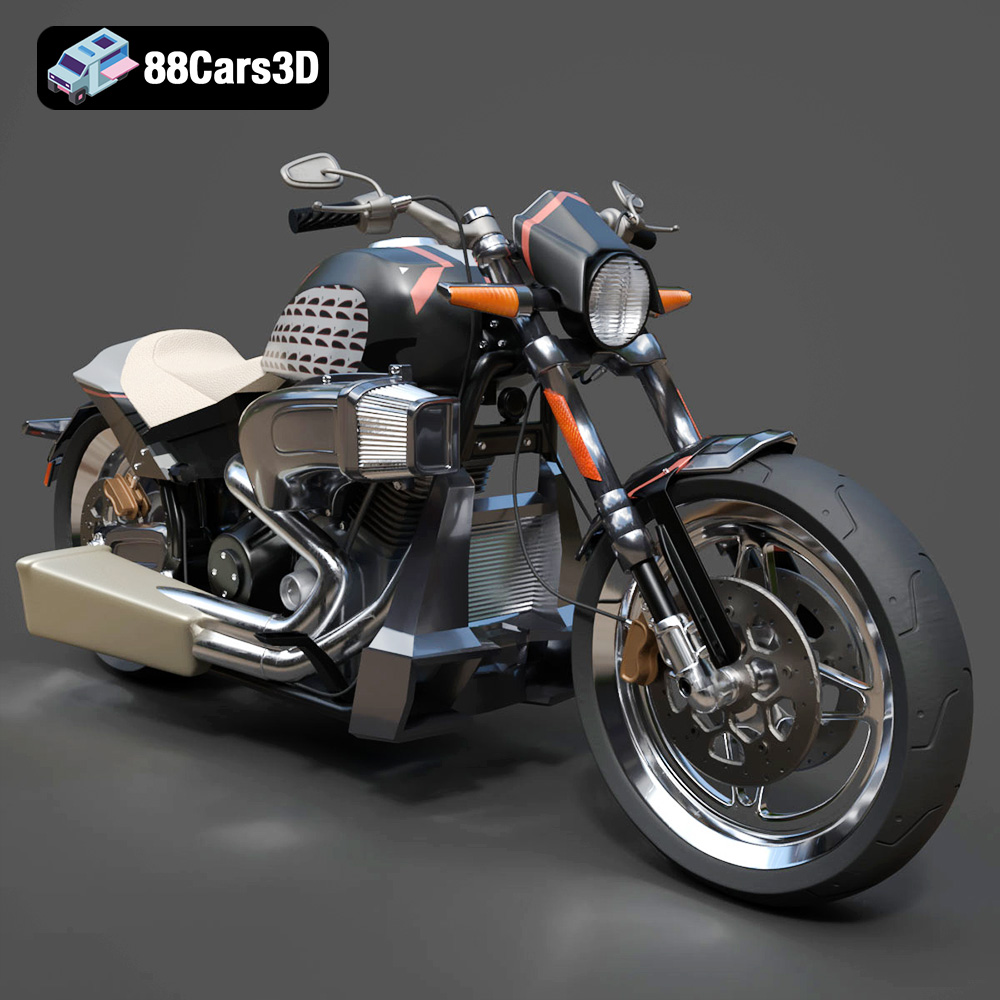
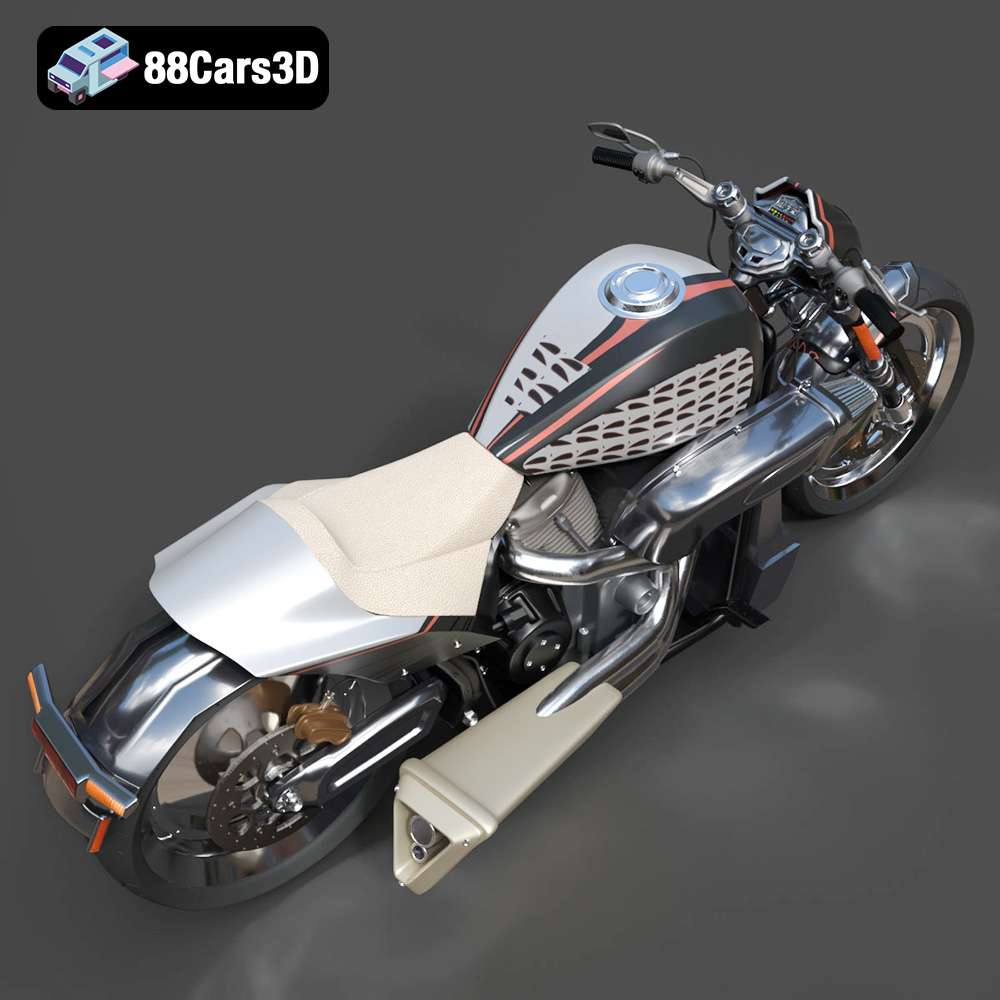
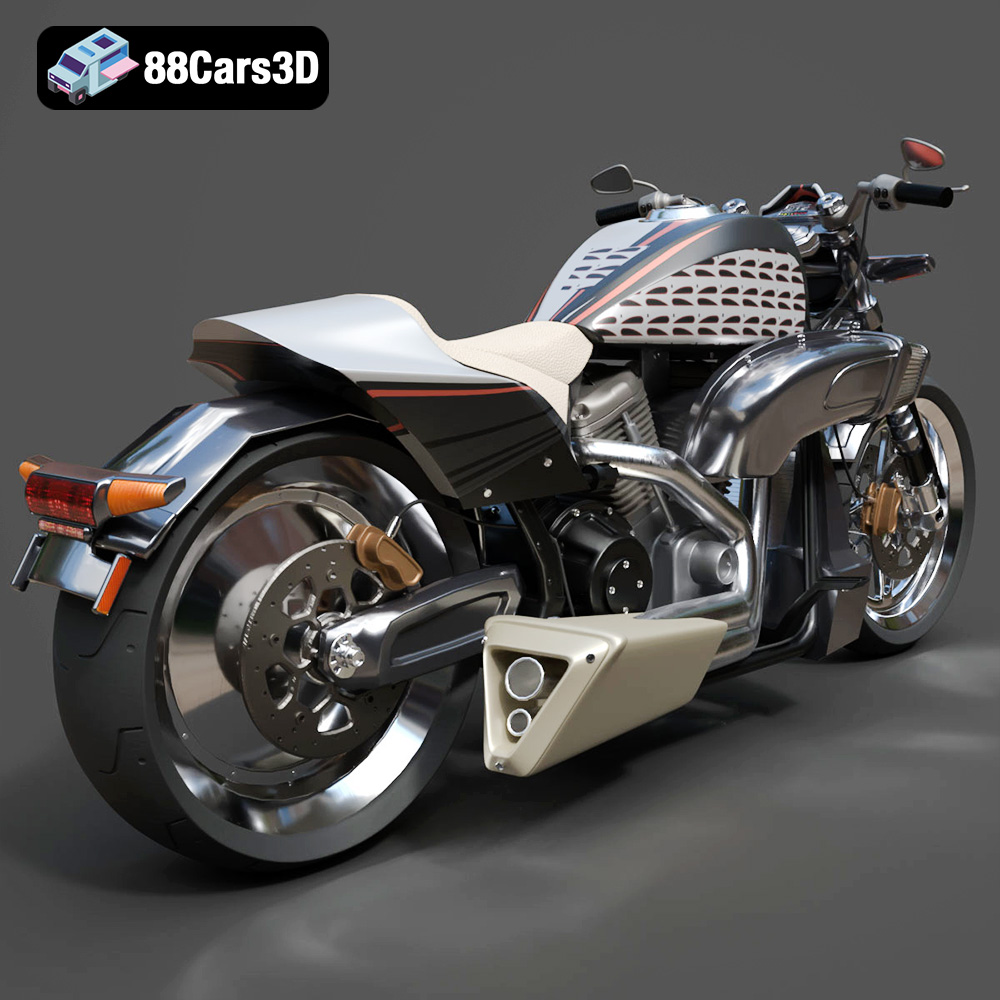
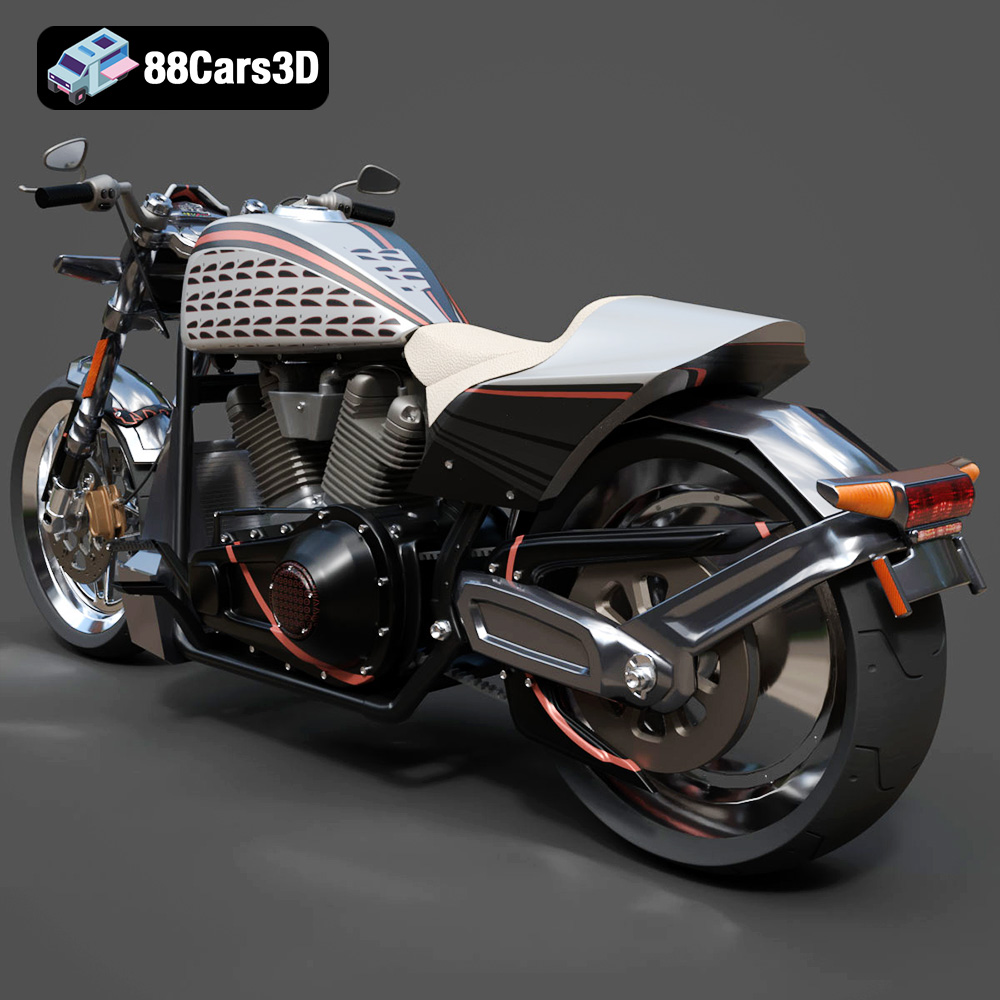
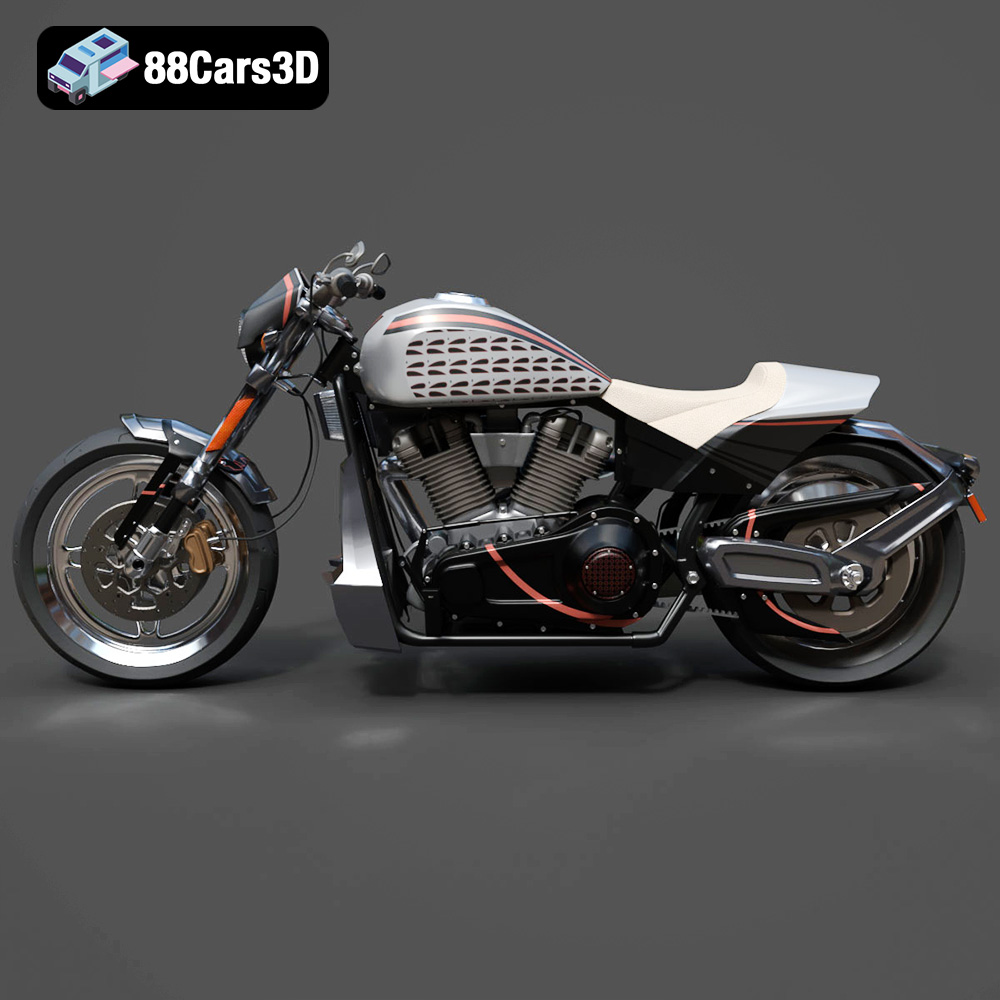
The Harley-Davidson FXDR 114 3D Model is a high-detail digital recreation of the aggressive, drag-inspired power cruiser. Built to represent raw, unapologetic muscle, the FXDR 114 combines the massive torque of the Milwaukee-Eight 114 V-Twin engine with weight-saving aluminum components, a clipped tail, and a massive 240mm rear tire. This 3D model accurately captures the drag-strip attitude of the original bike, featuring the signature forward-reaching air intake, 2-into-1 tuned exhaust, lightweight cast aluminum swingarm, and the sleek LED Daymaker headlamp surround. Built with an optimized mid-to-high polygon topology (just under 500k triangles), it strikes a fantastic balance between premium visual fidelity for close-up rendering and manageable performance for modern current-gen game engines as a hero asset. Perfect for gritty urban street-racing scenes, biker lifestyle campaigns, modern open-world video games, and automotive visualization.
$9.99
.blend
.fbx
.obj
.rendering
.stl
car-3d-model
drag-bike
fxdr
fxdr-114
game asset
harley-davidson
mid-poly
milwaukee-eight
motorcycle-3d-model
power-cruiser
softail
VR/AR