Get 50% OFF All Premium 3D & STL Models!

In the expansive and ever-evolving world of 3D modeling, precision, detail, and versatility are paramount. Whether you’re an automotive designer, a game developer, an architect visualizing a scene, or an enthusiast creating stunning renders, the quality of your 3D assets can make or break a project. High-quality 3D car models are not just visual elements; they are complex digital blueprints that demand careful consideration of topology, material definition, and adaptability across various platforms. Today, we’re diving deep into an exceptional example that perfectly embodies these principles: the Harley-Davidson Night Rod 3D Model, a masterpiece available at 88cars3d.com.
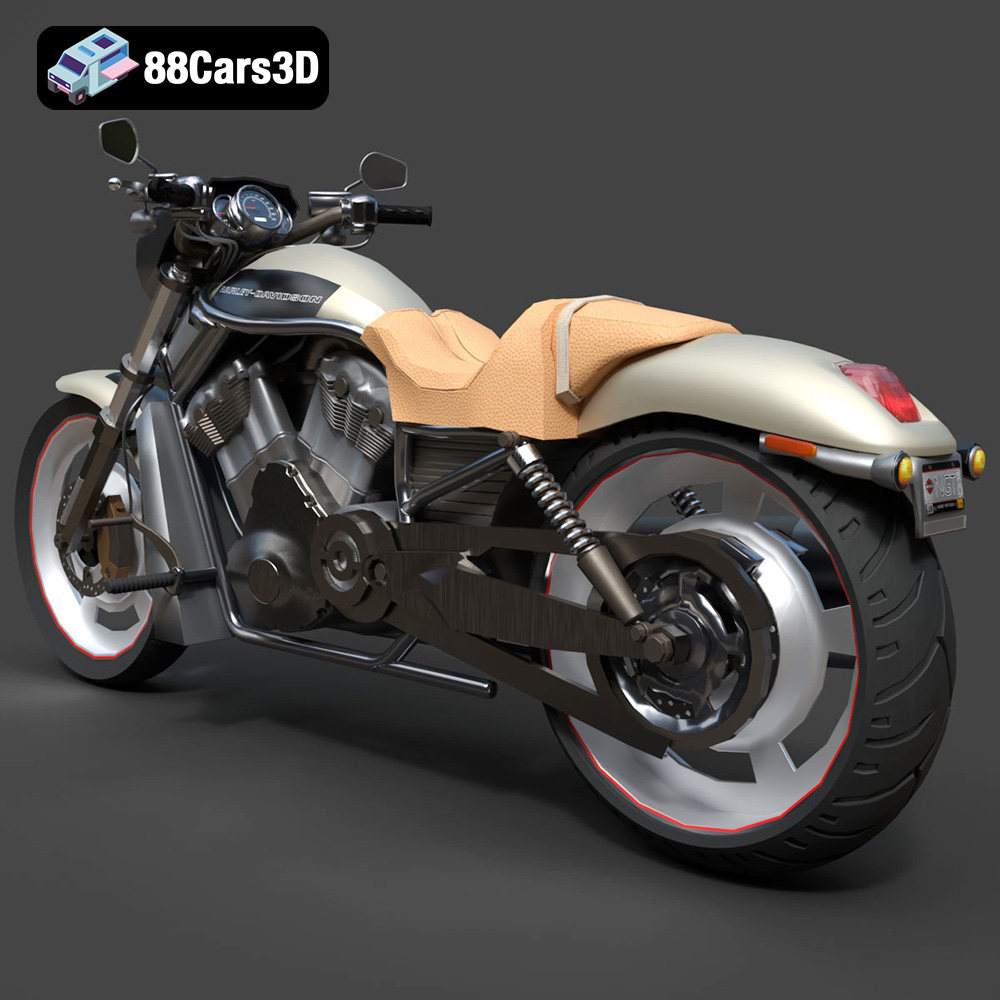
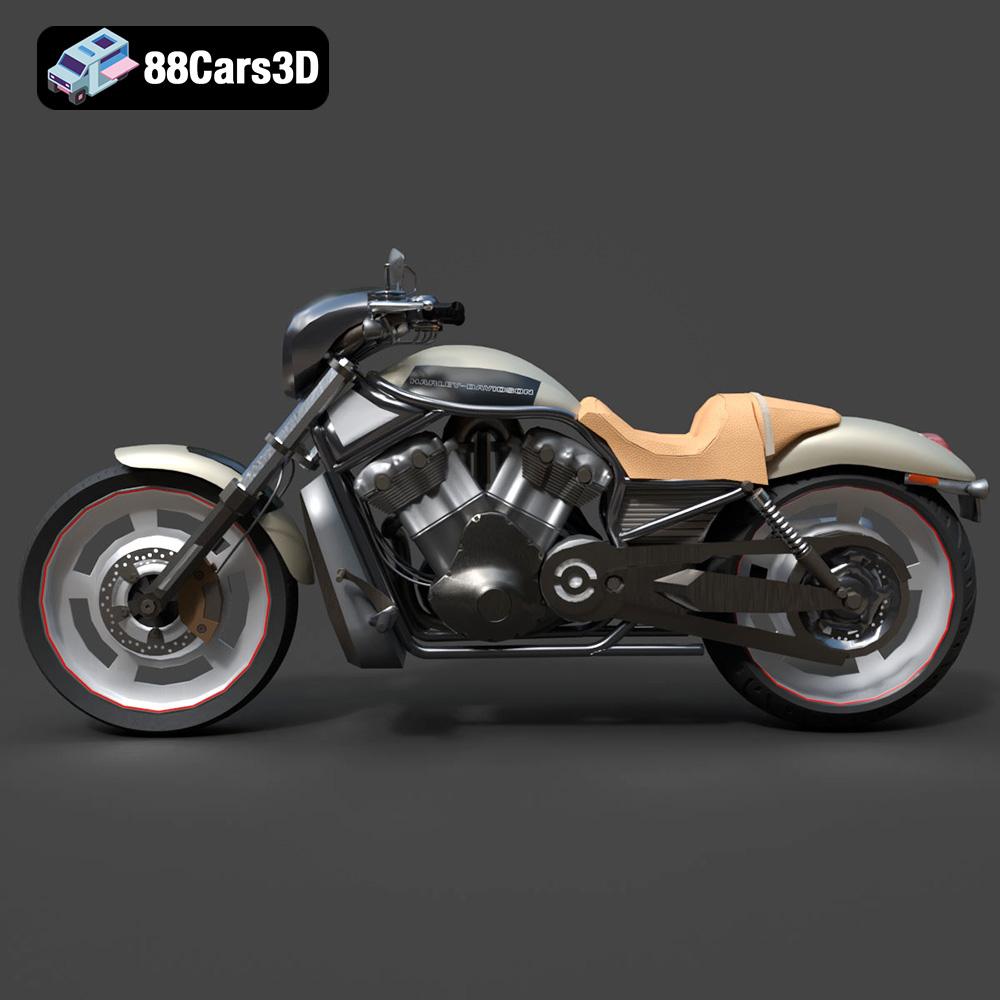
The Harley-Davidson Night Rod is more than just a motorcycle; it’s a statement. Known for its aggressive, low-slung drag-bike profile and the distinctive liquid-cooled Revolution V-Twin engine (developed in collaboration with Porsche), it represents a unique fusion of American muscle and high-performance engineering. This particular 3D model meticulously recreates that sinister aesthetic, offering a digital asset that is as technically robust as it is visually striking. From its signature blacked-out styling and massive 240mm rear tire to its finely detailed engine block and swept-back dual exhaust, every element has been crafted to deliver unparalleled realism and utility in your creative endeavors.
The foundation of a versatile 3D asset lies in its file format compatibility. Professional workflows often involve multiple software packages and target platforms, each with its own preferred or optimized format. The Harley-Davidson Night Rod 3D Model stands out by offering a comprehensive suite of file types, ensuring seamless integration into virtually any pipeline. Understanding these formats is crucial for maximizing your investment and streamlining your project.
The .blend format is native to Blender, one of the most popular and powerful open-source 3D creation suites. When you acquire a .blend file, you’re getting a fully editable scene, complete with materials, textures, lighting setups, and any associated modifiers or animation rigs. For Blender users, this means instant access to the model in its pristine, native state, allowing for effortless modifications, material adjustments, or scene integration without any data loss during import/export. It’s the ideal starting point for those who prefer to work within the Blender ecosystem.
.fbx (Filmbox) is arguably the most widely adopted proprietary 3D exchange format, especially dominant in game development. Developed by Autodesk, it excels at preserving complex scene data, including geometry, materials, textures, animation, and even skeletal rigs, across different 3D applications. For environments like Unreal Engine and Unity, .fbx is the go-to format for importing game assets due to its robust support for animation and hierarchy. The Harley-Davidson Night Rod 3D Model’s .fbx version ensures that its separate components for animation (wheels, steering, suspension) are preserved, making it production-ready for interactive experiences.
The .obj (Wavefront OBJ) format is a classic, universal standard for exchanging 3D geometry. While it doesn’t typically store animation or rigging data, it is exceptionally good at preserving mesh information (vertices, normals, UVs) and can reference external material (.mtl) and texture files. Its simplicity and widespread support make it an excellent choice for cross-software compatibility, ensuring that the Night Rod model can be opened and utilized in almost any 3D software, from older packages to contemporary renderers, for pure mesh manipulation or rendering setups.
.glb (GL Transmission Format Binary) is quickly becoming the standard for 3D web, AR, and VR applications. It’s a binary version of glTF, designed for efficient transmission and loading of 3D scenes and models. A .glb file packages all necessary data—geometry, materials, textures, and even animation—into a single file, making it incredibly easy to share and display models in browsers or augmented/virtual reality environments. This format is crucial for showcasing the Night Rod in interactive product configurators or virtual showrooms, delivering high visual quality with optimized performance.
.stl (Stereolithography) is the de facto standard format for 3D printing. It represents a 3D model as a series of connected triangles, describing only the surface geometry of an object without color, texture, or other CAD attributes. When considering the Harley-Davidson Night Rod for a physical output, the .stl format is essential. It provides a clean, watertight mesh ready for slicing software, allowing hobbyists and professionals to bring the digital model into the tangible world. The detailed information about print settings provided with the model (like recommended scale, layer height, and support requirements) directly leverages this format’s utility.
.ply (Polygon File Format) is another format for storing 3D data, particularly useful for scanned data, CAD applications, or scientific analysis. It can store a variety of properties including color, transparency, surface normals, and even confidence values. While less common for everyday artistic exchange than .fbx or .obj, its ability to store detailed mesh properties makes it valuable for specialized tasks where precision and data integrity are paramount, such as reverse engineering or detailed manufacturing prototyping based on the motorcycle’s geometry.
The .unreal designation implies a model that has been specifically prepared or optimized for the Unreal Engine, often indicating that it comes with appropriate material setups, collisions, and level of detail (LOD) assets. This significantly accelerates the integration process for game developers, allowing them to drop the Harley-Davidson Night Rod directly into their projects with minimal setup. It highlights a developer-centric approach, ensuring the asset is production-ready for demanding real-time environments.
Finally, the .max format is native to Autodesk 3ds Max, a leading software for 3D modeling, animation, and rendering. Similar to .blend for Blender users, a .max file contains the complete scene, including lights, cameras, materials, and modifiers. For professionals working in 3ds Max, this provides the most robust and flexible foundation for rendering high-quality static images, complex animations, or integrating the Night Rod into architectural visualization projects. Its inclusion ensures that users of this powerful platform can leverage the model without compatibility hurdles.
Creating a truly exceptional 3D car model, especially one as iconic as the Harley-Davidson Night Rod, goes far beyond simply mimicking its form. It requires a deep understanding of surface continuity, mechanical functionality, and efficient data management. This model exemplifies these principles, delivering an asset that balances visual fidelity with practical performance.
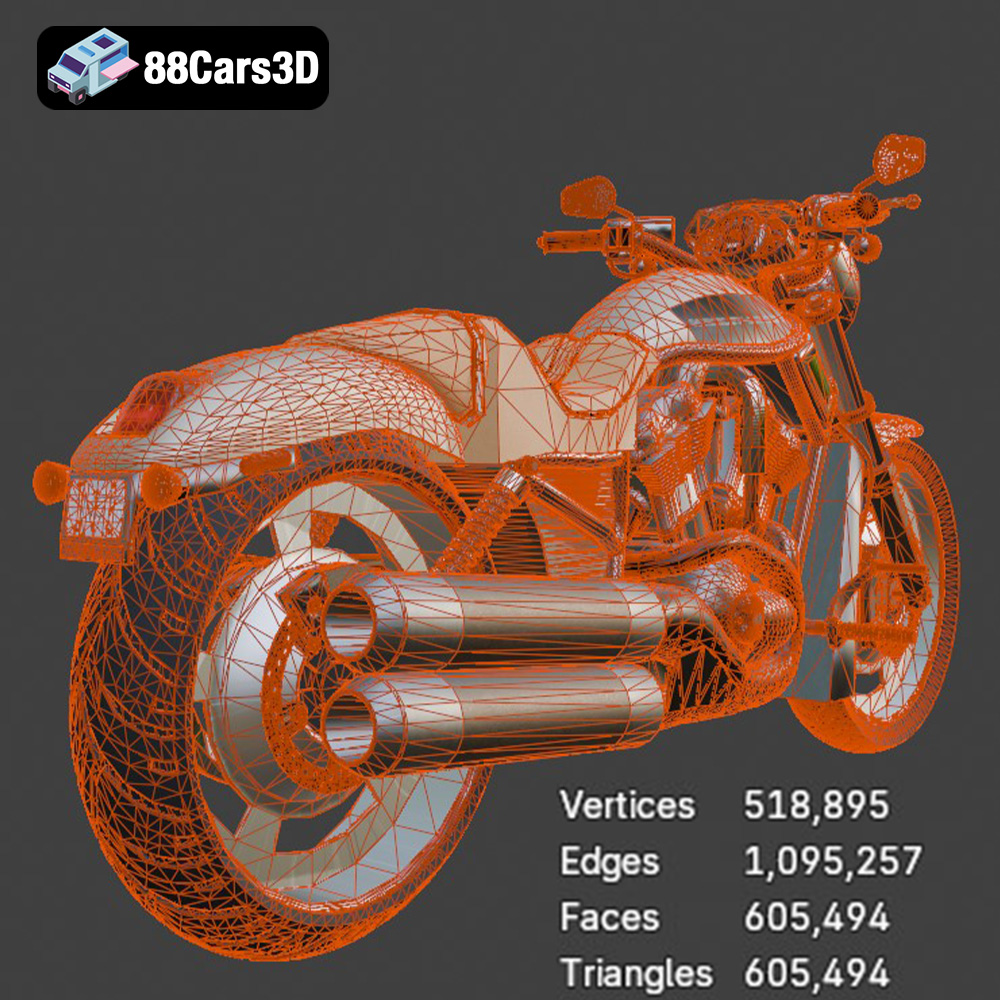
The Harley-Davidson Night Rod 3D Model boasts an impressive 605,494 triangles (605,494 faces / polygons and 518,895 vertices). This might sound like a high poly count, but in the context of modern 3D rendering and game engines, it represents a perfectly optimized “hero” asset. It strikes a crucial balance: enough polygons to deliver premium close-up mechanical detail, like the intricate fins of the liquid-cooled Revolution V-Twin engine or the subtle curves of the frame, without the crushing memory load associated with multi-million polygon CAD models. This optimized topology means that artists can render stunning, photorealistic images without excessive processing times, and game developers can feature the Night Rod as a primary drivable vehicle without sacrificing overall game performance. The clean mesh ensures smooth subdivision if even higher detail is required for extreme close-ups in cinematic renders.
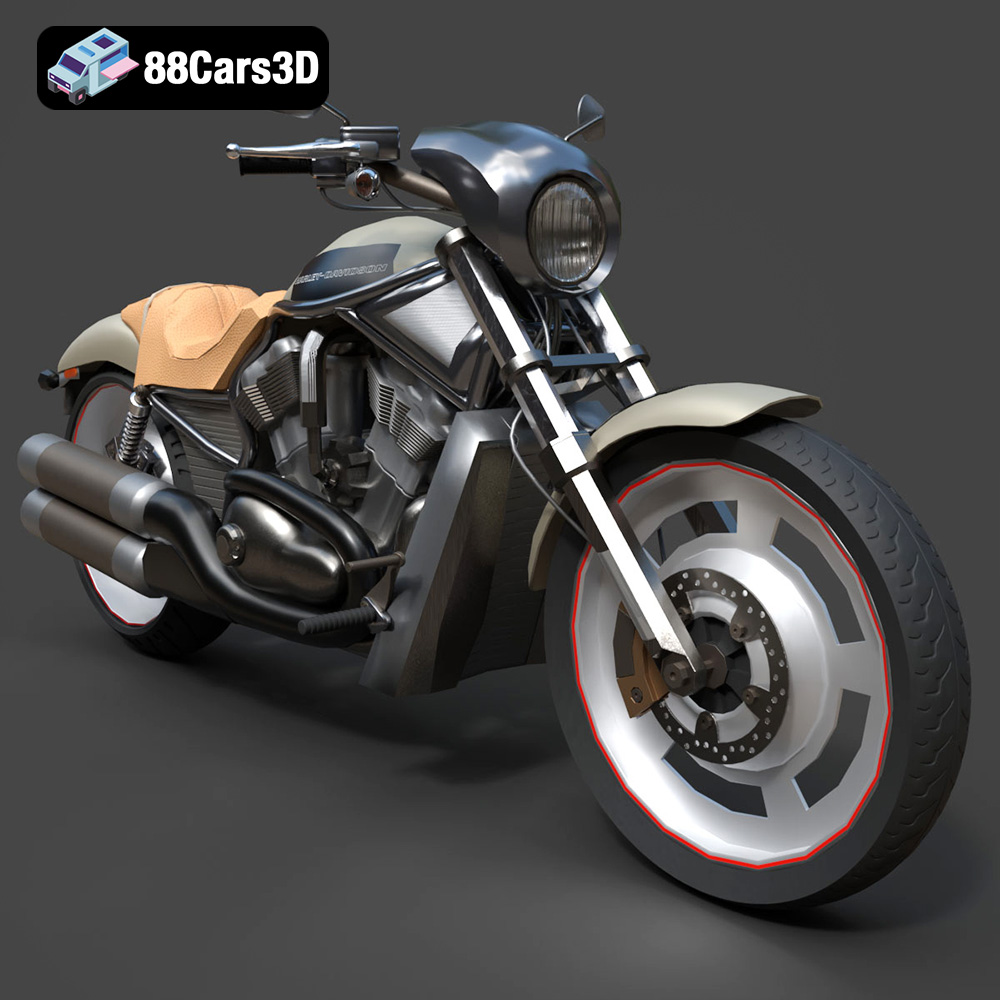
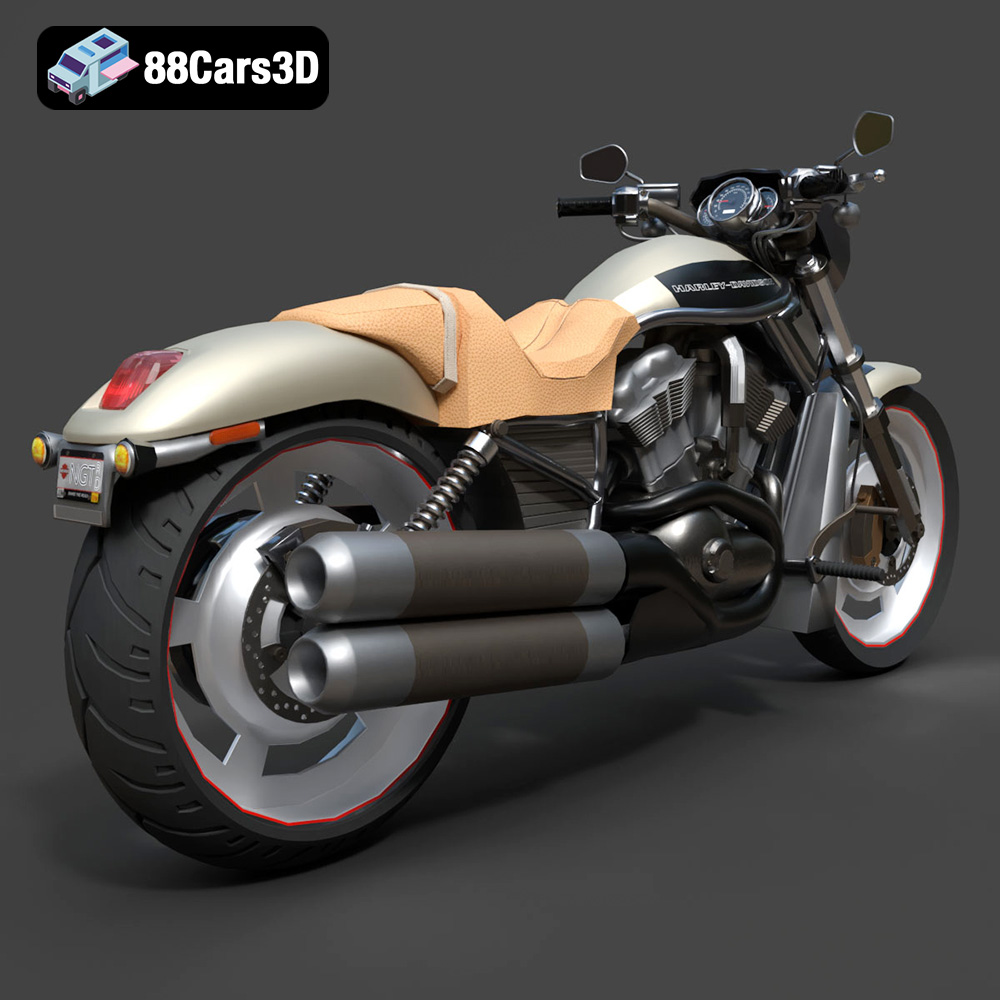
Every element of the Night Rod has been recreated with meticulous attention to authenticity. The accurate VRSC chassis geometry and drag-bike proportions are instantly recognizable. The signature blacked-out styling, from the engine block to the front forks, is faithfully replicated, giving the model its distinctive sinister aesthetic. Key visual identifiers, such as the aerodynamic speed screen cowl, sleek chopped rear fender, and the massive 240mm rear tire, are all present and accounted for. Crucially, functional components like the wheels, steering, and suspension are separated and feature proper pivot setups. This thoughtful segmentation is vital for animators and game developers, allowing for realistic wheel rotation, steering articulation, and even kickstand movement, adding dynamic realism to any scene or interactive experience.
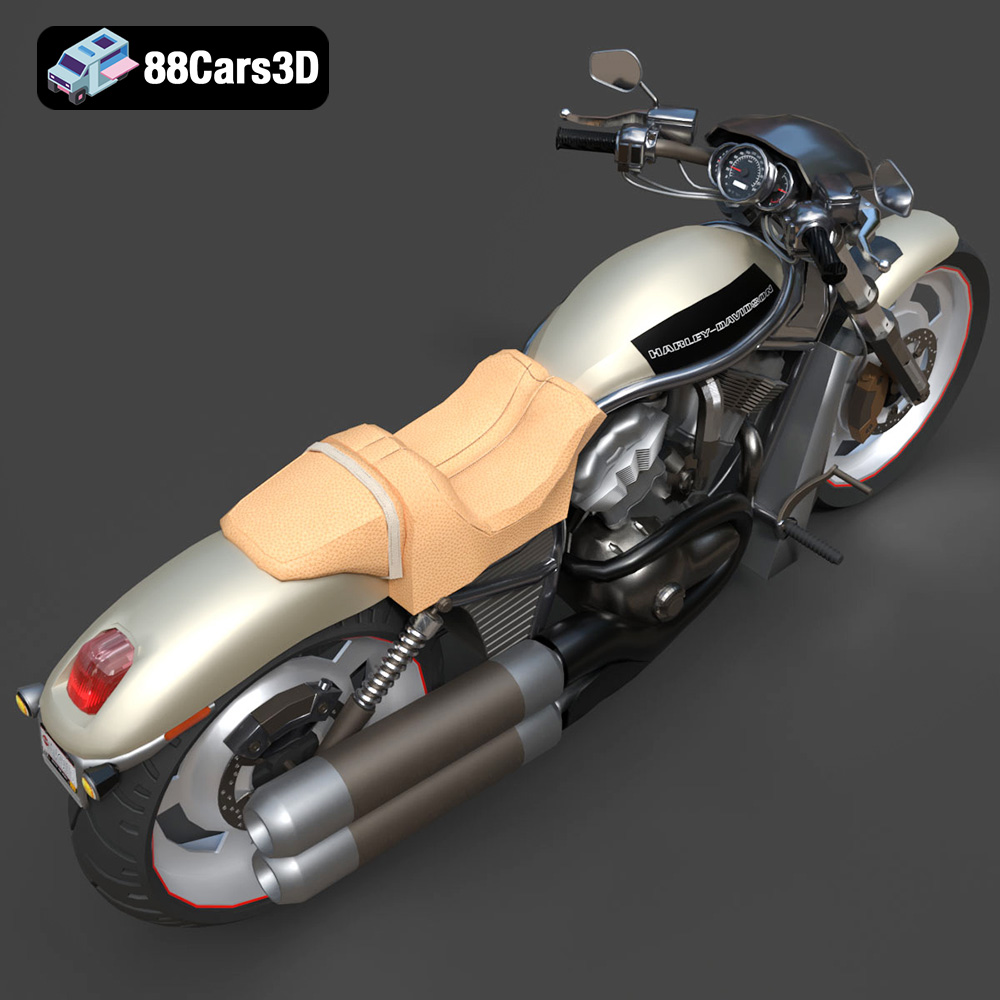
The attention to detail extends to the rider’s interface. The deep, low-slung drag-style saddle geometry, forward-reaching drag handlebars with their detailed grips, mirrors, and levers, and the authentic forward foot control and peg placements are all accurately modeled. Even the minimalist analog gauge cluster mounted below the handlebars contributes to the model’s realism. This level of internal detail is especially important for applications like AR/VR and first-person gaming, where immersion is key. A player or viewer experiencing the Night Rod from a first-person perspective will find the cockpit geometry optimized for a truly believable interaction, enhancing the sense of presence and control.
The true value of a high-quality 3D model lies in its utility across diverse professional applications. The Harley-Davidson Night Rod 3D Model, available on 88cars3d.com, is engineered to seamlessly integrate into various pipelines, from cinematic rendering to interactive real-time experiences.
For rendering artists and visualization specialists, this model is a dream. Its high-detail topology and accurate geometry make it ideal for generating photorealistic images and animations. Imagine the Night Rod staged in a moody studio lighting setup, its blacked-out chrome reflecting subtle highlights, or cruising through a gritty urban street scene, neon reflections dancing across its surfaces. It’s perfect for dark lifestyle brand campaigns, automotive advertising, or even creating striking elements within cyberpunk or street-racing narratives. With its clean mesh and separated components, artists can easily apply advanced PBR materials, simulate realistic paint finishes (like Vivid Black or Black Denim), and set up complex lighting scenarios to achieve breathtaking results. Compatibility with major rendering engines (V-Ray, Corona, Redshift, Octane) is ensured through its robust .max, .blend, and .fbx formats, making automotive rendering a fluid process.
In the competitive world of game development, assets need to be visually stunning yet performance-efficient. The Night Rod model, with its ~605k triangles, is perfectly balanced as a “hero” drivable vehicle for current-generation console and PC games. Its optimized topology means high visual fidelity without crippling frame rates. The inclusion of an .unreal format (and robust .fbx) signifies its readiness for engines like Unreal Engine 5 and Unity HDRP. Game developers can leverage its separated wheels, steering, and suspension components for realistic vehicle physics and animation. For immersive first-person POV experiences in open-world titles, the detailed cockpit geometry provides an authentic rider’s view, enhancing player engagement. This model significantly reduces the development time required for creating a high-quality motorcycle asset from scratch, allowing teams to focus on gameplay mechanics and world-building.
Augmented Reality (AR) and Virtual Reality (VR) demand highly optimized yet visually rich assets. The Harley-Davidson Night Rod 3D Model is an excellent candidate for high-end virtual motorcycle showrooms and interactive part configurators. Its .glb format is specifically designed for efficient web and AR/VR display, ensuring quick loading times and smooth performance on mobile devices or VR headsets. Users could walk around the bike in a virtual space, examine its details up close, change its colors, or even simulate engine sounds. The accurate real-world scale and high detail make it perfect for creating truly immersive and educational experiences for potential buyers or motorcycle enthusiasts, pushing the boundaries of interactive product visualization.
The utility of a digital 3D model often extends beyond pixels. For hobbyists, collectors, and prototyping specialists, the ability to transform a digital asset into a physical object is invaluable. The Harley-Davidson Night Rod 3D Model is explicitly designed with 3D printing in mind, opening up a world of tangible creativity.
The inclusion of an .stl file format is crucial for 3D printing. This triangulated mesh format is universally accepted by slicing software, which prepares the model for your 3D printer. The product description provides highly specific and valuable 3D print settings, which are essential for achieving a successful and detailed physical replica. Recommended scales of 1:12, 1:10, or 1:8 ensure a substantial, display-worthy model. The recommendation for resin printing (SLA/DLP) with a layer height of 0.04–0.08 mm is critical. Resin printers excel at reproducing the fine details of the engine cooling fins, the intricate spoke patterns of the wheels (if applicable), and other small elements that FDM printers might struggle with. Wall thickness (1.2–2.0 mm) and infill (20–30%) are specified for structural integrity without excessive material usage.
Successful 3D printing, especially for complex objects like a motorcycle, often requires strategic planning. The guidance on supports (required for the radiator shroud, handlebars, exhaust pipes, and kickstand) and print orientation (frame angled, wheels and exhaust separate) is invaluable. Printing components separately allows for optimal detail on each part and simplifies post-processing and assembly. Once printed, the true artistry begins with post-processing. Sanding, priming, and careful painting are essential to bring the model to life. The suggestion of classic Vivid Black or Black Denim for the bodywork, combined with gloss/matte black mixes for engine accents, offers a perfect guide for achieving an authentic look, mirroring the original bike’s sinister appeal. This transforms the 3D printable asset into a coveted automotive collectible or a unique display piece.
A truly versatile 3D model isn’t static; it’s a canvas for creativity. The Harley-Davidson Night Rod 3D Model offers ample customization options, empowering artists and developers to tailor it to their specific project needs and artistic visions.
The ability to easily change fuel tank and fender colors is a fundamental customization. While the Night Rod is famed for its blacked-out look, imagine it with Racing Orange stripes for a vintage drag-race feel, or a deep metallic red for a custom show bike. Beyond color, artists can swap out the stock dual exhaust for custom aftermarket pipes, giving the bike a unique auditory and visual signature. The inherent flexibility of the model allows for material adjustments, enabling the simulation of different paint types, chrome finishes, leather textures on the saddle, or rubber compounds for the tires. This level of customization ensures that the Night Rod can fit into a vast array of creative contexts, from gritty street scenes to high-end motorcycle showcases.
Beyond surface appearance, the model allows for deeper technical enhancements. Artists can add custom baked normal maps to simulate incredibly high-poly details like weld marks on the frame, subtle engine casing textures, or even wear and tear, without increasing the actual polygon count. This technique is crucial for maintaining performance in real-time applications while maximizing visual realism. Furthermore, adapting the lighting for specific scenarios is key to setting the mood. The Night Rod could be illuminated by moody, neon-lit nighttime streets, reflecting the vibrant urban glow, or bathed in the stark, golden light of a desert highway run, evoking a sense of freedom and adventure. The model’s clean UV mapping and material separation facilitate these advanced texture and lighting manipulations, making it a highly adaptable asset for any creative challenge.
In the dynamic landscape of 3D content creation, the demand for high-quality, versatile, and technically sound assets is ever-present. The Harley-Davidson Night Rod 3D Model exemplifies this pinnacle of digital craftsmanship. From its meticulously recreated aggressive aesthetic and optimized high-detail topology to its comprehensive multi-format compatibility, this model is a powerhouse for any creative professional.
Whether your goal is to produce stunning automotive rendering for a marketing campaign, integrate a compelling hero vehicle into your next-generation video game, design an interactive AR/VR experience, or even bring a legendary motorcycle to life through 3D printing, this asset delivers. Its thoughtful design, robust technical specifications, and wide array of included file formats—ranging from .blend and .max for native editing to .fbx and .unreal for game development, and .stl for 3D printing—make it an indispensable tool.
The Harley-Davidson Night Rod 3D Model offers not just a product, but a foundation for limitless creative exploration. Discover this exceptional asset and many other premium 3D car models by visiting 88cars3d.com today, and elevate your projects to the next level.
The Harley-Davidson Night Rod 3D Model is a high-detail digital recreation of the legendary dark custom power cruiser. Part of the iconic VRSC (V-Rod) family, the Night Rod is famous for its aggressive, low-slung drag-bike profile and its liquid-cooled Revolution V-Twin engine—developed in partnership with Porsche. Characterized by its blacked-out styling and massive rear tire, it represents a perfect fusion of American muscle and high-performance engineering. This 3D model accurately captures the sinister aesthetic of the original bike, featuring the signature color-matched speed screen, drag-style handlebars, fat 240mm rear tire, and the distinctive swept-back dual exhaust system. Built with an incredibly balanced, high-polygon topology (just over 600k triangles), it provides excellent visual fidelity for close-up rendering while remaining highly manageable as a hero vehicle for current-generation game engines. Perfect for gritty urban street scenes, dark biker lifestyle campaigns, modern open-world video games, and automotive visualization.
$9.99
.blend
.fbx
.obj
.rendering
.stl
blacked-out
drag-bike
game asset
harley-davidson
mid-poly
motorcycle-3d-model
night-rod
power-cruiser
revolution-engine
v-rod
VR/AR
vrsc