Get 50% OFF All Premium 3D & STL Models!

In the rapidly evolving world of 3D visualization, automotive design, and interactive media, the demand for exceptionally high-quality 3D assets is paramount. Professionals across industries, from game developers and architectural visualizers to automotive engineers and marketing agencies, rely on accurate and detailed models to bring their visions to life. These aren’t just pretty pictures; they are the digital backbone of simulations, interactive experiences, and crucial design evaluations. The pursuit of photorealism and functional accuracy drives innovation in asset creation, ensuring that every curve, every reflection, and every material nuance contributes to an immersive and believable experience.
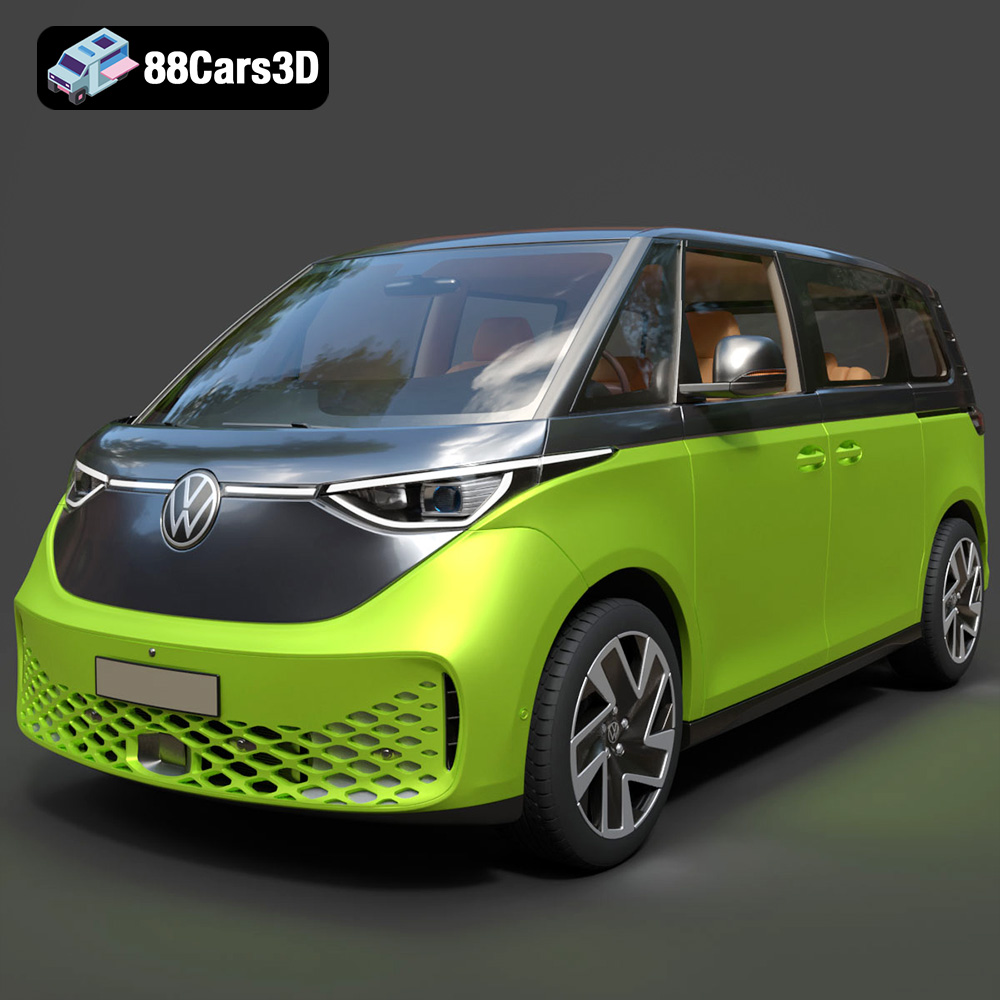
Among the myriad of vehicles captivating the public imagination, electric vehicles (EVs) stand out as symbols of future-forward design and sustainable innovation. The Volkswagen ID. Buzz, with its iconic retro-futuristic aesthetic and all-electric powertrain, has quickly become a standout. Capturing its unique charm and sophisticated engineering in a 3D model requires meticulous attention to detail and a deep understanding of 3D asset pipeline best practices. This is precisely what you get with the Volkswagen ID. Buzz 2023 3D Model – a comprehensively built asset designed to meet the rigorous demands of professional projects, offering clean geometry, realistic materials, and versatile format support.
Creating a premium 3D car model is a delicate balance of artistic vision and technical precision. It involves more than just replicating shapes; it’s about capturing the soul of the vehicle, its functional integrity, and its visual presence in a digital space. For a model like the Volkswagen ID. Buzz, this means translating its distinctive silhouette, the subtle creases in its bodywork, and the intricate details of its interior into a perfectly structured mesh.
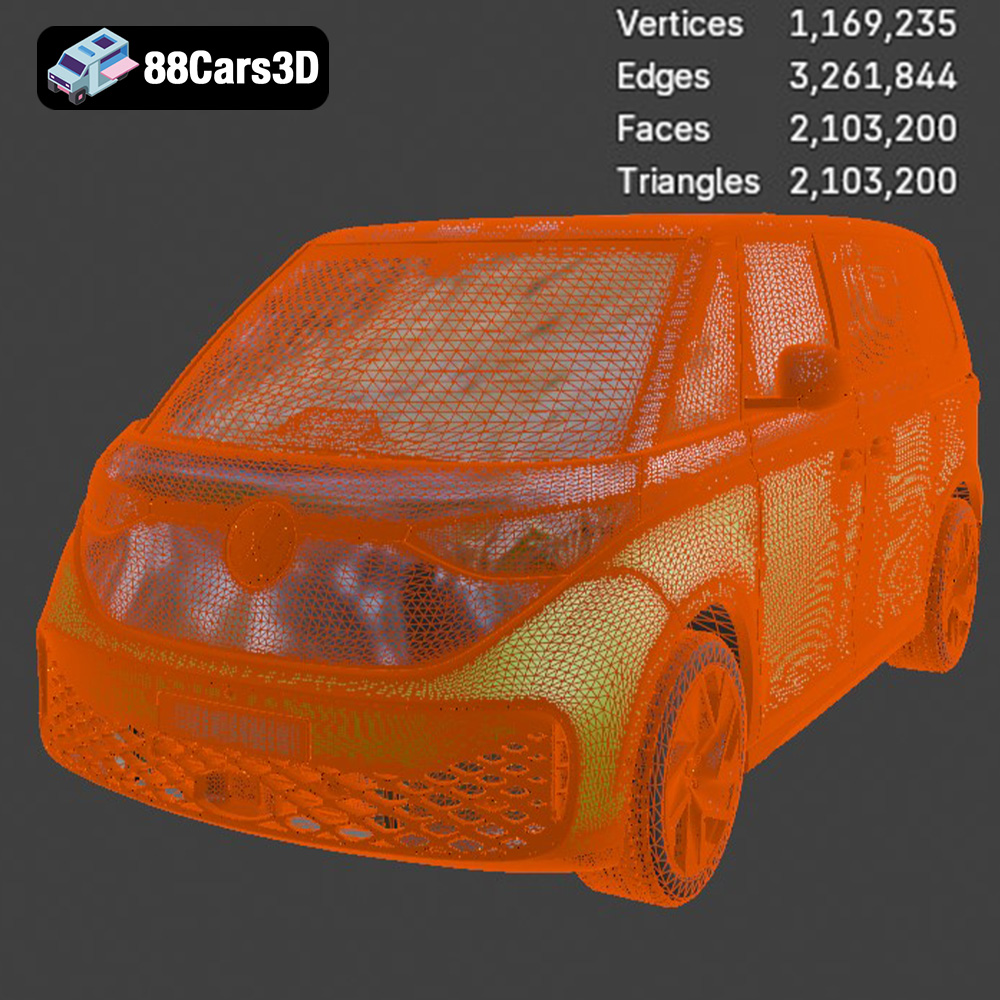
At the core of any high-quality 3D model lies its geometry and topology. Accurate geometry ensures that the model precisely represents the real-world object’s dimensions and proportions. For an automotive model, this includes everything from the overall vehicle dimensions to the thickness of body panels and the curvature of windows. Topology, on the other hand, refers to the arrangement of polygons and edges that form the mesh. Good topology is crucial for several reasons:
The Volkswagen ID. Buzz model boasts an optimized mesh structure, guaranteeing precise surfacing and fully modeled exterior components alongside detailed interior elements, crucial for advanced professional workflows where accuracy is essential.
Beyond the mesh, materials and textures are what truly bring a 3D car model to life. Automotive rendering demands sophisticated material setups to accurately simulate paint finishes, metallic reflections, glass refractions, tire rubber, and interior fabrics. Physically Based Rendering (PBR) workflows are the industry standard, utilizing maps like Albedo (base color), Roughness, Metallic, Normal, and Ambient Occlusion to define how light interacts with surfaces.
The Volkswagen ID. Buzz 2023 3D Model is described as having “realistic materials,” indicating it leverages these PBR principles to ensure accurate representations in demanding visual projects.
Different project types have varying demands for polygon count and texture resolution. Offline rendering (e.g., for advertisements, architectural visualization) often prioritizes maximum visual fidelity, allowing for very high polygon counts and detailed textures. In contrast, real-time applications (game development, AR/VR) require rigorous optimization to maintain smooth frame rates. This often involves:
A well-made 3D car model, like the Volkswagen ID. Buzz 2023 3D Model from 88cars3d.com, strikes this balance, offering both high detail for cinematic renders and structural integrity for optimization in real-time engines.
The versatility of a 3D model is often defined by the range of file formats it supports. Each format serves a specific purpose, catering to different software environments, workflows, and end-use cases. Understanding these formats is crucial for any professional working with 3D assets, as selecting the right one can streamline your pipeline and prevent compatibility headaches. The Volkswagen ID. Buzz 2023 3D Model is offered in a comprehensive suite of formats, ensuring broad applicability across various professional domains.
The .blend format is native to Blender, the powerful open-source 3D creation suite. When you receive a .blend file, it typically contains not just the raw mesh data, but also the entire scene setup: materials, textures, lighting, cameras, animation data, and even modifiers. This makes it a fully editable Blender scene, ideal for artists who want to delve into the model, modify its components, adjust materials, or integrate it seamlessly into an existing Blender project. For the Volkswagen ID. Buzz model, the .blend file would include its materials and potentially a lighting setup, offering an excellent starting point for customization and high-quality rendering directly within Blender.
The .fbx (Filmbox) format, developed by Autodesk, is widely recognized as the industry-standard exchange format for 3D data, especially prevalent in game development. It’s robust, capable of storing geometry, materials, textures, animations, and skeletal data. Its primary strength lies in its excellent compatibility with game engines like Unreal Engine and Unity, making it an ideal choice for exporting game-ready assets. When using the .fbx version of the ID. Buzz, you can expect a clean import into your game engine, with hierarchical data preserved, making it straightforward to set up for real-time interaction and physics.
The .obj (Wavefront OBJ) format is one of the oldest and most universally supported 3D file formats. It’s a simple, text-based format primarily used for exchanging raw geometry data (vertices, normals, UVs, faces) and material references (often in an accompanying .mtl file). While it doesn’t typically store advanced scene data like animation or rigging, its widespread compatibility across virtually all major 3D software makes it invaluable. For the Volkswagen ID. Buzz, the .obj file offers a solid, clean base mesh that can be imported into any 3D package, providing a foundational asset for diverse projects without proprietary software dependencies.
The .glb (GL Transmission Format Binary) format is a relatively newer standard designed for efficient transmission and loading of 3D scenes and models on the web and in augmented reality (AR) and virtual reality (VR) applications. It’s a compact, self-contained file that includes geometry, materials, textures, and animation, all optimized for quick loading and rendering. The .glb version of the Volkswagen ID. Buzz is perfect for integrating into web-based 3D viewers, interactive product configurators, or AR/VR experiences, ensuring smooth performance and visual fidelity across platforms.
The .stl (Stereolithography) format is the de facto standard for 3D printing and rapid prototyping. It describes only the surface geometry of a 3D object using a tessellated mesh of triangles. Unlike other formats, .stl files do not contain color, texture, or material information. They are purely about the physical shape. If you’re looking to create a physical model of the Volkswagen ID. Buzz, whether for design validation or a collectible, the .stl file is the one you’d send to your 3D printer, ensuring a topologically sound and watertight mesh suitable for additive manufacturing.
The .ply (Polygon File Format, or Stanford Triangle Format) is another format used for representing 3D scanner data and meshes. It’s capable of storing not just geometry but also color, transparency, surface normals, and other properties per vertex or face. While not as universally used as .obj or .fbx for general asset exchange, .ply is valued in scientific, engineering, and CAD applications where precise mesh data, often derived from scanning, is critical. The .ply version of the ID. Buzz could be utilized for detailed analysis or visualization requiring high-precision mesh representation.
The .unreal designation points to a pre-configured asset specifically tailored for direct import and optimal performance within Unreal Engine. While .fbx is the common conduit, an “.unreal” file often implies a package that might include pre-built materials, collision meshes, LODs, and other Unreal-specific settings, potentially saving significant setup time for developers. For the Volkswagen ID. Buzz, this means an engine-ready asset that can be dropped into an Unreal project with minimal fuss, accelerating development for real-time environments and virtual production.
The .max format is the native file type for Autodesk 3ds Max, a leading software for 3D modeling, animation, and rendering. Similar to .blend, a .max file stores the entire scene, including geometry, modifiers, materials, lights, cameras, and animation data. It offers full editability within 3ds Max, making it the preferred choice for professionals deeply integrated into the Autodesk ecosystem for animation, advanced rendering, and complex scene composition. The .max file for the Volkswagen ID. Buzz provides an editable project, allowing users to leverage 3ds Max’s powerful rendering capabilities (like V-Ray or Corona) and animation tools to create stunning visualizations.
The extensive range of formats for the Volkswagen ID. Buzz 2023 3D Model ensures that whether you’re working in game development, offline rendering, AR/VR, simulation, 3D printing, or any other visualization field, you’ll have the appropriate, optimized file to kickstart your project effectively.
A high-quality 3D car model is a powerful tool, but its true potential is realized when seamlessly integrated into professional workflows. The Volkswagen ID. Buzz 2023 3D Model is specifically designed for this purpose, offering the versatility needed across various disciplines.
For high-end automotive rendering, software like 3ds Max and Blender, paired with powerful render engines, are indispensable. The .max and .blend formats for the ID. Buzz provide artists with complete control over the scene. In a typical workflow:
This workflow is common for automotive marketing, virtual showrooms, and design reviews, where the Volkswagen ID. Buzz model can be showcased in various environments and lighting scenarios, illustrating its design features and presence.
Integrating a 3D car model into a game engine like Unreal Engine or Unity requires optimization for real-time performance. The .fbx and .unreal formats are specifically tailored for this. For a game or interactive simulation:
This workflow allows game developers to quickly integrate the Volkswagen ID. Buzz into racing games, open-world simulations, or virtual training modules, offering a highly detailed and performant game asset.
Augmented Reality (AR) and Virtual Reality (VR) environments demand highly optimized assets that can be rendered smoothly on mobile devices or VR headsets. The .glb format for the Volkswagen ID. Buzz is specifically designed for these applications.
The clean geometry and optimized materials of the Volkswagen ID. Buzz 2023 3D Model make it an ideal candidate for creating compelling and immersive AR/VR experiences, perfect for automotive brands and experiential marketing agencies.
The practical applications of high-quality 3D car models extend far beyond static images. They are integral to various industries, driving innovation and efficiency. The Volkswagen ID. Buzz 2023 3D Model, with its detailed construction and versatile format support, offers myriad possibilities.
The automotive industry was one of the first to embrace 3D visualization, transforming how vehicles are conceptualized, presented, and sold. A premium 3D model like the Volkswagen ID. Buzz allows manufacturers and agencies to create stunning visual content long before physical prototypes are available. Consider these scenarios:
Beyond marketing, 3D car models are vital for simulation and training applications, especially with the rise of electric vehicles and autonomous driving.
While design is largely digital, physical prototypes remain essential in the development process. The .stl and .ply formats of the Volkswagen ID. Buzz 3D Model serve this purpose.
These case studies underscore the versatility and necessity of high-quality, technically sound 3D car models across a spectrum of professional applications. The Volkswagen ID. Buzz 2023 3D Model provides a robust foundation for all these endeavors.
In a competitive digital landscape, the distinction between good and exceptional often lies in the quality of the assets used. For professionals, sourcing reliable, high-fidelity 3D models isn’t just a convenience; it’s a strategic advantage. This is where marketplaces like 88cars3d.com prove invaluable, offering curated collections of premium 3D car models, exemplified by the Volkswagen ID. Buzz 2023 3D Model.
The creation of a highly detailed, production-ready 3D car model from scratch is an incredibly time-consuming and resource-intensive process. It requires expert 3D artists, specialized software licenses, and countless hours dedicated to modeling, UV unwrapping, texturing, and material setup. For many projects, especially those with tight deadlines or limited budgets, developing such an asset in-house is simply not feasible.
The quality of publicly available 3D models can vary wildly. Generic marketplaces often host assets with poor topology, broken UVs, or incomplete material setups, leading to significant downstream issues. 88cars3d.com differentiates itself by focusing on professional-grade assets, ensuring consistency and reliability across its catalog.
Access to a rich library of high-quality 3D car models empowers artists and developers to explore more ambitious creative avenues. Instead of being limited by the time and skill required to model every vehicle, they can rapidly iterate on ideas, populate large scenes, or prototype interactive experiences with diverse vehicle types.
Whether you’re crafting an intricate automotive advertisement, developing an immersive racing game, or building a virtual showroom, the availability of meticulously crafted 3D car models like the Volkswagen ID. Buzz from 88cars3d.com accelerates your workflow, elevates your visual fidelity, and ultimately, helps you deliver more impactful and professional results.
The landscape of 3D visualization is continuously pushing the boundaries of realism and interactivity. At the heart of this evolution are the foundational assets – the 3D models that populate our digital worlds. For industries ranging from automotive marketing and game development to AR/VR experiences and intricate simulations, the demand for exceptionally high-quality 3D car models is not just a preference, but a critical necessity for achieving professional-grade results.
The Volkswagen ID. Buzz 2023 3D Model stands as a prime example of such an asset. Its comprehensively built structure, accurate geometry, realistic materials, and professional quality ensure it is perfectly suited for demanding visual projects. From its optimized mesh structure for precise surfacing to its detailed interior elements, this model is tailored for advanced professional workflows where accuracy and fidelity are paramount. Furthermore, its availability across a comprehensive suite of file formats – including .blend, .fbx, .obj, .glb, .stl, .ply, .unreal, and .max – guarantees seamless integration into virtually any professional pipeline, whether you’re rendering cinematic visuals in 3ds Max, developing real-time experiences in Unreal Engine, or prototyping with 3D printing.
For artists, designers, and developers, investing in high-quality 3D car models from reputable sources like 88cars3d.com is a strategic decision that saves time, resources, and ensures the highest level of visual excellence. By leveraging assets like the Volkswagen ID. Buzz 2023 3D Model, you can elevate your projects, meet the rigorous demands of modern digital production, and bring your creative visions to life with unparalleled detail and realism.
Discover exceptional detail with the Volkswagen ID. Buzz 2023 3D Model. This comprehensively built asset accurately recreates the unique design and modern characteristics of the celebrated electric van. It incorporates key features such as clean geometry, realistic materials, and professional quality, guaranteeing accurate representations in demanding visual projects. The optimized mesh structure offers precise surfacing and fully modeled exterior components alongside detailed interior elements. This asset is specifically tailored for advanced professional workflows where accuracy is essential. Ideal applications for this model encompass game development, offline rendering, AR/VR experiences, simulation environments, and commercial visualization.
$19.99
.arvr
.blend
.buzz
.car3dmodel
.electricvehicle
.ev
.fbx
.gameasset
.glb
.idbuzz
.max
.minivan
.obj
.ply
.rendering
.simulation
.stl
.unreal
.van
.volkswagen