Get 50% OFF All Premium 3D & STL Models!

In the dynamic world of 3D visualization, the quality of your base assets can make or break a project. Whether you’re an automotive designer, a game developer, an architect, or a VR/AR specialist, the demand for highly detailed, accurately modeled vehicles is constant. These aren’t just decorative elements; they are often the focal point, requiring a level of precision that reflects real-world engineering and aesthetic intent. The right 3D car model can elevate a scene from merely functional to truly captivating, offering unparalleled realism and performance.
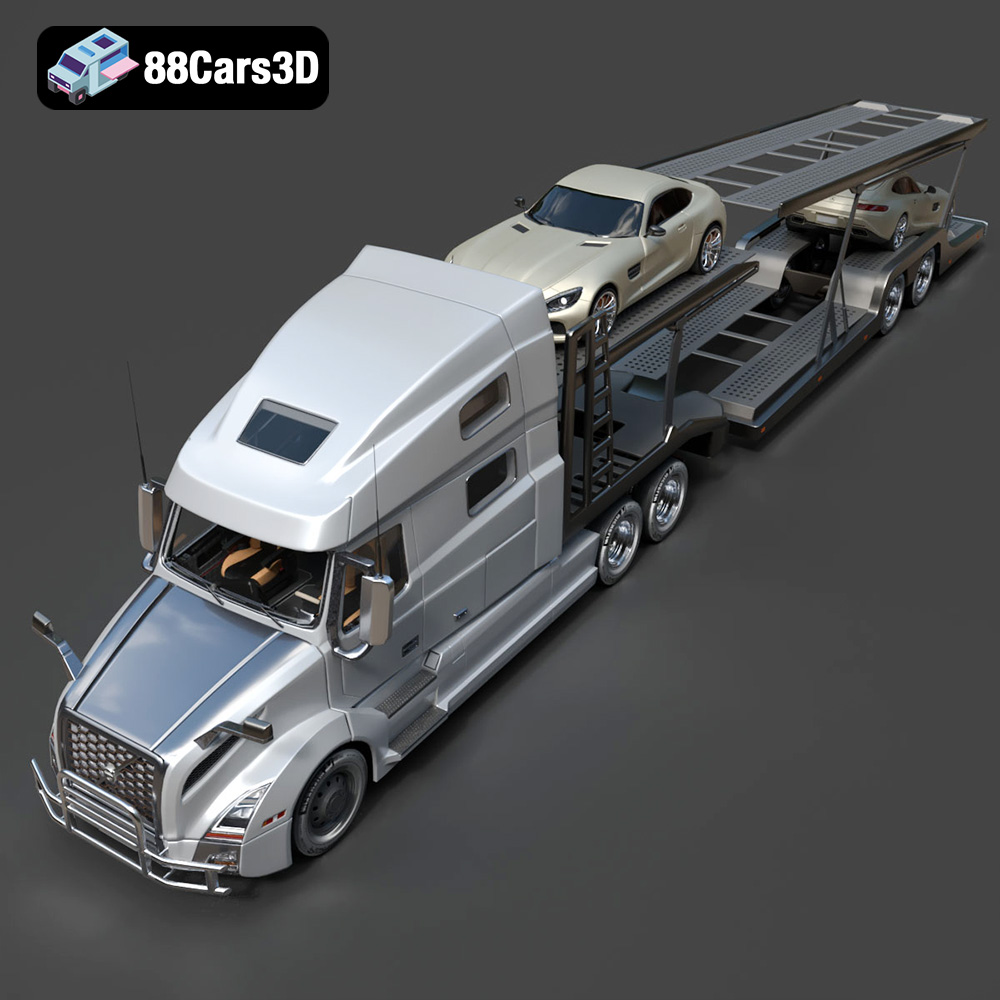
This pursuit of digital perfection is precisely where assets like the Volvo Trucks Benz GT-001 3D Model shine. This exceptional model is a testament to the meticulous craftsmanship required in professional 3D content creation. It captures the robust presence and intricate aesthetic of a premium concept truck, providing an invaluable asset for any digital environment. Engineered with clean geometry, authentic proportions, and realistic materials, it meets the rigorous demands of modern workflows, from cinematic rendering to interactive simulations, making it an ideal choice for professionals seeking precision and accuracy in vehicle design.
The visual fidelity of any 3D project hinges directly on the quality of its assets. For automotive visualization, where details are paramount and expectations for realism are sky-high, this is especially true. A high-quality 3D car model isn’t just a collection of polygons; it’s a meticulously crafted digital twin that embodies design intent, engineering precision, and a narrative.
Automotive design and marketing rely heavily on stunning visuals. From concept development to advertising campaigns, designers and marketers need models that can withstand close-up scrutiny, dynamic lighting, and a myriad of environmental conditions. This demands not only accurate external geometry but often fully detailed interiors, functional components, and PBR-ready materials that react realistically to light. Subpar models can introduce artifacts, scaling issues, or simply fail to convey the desired aesthetic, compromising the entire project’s integrity. The Volvo Trucks Benz GT-001 3D Model, for instance, offers a fully modeled interior, significantly expanding its utility for both external showcases and immersive first-person setups, a critical feature for professional applications.
In the early stages of automotive design, 3D models allow for rapid prototyping and visualization of concepts long before any physical components are manufactured. This iterative process demands flexible, editable models. For game developers, a well-optimized model means smoother gameplay and more immersive experiences. For AR/VR developers, it means the difference between a jarring, disjointed interaction and a seamless, believable virtual presence. Investing in a professional-grade 3D model like those found on 88cars3d.com ensures that your digital assets are not just visually appealing but also technically sound, providing a solid foundation for any creative or technical endeavor.
Choosing the correct file format for your 3D assets is a critical decision that impacts workflow efficiency, compatibility, and the final output quality. Each format is designed with specific use cases and software ecosystems in mind. Understanding their nuances is key to a streamlined and successful 3D pipeline. The Volvo Trucks Benz GT-001 3D Model, for example, is offered in a comprehensive suite of these industry-standard formats, ensuring seamless integration into virtually any professional environment.
The `.blend` file format is native to Blender, the popular open-source 3D creation suite. When you download a `.blend` file, you’re not just getting the model; you’re often receiving a fully editable Blender scene. This includes not only the mesh geometry, but also materials, textures, lighting setups, cameras, animation data, physics simulations, and even scene organization. For artists heavily integrated into the Blender ecosystem, a `.blend` file offers maximum flexibility for modifications, rigging, and rendering within Blender’s powerful Cycles or Eevee engines. It’s ideal for those who want to dive deep into the model’s construction, make custom adjustments, or leverage Blender’s extensive toolset without any conversion losses.
Developed by Autodesk, `.fbx` (Filmbox) has become the de facto standard for exchanging 3D data between different software applications, especially within game development and real-time pipelines like Unreal Engine and Unity. It’s renowned for its ability to store a wide range of data beyond just geometry, including animation, rigs, skinning, blend shapes, cameras, lights, and even PBR material definitions. While not always fully editable in every program, its robust support for crucial animation and hierarchy data makes it indispensable for bringing complex animated models into game engines or for transferring assets between different DCC (Digital Content Creation) tools for further refinement. Its versatility makes it a cornerstone for many professional workflows, including importing assets like the Volvo Trucks Benz GT-001 3D Model into a game environment.
The `.obj` (Wavefront OBJ) format is one of the oldest and most universally supported 3D formats. It’s a simple, text-based format that primarily stores mesh geometry (vertices, normals, UV coordinates, and faces) and references external `.mtl` (material template library) files for material definitions. Its simplicity is its strength: almost every 3D software can import and export `.obj` files, making it an excellent choice for cross-software compatibility when complex animations or rigging are not required. While it lacks advanced features like animation or hierarchies, its reliability for static mesh transfer ensures it remains a staple in any 3D artist’s toolkit.
`.glb` (GL Transmission Format Binary) is the binary version of glTF, a royalty-free specification for the efficient transmission and loading of 3D scenes and models by engines and applications. GLB files package all assets (geometry, materials, textures, animations) into a single, compact file. It’s rapidly gaining traction as the “JPEG of 3D” due to its optimization for web-based 3D, AR (Augmented Reality), and VR (Virtual Reality) experiences. Its efficient design and native support in many modern browsers and platforms make it ideal for delivering interactive 3D content directly on websites or integrating models into AR/VR applications without heavy processing. The Volvo Trucks Benz GT-001 3D Model in `.glb` format is perfect for showcasing interactive visualizations online or in mobile AR apps.
`.stl` (stereolithography) is primarily used for 3D printing and rapid prototyping. It describes only the surface geometry of a 3D object using a mesh of triangular facets. It doesn’t store color, texture, or other advanced attributes; it’s purely about the shape. When preparing a 3D model for physical fabrication, `.stl` is the go-to format as it’s universally recognized by 3D printers and slicing software. While not suitable for rendering or animation, its precision in representing solid geometry is unmatched for bringing digital designs into the physical world. For concepts like the Volvo Trucks Benz GT-001, an STL file can enable the creation of physical scale models.
The `.ply` (Polygon File Format, also known as Stanford Triangle Format) is another format for storing 3D data, particularly useful for scanned data and high-precision meshes. It can store a wider array of information than `.obj`, including color, transparency, surface normals, texture coordinates, and even properties like confidence values for scan points. It supports both ASCII and binary encodings. While less common for general 3D asset exchange compared to FBX or OBJ, it’s invaluable in scientific visualization, CAD, and applications where detailed point clouds or precise mesh data (often derived from 3D scanners) are handled.
While not a standalone general-purpose 3D format in the way FBX or OBJ are, `.unreal` often refers to assets pre-packaged or specifically configured for direct import and optimal performance within Unreal Engine. This typically means an `.fbx` file that has been optimized, or a proprietary asset structure within the engine itself. A “pre-configured for Unreal Engine use” asset suggests that materials are set up with PBR (Physically Based Rendering) shaders, textures are correctly linked, and the mesh may already be optimized for real-time performance with appropriate collision meshes and LODs (Levels of Detail). This saves significant time and effort for game developers and real-time artists working within the Unreal ecosystem, allowing for drag-and-drop integration.
The `.max` file is the native project file format for Autodesk 3ds Max. Similar to Blender’s `.blend`, a `.max` file encapsulates an entire scene, including geometry, materials, textures, lighting, cameras, animation, modifiers, and all scene settings. For users of 3ds Max, this format provides the most comprehensive and editable version of the model. It’s the ideal choice for animators, architectural visualizers, and product designers who utilize 3ds Max as their primary DCC application, offering full control over every aspect of the scene and model. For maximum flexibility in a 3ds Max workflow, the `.max` version of the Volvo Trucks Benz GT-001 3D Model is indispensable.
A high-quality 3D model like the Volvo Trucks Benz GT-001 3D Model is more than just a static object; it’s a versatile foundation for a multitude of professional applications. Its inherent quality and multi-format availability ensure it integrates smoothly into diverse pipelines, from traditional rendering to cutting-edge real-time experiences.
For rendering specialists, the .max and .blend formats of the Volvo Trucks Benz GT-001 provide full control. In 3ds Max, users can leverage powerful rendering engines like V-Ray or Corona to achieve breathtaking photorealism. This involves fine-tuning materials, setting up complex lighting scenarios (HDRI, photometric lights), and utilizing advanced camera effects to mimic real-world photography. The clean geometry of the model ensures smooth subdivision and accurate reflections, while its PBR-ready materials translate beautifully into realistic surfaces – from the sheen of painted metal to the subtle texture of tires. Similarly, in Blender, artists can harness the power of Cycles or Eevee. The .blend file often comes with pre-configured materials and lighting, providing a fantastic starting point for further customization, whether adding custom decals, adjusting paint finishes, or creating complex environmental reflections.
For game developers and simulation engineers, the .fbx and .unreal formats are game-changers. The .fbx file allows for straightforward import into Unreal Engine or Unity, retaining crucial data like UVs and material slots. From there, artists can set up PBR materials using the engine’s node-based material editors, ensuring accurate physical properties under real-time lighting. The “pre-configured for Unreal Engine use” asset of the Volvo Trucks Benz GT-001 significantly reduces setup time, allowing developers to focus on gameplay and interaction rather than asset preparation. This includes optimizing polygon counts, creating LODs (Levels of Detail) for performance at varying distances, and setting up collision meshes for realistic physics interactions. For driving simulators or open-world games, a well-optimized truck model is crucial for maintaining high frame rates and a truly immersive experience.
The rise of Augmented Reality (AR) and Virtual Reality (VR) demands 3D assets that are both visually rich and highly optimized for performance on diverse hardware. The .glb format of the Volvo Trucks Benz GT-001 is particularly suited for this. GLB files are lightweight and efficient, enabling quick loading times and smooth interaction within AR apps (like those on mobile devices) or VR environments (like Oculus Quest or Valve Index). This allows for interactive product showcases, virtual showrooms, or even industrial training simulations where users can explore the truck’s design and features in an immersive, 3D space. Imagine walking around the Volvo Trucks Benz GT-001 in a virtual showroom or placing it virtually in your driveway with an AR app – the .glb format makes these experiences seamless and engaging.
While visual appeal is paramount, the underlying technical integrity of a 3D model dictates its usability, performance, and longevity across various projects. Understanding these technical aspects is crucial for any professional working with 3D car models.
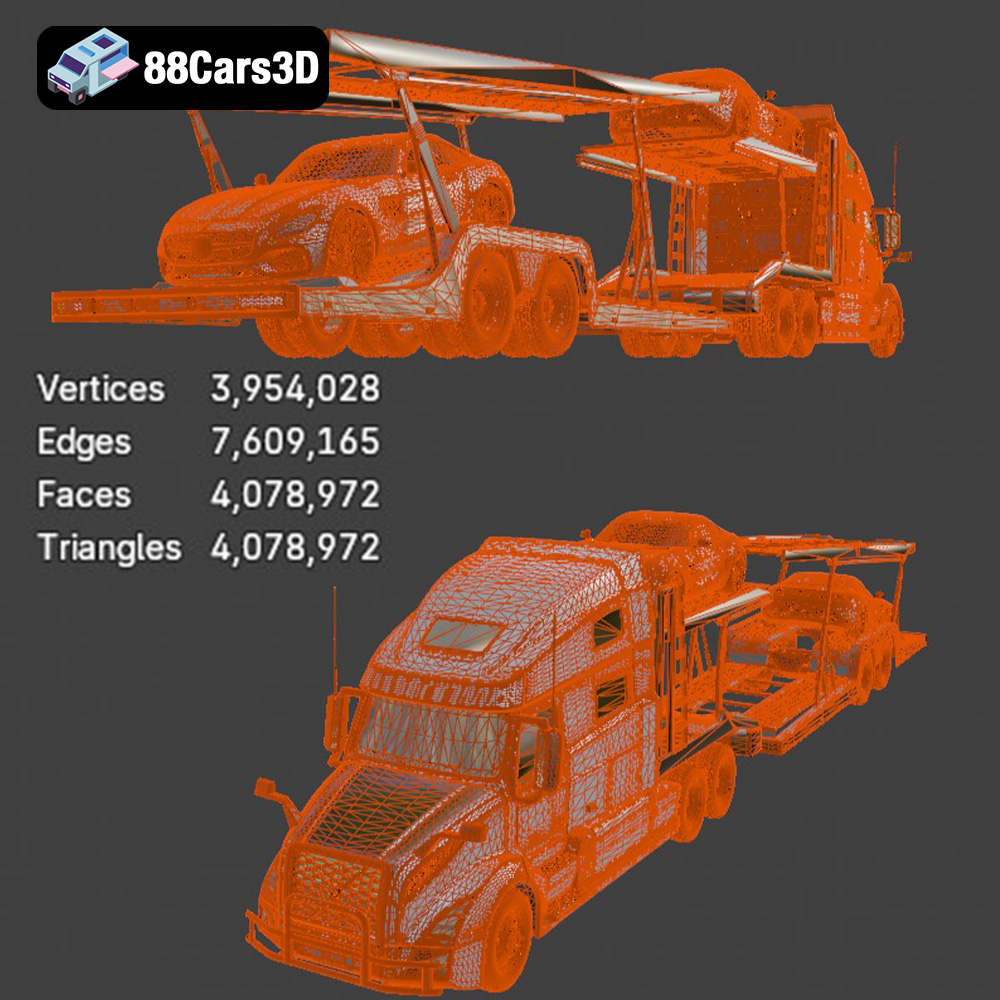
The “clean geometry” mentioned in the description of the Volvo Trucks Benz GT-001 3D Model refers to a mesh that is well-structured, free from non-manifold geometry, ngons (polygons with more than four sides), or overlapping faces. A clean mesh primarily uses quads (four-sided polygons), which allows for smooth subdivision, easier unwrapping, and predictable deformation if the model is rigged for animation. Optimal polygon count is also key; it should be detailed enough for close-ups but optimized to avoid unnecessary overhead, particularly for real-time applications. This balance ensures high fidelity without sacrificing performance, a hallmark of professional-grade 3D car models available on 88cars3d.com.
Realistic materials are fundamental to convincing 3D renders. Modern workflows predominantly use Physically Based Rendering (PBR), where materials are defined by properties like Base Color (Albedo), Metallic, Roughness, Normal, and Ambient Occlusion maps. These maps dictate how light interacts with the surface, simulating everything from the gloss of a polished fender to the subtle grain of a dashboard. The Volvo Trucks Benz GT-001 3D Model, with its “realistic materials,” implies that these PBR textures are correctly authored and applied, ensuring it looks authentic under any lighting condition, whether in a cinematic render or a game engine.
Effective UV unwrapping is critical for applying textures without distortion. A well-unwrapped model has logical seams and minimal stretching, allowing artists to paint or apply textures accurately. For complex objects like vehicles, multiple UV sets might be used for different purposes (e.g., one for primary textures, another for lightmaps). Furthermore, Levels of Detail (LODs) are essential for performance optimization in real-time applications. LODs are simplified versions of the model that automatically swap in at different distances from the camera, reducing the polygon count and improving frame rates without noticeable visual degradation. A professional asset, such as the Volvo Trucks Benz GT-001, is often prepared with these considerations in mind, ensuring it performs optimally across a range of viewing distances and hardware capabilities.
The versatility of a high-quality 3D truck model extends far beyond simple imagery, finding critical roles in diverse industries. The Volvo Trucks Benz GT-001 3D Model exemplifies how a single asset can power multiple professional applications.
In the automotive industry, 3D models are indispensable for marketing. Before a vehicle even rolls off the assembly line, its digital twin can be featured in stunning advertisements, virtual showrooms, and interactive product configurators. Imagine a customer on a car manufacturer’s website, customizing the paint, wheels, and interior of the Volvo Trucks Benz GT-001 in real-time, viewing it from every angle, and even placing it in their driveway via AR. High-fidelity models provide the backbone for these experiences, allowing for dynamic visual changes and compelling narratives that drive consumer engagement and sales. The clean geometry and realistic materials of models from 88cars3d.com are perfectly suited for such demanding interactive platforms.
Architects and urban planners frequently integrate vehicles into their renders to add scale, realism, and a sense of life to their architectural visualizations. A high-quality truck model like the Volvo Trucks Benz GT-001 can populate a street scene, an industrial complex, or a logistics hub, instantly grounding the architecture in a believable context. Its detailed interior even allows for shots looking into or out of the vehicle, offering narrative depth. When seamlessly integrated with realistic lighting and environments, these vehicles transform static architectural renders into vibrant, living spaces that better communicate design intent to clients and stakeholders.
Beyond entertainment, professional 3D models are critical for developing highly realistic training simulators. For commercial vehicles like trucks, simulators are invaluable for driver training, safety protocols, and operational planning, reducing costs and risks associated with real-world training. A detailed model of the Volvo Trucks Benz GT-001 can serve as the primary vehicle in such a simulator, offering accurate visual and physical representation. Furthermore, in the realm of Industry 4.0, digital twins – virtual replicas of physical assets – are used for monitoring, maintenance, and predictive analysis. A precise 3D model forms the visual and geometric core of these digital twins, allowing for interactive exploration and data visualization in real-time, whether for maintenance training or logistical planning.
The journey through the world of high-quality 3D automotive models reveals a profound truth: precision, versatility, and technical integrity are non-negotiable for professional success. From the nuanced choice of file formats to the intricate dance of geometry, materials, and optimization techniques, every element contributes to the final impact and usability of a digital asset. The demand for flawless visuals in rendering, seamless performance in real-time applications, and immersive detail in AR/VR experiences continues to grow, setting a high bar for content creators.
The Volvo Trucks Benz GT-001 3D Model stands as a prime example of an asset designed to meet these exacting standards. Its robust construction, authentic proportions, and comprehensive file format support ensure that professionals across various disciplines can integrate it effortlessly into their workflows. Whether you’re crafting a photorealistic render in 3ds Max, building a dynamic game environment in Unreal Engine, or developing an interactive AR/VR experience, this model provides the reliable, high-fidelity foundation you need. By choosing expertly crafted 3D car models from platforms like 88cars3d.com, you’re not just acquiring an asset; you’re investing in efficiency, quality, and the unparalleled realism that will elevate your projects and captivate your audience.
Discover exceptional digital realism with the Volvo Trucks Benz GT-001 3D Model, crafted for professionals seeking precision and accuracy in vehicle design. This model captures the robust presence and intricate aesthetic of the original vehicle, providing an incredible asset for your digital environment. Engineered with clean geometry, authentic proportions, and realistic materials, this model delivers a professional standard without unnecessary polygon overhead. Every detail is meticulously constructed to ensure optimal performance across various platforms. It perfectly highlights the modern design elements and functional features synonymous with premium truck concepts. Whether you are working on game development, creating cinematic rendering sequences, building interactive AR/VR experiences, or producing industrial visualizations, this versatile model provides the foundation you need. The inclusion of a fully modeled interior expands its utility for both external showcase shots and immersive first-person simulation setups. The package includes a comprehensive set of industry-standard file formats to guarantee seamless integration into any pipeline:
$29.99
.arvr
.benz
.blend
.car3dmodel
.commercialvehicle
.concepttruck
.fbx
.gameasset
.glb
.gt001
.max
.obj
.ply
.rendering
.simulation
.stl
.truck
.unreal
.volvo
.volvotrucks