Get 50% OFF All Premium 3D & STL Models!

In the vast landscape of digital creation, where photorealism meets boundless imagination, the demand for high-quality 3D assets is ever-growing. From the intricate worlds of AAA video games to groundbreaking architectural visualizations and immersive AR/VR experiences, precision and authenticity are paramount. At the heart of many compelling visual narratives lies the vehicle – an object of both functional design and profound aesthetic appeal. Few vehicles encapsulate this blend of history, engineering, and cultural impact quite like a classic motorcycle.
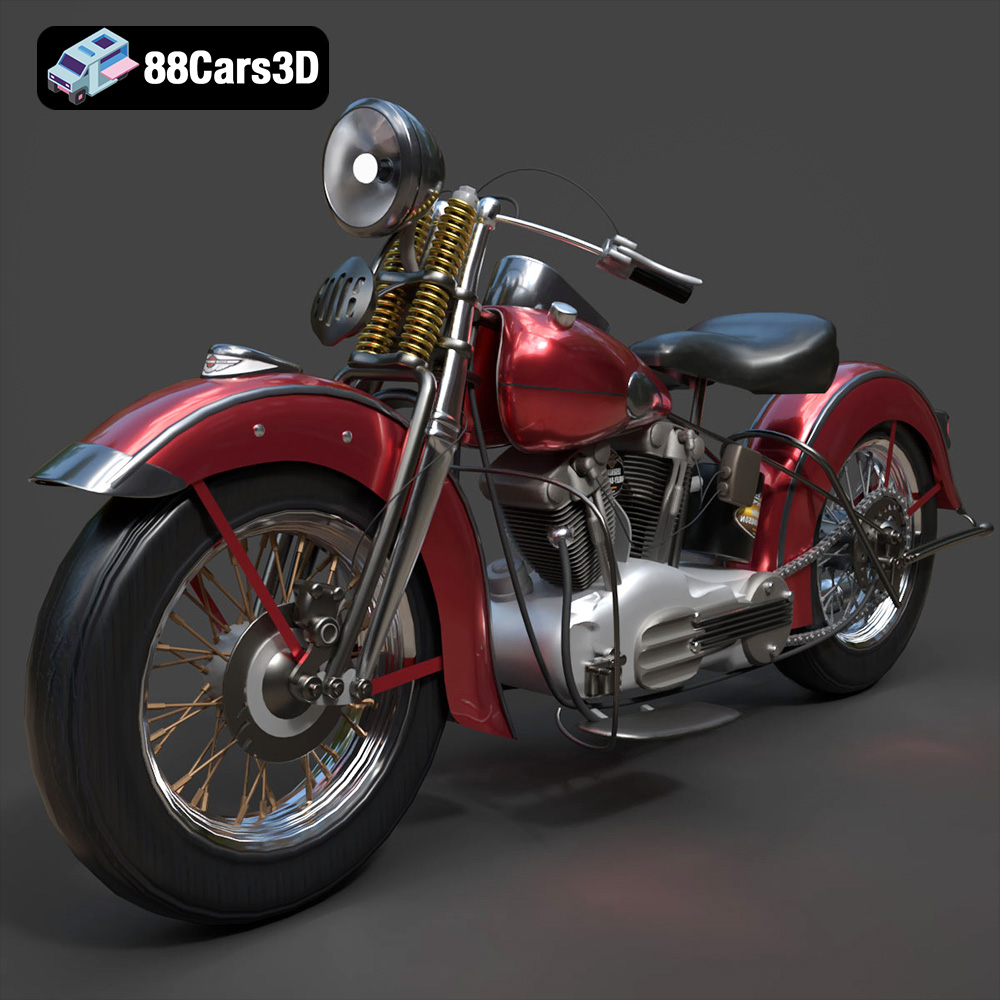
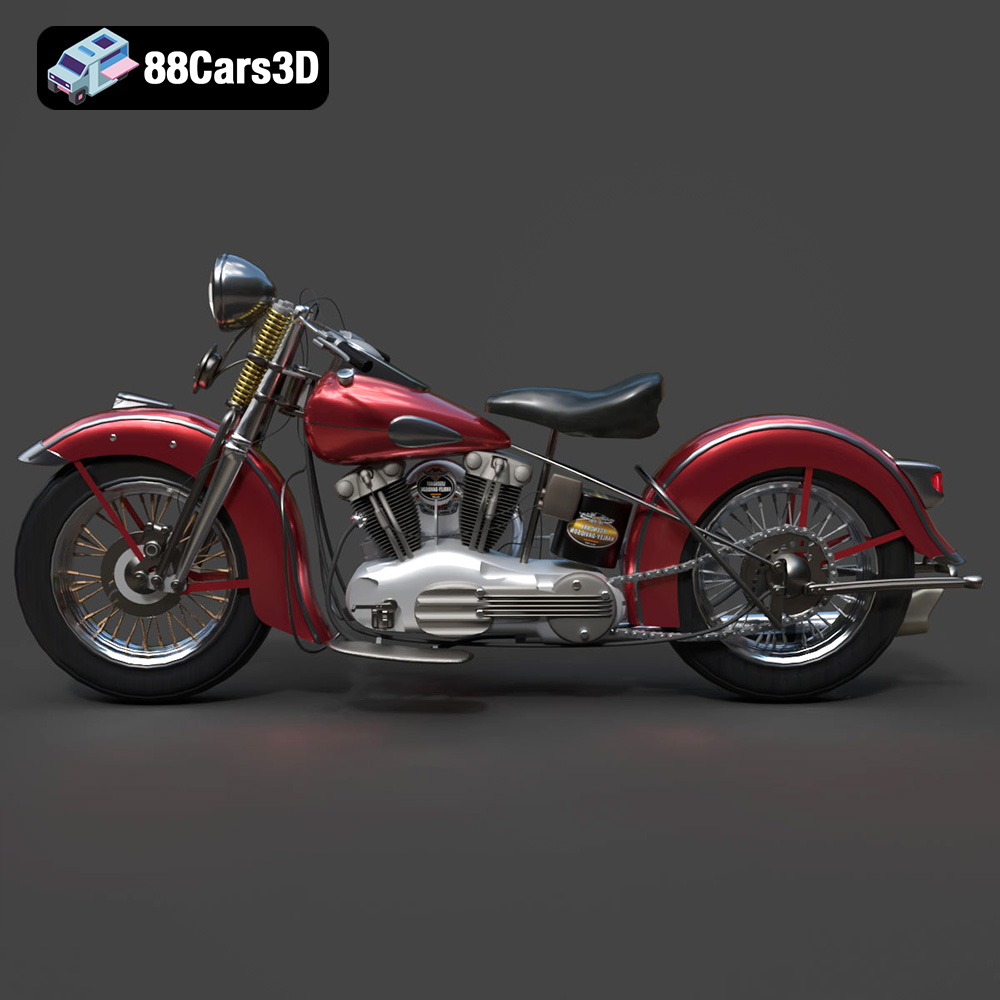
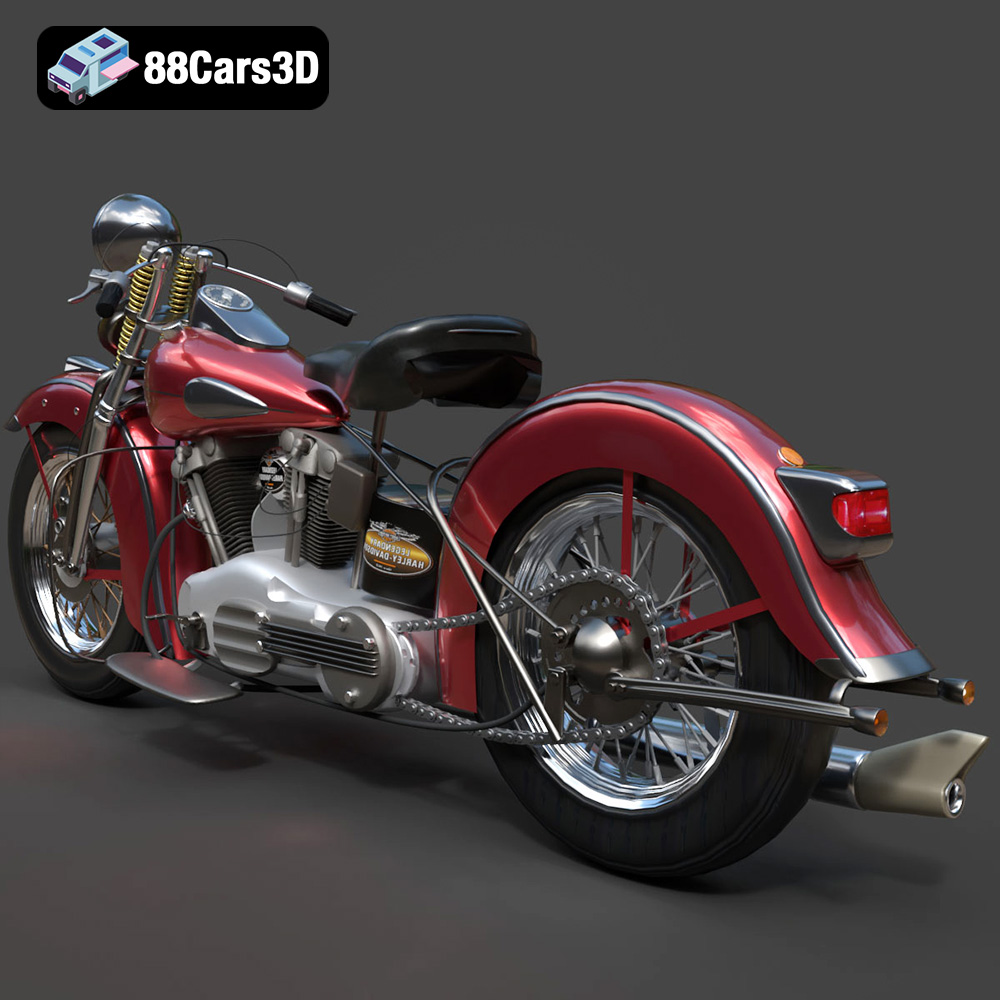
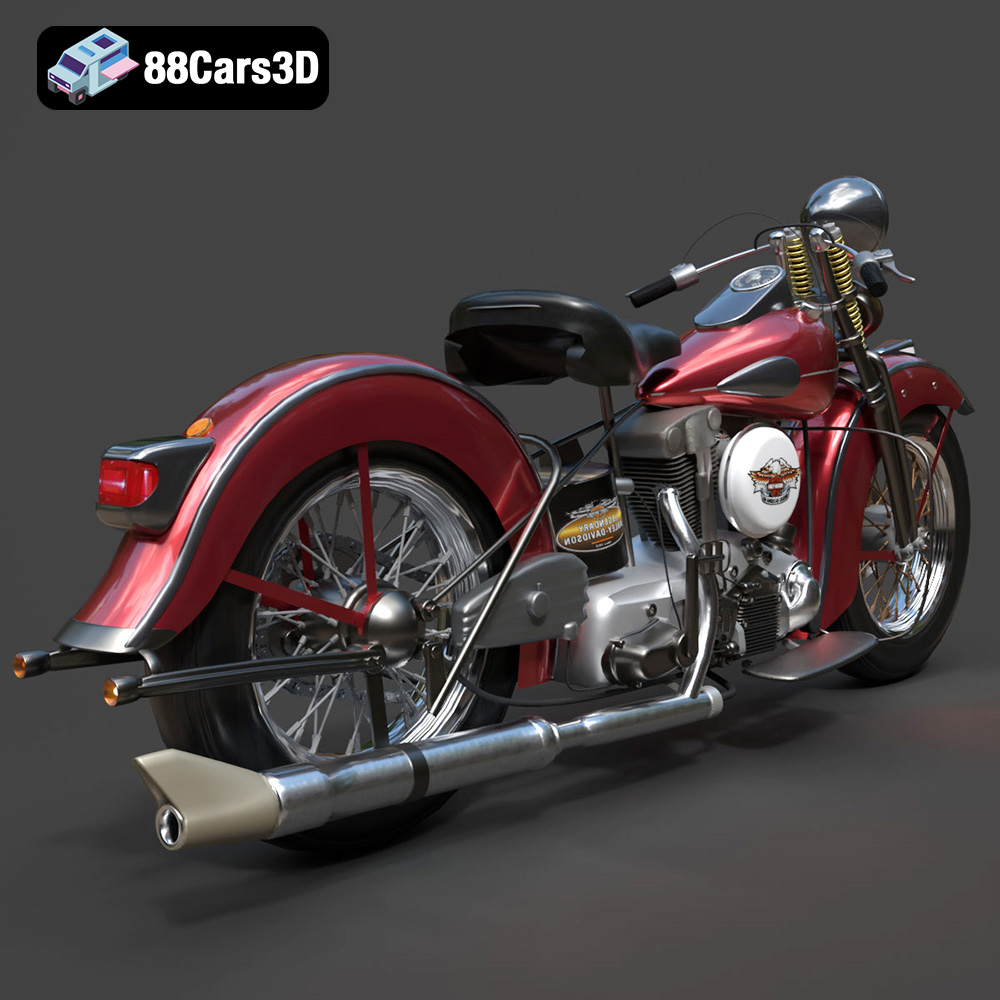
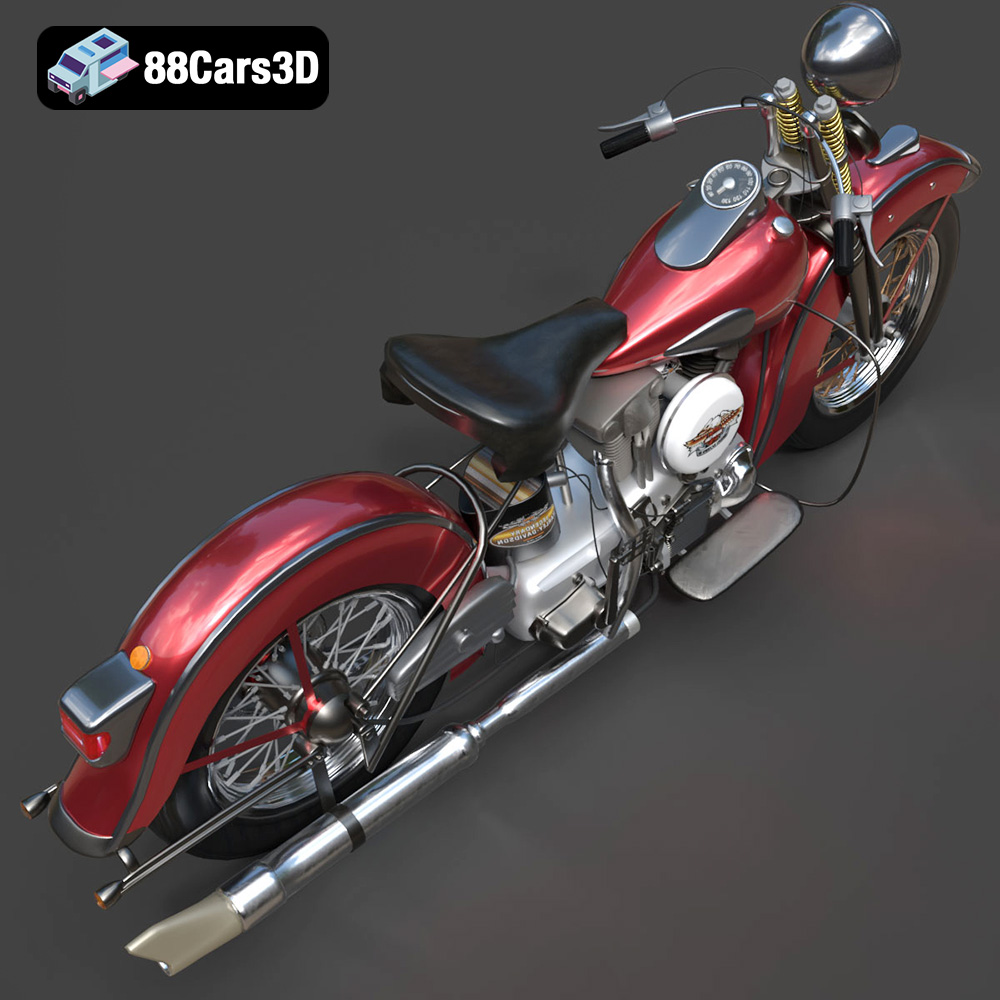
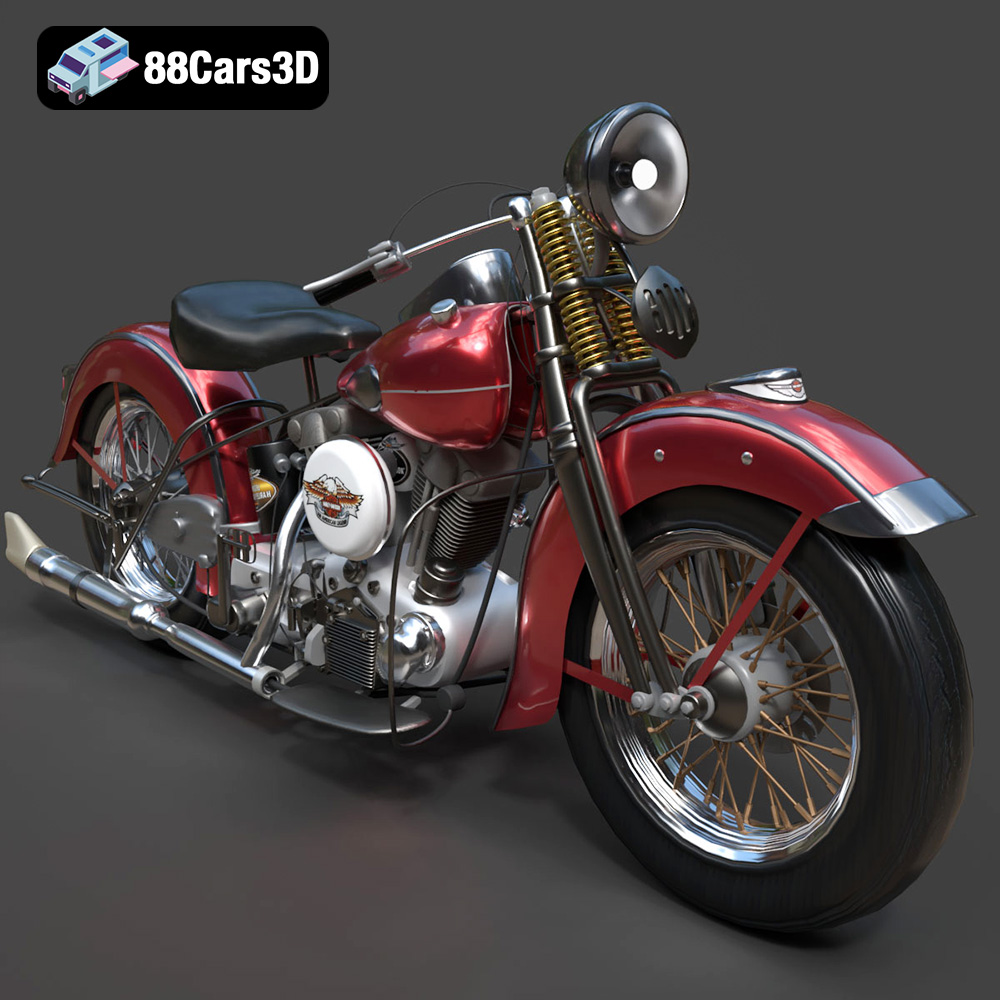
Today, we’re diving deep into the technical intricacies and creative potential offered by a truly iconic piece of history: the Harley Davidson F 1946 3D Model. This meticulously crafted asset, available on 88cars3d.com, is more than just a digital representation; it’s a gateway for creators to bring a piece of automotive legacy into their projects with stunning realism and unparalleled flexibility. Whether you’re an automotive rendering specialist, a game developer, or an AR/VR innovator, understanding the robust features and diverse file formats of such a model is crucial for maximizing its potential.
Classic vehicles hold a unique allure, transcending their original purpose to become symbols of an era, design philosophies, and technological milestones. For 3D artists and developers, these machines offer a rich canvas for exploration, storytelling, and technical challenge. The Harley Davidson F 1946, with its distinctive silhouette and historical significance, is a prime example of an asset that can significantly elevate any digital project.
Recreating a classic vehicle like the Harley Davidson F 1946 in 3D demands an obsessive attention to detail. It’s not just about getting the proportions right; it’s about accurately depicting the patina of age, the specific textures of period-correct materials, and the subtle mechanical nuances that define its character. A high-quality 3D model, such as the one offered for the Harley Davidson F 1946, goes beyond mere aesthetics. It reflects extensive research, precise modeling techniques, and a deep understanding of the original design. This commitment to authenticity ensures that the model isn’t just visually appealing but also historically accurate, making it invaluable for educational content, documentaries, or museum-style virtual exhibits.
While the nostalgic appeal is undeniable, the utility of classic 3D vehicle models extends far into practical applications. For game developers, a classic motorcycle can serve as a hero asset in an open-world title, a collectible, or a dynamic element in a historical racing game. In architectural visualization, placing a vintage Harley outside a rendered building can instantly add character and a sense of time. For product designers, studying the engineering and aesthetics of classic vehicles in 3D can inspire new creations. Furthermore, the burgeoning fields of AR/VR thrive on engaging, realistic content, where a classic motorcycle model can provide a tangible sense of presence in an immersive environment. The clean geometry and optimized nature of models like the Harley Davidson F 1946 ensure they perform efficiently across these varied demanding platforms.
The choice of file format for your 3D assets is not a minor detail; it’s a critical decision that impacts workflow efficiency, software compatibility, data integrity, and ultimately, the success of your project. The Harley Davidson F 1946 3D Model from 88cars3d.com is provided in a comprehensive array of formats, each serving distinct purposes and catering to specific professional pipelines. Understanding these formats is key to leveraging the model’s full potential.
The .blend format is native to Blender, a powerful open-source 3D creation suite. When you receive a .blend file, you’re not just getting a model; you’re getting a complete Blender scene. This typically includes the model’s clean geometry, all associated materials, textures, UV maps, and often a pre-configured lighting setup and camera angles. For artists who primarily work in Blender, this format offers maximum editability and immediate usability. You can easily modify the mesh, adjust shaders, animate components, or integrate it into an existing Blender project without any conversion losses. It’s ideal for deep customization, advanced rendering, and animation workflows within the Blender ecosystem.
.fbx (Filmbox) is arguably the most widely adopted proprietary 3D file format for data interchange between various 3D software applications and game engines. Developed by Autodesk, FBX supports geometry, materials, textures, animations, and rigs. Its strength lies in its ability to encapsulate a broad range of data, making it “game-engine ready.” For applications like Unreal Engine and Unity, FBX is the go-to format for importing complex assets. It efficiently transfers hierarchy, transforms, and animation data, ensuring that the Harley Davidson F 1946 3D Model, complete with its intended structure, can be seamlessly dropped into your real-time environment. While excellent for transfer, its proprietary nature means you might occasionally encounter minor import variations between software versions.
The .obj (Wavefront OBJ) format is a universal 3D model format, known for its widespread compatibility. Nearly every 3D software application can import and export OBJ files. It primarily stores geometry (vertices, normals, texture coordinates, and faces) and references to external material files (.mtl). Its simplicity is its strength; it’s a robust choice for transferring static mesh data. However, OBJ does not inherently support animation, rigging, or scene information like lights and cameras. For a static, high-detail model like the Harley Davidson F 1946, OBJ serves as an excellent fallback for cross-software compatibility, ensuring you can access the core mesh data regardless of your primary 3D suite.
.glb (GL Transmission Format Binary) is the binary version of glTF, a royalty-free specification for 3D scenes and models. Designed for efficient transmission and loading of 3D content, GLB packages everything – geometry, materials, textures, and animations – into a single, self-contained binary file. This makes it incredibly efficient for web-based 3D viewers, AR/VR applications, and mobile environments. Its small file size and quick parsing capabilities are crucial for delivering smooth, interactive experiences. For bringing the Harley Davidson F 1946 into an augmented reality app or a browser-based configurator, GLB is the optimized choice, ensuring fast load times and consistent visual quality across platforms.
.stl (Stereolithography) is the standard file format for 3D printing. Unlike other formats that store color or texture information, STL primarily describes the surface geometry of a 3D object using a mesh of triangular facets. It’s a “raw” mesh format, focused solely on the shape for manufacturing. If your goal is to physically prototype or 3D print a scaled-down version of the Harley Davidson F 1946, the STL format is what you’ll use. It ensures the geometric integrity necessary for additive manufacturing, allowing you to bring the classic motorcycle from the digital realm into the tangible world.
.ply (Polygon File Format or Stanford Triangle Format) is another format primarily used to store 3D data from 3D scanners or for CAD applications. Like OBJ and STL, it describes polygonal models, but it can also store a wider range of properties, including color, transparency, normals, texture coordinates, and even material properties per vertex. This makes PLY suitable for scientific data, engineering analysis, and applications where precise mesh information with additional attributes is critical. For detailed visualization or specialized analysis of the Harley Davidson F 1946’s geometry, the PLY format provides a robust and often more feature-rich representation than STL.
The .unreal format refers to assets specifically configured and ready for direct import and use within Unreal Engine. While .fbx is the common conduit, an .unreal file or a project folder containing engine-ready assets implies that the model has already been imported, scaled, had its materials set up with Unreal’s physically based rendering (PBR) system, and potentially has LODs (Levels of Detail) generated. This format dramatically accelerates development for Unreal Engine projects, eliminating much of the initial setup time. The Harley Davidson F 1946, provided in this pre-configured state, means you can instantly integrate it into your game or real-time visualization, saving countless hours on material creation and optimization within the engine.
Finally, the .max format is the native file format for Autodesk 3ds Max, a leading software for 3D modeling, animation, and rendering. A .max file contains a complete 3ds Max scene, including the model’s geometry, modifiers, materials, textures, lighting, cameras, animation data, and rendering settings. For professionals operating within the 3ds Max ecosystem, this format offers maximum flexibility for editing, rigging, animating, and producing high-fidelity renders. It allows for deep customization of the Harley Davidson F 1946, from fine-tuning shaders with V-Ray or Corona to setting up complex cinematic sequences, providing full access to the original project structure and all its rich details.
The foundation of any successful 3D project lies in the quality of its assets. For something as intricate as a classic motorcycle, “high-quality” isn’t just about looking good in a screenshot; it’s about robust construction that performs flawlessly across various demanding applications. The Harley Davidson F 1946 3D Model exemplifies the standards required for professional use.
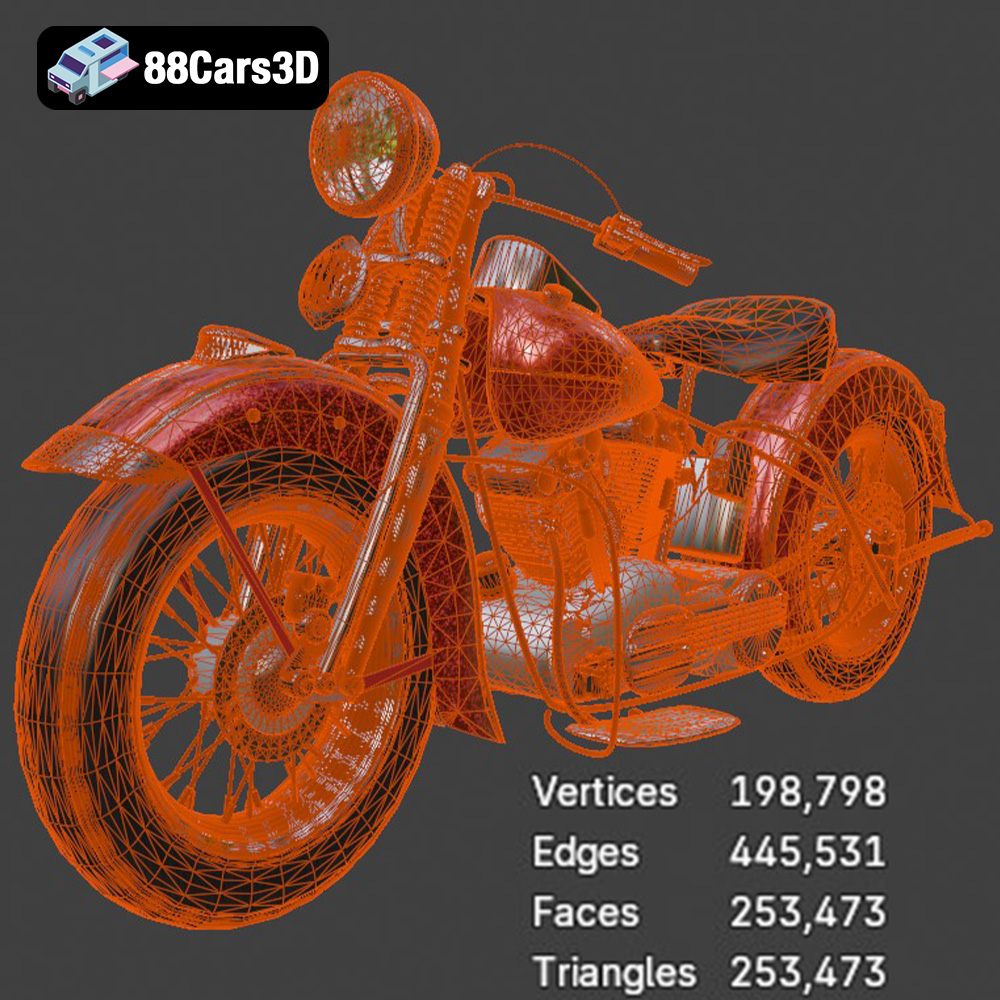
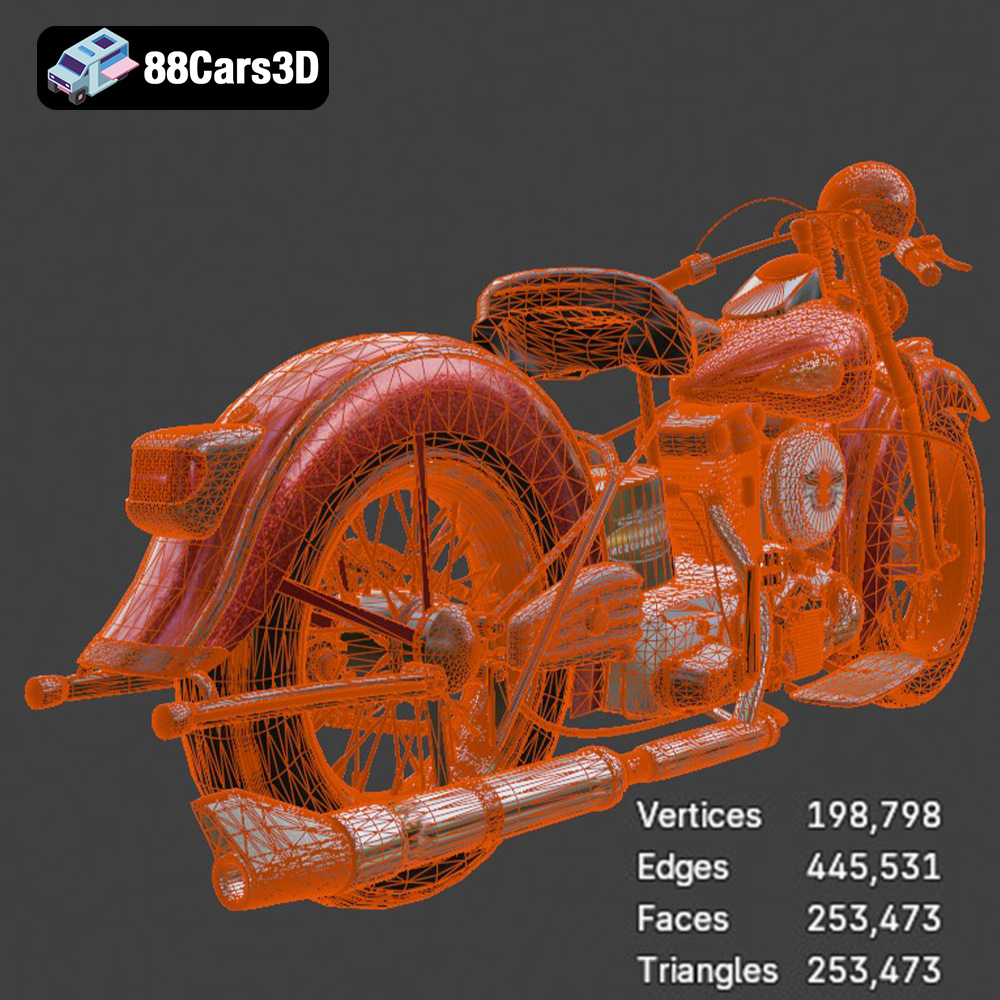
Central to a high-quality model is its clean geometry and efficient topology. This means the mesh is well-optimized, typically composed of quads (four-sided polygons) where possible, with minimal triangulation or non-manifold geometry. Such construction ensures smooth deformations for animation, predictable subdivision results, and efficient processing by rendering engines and game engines alike. For the Harley Davidson F 1946, this means every curve of the tank and every spoke of the wheel is represented with precision, without unnecessary polygon counts that can bog down performance. Coupled with clean geometry are meticulously crafted UV maps. These are critical for applying textures without stretching or distortion. Professional models feature organized UV layouts, often with multiple UV sets for different material types (e.g., base color, normal maps, metallic maps), ensuring realistic material application and PBR shader compatibility.
A 3D model, no matter how geometrically perfect, remains lifeless without realistic materials and textures. The Harley Davidson F 1946 3D Model comes equipped with high-resolution textures and carefully calibrated materials that accurately mimic real-world properties. This includes the gleam of chrome, the subtle reflections on painted metal, the texture of aged leather, and the intricate details of the engine block. These materials are often designed using Physically Based Rendering (PBR) workflows, utilizing maps such as Albedo/Base Color, Metallic, Roughness, Normal, and Ambient Occlusion. PBR materials ensure that the model looks consistent and realistic under various lighting conditions, whether rendered in V-Ray, Corona, Eevee, Cycles, or Unreal Engine’s native renderer.
Professional 3D models must cater to a spectrum of performance demands. A model suitable for high-resolution cinematic rendering might be too dense for a real-time game engine. The Harley Davidson F 1946 3D Model is designed with this in mind, often implying a balance or providing different levels of detail (LODs) if explicitly stated. “Clean geometry for efficient rendering and real-time performance” indicates careful optimization. This involves balancing polygon count for visual fidelity versus performance, efficient UV unwrapping, and potentially baked textures (like ambient occlusion or normal maps from a high-poly sculpt onto a lower-poly mesh). This optimization is crucial for integrating the model into demanding applications like game development, where frame rates are paramount, and for AR/VR, where mobile hardware limitations require lean, efficient assets.
Having a high-quality asset like the Harley Davidson F 1946 3D Model is only the first step. The true power lies in how it integrates into various professional workflows, enabling artists and developers to bring their visions to life. Here, we explore some common pipelines.
For cinematic visuals and stunning marketing collateral, professional rendering suites are indispensable.
3ds Max Workflow: If you’re utilizing the .max file, you gain full control over the scene. Import the Harley Davidson F 1946 model, and you’ll find pre-configured materials that can be easily adapted for renderers like V-Ray or Corona. A typical workflow involves setting up a studio lighting environment, perhaps with HDRi (High Dynamic Range Image) maps for realistic reflections and global illumination. You can then add animation, such as a slow camera pan or a detailed breakdown of the engine components, before rendering out high-resolution images or video sequences. The editable nature of the .max file allows for intricate adjustments to shaders, adding custom dirt or wear layers, or even modifying geometry for bespoke project requirements.
Blender Workflow: Similarly, with the .blend file, artists can leverage Blender’s Cycles or Eevee render engines. The file likely includes an initial lighting setup, which can be modified or replaced with a more complex three-point lighting system or an outdoor environment. Blender’s node-based material system allows for incredibly detailed shader creation, letting you fine-tune every aspect of the Harley’s surfaces. You might animate a fly-through or create a turntable render to showcase every angle, utilizing Blender’s powerful animation and physics tools for realistic movement, if desired. The “clean geometry” of the Harley Davidson F 1946 ensures smooth subdivision surfaces for ultra-high-detail renders.
The Harley Davidson F 1946 3D Model is explicitly “game-engine ready” with .fbx and .unreal formats.
Unreal Engine Integration: For Unreal Engine projects, the .unreal file offers the most streamlined path. This asset would typically be dragged directly into the content browser, appearing with its PBR materials correctly configured. If using the .fbx, the process involves importing the FBX, ensuring correct scale and axis settings, then re-creating or assigning materials using Unreal’s robust material editor. Developers can then place the Harley into their game world, set up collision meshes, and potentially add interactive elements – perhaps allowing players to inspect the bike, or even ride it if an appropriate vehicle physics system is implemented. Its optimized nature ensures it contributes minimally to draw calls and poly budgets, maintaining high frame rates for immersive gameplay in racing or open-world environments.
Augmented and Virtual Reality demand highly optimized assets that can run smoothly on a variety of hardware, from powerful VR headsets to mobile phones. The .glb format is tailor-made for these environments.
AR/VR Implementation: Using the .glb format, developers can integrate the Harley Davidson F 1946 into AR/VR applications with minimal fuss. For AR, the model can be placed onto a real-world surface via a smartphone camera, allowing users to walk around and inspect the classic motorcycle as if it were truly present. In VR, the model can become a centerpiece in a virtual garage, a historical exhibit, or part of an interactive experience. The self-contained nature and small file size of GLB files mean faster loading times and smoother performance on resource-constrained devices, crucial for a truly immersive experience without lag or visual hitches. The “optimized model for immersive augmented and virtual reality experiences” highlight its suitability for these bleeding-edge applications.
In today’s fast-paced digital production environment, time is a precious commodity. Creating a high-quality 3D model from scratch, especially one as detailed and iconic as the Harley Davidson F 1946, requires hundreds of hours of expert modeling, texturing, and optimization. This is where marketplaces like 88cars3d.com provide immense value to professionals and enthusiasts alike.
The most immediate benefit of acquiring a professionally crafted 3D model is the significant time savings. Instead of dedicating valuable resources to modeling a classic motorcycle from the ground up, artists can immediately integrate the Harley Davidson F 1946 into their project. This accelerates production timelines, allowing teams to focus on other critical aspects of their work – be it animation, scene composition, coding, or interactive design. For studios on tight deadlines or freelance artists juggling multiple projects, ready-made, high-quality 3D car models (and motorcycles!) are indispensable tools that enable greater output and efficiency without compromising on visual fidelity.
Purchasing models from a reputable source like 88cars3d.com also provides assurance of quality and consistency. The product description for the Harley Davidson F 1946 3D Model explicitly states “clean geometry,” “realistic materials and textures,” and being “professionally crafted.” This means the model adheres to industry best practices, minimizing potential issues like poor topology, messy UVs, or non-PBR materials that can derail a project. It guarantees that the asset will perform as expected across various software and engines, providing a reliable foundation for any digital endeavor. This level of quality control is paramount for achieving professional-grade results consistently across all your projects, from elaborate automotive rendering to streamlined game assets.
The digital realm offers unprecedented opportunities for creativity, limited only by the quality of our tools and assets. The Harley Davidson F 1946 3D Model stands as a testament to what’s possible when historical accuracy meets technical excellence. Its meticulously crafted details, robust geometry, realistic materials, and wide array of optimized file formats (from .blend and .max for comprehensive editing to .fbx and .unreal for game development, and .glb for cutting-edge AR/VR) make it an incredibly versatile and valuable asset for any professional workflow.
Whether you’re aiming to produce breathtaking automotive rendering, integrate a piece of history into a next-generation game, or create immersive augmented reality experiences, this classic motorcycle model provides the foundational quality you need. By choosing expertly prepared 3D car models and vehicle assets from platforms like 88cars3d.com, you invest in efficiency, quality, and the boundless potential of your creative vision. Embrace the legacy of the Harley Davidson F 1946 and let it drive your next digital masterpiece.
Immerse yourself in the detailed world of the Harley Davidson F 1946 3D Model. This meticulously crafted model replicates the iconic motorcycle with stunning realism, capturing every curve and detail.
Key Features:
$19.99
.arvr
.blend
.car3dmodel
.classicmotorcycle
.f
.fbx
.gameasset
.glb
.harleydavidson
.harleydavidsonf
.max
.motorcycle
.obj
.ply
.rendering
.simulation
.stl
.unreal