Get 20% OFF All Premium 3D & STL Models!

In today’s rapidly evolving digital landscape, the demand for exceptionally detailed and versatile 3D car models has never been higher. From breathtaking automotive rendering and captivating game assets to immersive AR/VR experiences and precise 3D printing, the quality of a vehicle model can profoundly impact a project’s success. Professionals across various industries require models that not only look stunning but are also technically optimized, easily integrated into diverse pipelines, and capable of bringing their creative visions to life with unparalleled realism.
A prime example of such a versatile asset is the Mitsubishi Outlander GT 2010 3D Model. This meticulously crafted digital representation offers a compelling blend of aesthetic accuracy and technical robustness, making it an invaluable addition to any digital artist’s or developer’s toolkit. It embodies the modern standard for high-quality 3D car models, perfectly suited for a multitude of applications.
The automotive industry has always been at the forefront of technological advancement, and its digital representation is no different. The ability to visualize vehicles in 3D, long before physical prototypes exist, has revolutionized design, marketing, and engineering processes. This digital transformation relies heavily on the quality and flexibility of 3D assets.
Whether for a new car configurator, a high-octane racing game, or a virtual showroom experience, realism is paramount. Consumers and users expect nothing less than photorealistic representations that accurately convey the texture, reflections, and intricate details of a vehicle. This drives the continuous innovation in 3D modeling techniques, pushing boundaries for polygon density, material fidelity, and lighting accuracy. High-quality 3D car models serve as the cornerstone for achieving this visual authenticity.
For designers, engineers, and marketers, 3D models bridge the gap between abstract concepts and tangible digital realities. They allow for iterative design, extensive testing in virtual environments, and compelling visual communication. A well-constructed 3D car model, such as the Mitsubishi Outlander GT 2010 available on 88cars3d.com, is not just an aesthetic object; it’s a functional tool that accelerates development cycles and enhances creative possibilities across various digital mediums.
Choosing the right file format is as critical as the model itself. Different formats are optimized for specific workflows, software compatibility, and end-use applications. Understanding their nuances is key to a smooth and efficient production pipeline. The Mitsubishi Outlander GT 2010 3D Model comes with a comprehensive suite of formats, ensuring maximum flexibility for any project.
The .blend format is Blender’s native file type. It’s an exceptionally powerful format as it encapsulates an entire Blender scene, including all 3D mesh data, materials, textures, lighting, cameras, animations, rigging, and even custom scripts. For artists primarily working within Blender, this offers a fully editable, self-contained project file. It allows for direct manipulation of geometry, material adjustments with Cycles or Eevee render engines, and comprehensive animation setup. The inclusion of a .blend file with the Outlander GT model means users can immediately dive into customizing and integrating it into their Blender-based projects with full control.
.fbx (Filmbox) is an industry-standard format owned by Autodesk, widely recognized for its robust support for mesh geometry, materials, textures, animations, and skeletal data. It is the go-to format for transferring assets between different 3D software packages (like 3ds Max, Maya, Cinema 4D, Blender) and, crucially, for importing into real-time game engines like Unreal Engine and Unity. Its ability to retain complex scene information makes it ideal for game assets and animation pipelines where precise data transfer is essential. For the Mitsubishi Outlander GT 2010, the .fbx file ensures seamless integration into these demanding environments.
.obj (Wavefront OBJ) is another highly universal format, lauded for its simplicity and wide compatibility. It primarily stores geometry (vertices, normals, texture coordinates, faces) and can reference external .mtl (material) files for basic material properties. While it doesn’t support animation or advanced rigging, its widespread acceptance makes it an excellent choice for basic mesh exchange, especially when moving static models between disparate software where .fbx might encounter specific version issues. It’s a reliable fallback for ensuring the core geometry of the Mitsubishi Outlander GT is accessible anywhere.
.glb (GL Transmission Format Binary) is an increasingly popular format for 3D models, particularly optimized for web-based applications, augmented reality (AR), and virtual reality (VR). It’s a binary version of glTF (GL Transmission Format), meaning all assets (geometry, materials, textures, animations) are packaged into a single, self-contained file. This makes it incredibly efficient for streaming and displaying 3D content quickly across browsers, mobile devices, and AR/VR platforms, making the Outlander GT instantly deployable in these emerging technologies.
.stl (Stereolithography) is perhaps the most common file format for 3D printing. It represents a 3D model as a collection of unconnected triangles, defining only the surface geometry without color or texture information. While simple, its ubiquity makes it essential for anyone planning to physically manifest their digital creations. The Outlander GT’s inclusion of an .stl file makes it directly ready for hobbyists or professionals looking to 3D print the model at various scales, as detailed in its product description.
.ply (Polygon File Format or Stanford Triangle Format) is similar to .obj but can also store properties like color, transparency, surface normals, and even data from 3D scanners. It’s often used for scientific data, CAD applications, and when a higher degree of precision for mesh properties is required beyond simple geometry, making it valuable for specific engineering or analysis tasks related to the Outlander GT model.
The .unreal designation often refers to assets specifically configured and exported for direct use within Unreal Engine, potentially including optimized materials, collision meshes, and LODs (Levels of Detail) tailored for the engine’s rendering pipeline. This “engine-ready” state streamlines integration significantly, saving developers precious time. For the Mitsubishi Outlander GT, this implies a highly optimized asset, ready for immediate placement in virtual environments.
Finally, .max is the native file format for Autodesk 3ds Max. Like .blend, it saves the entire scene, including geometry, lights, cameras, animations, and render settings. For artists and studios heavily invested in the 3ds Max ecosystem, the .max file provides full editability and control over the model, materials, and any potential animations, making it invaluable for high-end automotive rendering and visualization projects.
The Mitsubishi Outlander GT 2010 3D Model from 88cars3d.com stands out due to its thoughtful balance of visual authenticity and technical optimization. It’s a prime example of how detailed craftsmanship translates into a highly functional 3D asset for a wide array of professional uses.
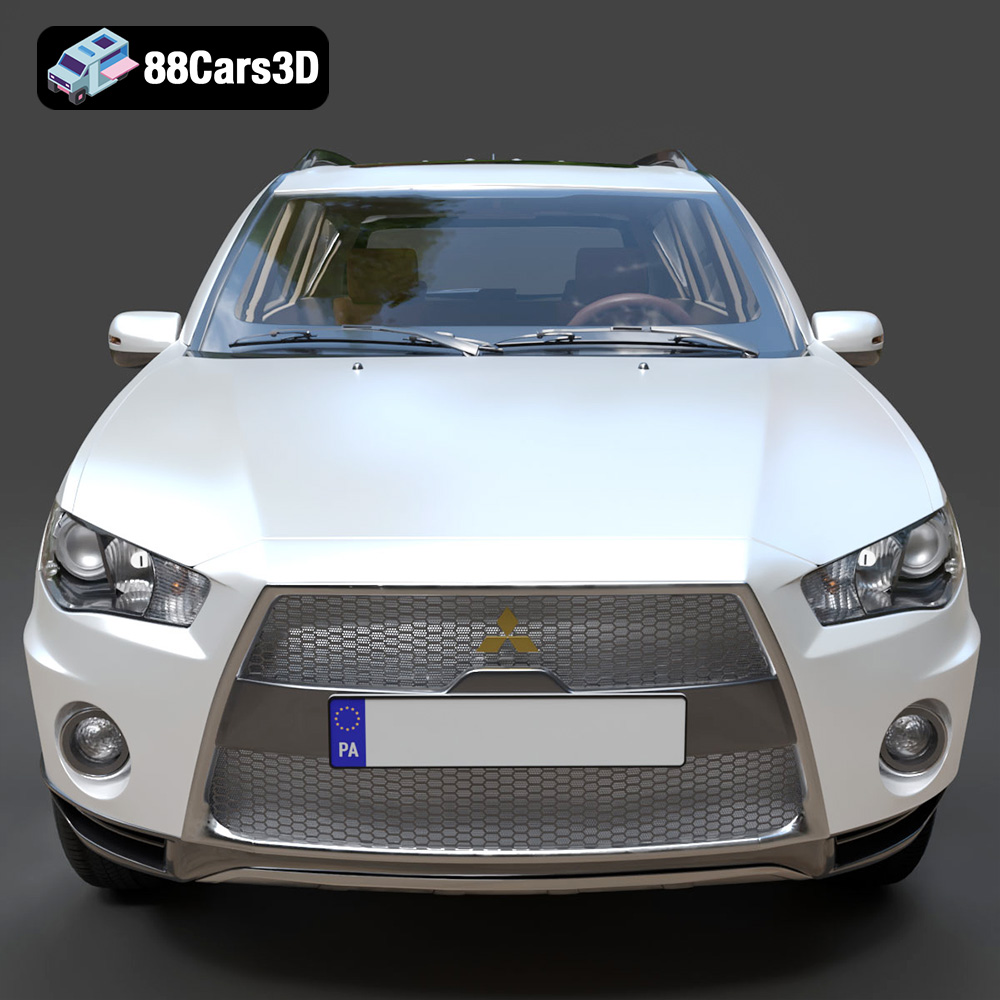
The model meticulously captures the aggressive Lancer Evolution-inspired ‘Jet Fighter’ front grille, a defining characteristic of the 2010 Outlander GT. Every curve, line, and panel gap is accurately replicated, ensuring that the vehicle’s sporty aesthetic is faithfully represented. This attention to detail extends to functional elements like the bi-xenon HID headlights and striking LED taillights, which are modeled with a level of precision that allows for realistic lighting setups. The 18-inch alloy wheels and detailed crossover tires, along with the authentic dual-tip exhaust system, contribute significantly to the overall realism, making it ideal for high-end automotive rendering.
Crucially, despite this detail, the model is “game-ready.” This means its topology has been carefully optimized, ensuring a clean mesh that performs efficiently in real-time environments. This balance is key for game developers who need visually rich assets that don’t bog down frame rates.
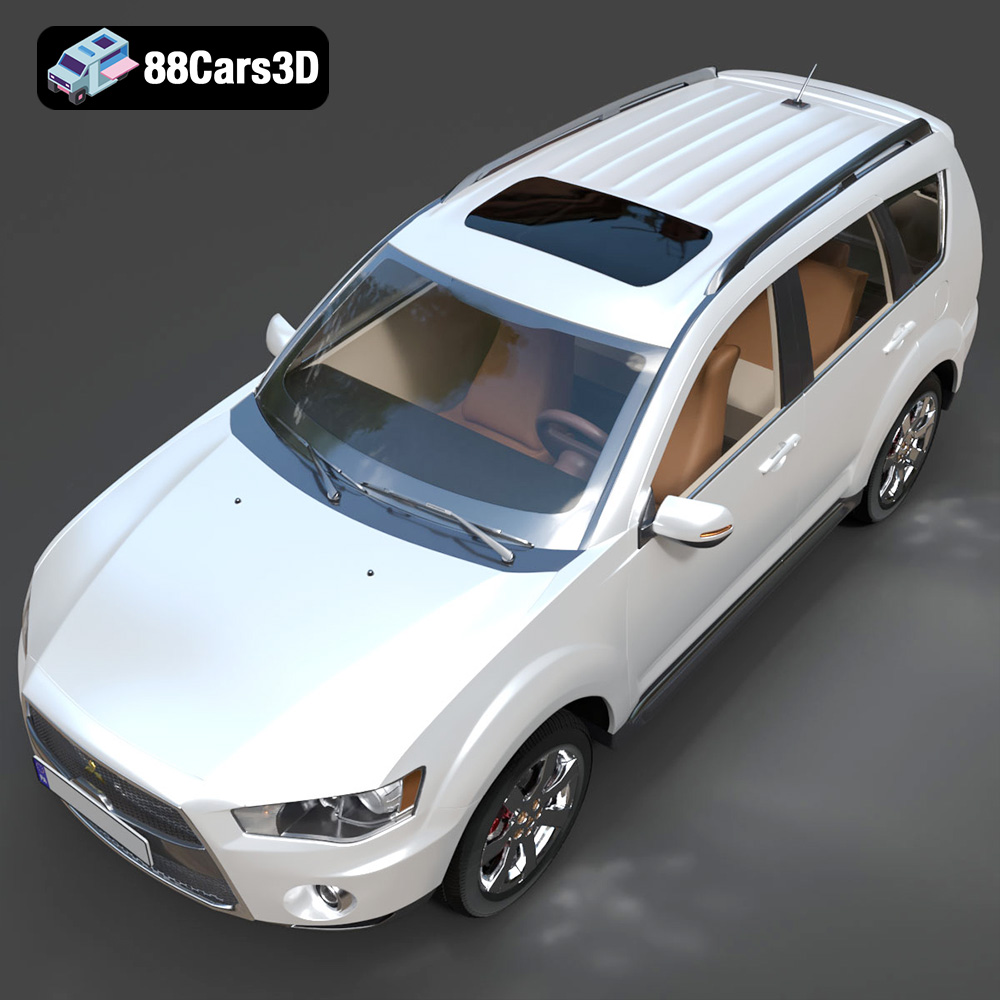
Beyond the exterior, the cockpit and interior features are equally impressive. The model includes premium leather-appointed seating with detailed stitching, a multifunction steering wheel equipped with paddle shifters, an accurate instrument cluster, and a central infotainment screen. Control details, such as pedals, the gear shifter, and drive mode selectors, are all present and accurately positioned. This level of interior detail is critical for immersive first-person POV experiences in gaming, AR/VR walkthroughs, or close-up architectural visualization scenes where the vehicle’s interior plays a role.
The geometry for the interior is also optimized, striking a balance between visual fidelity and polygon efficiency. This ensures that even with a detailed interior, the overall model remains suitable for real-time applications without excessively taxing system resources.
One of the standout technical advantages of this model is its optimized triangle count, sitting at approximately 180,000. This figure represents a sweet spot for modern 3D car models: it’s high enough to convey significant visual realism and intricate detail, yet low enough to ensure excellent performance in real-time engines like Unreal and Unity. For automotive rendering projects, this polycount allows for smooth interaction and faster render times without sacrificing quality.
Furthermore, the model is built to real-world scale accuracy, based on the actual vehicle chassis. This is not merely an aesthetic choice; it’s a technical necessity for accurate physics simulations in games, precise placement in architectural visualization scenes, and correct scaling for 3D printing. Proper pivot setup for steering, wheel rotation, and suspension travel further enhances its functionality, allowing for realistic animation without complex rigging from scratch.
The versatility of the Mitsubishi Outlander GT 2010 3D Model makes it a powerful asset across various professional workflows. Its optimized design and multiple file formats ensure seamless integration into diverse production pipelines.
For game developers, finding high-quality, game-ready assets is crucial. The Outlander GT’s optimized ~180,000 triangle count makes it ideal for open-world games, racing titles, and driving simulators. Its clean topology and proper pivot setup mean it’s ready to be imported directly into Unreal Engine or Unity. Developers can easily apply vehicle physics, set up collision meshes, and implement realistic driving mechanics. The separate wheels, suspension, and steering components are invaluable for creating dynamic animations, allowing for convincing vehicle movement, drifts, and impacts. This model significantly reduces development time, letting teams focus on gameplay and environment design rather than intricate vehicle modeling from scratch.
In the realm of automotive rendering, stunning visuals are paramount. Artists working with 3ds Max, Blender (using Cycles or Eevee), or other rendering software will find the Mitsubishi Outlander GT 2010 model a solid foundation for their projects. The detailed exterior and interior, combined with accurate geometry, make it perfect for studio lighting setups, brand campaigns, and lifestyle scenes. Its robust V6 engine profile and signature dual exhaust provide excellent points of interest for close-up renders. Artists can leverage the .max or .blend files to fully customize materials, add advanced lighting effects, and produce photorealistic images or cinematic animations that would be indistinguishable from real-world photography.
The rise of augmented and virtual reality demands optimized 3D car models that can perform efficiently on various devices. The .glb format of the Outlander GT model is specifically tailored for AR/VR, allowing for immersive virtual showrooms, interactive configurators, and mobile AR experiences where users can place the car in their real environment. Its optimized geometry ensures smooth performance without visual compromise. For those in product design or hobbyists, the .stl format makes the model directly convertible for 3D printing. With recommended settings for scale (1:12, 1:18, 1:24) and material suggestions (resin for fine details), users can physically manifest this detailed SUV, creating display-scale models with authentic factory colors and metallic finishes through post-processing.
A truly professional 3D car model offers more than just static beauty; it provides a canvas for extensive customization and adaptation. The Mitsubishi Outlander GT 2010 excels in this regard, offering numerous avenues for artists and developers to tailor it to their specific project needs.
The model’s design facilitates easy customization of its visual properties. Users can effortlessly change body colors, opting for authentic factory colors or exploring custom finishes like matte, gloss, or various metallic paints to match a specific brand aesthetic or mood. Tire textures can be modified to reflect different scenarios, from sleek street variants to rugged off-road options, instantly altering the vehicle’s character. Furthermore, material finishes for interior elements, such as leather seating and dashboard components, can be adjusted to create a premium or utilitarian feel, allowing for complete control over the vehicle’s appearance in any given scene or application. This flexibility is crucial for automotive rendering specialists crafting bespoke visual experiences.
Beyond static representation, the Outlander GT 2010 model is built for dynamic action. Its separate wheels, suspension, and steering components are pivot-ready, meaning they can be animated independently with ease. This functionality is invaluable for creating realistic driving simulations in games, cinematic cutscenes, or promotional animations showcasing the vehicle in motion. The ability to simulate suspension travel, steering input, and wheel rotation without complex rigging procedures saves significant production time and effort, enabling artists to focus on the narrative and visual impact of their animations. This animation-friendly structure enhances its value as a premier game asset.
The inherent versatility of this 3D car model allows for strategic deployment across a multitude of industries. In game development, it serves as a robust base for various vehicle roles, from player-controlled cars to AI-driven traffic. For architectural visualization, the Outlander GT can populate urban scenes, driveways, or showrooms, adding a touch of realism and scale. Marketing agencies can leverage it for engaging social media content, interactive online campaigns, or high-impact digital advertisements. Its adaptability to AR/VR platforms also opens doors for new interactive product experiences. The Mitsubishi Outlander GT 2010 3D Model is more than just a car; it’s a foundation for innovation, supporting diverse creative and commercial objectives.
The world of 3D visualization thrives on the availability of high-quality, versatile assets. The Mitsubishi Outlander GT 2010 3D Model exemplifies this necessity, offering a meticulously crafted and technically optimized solution for a broad spectrum of professional applications. From its accurate exterior and detailed interior to its game-ready polycount and extensive file format support, it’s designed to seamlessly integrate into virtually any workflow, be it for immersive game development, stunning automotive rendering, innovative AR/VR experiences, or precision 3D printing.
For designers, developers, and artists seeking to elevate their projects, investing in such a robust 3D car model is a strategic choice. The ability to customize aesthetics, animate components, and deploy across various platforms with ease makes this model an indispensable asset. Explore this and other exceptional 3D car models available on 88cars3d.com to bring your digital creations to life with unparalleled realism and efficiency.
Discover the dynamic and versatile 2010 Mitsubishi Outlander GT, a highly acclaimed crossover SUV known for its aggressive Lancer Evolution-inspired ‘Jet Fighter’ front grille and advanced S-AWC all-wheel-drive system. Our meticulously crafted 3D model perfectly captures the vehicle’s sporty aesthetic, featuring accurate exterior lines, a robust V6 engine profile, and its signature dual exhaust setup. Engineered with highly optimized topology and an efficient triangle count, this game-ready asset guarantees exceptional visual fidelity without compromising real-time performance. Designed to meet the stringent demands of modern 3D engines, it acts as a plug-and-play solution for game development, AR/VR experiences, animation, and architectural visualization. Perfect for urban driving simulators, off-road racing titles, virtual automotive showrooms, and high-end lifestyle rendering projects.
$19.99
.2010
.blend
.crossover
.fbx
.glb
.max
.mitsubishi
.obj
.outlander
.ply
.rendering
.stl
.unreal
car-3d-model
game asset
game-ready
low-poly
optimized
outlander-gt
SUV
VR/AR