Get 20% OFF All Premium 3D & STL Models!

In the expansive and ever-evolving world of 3D visualization, the demand for exceptionally detailed and technically sound assets is paramount. This holds especially true for automotive design, where precision, realism, and efficiency are non-negotiable. Professionals across industries—from game development studios and architectural visualization firms to automotive marketing agencies and AR/VR content creators—rely on high-quality 3D car models to bring their visions to life.
Creating a truly realistic and usable 3D car model from scratch is an incredibly time-consuming and complex undertaking. It requires not just artistic flair but also a deep understanding of vehicle design, advanced modeling techniques, material science, and optimization strategies for various platforms. Every curve, every panel gap, every interior detail must be meticulously crafted to ensure the final product meets the stringent standards of professional production. Subpar models can lead to rendering artifacts, poor performance in real-time engines, and a general lack of credibility, undermining the entire project.
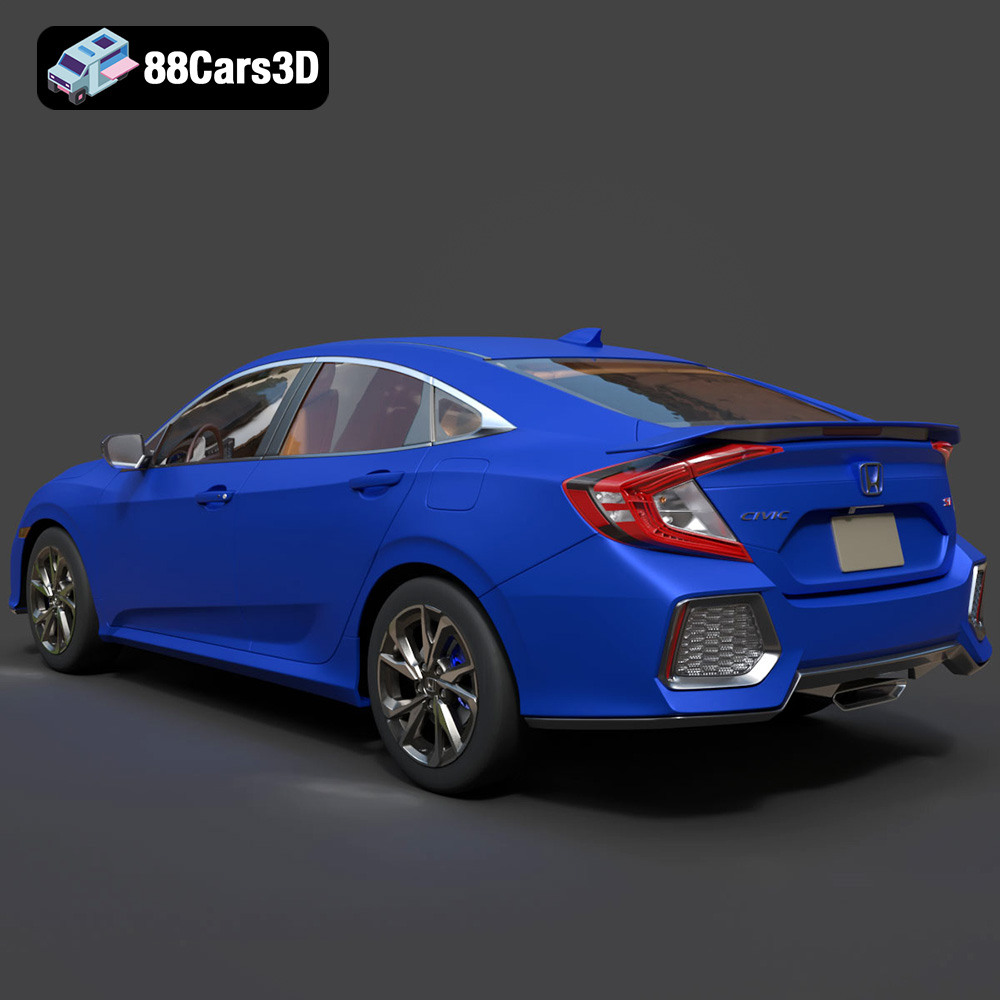
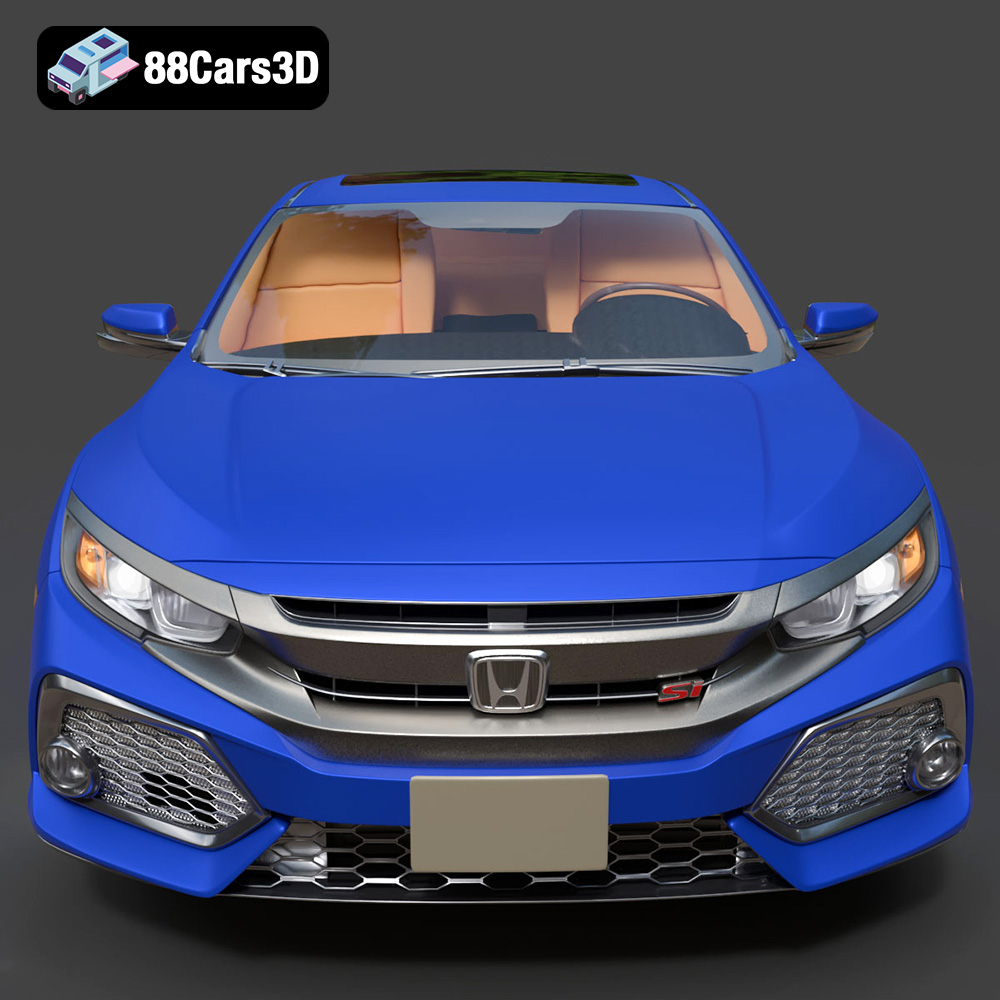
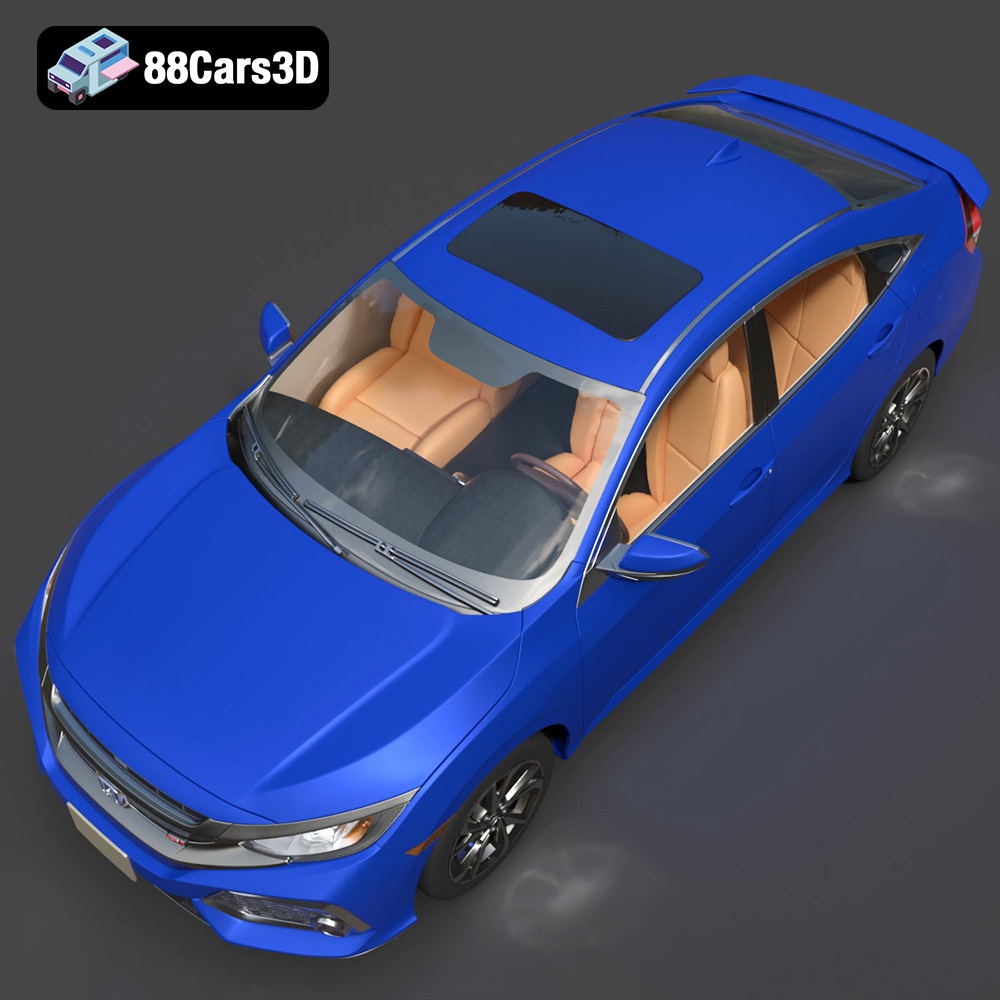
This is precisely where expertly crafted, production-ready assets become invaluable. We’re going to dive deep into what makes a premium 3D car model stand out, using the exceptional Honda Civic Si Sedan 2017 3D Model available on 88cars3d.com as our prime example. This particular model exemplifies the pinnacle of digital automotive craftsmanship, offering unparalleled realism, clean geometry, and a versatile suite of file formats. Whether your project demands photorealistic renders, immersive AR/VR experiences, or optimized game assets, understanding the technical underpinnings of such a model is key to maximizing its potential in your workflow.
The choice of a 3D model file format is far more than a simple preference; it dictates compatibility, workflow efficiency, and the ultimate usability of an asset across different software and platforms. The Honda Civic Si Sedan 2017 3D Model offers a comprehensive range of industry-standard formats, each tailored for specific use cases. Understanding their nuances is crucial for any serious 3D artist or developer.
The .blend file format is native to Blender, one of the most powerful and widely used open-source 3D creation suites. When you acquire a .blend file like that included with the Honda Civic Si, you’re not just getting the mesh; you’re getting a complete Blender scene. This typically includes the model with its materials, textures, lighting setups, and often camera configurations. This makes it incredibly easy for Blender users to jump straight into rendering, animation, or further customization without needing to import or reconfigure basic scene elements. Its integrated nature ensures that all data, from mesh topology to complex node-based materials, is preserved and immediately accessible.
Autodesk’s .fbx format is arguably the most widely adopted interchange format in the 3D industry, particularly for real-time applications like game development. It excels at preserving complex scene data, including meshes, materials, textures, animations, and even rigging information, across different software. For assets like the Honda Civic Si Sedan, an .fbx file is “game-engine ready” because it’s optimized for efficient import into platforms like Unreal Engine and Unity. It often includes embedded textures or clear references, proper scaling, and simplified material definitions that can be easily translated by game engines. Its robustness makes it indispensable for professional pipelines.
The .obj (Wavefront OBJ) format is a classic for a reason: its universal compatibility. Nearly every 3D software application can import and export .obj files. It’s a relatively simple text-based format that primarily stores mesh geometry (vertices, normals, texture coordinates, and faces) and can reference external material (.mtl) files for basic color and texture information. While it doesn’t support complex scene data like rigging or animation, its widespread support makes it ideal for cross-software compatibility, ensuring that the Honda Civic Si can be used in virtually any 3D package, from ZBrush to Maya to Cinema 4D, for sculpting, retopology, or rendering.
.glb (GL Transmission Format Binary) is increasingly becoming the standard for 3D models in augmented reality (AR), virtual reality (VR), and web-based applications. It’s a binary representation of the glTF format, designed for efficient transmission and loading of 3D scenes and models. Crucially, .glb packs all necessary assets—geometry, materials, textures, animations—into a single file, making it incredibly convenient for web embedding or mobile AR experiences where quick loading times and minimal external dependencies are vital. The inclusion of a .glb file for the Honda Civic Si highlights its suitability for cutting-edge interactive and immersive deployments.
The .stl (Stereolithography) format is the de facto standard for 3D printing. It represents a 3D model as a collection of unconnected triangular facets, defining only the surface geometry without color, texture, or other advanced attributes. While simple, its efficiency and widespread adoption make it perfect for rapid prototyping and manufacturing. For the Honda Civic Si, an .stl file would allow designers to quickly 3D print a physical scaled model for design review, educational purposes, or even custom aftermarket part prototyping, bridging the gap between digital and physical.
The .ply (Polygon File Format) is another format for storing 3D data, particularly useful for scanned data, engineering applications, and scientific visualization. It can store a variety of properties beyond basic geometry, such as color, transparency, surface normals, and even confidence values for each vertex or face. While less common for artistic exchange, its ability to store detailed polygon meshes makes it valuable for analytical visualization or integration into CAD (Computer-Aided Design) systems where precision and additional data attributes are critical. For the Honda Civic Si, this format could be beneficial in advanced simulation or reverse engineering contexts.
The specific .unreal file implies a pre-configured asset directly optimized or packaged for Unreal Engine. This is distinct from a generic .fbx, often suggesting that the asset has already gone through a conversion or setup process within Unreal, potentially including material instances, collision meshes, LODs (Levels of Detail), and blueprint configurations. This native format offers the most streamlined integration for Unreal Engine projects, significantly reducing setup time and ensuring optimal performance for the Honda Civic Si in real-time simulations or games.
Finally, the .max format is the native file type for Autodesk 3ds Max, a long-standing industry standard for 3D modeling, animation, and rendering. Similar to .blend, a .max file provides a complete 3ds Max project, including the detailed geometry, complex V-Ray or Arnold materials, lighting setups, cameras, and animation data. This allows 3ds Max users to leverage all the advanced features of the software for high-end automotive rendering or sophisticated animations of the Honda Civic Si Sedan 2017, offering full editability and control over every aspect of the scene.
Automotive rendering is an intricate discipline, blending technical prowess with artistic vision to create images and animations indistinguishable from reality. A high-quality 3D car model, such as the Honda Civic Si Sedan 2017 from 88cars3d.com, serves as the perfect canvas for achieving stunning visual results.
The foundation of photorealistic rendering lies in meticulously crafted materials and textures. A premium 3D car model comes with professional topology, allowing for seamless application of complex PBR (Physically Based Rendering) materials. For the Civic Si, this means accurate car paint shaders that react realistically to light, showing subtle reflections, clear coat effects, and metallic flakes. Tire rubber needs a distinct texture and subtle displacement for grip, while glass surfaces require precise refraction and reflection values. Interior elements, such as fabric, leather, plastics, and chrome accents, each demand their own specific material definitions to convey their real-world counterparts convincingly. Clean UV mapping, an essential characteristic of this model, ensures that textures wrap perfectly around the geometry without stretching or distortion.
Even the most detailed 3D car models will fall flat without proper lighting. Automotive rendering often employs High Dynamic Range Image (HDRI) environments for realistic global illumination and reflections, mimicking real-world lighting conditions. Studio lighting setups, using a combination of area lights, spot lights, and softboxes, are also crucial for showcasing design details and contours. The way light plays across the smooth curves and sharp lines of the Honda Civic Si Sedan 2017 is what truly brings it to life. Understanding light bounce, shadow softness, and ambient occlusion contributes significantly to the perceived realism. Integrating the model into a well-lit environment, whether a sprawling cityscape or a sterile studio, amplifies its visual impact.
Imagine an automotive marketing agency tasked with creating promotional material for the 2017 Honda Civic Si. Instead of expensive physical photoshoots, they could leverage this 3D model. Using 3ds Max, Blender, or Unreal Engine, artists could place the Honda Civic Si in various dynamic virtual environments: cruising through a bustling city at dusk, parked on a scenic mountain road, or displayed under dramatic studio lighting. High-resolution renders could be generated for brochures, website banners, and social media. Animated sequences could showcase its performance, interior features, and exterior styling, all without ever needing to move a physical vehicle. The professional topology and accurate proportions ensure that every shot looks authentic and appealing, making it a cost-effective and flexible solution for diverse marketing needs.
The use of 3D car models as game assets is a cornerstone of modern racing simulations, open-world adventures, and even mobile gaming. The Honda Civic Si Sedan 2017 3D Model is engineered to excel in this demanding environment, particularly with its game-engine-ready .fbx and .unreal formats.
For game development, balancing visual fidelity with performance is critical. While a model like the Honda Civic Si Sedan 2017 boasts intricate details for close-up shots, game engines require optimization. This typically involves creating multiple Levels of Detail (LODs). An LOD0 (the highest poly count) is used when the car is close to the camera, while LOD1, LOD2, and so on, have progressively fewer polygons, stripping away detail as the car moves further away. The “clean geometry” and “professional topology” of this model mean it’s easier for artists to generate these LODs without introducing errors. A well-optimized model minimizes draw calls and vertex processing, ensuring smooth frame rates even in complex scenes with multiple vehicles.
Beyond static representation, game assets need to be interactive. For a car model, this means rigging it for animation. A typical car rig involves bones or joints for wheels (rotation and steering), suspension, doors, hood, and trunk. Collision meshes are also essential to accurately simulate impacts and interactions with the game world. The clean topology of the Honda Civic Si Sedan 2017 ensures that rigging can be applied smoothly, preventing deformation issues. Once rigged, the car can be integrated into the game’s physics system, allowing players to drive, drift, and crash, providing a truly immersive and dynamic experience.
Consider a new racing game under development. The game studio requires a diverse fleet of realistic vehicles, and the Honda Civic Si Sedan 2017 is an ideal candidate for a compact sports sedan. Using the provided .fbx or .unreal files, developers can import the model directly into Unreal Engine. They’d then apply the pre-configured materials, set up the physics assets, integrate the collision geometry, and assign the vehicle blueprint. The detailed exterior and interior mean players can enjoy a fully immersive cockpit view, complete with functional dashboards and responsive steering wheel animations. This high level of detail, combined with game-ready optimization, makes the Honda Civic Si an invaluable asset for creating compelling and realistic driving experiences.
The utility of high-quality 3D car models extends far beyond traditional rendering and game development, venturing into the cutting-edge realms of augmented reality (AR), virtual reality (VR), and even physical fabrication through 3D printing.
AR and VR offer unprecedented opportunities for interaction and immersion. With the included .glb file, the Honda Civic Si Sedan 2017 3D Model is primed for these technologies. In AR, users could project the Civic Si into their real-world environment via a smartphone or tablet, walking around it, opening doors, and even “sitting inside” virtually. This is invaluable for showcasing new vehicle models to potential customers, allowing them to visualize the car in their driveway before purchase. In VR, users could explore the interior and exterior in a fully simulated environment, experiencing the vehicle’s design at a 1:1 scale with a level of detail that feels truly present. The meticulously crafted interior of the Civic Si model is particularly beneficial here, providing an authentic and engaging VR walkthrough.
The inclusion of an .stl file opens up the tangible world of 3D printing. While primarily designed for digital use, having an .stl version of the Honda Civic Si Sedan 2017 allows for rapid prototyping and the creation of physical models. Automotive designers can print scale models to assess proportions, aerodynamics, and overall aesthetics in a physical medium. Enthusiasts can print highly detailed replicas for display. This capability bridges the gap between the digital blueprint and a physical object, offering a unique avenue for design validation, educational tools, or personalized merchandise. The accuracy of the digital model translates directly into the precision of the printed object.
The .glb format’s efficiency and single-file nature are particularly advantageous for web-based AR. Imagine an automotive dealership wanting to feature the Honda Civic Si Sedan 2017 on their website. Instead of just static images, customers could click a button and, using their phone’s browser, instantly place a fully interactive 3D model of the car in their living room. This seamless, app-free experience is made possible by .glb and is a powerful tool for customer engagement and sales. The Honda Civic Si model’s optimized geometry and textures ensure a smooth experience even on mobile devices, showcasing its versatility for modern digital marketing strategies.
In the competitive landscape of 3D asset marketplaces, the difference between a good model and a truly exceptional one lies in the details. The Honda Civic Si Sedan 2017 3D Model exemplifies the commitment to quality that professionals seek, highlighting the advantages of sourcing assets from reputable platforms like 88cars3d.com.
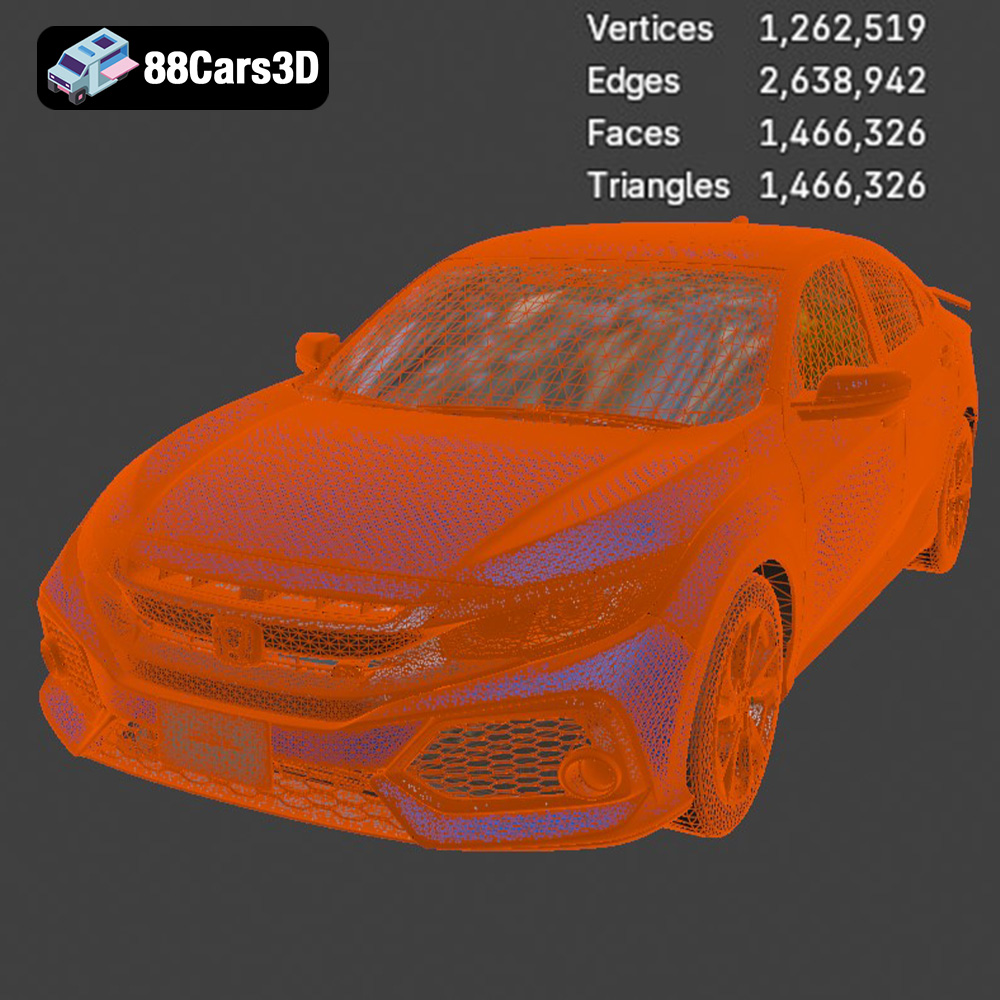
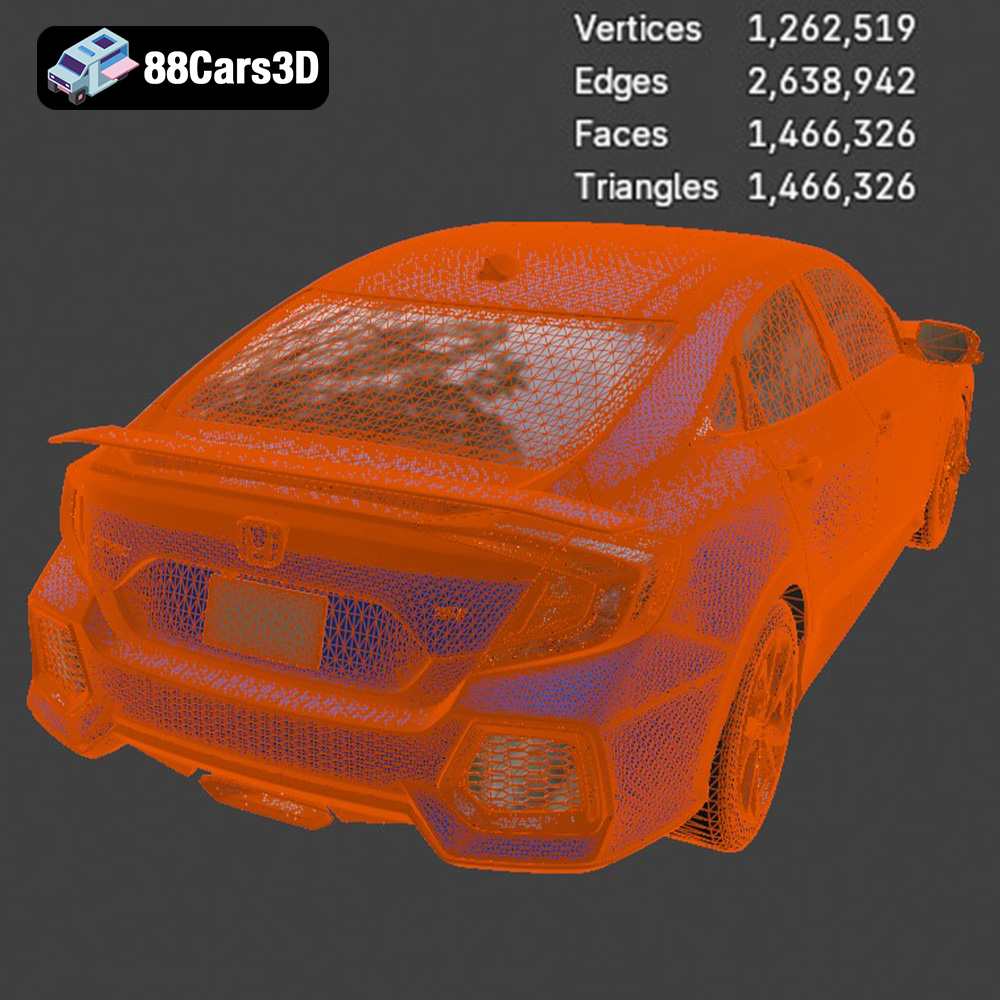
The product description for the Honda Civic Si Sedan 2017 emphasizes “clean geometry” and “professional topology.” This is not just marketing jargon; it’s a technical foundation for a superior asset. Clean topology means the mesh is organized with proper edge flow, using quads predominantly, and avoiding n-gons or excessive triangles unless strategically placed. This ensures smooth deformations during animation, correct subdivision for high-resolution renders, and easy editing. Similarly, “clean UVs” are crucial for texture mapping. Well-laid-out UVs prevent stretching, allow for efficient texture packing, and facilitate the creation of high-quality, seamless materials. A model with messy topology or UVs, no matter how good it looks initially, will inevitably cause headaches down the line during production, leading to wasted time and resources.
Time is money in any professional production. Starting from scratch with a complex asset like a car model can take hundreds, if not thousands, of hours for a skilled artist. Even downloading a free or cheap model can often lead to more work than it saves, as artists spend countless hours cleaning up bad geometry, fixing UVs, or rebuilding materials. A truly “production-ready” model, like the Honda Civic Si Sedan 2017, eliminates this bottleneck. Its meticulously modeled exterior, accurately crafted interior, and inclusion of multiple optimized file formats mean artists can immediately integrate it into their workflow. This allows teams to focus on creative tasks rather than remedial mesh repair, significantly accelerating project timelines and reducing overall costs.
The value proposition of platforms like 88cars3d.com is clear: they provide access to a curated collection of high-quality 3D car models that meet professional standards. The Honda Civic Si Sedan 2017 is a testament to this, offering “unparalleled realism” and fidelity suitable for “top-tier digital productions.” By investing in such assets, designers, developers, and artists are not just buying a 3D model; they are purchasing reliability, efficiency, and a guarantee of technical excellence. This trust allows creative teams to push the boundaries of their projects, confident that their foundational assets are robust and ready for any demanding scenario.
In the demanding landscape of 3D visualization and content creation, the difference between an acceptable output and an exceptional one often hinges on the quality of your core assets. The Honda Civic Si Sedan 2017 3D Model stands as a shining example of what truly high-fidelity 3D car models should offer: meticulous detail, professional topology, a versatile range of industry-standard file formats, and an unwavering commitment to realism.
From captivating automotive rendering for marketing campaigns to robust game assets that drive immersive virtual experiences, and from innovative AR/VR visualizations to functional 3D prints for prototyping, this model provides a solid foundation. Its thoughtful construction ensures seamless integration into major software packages like 3ds Max and Blender, and real-time engines such as Unreal Engine, minimizing setup time and maximizing creative potential. The array of formats—from .blend and .max for full editability, to .fbx and .unreal for game-readiness, and .glb for web and AR/VR, even .stl for physical output—underscores its adaptability across virtually any digital endeavor.
Ultimately, selecting a premium 3D asset like the Honda Civic Si Sedan 2017 3D Model from 88cars3d.com is an investment in efficiency, quality, and the success of your projects. It frees artists and developers from the arduous task of creating complex vehicles from scratch, allowing them to focus on innovation and delivering breathtaking results that truly stand out.
Experience unparalleled realism with the Honda Civic Si Sedan 2017 3D Model. This exceptionally detailed asset has been accurately modeled to represent the iconic exterior styling, dynamic lines, and precise proportions of the original vehicle. Engineered with clean geometry, professional topology, and realistic materials, this model delivers outstanding performance across various digital environments. It includes an intricately modeled exterior and an accurately crafted interior suitable for close-up shots and demanding rendering scenarios. Whether you are working on advanced game development, automotive rendering, AR/VR experiences, or technical visualization, this model provides the accuracy and fidelity required for top-tier digital productions. This versatile package includes multiple industry-standard file formats to ensure seamless integration into your workflow:
$19.99
.arvr
.blend
.car3dmodel
.civic
.compactcar
.fbx
.gameasset
.glb
.honda
.max
.obj
.ply
.rendering
.sedan
.si
.simulation
.stl
.unreal