Get 20% OFF All Premium 3D & STL Models!

In the dynamic world of digital content creation, the demand for realistic, high-fidelity 3D assets is ever-growing. From blockbuster video games to cinematic automotive advertisements and groundbreaking AR/VR experiences, the quality of a 3D model can significantly impact the final output. For professionals and enthusiasts alike, having access to expertly crafted 3D car models is not just a convenience; it’s a fundamental requirement for achieving visual excellence.
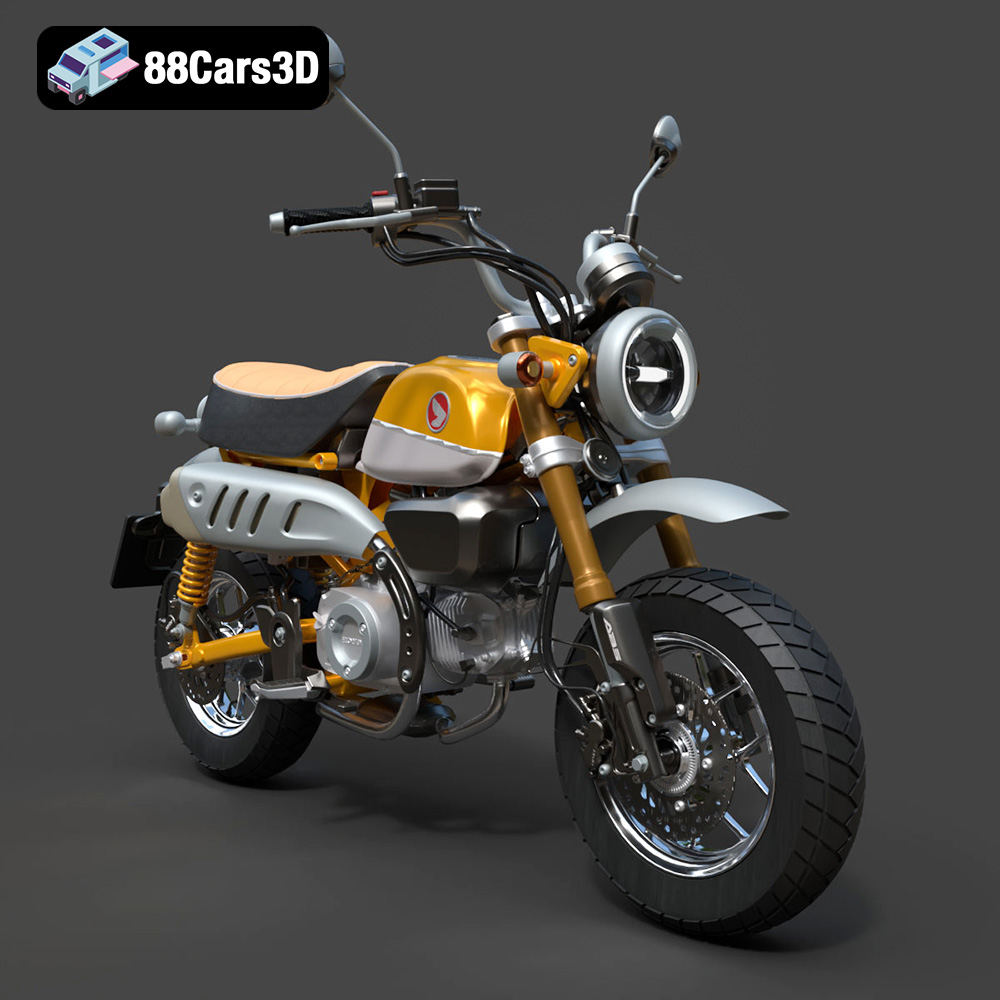
Today, we’re diving deep into the technical intricacies and creative possibilities offered by premium digital assets, exemplified by the superb Honda Monkey 125 2019 3D Model. This meticulously crafted asset is more than just a virtual representation; it’s a versatile tool designed to meet the rigorous demands of various industries. With its clean geometry, realistic materials, and optimized structure, it serves as an excellent case study for how a well-prepared 3D model can elevate any project, whether for professional rendering, immersive simulations, or responsive game development. Let’s explore the ecosystem of 3D modeling and how such assets empower creators.
The success of any 3D project often hinges on selecting the correct file format. Each format offers distinct advantages and is optimized for specific use cases, software compatibility, or performance requirements. When acquiring a versatile asset like the Honda Monkey 125 2019 3D Model, understanding the nuances of its included file formats is crucial for seamless integration into your pipeline.
The .blend format is native to Blender, a powerful open-source 3D creation suite. A .blend file like that included with the Honda Monkey 125 2019 3D Model typically contains not just the raw mesh data, but also the entire scene: materials, textures, lighting setups, cameras, animations, and even physics simulations. This makes it an ideal choice for users who operate primarily within the Blender ecosystem, offering full editability and the ability to dissect and modify every aspect of the model and its environment. It’s perfect for detailed customization, re-rigging, or leveraging Blender’s expansive toolset for rendering with Cycles or Eevee.
Autodesk’s .fbx (Filmbox) format has become an industry staple for data exchange between different 3D software and especially for real-time engines. It supports geometry, materials, textures, animations, and rigging. The .fbx version of the Honda Monkey 125 is game-engine ready, making it ideal for direct import into Unreal Engine, Unity, or other real-time pipelines. Its robust support for scene hierarchy and instancing ensures that complex models transfer efficiently and accurately, maintaining material assignments and UV mapping, which is critical for optimized game assets.
The .obj (Wavefront OBJ) format is one of the most widely supported and truly universal 3D model formats. While it doesn’t store animations or rigging, it excels at representing mesh geometry, UV coordinates, and material group assignments. Nearly every 3D application can import and export .obj files, making it an excellent fallback for cross-software compatibility. For the Honda Monkey 125 2019 3D Model, the .obj version provides a clean, raw mesh that can be easily loaded into any modeling or sculpting software for further detailing or retopology, proving its enduring utility in diverse workflows.
.glb (GL Transmission Format Binary) is an increasingly vital format, especially for modern applications like augmented reality (AR), virtual reality (VR), and web-based 3D viewers. It’s a self-contained, binary format that efficiently bundles 3D model data (geometry, materials, textures, animations) into a single file, optimizing load times and streamlining deployment. The .glb version of the Honda Monkey 125 2019 3D Model is specifically designed for these lightweight, interactive environments, ensuring smooth performance and high visual fidelity on mobile devices or in browser-based experiences.
The .stl (Stereolithography) format is the de facto standard for 3D printing. It represents a 3D model as a series of connected triangles, defining only the surface geometry without color, texture, or other attributes. For prototyping or physical production of the Honda Monkey 125, the .stl file is essential. It provides a watertight mesh suitable for direct slicing by 3D printing software, ensuring dimensional accuracy and manufacturability.
The .ply (Polygon File Format) is another widely used format for storing 3D data, particularly from 3D scanners or for scientific visualization. It supports a wider range of properties than .obj, including vertex color, normal vectors, and even properties like transparency or material definitions. For precise analysis or specialized rendering of the Honda Monkey 125, the .ply format offers a detailed polygon mesh that can be valuable for CAD integration or intricate visualization.
The inclusion of an .unreal file directly signifies an asset pre-configured for Unreal Engine. This isn’t a single file like .fbx, but rather an indication that the model comes with a set of optimized assets, materials, and potentially even blueprint setups ready for immediate use within an Unreal Engine project. For the Honda Monkey 125 2019 3D Model, this means reduced setup time and assurance that the materials, textures, and mesh are already tuned for Unreal’s physically-based rendering (PBR) pipeline, critical for developers aiming for visual fidelity and performance.
Similar to .blend for Blender, the .max format is the native file for Autodesk 3ds Max. This format offers complete editability within 3ds Max, allowing access to modifiers, animation data, complex material setups, and V-Ray or Corona specific scene configurations. For professionals deeply embedded in 3ds Max workflows for high-end automotive rendering or architectural visualization, the .max version of the Honda Monkey 125 2019 3D Model provides maximum flexibility for detailed scene composition, animation, and rendering.
Automotive rendering is a highly specialized field demanding precision, realism, and aesthetic flair. High-quality 3D car models are the bedrock of stunning visuals, allowing artists to create photorealistic images and animations that are often indistinguishable from actual photography.
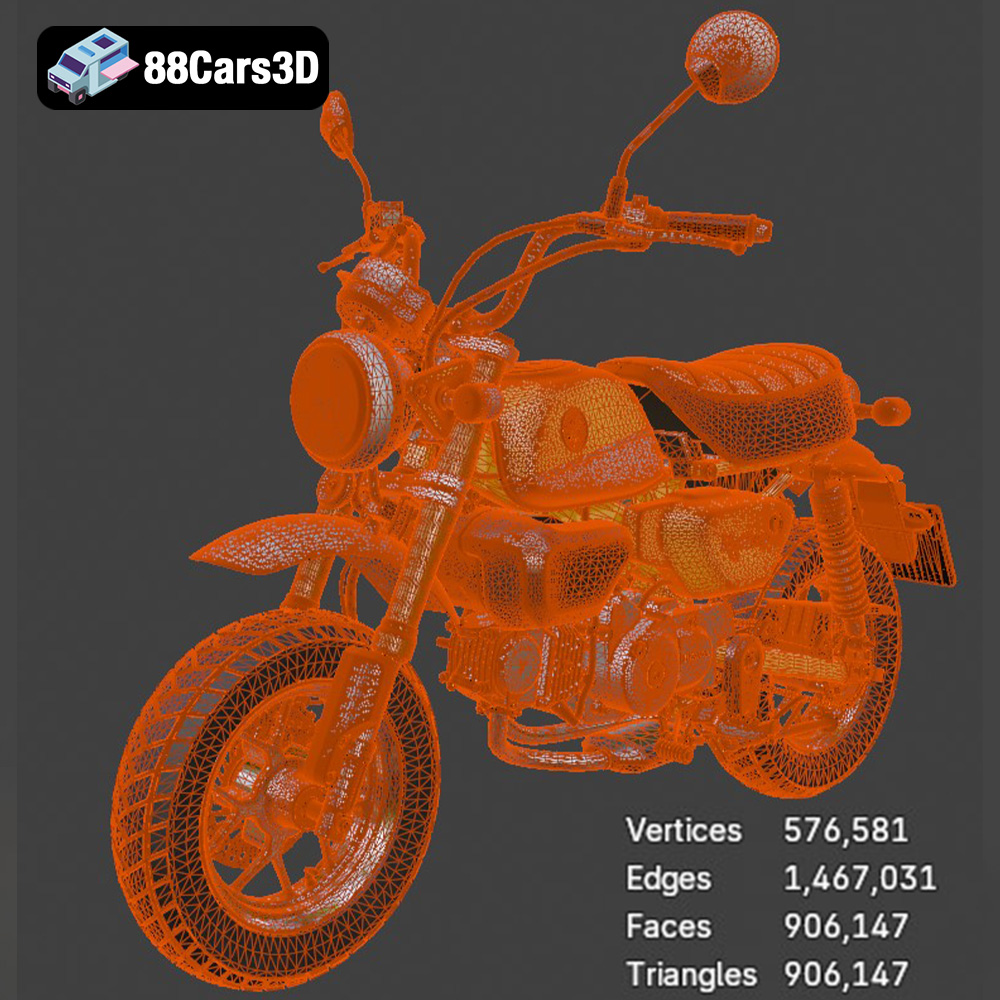
For static renders, every detail matters. The Honda Monkey 125 2019 3D Model, with its clean geometry and realistic materials, provides an excellent foundation. Artists can import the .max or .blend versions into their preferred rendering software (like 3ds Max with V-Ray or Blender with Cycles) and begin building complex scenes. This involves meticulous lighting setups—simulating studio environments, natural daylight, or even dramatic nocturnal scenes—and careful material adjustments to replicate paint sheen, tire texture, chrome reflections, and glass transparency. The optimized polygon count ensures that details are present without bogging down the renderer, allowing for crisp, high-resolution outputs.
Beyond static images, 3D car models are central to dynamic animations. Imagine the Honda Monkey 125 navigating a winding digital road or performing a detailed product showcase. The clean topology of such models is crucial for smooth deformations and reliable rigging, should intricate wheel rotations or suspension movements be required. Using the .max or .blend file allows for direct animation of components, while the .fbx can carry animation data for integration into other software. Professional studios rely on models from sources like 88cars3d.com to ensure their animated sequences feature vehicles that look and move with impeccable realism.
Modern automotive brands increasingly use interactive virtual showrooms and online configurators. These platforms allow potential buyers to explore vehicles from every angle, customize options, and even see them in various environments. A high-fidelity 3D model like the Honda Monkey 125 2019 3D Model is indispensable here. Its detailed components and realistic materials can be leveraged in real-time engines (using .fbx or .unreal files) to provide an engaging, immersive experience. Users can change paint colors, wheel designs, and accessories, with the 3D model updating instantly, offering a tangible sense of personalization.
Game development places a unique set of demands on 3D assets: they must be visually rich yet incredibly efficient. Balancing fidelity with performance is a constant challenge, and specialized 3D car models are designed with this in mind.
The “optimized polygon count” of the Honda Monkey 125 2019 3D Model is a key feature for game development. While high-poly models are great for cinematic renders, real-time engines require assets that can be rendered quickly across thousands of frames per second. Game artists often create multiple versions of a model at different levels of detail (LODs). A high-quality base model allows for efficient generation of these LODs, ensuring that the vehicle looks great up close and still performs well when viewed from a distance, without excessive triangles. The .fbx and .unreal formats are perfectly suited for this, allowing direct import and LOD setup within game engines.
UV mapping is the process of flattening a 3D model’s surface into a 2D space so a texture can be applied. “Clean geometry” often implies clean UVs, which are essential for seamless texture application without stretching or distortion. For game assets, efficient UV packing—maximizing the use of texture space—is also crucial. The realistic materials included with the Honda Monkey 125 are built upon robust UVs, allowing for the application of physically-based rendering (PBR) textures (Albedo, Normal, Roughness, Metallic, AO maps) that react realistically to light within a game engine. This attention to detail dramatically enhances the visual realism without compromising performance.
The inclusion of both .fbx and specifically .unreal files makes the Honda Monkey 125 2019 3D Model highly adaptable for the two leading game engines. In Unreal Engine, developers can import the .fbx, which automatically creates static meshes and basic materials. The dedicated .unreal asset, however, might come pre-configured with master materials, instances, and even specific collision meshes, significantly accelerating the integration process. Similarly, in Unity, the .fbx format imports seamlessly, allowing developers to set up materials, colliders, and attach scripts for vehicle physics. This streamlined workflow saves countless hours for game studios, enabling them to focus on gameplay and other core development tasks.
The utility of 3D models extends far beyond traditional screens, venturing into immersive realities and tangible prototypes.
Augmented Reality (AR) and Virtual Reality (VR) demand highly optimized, yet visually compelling 3D assets. Performance is paramount to avoid motion sickness and maintain immersion. The .glb format of the Honda Monkey 125 2019 3D Model is specifically tailored for these environments. Its compact, self-contained nature ensures quick loading times and efficient rendering on various devices, from high-end VR headsets to mobile AR applications. Imagine an AR app allowing users to place a virtual Honda Monkey 125 in their driveway, or a VR training simulation where technicians can interact with a digital twin of the bike for maintenance practice. The quality and optimization of the model are crucial for a believable and functional experience.
For designers, engineers, or hobbyists, the ability to 3D print a physical representation of a digital model is invaluable. The .stl format provided with the Honda Monkey 125 2019 3D Model is precisely for this purpose. It creates a watertight mesh, essential for successful 3D printing without errors. This allows for rapid prototyping of design concepts, creation of physical miniatures, or even functional parts for customized projects. The precision of the original digital model directly translates into the accuracy of the physical print, demonstrating the versatility of high-quality 3D assets in bridging the digital and physical worlds.
Professional pipelines often involve multiple software applications, each excelling at different tasks. High-quality 3D car models, especially those offering diverse file formats, facilitate a smooth transition between these stages.
For cinematic quality rendering and animation, 3ds Max remains a stalwart. Artists can import the .max file of the Honda Monkey 125 2019 3D Model, leveraging its editable structure to fine-tune polygon flow, apply advanced material shaders (e.g., V-Ray or Corona materials), and build intricate scene environments. The flexibility offered by a native .max file ensures that complex lighting scenarios, detailed reflections, and sophisticated camera animations can be crafted with ultimate control, yielding breathtaking results for advertising or product showcases.
Blender’s rise in popularity makes the .blend file format of the Honda Monkey 125 particularly valuable. Artists can open the scene, which often includes a pre-configured lighting and material setup, as described. This allows for immediate rendering or further customization. Blender’s powerful modeling tools, integrated sculpting, and Eevee real-time renderer make it an incredibly versatile platform for modifying the model, generating variations, or integrating it into complex open-source projects. For indie developers or smaller studios, Blender provides an accessible yet professional-grade environment.
Once the model is perfected for visual fidelity, it often transitions to a real-time engine like Unreal. Using the .fbx or .unreal files, developers can bring the Honda Monkey 125 2019 3D Model into a game level, a virtual production set, or an architectural visualization. Here, the focus shifts to optimizing assets for real-time performance, setting up complex material graphs using Unreal’s node-based editor, and implementing interactive elements. The engine-ready asset ensures that materials and UVs are correctly interpreted, allowing for the quick setup of physically based materials that react realistically to Unreal’s advanced lighting and reflection systems.
The market is flooded with 3D assets, but discerning quality is paramount. When investing in 3D car models, several factors should guide your decision.
A superior model, like the Honda Monkey 125 2019 3D Model available on 88cars3d.com, stands out due to its “exceptional detailing,” “accurate proportions,” and “meticulously structured” components. This isn’t just aesthetic; it impacts usability. Accurate scale ensures it fits realistically into scenes. High detail means it holds up to close-up shots. Clean geometry prevents rendering artifacts and facilitates easy modification. Always prioritize models that clearly demonstrate these attributes in their descriptions and preview images.
The breadth of included file formats is a strong indicator of a model’s versatility. A model offering .blend, .fbx, .obj, .glb, .stl, .ply, .unreal, and .max covers almost every conceivable professional workflow. This multi-format approach ensures that whether you’re working in game development, architectural visualization, AR/VR, or 3D printing, the asset will seamlessly integrate without requiring laborious conversion or cleanup. This saves significant time and resources, making the initial investment highly worthwhile.
Finally, consider the source. Reputable marketplaces like 88cars3d.com specialize in high-quality 3D car models created to “professional standards.” This often implies not just technical excellence but also proper licensing, clear documentation, and potentially even customer support. Investing in professional-grade assets guarantees reliability and helps you avoid common pitfalls associated with low-quality or poorly organized models.
The landscape of digital creation is constantly evolving, but the need for foundational, high-quality 3D assets remains constant. The Honda Monkey 125 2019 3D Model exemplifies what a truly versatile and professional asset should be: meticulously detailed, accurately proportioned, and delivered in a comprehensive suite of file formats tailored for every conceivable application. From stunning automotive rendering and engaging game development to cutting-edge AR/VR experiences and physical 3D prints, such a model provides the essential building blocks for creators across various industries.
By understanding the technical nuances of different file formats and appreciating the craftsmanship behind clean geometry and realistic materials, artists and developers can significantly enhance their workflows and elevate their final projects. Whether you’re a seasoned professional seeking to streamline your pipeline or an aspiring artist aiming for photorealism, investing in premium 3D car models like those found on 88cars3d.com is a strategic move towards achieving unparalleled visual fidelity and efficiency in your creative endeavors. Embrace the power of expertly crafted digital assets and transform your visions into stunning realities.
Experience superior realism with the Honda Monkey 125 2019 3D Model. This carefully crafted digital asset delivers exceptional detailing, capturing the iconic essence and unique design of the original vehicle. The model features clean geometry and realistic materials, ensuring a professional standard for any project. Every component is meticulously structured, offering accurate proportions and an optimized polygon count for seamless integration into complex scenes. Perfect for a wide range of applications, this versatile 3D model is ideal for game development, professional rendering, AR/VR experiences, and immersive visual simulations. Whether you are creating a dynamic cinematic sequence or an interactive showroom, this asset provides the reliability and visual fidelity required.
$19.99
.arvr
.blend
.car3dmodel
.fbx
.gameasset
.glb
.honda
.max
.minibike
.monkey125
.motorcycle
.obj
.ply
.rendering
.simulation
.stl
.unreal