Get 20% OFF All Premium 3D & STL Models!

The world of digital visualization is constantly accelerating, mirroring the rapid innovations seen in the automotive industry itself. From stunning marketing campaigns to immersive virtual experiences and cutting-edge game development, the demand for incredibly realistic and technically sound 3D car models has never been higher. Designers, engineers, and developers rely on assets that not only look authentic but are also built with precision and optimized for diverse professional pipelines.
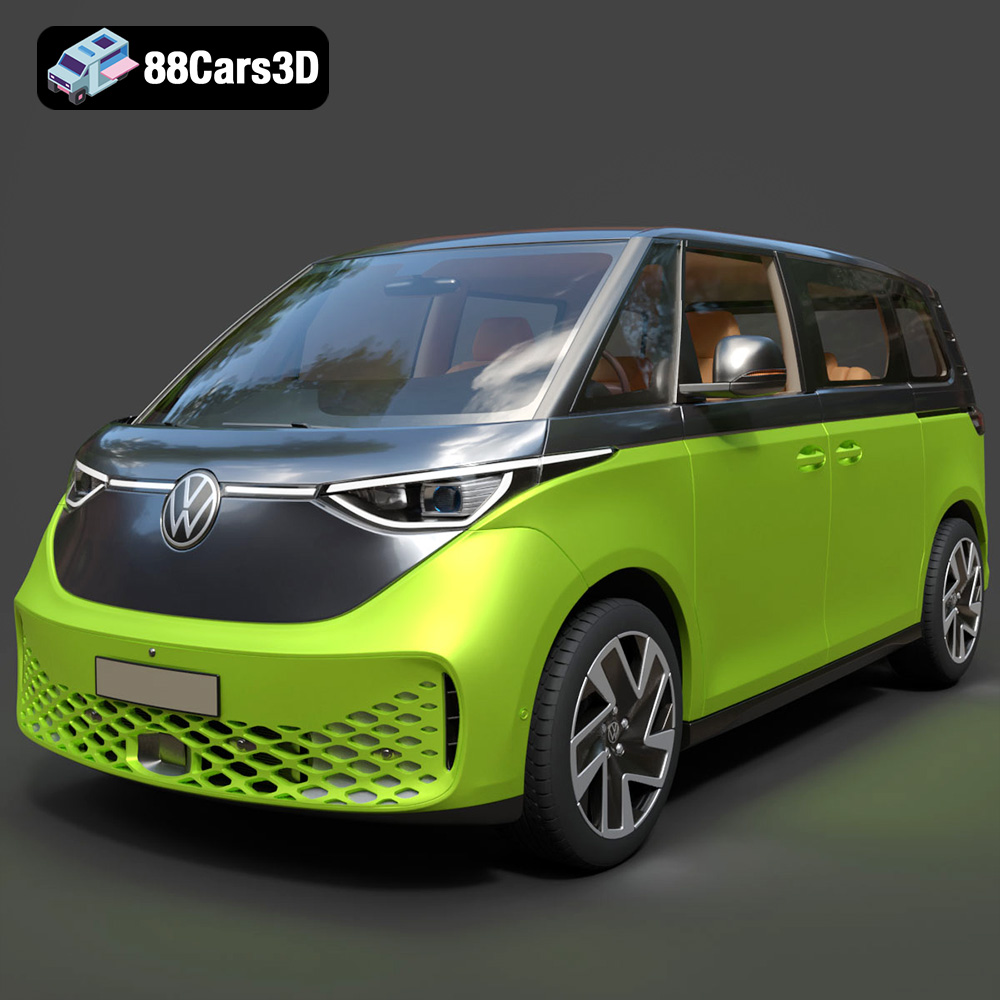
Amidst this evolution, certain vehicles capture the imagination and redefine categories. The Volkswagen ID. Buzz 2023 is one such icon – a modern electric van that blends retro charm with futuristic technology. Recreating such a distinctive vehicle in the digital realm requires an equally distinctive 3D model. This is where professional-grade assets, like the Volkswagen ID. Buzz 2023 3D Model available on 88cars3d.com, become indispensable. This article delves into the technical intricacies of utilizing high-quality 3D car models, exploring their impact across various industries and demonstrating how a meticulously crafted asset can elevate any project.
When working with professional 3D car models, understanding the various file formats is crucial. Each format serves specific purposes, offering different levels of editability, compatibility, and optimization for particular applications. The Volkswagen ID. Buzz 2023 3D Model, for instance, comes in a comprehensive suite of formats, ensuring its versatility across a wide spectrum of software and use cases.
The .blend format is Blender’s native file type. It’s much more than just a mesh; it’s a complete scene file. This means it can contain not only the geometry of the Volkswagen ID. Buzz but also its materials, textures, lighting setups, camera positions, animations, and even physics simulations. For artists and studios primarily operating within Blender, this format provides maximum flexibility. You can open the file and immediately begin tweaking shaders, adjusting lighting, or creating animations without extensive setup. Its fully editable nature makes it ideal for iterative design processes and detailed customization for automotive rendering projects.
As a proprietary format developed by Autodesk, .fbx has become a de facto standard for 3D asset interchange, especially critical for real-time applications like game development. When you acquire a .fbx file for the Volkswagen ID. Buzz 2023, you’re getting a robust package that can include geometry, materials, textures, animations, and even skeletal data. Its strength lies in its ability to transfer complex scene data between different 3D software packages (like 3ds Max, Maya, Blender) and, more importantly, into game engines such as Unreal Engine and Unity. For game assets, .fbx is often preferred because it handles animation curves and rigging data efficiently, making it simple to drop the ID. Buzz into a game environment and have it ready for movement.
The .obj (Wavefront OBJ) format is one of the oldest and most universally supported 3D formats. It primarily stores geometry (vertices, normals, texture coordinates) and references external material files (.mtl). While it doesn’t carry animation or rigging data, its simplicity is its strength. Almost every 3D software application can import and export .obj files. This makes the .obj version of the Volkswagen ID. Buzz 2023 3D Model a highly compatible choice for cross-software workflows, especially when you need to transfer just the base mesh and its UVs for further detailing, texturing, or sculpting in a different application.
.glb (GL Transmission Format Binary) is an increasingly vital format, especially with the rise of augmented reality (AR), virtual reality (VR), and web-based 3D experiences. It’s a compact, self-contained binary file that embeds models, textures, animations, and PBR (Physically Based Rendering) materials into a single file. This optimization makes it incredibly efficient for streaming and displaying 3D content directly in browsers or on mobile AR/VR devices. If your project involves showcasing the Volkswagen ID. Buzz 2023 in an interactive web configurator or an AR app, the .glb format offers superior performance and ease of integration.
The .stl (Stereolithography) format is the industry standard for 3D printing. Unlike other formats that describe surface geometry using polygons, .stl represents a 3D model as a series of connected triangles (tessellation) without any color, texture, or material information. This triangulated mesh defines the surface geometry necessary for slicing software to prepare the model for a 3D printer. The .stl version of the Volkswagen ID. Buzz 2023 allows for physical prototyping, creating scale models, or even fabricating custom parts, making it invaluable for product design and engineering visualization.
The .ply (Polygon File Format) is another popular format for storing 3D data, particularly useful for scanned data, CAD models, and scientific applications. It can store a variety of properties beyond just geometry, including color, transparency, and even normal vectors for each vertex or face. While not as universally supported as .obj, it’s favored in fields requiring precise mesh data for analysis or direct conversion into CAD systems. For detailed inspection or reverse engineering projects involving the Volkswagen ID. Buzz, the .ply format offers a robust representation of its complex surfaces.
The .unreal format signifies an asset specifically configured for Unreal Engine. This isn’t a standalone file format in the traditional sense but rather an indicator that the asset has been pre-packaged and optimized within Unreal Engine’s native structure. This often means materials are set up with appropriate shaders, textures are imported and assigned, LODs (Levels of Detail) might be configured, and collision meshes are potentially generated. Importing a .unreal version of the Volkswagen ID. Buzz 2023 means significantly less setup time within the engine, allowing developers to integrate the asset directly into their real-time environments for game development or architectural visualization with maximum efficiency.
Finally, the .max format is the native file type for Autodesk 3ds Max. Similar to .blend, it’s a complete scene file that can contain everything from geometry and materials to lighting, animation, and intricate rigging. 3ds Max is a powerhouse for high-fidelity rendering and complex animation, making the .max version of the Volkswagen ID. Buzz 2023 ideal for advanced automotive rendering, product visualization, and cinematic projects. Users can leverage 3ds Max’s extensive toolset to animate the vehicle, create dynamic simulations, or render breathtaking photorealistic images using renderers like V-Ray or Corona.
By offering the Volkswagen ID. Buzz 2023 3D Model in such a comprehensive array of formats, 88cars3d.com ensures that professionals can seamlessly integrate this high-quality asset into virtually any pipeline, from conceptual design to final deployment.
Achieving photorealism in 3D car models goes far beyond just getting the shape right. It’s a meticulous process involving intricate technical details that combine to create an utterly convincing digital twin. The Volkswagen ID. Buzz 2023 3D Model embodies these principles, built for demanding visual projects where accuracy is paramount.
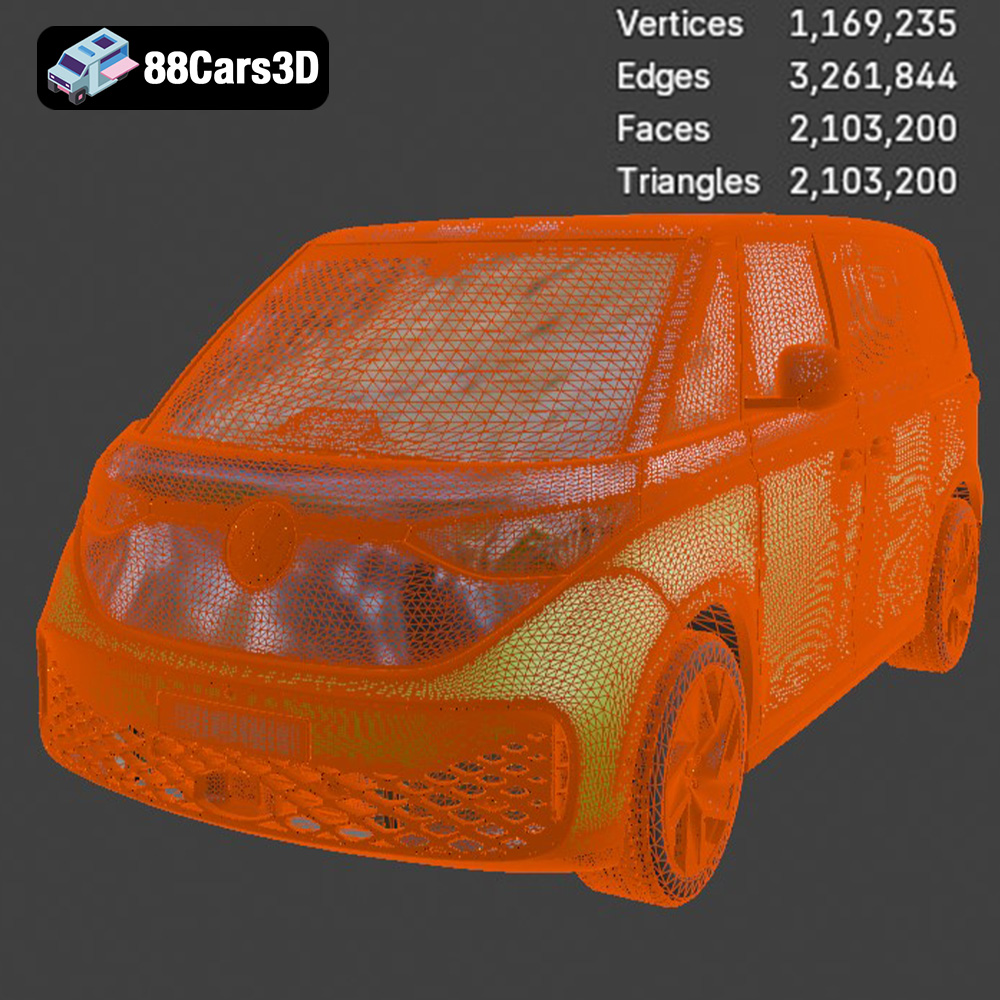
The foundation of any high-quality 3D model is its geometry and topology. Clean geometry, characterized by a well-structured mesh of quads (four-sided polygons), is essential for smooth deformations, accurate reflections, and efficient subdivision. The Volkswagen ID. Buzz model boasts an optimized mesh structure designed for precise surfacing. This means the curves of the bodywork, the subtle creases, and the sharp edges are all represented with fidelity. For rendering, a clean quad-based mesh allows for easy subdivision to achieve incredible smoothness without introducing artifacts. For game development, the poly count is carefully balanced; while high-poly versions are ideal for cinematic shots, optimized versions with good edge flow are crucial for real-time performance, allowing for the generation of efficient LODs (Levels of Detail).
Material definition and texturing are where a 3D model truly comes to life. The Volkswagen ID. Buzz 2023 3D Model incorporates realistic materials, often leveraging Physically Based Rendering (PBR) workflows. PBR shaders accurately simulate how light interacts with different surfaces in the real world, accounting for properties like albedo (base color), roughness, metallicness, normal maps (for fine surface details), and ambient occlusion. This ensures that the vehicle’s paintwork reflects light correctly, glass appears transparent and reflective, rubber textures have the right sheen, and chrome elements gleam authentically. Meticulously unwrapped UVs (coordinate systems that map 2D textures onto 3D surfaces) are critical for applying these high-resolution textures (e.g., 4K or 8K) without distortion, ensuring every decal, grille texture, and interior fabric looks sharp and convincing.
What sets professional 3D car models apart is their attention to detail. The Volkswagen ID. Buzz 2023 model isn’t just a shell; it features fully modeled exterior components, including detailed headlights, taillights, badges, grilles, wheels, and tire treads. Every panel gap and seam is accurately represented. Furthermore, it includes detailed interior elements – a crucial factor for immersive experiences and close-up shots. This means a carefully modeled dashboard, seats, steering wheel, door panels, and often intricate details like stitching and button layouts. Such comprehensive detailing is essential for simulations, virtual showrooms, and cinematics where viewers expect to explore the vehicle from every angle, inside and out, with uncompromising realism.
High-quality 3D car models are designed to be production-ready, meaning they can be seamlessly integrated into various professional workflows. The Volkswagen ID. Buzz 2023 3D Model offers this flexibility, serving as a robust asset for diverse creative and technical endeavors.
For cinematic visuals and advertising, offline rendering is king, and 3ds Max and Blender are industry staples.
The demand for realistic vehicles in video games and interactive simulations is immense. The Volkswagen ID. Buzz 2023 3D Model is game-engine ready, especially with its .fbx and .unreal formats.
Interactive experiences in AR/VR and on the web are transforming how we interact with products. The .glb format of the Volkswagen ID. Buzz 2023 is specifically optimized for these cutting-edge applications.
The versatility of a high-fidelity 3D car model like the Volkswagen ID. Buzz 2023 extends across numerous industries, offering powerful solutions for diverse challenges.
In the highly competitive automotive market, stunning visuals are paramount.
The entertainment industry frequently leverages 3D car models for diverse narrative purposes.
Precision and accuracy make 3D car models invaluable for simulation and training applications.
The journey from digital to physical is made possible by formats like .stl.
Even the highest quality 3D car model needs careful optimization to perform optimally across various platforms and applications. Professionals must consider several factors to ensure seamless integration and breathtaking results.
Levels of Detail (LODs) are critical for real-time applications like games and AR/VR. A single, high-resolution model is too demanding to render efficiently when viewed from a distance. LODs are progressively simpler versions of the same model, with fewer polygons and potentially lower-resolution textures. The engine automatically switches between these LODs based on the viewer’s distance from the object. A professionally built asset like the Volkswagen ID. Buzz 2023 3D Model often includes guidelines or pre-built LODs, allowing developers to maintain visual fidelity for close-ups while drastically improving performance for distant objects. This is key for creating large, complex scenes without bogging down the frame rate.
Efficient UV mapping is paramount. Clean, non-overlapping UVs are essential for applying textures accurately and without distortion. For game assets, maximizing texture space and minimizing the number of separate materials is also important. Texture atlasing, where multiple smaller textures are combined into a single, larger texture map, can significantly reduce draw calls in game engines, further boosting performance. A well-prepared 3D car model will have logical UV layouts, making it easier for artists to modify or create new liveries and decals with precision.
In large-scale projects, managing numerous 3D assets, especially detailed ones like the Volkswagen ID. Buzz 2023, requires robust strategies.
These practices ensure that the 3D car models remain manageable and scalable, even in the most ambitious undertakings.
The journey of a 3D car model from concept to a fully realized digital asset is a testament to technical skill and artistic vision. For professionals seeking to push the boundaries of automotive rendering, game development, AR/VR, or any visualization project, the quality of their 3D assets is non-negotiable. The Volkswagen ID. Buzz 2023 3D Model exemplifies what a truly professional asset should be: meticulously detailed, accurately recreated, and versatile across a spectrum of software and applications.
With its clean geometry, realistic materials, and availability in multiple industry-standard formats—from the fully editable .blend and .max files to game-engine ready .fbx and .unreal, and AR/VR optimized .glb—this model provides an unparalleled foundation for any demanding visual project. It allows creators to immerse audiences in photorealistic experiences, develop engaging game assets, or conduct precise simulations with confidence.
Investing in high-quality 3D car models saves invaluable time and resources while guaranteeing superior results. For those ready to elevate their projects with premium 3D assets, exploring the curated selection at 88cars3d.com is the next logical step. The Volkswagen ID. Buzz 2023 3D Model stands as a prime example of the exceptional detail and professional quality you can expect, empowering you to drive the future of digital visualization.
Discover exceptional detail with the Volkswagen ID. Buzz 2023 3D Model. This comprehensively built asset accurately recreates the unique design and modern characteristics of the celebrated electric van. It incorporates key features such as clean geometry, realistic materials, and professional quality, guaranteeing accurate representations in demanding visual projects. The optimized mesh structure offers precise surfacing and fully modeled exterior components alongside detailed interior elements. This asset is specifically tailored for advanced professional workflows where accuracy is essential. Ideal applications for this model encompass game development, offline rendering, AR/VR experiences, simulation environments, and commercial visualization.
$19.99
.arvr
.blend
.buzz
.car3dmodel
.electricvehicle
.ev
.fbx
.gameasset
.glb
.idbuzz
.max
.minivan
.obj
.ply
.rendering
.simulation
.stl
.unreal
.van
.volkswagen