Get 20% OFF All Premium 3D & STL Models!

In the dynamic world of digital content creation, the demand for high-fidelity, optimized 3D assets continues to surge across diverse industries. From crafting immersive video game experiences to producing photorealistic architectural visualizations and groundbreaking augmented reality applications, the quality of a 3D model can significantly impact a project’s success. At the heart of many such endeavors lies the meticulously crafted 3D vehicle model, a cornerstone asset that brings scenes to life with unparalleled realism and functional versatility.
Achieving this level of detail and optimization requires a profound understanding of 3D modeling principles, software pipelines, and industry-specific requirements. Whether you’re a seasoned game developer needing a vehicle ready for real-time environments, an architect populating a sprawling urban scene, or an automotive designer showcasing a new concept, the foundation is always a robust and accurate 3D model. It’s precisely this blend of aesthetic precision and technical readiness that defines premium assets, such as the Mercedes Benz A Class 3 Door 2010 3D Model, a versatile offering available at 88cars3d.com designed to meet the rigorous demands of today’s digital artists and engineers.
The role of 3D automotive models has transcended simple visual representation, becoming integral to almost every stage of a vehicle’s lifecycle and its digital presence. From initial concept validation to marketing campaigns and post-launch engagement, high-quality 3D car models are indispensable tools that drive innovation and foster deeper connections with audiences.
In the automotive industry, 3D models are fundamental. Designers leverage powerful software like 3ds Max or Blender to sculpt virtual prototypes, iterating on shapes, proportions, and features long before any physical material is cut. These digital models allow for rapid experimentation with aerodynamics, ergonomics, and aesthetics, simulating real-world conditions to refine every curve and panel. For external studios and artists, having access to accurate base models, like the Mercedes Benz A Class 3 Door 2010 3D Model, provides a solid starting point for custom projects, enabling focus on specific modifications or bespoke livery designs without the overhead of building a vehicle from scratch.
Beyond traditional automotive design, 3D car models are crucial for a myriad of other sectors. Game developers rely on optimized versions for racing titles, open-world adventures, and realistic simulators, where performance and visual fidelity must strike a delicate balance. Architectural visualization (ArchViz) firms use them to populate street scenes, driveways, and parking lots, adding a layer of realism and context to building designs. In the burgeoning fields of Augmented Reality (AR) and Virtual Reality (VR), immersive experiences are built upon detailed, real-world scale models, offering users interactive tours or virtual test drives. The versatility of an asset like the Mercedes Benz A Class 3 Door 2010 3D Model means it can seamlessly transition between these demanding environments, proving its value across the digital spectrum.
What truly sets a premium 3D car model apart is its authenticity and level of optimization. Authenticity ensures that every detail, from the iconic grille to the specific tire treads, accurately reflects the real-world vehicle. This is paramount for brand consistency and immersive experiences. Optimization, on the other hand, refers to the model’s technical efficiency—its polygon count, UV mapping, and material setup—which dictates how well it performs in real-time engines or renders without bogging down system resources. The Mercedes Benz A Class 3 Door 2010 3D Model, with its game-ready optimization and precise detailing, exemplifies how both criteria can be met simultaneously, offering a ~150,000 triangle count that achieves visual fidelity without sacrificing performance.
The ability to transfer and utilize 3D assets across different software platforms and pipelines is a cornerstone of modern digital production. This flexibility is largely facilitated by a variety of 3D model file formats, each with its strengths, intended use cases, and technical characteristics. Understanding these formats is crucial for any professional working with 3D content, ensuring compatibility and optimal performance for specific project requirements. The Mercedes Benz A Class 3 Door 2010 3D Model from 88cars3d.com comes in an extensive array of these formats, maximizing its utility for various applications.
The .blend format is native to Blender, the popular open-source 3D creation suite. A .blend file typically contains the entire scene data, including geometry, materials, textures, lighting, cameras, animations, and even physics simulations. This format is ideal for users working primarily within Blender, offering full editability and access to all the original scene settings. When you download a .blend file, you gain the complete project file, allowing for deep customization and seamless integration into a Blender-centric workflow. For artists using Blender for automotive rendering or game asset preparation, the .blend version of the Mercedes A-Class model provides an unhindered starting point for any modification.
The .fbx (Filmbox) format, owned by Autodesk, is one of the most widely supported and robust file formats for 3D data exchange, particularly prevalent in game development. It can store models, materials, textures, animations, and even rigging information. Its versatility makes it the go-to choice for transferring assets between different 3D software packages (like 3ds Max, Maya, Blender) and especially into real-time engines such as Unreal Engine and Unity. FBX files are highly optimized for game engines, making them excellent for models like the Mercedes Benz A Class 3 Door 2010 3D Model when performance and fidelity are paramount in a game environment.
The .obj (Wavefront OBJ) format is a simple, universal 3D data format that defines geometry (vertices, normals, texture coordinates, and faces) and can reference external material files (.mtl). While it doesn’t support animation or rigging directly, its widespread compatibility across virtually all 3D software makes it a reliable choice for mesh transfer. For basic model import and simple scene population, the .obj format of the Mercedes A-Class is a workhorse, ensuring maximum interoperability when other formats might pose compatibility issues.
The .glb (GL Transmission Format Binary) is a modern, compact, and efficient format designed for WebGL applications, AR, and VR. It’s a binary container for 3D scenes and models, encapsulating geometry, materials, textures, and animation into a single file. This self-contained nature and optimization for real-time web rendering make .glb perfect for interactive 3D viewers on websites, social media platforms, and mobile AR apps. Utilizing the .glb version of the Mercedes Benz A Class 3 Door 2010 3D Model allows for seamless deployment in cutting-edge immersive experiences and online configurators.
The .stl (Stereolithography) format is the standard for 3D printing. It represents a 3D model as a collection of unconnected triangular facets, defining only the surface geometry without color, texture, or other properties. While simplistic, its ubiquity ensures compatibility with virtually all 3D printers and slicing software. When preparing the Mercedes A-Class for physical prototyping or hobbyist 3D printing, the .stl file is the essential format, allowing enthusiasts to bring the digital model into the physical world.
The .ply (Polygon File Format) is another widely used format for storing 3D data, particularly scan data and models with complex mesh properties. It can store a wider range of information than .obj or .stl, including color, transparency, and even normal vectors for each vertex or face. While not as common for general asset exchange as .fbx, it’s favored in scientific, engineering, and CAD applications where precise mesh data is paramount. For detailed analysis or specialized manufacturing processes, the .ply version offers a robust representation.
The .unreal format, or rather, the direct import of assets structured for Unreal Engine, implies a highly optimized asset specifically prepared to leverage Unreal’s material system, LODs (Levels of Detail), and collision meshes. While not a standalone file extension in the same way as .fbx or .obj, “unreal” typically means the asset package includes materials, textures, and possibly blueprints configured for immediate drag-and-drop use within the Unreal Editor. This saves significant setup time, making the Mercedes A-Class model an instant addition to any Unreal project.
The .max format is the native file type for Autodesk 3ds Max, a leading software for 3D modeling, animation, and rendering, particularly strong in architectural visualization and high-end cinematic production. Like .blend, a .max file contains the complete scene, including complex hierarchies, modifiers, materials, lighting, and animation data. For professionals using 3ds Max, the .max version of the Mercedes Benz A Class 3 Door 2010 3D Model provides maximum flexibility for detailed rendering, intricate animations, and seamless integration into existing 3ds Max projects.
The Mercedes Benz A Class 3 Door 2010 3D Model is a testament to the meticulous attention to detail and technical expertise required for premium 3D car models. It’s not just a collection of polygons; it’s a digital recreation engineered for diverse professional applications, embodying the distinct characteristics of the compact luxury hatchback.
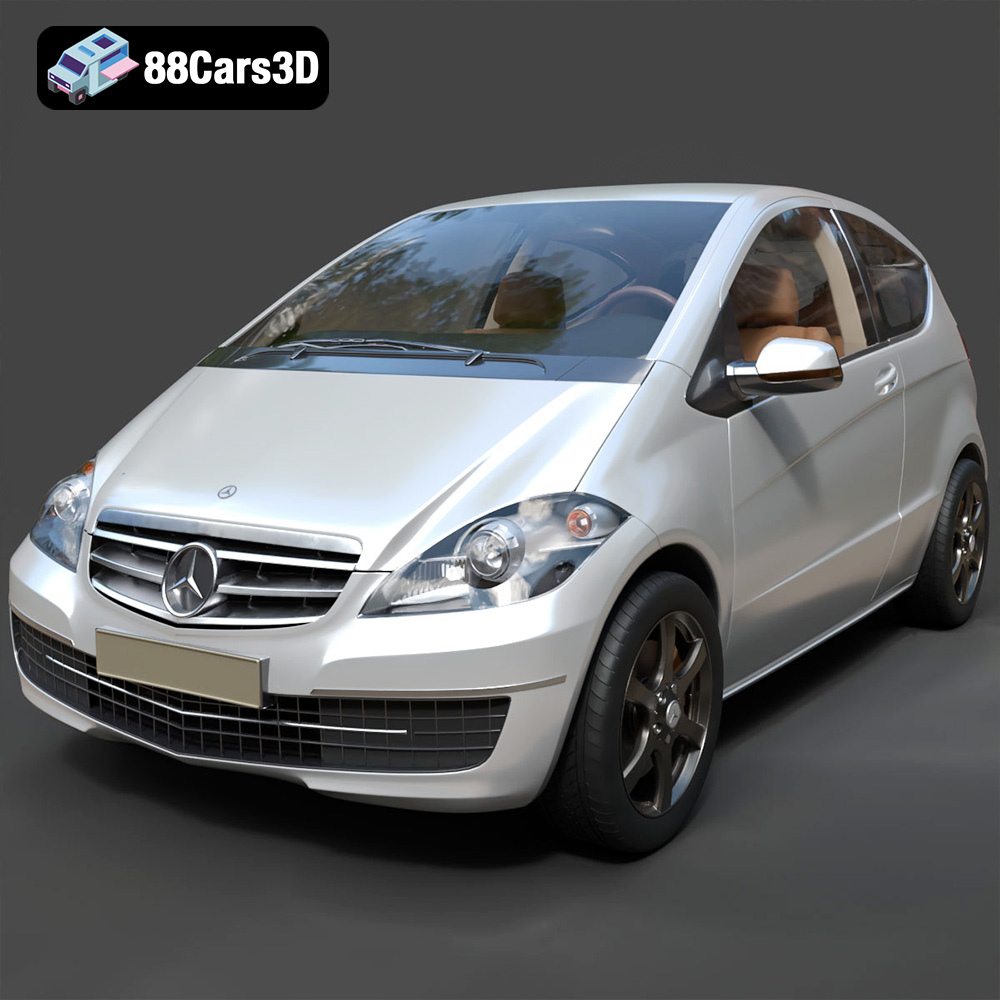
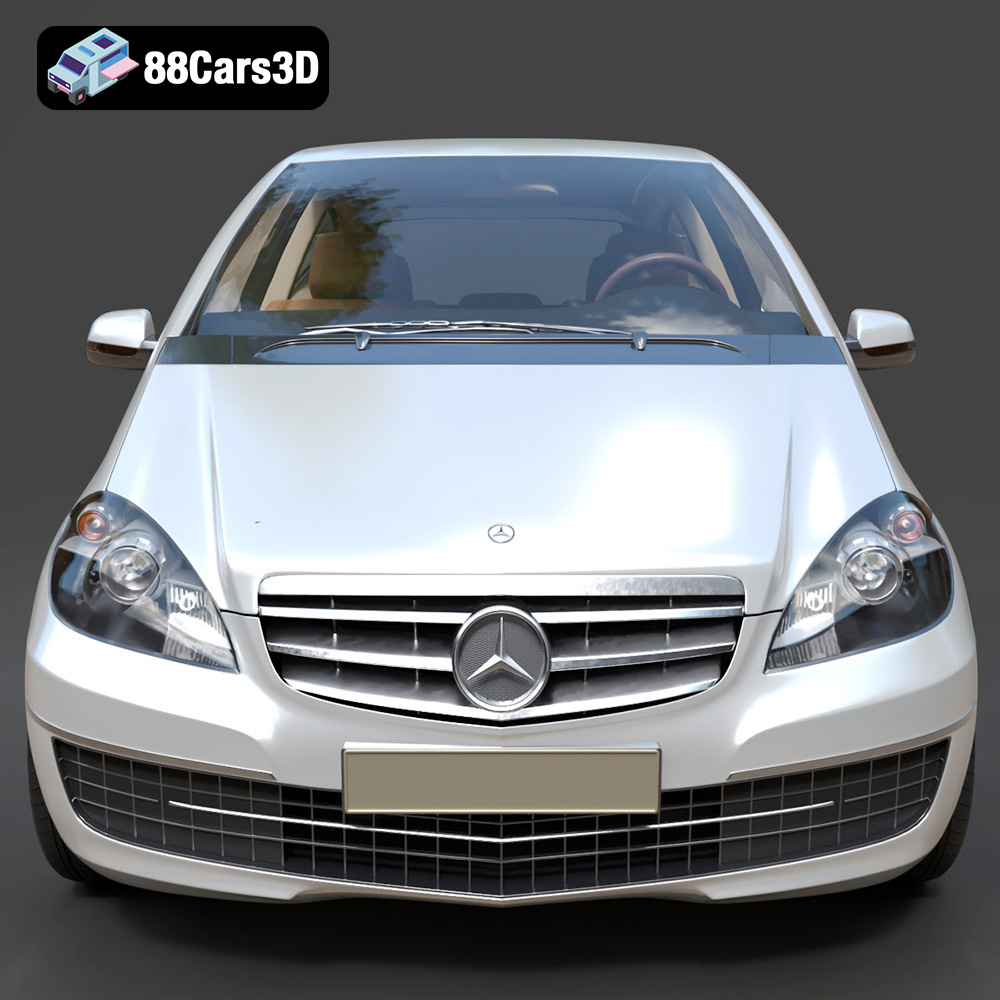
The model accurately reproduces the Mercedes-Benz A-Class W169’s defining features. The wedge-shaped silhouette, a hallmark of the 2010 A-Class, is perfectly preserved, giving it a sporty and dynamic stance. From the prominent front grille adorned with the iconic three-pointed star to the swept-back headlights and distinct taillight clusters, every element of the exterior has been carefully sculpted. The factory-spec alloy wheel design and realistic tire treads further enhance its visual authenticity, making it suitable for close-up renders and simulations where precision matters.
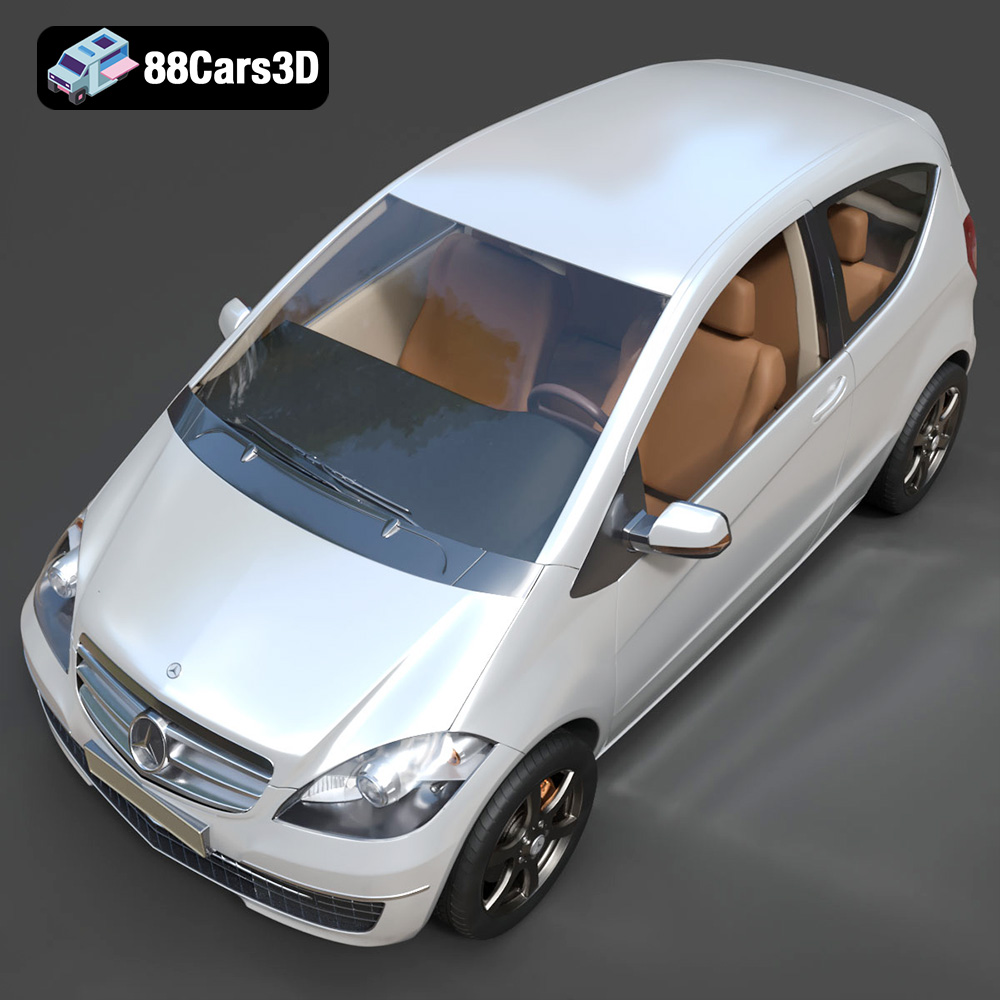
Beyond its striking exterior, the model boasts a thoughtfully detailed interior. The cockpit features an authentic Mercedes-Benz compact luxury seating arrangement, a detailed steering wheel with integrated emblem and controls, and an accurate dashboard layout with instrument cluster details. The center console, shifter, pedals, and climate controls are all modeled, providing a comprehensive environment for first-person POV in gaming or detailed interior shots for visualizations. Crucially, this detail is delivered with game-ready optimization, meaning the interior geometry is efficient without sacrificing the immersive quality required for modern interactive experiences.
One of the most significant advantages of this 3D car model is its technical foundation. With approximately 150,000 triangles, it achieves a perfect balance between high-end visual realism for rendering and efficient performance for real-time engines like Unreal and Unity. This optimized polycount ensures smooth framerates in games and quick loading times in AR/VR applications. Furthermore, the model is built to real-world scale accuracy, based on the actual vehicle chassis, which is essential for realistic physics simulations, accurate spatial relationships in architectural scenes, and precise 3D printing. Proper UV mapping, though not explicitly detailed in polycount, is implicitly present in any “game-ready” asset, ensuring textures are applied without distortion and maximizing texture resolution across the model’s surfaces. The pivot setup for steering, wheel rotation, and suspension travel is also correctly configured, simplifying animation and dynamic interactions within game engines.
The true value of a premium 3D model, such as the Mercedes Benz A Class 3 Door 2010, lies in its seamless integration into diverse professional workflows. Its multi-format availability and optimized structure ensure it serves as a versatile asset across various industries and software pipelines.
For game developers, the Mercedes A-Class model is a ready-to-use asset, perfectly suited for open-world games, racing simulators, and urban environments. The inclusion of .fbx and “unreal” (presumably Unreal Engine-ready asset package) formats simplifies the import process into engines like Unreal and Unity. Its ~150,000 triangle count is an ideal sweet spot, providing sufficient detail for modern gaming graphics while remaining performant for real-time rendering. Developers can quickly implement collision meshes, set up Levels of Detail (LODs) for distant views, and integrate the model into a vehicle physics system, leveraging its proper pivot setup for realistic steering, wheel rotation, and suspension travel. This optimization saves countless hours of asset preparation, allowing teams to focus on gameplay and environment design.
When it comes to high-end automotive rendering, accuracy and flexibility are paramount. The .max and .blend files provide artists with fully editable scene files, allowing for complete control over materials, lighting, and animation. In 3ds Max, artists can easily assign V-Ray or Corona materials, set up studio lighting environments, and render photorealistic images or animations for marketing campaigns. Similarly, Blender users can leverage Cycles or Eevee for stunning visualizations. The model’s separate components—wheels, doors, and steering—are crucial here, enabling complex animations like door openings, wheel turns, and suspension articulation, bringing static scenes to life with dynamic motion. Whether it’s for an interactive configurator or a cinematic commercial, the Mercedes Benz A Class 3 Door 2010 3D Model offers the fidelity and control required.
The burgeoning fields of AR and VR demand highly optimized yet visually rich models. The .glb format included with the Mercedes A-Class model is specifically tailored for these applications, offering a lightweight, self-contained asset ideal for immersive virtual showrooms, configurators, or mobile AR experiences. Its efficiency ensures smooth performance on a variety of devices, from high-end VR headsets to smartphones. Web developers can embed the .glb model directly into websites, allowing users to interact with a 3D car model in their browser, spinning it around, changing colors, and exploring details without needing powerful client-side hardware or complex plugins. This makes the Mercedes Benz A Class 3 Door 2010 3D Model a forward-thinking asset for engaging digital presentations.
The utility of high-quality 3D car models extends beyond digital realms into tangible physical objects through 3D printing. This capability opens new avenues for prototyping, display models, and hobbyist projects, bringing digital designs to life.
For 3D printing, the .stl format is the industry standard. The Mercedes Benz A Class 3 Door 2010 3D Model is provided in .stl, making it immediately compatible with almost any 3D printer and slicing software. While FDM (Fused Deposition Modeling) printers are common for larger, functional prints, the detailed nature of car models often benefits immensely from resin (SLA/DLP) printing. Resin printers, with their finer resolution, can capture the intricate details of the A-Class’s grille, headlights, and interior components with exceptional accuracy. Recommended scales like 1:12, 1:18, or 1:24 allow for various display possibilities, from collector’s pieces to RC car bodies.
While .stl is primarily for hobbyist and general 3D printing, the .ply format also plays a role in more industrial applications, particularly for models derived from 3D scanning or for those requiring precise mesh analysis. In a manufacturing context, these formats can be used for rapid prototyping of specific vehicle components or for creating scale models for wind tunnel testing or ergonomic studies. The ability to export the Mercedes A-Class model into these formats showcases its adaptability for both artistic and engineering-driven physical creations.
Achieving a truly realistic physical replica requires more than just a good print; it demands meticulous post-processing. For the Mercedes Benz A Class 3 Door 2010 3D Model, this would involve careful sanding to eliminate layer lines, applying primer to create a smooth surface, and then painting with authentic factory colors, often incorporating metallic finishes to mimic the vehicle’s original paintwork. For detailed parts like exhaust systems, mirrors, and steering components, supports are typically required during printing and then carefully removed and finished. The separated nature of the wheels and body frame allows for different print orientations to optimize structural integrity and detail, further emphasizing the model’s suitability for high-quality physical output.
A truly professional 3D car model offers more than just aesthetic accuracy; it provides a canvas for boundless customization. The Mercedes Benz A Class 3 Door 2010 3D Model is engineered with this versatility in mind, allowing artists and developers to adapt it to an endless array of project requirements.
The ability to easily modify material finishes is critical for achieving specific visual styles. With the Mercedes A-Class model, users can effortlessly change body colors, applying anything from authentic factory colors to custom metallic, matte, or gloss finishes. This is invaluable for brand campaigns requiring specific color palettes or for creating distinct variations of the vehicle in a game. Beyond paint, tire textures can be swapped between street and winter variants, or even custom tread patterns, to suit different environments or performance scenarios. This level of material control empowers artists to push creative boundaries without having to remodel core geometry.
The inclusion of separate, properly pivoted components like wheels, doors, and steering is a massive advantage for animators. This structure enables the creation of dynamic scenes, from a car driving down a virtual street with turning wheels and active suspension, to a detailed shot of a door opening in a virtual showroom. For cinematic renders or interactive experiences, these animation capabilities are essential for bringing the Mercedes Benz A Class 3 Door 2010 3D Model to life. Imagine a configurator where users can open doors, turn the steering wheel, and even see the suspension react to terrain changes, all thanks to the model’s intelligent setup.
The model’s optimized geometry and real-world scale provide a robust foundation for a wide range of modifications. Artists might want to add custom spoilers, body kits, or different lighting configurations for a tuner-style render. Game developers could easily integrate damage models or unique visual effects, knowing the underlying topology is clean and efficient. Even for AR/VR applications, this structure allows for custom interactive elements, such as hotspots that reveal technical specifications when tapped. The versatility of this 3D car model from 88cars3d.com ensures it can be adapted far beyond its initial purpose, becoming a powerful tool in any creative arsenal.
The pursuit of excellence in 3D content creation hinges on access to high-quality, versatile, and technically optimized assets. As we’ve explored, a premium 3D car model is far more than just a static visual; it’s a dynamic foundation that underpins immersive experiences in gaming, drives realism in architectural visualization, and pushes the boundaries of design in AR/VR and 3D printing. The Mercedes Benz A Class 3 Door 2010 3D Model stands as a prime example of such an asset, expertly crafted to meet the diverse and demanding requirements of modern digital production workflows.
From its accurate exterior and detailed, game-ready interior to its optimized ~150,000 triangle count and comprehensive array of file formats—including .blend, .fbx, .obj, .glb, .stl, .ply, .unreal, and .max—this model offers unparalleled flexibility. It empowers game developers with performant real-time assets, enables artists to create stunning automotive renderings, and provides a robust starting point for physical prototypes. Its inherent customizability, allowing for easy material changes, animation of components, and adaptation for specific project needs, makes it an invaluable addition to any professional’s toolkit.
For those seeking to elevate their projects with meticulously detailed and production-ready 3D car models, the Mercedes Benz A Class 3 Door 2010 3D Model is an exceptional choice. Discover this and a wide range of other premium game assets and visualization models by visiting 88cars3d.com, where quality and versatility drive digital innovation.
The Mercedes-Benz A-Class 3-Door (2010) represents a defining era of compact luxury, blending urban practicality with premium German engineering. This 3D model captures the distinctive wedge-shaped silhouette, prominent front grille with the iconic three-pointed star, and the sleek 3-door configuration that gives it a sportier edge over its 5-door sibling.
Expertly crafted with game-ready optimization, this model features a highly efficient topology while maintaining exceptional visual fidelity. With an optimized triangle count, it perfectly bridges the gap between high-end architectural visualization and real-time performance, making it an ideal asset for game development, AR/VR experiences, and high-quality animations.
Perfect for urban driving simulations, virtual showrooms, architectural traffic populations, and lifestyle renders.
.blend, .fbx, .obj, .glb, .stl, .ply, .unreal, .max
Tags:
mercedes-benz, a-class, 3-door, 2010, hatchback, compact-car, game-ready, low-poly, optimized, car-3d-model, game-asset, rendering, vr-ar, blend, fbx, obj, glb, stl, ply, unreal, maxBMW 328 Mille Miglia Touring Coupe 3D Model 3D Printable STL
$19.99
.2010
.blend
.fbx
.glb
.hatchback
.max
.obj
.ply
.rendering
.stl
.unreal
3-door
a-class
car-3d-model
compact-car
game asset
game-ready
low-poly
mercedes-benz
optimized
VR/AR