Get 20% OFF All Premium 3D & STL Models!

Few vehicles embody timeless elegance, freedom, and a distinct cultural spirit quite like the Vespa. Among its storied lineage, the Vespa GS 150 (Gran Sport) stands as an icon, celebrated for its groundbreaking design, exhilarating performance for its era, and undeniable Italian charm. It was more than just a scooter; it was a statement, a symbol of post-war resurgence and dolce vita.
Today, this legendary machine continues to inspire, not just on the road, but within the boundless canvas of 3D artistry. For designers, game developers, visualization specialists, and AR/VR creators, the ability to accurately and efficiently integrate such a revered classic into their projects is invaluable. This is precisely where a meticulously crafted 3D model, like the Vespa GS 150 3D Model available on 88cars3d.com, becomes an indispensable asset. It’s not just a digital representation; it’s a carefully engineered tool designed to meet the rigorous demands of professional 3D pipelines, bringing the spirit of the Gran Sport to life in stunning detail and versatility.
When working with 3D assets, particularly intricate ones like a detailed vehicle model, understanding the various file formats is paramount. Each format serves a specific purpose, offering different levels of compatibility, data retention, and optimization for distinct workflows. The Vespa GS 150 3D Model from 88cars3d.com comes equipped with a comprehensive suite of formats, ensuring maximum flexibility for any project requirement.
The .blend file is Blender’s native format, renowned for its ability to store an entire scene, including geometry, materials, textures, lighting, cameras, animation data, and even custom scripts. For artists deeply integrated into the Blender ecosystem, this format offers the most flexibility. You can access the full modifier stack, adjust shader nodes, refine UV maps, and manipulate the original rigging or animation setup. It’s perfect for those who want to dive deep into the model’s construction, make extensive modifications, or render directly within Blender’s Cycles or Eevee engines with full fidelity.
Autodesk’s .fbx (Filmbox) format is arguably the most widely adopted interchange format in the 3D industry. It excels at transferring 3D model data, including meshes, materials, textures, animations, and even skeletal deformation, between different software packages. For real-time applications like Unreal Engine and Unity, .fbx is the gold standard for importing game-ready assets. Its robustness and support for complex data make it ideal for pipelines where assets need to move seamlessly from a modeling application to an engine, retaining pivot information and animation data essential for interactive experiences. The Vespa GS 150’s game-ready optimization shines particularly well when imported via .fbx.
The .obj (Wavefront OBJ) format is a universal standard for 3D geometry. While it doesn’t support animation or advanced material properties as robustly as .fbx, it’s incredibly reliable for transferring pure polygonal mesh data and basic UV mapping across virtually any 3D software. If you need to import the Vespa GS 150 into an older application, or simply require the raw geometry for custom texturing or re-topology, .obj is an excellent choice due to its broad compatibility and straightforward structure. It’s often accompanied by an .mtl file for basic material definitions.
.glb (GL Transmission Format Binary) is an increasingly popular format, especially for web-based 3D, augmented reality (AR), and virtual reality (VR) applications. It’s a binary version of .gltf, designed to be a single-file asset that includes model data, textures, and animations. This self-contained nature makes it highly efficient for streaming and display in browsers or mobile AR apps, minimizing load times and simplifying asset management. For presenting the Vespa GS 150 in an interactive web viewer or an immersive AR experience, .glb offers unparalleled optimization and ease of deployment.
The .stl (Stereolithography) format is the cornerstone of 3D printing. It represents a 3D model as a series of connected triangles, defining only the surface geometry without color, texture, or material information. While simplistic, its universal acceptance by 3D printers and slicing software makes it indispensable for physical fabrication. The Vespa GS 150 3D Model, when converted to .stl, becomes a tangible object, allowing hobbyists and professionals to create physical replicas for display or prototyping. The provided print settings further enhance its utility in this domain.
The .ply (Polygon File Format) is another widely supported format for storing 3D data, particularly known for its ability to represent points, polygons, and often color information per vertex or face. It’s frequently used in applications involving 3D scanning, scientific visualization, and CAD/CAM, where precise geometric and attribute data is crucial. For specialized analysis or detailed reverse engineering of the Vespa GS 150’s geometry, the .ply format provides a robust and comprehensive data set.
While not a standalone file format in the traditional sense like .fbx, the inclusion of .unreal in the listed formats signifies an asset that is specifically packaged or pre-configured for direct use within the Unreal Engine. This often implies that the model has been imported as an .fbx and then had materials set up, collision meshes generated, and potentially Blueprints or animation sequences configured within an Unreal project. This distinction ensures that developers can drop the Vespa GS 150 directly into their Unreal projects with minimal setup, saving significant time and effort in material configuration and optimization, allowing for immediate integration into real-time environments.
The .max file is Autodesk 3ds Max’s native project format, similar to .blend for Blender. It contains the complete scene data, including all geometry, materials (often V-Ray or Corona Renderer specific), lighting, cameras, animation, and scene setup. For users of 3ds Max, this format provides the highest level of detail and editability, allowing full access to the original scene hierarchy, modifiers, and rendering settings. It’s the ideal choice for high-end automotive rendering, detailed architectural visualizations, or incorporating the Vespa GS 150 into complex animated sequences within a professional studio environment.
Creating a compelling 3D model, especially of an iconic vehicle like the Vespa GS 150, requires a delicate balance between artistic fidelity and technical precision. This model embodies both, offering a digital twin that captures the very soul of the classic scooter while being engineered for peak performance across various platforms.
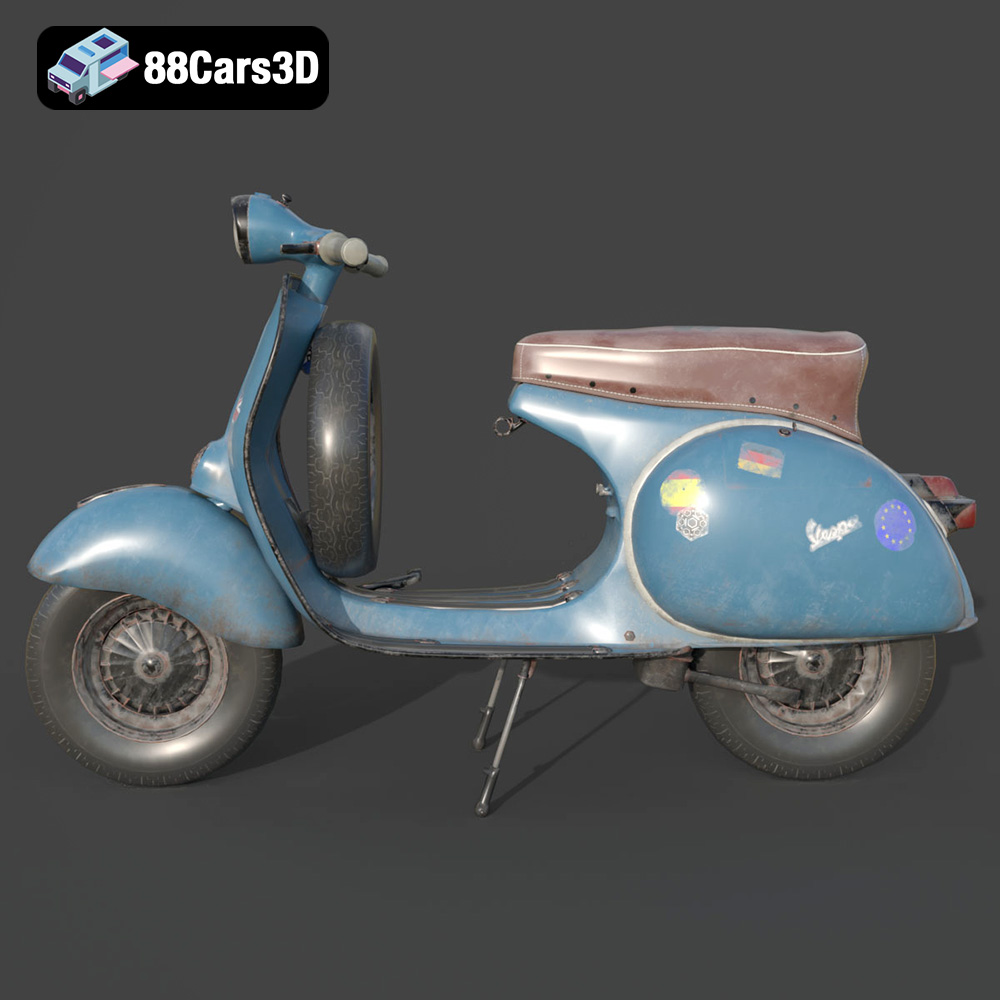
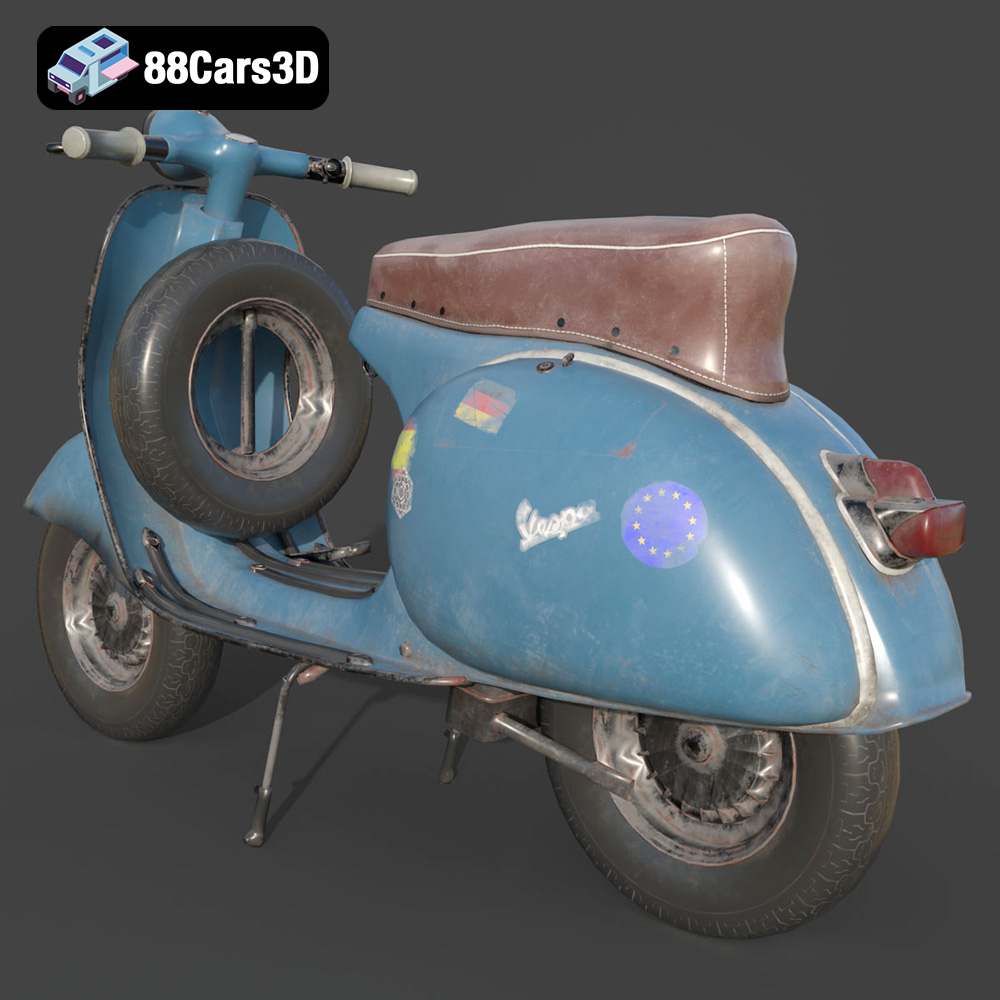
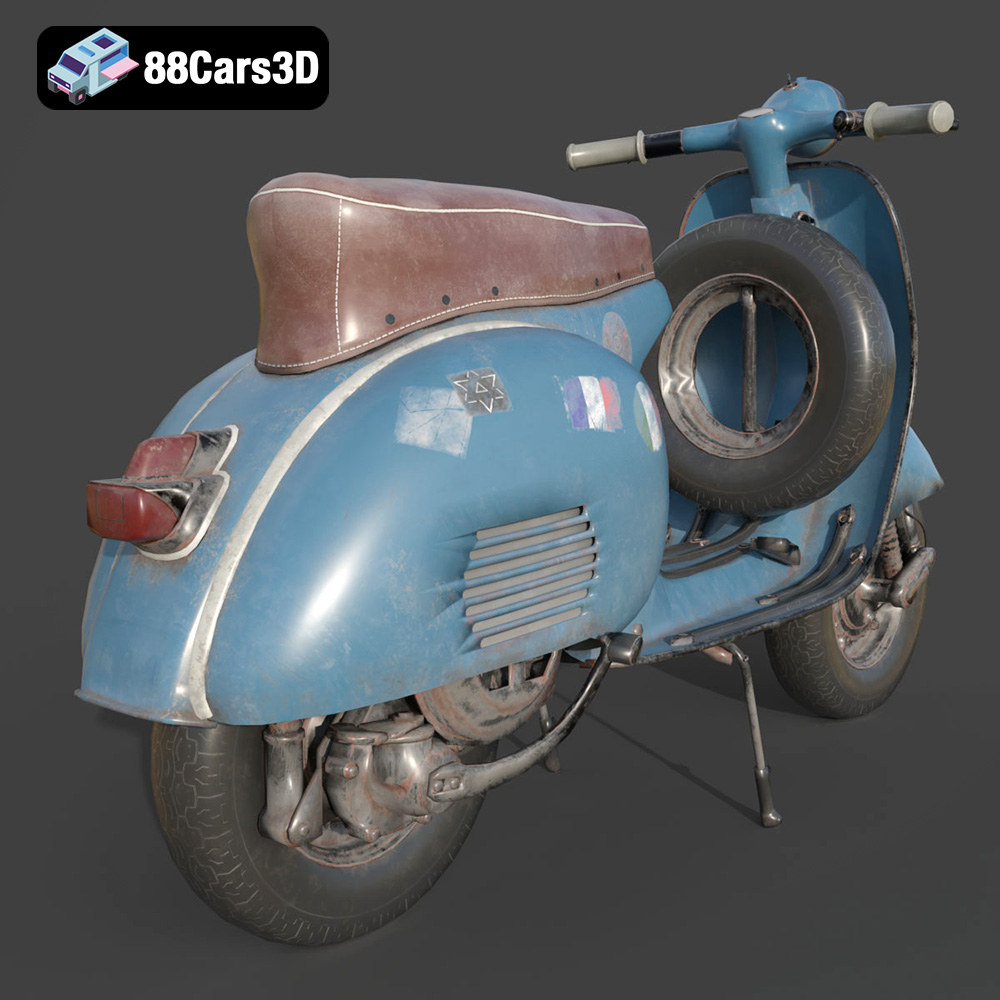
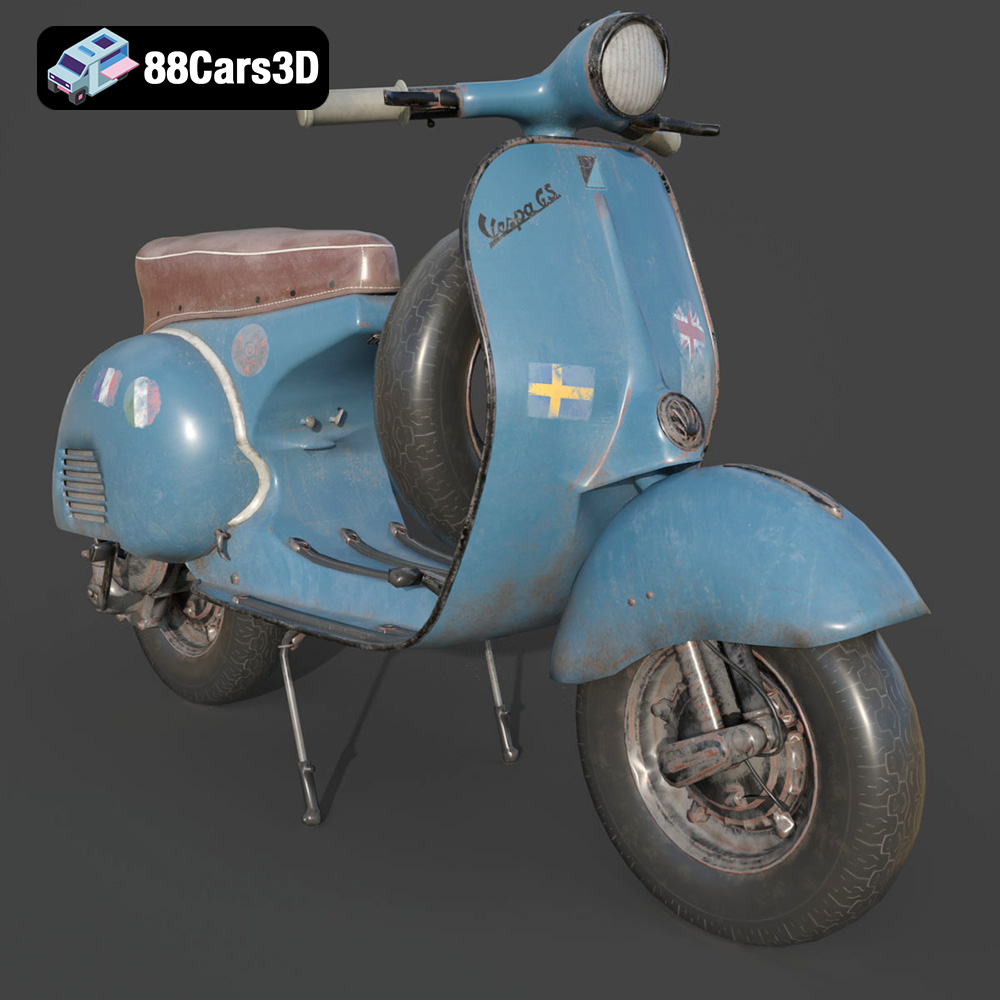
The intrinsic beauty of the Vespa GS 150 lies in its elegant aerodynamic curves, its distinctive unibody frame, and its instantly recognizable profile. This 3D model has been meticulously crafted to reproduce these characteristics with exacting accuracy. From the signature swept-back leg shield to the rounded side panels that house the 150cc two-stroke engine, every detail reflects the historical significance and unparalleled Italian styling of the original. The classic round headlamp, sleek teardrop taillight, and authentic 10-inch wheels with period-correct tread patterns contribute to an overall aesthetic that is genuinely faithful to the source material. It’s a digital ode to a design masterpiece.
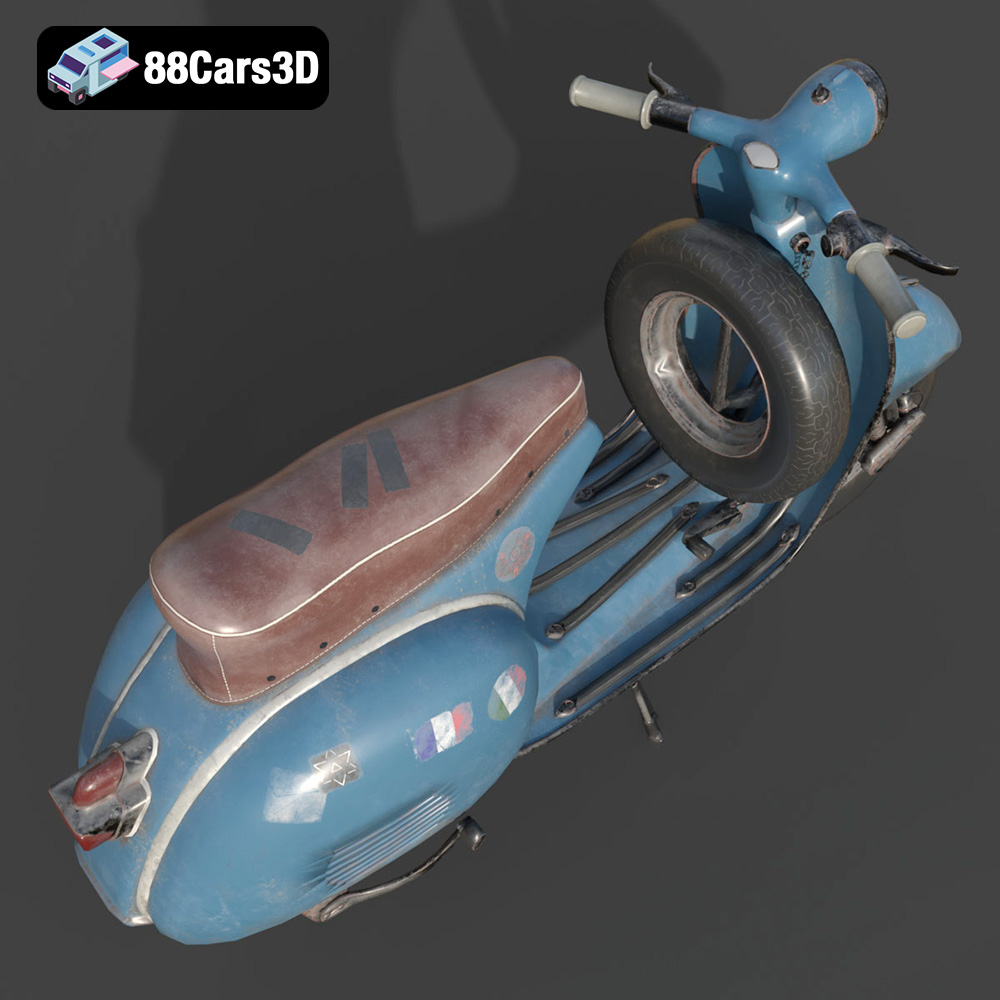
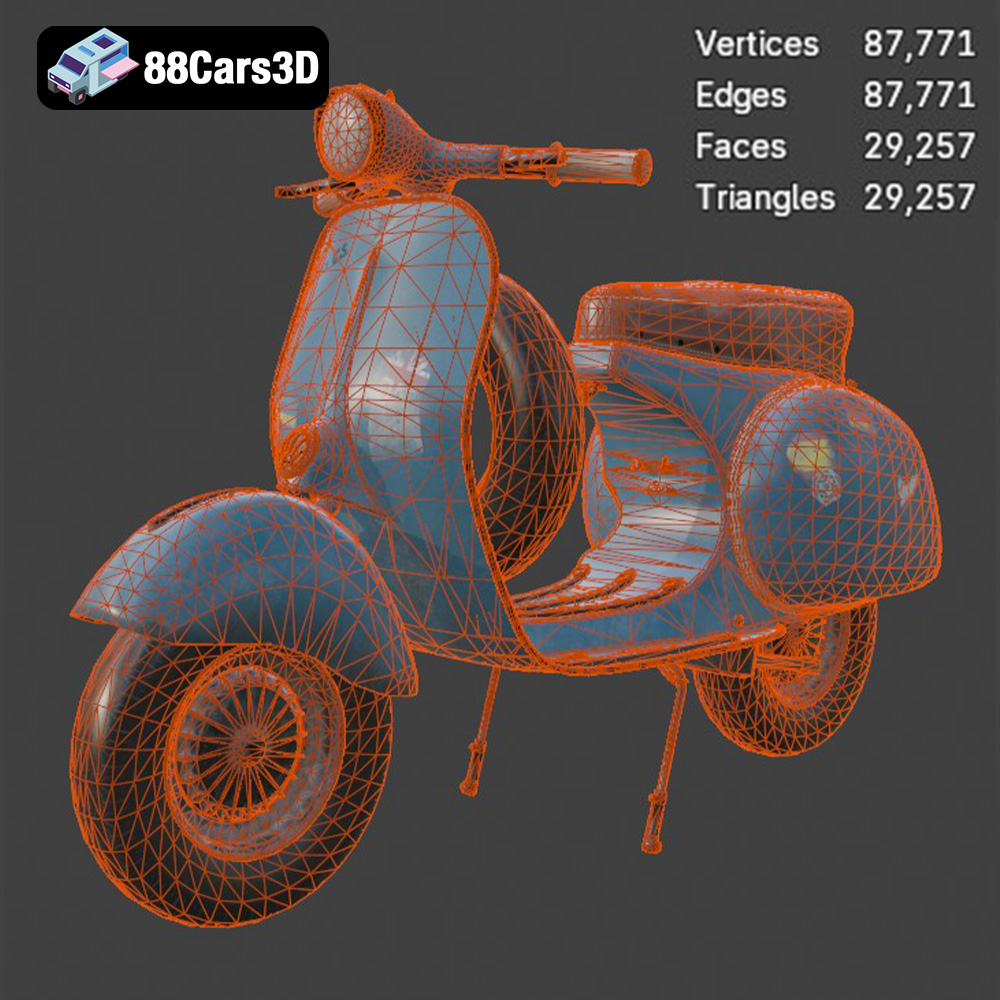
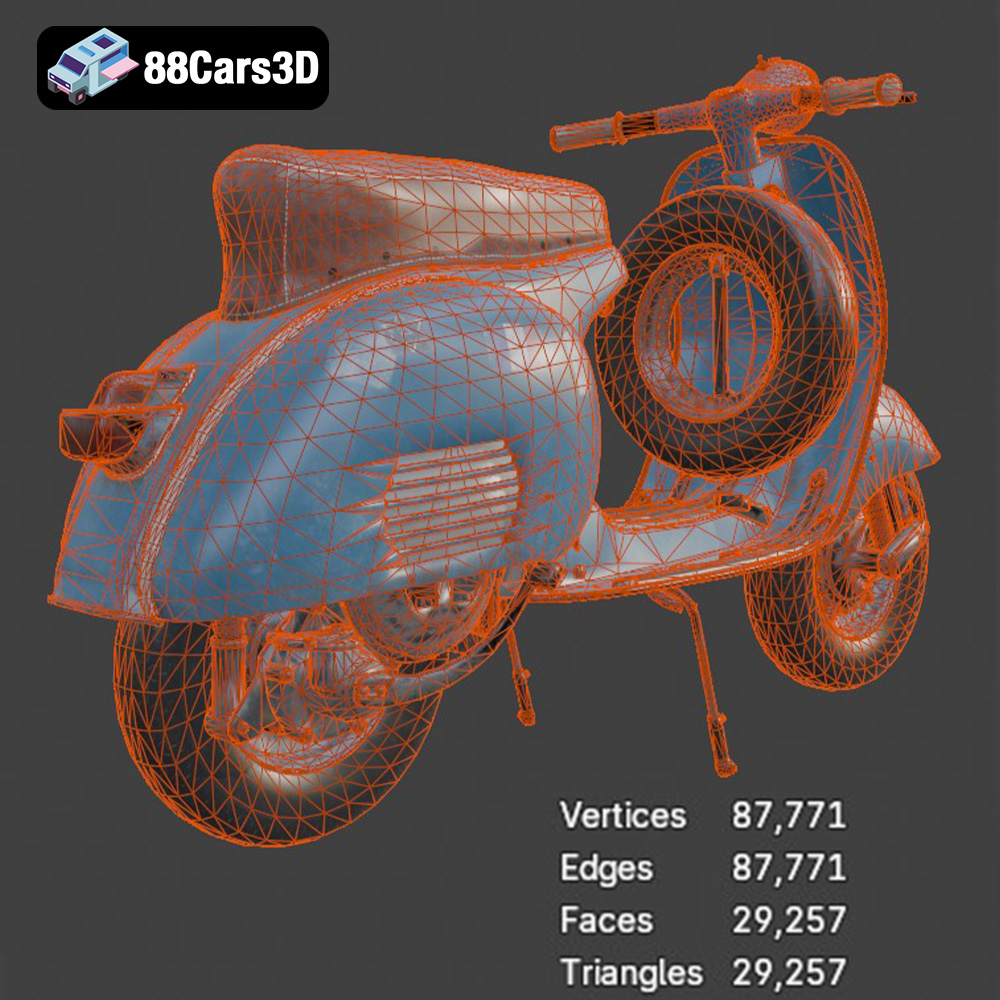
Beyond its visual appeal, the Vespa GS 150 3D Model is built with robust technical specifications that cater to demanding professional workflows. Featuring an optimized topology with approximately 200,000 triangles, it strikes a perfect balance between high visual fidelity and game-ready performance. This polycount ensures that the model looks exceptional in close-up renders while remaining efficient enough for real-time engines like Unreal and Unity. Furthermore, the model adheres to real-world scale accuracy, based on the actual vehicle chassis, ensuring seamless integration into scenes where dimensional consistency is critical. Components like the wheels, suspension, and steering are separated and boast proper pivot setups, enabling realistic animation for dynamic scenes or interactive simulations. The attention to detail extends to the engine block, featuring the 150cc 2-stroke casing and cooling fins, and the classic sweeping exhaust system with authentic muffler details. Even the cockpit, with its dual saddle or long bench seat, detailed tubular handlebars, Piaggio-style instrument cluster, and accurate hand grips, is optimized for potential first-person views in gaming applications, demonstrating a comprehensive approach to model construction.
The true value of a versatile 3D asset lies in its seamless integration into diverse production pipelines. The Vespa GS 150 3D Model is designed with cross-platform compatibility in mind, making it an ideal choice whether you’re working in 3ds Max, Blender, or a real-time engine like Unreal.
For architectural visualization, automotive rendering, or high-fidelity promotional imagery, 3ds Max and Blender are often the tools of choice. With the included .max and .blend files, users gain full access to the model’s native project files. In 3ds Max, artists can leverage advanced renderers like V-Ray or Corona to produce photorealistic images. This involves setting up studio lighting, refining PBR (Physically Based Rendering) materials for metallic finishes and reflections, and potentially incorporating the model into a larger scene, perhaps a classic European streetscape. The separated components and proper pivot points make it easy to animate the Vespa GS 150 for turntable renders or dynamic sequences. Similarly, Blender users can take advantage of the .blend file for immediate rendering in Cycles or Eevee, experimenting with different lighting scenarios and material adjustments directly within the powerful open-source environment. The optimized geometry ensures quick render times without sacrificing detail, perfect for creating stunning marketing visuals or detailed portfolio pieces.
Game developers and AR/VR creators demand assets that are not only visually impressive but also performant and easy to implement in real-time environments. The Vespa GS 150 3D Model excels here. The .fbx format is perfect for importing into Unreal Engine or Unity. Developers can import the model, ensure correct scale, and apply or create PBR materials using the engine’s native shader systems. For Unreal, the inclusion of an .unreal optimized asset implies pre-configured setups, potentially including collision meshes, material instances, and even basic blueprint interactions, significantly accelerating development. The ~200,000 triangle count is a sweet spot, providing enough detail for modern game engines while maintaining excellent frame rates. The separate wheels and suspension components allow for realistic vehicle physics and animation, essential for racing games or interactive simulators. This means less time spent optimizing and more time focused on gameplay mechanics or immersive experiences.
The versatility of the Vespa GS 150 3D Model extends far beyond static renders, opening doors to a multitude of interactive and tangible applications across various industries.
In the realm of game development, authenticity and performance are key. The Vespa GS 150, with its optimized polycount and real-world scale, is a dream asset for developers. It’s ideally suited for open-world games where players might cruise through meticulously detailed urban environments, or for racing titles that demand accurate vehicle dynamics. Imagine a historic racing game featuring classic scooters, or an adventure game where the Vespa is a trusty mode of transport through a European setting. The separate, animatable components mean that developers can easily integrate realistic steering, wheel rotation, and suspension travel, enhancing the immersion. The “game-ready” designation isn’t just a label; it signifies an asset engineered for efficient resource management within a dynamic, real-time context, making it a powerful addition to any game developer’s arsenal.
Augmented Reality (AR) and Virtual Reality (VR) are transforming how we interact with digital content. The Vespa GS 150 3D Model is perfectly poised for these emerging technologies. For virtual showrooms, the model can be integrated into an interactive experience, allowing users to inspect every detail of the classic scooter from any angle, customize its color, or even place it realistically in their own living room via AR. The .glb format is particularly beneficial here, offering a highly optimized, single-file solution for web-based AR/VR experiences and mobile applications. Imagine an educational VR experience where users can virtually “ride” the GS 150 through historical Rome, or an AR configurator for custom scooter designs. The high visual fidelity combined with performance optimization ensures a smooth, believable, and truly immersive experience.
For hobbyists, collectors, and prototyping professionals, the ability to physically manifest a digital model is a significant advantage. The Vespa GS 150 3D Model is convertible to the .stl format, making it ready for 3D printing. This allows for the creation of display-scale replicas at recommended scales like 1:12, 1:18, or 1:24. The detailed 3D print settings provided – including layer height, wall thickness, infill, and support recommendations – guide users through the process of achieving high-quality physical prints. Resin printing is specifically recommended for capturing the fine details, such as the cooling fins on the engine or the delicate handlebars. Post-processing, including sanding, priming, and painting with authentic factory colors, can further elevate these prints into museum-quality models, blurring the line between digital creation and physical craftsmanship.
A truly professional 3D asset provides not only visual excellence but also the flexibility for artists and developers to adapt it to specific project needs without compromising performance. The Vespa GS 150 3D Model exemplifies this philosophy.
The model’s approximately 200,000 triangles represent a carefully chosen optimization target. For high-end cinematic rendering, this polycount allows for impressive detail, capturing the subtle curves and intricate components of the Vespa without being excessively heavy on rendering resources. In real-time applications, this figure strikes a critical balance: it’s sufficiently detailed for close-up shots and hero assets in modern games or AR/VR experiences, yet it remains performant enough to be included in larger scenes or populate open-world environments without causing significant frame rate drops. This judicious polygon budgeting means that the asset is truly “game-ready” while still being visually rich, reducing the need for extensive re-topology or baking processes.
Furthermore, an optimized model like this implies clean UV mapping, essential for applying high-resolution textures effectively. Proper UVs ensure that textures appear crisp and undistorted, contributing to the overall realism of the PBR materials. The real-world scale accuracy and proper pivot setups for animated parts are also critical optimizations, ensuring that the model behaves predictably and integrates seamlessly with physics engines or rigging systems.
The inherent design of the Vespa GS 150 3D Model offers extensive customization options, empowering artists to tailor it to their unique creative vision. The most straightforward customization is altering the body and tank colors. Whether it’s replicating the original factory hues, applying custom metallic finishes, or experimenting with contemporary palettes, changing colors is simple. This allows the model to fit into diverse scenes, from nostalgic period pieces to modern, stylized advertisements. Additionally, modifying tire textures can adapt the scooter for different environments – from smooth street variants to more rugged off-road styles for adventurous scenarios. Artists can also adjust material finishes, switching between matte, gloss, or various metallic sheens to achieve desired levels of realism or artistic expression. Finally, adapting the lighting for different environments is crucial for integrating the Vespa into any scene. Whether bathed in the warm glow of a sunset or illuminated by harsh studio lights, the model’s well-defined materials react realistically, allowing for dynamic storytelling and captivating visuals. This level of adaptability ensures the Vespa GS 150 is a living, breathing asset in any creative pipeline.
The versatility and quality of a 3D asset are best demonstrated through its application in various professional contexts. The Vespa GS 150 3D Model from 88cars3d.com is designed to make a significant impact across multiple industries.
Consider a luxury clothing brand launching a new collection inspired by vintage Italian style. Instead of an expensive real-world photoshoot with a physical Vespa GS 150, they could utilize the 3D model. A creative agency could render the scooter in a picturesque digital environment – perhaps a sun-drenched piazza in Rome – with a virtual model interacting with it. The ability to precisely control lighting, camera angles, and even the “weather” in a digital scene far surpasses the limitations of physical production. This approach saves significant budget, time, and logistical overhead while allowing for unparalleled creative control and a flawlessly stylized final image or animation. The model’s accurate proportions and rich details would ensure brand integrity and a sophisticated aesthetic.
A prominent game studio is developing an open-world historical game set in post-war Europe. To truly immerse players, they need period-accurate vehicles that perform well within the game engine. Integrating the Vespa GS 150 3D Model, with its optimized polycount and separate animatable components, provides an instant solution. Developers can rig the wheels for realistic movement, integrate collision meshes, and apply era-specific wear and tear textures. Players could then discover or ride this iconic scooter through historically recreated streets, adding a layer of authenticity and nostalgic charm to the gameplay experience. The “game-ready” nature of the asset significantly reduces development time, allowing the team to focus on narrative and core mechanics rather than extensive asset creation.
A specialized museum or a vintage vehicle dealership wants to create an interactive experience that allows visitors to explore the history and design of the Vespa GS 150. Using the .glb version of the 3D model, they could develop an AR application for tablets or a VR experience. Visitors could “walk around” the virtual scooter, open compartments, and view exploded diagrams of its engine, all in real-time and with high visual fidelity. This interactive showcase offers a level of engagement impossible with a static display. For the dealership, it could even allow potential customers to customize the Vespa’s color and see it “parked” in their driveway via AR before making a purchase, enhancing the sales experience dramatically.
The Vespa GS 150 remains a timeless symbol of design and cultural impact, and its legacy is now brilliantly preserved and extended into the digital realm through this exceptional 3D model. From its meticulously recreated aesthetics to its robust technical underpinnings, the Vespa GS 150 3D Model is a testament to quality and versatility. It caters to the diverse needs of modern 3D artists, game developers, AR/VR creators, and visualization specialists, offering a plug-and-play solution that saves invaluable time and resources while delivering stunning results.
Whether your project demands photorealistic renders, seamless integration into a real-time game engine, or the tangible output of a 3D print, this model is equipped to exceed expectations. Its support for a comprehensive range of file formats – including .blend, .fbx, .obj, .glb, .stl, .ply, .unreal, and .max – ensures unparalleled compatibility across industry-standard software. By choosing a high-quality asset like this, available from 88cars3d.com, you’re not just acquiring a 3D model; you’re investing in efficiency, authenticity, and the creative freedom to bring your most ambitious visions to life with the iconic spirit of the Vespa GS 150.
The Vespa GS 150 (Gran Sport) is widely regarded as one of the most beautiful and iconic scooters ever produced. Known for its elegant aerodynamic curves, historical significance as the first mass-market sports Vespa, and unparalleled Italian styling, this classic masterpiece defined a generation. It features the signature swept-back leg shield, rounded side panels, and the distinctive 150cc two-stroke engine layout.
This high-quality 3D model features a well-optimized topology (~200,000 triangles), ensuring exceptional visual fidelity while maintaining game-ready performance. The model is meticulously crafted to capture the essence of the classic scooter, making it a perfect asset for close-up renders, real-time engines, and detailed environment populating.
Perfect for classic European street scenes, retro lifestyle visualizations, virtual showrooms, and historic racing games.
.blend, .fbx, .obj, .glb, .stl, .ply, .unreal, .max
Tags:
vespa, gs-150, scooter, classic-scooter, retro-scooter, game-ready, low-poly, optimized, scooter-3d-model, motorcycle-3d-model, game-asset, rendering, vr-ar, blend, fbx, obj, glb, stl, ply, unreal, maxVespa VNB 125-B 3D Model 3D Printable STL
$19.99
.blend
.fbx
.glb
.max
.obj
.ply
.rendering
.scooter
.stl
.unreal
.vespa
classic-scooter
game asset
game-ready
gs-150
low-poly
motorcycle-3d-model
optimized
retro-scooter
scooter-3d-model
VR/AR