Get 20% OFF All Premium 3D & STL Models!

The world of 3D modeling for automotive design is a fascinating convergence of art, engineering, and digital wizardry. From sleek hypercars destined for cinematic renders to rugged off-road vehicles ready for the next-generation game engine, the demand for high-quality 3D car models is constantly escalating. Professionals across game development, architectural visualization, virtual reality, and even 3D printing rely on meticulously crafted assets to bring their visions to life. It’s not just about creating a visually appealing model; it’s about understanding its underlying structure, its optimal performance across different platforms, and its versatility in myriad applications.
Among the countless vehicles that have graced history, some stand out not just for their design, but for their sheer iconic status and engineering ingenuity. The Volkswagen Schwimmwagen Typ 166 is precisely one such legend. An amphibious off-road vehicle from World War II, it’s celebrated for its rugged durability, distinctive boat-like hull, and groundbreaking capabilities. Imagine integrating such a historically significant and uniquely engineered vehicle into your next project. This is where a high-fidelity 3D model, like the Volkswagen Schwimmwagen Typ 166 available at 88cars3d.com, becomes an invaluable asset, ready to navigate both virtual battlefields and serene digital waterways.
Before diving deep into the specifics of a particular 3D model, it’s crucial to grasp the fundamental language of 3D assets: file formats. Each format serves a unique purpose, optimized for specific workflows, software compatibility, or end-use applications. Understanding these distinctions is paramount for any professional working with 3D car models or game assets, ensuring smooth integration and optimal performance. The Volkswagen Schwimmwagen Typ 166 3D model, like many professional assets, comes with a comprehensive suite of these formats, empowering creators with maximum flexibility.
The .blend format is Blender’s native file type. When you download a .blend file, you’re not just getting the mesh; you’re receiving a complete Blender scene. This includes the model’s geometry, materials (with all their nodes and textures properly linked), lighting setups, camera positions, animation data, and even physics simulations. For artists primarily working within Blender, this is often the preferred format, offering full editability and preserving all native Blender-specific features. It allows for advanced customization, tweaking materials, or making topology adjustments without losing any data.
.fbx (Filmbox) is arguably the most widely adopted interchange format in the 3D industry. Developed by Autodesk, it’s an excellent choice for transferring 3D data between different software applications like Maya, 3ds Max, Blender, and crucially, game engines like Unreal Engine and Unity. FBX files support geometry, materials, textures, animations, skinning, and blend shapes. Its robust support for animation data makes it ideal for game-ready assets that require movement, such as the Schwimmwagen’s animated wheels or propeller. When importing into Unreal, FBX is the go-to for a reliable, engine-ready asset pipeline.
The .obj (Wavefront Object) format is one of the oldest and most universally compatible 3D formats. It primarily stores geometric data – vertices, faces, UV coordinates, and normals – making it excellent for plain mesh transfer. While it’s less sophisticated than FBX in terms of animation or scene data, its simplicity ensures it can be opened by virtually any 3D software. Materials and textures are typically referenced via a separate .mtl (material template library) file. For foundational geometry exchange or situations where complex scene data isn’t needed, OBJ remains a reliable choice.
.glb (GL Transmission Format Binary) is the binary version of glTF, a royalty-free specification for the efficient transmission and loading of 3D scenes and models by applications. It’s rapidly becoming the standard for 3D content on the web, AR (Augmented Reality), and VR (Virtual Reality) platforms. A single .glb file packages everything – geometry, materials, textures, and animations – into one self-contained, compact file. This optimization makes it perfect for interactive web viewers, mobile AR experiences, or quick previews, ensuring fast loading times and broad compatibility across browsers and devices.
.stl (Stereolithography) is the de facto standard file format for 3D printing. It represents a 3D model as a series of connected triangles, describing only the surface geometry of an object without any color, texture, or material information. While not suitable for rendering or animation, its simplicity makes it ideal for additive manufacturing. For hobbyists or professionals looking to print a physical replica of the Volkswagen Schwimmwagen Typ 166, the .stl format provides the necessary data for slicing software to prepare the model for printing.
.ply (Polygon File Format or Stanford Triangle Format) is another format for storing 3D data, particularly known for its ability to store properties like color, transparency, and normals per vertex or face. It’s often used in academic and research contexts, especially for scanned data, 3D photography, and reverse engineering. While less common for typical game assets, its precision can be valuable for specific CAD applications, scientific visualization, or detailed mesh analysis, offering an alternative when high data integrity is crucial.
The inclusion of an .unreal file (or a package specifically prepared for Unreal Engine) signifies that the asset is not just compatible, but has been optimized and structured for direct import and use within Unreal Engine. This often means textures are properly packed, materials are set up with Unreal’s Physically Based Rendering (PBR) workflows, and potentially even blueprint-ready components are included. For game developers, this format can significantly reduce setup time, allowing for immediate integration of the Volkswagen Schwimmwagen Typ 166 into their real-time environments.
Similar to .blend for Blender, the .max format is Autodesk 3ds Max’s native file type. It contains the entire 3ds Max scene, including geometry, materials, textures, lighting, cameras, and any modifiers or animation data specific to 3ds Max. For professionals entrenched in the 3ds Max ecosystem, having the native file offers the highest degree of editability and ensures all proprietary features are preserved. This is particularly valuable for detailed rendering setups, complex rigging, or advanced animation sequences for the Schwimmwagen model.
The availability of such a diverse range of formats for the Volkswagen Schwimmwagen Typ 166 3D model underscores its versatility and professional-grade development. Whether you’re an indie game developer, a seasoned architectural visualizer, or a hobbyist 3D printer, these formats provide the necessary tools for seamless integration into your preferred pipeline.
The Volkswagen Schwimmwagen Typ 166 is not just a vehicle; it’s a piece of history, an engineering marvel that combined land and water mobility in a compact, rugged package. Recreating such an iconic machine in 3D requires an extraordinary level of precision and reverence for its original design. The 3D model of the Schwimmwagen available on 88cars3d.com exemplifies this dedication, delivering a digital asset that is both historically accurate and technically robust.
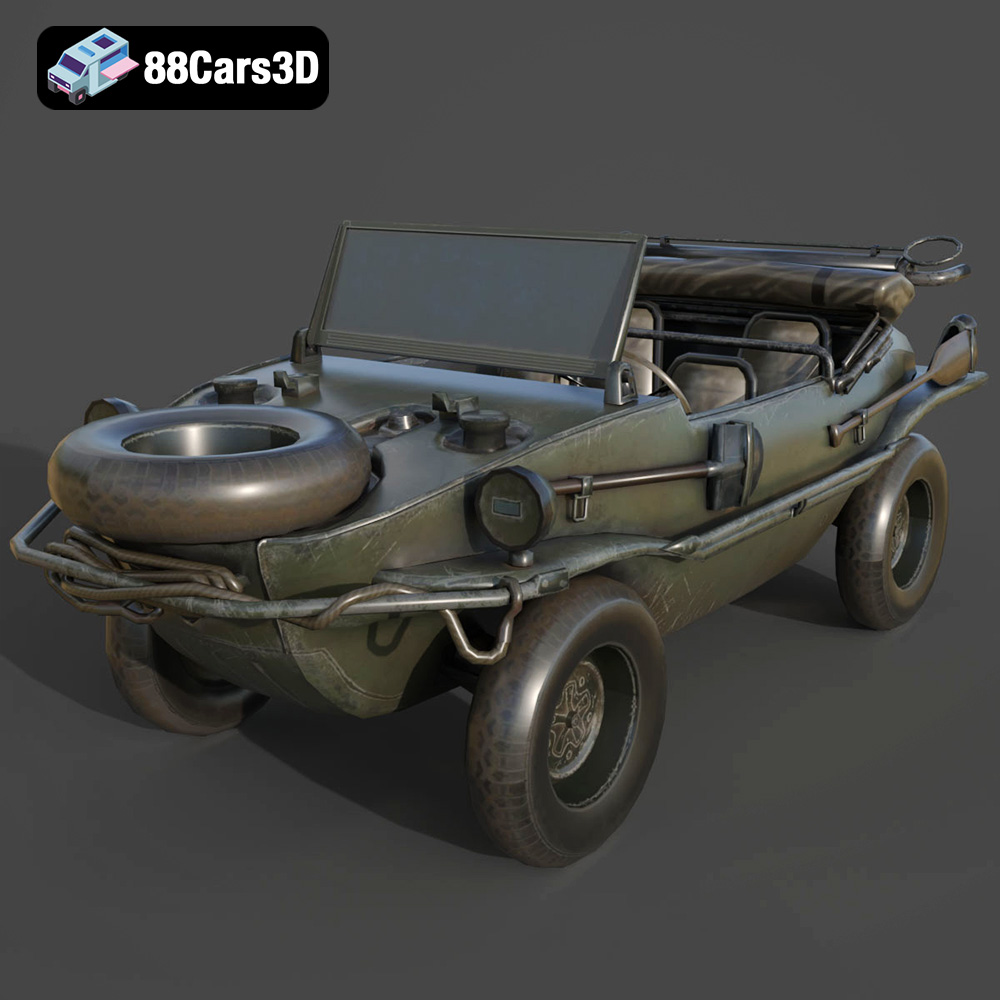
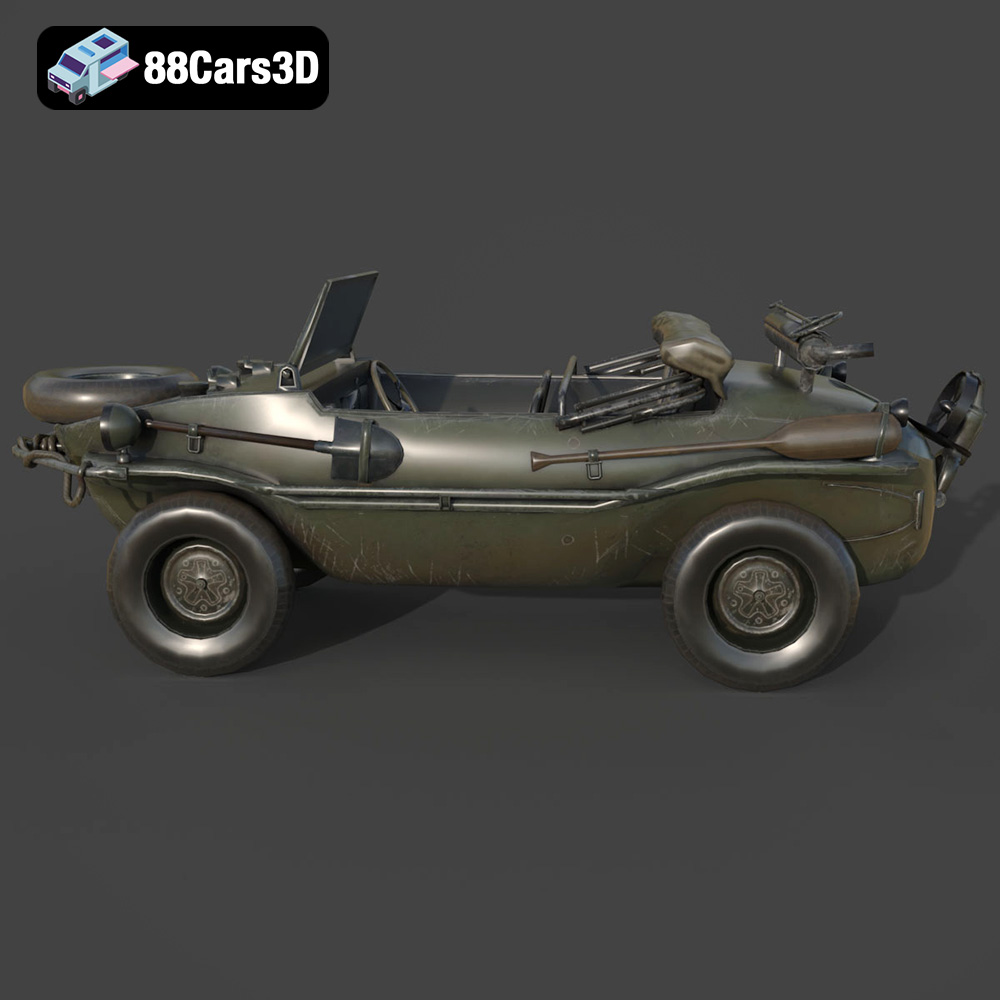
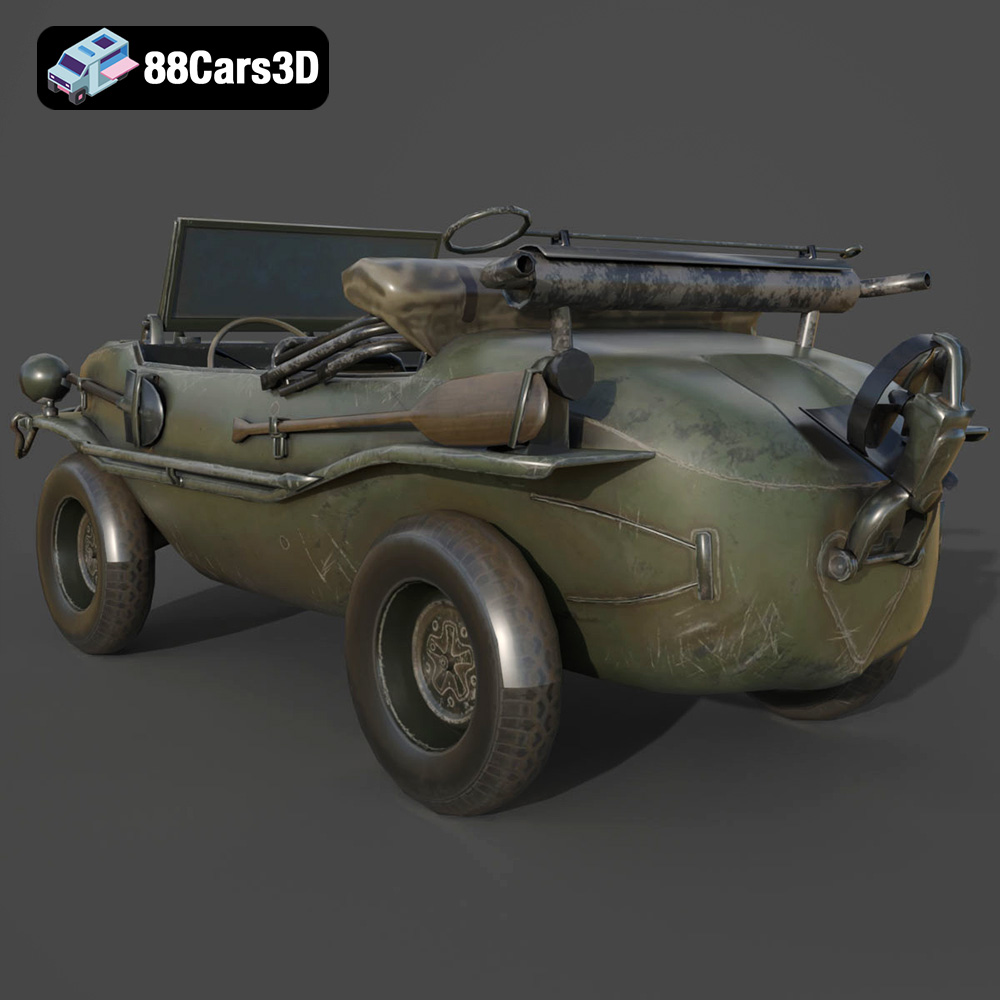
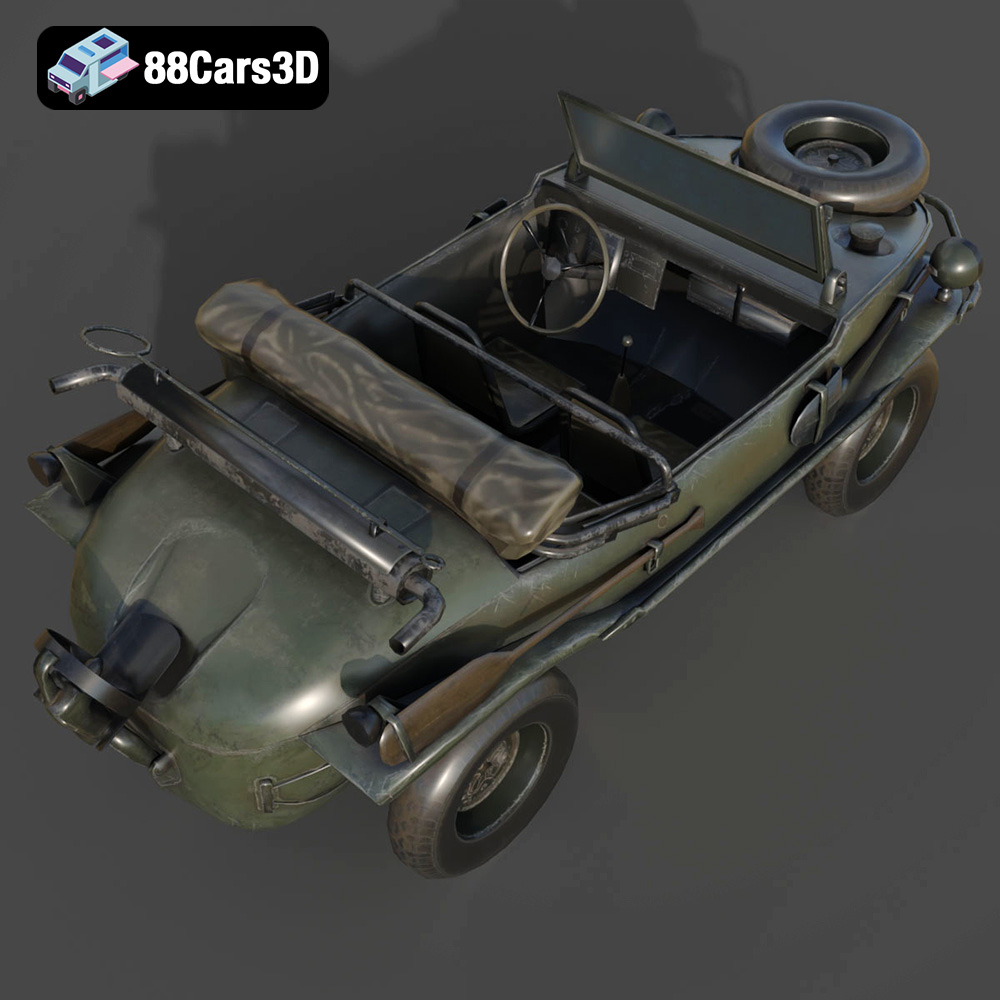
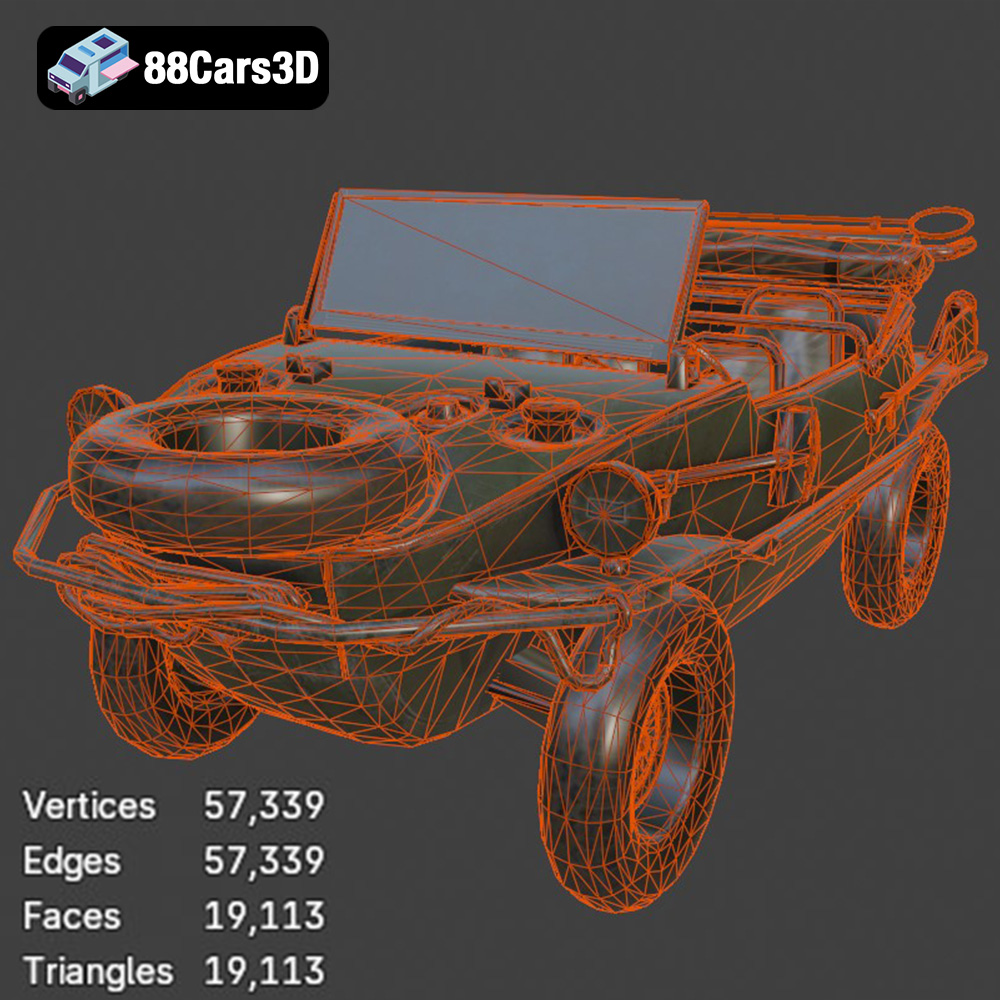
Every curve, rivet, and component of the Schwimmwagen has been meticulously recreated. The distinctive watertight hull geometry, which gave the vehicle its amphibious capabilities, is accurately proportioned, reflecting its unique boat-like design. Key exterior features include the detailed rear-mounted air-cooled flat-four engine housing, an authentic fold-down rear propeller mechanism, and the period-accurate military lighting, complete with blackout headlamps. The high-tread off-road tires and stamped steel wheels are rendered with precision, as are the rugged leaf spring and torsion bar suspension details. Crucially, components like the wheels, propeller, suspension, and steering are separate, enabling realistic animation and interaction within game engines or cinematic sequences.
The interior, while utilitarian, doesn’t compromise on detail. The minimalist three-spoke steering wheel, authentic column, and sparse military-spec instrument cluster and gauges are all accurately represented. The detailed floor-mounted gear shifter and 4WD engagement levers are present, contributing to an immersive experience. This level of interior detail is vital, especially for first-person perspectives in gaming or detailed interior shots in renders, ensuring that the model holds up under close scrutiny.
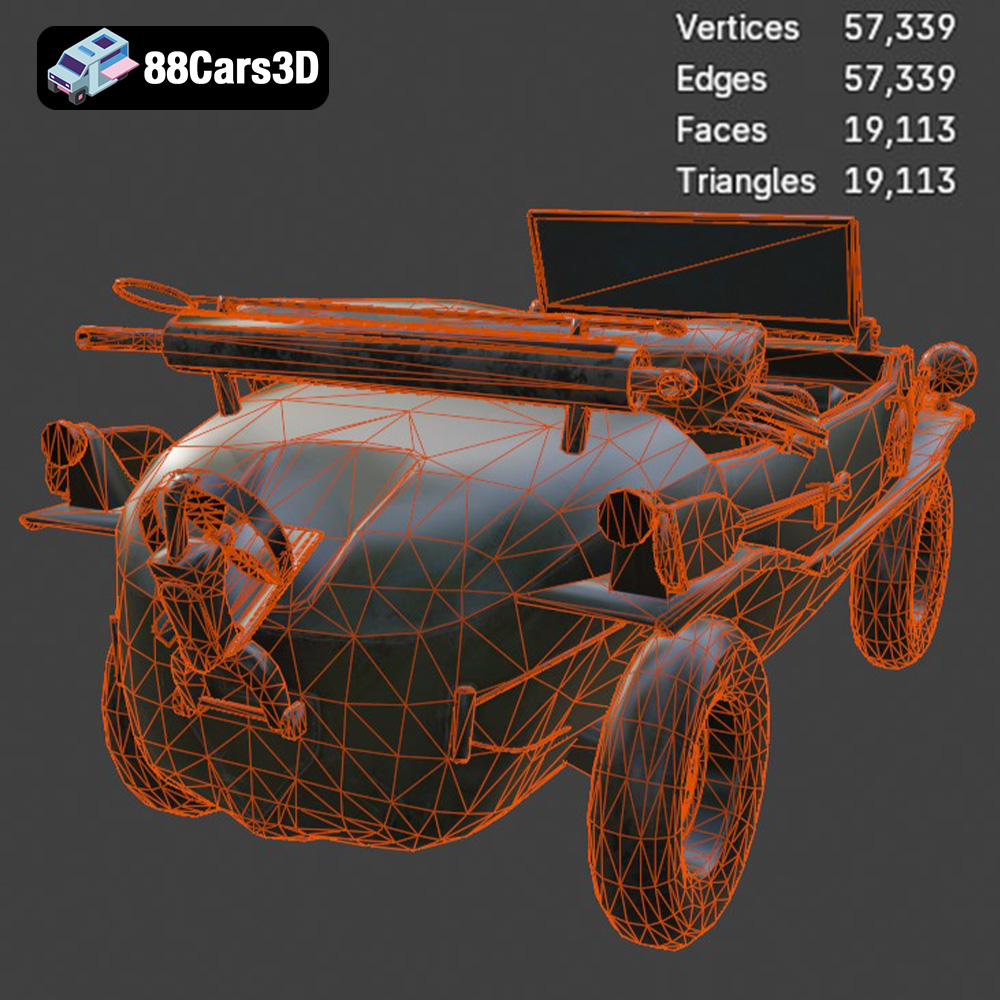
Beyond visual fidelity, the true hallmark of a professional 3D model lies in its technical specifications and optimization. The Volkswagen Schwimmwagen Typ 166 3D model strikes an ideal balance, boasting approximately 150,000 triangles. This polycount is perfectly optimized for real-time engines like Unreal and Unity, ensuring high-end visual realism without sacrificing performance. It’s a game-ready asset, meaning it’s designed to run efficiently in interactive environments, crucial for game development and AR/VR applications.
Furthermore, the model adheres to real-world scale accuracy, based on the actual vehicle chassis, ensuring correct proportions when integrated into larger scenes or environments. Proper pivot setups for steering, wheel rotation, propeller deployment, and suspension travel are included. These carefully established pivots are essential for animators and game developers, allowing for smooth, realistic movement and interaction without needing extensive post-import setup. This attention to technical detail significantly enhances workflow efficiency and the overall quality of any project using this exceptional 3D car model.
The true value of a versatile 3D asset like the Volkswagen Schwimmwagen Typ 166 lies in its seamless integration into diverse professional workflows. Whether you’re a game developer aiming for historical accuracy, an architectural visualizer adding narrative elements, or a product designer creating immersive experiences, a well-prepared 3D car model can be a cornerstone of your project.
For game developers, performance is paramount. The Schwimmwagen model’s optimized topology (~150,000 triangles) ensures it’s fully game-ready, performing efficiently in demanding real-time environments. With included .fbx and .unreal formats, integrating this vehicle into game engines like Unreal Engine or Unity is streamlined. Developers can import the model with confidence, knowing that materials are typically set up for PBR (Physically Based Rendering) workflows, and pivots are correctly positioned for animation. Imagine a historical military simulator where players can drive this amphibious vehicle across challenging terrains and through water, with animated wheels, functional steering, and a deployable propeller. Its robust design makes it an ideal game asset for open-world titles, racing games, or even strategic simulations set in World War II. The separation of components like wheels and suspension allows for advanced vehicle physics setups, adding another layer of realism to gameplay.
For artists focused on producing stunning visual content, whether for advertising, film, or visualization, the Schwimmwagen model excels. With .max and .blend files included, users of 3ds Max and Blender gain full editability over the scene. This means complete control over materials – from adjusting the reflectivity of weathered metal to refining the roughness of the period-accurate tires. Lighting artists can craft intricate studio lighting setups or realistic outdoor environments, showcasing the vehicle in various scenarios. A cinematic render could depict the Schwimmwagen emerging from a misty river, or parked stoically in a historical diorama. Customization options, such as changing body colors to factory finishes or intricate camouflage patterns, allow for endless creative expression in automotive rendering projects. The model’s high-fidelity details make it perfect for close-up shots and high-resolution stills or animations.
The rapidly expanding fields of Augmented Reality (AR) and Virtual Reality (VR) demand highly optimized 3D assets. The Schwimmwagen’s game-ready optimization and the inclusion of the .glb format make it an excellent candidate for immersive experiences. Picture an interactive museum exhibit where users can virtually walk around, inspect, and even “drive” the Schwimmwagen in VR, exploring its features in full 3D. For AR, the model can be placed in real-world environments via a smartphone or tablet, allowing users to scale, rotate, and interact with the vehicle as if it were physically present. The compact nature of .glb ensures fast loading times, which is critical for mobile AR experiences and browser-based 3D configurators. This makes the Schwimmwagen 3D model a perfect fit for educational tools, virtual showrooms, or engaging historical simulations that transcend traditional screen-based interactions.
While digital visualization is a primary use case, a high-quality 3D model offers possibilities that extend into the physical realm. The Volkswagen Schwimmwagen Typ 166 3D model is not just a digital asset; it’s also a blueprint for a tangible replica, thanks to its compatibility with 3D printing technologies.
The inclusion of the .stl format directly addresses the needs of hobbyists and professionals interested in 3D printing. This format strips away visual attributes like color and texture, focusing solely on the geometrical form, which is exactly what a 3D printer needs to create a physical object. For a complex model like the Schwimmwagen, attention to 3D print settings is crucial. Recommended scales such as 1:16, 1:35 (military modeling standards), or 1:24 allow for various display sizes. Fine details necessitate specific printing parameters: a layer height of 0.04–0.12 mm, with resin printing often recommended for capturing the intricate rivets, engine housing details, and delicate propeller mechanism. Adequate wall thickness (1.2–2.0 mm) ensures structural integrity, while an infill of 20–30% balances strength with material usage. Supports are typically required for overhanging parts like the exhaust, propeller, and the steering wheel, and careful print orientation (e.g., frame printed angled, wheels separately) optimizes for strength and finish. Post-processing, including sanding, priming, and painting with authentic factory colors, can transform the printed model into a museum-quality miniature. This capability opens doors for creating physical dioramas, educational models, or collectible replicas of this iconic amphibious vehicle.
While less common for direct 3D printing or game development, the .ply format offers capabilities for highly precise mesh representation. In certain niche applications, such as detailed reverse engineering, metrology, or advanced computational analysis, the .ply format can be beneficial. It allows for the storage of specific data per vertex or face, which can be critical for verifying the exact dimensions or structural integrity of complex components. For instance, if one were to analyze the aerodynamic or hydrodynamic properties of the Schwimmwagen’s hull, a .ply export could serve as a precise foundation for simulation software, providing engineers with accurate data to study its performance characteristics in detail. While the primary use cases for a vehicle model might lean towards visualization and games, the availability of .ply underscores the comprehensive and robust nature of the Schwimmwagen 3D model, catering to a broad spectrum of technical demands.
A superior 3D model provides not just a static representation, but a foundation for boundless creativity. The Volkswagen Schwimmwagen Typ 166 3D model from 88cars3d.com offers extensive customization options, allowing artists and developers to adapt it perfectly to their unique vision and project requirements.
The flexibility of the included file formats, especially .blend and .max, allows for deep customization. Artists can easily modify the body colors, applying historically accurate factory colors, experimenting with custom finishes, or even designing intricate camouflage patterns suited for specific wartime scenarios. The ability to adjust material finishes means you can render the Schwimmwagen with a pristine gloss, a battle-worn matte, or a rusted, metallic sheen, telling a different story through its appearance. Tire textures can be swapped between clean off-road variants or mud-caked versions, reflecting different environmental conditions. Moreover, the model’s structure facilitates adapting lighting for various environments – from bright sunny beaches to gloomy, overcast battlefields. This level of customization ensures that the Schwimmwagen can be a versatile asset in any scene, not just a historical prop, but a character in its own right, responding to the creative direction of the project.
The applications for such a detailed and optimized 3D car model are vast and impactful. Consider its use in:
These scenarios highlight how investing in a high-quality 3D car model like the Volkswagen Schwimmwagen Typ 166 from 88cars3d.com provides significant dividends, saving countless hours of modeling work and delivering a foundation that meets the exacting standards of professional production across multiple industries.
The journey of creating compelling 3D content, especially in the demanding fields of automotive rendering and game asset development, hinges on access to exceptional digital resources. The Volkswagen Schwimmwagen Typ 166 3D model stands as a testament to the meticulous craftsmanship and technical optimization required for professional-grade assets. From its historically accurate exterior and interior detailing to its game-ready polycount and versatile file format support, it’s an asset designed to empower creators across every discipline.
Whether you are developing the next major game title, crafting high-fidelity cinematic renders, building immersive AR/VR experiences, or even producing physical models via 3D printing, this Schwimmwagen model provides an unparalleled foundation. Its compatibility with diverse workflows and software, coupled with extensive customization options, ensures it will integrate seamlessly and elevate the quality of your projects. For anyone seeking to bring the rugged charm and unique engineering of this iconic amphibious vehicle into their digital world, the Volkswagen Schwimmwagen Typ 166 3D model from 88cars3d.com is an indispensable tool, ready to drive your creative endeavors forward.
The Volkswagen Schwimmwagen Typ 166 is an iconic World War II amphibious off-road vehicle, celebrated for its rugged durability and unique boat-like hull design. Serving as one of the most mass-produced amphibious cars in history, it features a distinctive rear-mounted air-cooled flat-four engine, a fold-down propeller system, and four-wheel drive capability. This highly accurate 3D model meticulously captures its utilitarian military aesthetics, from the riveted watertight chassis to the spare tire mounted on the sloping front hood. Engineered with exceptional attention to detail, this 3D model boasts optimized topology and an efficient triangle count, ensuring it is fully game-ready without compromising on visual fidelity. Whether you are developing a historic military simulator, creating an immersive AR/VR educational experience, or producing high-end cinematic renders, this model delivers unparalleled realism and performance across all major real-time engines and 3D software.
$19.99
.blend
.fbx
.glb
.max
.obj
.ply
.rendering
.stl
.unreal
.volkswagen
amphibious-vehicle
car-3d-model
classic-car
game asset
game-ready
low-poly
military-vehicle
off-road
optimized
schwimmwagen-typ-166
VR/AR
ww2-vehicle