Get 20% OFF All Premium 3D & STL Models!

In the dynamic world of 3D visualization, game development, and digital historical preservation, the ability to accurately and efficiently represent iconic vehicles is paramount. From the meticulous detail required for automotive rendering to the optimized performance demanded by game engines, 3D car models serve as the foundation for countless creative endeavors. They bridge the gap between imagination and tangible digital reality, allowing artists, developers, and enthusiasts to explore, interact with, and even animate the machines that have shaped our history and culture.
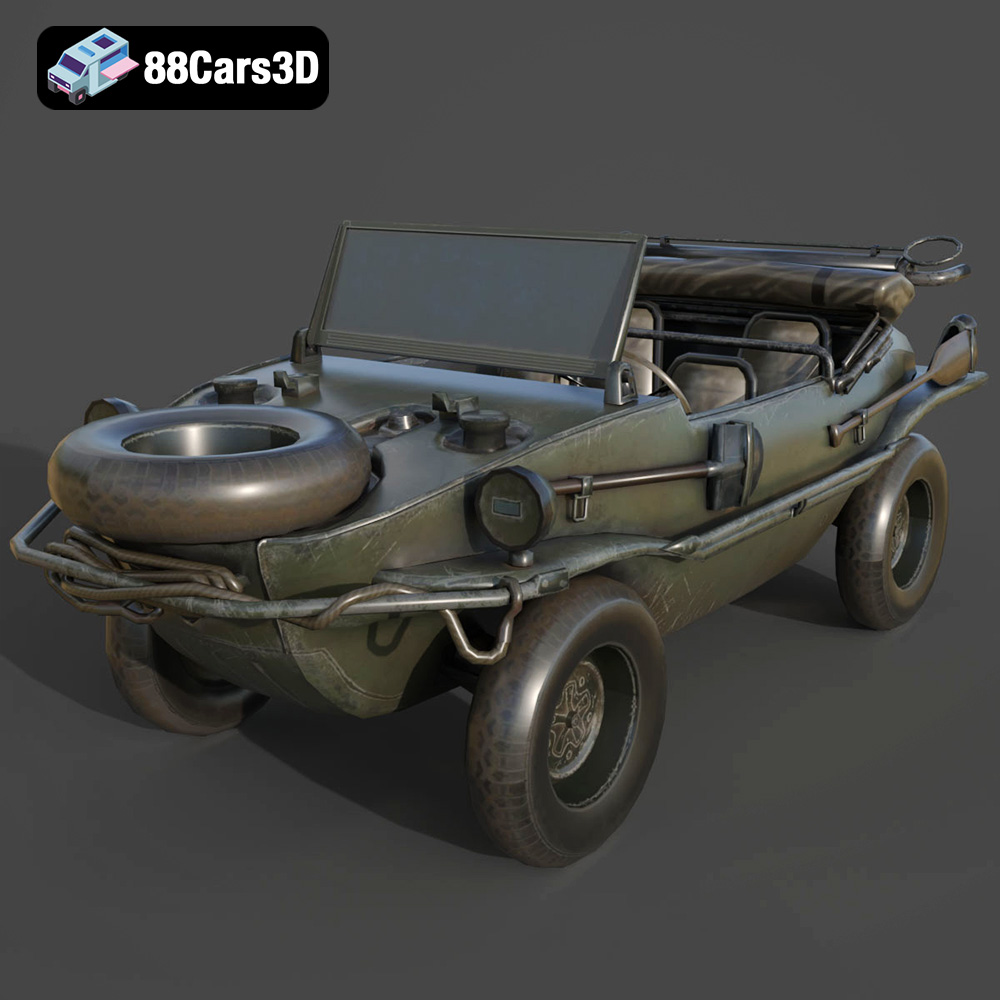
One such machine, steeped in a unique legacy of engineering ingenuity and historical significance, is the Volkswagen Schwimmwagen Typ 166. This iconic World War II amphibious off-road vehicle is a testament to rugged durability and innovative design. Recreating such a distinctive piece of history in a digital format presents both a challenge and an opportunity for 3D artists. Fortunately, high-quality, pre-built assets, like the Volkswagen Schwimmwagen Typ 166 3D Model available at 88cars3d.com, provide a powerful solution, offering unparalleled realism and performance right out of the box for a wide array of applications. This model, meticulously crafted with an eye for historical accuracy and technical efficiency, stands as a prime example of what professional-grade 3D assets can achieve.
The versatility of a 3D model often hinges on the range of file formats it supports. Different formats are optimized for distinct purposes, software environments, and performance requirements. Understanding these distinctions is crucial for anyone working with 3D assets, ensuring smooth integration into various pipelines, from real-time game engines to high-fidelity rendering applications and even physical fabrication. The Volkswagen Schwimmwagen Typ 166 3D Model, offered with a comprehensive suite of formats, exemplifies this commitment to broad compatibility.
Choosing the correct file format can significantly impact a project’s efficiency and final output quality. A single, well-modeled asset can serve multiple masters if provided in the right containers. This is why platforms like 88cars3d.com emphasize offering a broad spectrum of choices for their 3D car models.
This comprehensive array of formats ensures that the Volkswagen Schwimmwagen Typ 166 3D Model from 88cars3d.com is not just a high-quality asset but also an incredibly versatile one, ready for integration into virtually any professional pipeline.
Recreating a historical vehicle like the Volkswagen Schwimmwagen Typ 166 demands an obsessive attention to detail. Every rivet, every curve, every functional component must be accurately translated from its physical counterpart into a digital mesh. This process goes beyond mere visual representation; it involves understanding the engineering and purpose of each element to ensure both aesthetic fidelity and functional realism in the 3D model.
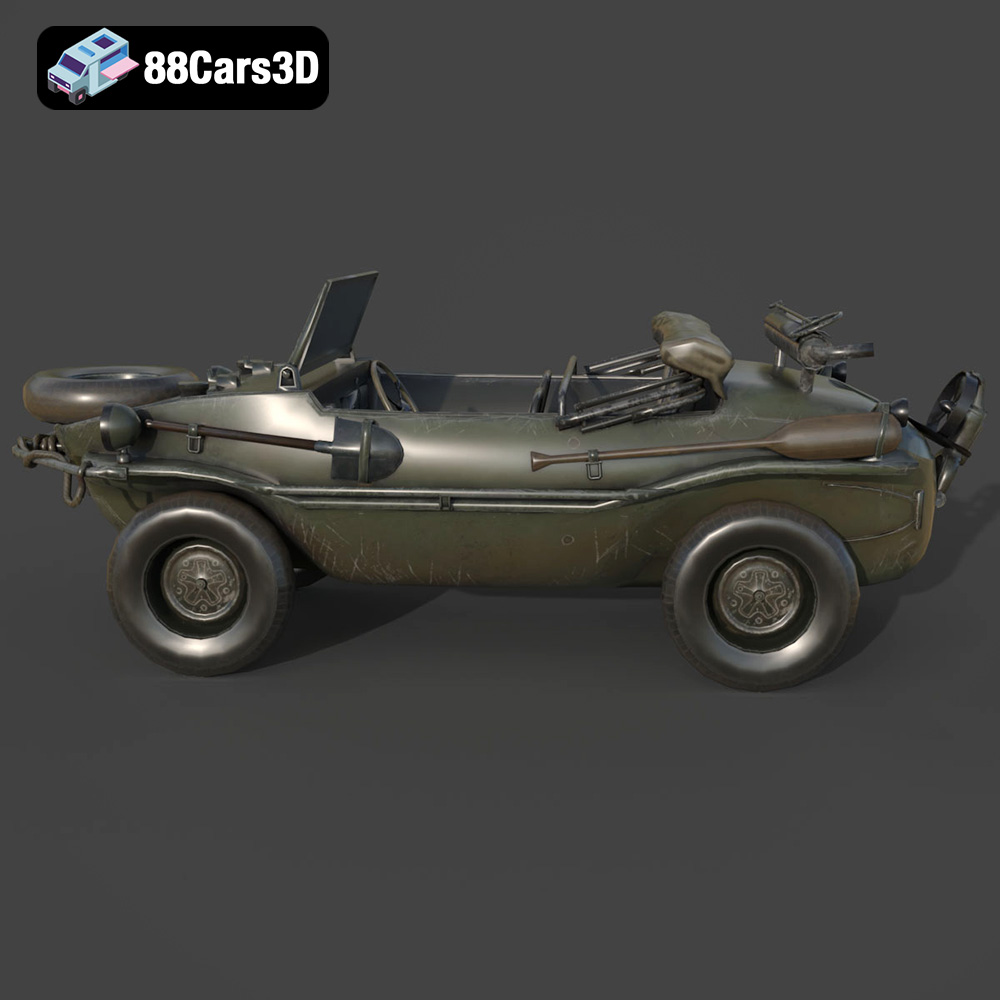
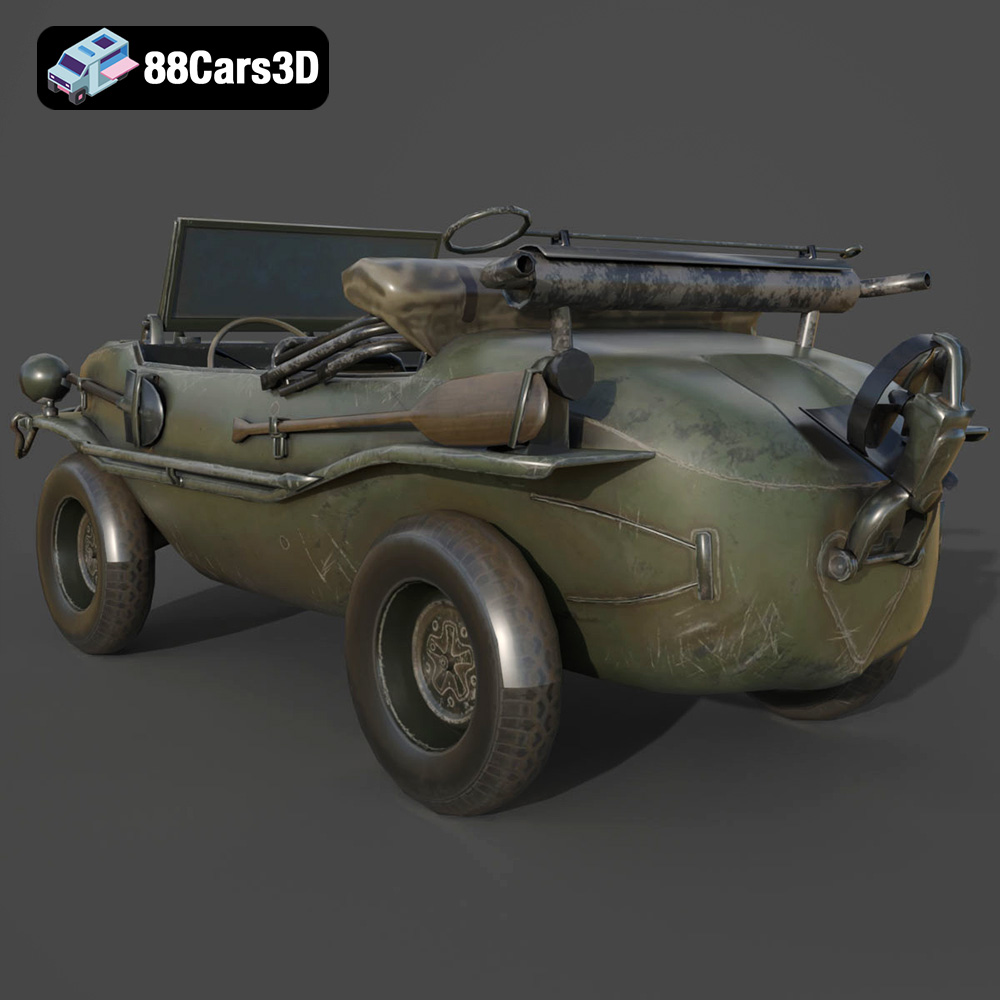
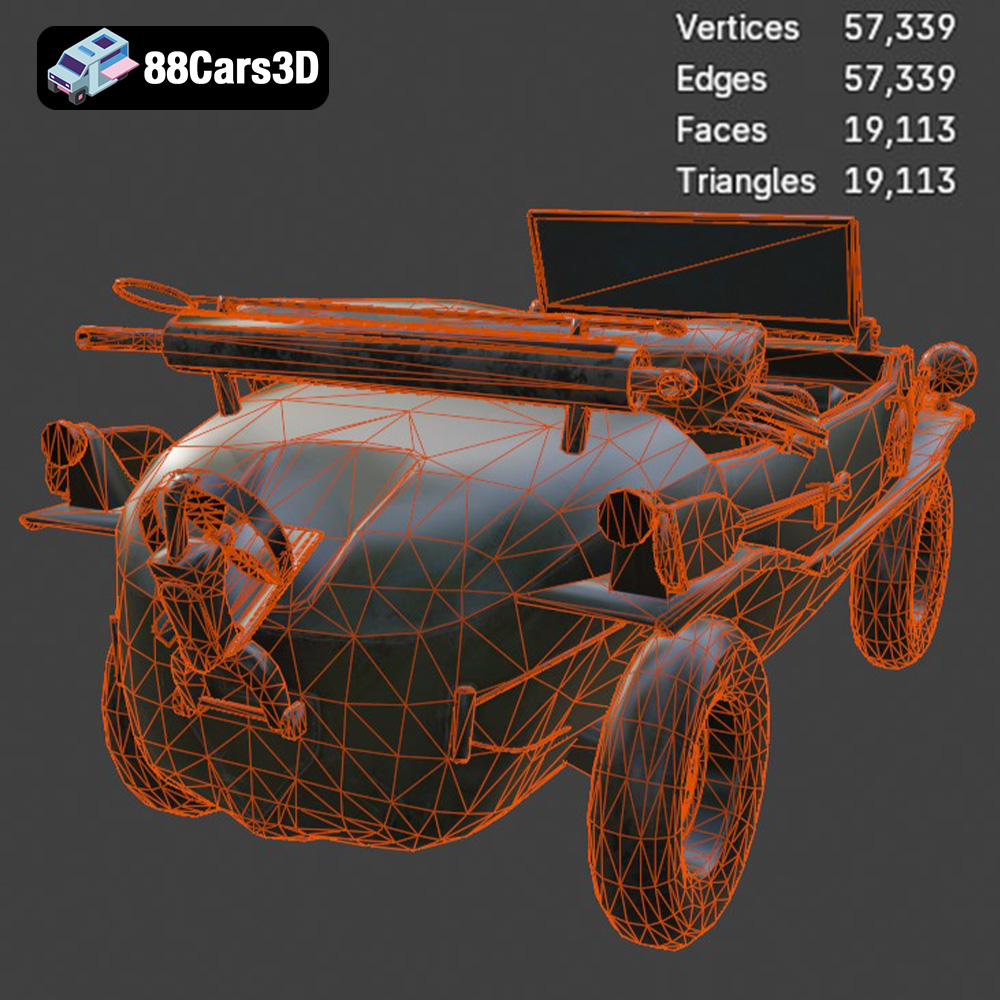
The exterior of the Schwimmwagen is its most defining feature, characterized by its distinctive boat-like hull and rugged military aesthetic. The 3D model meticulously captures these elements. The watertight hull geometry and proportions are accurate, reflecting its amphibious nature. Details like the rear-mounted air-cooled flat-four engine housing and the authentic fold-down rear propeller mechanism are not just present, but also engineered with proper pivot setups. This means that animators can effortlessly simulate the deployment of the propeller for water travel or the rotation of the wheels for land movement. Period-accurate military lighting, including blackout headlamps, high-tread off-road tires, and stamped steel wheels, further enhance its historical realism. The inclusion of separate components for wheels, suspension, and steering allows for complex animations, crucial for realistic driving simulations or cinematic sequences where every moving part needs to behave authentically.
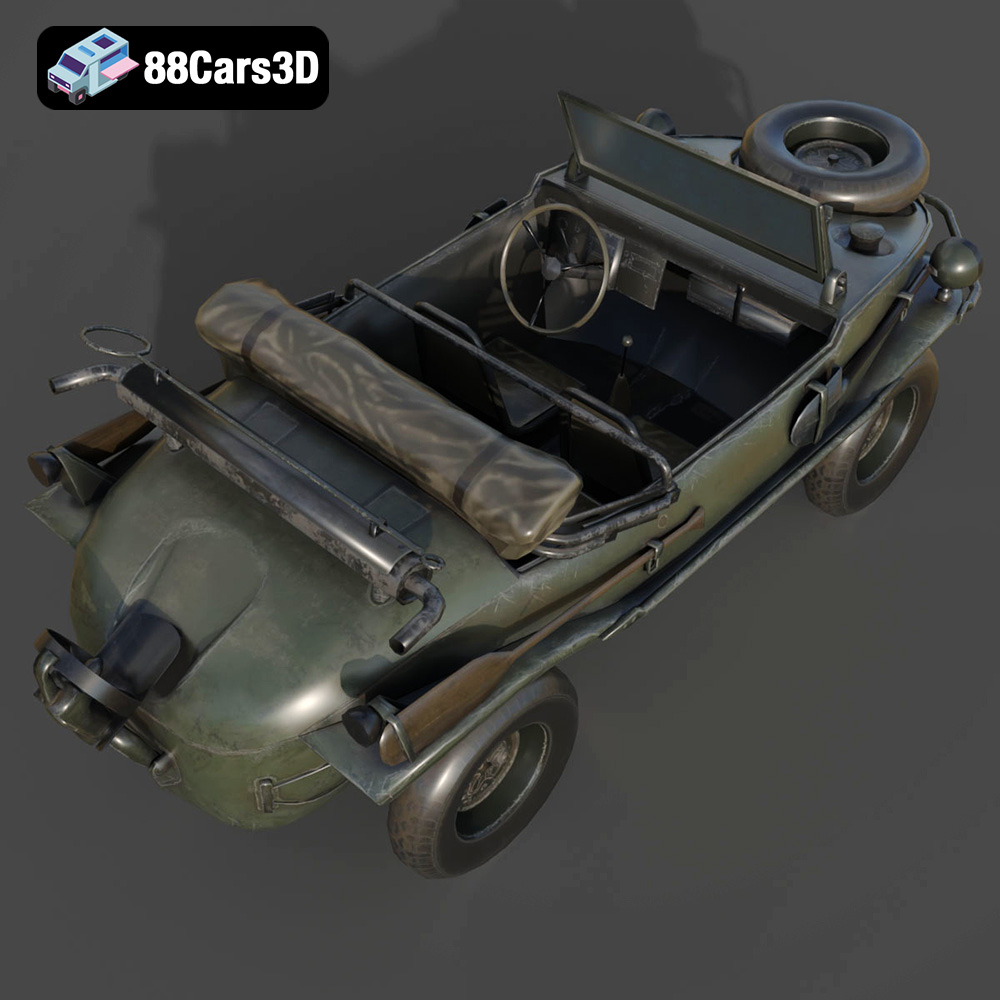
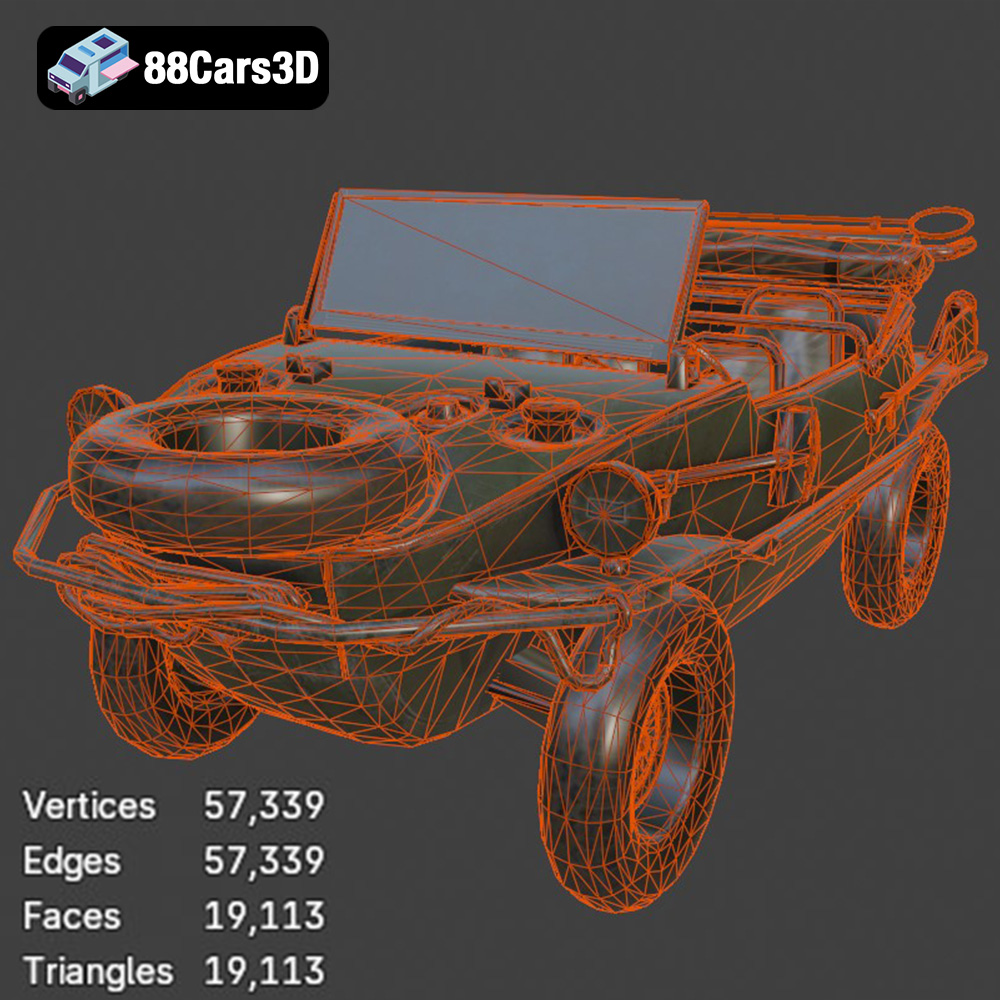
While the Schwimmwagen’s interior is utilitarian by design, its accurate digital representation is critical for creating truly immersive experiences. The 3D model features minimalist three-spoke steering wheel and an authentic column, alongside a sparse military-spec instrument cluster and gauges. The detailed floor-mounted gear shifter and 4WD engagement levers are also faithfully replicated. This attention to cockpit detail is vital for first-person perspective in gaming or virtual reality simulations, where users interact directly with the vehicle’s controls. Optimized geometry ensures that even with these details, the model maintains an efficient triangle count, striking a perfect balance between visual richness and real-time performance.
For game developers, the quality of a 3D vehicle asset is measured not only by its visual fidelity but also by its technical optimization. A model must look great and perform flawlessly in real-time environments, often under strict polygon budgets and rendering constraints. The Volkswagen Schwimmwagen Typ 166 3D Model is specifically engineered to excel in this demanding landscape, making it an ideal choice for a variety of game genres.
Unreal Engine is renowned for its capabilities in delivering high-fidelity graphics and complex gameplay. Integrating the Schwimmwagen model into an Unreal project is streamlined by its game-ready optimization. With approximately 150,000 triangles, the model achieves an excellent balance. This polycount is substantial enough to retain all the critical visual details – from the riveted hull to the engine housing – without bogging down the engine. Developers can expect smooth frame rates even with multiple instances of the vehicle. The inclusion of an `.unreal` package or pre-configured `.fbx` asset means that materials, textures (likely PBR for realistic surface interaction), and proper pivot points for animation are ready to go. Artists can quickly set up vehicle blueprints, integrate physics, and even script the fold-down propeller mechanism to respond to in-game conditions, making it perfect for historical military simulators or open-world adventures.
Unity, another powerhouse in game development, also benefits greatly from optimized assets like the Schwimmwagen. The `.fbx` format, a core component of this product, ensures a seamless import process. Unity’s robust material system can readily interpret the PBR textures (Albedo, Normal, Metallic, Roughness, AO) that typically accompany such a high-quality asset, allowing for realistic lighting and shading. The separate mesh components for wheels, steering, and the propeller mean that setting up vehicle controllers in Unity is intuitive. Developers can easily attach wheel colliders, define suspension travel, and implement vehicle physics for a convincing driving experience. This model is perfectly suited for mobile AR games where the Schwimmwagen could drive across a real-world table, or for desktop racing titles where players navigate challenging historical terrains.
The utility of a professional 3D car model extends far beyond game engines. High-quality assets are indispensable for automotive rendering, architectural visualization, product showcases, and immersive AR/VR experiences. The Schwimmwagen’s exceptional detail and versatile file formats make it a valuable tool in these diverse professional applications.
For high-end cinematic rendering, precision and material realism are paramount. Utilizing the `.max` or `.blend` files, artists can leverage the full power of their preferred rendering software. In 3ds Max, for example, the Schwimmwagen model can be integrated into V-Ray or Corona Renderer workflows. Artists can refine the materials, add complex lighting setups, and apply sophisticated post-processing effects to create photorealistic images or animations. Imagine a historical documentary sequence featuring the Schwimmwagen in a pristine, studio-lit environment, or a dramatic wartime scene rendered with advanced atmospheric effects. Similarly, Blender users can harness Cycles or Eevee to produce stunning visuals, adjusting surface properties like paint reflectivity, metal wear, and tire dirt to achieve absolute historical authenticity or a stylized look for a brand campaign. The model’s optimized topology also means cleaner renders and faster processing times, even for complex scenes.
Augmented Reality (AR) and Virtual Reality (VR) are transforming how we interact with digital content, offering immersive educational, promotional, and experiential opportunities. The Schwimmwagen’s `.glb` format is specifically designed for these cutting-edge applications. Its compact, self-contained nature ensures quick loading times and efficient performance on mobile devices and VR headsets. Imagine a museum exhibit where visitors can view a life-sized virtual Schwimmwagen in AR through their phone, walking around it, inspecting details, and even deploying its propeller with a tap. Or a VR experience that places the user directly in the cockpit, exploring its sparse military-spec instruments and levers. The real-world scale accuracy of the model further enhances the sense of presence in these immersive environments, making it an invaluable asset for interactive historical simulations or virtual showrooms.
The journey of a 3D model doesn’t always end on a screen. For many enthusiasts and professionals, the ultimate goal is to bring digital creations into the physical world through 3D printing. The Volkswagen Schwimmwagen Typ 166 3D Model, with its `.stl` and `.ply` formats, provides a perfect foundation for this exciting process, allowing for tangible recreations of this iconic vehicle.
The `.stl` format is the industry standard for 3D printing, translating the model’s surfaces into a series of triangles that 3D printers can interpret. The detailed product description for the Schwimmwagen includes specific 3D print settings, which are crucial for a successful print. Recommendations such as scale (1:16, 1:35, 1:24), layer height (0.04–0.12 mm, recommending resin printing for fine details), and wall thickness (1.2–2.0 mm) guide users towards optimal results. The mention of required supports for delicate parts like the exhaust and propeller, and suggested print orientation (frame angled for structural integrity, wheels separately), demonstrates a deep understanding of the 3D printing process. For hobbyists building World War II dioramas or collectors seeking a display-scale replica, having a print-ready model saves significant time and effort in preparing the geometry.
Successful 3D printing is often just the first step. Post-processing can elevate a raw print into a museum-quality replica. The guidelines provided, such as sanding, primer application, and using authentic factory colors with metallic finishes, are essential for achieving a high level of realism. These steps allow for the accurate representation of the Schwimmwagen’s utilitarian military aesthetics, including its riveted watertight chassis and rugged components. For model makers, the ability to print individual, separate components like the wheels and suspension simplifies painting and assembly, leading to a much higher fidelity final product. This level of thought in providing both the digital asset and guidance for its physical realization truly enhances the value proposition of the Volkswagen Schwimmwagen Typ 166 3D Model.
In professional environments, efficiency and adaptability are key. A 3D asset must not only be high-quality but also seamlessly integrate into existing workflows and allow for straightforward customization to meet specific project demands. The Volkswagen Schwimmwagen Typ 166 3D Model is designed with this professional imperative in mind, offering flexibility that saves valuable production time.
The comprehensive set of included file formats – `.blend`, `.fbx`, `.obj`, `.glb`, `.stl`, `.ply`, `.unreal`, `.max` – is a testament to the model’s adaptability across various production pipelines. For studios working with mixed software environments, this eliminates conversion headaches and potential data loss, ensuring that the Schwimmwagen can be dropped into a 3ds Max rendering project, then optimized for an Unreal Engine game, and finally prepared for a 3D print without significant rework. The “game-ready & optimized” technical specifications, including its balanced triangle count and proper pivot setups, mean less time spent on optimization and more time on creative development. This streamlined integration allows teams to rapidly iterate on concepts, test different scenarios, and deliver polished results on schedule, a critical advantage offered by premium 3D car models from marketplaces like 88cars3d.com.
Beyond mere integration, the ability to customize an asset is crucial for differentiating projects. The Schwimmwagen model comes with inherent customization options. Artists can easily change body colors, applying historical factory hues, custom finishes, or elaborate camouflage patterns suitable for different military scenarios. Modifying tire textures from clean variants to off-road mud adds realism to specific environments. Adjusting material finishes – from matte to gloss or weathered metal – allows for dramatic shifts in aesthetic, portraying a pristine museum piece versus a battle-hardened veteran. The flexibility to adapt lighting for different environments further enhances its utility, enabling artists to place the vehicle convincingly in diverse digital worlds, from a sunny beach assault to a moody, rain-soaked forest. This adaptability makes the Volkswagen Schwimmwagen Typ 166 3D Model a truly versatile asset, capable of fulfilling a wide range of creative visions.
The world of 3D modeling thrives on detail, accuracy, and versatility. The Volkswagen Schwimmwagen Typ 166 3D Model embodies these principles, offering a meticulously crafted digital asset that transcends mere visual representation. From its historically accurate exterior and interior details to its optimized geometry for real-time performance, this model stands as a testament to professional-grade 3D asset development. Its comprehensive support for a multitude of file formats – including .blend, .fbx, .obj, .glb, .stl, .ply, .unreal, and .max – ensures unparalleled compatibility across game engines, rendering software, AR/VR platforms, and 3D printing workflows.
Whether you are a game developer crafting an immersive historical simulation, an automotive renderer creating cinematic visualizations, an AR/VR designer building interactive experiences, or a hobbyist looking to 3D print a tangible piece of history, the Schwimmwagen model provides the technical foundation and visual fidelity required. It empowers creators to bring the iconic amphibious capabilities and rugged charm of this World War II vehicle to life in virtually any digital or physical medium. Investing in such a high-quality, pre-optimized asset not only saves invaluable production time but also elevates the overall quality of any project. Discover this exceptional model and more premium 3D car models at 88cars3d.com, where quality meets versatility.
The Volkswagen Schwimmwagen Typ 166 is an iconic World War II amphibious off-road vehicle, celebrated for its rugged durability and unique boat-like hull design. Serving as one of the most mass-produced amphibious cars in history, it features a distinctive rear-mounted air-cooled flat-four engine, a fold-down propeller system, and four-wheel drive capability. This highly accurate 3D model meticulously captures its utilitarian military aesthetics, from the riveted watertight chassis to the spare tire mounted on the sloping front hood. Engineered with exceptional attention to detail, this 3D model boasts optimized topology and an efficient triangle count, ensuring it is fully game-ready without compromising on visual fidelity. Whether you are developing a historic military simulator, creating an immersive AR/VR educational experience, or producing high-end cinematic renders, this model delivers unparalleled realism and performance across all major real-time engines and 3D software.
$19.99
.blend
.fbx
.glb
.max
.obj
.ply
.rendering
.stl
.unreal
.volkswagen
amphibious-vehicle
car-3d-model
classic-car
game asset
game-ready
low-poly
military-vehicle
off-road
optimized
schwimmwagen-typ-166
VR/AR
ww2-vehicle