Get 20% OFF All Premium 3D & STL Models!

In the rapidly evolving landscape of digital media, high-quality 3D automotive models are no longer just visual enhancements; they are foundational assets driving innovation across industries. From photorealistic advertising campaigns to immersive open-world games and cutting-edge AR/VR experiences, the demand for meticulously crafted digital vehicles is paramount. Professionals in these fields understand that the true value of a 3D car model lies not just in its aesthetics, but in its technical precision, optimization, and versatility.
Today, we delve into the intricate world of automotive 3D modeling, exploring the critical factors that elevate a digital asset from good to indispensable. We’ll examine the technical specifications, workflow considerations, and diverse applications that define excellence in this niche. As a prime example of such an asset, we’ll frequently reference the Lexus LX Mk3f J200 2016 3D Model available on 88cars3d.com – a premium asset engineered for demanding production environments. This highly detailed replica of the iconic luxury SUV perfectly illustrates the balance between visual fidelity and real-time performance, making it an ideal case study for anyone serious about digital automotive design.
One of the first considerations for any professional working with 3D assets is understanding the array of file formats available and when to leverage each. The choice of format significantly impacts compatibility, data integrity, and the efficiency of your workflow. High-quality assets, like the Lexus LX Mk3f J200 2016 3D Model, are often provided in multiple formats to ensure maximum utility across various software and platforms.
The `.blend` file format is the native format for Blender, a powerful open-source 3D creation suite. When you acquire a `.blend` file, you are essentially getting a fully editable Blender scene. This includes not only the mesh data but also materials, textures, lighting, cameras, animation rigs, and any modifiers or procedural setups used during creation. For artists primarily working in Blender, this format offers the most flexibility for customization, material adjustments, or further development. It’s an excellent choice for deep integration into a Blender-centric pipeline, allowing for full control over every aspect of the model’s construction and presentation.
Developed by Autodesk, the `.fbx` (Filmbox) format has become the de facto industry standard for exchanging 3D data between different software applications. Its strength lies in its ability to store a comprehensive range of 3D information, including geometry, materials, textures, animations, skinning, and even camera and light data. This makes `.fbx` incredibly versatile for pipelines involving multiple software packages, such as exporting a model from 3ds Max to Unreal Engine or Unity. For real-time applications like game development or AR/VR, `.fbx` is frequently preferred due to its robust support for animation and scene hierarchy, crucial for interactive experiences where elements like opening doors or rotating wheels (as found in the Lexus LX J200 model) need to be animated.
The `.obj` (Wavefront OBJ) format is one of the oldest and most widely supported 3D file formats. It primarily stores geometric data – vertices, normals, UV coordinates, and faces – and can reference external `.mtl` (material template library) files for basic material properties and texture paths. While it doesn’t support animation or rigging, its simplicity and universal compatibility make it an excellent choice for basic mesh exchange between almost any 3D software. If your primary need is robust geometry for sculpting, retopology, or foundational rendering where advanced material setups will be done natively in your target software, `.obj` is a reliable option.
`.glb` (GL Transmission Format Binary) is the binary version of glTF, a royalty-free specification for the efficient transmission and loading of 3D scenes and models by applications. `.glb` files package all assets – geometry, materials, textures, and animation – into a single, self-contained binary file, making them highly optimized for web-based 3D, AR, and VR applications. Its compact size and efficient parsing make it ideal for delivering interactive 3D content directly in browsers or mobile AR experiences without lengthy load times. For deploying a virtual showroom or showcasing a model like the Lexus LX J200 on a website, `.glb` is the format of choice.
The `.stl` (Stereolithography) format is almost exclusively used for 3D printing. It describes only the surface geometry of a 3D object using a tessellated mesh of triangles, without any color, texture, or material information. While not suitable for rendering or animation, it’s the standard input format for most 3D printers and slicing software. If you plan to create a physical replica of the Lexus LX J200 model, converting the digital asset to `.stl` is the necessary step, ensuring the geometric integrity required for manufacturing.
The `.ply` (Polygon File Format or Stanford Triangle Format) is a file format for storing 3D data, particularly from 3D scanners or for CAD applications. It can store various properties for points, faces, and other elements, including color, transparency, normals, texture coordinates, and scalar values. It’s less common for general-purpose 3D asset exchange but is crucial in fields like digital heritage, medical imaging, or engineering analysis where precise mesh data with additional per-vertex or per-face properties is required.
The `.unreal` format (often implying assets packaged specifically for Unreal Engine, usually as `.uasset` files or imported via `.fbx` and then configured within the engine) signifies an asset that has been prepared or is directly importable into Unreal Engine with minimal setup. This means it often includes optimized meshes, PBR (Physically Based Rendering) materials, collision meshes, LODs (Levels of Detail), and potentially even Blueprint functionality. For game developers or real-time visualization specialists working with Unreal Engine, an `.unreal` packaged asset for the Lexus LX J200 would offer a streamlined integration process, saving significant time on material setup and optimization.
Similar to `.blend` for Blender, `.max` is the native file format for Autodesk 3ds Max, a powerful 3D modeling, animation, rendering, and compositing software. A `.max` file contains the complete scene, including geometry, materials, textures, lighting, cameras, animation, and any scene-specific settings. For professionals using 3ds Max for architectural visualization, product design, or animation, a `.max` file of the Lexus LX J200 provides the most comprehensive access to the original scene setup, allowing for advanced rendering, scene integration, or animation sequences tailored to the 3ds Max environment.
The Lexus LX Mk3f J200 2016 3D Model exemplifies the pinnacle of professional-grade 3D automotive assets. It’s not just a pretty mesh; it’s a meticulously engineered digital replica designed for performance and visual fidelity across a spectrum of demanding applications. This model is a testament to the dedication required to transform a real-world vehicle into a versatile digital asset.
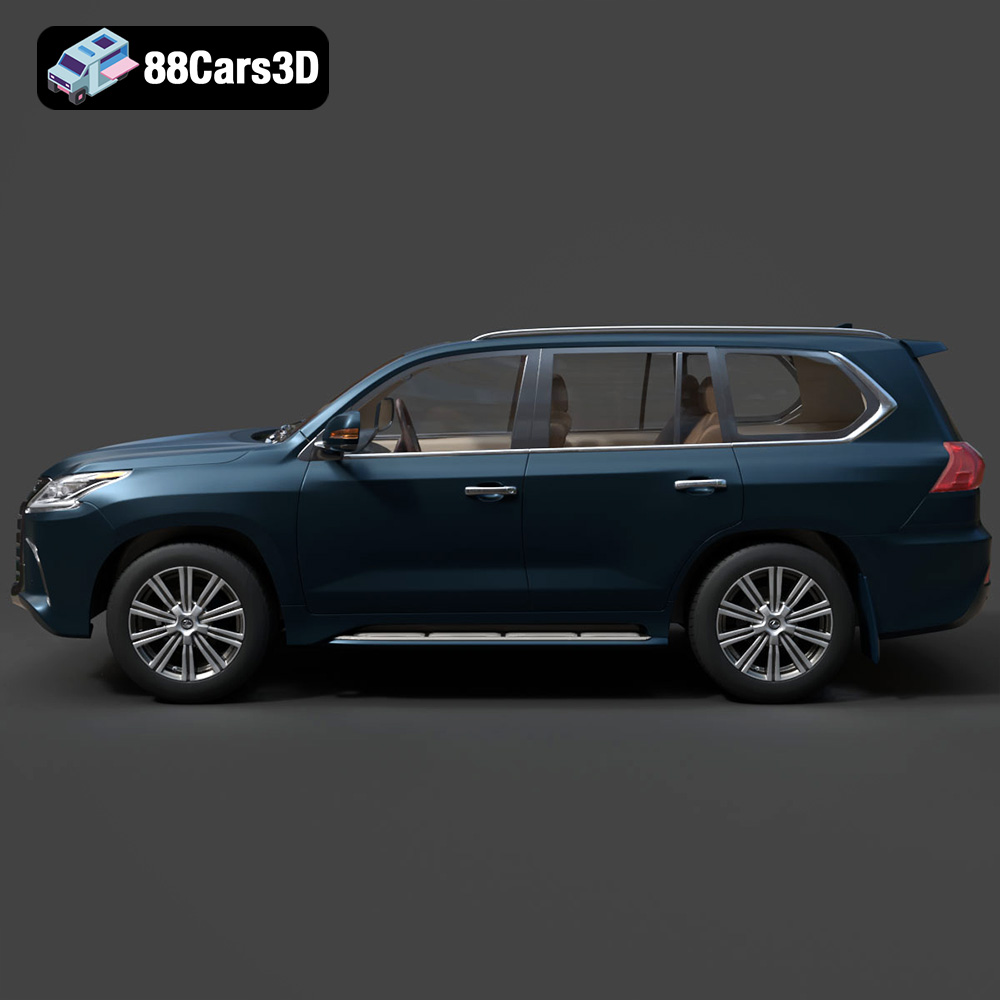
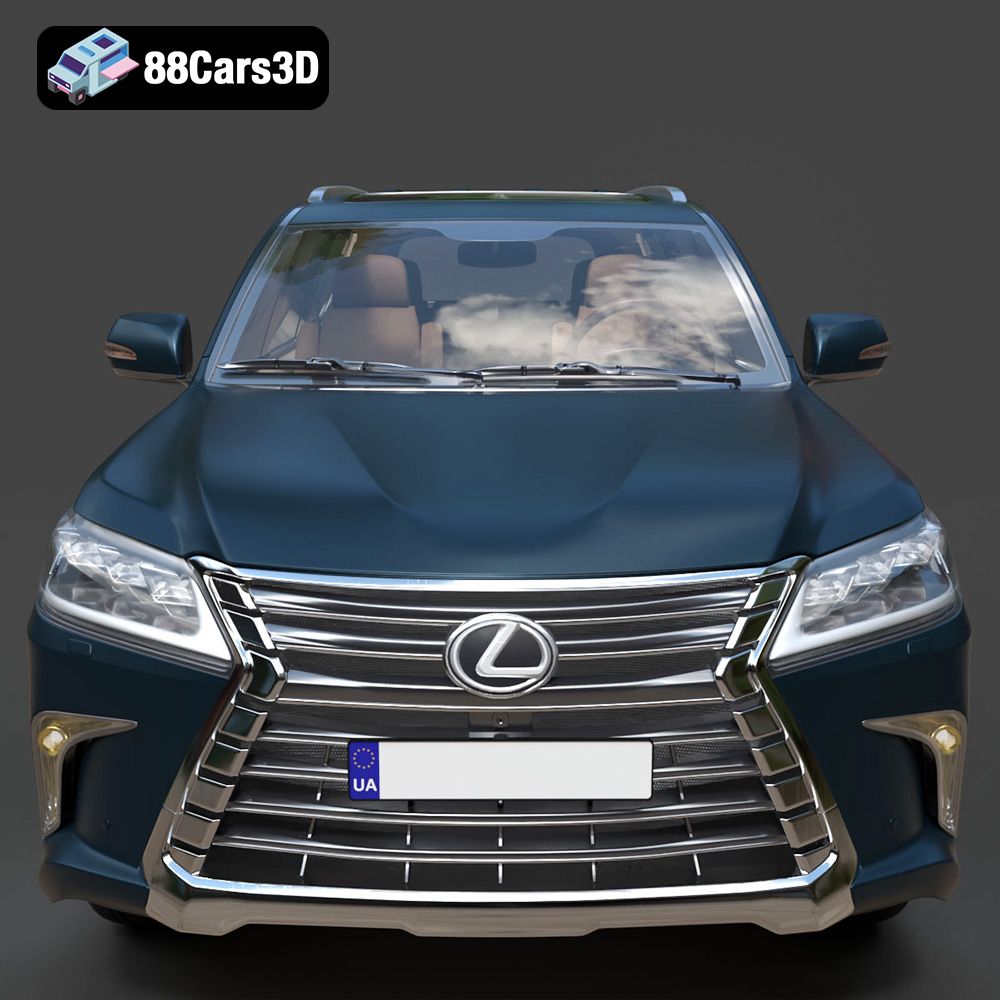
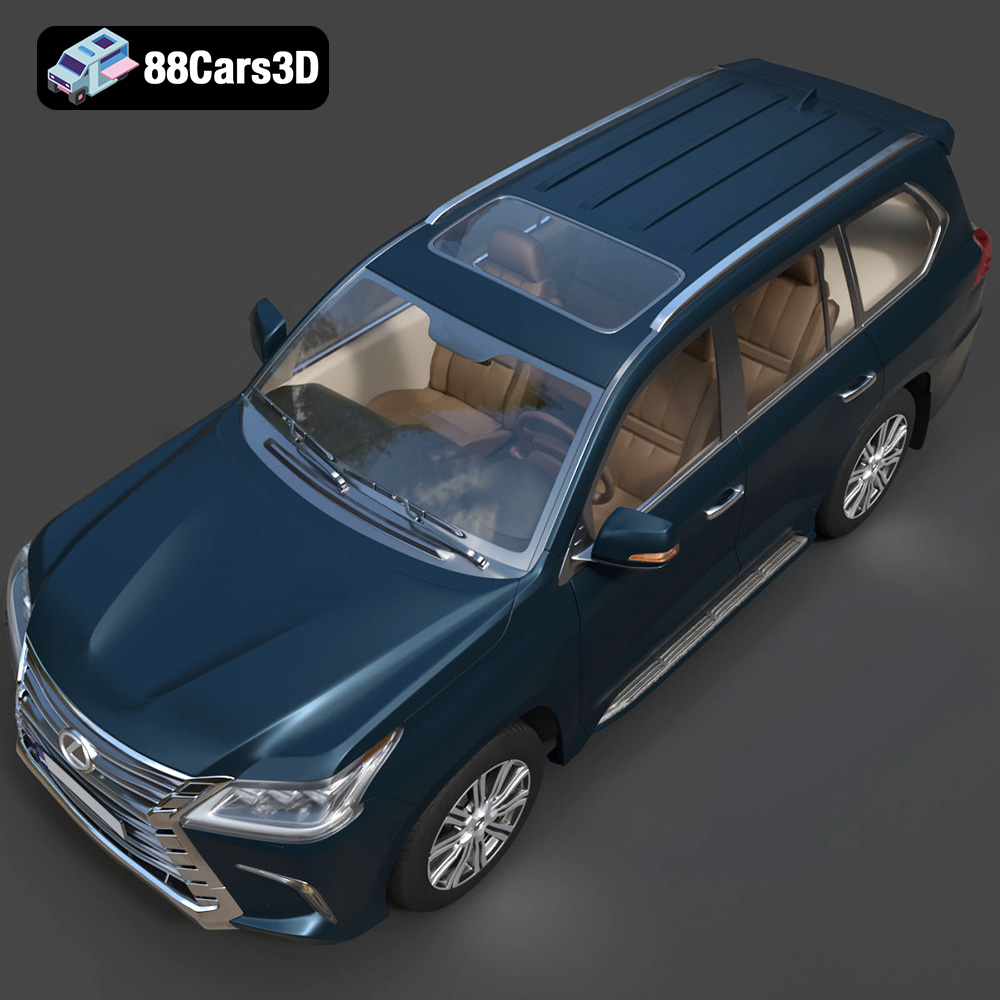
The first impression of any automotive model is its exterior, and the LX J200 does not disappoint. The model faithfully captures the imposing stance and distinctive features of the third facelift of the J200 generation. This includes the bold spindle grille, a hallmark of modern Lexus design, and the sharp L-shaped LED lighting signatures that define its aggressive yet refined character. Beyond the aesthetics, the geometry is built with precision. We’re talking about accurate frame geometry and proportions, ensuring the digital model mirrors its real-world counterpart. Details extend to the distinctive dual exhaust outlets and a detailed undercarriage, which are crucial for close-up shots or even in-game physics. The authentic 20-inch alloy wheel design and realistic tire treads are vital for ground contact and overall realism, with separate components for wheels, suspension, and steering, enabling realistic animation and dynamic simulations. Even the robust body-on-frame architecture is reflected in the suspension components, showcasing a deep understanding of the vehicle’s engineering.
The interior of a luxury SUV like the Lexus LX is just as critical as its exterior, especially for virtual showrooms, architectural visualizations, or first-person gaming perspectives. This model’s cockpit boasts premium quilted leather seating and intricate luxury trim details, bringing the essence of the real vehicle’s cabin to life. The multi-function steering wheel with wood-grain accents and the detailed analog and digital instrument cluster are faithfully recreated, along with the complete center console layout, including the infotainment screen, shift lever, and off-road controls. Crucially, while highly detailed, the interior geometry is optimized. This optimization is key for maintaining performance in real-time engines, allowing for immersive first-person POV in games without bogging down the rendering pipeline. It’s a delicate balance: enough detail to feel luxurious, but efficient enough to be rendered smoothly.
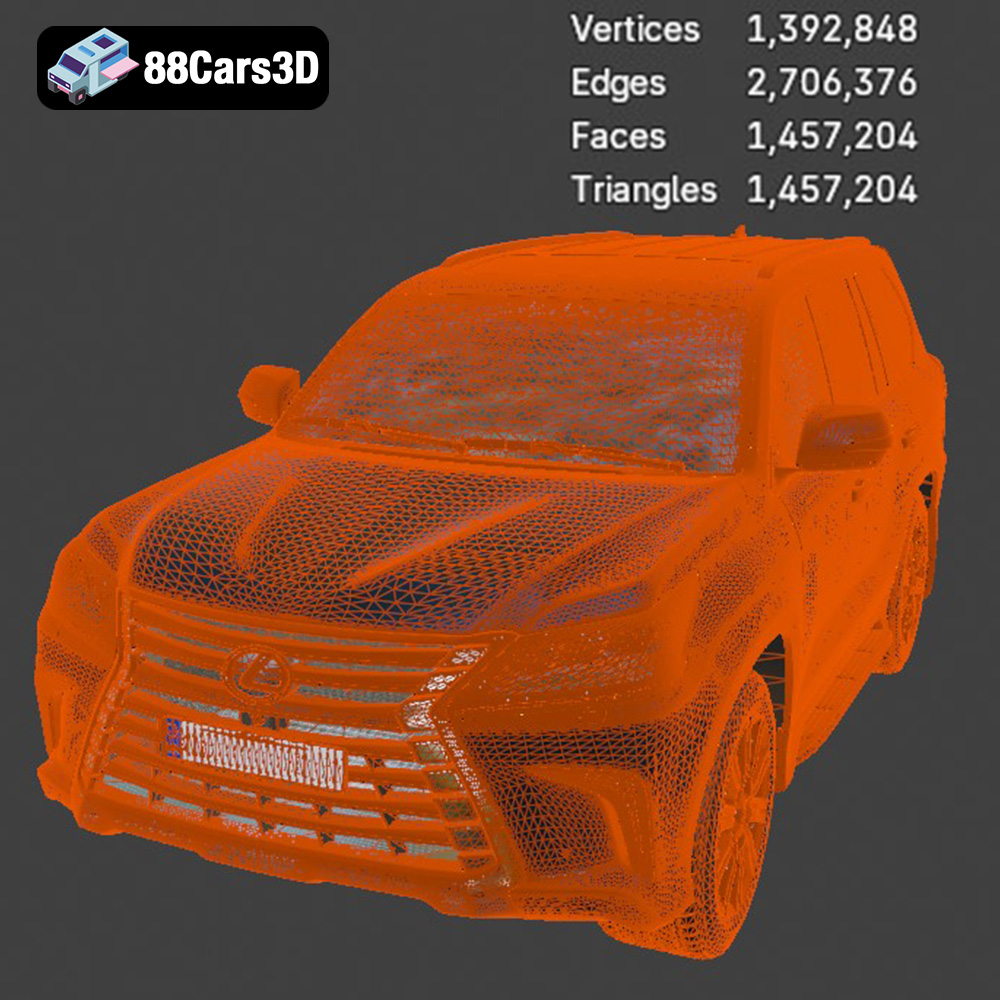
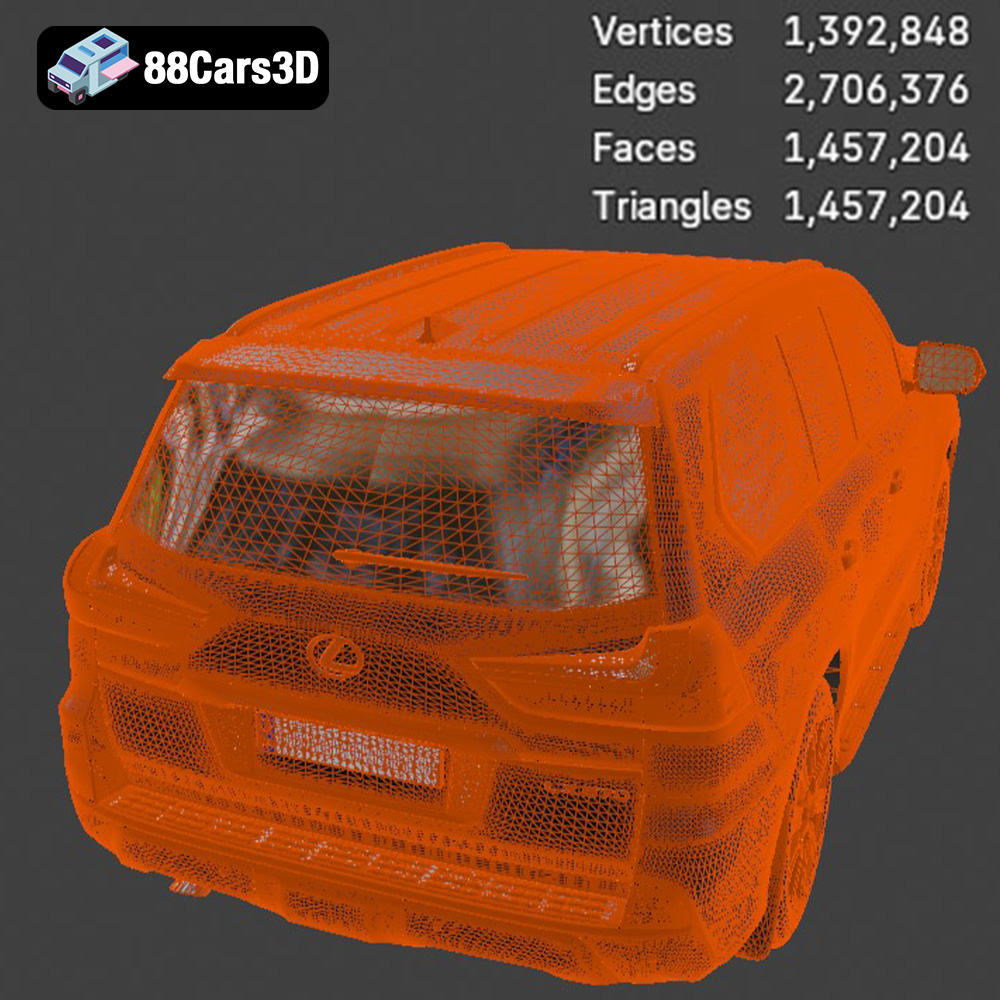
The true power of this Lexus LX 3D model lies in its technical specifications. With approximately 500,000 triangles, it strikes an optimal balance between visual realism and game-ready performance. This triangle count is significant enough to convey intricate details for high-end rendering yet optimized for smooth operation in real-time engines like Unreal and Unity. Real-world scale accuracy is maintained, based on the actual vehicle chassis, which is fundamental for seamless integration into existing scenes or CAD workflows. Furthermore, proper pivot setups for steering, wheel rotation, and suspension travel are included, which are non-negotiable for realistic animation and interactive simulations. This level of preparation ensures that the model is not just visually appealing but also functionally ready for advanced animation and physics. This versatility, packaged with multiple file formats (including .blend, .fbx, .obj, .glb, .stl, .ply, .unreal, .max), makes it an invaluable asset for any professional workflow.
A high-quality 3D asset like the Lexus LX Mk3f J200 2016 3D Model is designed to be a plug-and-play solution for various professional pipelines, significantly accelerating production times and reducing the need for costly custom modeling.
In ArchViz, realism is paramount. Architects and interior designers often require detailed automotive models to populate their scenes, providing context, scale, and a sense of lifestyle. The Lexus LX J200 model, with its accurate proportions, premium interior, and high-quality topology, is an ideal candidate. Imagine it parked majestically outside a luxury villa in a twilight render, its L-shaped LEDs casting subtle glows on the pavement. In product rendering, automotive brands or associated industries might use such models for lifestyle shots, showing accessories, or demonstrating vehicle features in a controlled, virtual studio environment. The model’s clean mesh and realistic materials allow for stunning close-ups and dramatic lighting setups, easily integrated into rendering software like V-Ray, Corona Renderer, or Arnold within 3ds Max or Blender. Its separate components mean custom animations can be easily created, perhaps showcasing the SUV pulling up to a destination or an elegant camera pan around its luxurious interior.
The “game-ready” label for the Lexus LX J200 3D Model isn’t just a marketing term; it reflects intrinsic technical advantages. Its optimized ~500k triangle count strikes a sweet spot for real-time performance. In open-world games, where dozens or hundreds of vehicles might be rendered simultaneously, efficiency is critical. The model’s proper pivot setups for steering, wheel rotation, and suspension travel are crucial for integrating physics-based vehicle systems in engines like Unreal or Unity. Developers can quickly set up car controllers, apply wheel colliders, and animate suspension using the pre-configured pivots, saving countless hours. Furthermore, with file formats like `.fbx` and `.unreal` included, importing and configuring the model’s materials, textures, and collision meshes within these engines becomes a streamlined process. This allows artists and developers to focus on gameplay mechanics and environmental design rather than remedial asset preparation.
The burgeoning fields of Augmented Reality (AR) and Virtual Reality (VR) demand highly optimized assets that can render smoothly on a variety of devices, from high-end VR headsets to mobile AR applications. The Lexus LX J200’s balanced polycount and included `.glb` format make it exceptionally well-suited for these immersive experiences. Imagine a virtual showroom where potential buyers can explore the LX J200 in 3D, change its paint color, open doors, and even sit virtually inside the cabin. For mobile AR, the `.glb` format allows for quick loading and interaction, enabling users to place the luxury SUV in their driveway via their smartphone. Its accurate scale and detailed interior make it perfect for car configurators or training simulations where a high degree of realism and interactivity is expected. The ability to manipulate individual components like wheels and steering also means more engaging interactive features can be built around the model.
In real-time environments, such as video games, simulators, and interactive visualizations, optimizing 3D assets is not merely a recommendation; it’s a necessity. The Lexus LX Mk3f J200 2016 3D Model is specifically designed with this principle at its core, offering features that cater directly to performance-critical applications.
The ~500,000 triangle count of the Lexus LX J200 model is carefully chosen. For a highly detailed modern vehicle with a full interior, this is an excellent balance. It allows for the intricate design elements of the spindle grille, detailed lighting, and luxury interior to be clearly represented without overburdening the GPU. However, for maximum performance in open-world games or scenarios with many vehicles, leveraging Levels of Detail (LODs) is crucial. While not explicitly mentioned as included, a professional model of this caliber is typically designed to facilitate the creation of LODs. Developers would generate lower poly versions of the model (e.g., 250k, 100k, 20k triangles) that swap in as the vehicle moves further from the camera, significantly reducing rendering overhead. This hierarchical optimization ensures that performance remains smooth whether the LX J200 is foreground hero or a distant vehicle in traffic.
Beyond raw geometry, texture mapping and material setup are pivotal for realistic rendering and performance. The Lexus LX J200 model’s “high-quality topology” implicitly suggests clean, non-overlapping UV maps, which are essential for applying textures without distortion and for efficient texture baking. Modern game engines and real-time renderers rely heavily on Physically Based Rendering (PBR) workflows. This means materials are defined by maps like Albedo (or Base Color), Metallic, Roughness, Normal, and Ambient Occlusion. A well-constructed 3D car model provides these texture maps or is built in a way that allows for easy generation and assignment of PBR materials. This ensures that the vehicle reacts realistically to light in any environment, from the harsh sun of a desert road to the artificial glow of a virtual showroom, contributing immensely to visual immersion and believability.
For any interactive automotive experience, animation and physics are non-negotiable. The Lexus LX J200 model comes with “proper pivot setup for steering, wheel rotation, and suspension travel,” which is a significant time-saver. This means the origin points for rotation are correctly placed at the center of each wheel, the steering column, and the suspension joints, allowing for immediate implementation of vehicle physics and animation blueprints. Additionally, for real-time interactions, collision geometry is vital. While the model provides the high-fidelity visual mesh, game engines typically require simplified, optimized collision meshes (often convex hulls or simple box shapes) that accurately represent the vehicle’s physical boundaries without the computational cost of using the detailed render mesh for physics calculations. Professionals integrating this model would create or generate these simplified collision meshes within their engine of choice, ensuring realistic interactions with the environment and other objects.
The utility of a meticulously crafted 3D car model extends far beyond traditional screen-based rendering and game development. The Lexus LX Mk3f J200 2016 3D Model exemplifies an asset designed to bridge various digital and even physical applications, catering to a diverse set of professional needs.
The immersive nature of Augmented and Virtual Reality demands assets that are both visually rich and highly optimized. For AR, the Lexus LX J200 model’s inclusion of the `.glb` format is a game-changer. This compact, self-contained file is ideal for mobile AR applications, allowing users to place a virtual LX J200 into their real-world environment via their smartphone. Imagine showcasing the vehicle’s features interactively, changing colors, or even scaling it to full size in a client’s driveway. In VR, the model can form the centerpiece of a virtual showroom, an interactive configurator, or even a driving simulation. The detailed interior, accurate proportions, and game-ready optimization ensure a smooth, high-fidelity experience that truly transports the user into the vehicle’s luxurious cabin. Professionals in automotive marketing, training, or product development will find such an asset invaluable for creating next-generation interactive experiences.
For advertising agencies, automotive studios, and visualization specialists, the Lexus LX J200 model is a powerful tool for crafting stunning static renders and animated sequences. Its accurate frame geometry, detailed exterior, and rich interior allow for photorealistic results in any rendering engine. Whether the goal is a dramatic studio shot emphasizing the vehicle’s premium finishes, a dynamic action sequence showcasing its off-road prowess, or a subtle lifestyle render integrated into an architectural scene, this model provides the necessary foundation. The separate components for wheels, suspension, and steering facilitate complex animation workflows, from simulating realistic driving dynamics to intricate camera movements around the vehicle. The capability to customize body colors, tire textures, and material finishes further enhances creative control, allowing artists to match brand guidelines or specific artistic visions effortlessly.
While primarily a digital asset, the Lexus LX J200 3D Model also offers a tangible output through 3D printing, catering to hobbyists, model makers, and even design prototyping. The inclusion of the `.stl` format makes this directly achievable. The product description provides specific print settings: recommended scales (1:12, 1:18, 1:24), layer height (0.04–0.12 mm for resin), wall thickness (1.2–2.0 mm), infill (20–30%), and the necessity of supports for detailed parts. These are crucial guidelines for successfully transforming the digital mesh into a physical object. While 3D printing typically simplifies certain fine details compared to digital renders, a well-prepared `.stl` ensures that the core form and significant features of the LX J200 are accurately reproduced. This opens avenues for creating physical display models, scale prototypes for design review, or even custom aftermarket accessories. Post-processing, including sanding, priming, and painting with authentic factory colors, can elevate the printed model to a collector’s item.
The longevity and value of a 3D automotive asset are significantly enhanced by its inherent customizability and adaptability. The Lexus LX Mk3f J200 2016 3D Model provides a solid foundation that allows professionals to tailor the asset to specific project requirements, ensuring it remains relevant across evolving digital landscapes.
One of the most powerful aspects of working with high-quality 3D models is the ability to customize them. The Lexus LX J200 model offers several key customization options that are invaluable in production. Changing body colors, for instance, is a fundamental requirement for marketing and visualization. Artists can easily swap out material colors to match factory palettes, implement custom finishes, or experiment with unique wraps for concept work. Similarly, modifying tire textures allows for adapting the vehicle to different environments, from rugged off-road variants for adventurous scenes to sleek street variants for urban settings. Adjusting material finishes – be it matte, gloss, or metallic – gives precise control over how light interacts with the vehicle’s surfaces, crucial for achieving photorealism in various lighting conditions. This flexibility means a single base model can be transformed to fit countless visual narratives without extensive re-modeling, making it an incredibly efficient asset.
The environment and lighting are as critical as the model itself in creating compelling renders and immersive experiences. With a robust asset like the Lexus LX J200, adapting lighting for different environments becomes a creative playground. In a studio rendering context, artists can experiment with complex light setups, softboxes, and HDRIs to highlight the vehicle’s contours and materials. For a game environment, the model will seamlessly integrate with the engine’s global illumination and real-time lighting systems, adapting to day-night cycles, weather effects, and specific in-game scenarios. For AR/VR, its PBR-ready materials will respond accurately to real-world lighting or virtual environment probes, ensuring believable integration. This adaptability means the model isn’t restricted to a single look but can take on new life in every unique setting you place it in, maintaining its visual integrity and impact.
The inclusion of a wide array of file formats for the Lexus LX J200 3D Model (.blend, .fbx, .obj, .glb, .stl, .ply, .unreal, .max) is a significant aspect of future-proofing. Technology and software evolve rapidly, but foundational formats tend to persist. Providing both native software files (like .blend and .max) ensures full editability and compatibility within those ecosystems, allowing for deep modifications or updates. Universal interchange formats like .fbx and .obj guarantee that the model can be imported into virtually any 3D software that might emerge or gain prominence. Specialized formats like .glb address the growing demand for web and immersive experiences, while .stl caters to the physical realm of 3D printing. This comprehensive offering minimizes the risk of obsolescence and maximizes the asset’s lifespan and utility across current and future production pipelines. Investing in a multi-format asset like this ensures that your digital library remains versatile and ready for any project the future may hold.
The world of 3D automotive modeling is a sophisticated intersection of artistic vision and technical prowess. As we’ve explored, creating and utilizing high-quality 3D car models demands an understanding of intricate geometries, optimized performance metrics, and a diverse array of file formats crucial for interoperability. Assets like the Lexus LX Mk3f J200 2016 3D Model are not merely digital replicas; they are meticulously engineered tools designed to empower professionals across game development, architectural visualization, AR/VR, and high-end rendering.
From its faithfully recreated exterior and luxurious interior to its game-ready optimization and comprehensive file format support, this model exemplifies what it means to be a professional-grade asset. It streamlines workflows, accelerates production, and provides the flexibility needed to bring complex creative visions to life. Whether you’re a game developer seeking realistic vehicles for an open-world environment, an architect populating a photorealistic render, or a marketer crafting an immersive AR experience, the right 3D car model can make all the difference. For those seeking such premium assets, marketplaces like 88cars3d.com serve as a valuable resource, offering a curated selection of models engineered to meet the rigorous demands of professional production.
Experience luxury and capability with the highly detailed Lexus LX Mk3f J200 2016 3D model. Representing the iconic third facelift of the acclaimed J200 generation, this full-size luxury SUV perfectly captures the bold spindle grille, sharp L-shaped LED lighting signatures, and robust, imposing stance. Renowned for its legendary 5.7-liter V8 engine and unmatched off-road prowess combined with premium refinement, this digital replica brings the flagship Lexus SUV to life in stunning detail.
Constructed with meticulous attention to detail, this model features game-ready optimization and a balanced triangle count for superior performance in real-time engines. It delivers incredible visual fidelity with accurate proportions, crisp exterior paneling, and high-quality topology. Designed specifically for versatile integration, it excels in demanding production environments including game development, AR/VR simulations, animation, and high-end visualization.
Perfect for open-world games, architectural visualizations, virtual automotive showrooms, and lifestyle rendering projects.
.blend, .fbx, .obj, .glb, .stl, .ply, .unreal, .max
Tags:
lexus, lx, mk3f, j200, 2016, suv, luxury-suv, game-ready, low-poly, optimized, car-3d-model, game-asset, rendering, vr-ar, blend, fbx, obj, glb, stl, ply, unreal, maxVespa VNB 125-B 3D Model 3D Printable STL
$19.99
.2016
.blend
.fbx
.glb
.lexus
.luxury suv
.lx
.max
.obj
.ply
.rendering
.stl
.unreal
car-3d-model
game asset
game-ready
j200
low-poly
mk3f
optimized
SUV
VR/AR