Get 20% OFF All Premium 3D & STL Models!

In the dynamic world of digital visualization, the demand for hyper-realistic and meticulously crafted 3D models continues to accelerate. From breathtaking cinematic renders to immersive game environments and cutting-edge AR/VR experiences, the quality of a 3D asset dictates the success of a project. At the heart of this digital transformation lies the artistry and technical precision required to bring complex subjects, like modern automobiles, to life in the virtual realm.
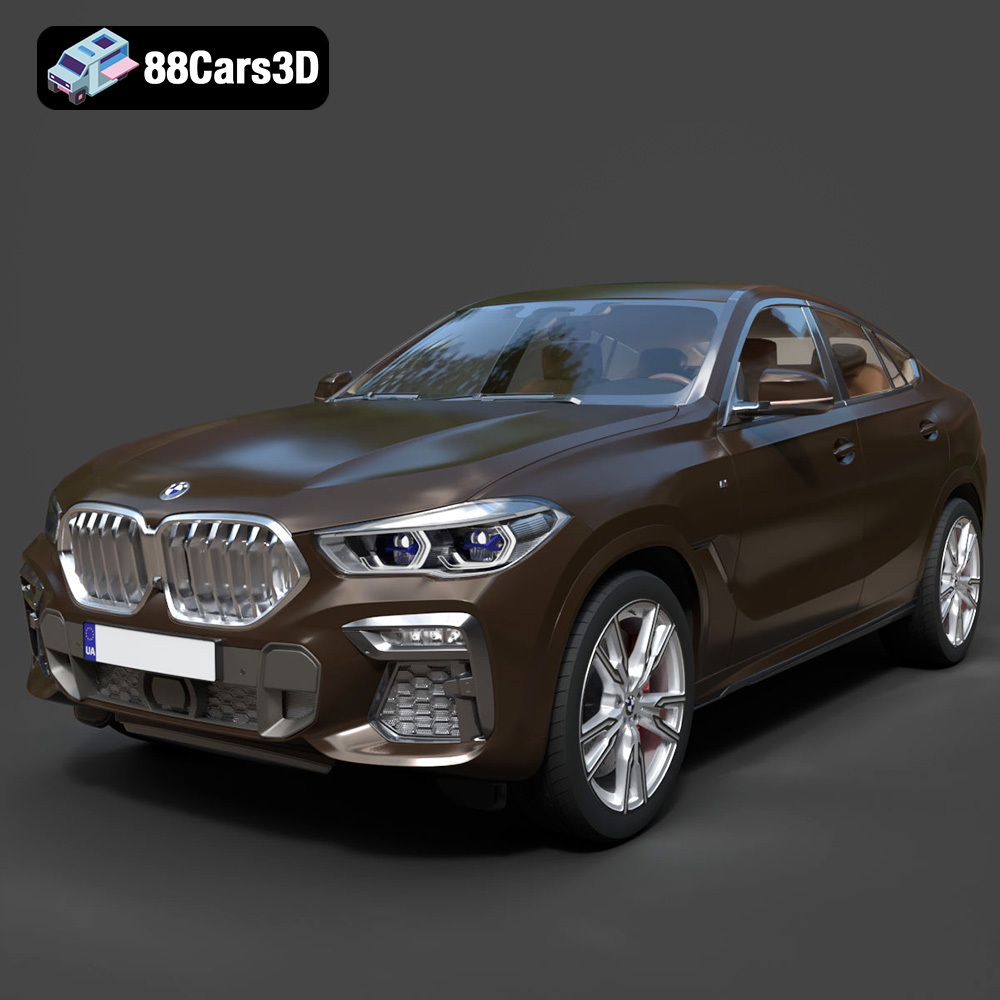
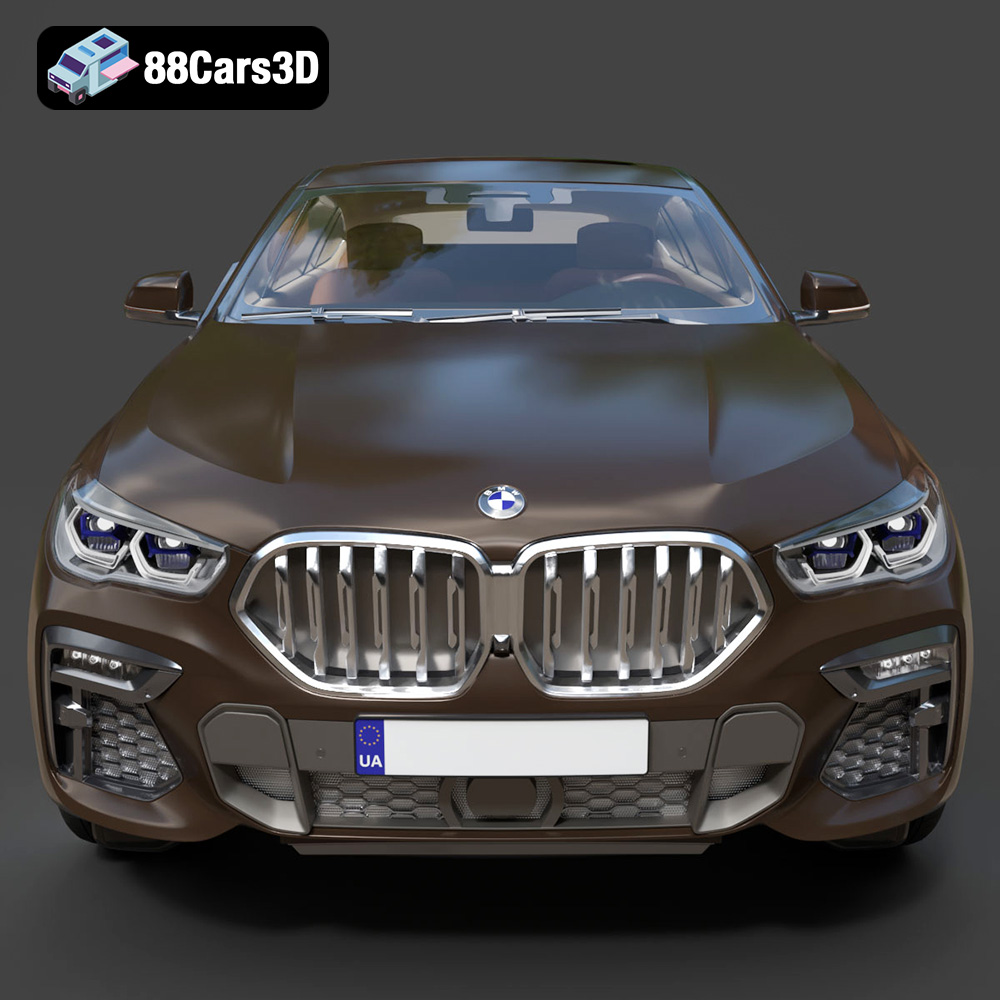
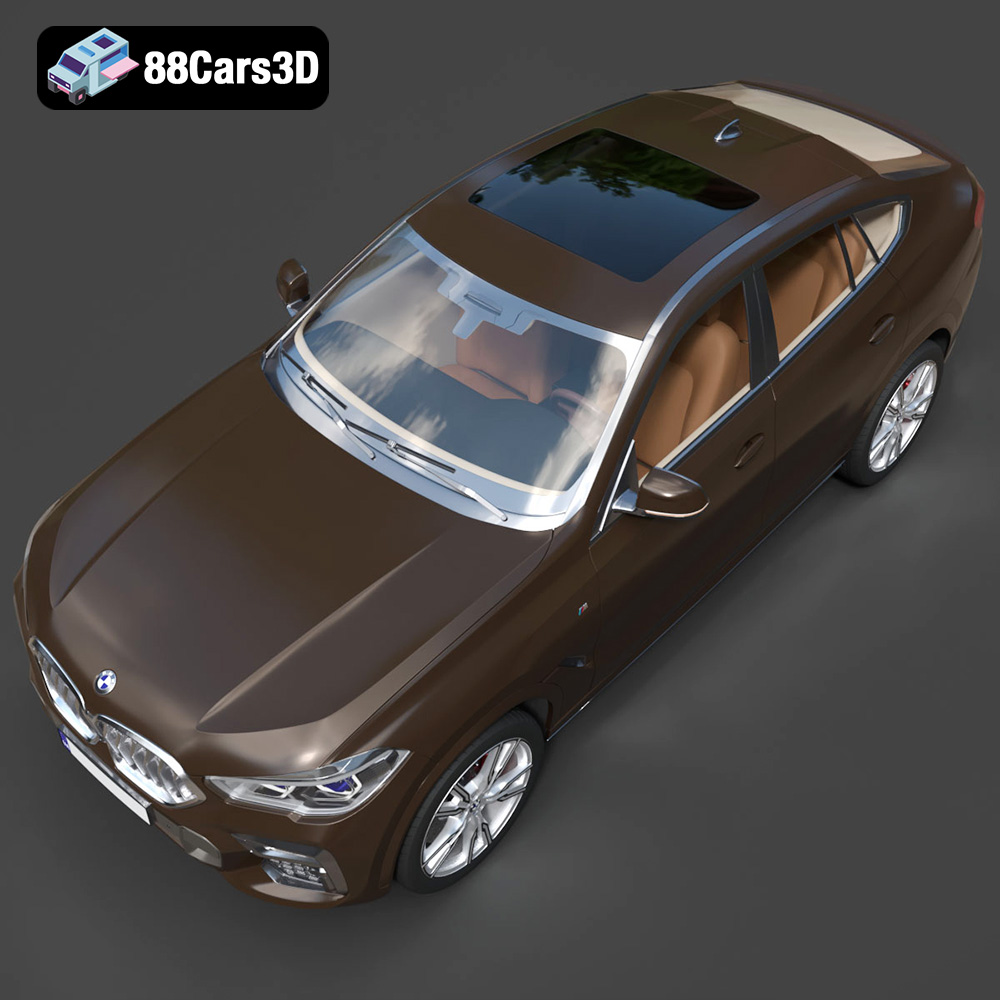
The creation of a truly exceptional 3D car model is a multi-faceted discipline, blending artistic interpretation with rigorous technical standards. It’s about more than just replicating a shape; it’s about capturing the essence, the subtle curves, the interplay of light on polished surfaces, and the functional details that define a vehicle. This level of dedication is epitomized by models such as the BMW X6 (Mk3) (G06) M Sport 2020 3D Model, a digital asset that delivers unparalleled realism and versatility for professionals across various industries.
This comprehensive guide delves into the intricate world of 3D automotive modeling, exploring the technical underpinnings, professional workflows, and diverse applications that make high-quality assets indispensable. We’ll uncover how models like the BMW X6 (Mk3) (G06) M Sport 2020 are engineered for precision, optimized for performance, and ready to integrate seamlessly into your most ambitious projects, establishing a new benchmark for 3D car models.
The versatility of any high-quality 3D model, such as the BMW X6 (Mk3) (G06) M Sport 2020 3D Model, is profoundly enhanced by its availability in a wide array of industry-standard file formats. Each format serves a specific purpose, catering to different software ecosystems, project requirements, and end-use applications. Understanding these formats is crucial for any 3D artist or developer aiming for efficient workflows and optimal performance.
The `.blend` file is Blender’s native format, acting as a complete scene container. For models like the BMW X6, a `.blend` file typically includes the entire 3D mesh, materials, textures, lighting setups, camera positions, and even animation data if present. Its primary advantage is its fully editable nature within Blender, allowing artists to easily modify geometry, adjust materials, or reconfigure scene elements. This makes it ideal for users working primarily in Blender who require maximum flexibility and direct access to all aspects of the model. Technical details often include non-destructive modifiers, node-based shaders, and fully baked or procedural textures, ensuring the model’s appearance is perfectly preserved within its native environment.
Autodesk’s `.fbx` (Filmbox) format is arguably the most widely adopted interchange format in 3D production, especially for game development with engines like Unreal and Unity, and animation pipelines. It excels at storing not just geometry, but also complex data such as skeletal animations, blend shapes, lights, cameras, and material properties. While it’s a proprietary format, its robust support across diverse software makes it a go-to for asset transfer. When using the BMW X6 in `.fbx` format, you can expect efficient import into game engines, retaining UVs, material assignments (though shaders might need rebuilding in the destination engine), and often even basic PBR (Physically Based Rendering) texture maps.
The `.obj` (Wavefront OBJ) format is one of the oldest and most universally compatible 3D file formats. It’s a simple, text-based format primarily used for storing geometric data: vertices, faces, UV coordinates, and normals. Material information is typically stored in a separate `.mtl` (Material Template Library) file referenced by the `.obj`. Its simplicity ensures broad compatibility with virtually all 3D software. For the BMW X6, the `.obj` version provides a clean mesh and UVs, making it excellent for foundational asset transfer or when you need a barebones mesh to build upon in a new software environment without carrying over complex scene data.
`.glb` (GL Transmission Format Binary) is the binary version of `.gltf` and has rapidly become the standard for 3D model delivery on the web, in augmented reality (AR), and virtual reality (VR) applications. It bundles all necessary data – mesh, textures, materials, and animations – into a single, compact file. `.glb` is designed for efficient transmission and loading, making it perfect for real-time interactive experiences where file size and performance are critical. The BMW X6 (Mk3) (G06) M Sport 2020 in `.glb` format is specifically optimized for these modern applications, ensuring smooth performance in browsers, mobile AR apps, and VR headsets.
`.stl` (Standard Tessellation Language or Stereolithography) is the dominant file format for 3D printing. It represents a 3D model as a collection of unconnected triangular facets, making no provision for color, texture, or other model attributes. Its primary use is to describe the surface geometry of a 3D object for manufacturing via additive processes. While the BMW X6 model is primarily for visualization, its availability in `.stl` means it can be directly used for rapid prototyping or creating physical miniatures, albeit without textures or internal details, demonstrating incredible versatility.
`.ply` (Polygon File Format) is another format that can store 3D data, often used in applications requiring high precision like 3D scanning, CAD (Computer-Aided Design), and scientific visualization. It can store a wide range of data including color, transparency, surface normals, texture coordinates, and even reliability information. While less common for everyday artistic rendering, its capability to accurately represent dense point clouds or detailed polygonal meshes makes it suitable for specific analytical or industrial visualization tasks, providing a robust representation of the BMW X6’s geometry.
This specific format refers to a pre-configured asset pack or project file tailored for direct import and optimal performance within Unreal Engine. It implies that the BMW X6 model has already undergone crucial steps like material setup using Unreal’s PBR workflow, potential LOD (Level of Detail) generation, collision mesh creation, and proper scaling within the engine’s coordinate system. This eliminates significant setup time for game developers, allowing immediate integration into Unreal Engine projects without extensive optimization work.
The `.max` file is the native scene format for Autodesk 3ds Max, a powerhouse in architectural visualization, animation, and high-end rendering. Similar to `.blend`, a `.max` file contains a complete scene, including geometry, materials (often V-Ray or Corona shaders), lighting, cameras, and animation. For professionals using 3ds Max, the `.max` version of the BMW X6 provides full editability and direct access to all components as intended by its creators, making it ideal for studio-grade rendering and complex animation sequences.
The inclusion of such a comprehensive selection of formats with the BMW X6 (Mk3) (G06) M Sport 2020 3D Model from 88cars3d.com underscores its value as a truly professional and adaptable asset for any digital project.
Achieving true realism in a 3D car model goes far beyond basic shape replication. It demands an intricate understanding of topology, material science, and real-world automotive design. The BMW X6 (Mk3) (G06) M Sport 2020 3D Model exemplifies this dedication, offering a blueprint for what constitutes a professional-grade automotive asset.
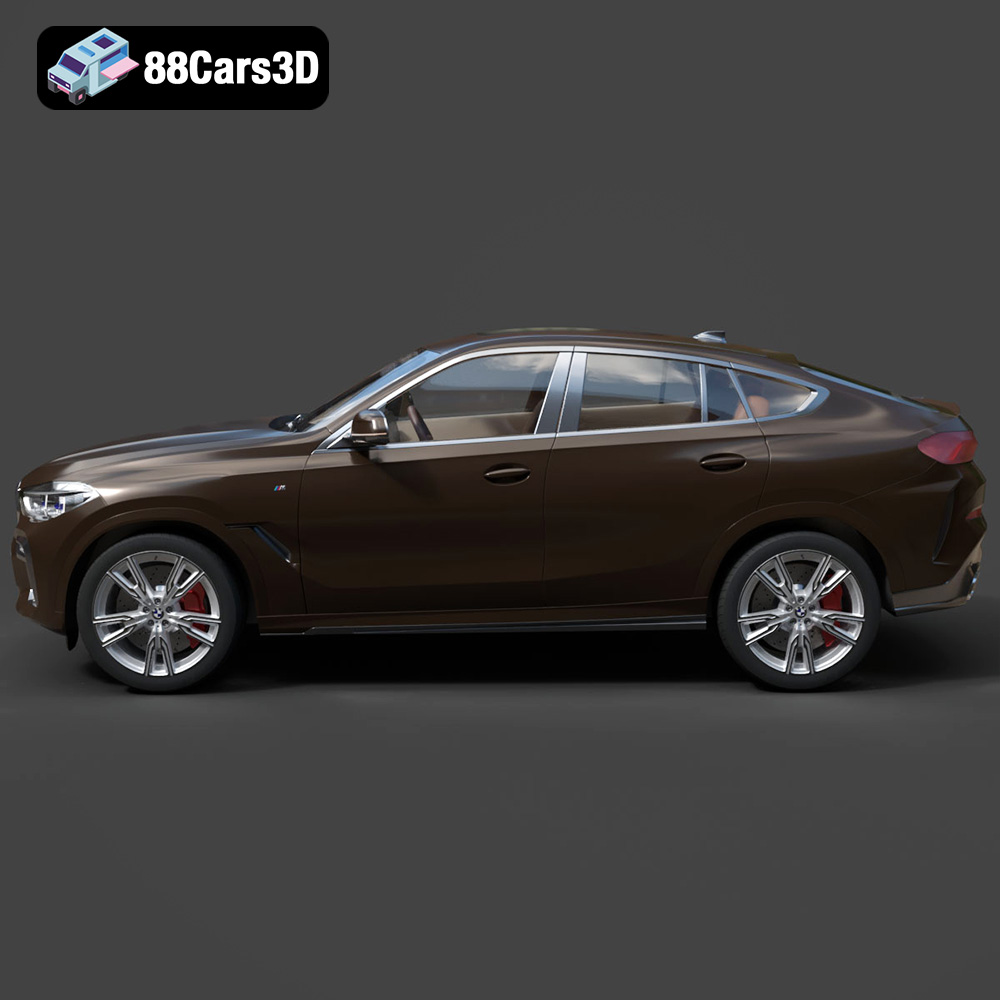
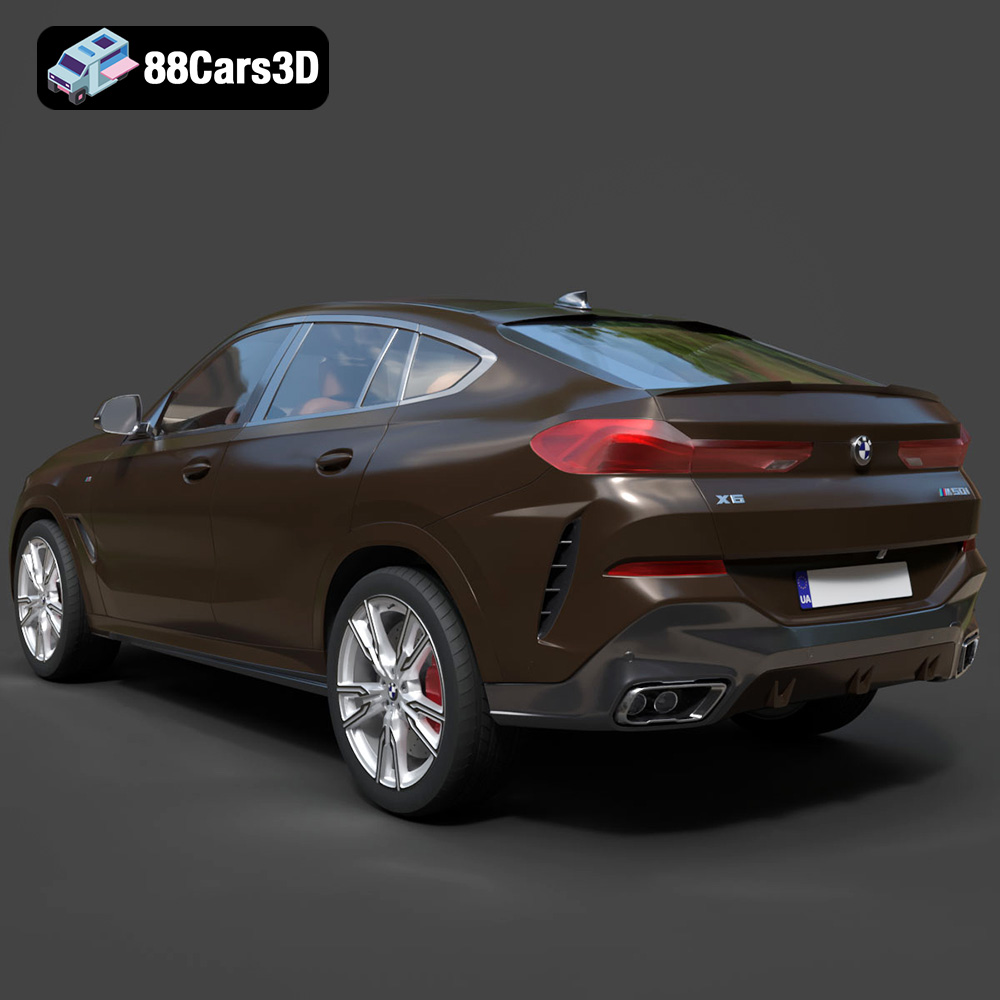
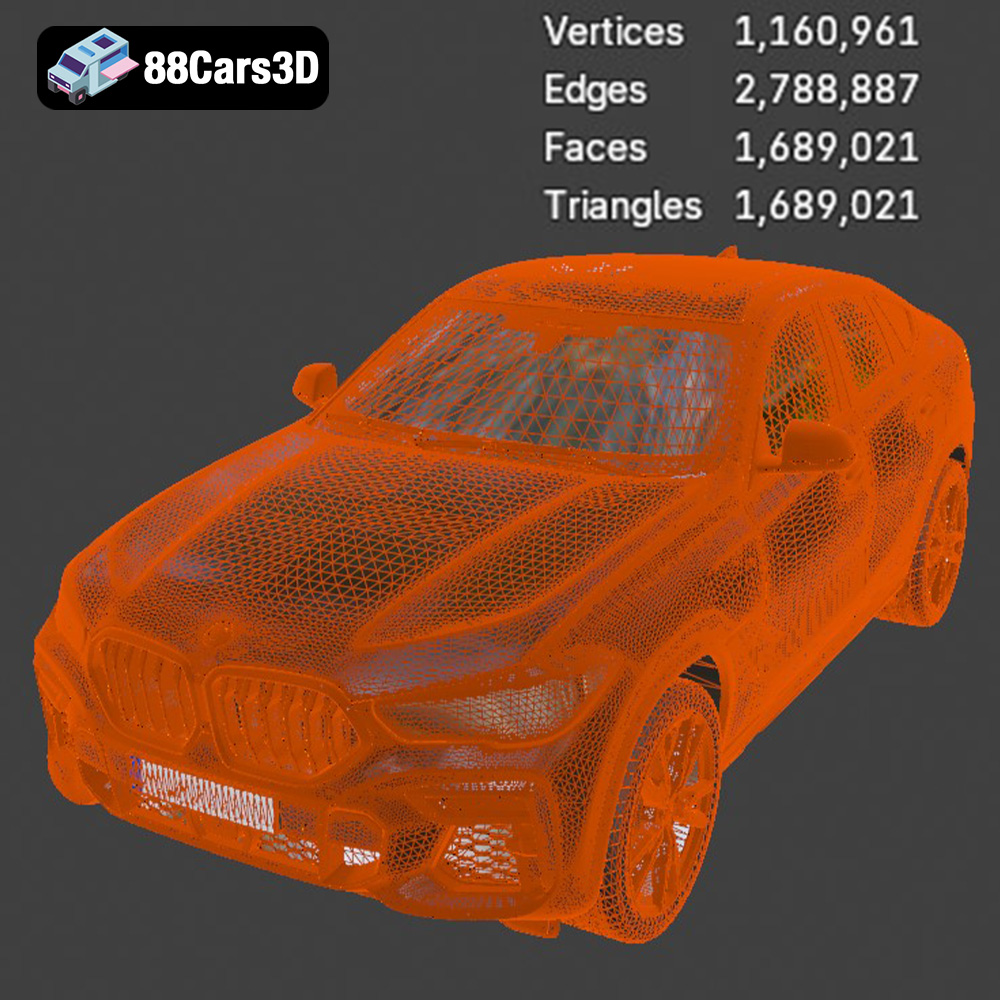
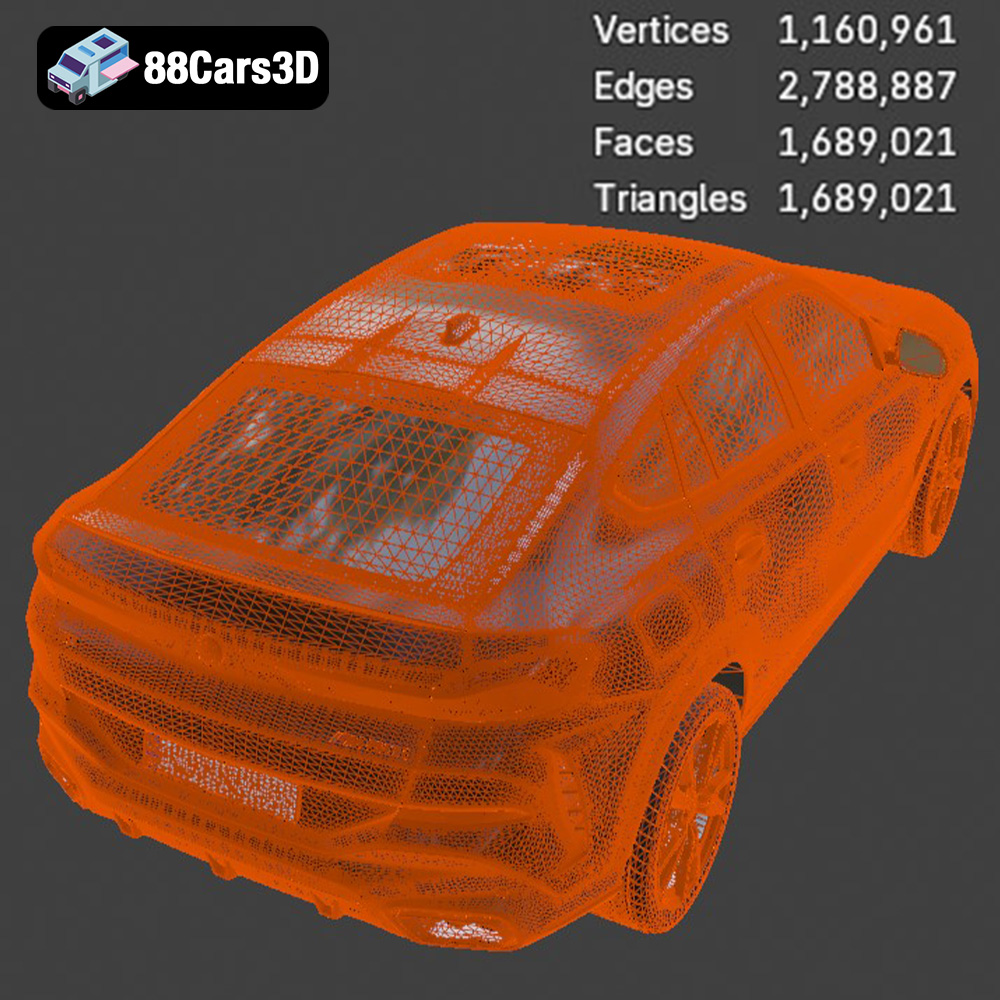
The exterior of a vehicle is its most defining characteristic, and in 3D, its accuracy is paramount. A high-fidelity model boasts “exceptionally clean geometry” and “precise edge flow.” This means the polygonal mesh is optimized, free of n-gons (polygons with more than four sides), inverted normals, or overlapping faces, which can lead to rendering artifacts. Precision in edge flow ensures that when the model is subdivided (e.g., using a Subdivision Surface modifier), the curves remain smooth and accurate, perfectly capturing the distinct proportions and aggressive styling of the BMW X6 M Sport.
Material realism is equally crucial. Modern rendering relies heavily on Physically Based Rendering (PBR) workflows, where materials like car paint, glass, chrome, and rubber accurately simulate their real-world properties. The BMW X6 model features “realistic materials that seamlessly interact with diverse lighting scenarios.” This implies carefully calibrated PBR textures for albedo (base color), roughness, metallic, normal, and perhaps even subsurface scattering for transparent elements. The result is a vehicle that looks convincingly real whether bathed in bright sunlight, ambient city glow, or dramatic studio lighting.
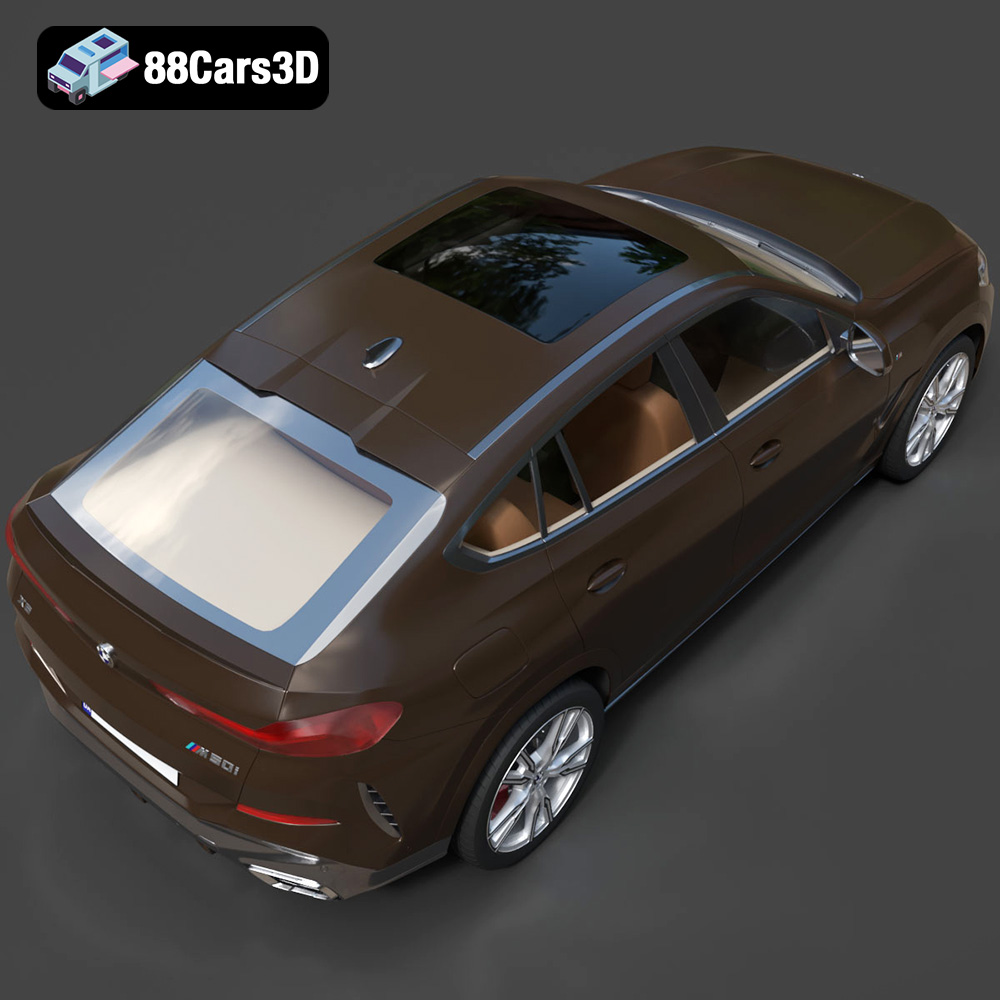
While often overlooked in distant shots, a truly professional 3D car model includes a fully detailed interior. The product description emphasizes “fully detailed interior components [that] guarantee outstanding results, even in close-up renders.” This means that from the intricate dashboard controls and stitched leather seats to the steering wheel, pedals, and door panels, every element is modeled with accuracy. Such attention to detail is vital for virtual showrooms, interactive AR/VR experiences, or cinematic sequences where the camera might linger inside the cabin.
Beyond visual fidelity, functional accuracy in modeling refers to elements being built in a way that suggests their real-world purpose. For instance, car doors might be modeled as separate elements, allowing for easy animation of opening and closing. Wheels and tires are typically separate from the body, enabling realistic suspension and steering animations. UV mapping, the process of unwrapping the 3D mesh onto a 2D plane for texture application, must be clean and organized across both exterior and interior components to facilitate flawless texture painting and decal placement without stretching or distortion.
The true value of a versatile 3D asset lies in its ability to integrate seamlessly into diverse professional pipelines. The BMW X6 (Mk3) (G06) M Sport 2020 3D Model is engineered precisely for this, supporting both high-fidelity offline rendering and optimized real-time applications.
For cinematic quality renders, product visualization, or architectural visualization, 3ds Max and Blender stand as industry titans. The inclusion of native `.max` and `.blend` files with the BMW X6 model is a significant advantage. In 3ds Max, artists can leverage powerful rendering engines like V-Ray or Corona Renderer. The `.max` file typically comes with optimized materials and lighting setups ready for immediate high-resolution output. This allows for intricate scene composition, advanced global illumination, and photorealistic effects like depth of field and motion blur. Artists can place the BMW X6 in a stunning virtual showroom, a dynamic cityscape, or a serene natural landscape, knowing the model’s quality will hold up to extreme scrutiny.
Similarly, the `.blend` file for Blender users offers immediate access to Cycles or Eevee render engines. Cycles provides unbiased, physically accurate rendering, ideal for pristine automotive imagery, while Eevee offers real-time rendering capabilities for rapid iteration and animation previews. Both environments allow artists to experiment with complex lighting scenarios – from dramatic sunset reflections to subtle studio softboxes – enhancing the X6’s already impressive material realism. The clean topology also makes it easy to apply subdivision surfaces for even smoother results without compromising performance.
The demands of real-time applications like game development, AR/VR, and interactive configurators are distinct. Here, performance is paramount, and every polygon, every texture map, must be optimized. The BMW X6 model addresses this with its `.fbx` and `.unreal` formats. The `.fbx` file, being game-engine ready, ensures proper scale, pivot points, and UVs are maintained upon import into Unreal Engine or Unity. However, the `.unreal` package takes optimization a step further.
The `.unreal` format implies that the model has been pre-configured specifically for Unreal Engine. This often includes crucial steps like Level of Detail (LOD) generation, where lower-polygon versions of the model are created to swap in dynamically based on camera distance, saving processing power. Collision meshes, essential for realistic physics and interaction, are also typically included. Materials are set up using Unreal’s PBR workflow, ensuring optimal visual quality while adhering to real-time performance budgets. This level of preparation significantly accelerates development time for studios looking to incorporate high-quality vehicles into their games or simulations, ensuring the BMW X6 performs flawlessly in a demanding real-time environment.
The utility of a high-quality 3D car model extends far beyond static renders. Its robust construction and versatile file formats open doors to advanced applications across various industries.
Augmented Reality (AR) and Virtual Reality (VR) are transforming how we interact with digital content. For automotive brands, this means virtual showrooms, interactive car configurators, and immersive driving experiences. The BMW X6 (Mk3) (G06) M Sport 2020 3D Model is perfectly suited for these environments, especially with its `.glb` format. `.glb` is optimized for web delivery and real-time performance, allowing users to experience the X6 in their own driveways via AR apps or explore its interior details in a VR headset. The model’s clean geometry and optimized materials ensure smooth frame rates and realistic visuals, providing an engaging and memorable user experience. This also extends to web-based 3D viewers, where customers can rotate, zoom, and inspect the vehicle directly in their browser without needing specialized software.
While a visually rich model, the inherent geometric accuracy of the BMW X6 also lends itself to more technical applications. For certain simulation projects, such as urban planning, traffic flow analysis, or even basic physics simulations, having accurately scaled vehicles is crucial. The `.ply` format, known for its precision in representing polygon meshes, could be leveraged in specific engineering visualization contexts where precise geometric data is needed for analysis rather than just aesthetic rendering.
Furthermore, the inclusion of the `.stl` file format means the model can be directly used for 3D printing and rapid prototyping. While a full-detail physical model might require significant preparation and support structures, the `.stl` provides a solid foundation for creating physical miniatures, mock-ups, or even components for larger prototypes. This blend of visual fidelity and foundational geometric integrity showcases the breadth of uses for a well-constructed 3D asset.
To truly appreciate the power of a premium 3D asset like the BMW X6 (Mk3) (G06) M Sport 2020, it’s helpful to visualize its deployment in real-world professional scenarios.
Imagine a global automotive brand launching a new marketing campaign for the BMW X6. Instead of costly physical photoshoots in exotic locations, a team of visualization artists leverages the 88cars3d.com model. Using 3ds Max with V-Ray or Blender with Cycles, they generate a series of stunning high-resolution images and animation sequences. The clean geometry allows for perfect reflections of virtual environments, and the realistic materials make the paint shimmer under simulated lighting. They can place the X6 on a mountaintop, cruising through a futuristic city, or parked elegantly in front of a luxury villa – all without leaving the studio. The detailed interior guarantees compelling close-ups that highlight the vehicle’s luxurious craftsmanship, creating marketing assets that are both flexible and incredibly lifelike, driving engagement and sales.
A major game studio is developing an expansive open-world racing or action-adventure title. They require a fleet of high-quality, recognizable vehicles. Integrating the BMW X6 (Mk3) (G06) M Sport 2020 3D Model via its `.unreal` or `.fbx` format streamlines their development. The pre-optimized meshes and PBR materials save countless hours of setup. Game designers can quickly populate their virtual cities or race tracks with realistic traffic, or even make the X6 a playable vehicle with custom physics and damage models. The integrated LODs ensure smooth performance even with many vehicles on screen, while the accurate exterior and interior details provide a rich, immersive experience for players. This rapid asset integration allows the development team to focus on gameplay mechanics and world-building, confident in the visual quality of their vehicles.
An architectural firm is presenting a proposal for a new luxury condominium complex, featuring underground parking and spacious driveways. To convey the scale and lifestyle associated with the project, they need realistic vehicles in their renderings. The BMW X6 (Mk3) (G06) M Sport 2020 3D Model is imported into their architectural visualization software (likely 3ds Max or Blender). The car is strategically placed within the rendered scenes, adding a crucial element of realism and context. Its sophisticated design complements the modern architecture, making the visualization more believable and aspirational. The model’s precise dimensions ensure it fits accurately within parking spaces and roadways, enhancing the overall presentation and helping clients envision the finished project more vividly.
The journey through the intricacies of high-fidelity 3D car models reveals a landscape where technical precision meets artistic vision. Assets like the BMW X6 (Mk3) (G06) M Sport 2020 3D Model are not just static objects; they are dynamic tools engineered to elevate projects across an expansive range of industries.
From the foundational importance of understanding diverse file formats like `.blend`, `.fbx`, `.obj`, and `.glb` to the meticulous crafting of exterior curves and interior details, every aspect contributes to a model’s professional-grade performance. Whether you are aiming for a breathtaking cinematic render, seamless integration into a real-time game environment, or innovative AR/VR experiences, the quality of your 3D car models is a critical determinant of success.
The BMW X6 (Mk3) (G06) M Sport 2020 3D Model stands as a testament to this commitment to excellence, providing creators with a meticulously crafted asset optimized for immediate deployment and unparalleled visual impact. For professionals seeking top-tier 3D car models that combine realism, versatility, and technical robustness, resources like 88cars3d.com offer the indispensable assets needed to bring digital visions to life with stunning accuracy and creative freedom.
Experience unparalleled realism with the BMW X6 (Mk3) (G06) M Sport 2020 3D Model. This meticulously crafted digital asset accurately replicates the distinct proportions, aggressive styling, and luxurious detailing of the renowned sports activity coupe. Engineered with precision, this model provides an exceptional level of accuracy, making it an indispensable resource for creators seeking top-tier automotive models.
Key features include exceptionally clean geometry, precise edge flow, and realistic materials that seamlessly interact with diverse lighting scenarios. The accurately modeled exterior and fully detailed interior components guarantee outstanding results, even in close-up renders. Optimized for seamless integration into various pipelines, this model sets a professional standard for 3D vehicle assets.
This versatile 3D model is ideal for a broad spectrum of applications, including advanced visualization, game development, realistic rendering, and simulation projects. Whether deployed in augmented and virtual reality (AR/VR) environments or used for cinematic productions and architectural visualizations, it delivers consistent, professional-grade performance.
The package includes a comprehensive selection of industry-standard file formats to accommodate any workflow:
$39.99
.arvr
.blend
.bmw
.car3dmodel
.fbx
.g06
.gameasset
.glb
.luxurycar
.max
.mk3
.msport
.obj
.ply
.rendering
.simulation
.sportSUV
.stl
.unreal
.x6
SUV