Get 20% OFF All Premium 3D & STL Models!

In the rapidly evolving landscape of digital visualization, the demand for realistic and technically sound 3D assets has never been higher. From breathtaking cinematic sequences to immersive virtual realities and dynamic game environments, the quality of your foundational models dictates the success of your entire project. For automotive enthusiasts, designers, game developers, and visualization artists, the allure of a perfectly replicated vehicle transcends mere aesthetics – it speaks to precision, performance, and professionalism.
At the heart of this digital revolution are meticulously crafted 3D car models, assets that serve as the backbone for countless applications. These aren’t just pretty pictures; they are complex data structures built with engineering-level accuracy, optimized for performance, and ready for integration into diverse software ecosystems. Today, we’re delving into the technical intricacies and profound impact of such assets, using the exceptional Honda Civic Si Sedan 2017 3D Model available on 88cars3d.com as our prime example. This model embodies the pinnacle of digital craftsmanship, offering unparalleled realism and versatility for any demanding production.
The pursuit of realism in digital environments hinges on the quality of source assets. For vehicles, this means going beyond a simple visual approximation to capture the true essence of design, engineering, and material properties. High-quality 3D car models are not just about polygon count; they are about intelligent mesh topology, accurate proportions, physically based materials, and comprehensive UV mapping.
In automotive design and marketing, every curve, every reflection, and every subtle shift in light needs to be perfectly represented. A high-fidelity 3D model allows designers to visualize concepts with absolute accuracy, long before physical prototypes are created. For marketing, it enables the creation of photorealistic renders and animations that are indistinguishable from real-world photography, showcasing a vehicle like the Honda Civic Si Sedan 2017 in its best light, complete with dynamic lines and iconic styling. This level of precision is critical for conveying the quality and appeal of a vehicle to potential customers or stakeholders.
Beyond aesthetics, high-quality 3D models serve as a crucial bridge in the product development lifecycle. Engineers can use them for simulations, aerodynamic testing, and ergonomic studies in a virtual space, reducing the need for costly physical iterations. For architects integrating vehicles into scenes, or filmmakers creating action sequences, a model that truly reflects the vehicle’s real-world counterpart ensures consistency and believability. The Honda Civic Si Sedan 2017 3D Model, with its accurately modeled exterior and intricately crafted interior, provides the necessary detail to ensure that digital representations stand up to rigorous scrutiny.
Time is a valuable commodity in any production pipeline. Investing in production-ready 3D assets saves countless hours that would otherwise be spent on modeling, texturing, and optimization. High-quality models come with clean geometry, professional topology, and optimized UVs, meaning they are ready to be textured, rigged, and animated with minimal fuss. Furthermore, the inclusion of realistic materials ensures that these models look great right out of the box, drastically cutting down on setup time for rendering or real-time integration. This efficiency is a core reason why professional studios rely on trusted sources like 88cars3d.com for their 3D car models.
The versatility and utility of a 3D model are often defined by the file formats it supports. Different formats are optimized for different stages of a workflow, from initial modeling and animation to game engine integration and specialized applications like 3D printing or AR/VR. Understanding these distinctions is crucial for anyone working with digital assets. The Honda Civic Si Sedan 2017 3D Model offers a comprehensive suite of formats, ensuring seamless integration into virtually any professional pipeline.
The .blend format is Blender’s native file type, containing an entire scene with all associated data: meshes, materials, textures, animations, lighting, cameras, and even physics simulations. For artists primarily working within Blender, this format offers the most flexibility, as it retains all the original modifiers, rigging, and internal node-based material setups. This makes it ideal for artists who wish to dissect, learn from, or heavily customize the model. The .blend file for the Honda Civic Si Sedan 2017 3D Model is fully editable and includes its materials and lighting setup, providing a perfect starting point for any Blender-centric project.
.fbx (Filmbox) is a proprietary format developed by Autodesk, serving as a robust standard for exchanging 3D data between various software applications like 3ds Max, Maya, Unity, and Unreal Engine. It supports not only geometry but also animations, rigs, cameras, and lights, making it incredibly powerful for complex scene transfers, especially in game development. The .fbx version of the Civic Si is game-engine ready, optimized for real-time performance. Conversely, .obj (Wavefront OBJ) is a more universal, simpler format primarily focused on geometry (vertices, normals, UVs) and material references. While it doesn’t support animation or rigging, its widespread compatibility makes it a safe bet for ensuring a model can be opened and used in virtually any 3D software on the market. It’s an excellent fallback for basic mesh import and texturing across different pipelines.
.glb (GL Transmission Format Binary) is a relatively newer format gaining significant traction, particularly for web-based 3D, augmented reality (AR), and virtual reality (VR) applications. It’s essentially a binary version of glTF, bundling all textures and other assets directly into a single file, making it incredibly efficient for delivery over the web. Its optimization for real-time rendering and small file size makes it perfect for displaying the Honda Civic Si Sedan 2017 in interactive web viewers or AR experiences. .ply (Polygon File Format), also known as the Stanford Triangle Format, is primarily used for storing 3D data from 3D scanners. It’s excellent for precise mesh information, often including color per vertex, normal information, and sometimes even confidence values. While less common for general design, it’s a precision mesh format valuable for detailed analysis, scientific visualization, or highly accurate CAD workflows where the fidelity of scan data is paramount.
The .unreal format refers to assets specifically configured and optimized for direct import into Unreal Engine. This often implies proper scaling, collision setups, and material configurations that adhere to Unreal’s physically based rendering (PBR) pipeline, saving developers significant setup time. The pre-configured .unreal version of the Civic Si ensures a smooth, drag-and-drop experience in your Unreal projects. .stl (Stereolithography) is the de-facto standard for 3D printing. It represents a 3D model as a collection of unconnected triangular facets, making it simple and robust for additive manufacturing. While it lacks color or texture information, it’s indispensable for creating physical prototypes or models of the Civic Si. Finally, .max is Autodesk 3ds Max’s native project file. Like .blend, it retains all scene data, including modifiers, animation, and V-Ray or Corona materials, making it fully editable for users of 3ds Max, especially for high-end rendering and animation tasks.
What truly sets a premium 3D car model apart is the meticulous attention to detail and technical craftsmanship. The Honda Civic Si Sedan 2017 3D Model from 88cars3d.com exemplifies this dedication, built to exceed the expectations of even the most demanding professionals.
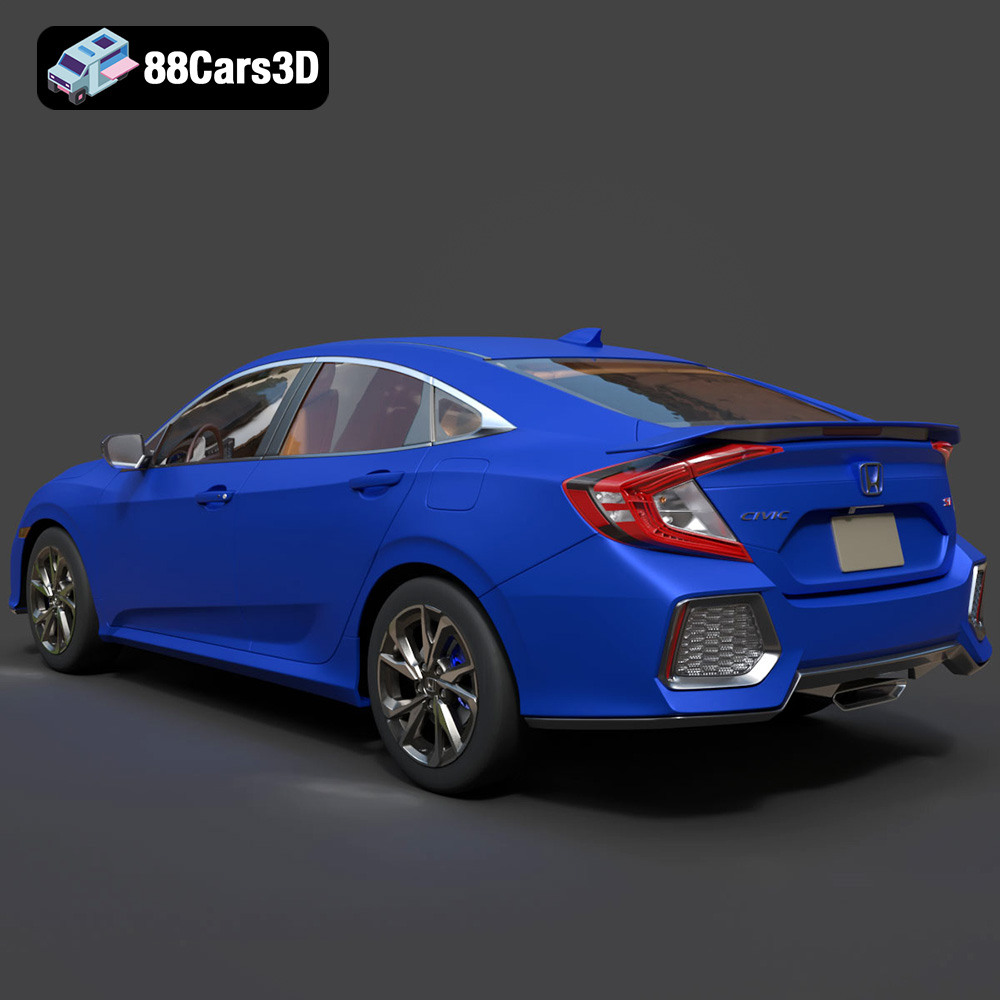
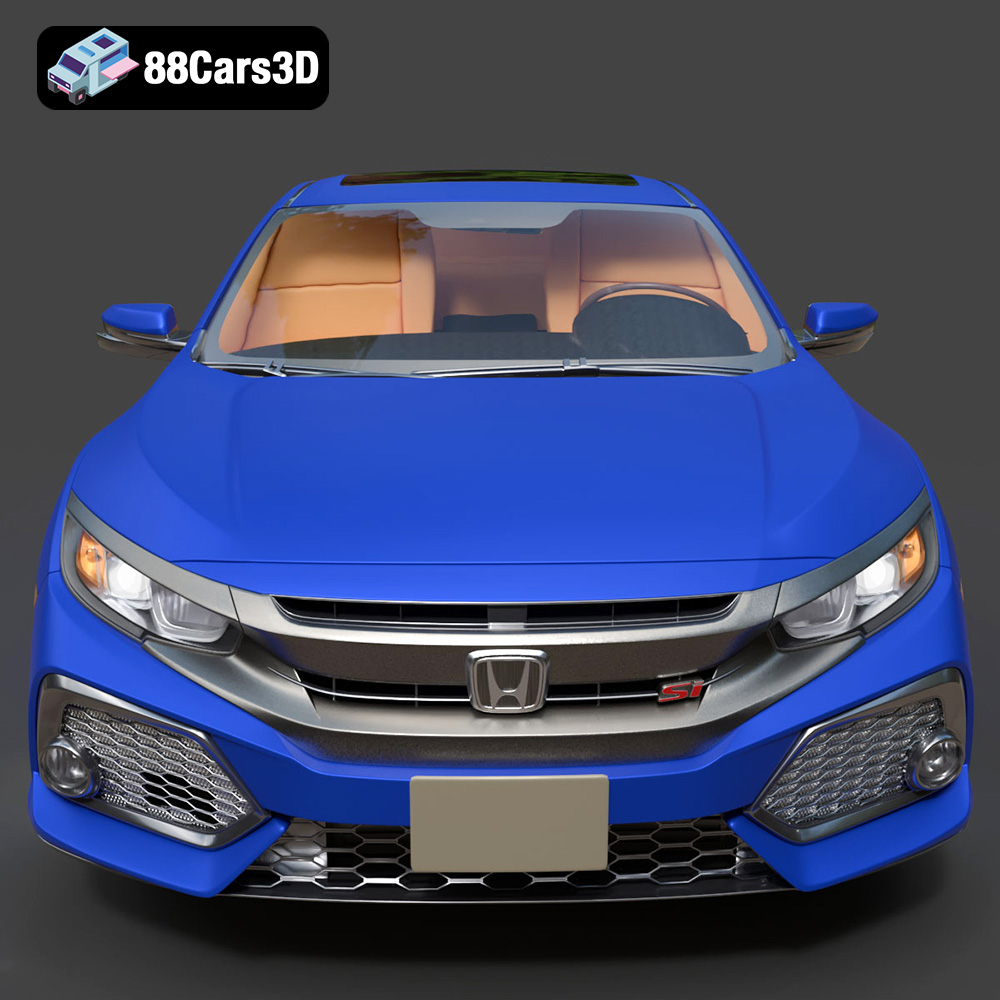
The exterior of the Honda Civic Si Sedan 2017 is iconic, known for its sporty yet sophisticated presence. This 3D model captures every nuance, from the aggressive front fascia and distinctive grille to the sleek body lines and prominent rear spoiler. The model accurately reflects the original vehicle’s precise proportions and dynamic contours. Careful attention has been paid to elements like headlight and taillight assemblies, wheel designs, and subtle aerodynamic elements, ensuring that close-up renders reveal no imperfections and maintain absolute authenticity. This level of detail is crucial for projects requiring photorealistic visual fidelity.
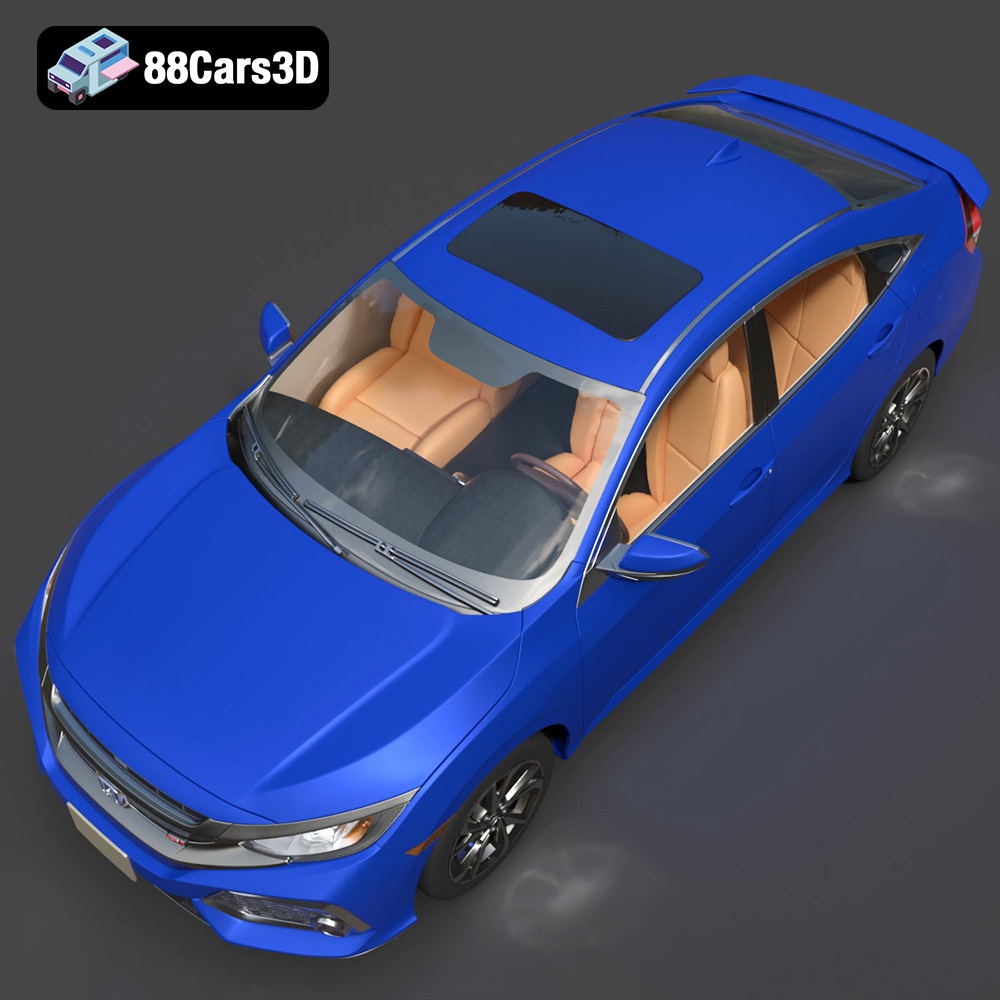
While often overlooked in basic models, a high-quality interior is paramount for truly immersive experiences, especially in virtual reality, architectural visualizations, or cinematic sequences where the camera might peek inside. The Honda Civic Si Sedan 2017 3D Model boasts an accurately crafted interior, suitable not just for distant shots but for demanding close-up renders. This includes details like dashboard layout, steering wheel, seats with realistic stitching, door panels, and even control knobs. Such intricate modeling provides a comprehensive asset that can be used for virtual showrooms, driving simulations, or character interaction scenes without compromising visual integrity.
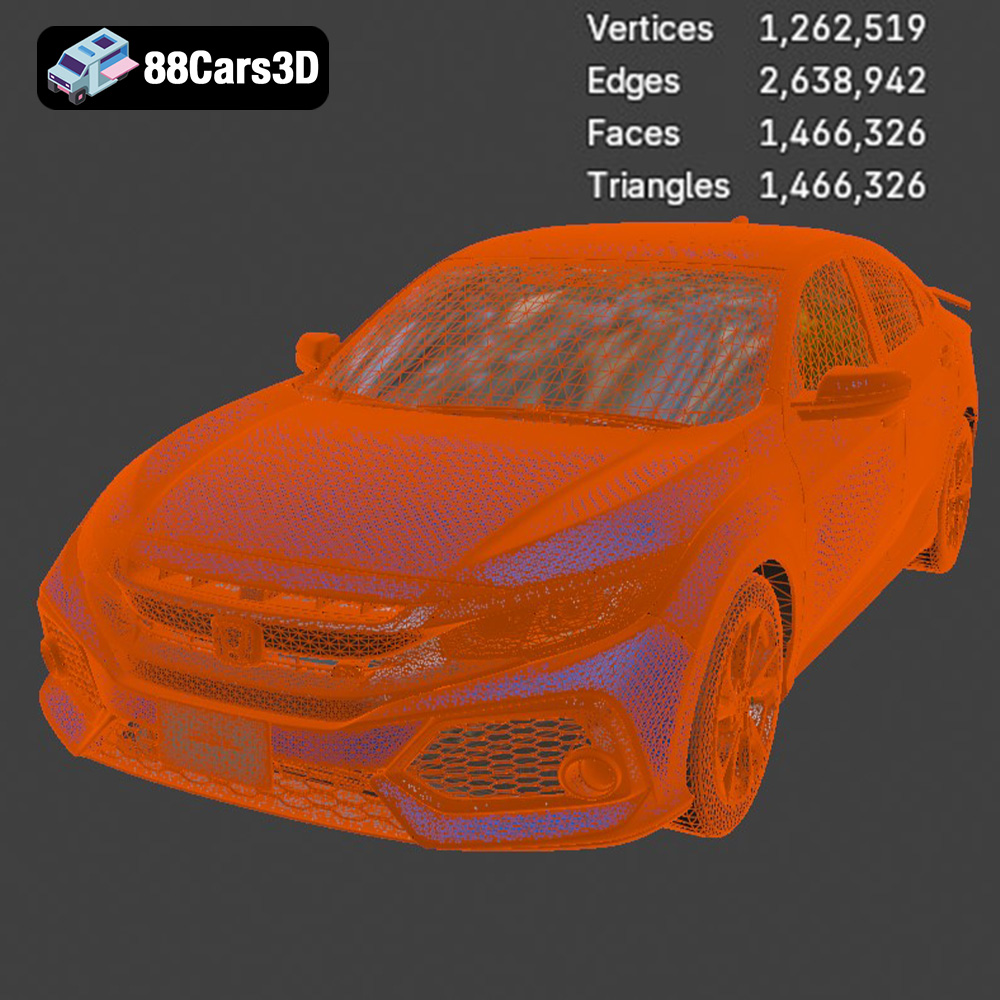
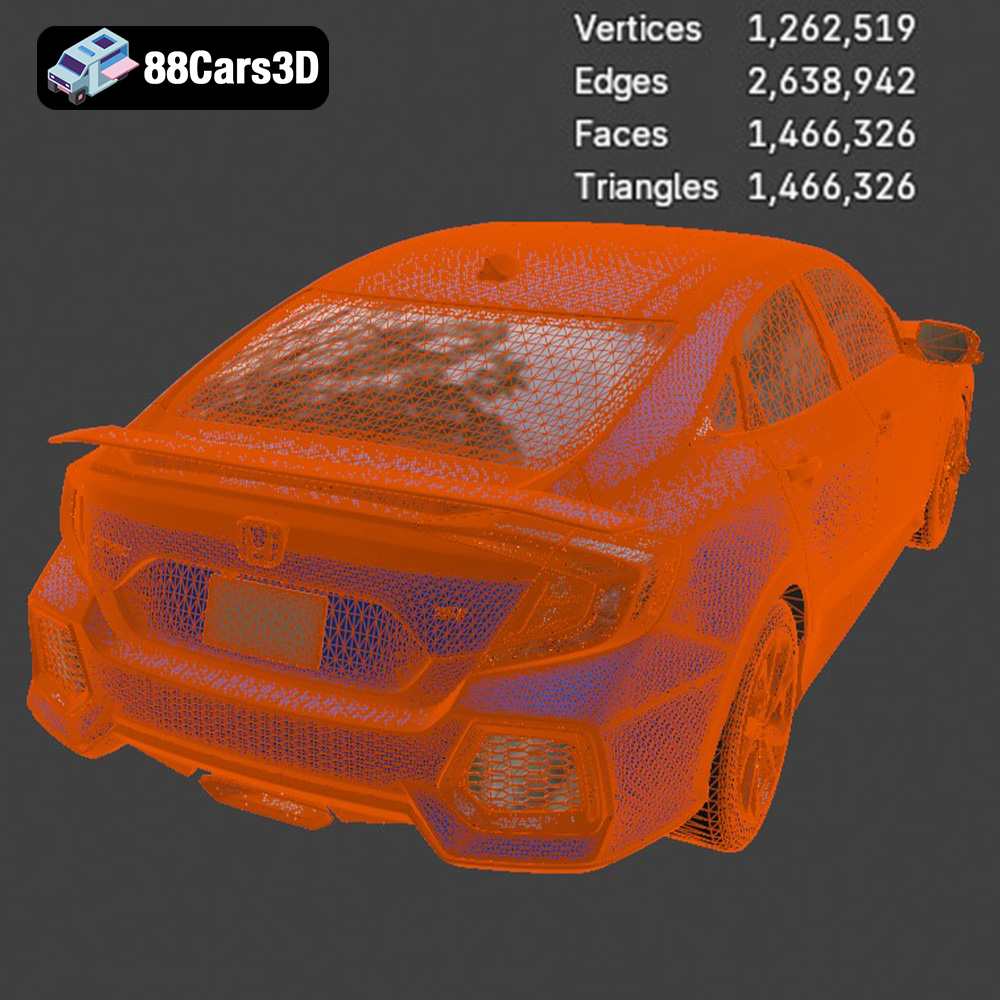
Underneath the stunning visuals lies a foundation of technical excellence. The model is engineered with clean geometry, meaning an absence of non-manifold edges, flipped normals, or excessive polygon density where it’s not needed. This clean mesh is complemented by professional topology, which refers to the strategic arrangement of polygons to ensure smooth deformations during animation and efficient subdividing for high-resolution renders. Furthermore, the inclusion of realistic materials—calibrated for physically based rendering (PBR)—ensures that surfaces react to light exactly as they would in the real world. From the metallic sheen of the paint to the subtle reflections on the glass and the texture of the interior fabrics, these materials provide immediate visual authenticity and greatly streamline the rendering process across various software platforms.
The true value of a versatile 3D asset lies in its seamless integration into diverse professional workflows. The Honda Civic Si Sedan 2017 3D Model is designed for maximum compatibility and efficiency across leading industry software, making it an invaluable tool for various creative and technical endeavors.
For high-end automotive rendering, the `.max` file for 3ds Max users and the `.blend` file for Blender artists offer native compatibility. In 3ds Max, artists can leverage powerful renderers like V-Ray or Corona to create stunning photorealistic imagery. The pre-configured materials in the `.max` file mean less setup time, allowing focus to shift to lighting, camera angles, and scene composition. Similarly, Blender users can utilize Cycles or Eevee for breathtaking renders, benefiting from the editable scene with materials and lighting setup provided in the `.blend` file. Both environments allow for intricate control over reflections, refractions, and global illumination, pushing the boundaries of visual realism for the Honda Civic Si Sedan 2017.
Game developers demand optimized assets that perform flawlessly in real-time environments. The `.fbx` and `.unreal` formats included with the Honda Civic Si Sedan 2017 3D Model are specifically tailored for game engine integration. The `.fbx` file is universally recognized by both Unreal Engine and Unity, providing a robust transfer of mesh data, UVs, and basic material assignments. For Unreal Engine users, the `.unreal` file offers a distinct advantage, often meaning the asset is already scaled correctly, has appropriate collision meshes, and basic PBR materials configured, drastically accelerating the import and setup process. This allows developers to quickly populate their virtual worlds with a high-fidelity car model, whether for racing games, open-world environments, or interactive architectural walkthroughs.
The burgeoning fields of Augmented Reality (AR) and Virtual Reality (VR) require highly optimized models that maintain visual quality while ensuring smooth performance. The `.glb` format is a game-changer here, providing a compact, single-file solution ideal for web-based AR/VR experiences or applications. Its efficiency means faster load times and smoother interactions when presenting the Honda Civic Si Sedan 2017 in a virtual showroom or an interactive product configurator. For real-time architectural visualization or product demonstrations, the lightweight and efficient `.glb` alongside the `.fbx` (for desktop applications) allows for dynamic, interactive presentations where users can explore the model from all angles, opening doors to new forms of engagement and decision-making processes.
The versatility of a high-quality 3D car model like the Honda Civic Si Sedan 2017 extends across a multitude of industries, enabling innovative solutions and captivating experiences. Its application goes beyond simple imagery to facilitate complex interactive and analytical tasks.
Imagine launching a new marketing campaign for a vehicle, where every shot needs to convey sophistication and performance. Using the Honda Civic Si Sedan 2017 3D Model, automotive brands and advertising agencies can create stunning photorealistic images and cinematic animations without the logistical challenges and costs associated with real-world car shoots. From studio-style glamour shots with custom lighting to dynamic action sequences in impossible environments, the model provides complete creative freedom. This empowers marketers to generate high-impact visuals that resonate with their target audience, showcasing the car in ideal conditions, every time.
Beyond marketing, realistic 3D car models are vital for simulations and training. Driving simulators for professional training or entertainment can integrate the Civic Si model to provide a highly immersive and accurate virtual driving experience. Engineering and technical training modules can use the model to allow users to virtually inspect components, understand assembly processes, or practice maintenance procedures in a safe, controlled digital environment. The accurately crafted interior of the Honda Civic Si Sedan 2017 3D Model, for instance, makes it ideal for familiarizing trainees with dashboard controls and cabin ergonomics, enhancing the effectiveness of the training.
The inclusion of the `.stl` format opens up possibilities for rapid prototyping and physical visualization. Designers can quickly iterate on custom accessories, body kits, or even scaled-down replicas of the Honda Civic Si Sedan 2017 using 3D printing. This allows for tangible evaluation of designs, fitment testing, or creation of promotional merchandise. Furthermore, the fully editable `.blend` or `.max` files provide a clean base for digital customization, enabling artists to create bespoke versions of the car, experimenting with different colors, wheel designs, or even structural modifications for specialized projects, all within the digital realm before committing to physical production.
The journey from a digital concept to a tangible, immersive experience is paved with high-quality assets. The Honda Civic Si Sedan 2017 3D Model stands as a testament to this principle, offering a meticulously crafted digital twin that transcends mere aesthetics. With its clean geometry, professional topology, realistic materials, and an extensive array of industry-standard file formats—including .blend, .fbx, .obj, .glb, .stl, .ply, .unreal, and .max—it provides an unparalleled foundation for any project.
Whether your goal is to produce stunning automotive rendering, develop cutting-edge game assets, create immersive AR/VR experiences, or perform precise technical visualizations, this model from 88cars3d.com is engineered to deliver. It significantly reduces production time and costs while elevating the visual fidelity of your work to professional standards. By leveraging assets of this caliber, you not only meet but exceed the demands of today’s dynamic digital landscape, bringing your visions to life with accuracy and breathtaking realism.
Experience unparalleled realism with the Honda Civic Si Sedan 2017 3D Model. This exceptionally detailed asset has been accurately modeled to represent the iconic exterior styling, dynamic lines, and precise proportions of the original vehicle. Engineered with clean geometry, professional topology, and realistic materials, this model delivers outstanding performance across various digital environments. It includes an intricately modeled exterior and an accurately crafted interior suitable for close-up shots and demanding rendering scenarios. Whether you are working on advanced game development, automotive rendering, AR/VR experiences, or technical visualization, this model provides the accuracy and fidelity required for top-tier digital productions. This versatile package includes multiple industry-standard file formats to ensure seamless integration into your workflow: .blend – Editable Blender file with materials and lighting setup; .fbx – Game-engine ready format for Unreal Engine and Unity; .obj – Standard 3D model format compatible with all major software; .glb – Optimized for AR/VR and web-based visualization; .stl – Suitable for 3D printing and prototyping; .ply – Detailed polygon mesh for analysis and visualization; .unreal – Pre-configured for Unreal Engine use; .max – Editable 3ds Max file for rendering and animation.
$39.99
.arvr
.blend
.car3dmodel
.civic
.compactcar
.fbx
.gameasset
.glb
.honda
.max
.obj
.ply
.rendering
.sedan
.si
.simulation
.stl
.unreal