Get 20% OFF All Premium 3D & STL Models!

In the expansive world of 3D visualization and simulation, the demand for highly detailed and authentic vehicle models continues to grow. Whether you’re crafting an immersive open-world game, developing a cutting-edge AR/VR experience, or producing a high-fidelity automotive rendering, the quality of your assets dictates the success of your project. Few vehicles embody the spirit of adventure and rugged capability quite like the BMW R1150GS Adventure, especially when it’s custom-fitted with a heavy-duty sidecar for ultimate overland exploration. This iconic dual-sport motorcycle, renowned for its boxer twin engine and shaft drive, transforms into an all-terrain expedition rig, promising untold stories of digital journeys.
For 3D artists, game developers, and visualization specialists, the challenge lies in finding models that not only capture this spirit visually but also integrate seamlessly into diverse production pipelines. This is precisely where a meticulously crafted asset like the Custom Off-Road BMW R1150GS Adventure Sidecar 3D Model from 88cars3d.com stands out. Designed with both visual fidelity and optimal performance in mind, this premium model offers an unparalleled foundation for a wide array of digital applications, from post-apocalyptic survival games to intricate architectural visualizations that require a dynamic focal point.
Creating a compelling 3D model, especially for a complex machine like a motorcycle with a sidecar, involves a delicate balance between artistic interpretation and technical precision. The goal is to evoke the real-world feel and functionality while ensuring the model performs flawlessly within various digital environments. The Custom Off-Road BMW R1150GS Adventure Sidecar 3D Model exemplifies this philosophy, offering a wealth of detail coupled with intelligent optimization.
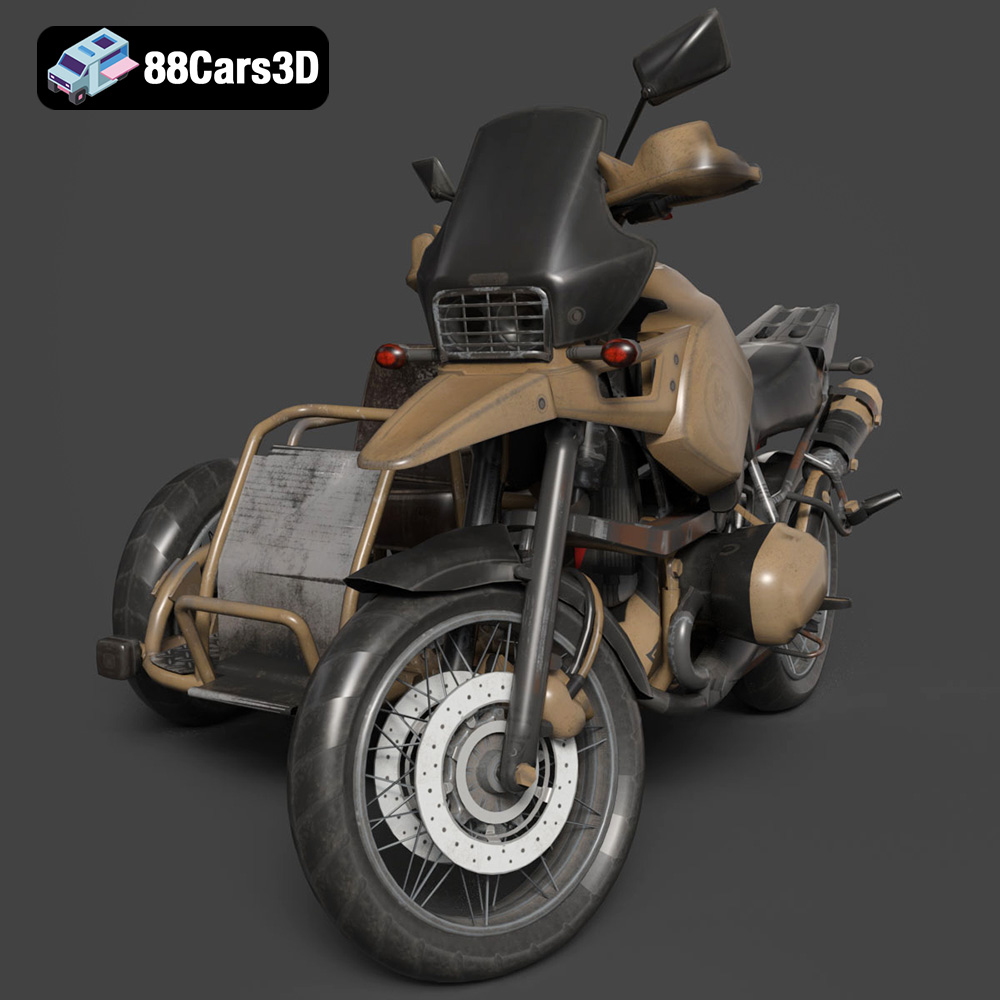
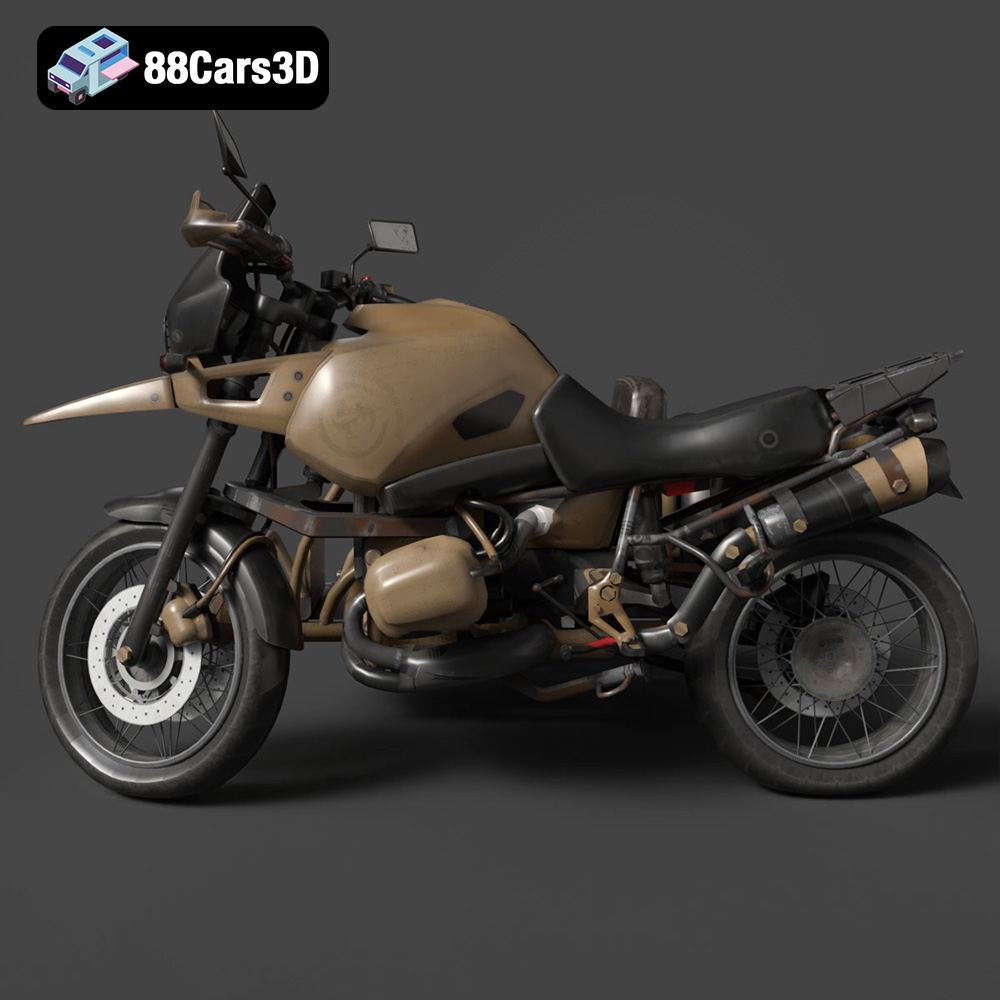
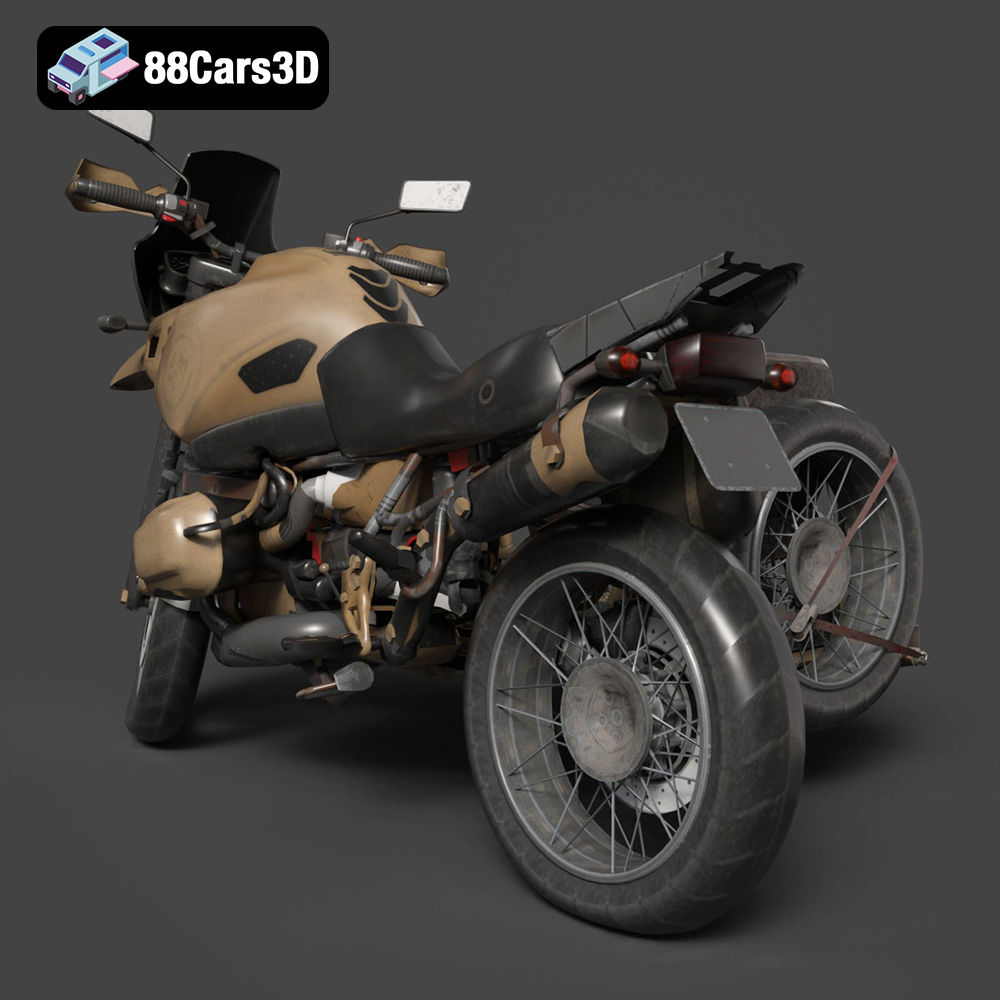
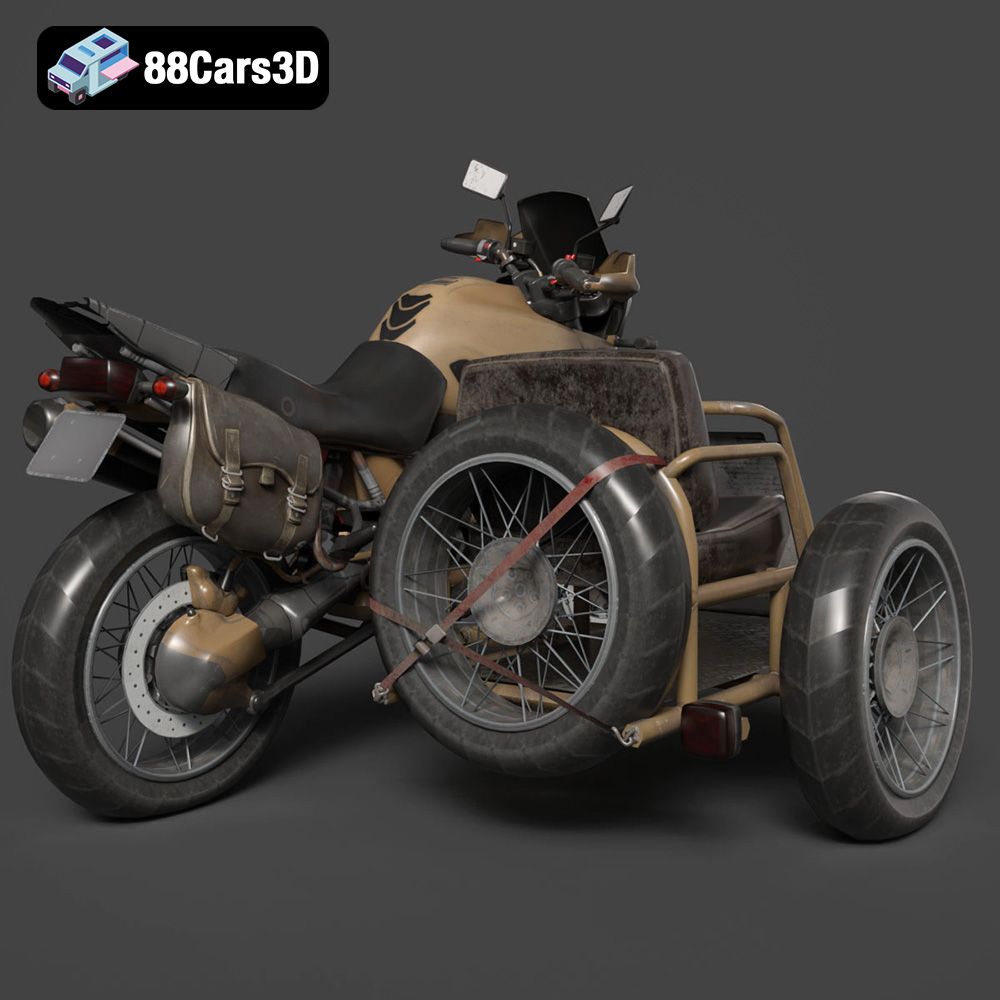
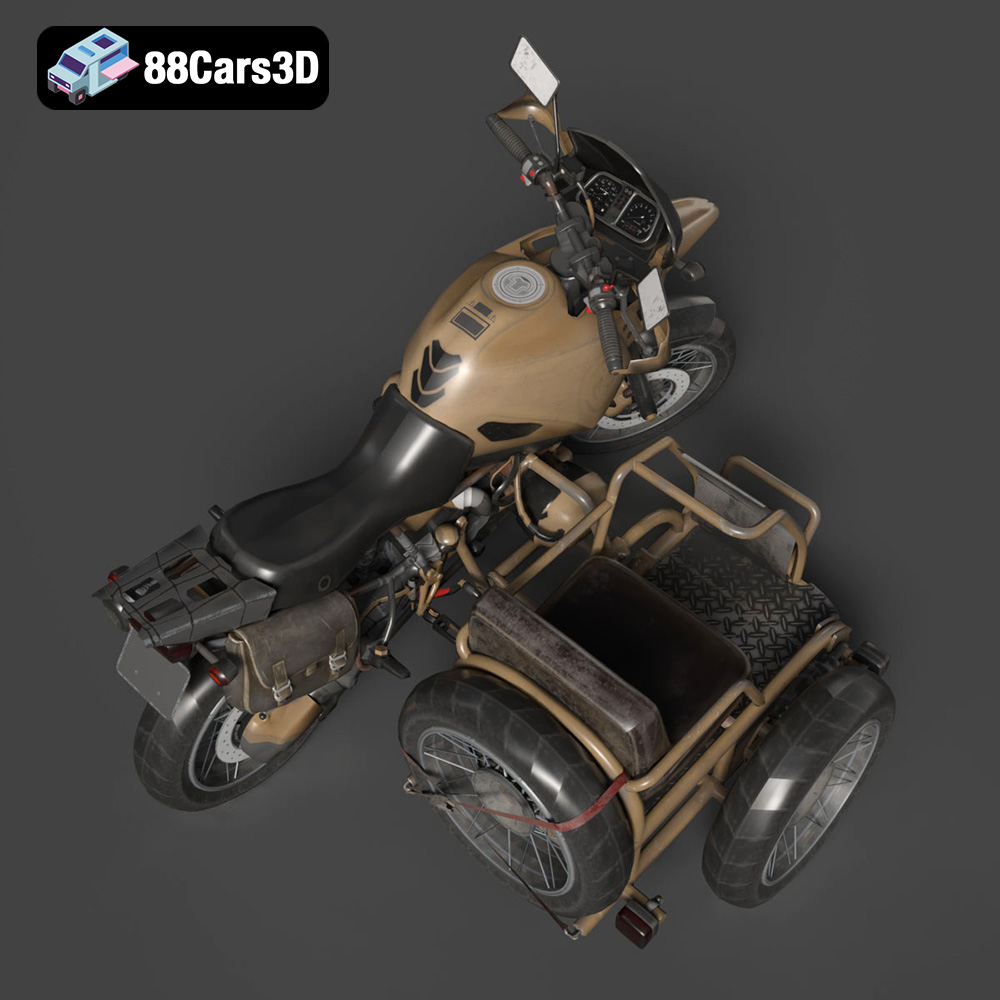
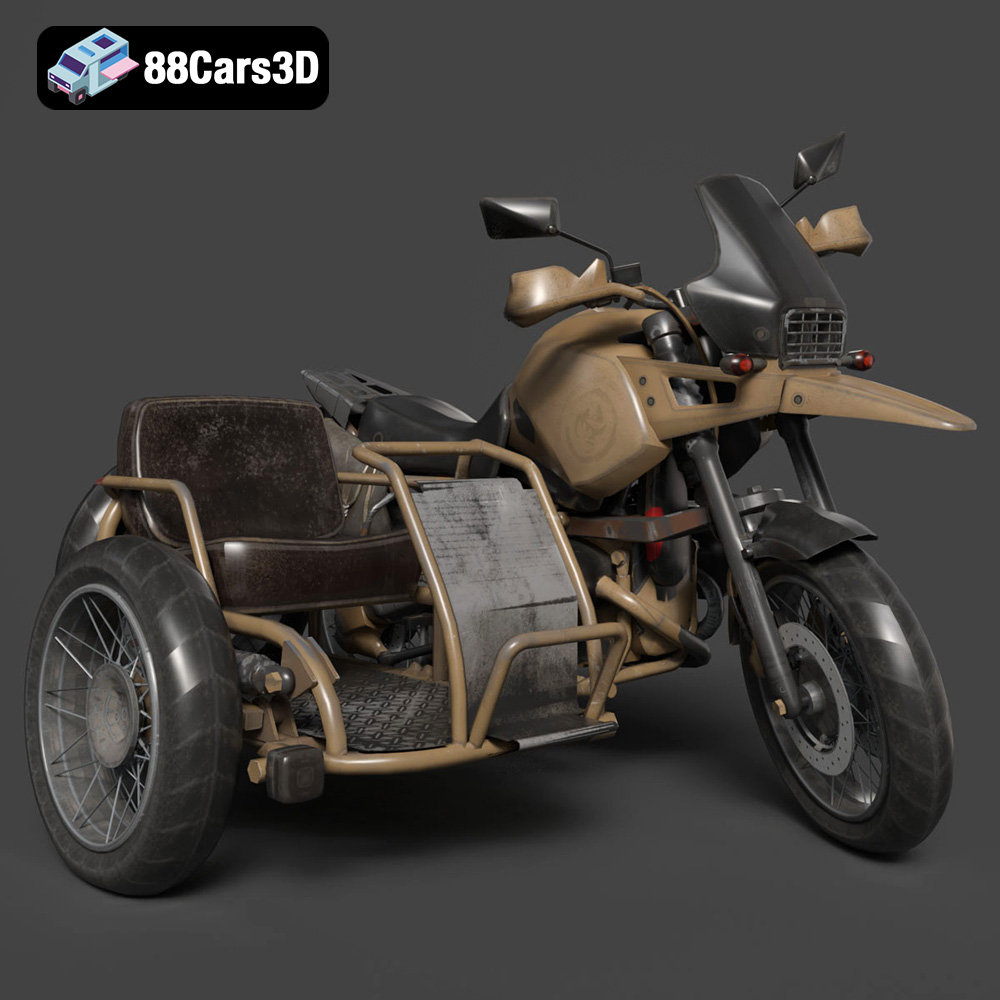
The foundation of any exceptional 3D vehicle model is its anatomical accuracy. For the BMW R1150GS Adventure Sidecar, this means capturing the distinctive design elements that make the vehicle recognizable and beloved. From the moment you inspect the model, you’ll notice the precise replication of the original’s robust frame geometry and proportions. The heart of the machine, the 1,130cc horizontally opposed boxer twin engine block, is meticulously detailed, showcasing the intricate cooling fins and mechanical components that are characteristic of BMW’s engineering.
Exterior features are equally impressive: the massive dual-sport fuel tank, aggressive knobby tires mounted on wire-spoke wheels, and robust crash bars that scream ruggedness are all faithfully reproduced. The distinctive asymmetric headlights, a signature of the GS lineage, are present, alongside auxiliary off-road LED lighting to complete its expedition-ready look. The high-clearance exhaust system is accurately modeled and integrated with the heavy-duty sidecar, which itself features specific mounting hardware and a comfortable passenger seat. The attention to these nuanced details ensures that whether viewed up close in a cinematic render or from a distance in a sprawling game world, the model maintains its striking visual integrity.
Visual authenticity is only one part of the equation; functional design is equally crucial for professional applications. This 3D model goes beyond static beauty by incorporating intelligent design choices for dynamic use. Key components like the wheels, suspension (Telelever front and Paralever rear, with the sidecar swingarm), and steering are modeled as separate, pivot-ready elements. This modularity is essential for animators, allowing for realistic wheel rotation, suspension travel, and steering articulation, bringing the vehicle to life in simulations or animated sequences.
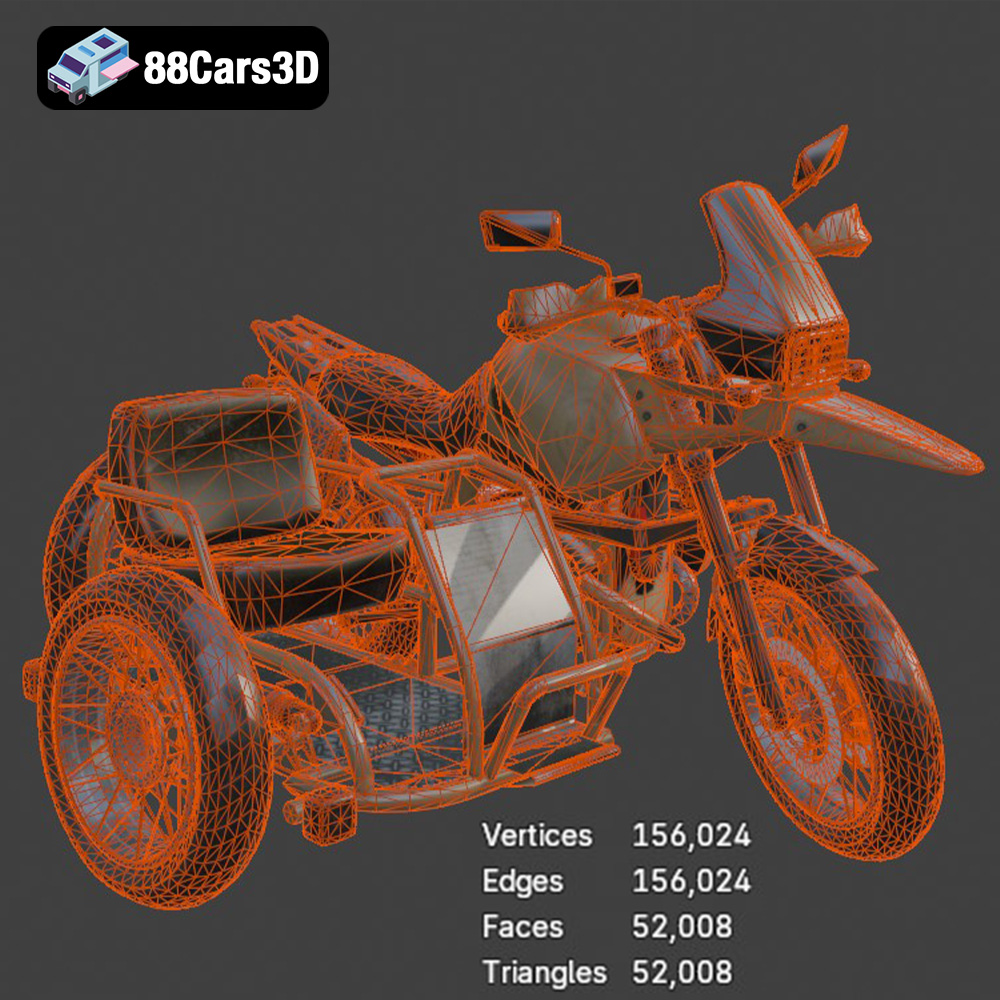
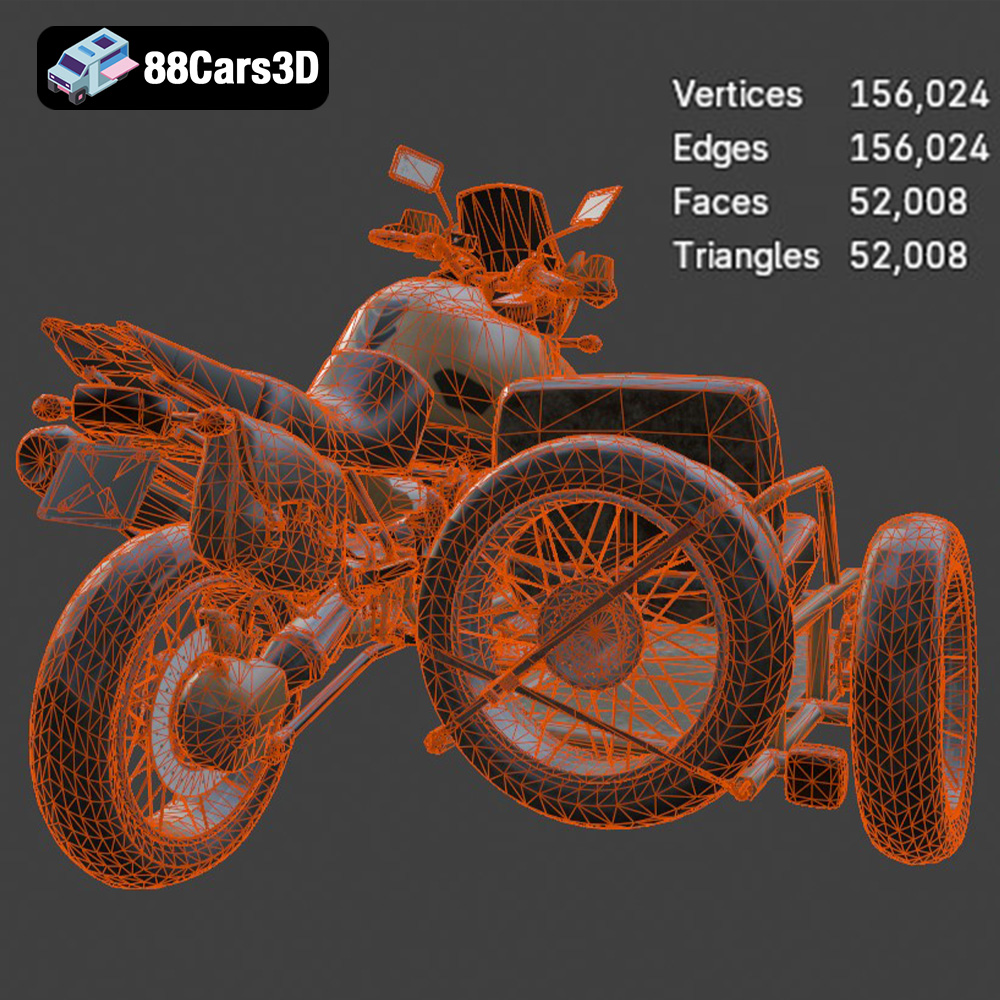
Furthermore, the model is “game-ready & optimized,” a critical advantage for real-time engines like Unreal Engine and Unity. With approximately 180,000 triangles, it strikes a perfect balance, delivering high-end visual realism without sacrificing frame rates. This optimized polycount ensures that developers can integrate the model into complex scenes without concerns about performance bottlenecks. The real-world scale accuracy, based on actual vehicle chassis dimensions, further enhances its utility, allowing for seamless integration into environments built to scale. From the ergonomic dual-stepped adventure saddle to the detailed analog instrument cluster and wide enduro handlebars, every aspect is considered for both visual appeal and practical application in first-person POV gaming or virtual reality experiences.
The versatility of a premium 3D model is often defined by the range of file formats it supports. Different formats are optimized for specific purposes, software environments, and performance needs. The Custom Off-Road BMW R1150GS Adventure Sidecar 3D Model from 88cars3d.com is provided in a comprehensive suite of formats, ensuring maximum compatibility and utility across virtually any professional workflow. Understanding each format’s strengths and weaknesses is key to leveraging your assets effectively.
The .blend format is Blender’s native file type. It’s a complete package, containing not just the mesh data but also all scene information: materials, textures, lighting, camera setups, animation data, physics simulations, and even custom scripts. This makes it an ideal choice for artists who work primarily within Blender, offering full editability and control over every aspect of the model. When you download the BMW R1150GS Sidecar in .blend format, you’re getting a fully configured scene, ready for immediate modification, rendering with Cycles or Eevee, or export to other applications. This format allows for intricate adjustments to topology, UV maps, shader nodes, and rigging, providing unparalleled flexibility for customization.
.fbx (Filmbox) is an industry-standard proprietary file format developed by Autodesk, widely adopted for interoperability between 3D software applications and real-time game engines like Unreal Engine and Unity. It excels at storing not only geometry but also crucial data like materials, textures, animation, skeletal rigs, and blend shapes. Its primary advantage lies in its ability to transfer complex animated scenes efficiently. When using the BMW R1150GS Sidecar as an .fbx, it typically imports with preserved hierarchies, pivots, and basic material assignments, making it ready for material creation with PBR (Physically Based Rendering) workflows in your target engine. However, specific material setups (e.g., complex node networks) often need to be recreated or adjusted in the destination software.
The .obj (Wavefront OBJ) format is one of the most widely supported and universal 3D file formats. It’s excellent for exchanging pure geometric data (vertices, normals, UVs, faces) between virtually any 3D software. While it doesn’t typically store animation, rigging, or complex material properties (these are usually in an accompanying .mtl file for basic color and texture references), its simplicity makes it robust. For the BMW R1150GS Sidecar, the .obj format is perfect for static renders or as a clean base mesh for sculpting, retopology, or applications where you plan to build materials and animation from scratch in your preferred software.
.glb (GL Transmission Format Binary) is the binary version of glTF, a royalty-free specification for the efficient transmission and loading of 3D scenes and models by engines and applications. GLB bundles the JSON model data, binary data (geometry, animations, skins), and textures into a single file, making it highly efficient for web-based 3D, AR/VR experiences, and mobile applications. It natively supports PBR materials, making the BMW R1150GS Sidecar look consistent across different platforms. Its compact size and single-file nature are major advantages for distribution and performance in browser-based configurators or interactive AR filters.
The .stl (Stereolithography) format is the de facto standard for 3D printing. It represents the surface geometry of a 3D object using a collection of interconnected triangles, similar to .obj but without color or texture information. It’s purely about shape. For the Custom Off-Road BMW R1150GS Adventure Sidecar, the .stl version would be an optimized, manifold mesh ready to be sliced for a 3D printer. Artists would typically convert their high-detail model to .stl, ensuring it’s “watertight” (no holes in the mesh) before sending it to a 3D printer for tangible display models.
.ply (Polygon File Format) is another format for storing 3D data, particularly useful for scan data, point clouds, and CAD applications. It’s more flexible than .stl, as it can store not only geometry but also properties like color, transparency, normals, texture coordinates, and even reliability information for each vertex. While not as universally used as .obj or .fbx for general animation and rendering, .ply is valuable for precise analysis or when dealing with highly detailed mesh data derived from laser scanning, which could be relevant for intricate parts of the BMW R1150GS Sidecar or if precise physical measurements are critical.
The .unreal format (or often, assets pre-packaged for Unreal Engine) signifies an asset specifically optimized and configured for direct import into Unreal Engine projects. This might involve an FBX file that has been thoroughly tested, with proper pivot points, collision meshes, material slots, and potentially even basic blueprints or skeletal setups ready to go. When provided directly, an .unreal asset (often a .uasset file within an Unreal project structure) for the BMW R1150GS Sidecar saves significant setup time, ensuring seamless integration into your real-time environment with minimal fuss, reflecting a “drag-and-drop” level of readiness.
The .max format is the native file type for Autodesk 3ds Max. Similar to .blend for Blender, it contains the entire scene data, including geometry, materials (with all their complex shader networks), lighting, cameras, animation, modifiers, and plugin-specific data. This format is crucial for users who rely on 3ds Max for their automotive rendering, animation, or architectural visualization projects. Having the BMW R1150GS Sidecar in .max format allows for full creative control within 3ds Max, enabling artists to leverage its robust modeling, rendering (V-Ray, Corona), and animation tools without any data loss during conversion.
The provision of the Custom Off-Road BMW R1150GS Adventure Sidecar 3D Model in all these diverse formats ensures that whatever your software of choice or your project’s specific requirements, you have a high-quality, compatible asset at your disposal. This comprehensive file format support underscores the professional-grade nature of models available at 88cars3d.com.
The true measure of a professional 3D asset lies in its adaptability across various demanding applications. The Custom Off-Road BMW R1150GS Adventure Sidecar 3D Model is engineered for seamless integration into diverse production pipelines, from game development to cinematic rendering and immersive AR/VR experiences.
For game developers, the pursuit of realism and performance is a constant balancing act. The BMW R1150GS Sidecar, optimized with approximately 180,000 triangles, is a prime example of a game-ready asset. In engines like Unreal Engine or Unity, the workflow typically begins with importing the .fbx or, if available, the pre-packaged .unreal format. Artists can then set up Physically Based Rendering (PBR) materials, leveraging the model’s carefully mapped textures to achieve realistic surface finishes, from the gritty knobby tires to the metallic sheen of the engine components.
Critical for in-game functionality, the model’s proper pivot setup for steering, wheel rotation, and suspension travel allows developers to easily implement vehicle physics and animation systems. Imagine this rugged rig navigating treacherous terrain in an open-world adventure game or serving as a unique vehicle in a post-apocalyptic survival scenario. The inclusion of separate components means that suspension compression, steering input, and wheel spin can all be animated independently, contributing to a believable and immersive driving experience. Its optimized geometry is specifically designed to maintain high frame rates, crucial for fluid gameplay in even the most demanding titles.
When it comes to high-end automotive rendering and visualization, details matter immensely. Artists using software like 3ds Max (with V-Ray or Corona Renderer) or Blender (with Cycles) can harness the full visual fidelity of the BMW R1150GS Sidecar. The .max or .blend formats provide native access to the model’s intricate details, allowing for advanced material customization. For instance, you could easily change the body and fuel tank colors to replicate factory finishes or invent custom expedition liveries. Adjusting material properties for matte, gloss, or metallic effects can dramatically alter the vehicle’s appearance under different lighting conditions.
Workflows often involve setting up elaborate studio lighting environments, using HDRI (High Dynamic Range Image) maps for realistic reflections, and composing dramatic camera angles. This model is perfect for creating compelling brand campaigns, lifestyle scenes depicting rugged journeys, or detailed product showcases. Its accurate scale and intricate mechanical components make it an excellent subject for hero shots, offering designers and marketers a powerful tool to communicate the spirit of adventure and engineering prowess. The ability to modify tire textures from off-road to street variants further enhances its versatility for various narrative contexts.
The burgeoning fields of Augmented Reality (AR) and Virtual Reality (VR) demand highly optimized yet visually engaging 3D car models. The .glb format, included with this model, is specifically tailored for these applications. Its compact size and single-file nature make it ideal for quick loading in web-based AR configurators, mobile AR experiences where the sidecar can appear in a real-world environment, or immersive VR garage environments where users can explore the vehicle up close. The optimized polycount ensures that even on less powerful mobile or standalone VR hardware, the model renders smoothly, providing a compelling and interactive experience without performance hitches. Imagine a virtual showroom where prospective buyers can walk around the BMW R1150GS Sidecar, change its colors, and even “sit” in the sidecar, all powered by this high-quality, optimized asset.
Beyond digital screens, the world of 3D printing offers an exciting avenue for bringing virtual assets into the physical realm. The Custom Off-Road BMW R1150GS Adventure Sidecar 3D Model is designed with this possibility in mind, allowing hobbyists and professionals to create tangible replicas.
For 3D printing, the .stl format is your go-to. This format represents the model as a series of triangulated surfaces, stripped of color, textures, and animation data, focusing purely on geometric shape. When converting or exporting to .stl, it’s crucial to ensure the mesh is “manifold” or “watertight,” meaning there are no holes, inverted normals, or self-intersecting geometry that could confuse the 3D printer’s slicer software. The .ply format, while less common for general consumer 3D printing, could also be used, particularly for industrial applications that require more detailed mesh information like vertex colors or higher precision.
The product description provides excellent guidance for 3D printing the R1150GS Sidecar. Recommended scales like 1:12, 1:18, or 1:24 offer a good balance between detail and printability. For capturing the fine details of the engine, handlebars, and intricate sidecar mounting hardware, resin printing (SLA/DLP) is highly recommended over FDM, as it can achieve much finer layer heights (0.04–0.12 mm). If using FDM, a lower layer height is still preferable for better detail.
Wall thickness (1.2–2.0 mm) and infill (20–30%) are critical for structural integrity, especially for complex parts. Supports will undoubtedly be required for overhangs, such as the exhaust system, mirrors, and handlebars, to prevent print failures. Proper print orientation, like printing the frame angled, can improve structural strength and reduce the need for excessive supports. After printing, post-processing is key: sanding to smooth layer lines, applying primer for an even surface, and then painting with authentic factory colors or custom finishes, perhaps even metallic paints, will bring the model to life with stunning realism. This tangible manifestation of the digital asset creates a unique display piece or a valuable prototype.
In a competitive digital landscape, efficiency and quality are paramount. Sourcing high-quality, pre-optimized 3D car models is a strategic decision that can significantly impact project timelines and final output. 88cars3d.com is dedicated to providing such assets, ensuring artists and developers have access to top-tier resources.
Developing a complex 3D vehicle from scratch is an incredibly time-consuming and resource-intensive endeavor. It requires specialized modeling, texturing, rigging, and optimization skills. By choosing a pre-optimized asset like the Custom Off-Road BMW R1150GS Adventure Sidecar 3D Model, you immediately gain a significant advantage. You’re not just buying a mesh; you’re investing in countless hours of expert craftsmanship, rigorous quality assurance, and meticulous optimization. This dramatically reduces development cycles, allowing your team to focus on core game mechanics, animation sequences, or environmental storytelling rather than spending valuable time on foundational asset creation. The consistent quality and technical readiness of models from 88cars3d.com ensure that your projects start on a strong footing, leading to more professional and polished results.
While pre-made, these 3D car models are designed for extensive customization. The BMW R1150GS Sidecar model offers numerous options for artists to tailor it to their specific project vision. You can easily change body and fuel tank colors, selecting from realistic factory hues or applying unique custom finishes. Modifying tire textures to switch between aggressive off-road knobbies and street-oriented variants allows the vehicle to fit different environments and narratives. Adjusting material finishes—from a rugged matte to a glossy showroom shine or a weathered metallic—can completely alter the vehicle’s character. Furthermore, adapting the lighting setup can create dramatic visual effects, simulating different times of day or specific atmospheric conditions. This level of adaptability ensures that while you start with a high-quality base, you have the creative freedom to make the model truly your own, integrating it seamlessly into diverse artistic directions and project requirements.
The Custom Off-Road BMW R1150GS Adventure Sidecar 3D Model represents a pinnacle of digital craftsmanship, offering an exceptional blend of visual authenticity, technical precision, and versatile functionality. From its meticulously recreated engine block and robust sidecar integration to its game-ready optimization and comprehensive file format support, this model is a powerful asset for any serious 3D artist, game developer, or visualization specialist.
Whether you’re striving for cinematic realism in automotive rendering, pushing the boundaries of interactive experiences in AR/VR, building an immersive world for game development, or even creating a tangible replica through 3D printing, this model provides the quality and flexibility needed to achieve outstanding results. By choosing expertly crafted 3D car models like this one, available at 88cars3d.com, you empower your projects with assets that are not only visually stunning but also technically robust, streamlining your workflow and elevating your final output. Embark on your next digital adventure with confidence, knowing you have a premium foundation to build upon.
The Custom Off-Road BMW R1150GS Adventure Sidecar represents the pinnacle of overland exploration and rugged dual-sport capability. Renowned for its iconic boxer twin engine and indestructible shaft drive, this customized adventure rig integrates a heavy-duty passenger sidecar, transforming it into an ultimate all-terrain expedition vehicle. Key visual elements include the massive dual-sport fuel tank, aggressive knobby tires, robust crash bars, and the distinctive asymmetric headlights that define the GS lineage.
This premium 3D model is meticulously crafted to deliver exceptional visual fidelity while maintaining optimal performance. With a well-balanced topology and game-ready optimization, it ensures high-quality real-time rendering without sacrificing frame rates. The model boasts carefully mapped textures, realistic material finishes, and accurately modeled mechanical components, making it an outstanding asset for game development, AR/VR applications, animation, and digital visualization.
Perfect for post-apocalyptic survival games, off-road racing simulators, overland expedition visualizations, and immersive VR garage environments.
.blend, .fbx, .obj, .glb, .stl, .ply, .unreal, .max
Tags:
bmw, r1150gs, adventure, sidecar, off-road, custom, motorcycle-3d-model, game-ready, low-poly, optimized, game-asset, rendering, vr-ar, blend, fbx, obj, glb, stl, ply, unreal, maxMercedes Benz CLS 500 3D Model 3D Printable STL
$39.99
.adventure
.blend
.bmw
.custom
.fbx
.glb
.max
.obj
.ply
.rendering
.sidecar
.stl
.unreal
game asset
game-ready
low-poly
motorcycle-3d-model
off-road
optimized
r1150gs
VR/AR