Get 20% OFF All Premium 3D & STL Models!

In the dynamic world of digital content creation, the demand for high-quality, technically sound 3D assets is paramount. Whether you’re a game developer building vast open worlds, an architectural visualizer crafting a compelling street scene, or an automotive designer showcasing a new concept, the fidelity and optimization of your 3D models can make or break a project. Professional-grade 3D car models are no longer just static representations; they are versatile building blocks for interactive experiences, photorealistic renders, and even physical prototypes.
This pursuit of digital perfection often leads creators to specialized marketplaces offering meticulously crafted assets. Today, we’re diving deep into the technical intricacies and broad applications of one such exceptional asset: the Mercedes-Benz Actros Tipper 3-Axle 2011 3D Model. This isn’t just a vehicle; it’s a testament to robust engineering translated into a highly optimized digital form, ready to drive your projects forward, available through reputable sources like 88cars3d.com. We’ll explore its features, discuss essential file formats, and trace its journey from concept to diverse professional workflows, from game development to advanced automotive rendering.
Navigating the ecosystem of 3D modeling requires a fundamental understanding of various file formats. Each format serves a specific purpose, offering unique advantages for different stages of a project, software compatibility, and final output. The Mercedes-Benz Actros Tipper 3-Axle 2011 3D Model, for instance, is offered in a comprehensive suite of formats, ensuring maximum flexibility for any professional workflow. Let’s break down these essential formats:
The .blend format is the native file type for Blender, a powerful open-source 3D creation suite. When you download a .blend file, you’re getting a fully editable Blender scene. This means all the original mesh data, materials, textures (often packed within the file or referenced externally), animations, cameras, lighting setups, and even modifiers are preserved. This format is ideal for artists who use Blender as their primary DCC (Digital Content Creation) tool, allowing for full customization, re-rigging, and deep integration into Blender-centric pipelines. It provides the highest level of control and editability over the original asset.
.fbx (Filmbox) is arguably the most widely used 3D interchange format in the industry, developed by Autodesk. Its strength lies in its ability to store a vast array of data, including geometry, materials, textures, animations (skeletal and blend shapes), cameras, and lights, while maintaining scene hierarchy. This makes it an ideal choice for transferring assets between different 3D software applications like 3ds Max, Maya, Blender, and especially into real-time engines such as Unreal Engine and Unity. For the Mercedes-Benz Actros, an .fbx file would typically contain the optimized mesh, PBR materials, and crucial pivot setups for animation (wheels, suspension, tipper bed), making it perfect for game asset integration.
The .obj (Wavefront OBJ) format is a venerable and widely supported option primarily focused on geometry and basic material information. It’s a universal format, highly compatible with virtually all 3D software. An .obj file typically stores vertex positions, UV coordinates, normals, and face information, often accompanied by a separate .mtl (Material Template Library) file for basic material properties. While it doesn’t support animation or rigging, its simplicity and widespread compatibility make it excellent for static mesh exchange, 3D printing preparation (after conversion), or when you only need the raw geometry for a scene. It’s a reliable fallback when other formats present compatibility issues.
.glb (GL Transmission Format Binary) is an increasingly important format, especially for modern applications like augmented reality (AR), virtual reality (VR), and web-based 3D experiences. It’s the binary version of glTF (Graphics Language Transmission Format), designed to be a highly efficient, single-file container for 3D scenes and models. A .glb file packs geometry, materials, textures, animations, and scene graphs into one compact file, making it fast to load and ideal for real-time applications where performance is critical. For AR/VR showcases of the Actros Tipper, .glb would be the go-to format for smooth, interactive viewing on mobile devices or dedicated headsets.
.stl (Stereolithography) is the de facto standard for 3D printing. This format represents a 3D model as a series of connected triangles, defining only the surface geometry of an object without color, texture, or material information. While not suitable for rendering or animation, its simplicity makes it universally understood by 3D printers and slicing software. The Mercedes-Benz Actros Tipper, when converted to .stl, can be brought to life as a physical model, ideal for display, prototyping, or detailed dioramas, allowing hobbyists and professionals to physically hold the digital design.
.ply (Polygon File Format) is another format that describes 3D objects, but it often includes additional properties like color, transparency, and sometimes even data generated from 3D scanners. While less common for general 3D asset exchange than .fbx or .obj, it’s particularly useful in scientific, engineering, and CAD applications where precise mesh data, potentially with vertex colors or other attributes, is crucial for analysis or measurement. It offers a robust alternative for geometry transfer where data integrity beyond basic mesh is important.
The .unreal format, often referring to a package containing a Unreal Engine asset, typically signifies an FBX file that has been specifically prepared, imported, and configured within Unreal Engine itself. This usually means the mesh, materials (often PBR setups), textures, collision data, and possibly initial blueprints for animation or interaction, are ready to be dropped into an Unreal project. It streamlines the workflow significantly, as the model is already optimized and set up to leverage Unreal Engine’s rendering capabilities, making the Mercedes-Benz Actros immediately usable in a trucking simulator or industrial visualization built in Unreal.
Lastly, the .max format is the native file format for Autodesk 3ds Max, a leading software for 3D modeling, animation, and rendering. Similar to .blend for Blender, a .max file contains all the scene data specific to 3ds Max, including geometry, modifiers, materials, textures, lighting, cameras, animation timelines, and render settings. This format provides complete editability within 3ds Max, making it the preferred choice for professionals deeply entrenched in an Autodesk-centric pipeline who need to modify, animate, or render the Mercedes-Benz Actros Tipper with the full power of 3ds Max at their disposal.
The availability of the Mercedes-Benz Actros Tipper 3-Axle 2011 in these diverse formats underscores its versatility and the commitment of 88cars3d.com to providing truly professional-grade 3D car models for a wide array of applications.
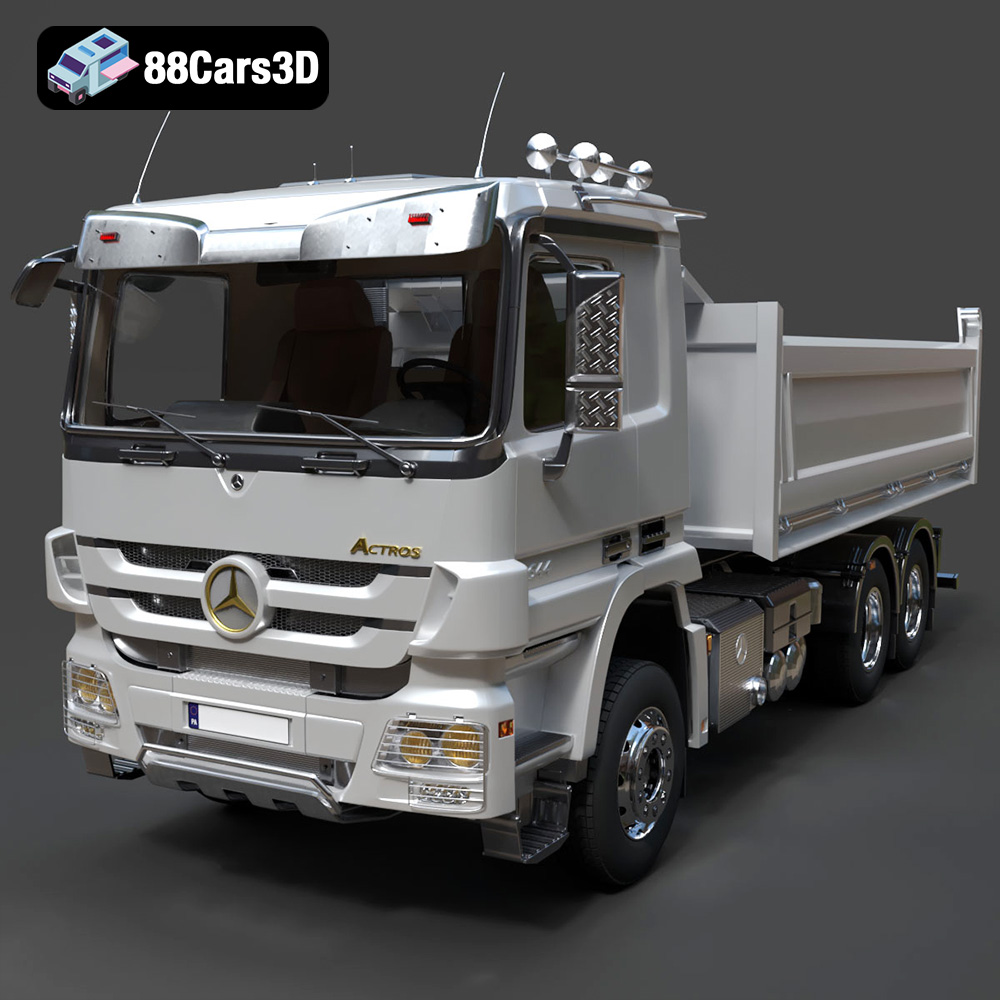
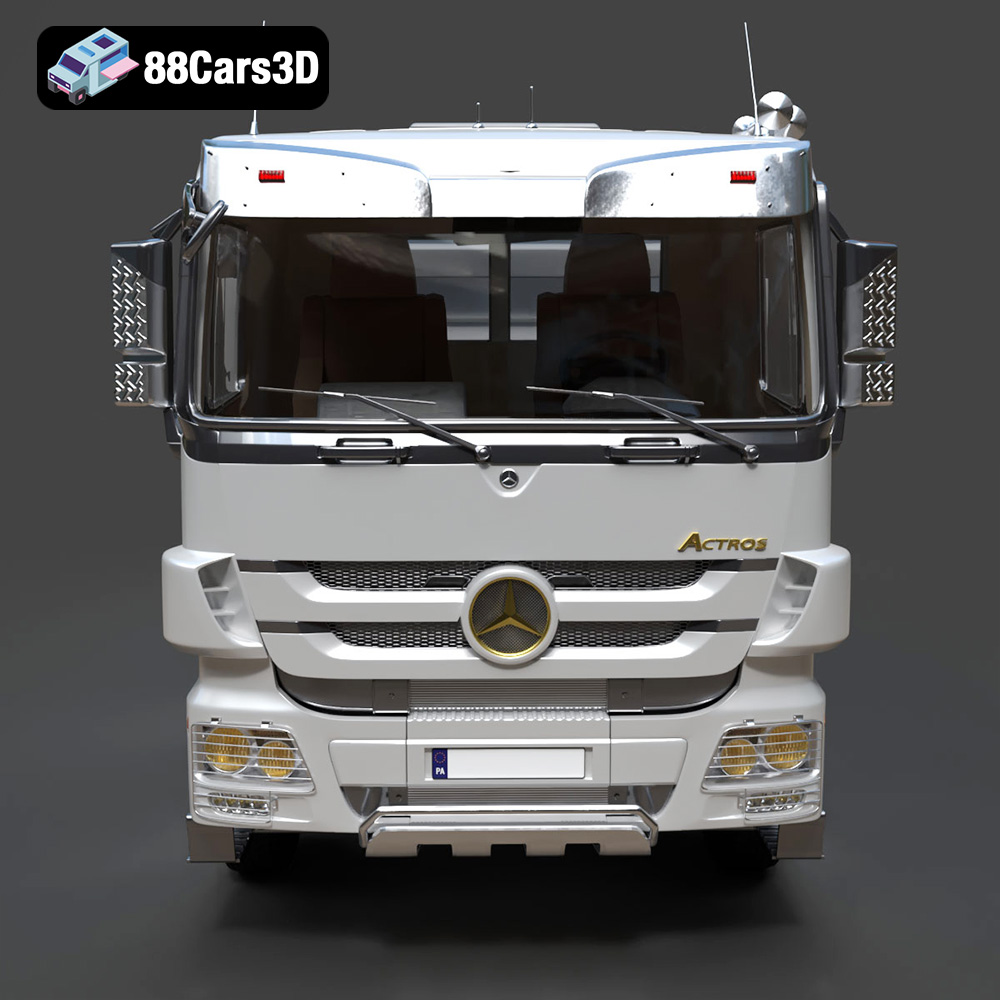
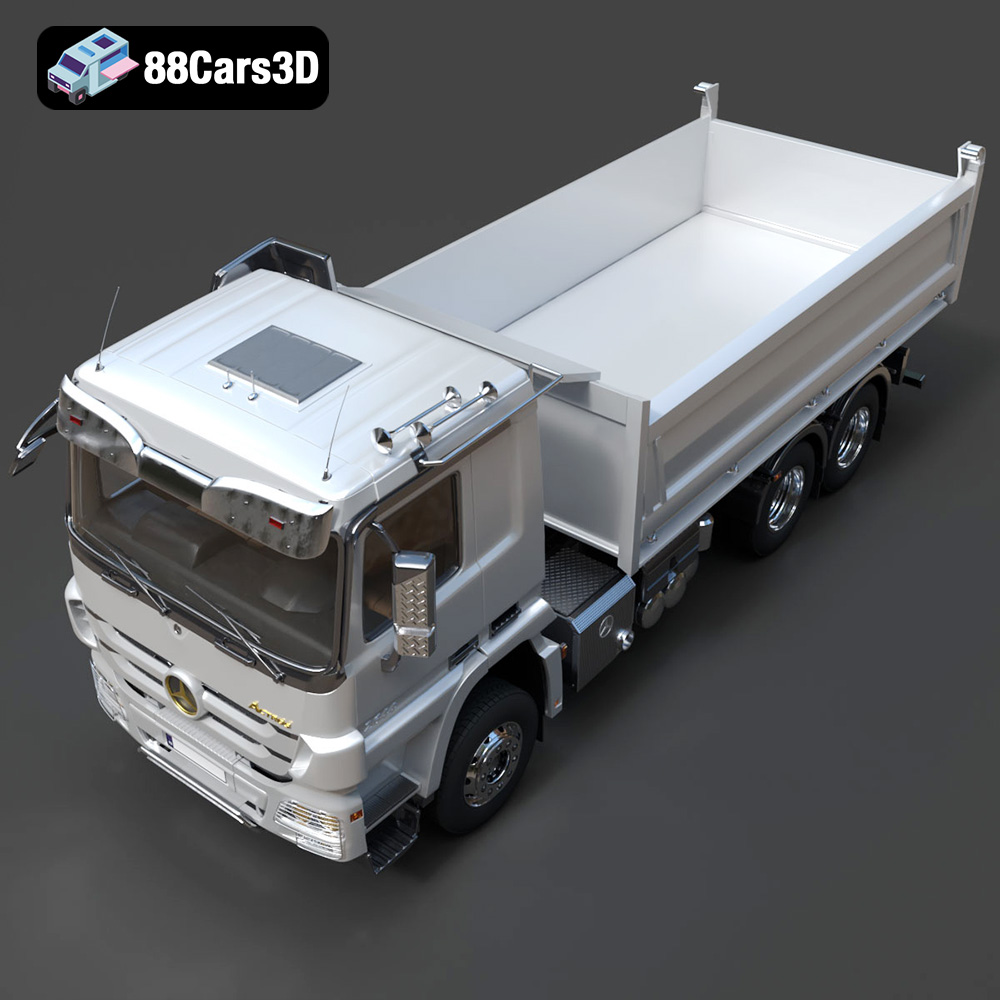
The Mercedes-Benz Actros Tipper 3-Axle 2011 is a formidable presence in the real world, and its digital counterpart is no less impressive. This 3D model captures the essence of a heavy-duty workhorse, translated into a highly detailed and optimized digital asset.
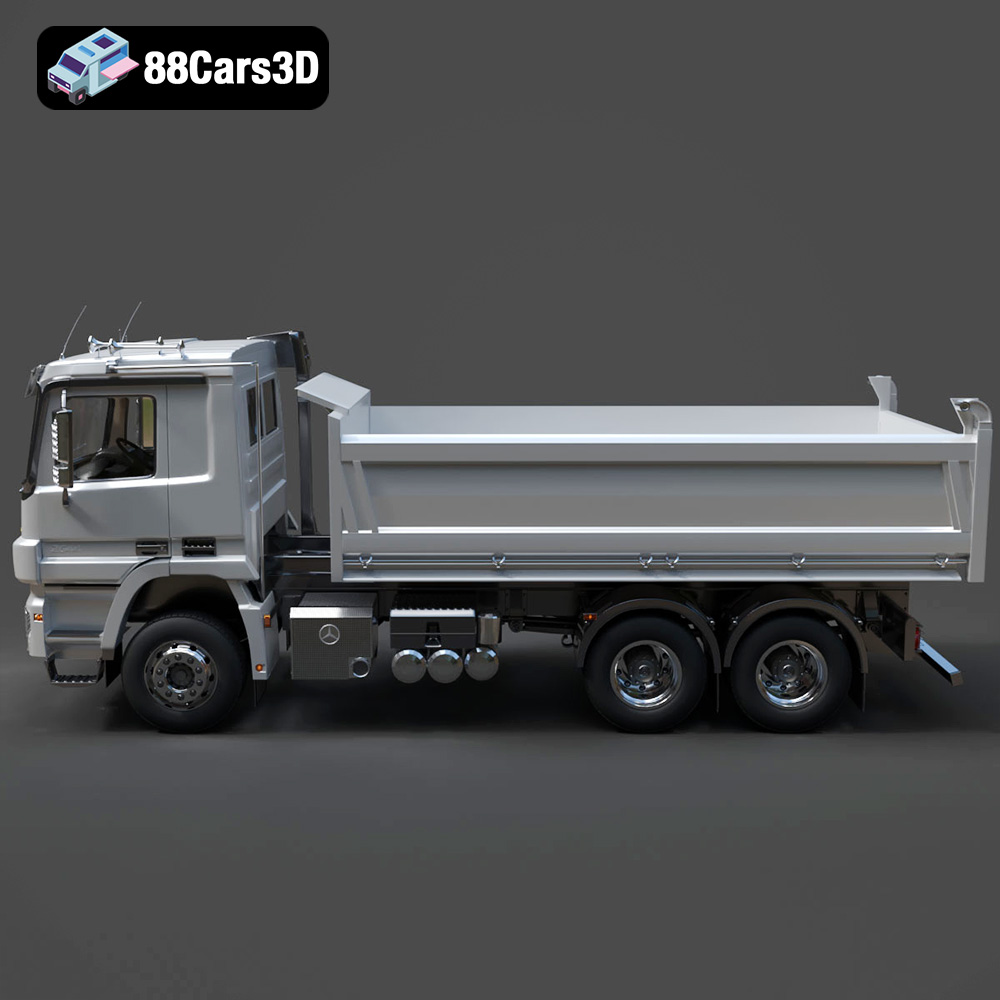
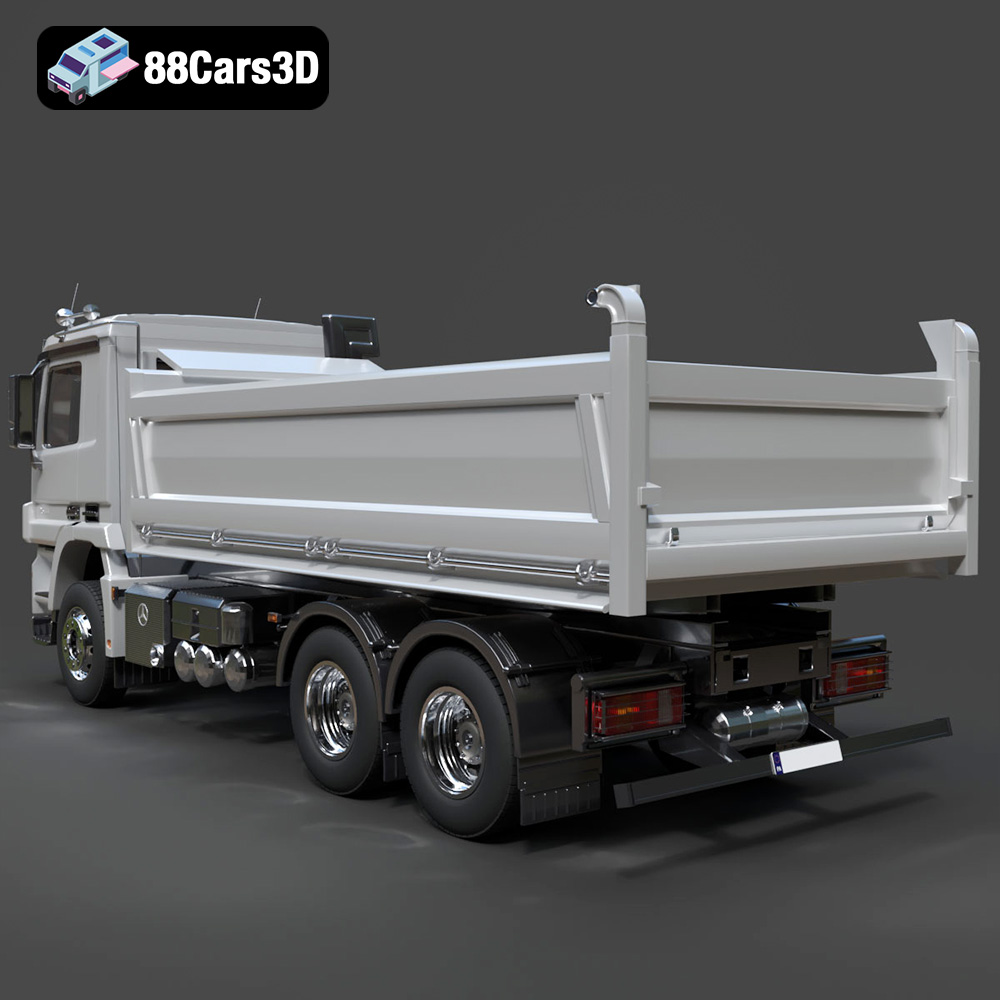
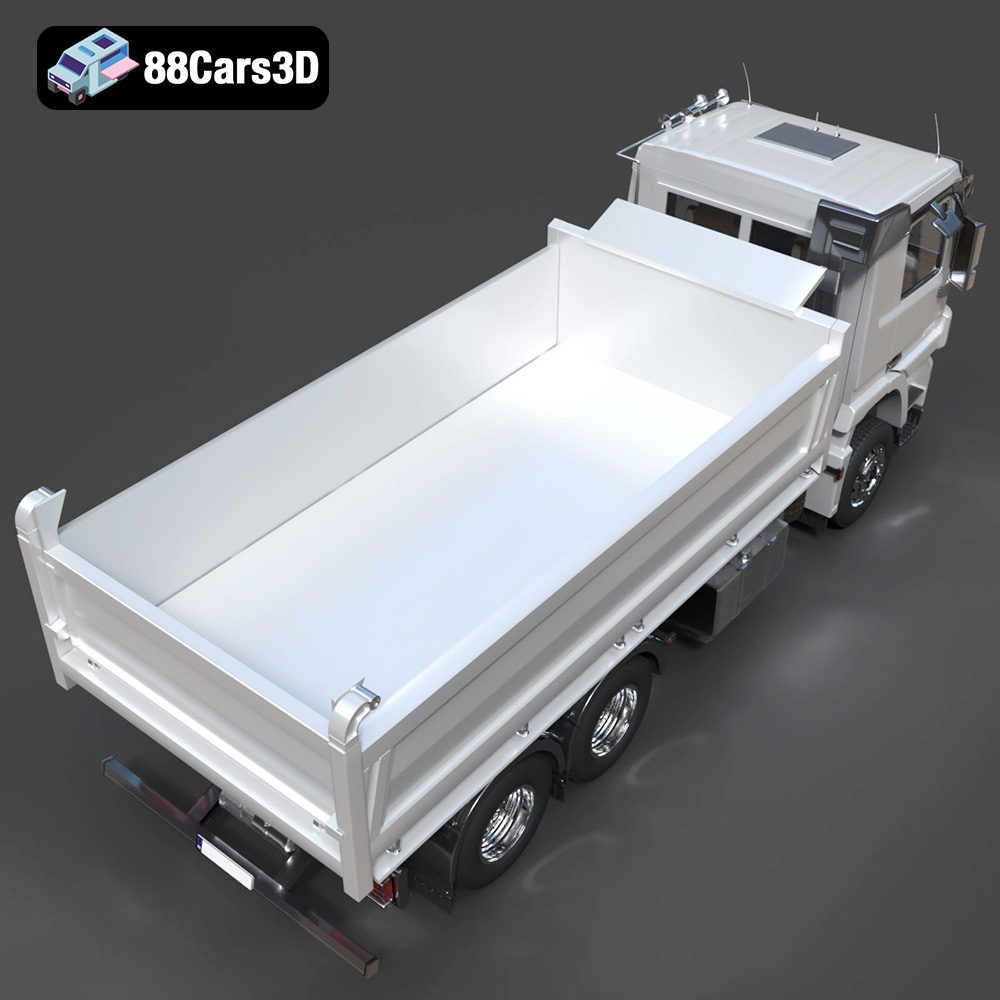
The external features of this 3D car model are where its robust character truly shines. The designers at 88cars3d.com have meticulously replicated the accurate frame geometry and proportions of the actual Mercedes-Benz Actros Tipper 3-Axle 2011. This isn’t just about getting the silhouette right; it extends to a detailed heavy-duty diesel engine block and powertrain components, offering an impressive level of under-the-hood realism, even if often unseen. Authentic commercial exhaust and high-capacity air intake systems are faithfully modeled, adding to the industrial grit. Critical for any automotive rendering, high-fidelity lighting elements are included, from cab roof lights to primary headlamps and heavy-duty taillights, ensuring realistic illumination in any scene. The dual-wheel rear axles and rugged commercial off-road tires, complete with multi-leaf spring suspension and intricate hydraulic tipper bed mechanisms, are not just visually accurate but also functionally separated. This segmentation—separate wheels, suspension, cab, tipper bed, and steering components—is crucial for animators and riggers, allowing for dynamic interactions and realistic motion in simulations and cinematics.
For applications like trucking simulators or virtual training environments, the interior experience is as vital as the exterior. The Actros Tipper 3D model delivers with a well-appointed cockpit. It features an ergonomically designed commercial driver air-suspension seat, an accurately scaled heavy-duty steering wheel and column, and a detailed dashboard and commercial instrument cluster. The authentic control layout, including pedals, shifters, and hydraulic bed levers, is modeled with precision, creating a believable environment for a virtual driver. Crucially, the geometry is optimized for first-person POV (Point of View), ensuring excellent visual fidelity and performance from a driver’s perspective in demanding real-time trucking simulators.
Creating a 3D model that looks fantastic is one thing; ensuring it performs flawlessly across various digital platforms is another. The Mercedes-Benz Actros Tipper 3-Axle 2011 3D model exemplifies this balance, making it a stellar game asset and rendering solution.
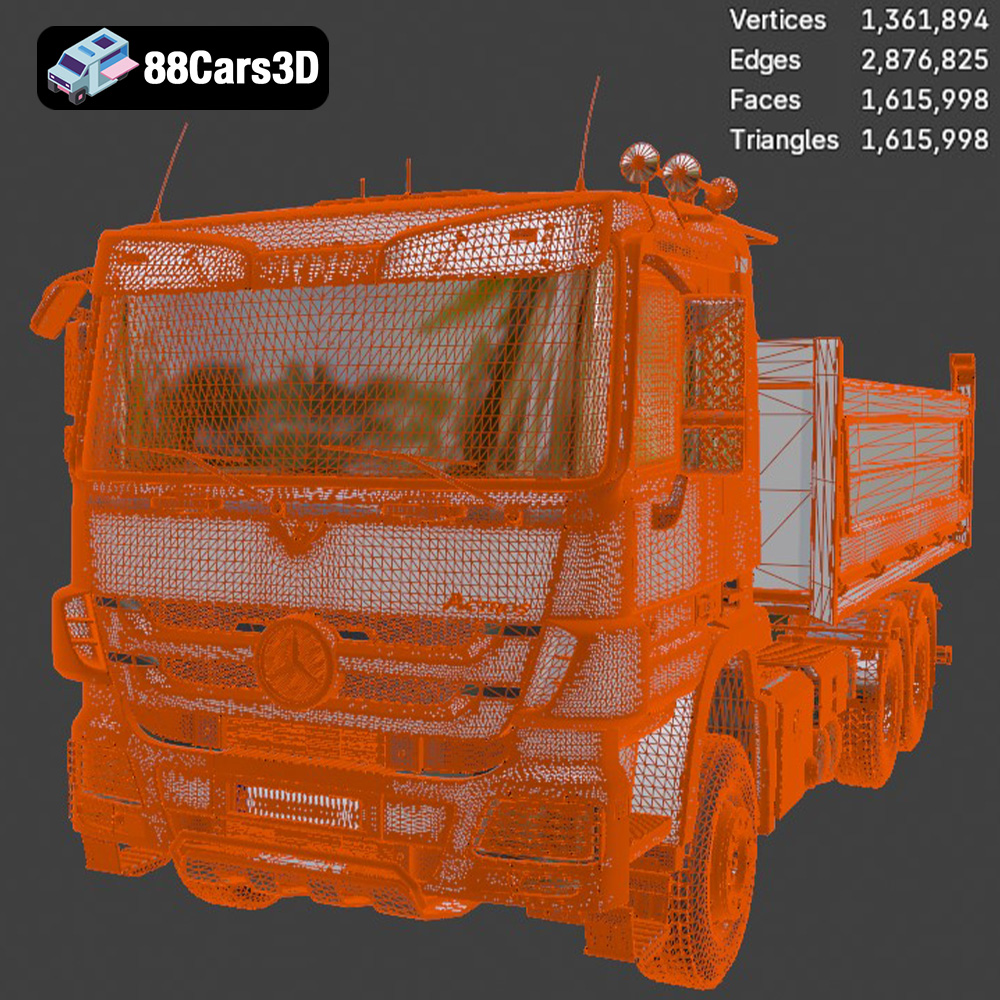
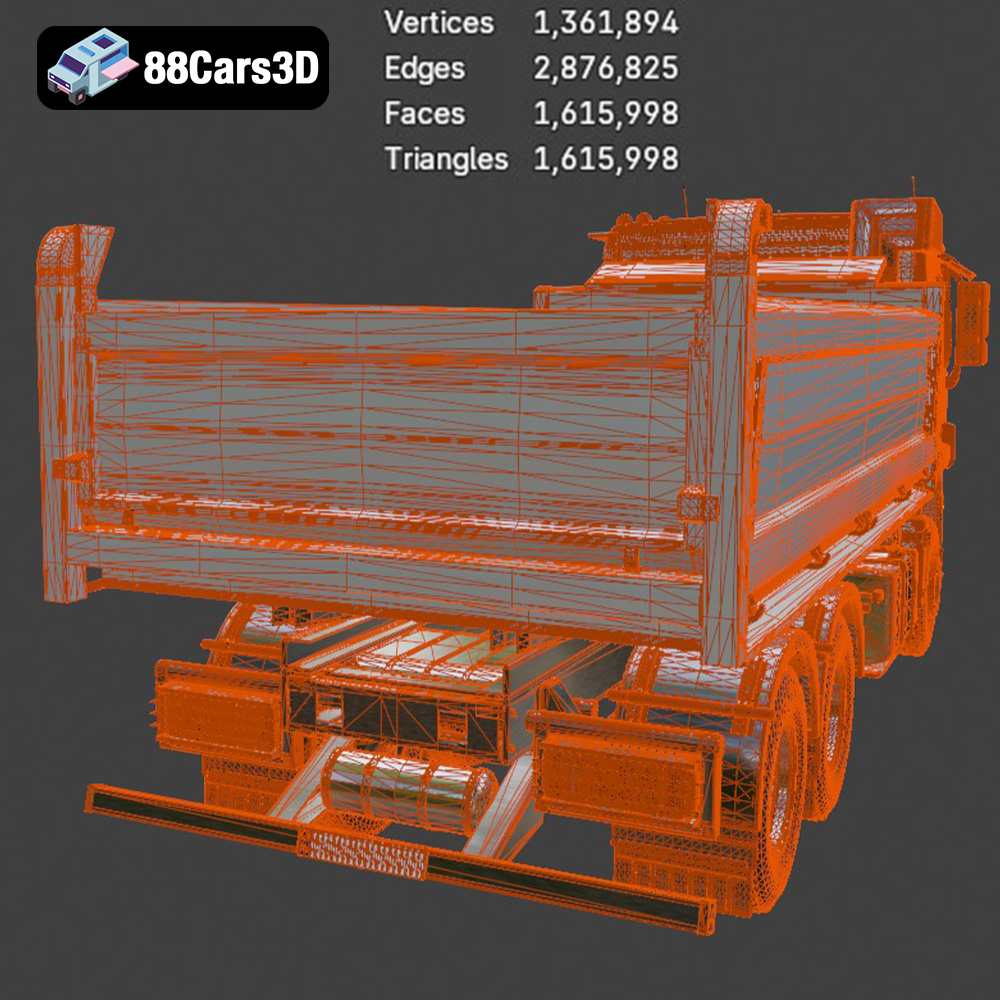
A significant technical advantage of this 3D model is its optimized topology. With approximately 150,000 triangles, it achieves a perfect balance between high-end visual realism and performance efficiency. For real-time engines like Unreal Engine and Unity, an excessively high polycount can severely impact frame rates, while a model with too few polygons might lack detail. This “sweet spot” polycount ensures the Mercedes-Benz Actros Tipper can be integrated into open-world games or complex industrial scenes without bogging down the engine, all while maintaining rich visual detail. This optimization is a hallmark of professional game assets, allowing developers to populate their worlds with compelling vehicles without performance compromises.
Beyond static appearance, the Actros model is engineered for dynamic use. It boasts real-world scale accuracy, a non-negotiable feature for architectural visualization, engineering simulations, and realistic game environments. Furthermore, proper pivot setups are a critical technical detail often overlooked in lesser models. For this Actros, pivots are correctly established for steering, wheel rotation, hydraulic bed lift, and suspension travel. This means animators can immediately begin rigging and creating realistic motion, whether it’s the subtle bounce of the suspension over rough terrain or the full articulation of the tipper bed, making it an incredibly versatile 3D car model for any project requiring mechanical animation.
While not explicitly detailed in the specifications, a “high-quality” and “game-ready” 3D model like the Actros Tipper implicitly includes professional material and texturing work, typically PBR (Physically Based Rendering) workflows. PBR textures (Albedo/Base Color, Metallic, Roughness, Normal, Ambient Occlusion maps) are crucial for achieving photorealistic results in modern renderers and game engines. These textures ensure that the surfaces of the cab, chassis, tipper bed, and tires react accurately to light, producing realistic reflections, shadows, and surface details. The ability to customize these materials, as noted in the product description, allows artists to adapt the truck’s appearance, from a pristine factory finish to a weathered, mud-splattered work vehicle, enhancing its realism in diverse scenarios.
The versatility of a well-crafted 3D car model extends far beyond simple imagery. The Mercedes-Benz Actros Tipper 3-Axle 2011 3D model is designed to be a multi-functional asset, serving a broad spectrum of industries and creative endeavors.
Game developers constantly seek optimized yet visually stunning assets to build immersive experiences. The Actros Tipper 3D model is an ideal game asset for open-world games, trucking simulators, and industrial titles. Its optimized polycount and segmented components mean it can be readily integrated into game engines like Unreal Engine and Unity. Imagine this robust tipper truck navigating the intricate construction sites of a simulation game, or serving as a key vehicle in a large-scale industrial management title. The ready-to-animate parts facilitate realistic vehicle physics and interactive gameplay, contributing significantly to player immersion and game performance.
Augmented Reality (AR) and Virtual Reality (VR) are revolutionizing how we interact with digital content. This 3D car model is perfect for immersive virtual showrooms, where potential buyers can explore the truck in a 360-degree environment. For commercial fleet operators, it can be used in configurators, allowing for real-time customization of colors and features. Furthermore, its detail and accuracy make it invaluable for mobile AR training experiences, enabling virtual walk-arounds and demonstrations of complex hydraulic systems or maintenance procedures without needing the physical vehicle. The .glb format, specifically, makes it highly suitable for these performance-critical, browser- and device-friendly applications.
When it comes to high-impact visual communication, photorealistic rendering is king. The Mercedes-Benz Actros Tipper is an excellent asset for commercial campaigns, providing the visual backbone for advertisements that showcase its power and reliability. Picture it in a construction site scene, rendered with stunning detail under various studio lighting setups, or presented in industrial visualization projects to illustrate logistics, planning, or operational workflows. Its high fidelity ensures that whether it’s a still image for a brochure or a full-blown animated sequence for a corporate presentation, the Actros delivers impactful visual storytelling.
The journey of a 3D model doesn’t always end on a screen. For enthusiasts, educators, or design professionals, bringing a digital model into the physical world through 3D printing offers a unique tactile experience.
Converting the Mercedes-Benz Actros Tipper 3-Axle 2011 3D model into a physical object requires careful preparation, especially when targeting hobbyists and diorama builders. The recommended scales (1:24, 1:32, 1:50) provide flexibility for different display needs. Technical details like layer height (0.04–0.12 mm, with resin printing recommended for fine details) are critical for capturing intricate elements like the engine block details or hydraulic rams. A wall thickness of 1.2–2.0 mm ensures structural integrity, while an infill of 20–30% offers a good balance between material usage and strength. Given the complexity of the truck, supports are required for detailed parts such as the exhaust system, mirrors, hydraulic rams, and the chassis itself. Strategic print orientation – printing the frame angled for structural integrity and wheels/tipper separately – minimizes support material and optimizes print quality, leading to a robust physical representation of this iconic 3D car model.
Achieving a truly professional physical model goes beyond the print. Post-processing is key to bringing the 3D printed Actros to life. This includes sanding to smooth layer lines, applying primer to create a uniform surface for paint, and then meticulously applying authentic factory or fleet colors. The use of metallic finishes can replicate the real truck’s industrial aesthetic. This detailed approach allows creators to produce high-fidelity physical models suitable for display, educational purposes, or as components in intricate dioramas, bridging the gap between the digital and tangible realms.
Even the most detailed 3D models benefit from customization. The Mercedes-Benz Actros Tipper 3-Axle 2011 3D model offers several avenues for artists and developers to adapt it to their specific project requirements, ensuring it seamlessly integrates into any scene or narrative.
The ability to change cab and tipper colors is fundamental. Whether replicating authentic factory colors, applying custom fleet finishes for a corporate visualization, or even creating a weathered, post-apocalyptic aesthetic for a game, the model’s material setup allows for easy modifications. Artists can also adjust material finishes, switching between matte, gloss, or metallic looks to simulate different paint types or wear patterns. This flexibility ensures that the Actros Tipper can fit into diverse visual styles, from pristine showroom renders to gritty construction site scenes, highlighting the power of high-quality 3D car models.
Beyond basic color, adapting lighting for different environments is crucial for realism. The model’s detailed lights can be integrated into day, night, or moody overcast scenes. Furthermore, modifying tire textures, such as swapping out rugged off-road mud variants for cleaner street variants, allows the truck to instantly convey a different operational context. These customization options empower artists to create unique visual narratives and seamlessly integrate the Mercedes-Benz Actros Tipper into any digital environment, making it a truly adaptable game asset or rendering component for complex projects.
The Mercedes-Benz Actros Tipper 3-Axle 2011 3D Model is more than just a digital representation of a truck; it’s a meticulously crafted, technically optimized asset designed to empower creators across industries. From its accurate exterior and immersive interior to its game-ready polycount and versatile file formats, every aspect is engineered for professional use.
Whether you are developing the next big trucking simulator, visualizing complex construction projects, creating engaging AR/VR experiences, or even fabricating physical models through 3D printing, this asset provides the foundation for exceptional results. Understanding the nuances of its technical specifications and the strategic use of its various file formats – from .blend for deep editing to .fbx for universal compatibility and .glb for web-based applications – allows professionals to leverage its full potential.
For those seeking to elevate their projects with high-quality 3D car models and game assets, resources like 88cars3d.com offer a curated selection of assets that meet stringent industry standards. The Mercedes-Benz Actros Tipper is a prime example of the kind of robust, adaptable asset that can accelerate your workflow and bring your creative visions to life with unparalleled detail and performance. Equip your digital garage with the best, and drive your projects towards success.
The Mercedes-Benz Actros Tipper 3-Axle 2011 is a heavy-duty powerhouse, renowned globally for its robust engineering, exceptional payload capacity, and reliability in demanding construction and mining environments. This iconic commercial truck features a muscular front grille, a towering aerodynamic cab, a durable multi-axle chassis, and a heavy-duty hydraulic tipper body designed to handle the toughest payloads. This high-quality 3D model boasts optimized topology with an efficient triangle count, ensuring it is game-ready while maintaining incredible visual fidelity. Designed for maximum performance without sacrificing detail, it is perfectly suited for game development, AR/VR applications, commercial animations, and industrial visualization.
$39.99
.2011
.actros
.blend
.fbx
.glb
.max
.obj
.ply
.rendering
.stl
.truck
.unreal
3-axle
actros-tipper
commercial-vehicle
construction-equipment
dump-truck
game asset
game-ready
heavy-duty
low-poly
mercedes-benz
optimized
tipper-truck
truck-3d-model
VR/AR