Get 20% OFF All Premium 3D & STL Models!

In the fast-paced world of automotive design, visualization, and interactive media, the quality of a 3D model can be the linchpin of a project’s success. From concept art to immersive virtual experiences, high-fidelity 3D car models are no longer a luxury but a fundamental necessity. They serve as the digital backbone for everything from cinematic commercials to real-time game environments, demanding precision, versatility, and impeccable attention to detail.
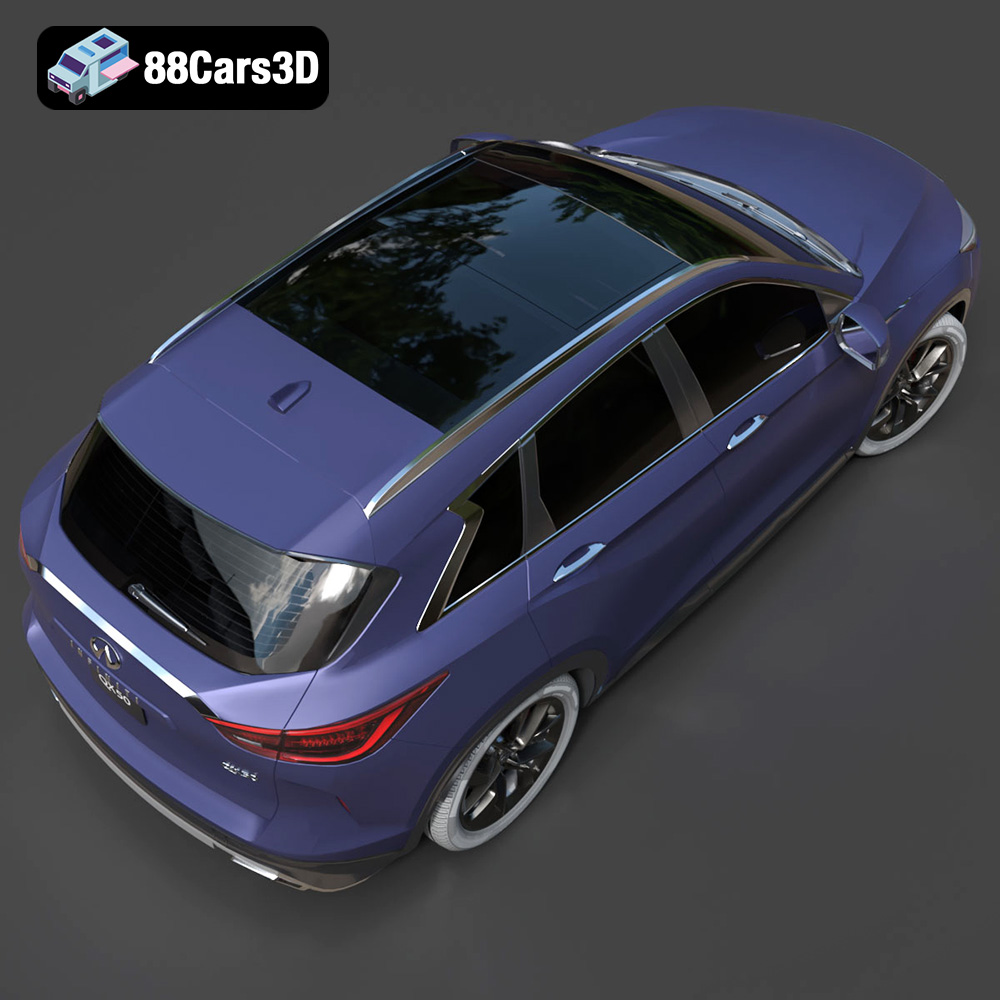
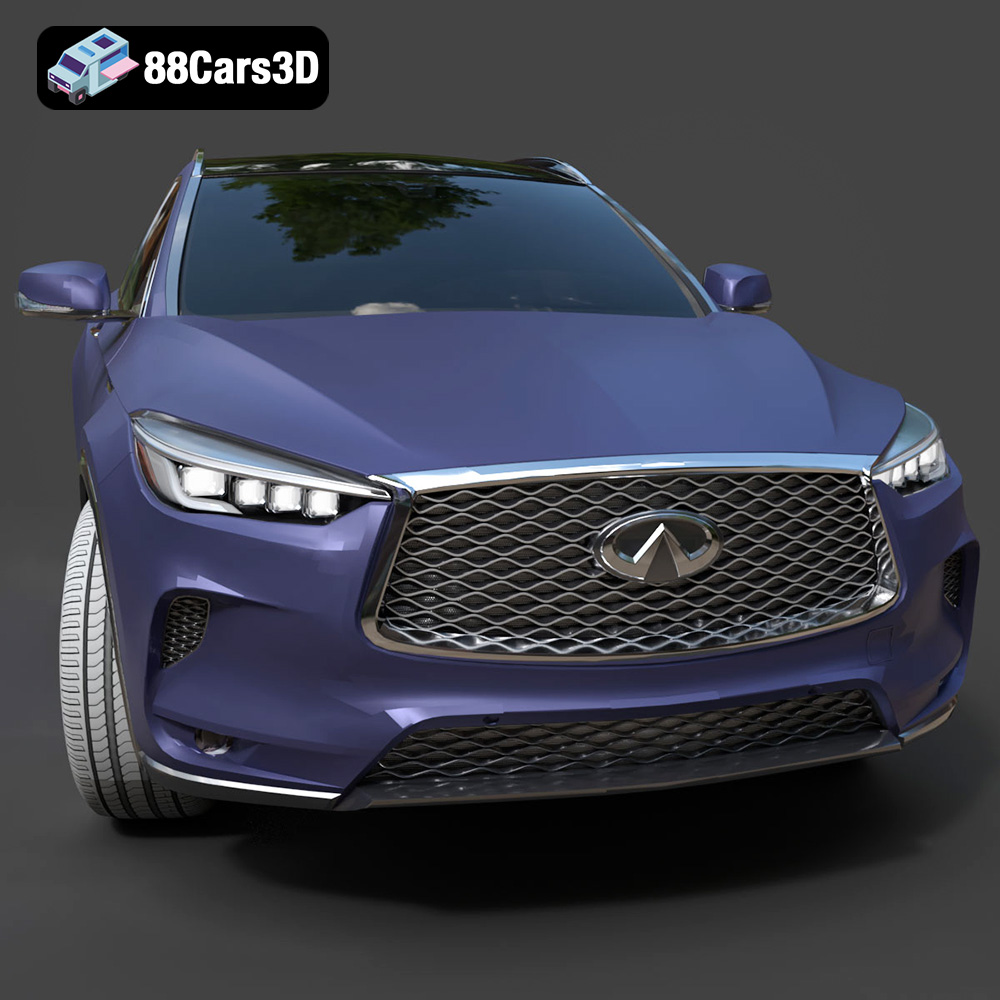
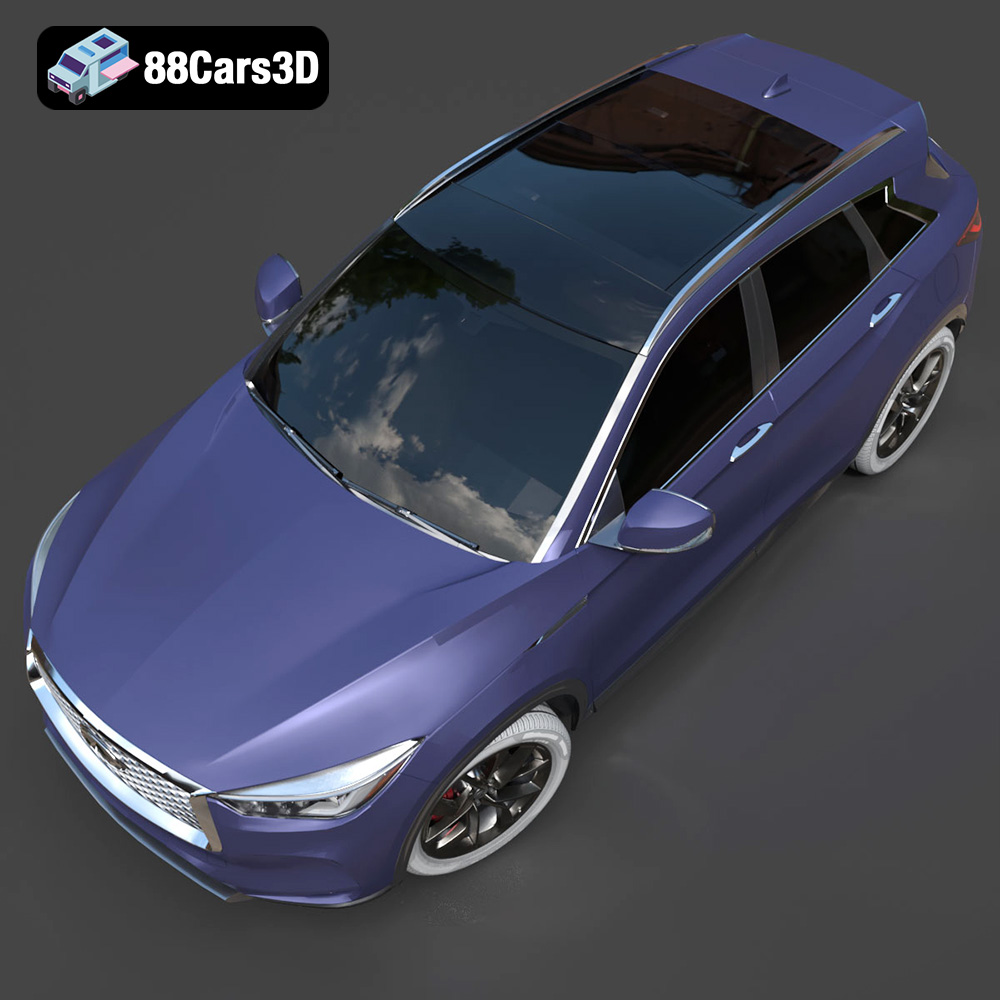
Today, we delve into the intricate world of professional 3D car modeling, exploring the technical nuances, essential workflows, and diverse applications that define this specialized field. We’ll highlight how premium assets, such as the Infiniti QX50 2019 3D Model available on 88cars3d.com, empower artists and developers to achieve stunning, photorealistic results and efficient production pipelines. This particular model stands out with its meticulously crafted geometry, professional topology, and realistic materials, making it a stellar example of what a high-quality 3D automotive asset should be.
The versatility of a 3D model is often defined by the range of file formats it supports. Each format has distinct advantages, optimized for specific software, workflows, or target applications. Understanding these differences is crucial for anyone working with 3D assets, ensuring smooth integration and optimal performance. The Infiniti QX50 2019 3D Model, for instance, comes equipped with an impressive array of formats, ensuring broad compatibility across the industry.
The .blend format is the native file type for Blender, the powerful open-source 3D creation suite. A .blend file typically encapsulates an entire Blender scene, including the 3D mesh, materials, textures, lighting setups, camera positions, animations, physics simulations, and even custom scripts. When a model is provided in .blend format, it means the artist has access to the full, editable project, allowing for intricate adjustments, re-texturing, or animation work directly within Blender’s ecosystem. For users deeply integrated into Blender workflows, this offers unparalleled flexibility and control over every aspect of the asset.
Autodesk’s .fbx (Filmbox) format is arguably the most ubiquitous interchange format in the 3D industry. It’s designed to transfer data between various 3D software applications, game engines, and animation suites efficiently. An .fbx file can carry not just geometric data (vertices, faces, UVs) but also materials, textures, animations, skeletal rigging, camera data, and even lighting information. This makes it ideal for pipelines involving Unreal Engine, Unity, 3ds Max, Maya, and more. Its robustness in preserving complex scene data during export and import is why it’s a go-to for real-time applications and complex animation projects.
The .obj (Wavefront OBJ) format is a classic, widely supported 3D model format known for its simplicity and universality. Primarily, it stores geometric data: vertices, their normals, texture coordinates (UVs), and the polygonal faces that connect them. While it doesn’t support animations, rigging, or advanced scene properties, it’s excellent for static meshes and offers incredible cross-software compatibility. Materials are typically defined in an accompanying .mtl (Material Template Library) file, which references textures. For basic mesh transfers between almost any 3D software, .obj remains a reliable choice.
.glb (GL Transmission Format, binary) is a relatively newer format gaining significant traction, especially in web-based 3D, AR (Augmented Reality), and VR (Virtual Reality) applications. It’s a binary version of the glTF format, designed for efficient transmission and loading of 3D scenes and models. What makes .glb stand out is its ability to package all necessary assets (geometry, materials, textures, animations) into a single, self-contained file. This optimization makes it perfect for quick deployment on websites, mobile AR apps, and any platform where performance and file size are critical.
The .stl (Stereolithography) format is the cornerstone of 3D printing and rapid prototyping. It exclusively describes the surface geometry of a 3D object using a tessellated mesh of triangles, without any color, texture, or material information. While not suitable for rendering or animation, its simplicity and widespread acceptance among 3D printers and CAD software make it indispensable for translating digital models into physical objects. For engineers, product designers, and hobbyists looking to print the Infiniti QX50 2019 3D Model, the .stl file is essential.
The .ply (Polygon File Format) is often used to store 3D data derived from 3D scanners, CAD systems, or scientific computations. It can store a wide range of data beyond simple geometry, including color, transparency, normals, texture coordinates, and even confidence values for each vertex or face. This makes it a robust format for applications requiring high precision and detailed attribute information, such as reverse engineering, quality control, or academic research. It provides a deeper level of data integrity compared to .obj for specific analytical tasks.
When an asset is provided as .unreal, it typically signifies more than just a raw file. It means the model has been pre-configured and optimized specifically for Unreal Engine. This could involve an exported Unreal Engine project package, a .uasset file, or a folder structure ready for direct migration into an Unreal project. Such assets often include pre-set materials, collision meshes, LODs (Levels of Detail), and potentially even blueprint integrations, saving significant development time for game developers and real-time visualization artists. The Infiniti QX50 2019 3D Model’s .unreal inclusion streamlines its integration into high-fidelity real-time environments.
Similar to .blend for Blender, the .max format is the native project file for Autodesk 3ds Max, a leading software for 3D modeling, animation, and rendering. An .max file contains the complete scene data, including all geometry, modifiers, materials (V-Ray, Corona, etc.), lighting, cameras, animations, and scene settings. For professionals working in architectural visualization, product design, or animation studios heavily reliant on 3ds Max, having the model in its native .max format offers the ultimate level of editability and control, allowing for seamless integration into existing 3ds Max pipelines and specific rendering setups.
The availability of such a comprehensive set of file formats for models like the Infiniti QX50 2019 3D Model underscores their utility across various professional domains. From initial concept validation to final marketing collateral, 3D car models are indispensable tools.
Long before a physical vehicle hits the road, its digital twin undergoes rigorous testing and refinement. High-quality 3D car models allow designers to visualize and iterate on concepts with unprecedented speed and accuracy. Engineers can perform aerodynamic simulations, conduct virtual crash tests, and assess ergonomic factors, all within a digital environment. The precision of models found on 88cars3d.com ensures that these simulations are based on geometrically accurate representations, critical for informed decision-making.
In architectural visualization, context is everything. Placing a realistic 3D car model, such as the Infiniti QX50 2019, into an architectural render can dramatically enhance the scene’s realism and scale. It breathes life into sterile environments, illustrating how people might interact with the space. For exterior shots, the reflection of a vehicle’s paintwork on a building’s glass façade or the subtle shadows it casts can elevate a render from good to breathtaking. Clean topology and optimized materials, like those present in the Infiniti QX50 3D model, are crucial here for flawless integration and rendering performance.
Modern consumers expect immersive shopping experiences. Interactive 3D car configurators, often seen on manufacturer websites, allow customers to customize vehicles in real-time – changing colors, wheel types, and interior trims. These applications rely entirely on highly detailed and optimized 3D models. For marketing, photorealistic renders and animations generated from these models populate brochures, websites, and television commercials, showcasing the vehicle in its best light without the need for costly physical photography or film shoots.
The description of the Infiniti QX50 2019 3D Model emphasizes “exceptional realism and precision,” “clean geometry,” “professional-grade topology,” and “realistic materials.” These aren’t just marketing buzzwords; they represent critical technical attributes that define a premium 3D asset.
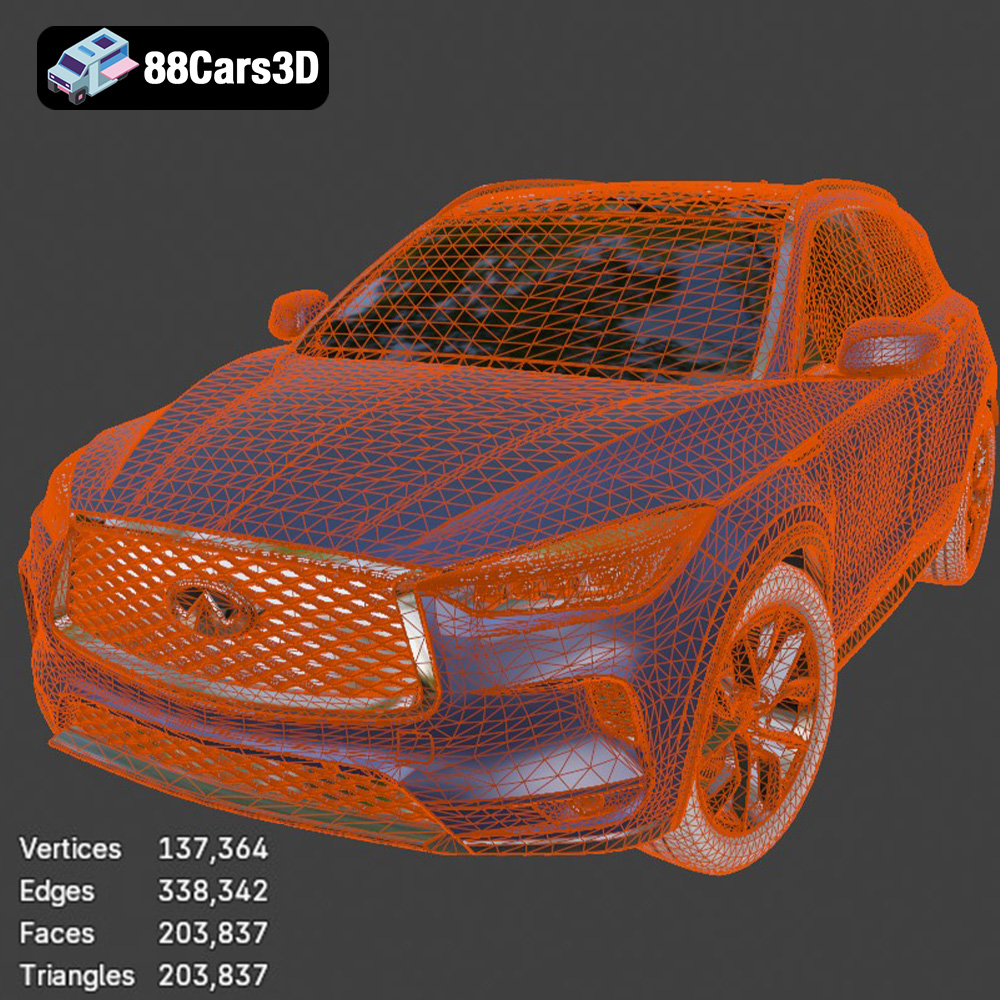
Clean geometry means the model is free from common issues like overlapping faces, inverted normals, or isolated vertices. This ensures predictable behavior during rendering, texturing, and animation. Professional-grade topology refers to the strategic arrangement of polygons (mostly quads, four-sided polygons) that form the mesh. Good topology ensures smooth subdivisions, facilitates clean UV unwrapping, and allows for deformation (animation) without unwanted pinching or stretching. For a complex object like a car, this is paramount, enabling crisp edges, smooth curves, and accurate reflections that mimic real-world automotive surfaces.
The “realistic materials” mentioned in the product description are fundamental to achieving photorealism. This involves PBR (Physically Based Rendering) workflows, where materials simulate how light interacts with surfaces in the real world. This includes properties like metallicness, roughness, albedo (base color), normal maps (for surface detail without increasing poly count), and opacity. For a car, this translates to accurately rendered paint flakes, believable tire rubber, glass refraction, and intricate interior textures. The Infiniti QX50 2019 3D Model’s materials are set up to respond realistically under varied lighting conditions, making it suitable for both studio renders and dynamic outdoor scenes.
While not explicitly detailed in the product description, professional 3D car models will always feature well-executed UV mapping. UVs are 2D coordinates that tell the software how to project 2D textures onto the 3D surface. Clean UVs prevent texture stretching, allow for efficient use of texture space, and are essential for applying decals, logos, and intricate patterns precisely. A model with clean UVs significantly reduces the time and effort required for texturing and material adjustments.
The broad spectrum of included formats for the Infiniti QX50 2019 3D Model unlocks its potential across diverse and demanding applications, truly demonstrating the power of sourcing high-quality assets from platforms like 88cars3d.com.
For film and television, the demand for photorealistic digital doubles of vehicles is constant. Whether it’s for crash sequences, impossible stunts, or simply populating a digital cityscape, a high-detail 3D car model is essential. The Infiniti QX50 2019, with its clean geometry and realistic materials, can be seamlessly integrated into live-action footage, allowing VFX artists to render it under specific lighting conditions to match the plate photography. The .max or .blend files offer the complete flexibility needed for intricate animation and rendering setups required in high-end VFX.
The rise of Augmented and Virtual Reality creates a new frontier for 3D car models. Imagine walking around the Infiniti QX50 2019 in your living room via an AR app, or test-driving it virtually in a VR headset. These experiences demand optimized models that can render smoothly in real-time on diverse hardware. The .glb format is particularly beneficial here, offering a compact and efficient package for AR/VR deployment. Furthermore, the inclusion of an .unreal file indicates a model ready to be dropped into a robust real-time engine, facilitating the creation of highly interactive and visually rich immersive environments.
Beyond entertainment, 3D car models are crucial for professional training and simulation. Driving simulators for professional drivers, military training, or autonomous vehicle development rely on accurate digital environments and vehicle models. The Infiniti QX50 2019 3D Model’s precision and engine-ready formats (.fbx, .unreal) make it an excellent candidate for such serious applications, where accurate visual feedback and physics interactions are paramount.
While photorealism is key for cinematic renders, real-time applications like video games and interactive configurators have an additional constraint: performance. This requires careful optimization of 3D assets.
High-detail models like the Infiniti QX50 2019 might have millions of polygons for ultimate fidelity in close-up renders. However, for real-time engines, rendering every polygon of every distant object is impractical. This is where Levels of Detail (LODs) come in. LODs are simplified versions of the model that automatically switch based on the camera’s distance. A well-prepared game asset will include multiple LODs, from high-poly (for close-ups) to low-poly (for distant views), ensuring optimal performance without sacrificing visual quality where it matters. The clean topology of the base model makes creating these LODs much more straightforward.
In game engines, a visual mesh is distinct from a collision mesh. The collision mesh is a simpler, often invisible, geometry used by the physics engine to detect impacts and interactions. Creating an accurate yet optimized collision mesh is vital for realistic driving physics and interactions within a game world. Similarly, materials need to be set up within the engine to interact correctly with lighting, reflections, and potentially even damage systems. The .fbx and .unreal formats are specifically designed to carry or facilitate the setup of these engine-specific properties.
Optimized game assets often utilize texture atlases (combining multiple textures into one sheet) and material instancing (creating variations of a base material) to reduce draw calls and improve rendering efficiency. While the core Infiniti QX50 2019 3D Model provides the base realistic materials, an experienced game developer can further optimize these within Unreal Engine or Unity to meet specific project performance targets, benefiting from the model’s robust foundation.
The journey from a designer’s vision to a fully realized digital car model is complex, requiring a blend of artistic skill and technical prowess. As industries increasingly rely on digital assets for everything from marketing to interactive experiences, the demand for high-quality, versatile 3D models only grows.
The Infiniti QX50 2019 3D Model exemplifies the pinnacle of professional 3D car modeling. Its exceptional realism, meticulously clean geometry, and comprehensive suite of file formats (including .blend, .fbx, .obj, .glb, .stl, .ply, .unreal, and .max) position it as an invaluable asset for any professional workflow. Whether you’re an architectural renderer seeking contextual realism, a game developer building an immersive world, or a visualization artist crafting the next automotive masterpiece, this model provides the foundation for success.
Investing in premium 3D car models from trusted marketplaces like 88cars3d.com not only saves precious development time but also guarantees a level of quality and compatibility that elevates projects across the board. The future of automotive visualization and digital content creation is bright, and it’s built upon the meticulous details of assets like the Infiniti QX50 2019 3D Model.
Discover the exceptional realism and precision of the Infiniti QX50 2019 3D Model. Crafted with meticulous attention to detail, this premium digital asset accurately reflects the stunning aesthetics and sophisticated design of the renowned luxury crossover SUV. This model features exceptionally clean geometry, professional-grade topology, and realistic materials that ensure outstanding performance under varied lighting conditions. Every element, from its bold exterior curves to its fully modeled interior, has been constructed to meet the strictest industry standards for professional 3D design. Designed for unparalleled versatility, this 3D vehicle is ready to be integrated seamlessly into a wide range of professional applications. Whether you are working on advanced game development, creating photorealistic architectural renders, building immersive AR/VR experiences, or producing cinematic visual effects, this asset delivers reliable and visually striking results. Included File Formats: .blend, .fbx, .obj, .glb, .stl, .ply, .unreal, .max
$39.99
.2019
.arvr
.blend
.car3dmodel
.crossover
.fbx
.gameasset
.glb
.infiniti
.max
.obj
.ply
.qx50
.rendering
.simulation
.stl
.unreal
SUV