Get 20% OFF All Premium 3D & STL Models!

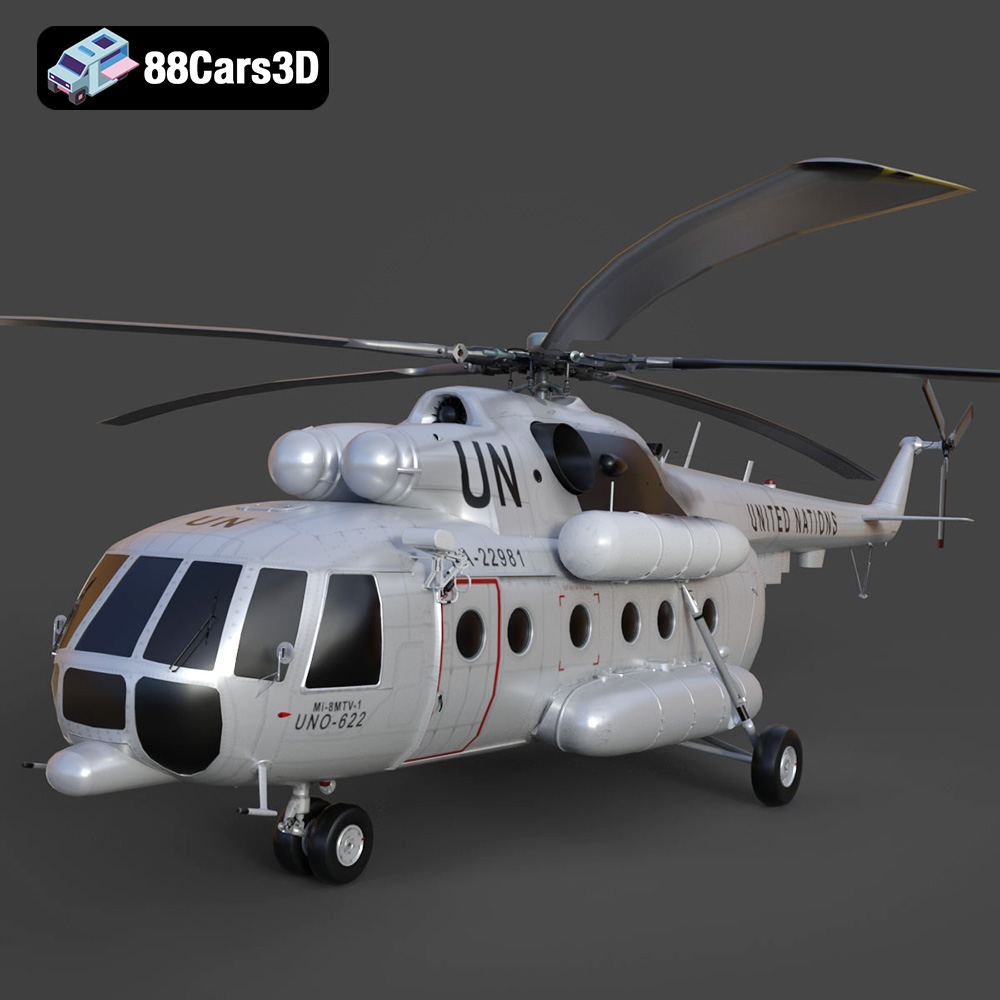
The Mil Mi-8MTV-UN is a legendary helicopter, renowned for its service in UN peacekeeping and humanitarian missions. Its distinctive silhouette and rugged design make it a captivating subject for 3D printing enthusiasts. With a highly detailed 3D model from 88cars3d.com, you can now bring this iconic aircraft to life. This guide will walk you through the entire 3D printing process, from selecting the right materials and settings to post-processing and finishing techniques, ensuring a successful and rewarding build. Let’s dive into the exciting world of additive manufacturing and explore how to create a stunning replica of the Mil Mi-8MTV-UN.
Before embarking on your 3D printing journey, it’s crucial to understand the different file formats available and how they impact the printing process. The 88cars3d.com model comes with a variety of formats, each designed for specific purposes, but some are better suited for 3D printing than others.
The .stl (Stereolithography) format is the industry standard for 3D printing. It represents the 3D model’s surface geometry as a collection of triangles. While .stl files are simple and widely compatible with slicing software, they lack color and texture information. This means your 3D printed Mil Mi-8MTV-UN will be a single-color print, requiring painting for a realistic finish.
The .stl format excels in its ease of use and compatibility. Most slicing software readily accepts .stl files, allowing you to quickly prepare the model for printing. However, it’s important to inspect the .stl file for any errors, such as non-manifold geometry or holes, which can lead to printing failures. Mesh repair tools, available in most slicing programs, can help resolve these issues. When working with .stl files for the Mil Mi-8MTV-UN, ensure the mesh quality is sufficient to capture the helicopter’s intricate details, especially the rotor blades and engine components.
The .obj (Wavefront Object) format is a more versatile format than .stl, as it can store color and texture information. This is particularly useful if you plan to create a multi-color print using a printer equipped with multiple extruders or if you want to apply textures to the model in a 3D painting software before printing.
However, .obj files are often larger than .stl files and may not be as universally supported by all slicing software. If you choose to use the .obj format for the Mil Mi-8MTV-UN, verify that your slicing software can properly interpret the color and texture data. For single-color printing, the .stl format is generally preferred due to its simplicity and widespread compatibility.
The .ply (Polygon File Format) is designed for capturing high-detail 3D data, often used in 3D scanning applications. It stores vertex data, including color and normals, allowing for more accurate representation of complex shapes. While .ply can be used for 3D printing, it is not as common as .stl or .obj.
The high level of detail in .ply files can be beneficial for reproducing the fine details of the Mil Mi-8MTV-UN, such as the panel lines and rivets. However, the increased file size and potential compatibility issues with slicing software make it a less practical choice for most 3D printing applications.
The other formats included – .blend (Blender), .fbx (Filmbox), .glb (GL Transmission Format), and .max (3ds Max) – are primarily intended for editing, animation, and previewing the model. These formats are not directly used for 3D printing.
* **.blend:** This is the native file format for Blender, a popular open-source 3D modeling software. It allows you to modify the model before exporting it to a 3D printable format.
* **.fbx:** This format is commonly used for exchanging 3D models between different software applications. It supports materials and animations.
* **.glb:** This is a binary file format that is used for previewing models in AR applications.
* **.max:** This is the native file format for 3ds Max, a professional 3D modeling and animation software.
For 3D printing purposes, you’ll typically export the model from one of these formats (.blend or .max) to an .stl file after making any desired modifications. The .stl file can then be imported into your slicing software for print preparation.
In conclusion, for 3D printing the Mil Mi-8MTV-UN model from 88cars3d.com, the **.stl format is the recommended choice** due to its simplicity, compatibility, and ease of use. Ensure that the mesh quality is sufficient for capturing the model’s details and repair any errors before slicing.
Before hitting the print button, careful preparation is crucial for a successful outcome. This involves inspecting the model, making necessary repairs, and optimizing it for your specific 3D printer and material.
* **Mesh Analysis:** Load the STL file into a 3D modeling or slicing software. Use the built-in tools to analyze the mesh for errors like non-manifold edges, holes, or inverted normals. These issues can cause printing problems and need to be addressed.
* **Repair Tools:** Most slicing software includes automatic repair tools that can fix common mesh errors. Utilize these tools to ensure a clean and printable model. For more complex repairs, consider using dedicated mesh editing software like MeshMixer or Blender.
* **Detail Preservation:** While repairing the mesh, be mindful of preserving the intricate details of the Mil Mi-8MTV-UN, such as the panel lines, rivets, and engine components. Avoid over-simplifying the model during the repair process.
* **Scale Selection:** The product description suggests scales of 1:48 or 1:72. Choose the scale that best suits your needs and printer capabilities. Larger scales will reveal more detail but require more material and print time.
* **Orientation Strategy:** The orientation of the model on the print bed significantly impacts the print quality and the amount of support material required. For the fuselage, printing horizontally or at a slight angle can provide structural integrity and minimize the need for supports on curved surfaces.
* **Rotor Separation:** As suggested, print the rotor blades separately. This allows for optimal orientation to minimize support usage and ensure the thin blades are printed with adequate strength.
* **Slicing Software Selection:** Choose a slicing software that is compatible with your 3D printer and offers the necessary features for fine-tuning the printing process. Popular options include Cura, Simplify3D, and PrusaSlicer.
* **Layer Height:** The recommended layer height is 0.04–0.12 mm. Lower layer heights result in smoother surfaces and finer details but increase print time. Experiment with different layer heights to find the optimal balance between quality and speed. For resin printing, stick to the lower end of the range for maximum detail.
* **Wall Thickness:** The suggested wall thickness is 1.2–2.0 mm. This provides sufficient strength for the model’s exterior. Adjust the wall thickness based on your chosen material and desired level of durability.
* **Infill Density:** An infill density of 20–30% is recommended. This provides internal support without adding excessive weight or material. Adjust the infill pattern and density based on the model’s structural requirements.
* **Support Generation:** Supports are crucial for printing overhanging features like rotor blades, exhaust ports, and landing gear. Use the slicing software’s support generation tools to automatically create supports. Experiment with different support settings, such as support density, overhang angle, and support interface, to minimize support material usage and improve surface quality.
The choice of material significantly impacts the final appearance, strength, and durability of your 3D printed Mil Mi-8MTV-UN. Here’s a breakdown of popular materials and their suitability for this project:
* **Pros:** PLA is a biodegradable thermoplastic known for its ease of use, low printing temperature, and minimal warping. It’s a great option for beginners and produces parts with good detail.
* **Cons:** PLA is relatively brittle and has low heat resistance, making it unsuitable for parts that will be exposed to high temperatures or stress.
* **Suitability:** PLA is a good choice for a display model that won’t be subjected to rough handling. Its ease of printing makes it ideal for initial prototypes and learning the ropes of 3D printing.
* **Pros:** PETG offers a good balance of strength, flexibility, and heat resistance. It’s more durable than PLA and less prone to warping than ABS.
* **Cons:** PETG can be more challenging to print than PLA, requiring higher printing temperatures and careful calibration. It also tends to string, which can require additional post-processing.
* **Suitability:** PETG is an excellent choice for a more durable Mil Mi-8MTV-UN model. Its increased strength and heat resistance make it suitable for parts that may be handled frequently or exposed to moderate temperatures.
* **Pros:** Resin 3D printing (SLA/DLP) produces parts with exceptional detail and smooth surfaces. It’s ideal for printing small, intricate parts like antennas and rotor blades.
* **Cons:** Resin printing is more expensive than FDM printing and requires careful handling of the resin material. The parts also need to be post-processed to remove uncured resin.
* **Suitability:** Resin printing is highly recommended for printing the detailed parts of the Mil Mi-8MTV-UN, such as the antennas, rotor blades, and cockpit details. Combining resin-printed parts with a larger FDM-printed fuselage can result in a highly detailed and visually stunning model.
* **Pros:** ABS is a strong and heat-resistant thermoplastic commonly used in engineering applications.
* **Cons:** ABS is more difficult to print than PLA and PETG, requiring a heated bed and enclosure to prevent warping. It also emits fumes during printing, so proper ventilation is necessary.
* **Suitability:** While ABS offers excellent strength and heat resistance, its printing challenges make it less ideal for this project, especially for beginners.
Achieving optimal print quality requires careful adjustment of printer settings. These settings will vary depending on your chosen material and 3D printer. Here are some key settings to consider:
* **Extruder Temperature:** The optimal extruder temperature depends on the material. PLA typically prints between 190-220°C, PETG between 220-250°C, and ABS between 230-260°C. Refer to the filament manufacturer’s recommendations for the best results.
* **Bed Temperature:** A heated bed is essential for preventing warping, especially with PETG and ABS. PLA can be printed without a heated bed, but a bed temperature of 50-60°C is recommended. PETG requires a bed temperature of 70-80°C, and ABS requires a bed temperature of 100-110°C.
* **Resin Printer Settings:** For resin printing, follow the resin manufacturer’s recommendations for exposure time, layer thickness, and lift speed.
* **Print Speed:** A slower print speed generally results in higher quality prints. A print speed of 40-60 mm/s is a good starting point for most materials. Reduce the print speed for intricate details and overhangs.
* **Travel Speed:** The travel speed is the speed at which the print head moves between printing sections. A higher travel speed can reduce print time, but it can also cause vibrations and affect print quality.
* **Retraction Speed and Distance:** Retraction settings control how much filament is pulled back into the nozzle when the print head moves between printing sections. Proper retraction settings are crucial for preventing stringing and blobs.
* **Support Density:** Increase support density for complex overhangs and intricate details. Reduce support density for simpler overhangs to save material and reduce post-processing effort.
* **Support Overhang Angle:** The support overhang angle determines the angle at which supports are generated. A lower overhang angle will result in more supports but provide better support for overhanging features.
* **Support Interface:** A support interface creates a dense layer between the support structure and the printed part, making it easier to remove the supports without damaging the surface of the part.
Once the 3D printing is complete, post-processing is necessary to remove supports, smooth surfaces, and apply the finishing touches that bring the Mil Mi-8MTV-UN to life.
* **Gentle Removal:** Carefully remove the support structures using pliers, tweezers, or a sharp knife. Be patient and avoid applying excessive force, which can damage the printed part.
* **Soluble Supports:** If you used soluble support material (e.g., PVA for PLA), dissolve the supports in water according to the manufacturer’s instructions.
* **Sanding:** After removing the supports, sand the surface of the model to remove any remaining support marks and smooth out any imperfections. Start with coarse sandpaper and gradually move to finer grits.
* **Sanding:** Sanding is the most common method for smoothing 3D printed surfaces. Use wet sanding for best results and to minimize dust.
* **Chemical Smoothing:** Chemical smoothing involves exposing the printed part to a solvent vapor, which melts the surface and creates a smooth finish. This method is typically used for ABS and requires careful handling of the solvent.
* **Epoxy Coating:** Applying a thin layer of epoxy resin can fill in any remaining imperfections and create a smooth, glossy surface.
* **Priming:** Apply a primer coat to the model to create a uniform surface for painting.
* **Painting:** Use acrylic paints for painting the Mil Mi-8MTV-UN. Apply multiple thin coats for best results. Use masking tape to create clean lines and sharp details.
* **Weathering:** Add weathering effects to the model to create a realistic, battle-worn appearance. Use techniques like dry brushing, washes, and pigment powders to simulate dirt, grime, and wear.
* **Decals:** Apply decals to add markings and details to the model. Use decal setting solution to ensure the decals adhere properly to the surface.
Even with careful preparation, you may encounter some common 3D printing issues. Here are some tips for troubleshooting:
* **Problem:** The corners of the printed part lift off the print bed.
* **Solution:** Increase the bed temperature, use a brim or raft, ensure the print bed is level, and reduce the cooling fan speed.
* **Problem:** Thin strands of filament are left between printing sections.
* **Solution:** Increase the retraction speed and distance, decrease the printing temperature, and ensure the filament is dry.
* **Problem:** The layers of the printed part are misaligned.
* **Solution:** Tighten the belts and screws on the 3D printer, reduce the printing speed, and ensure the print bed is stable.
* **Problem:** The printed part has gaps or thin walls due to insufficient filament extrusion.
* **Solution:** Increase the printing temperature, decrease the printing speed, and ensure the nozzle is not clogged.
* **Problem:** The printed part has blobs or excessive material due to too much filament extrusion.
* **Solution:** Decrease the printing temperature, increase the printing speed, and calibrate the extruder.
By carefully following these steps and troubleshooting any issues that arise, you can create a stunning 3D printed replica of the Mil Mi-8MTV-UN. The detailed model available at 88cars3d.com provides an excellent foundation for this exciting project.
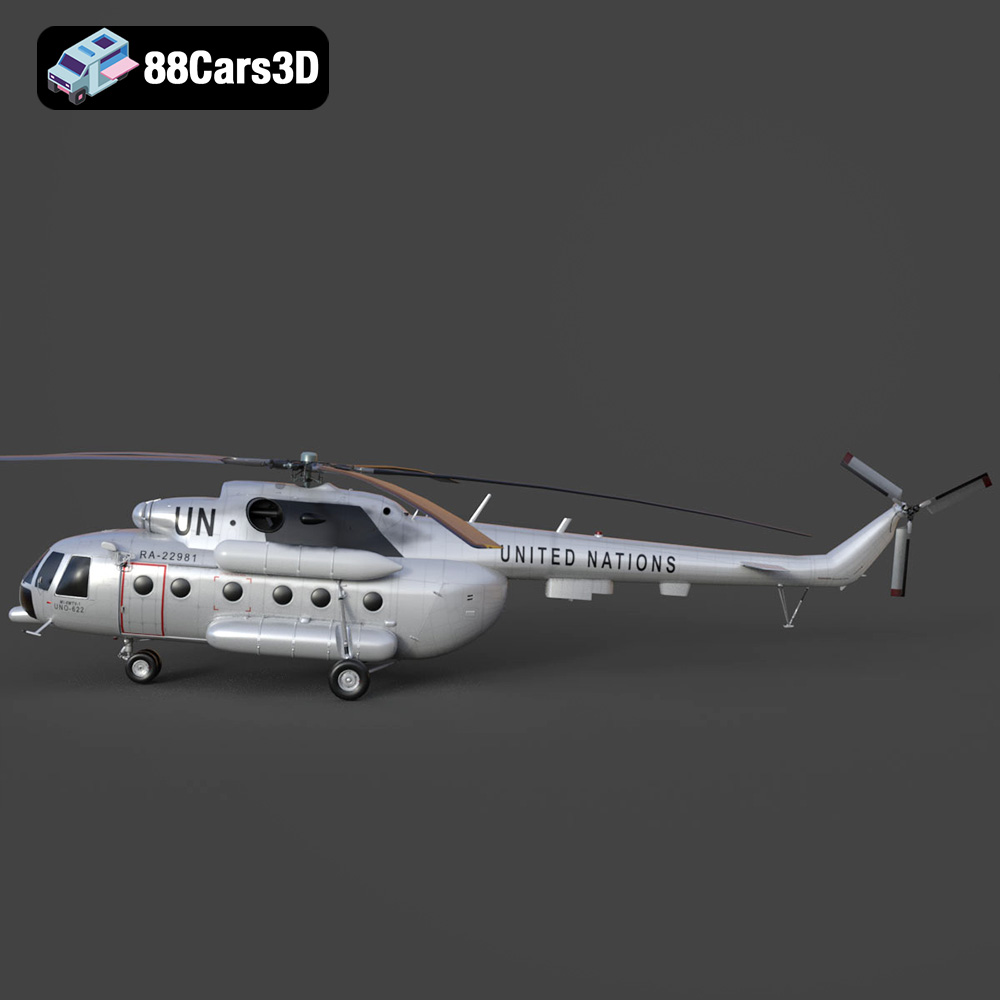
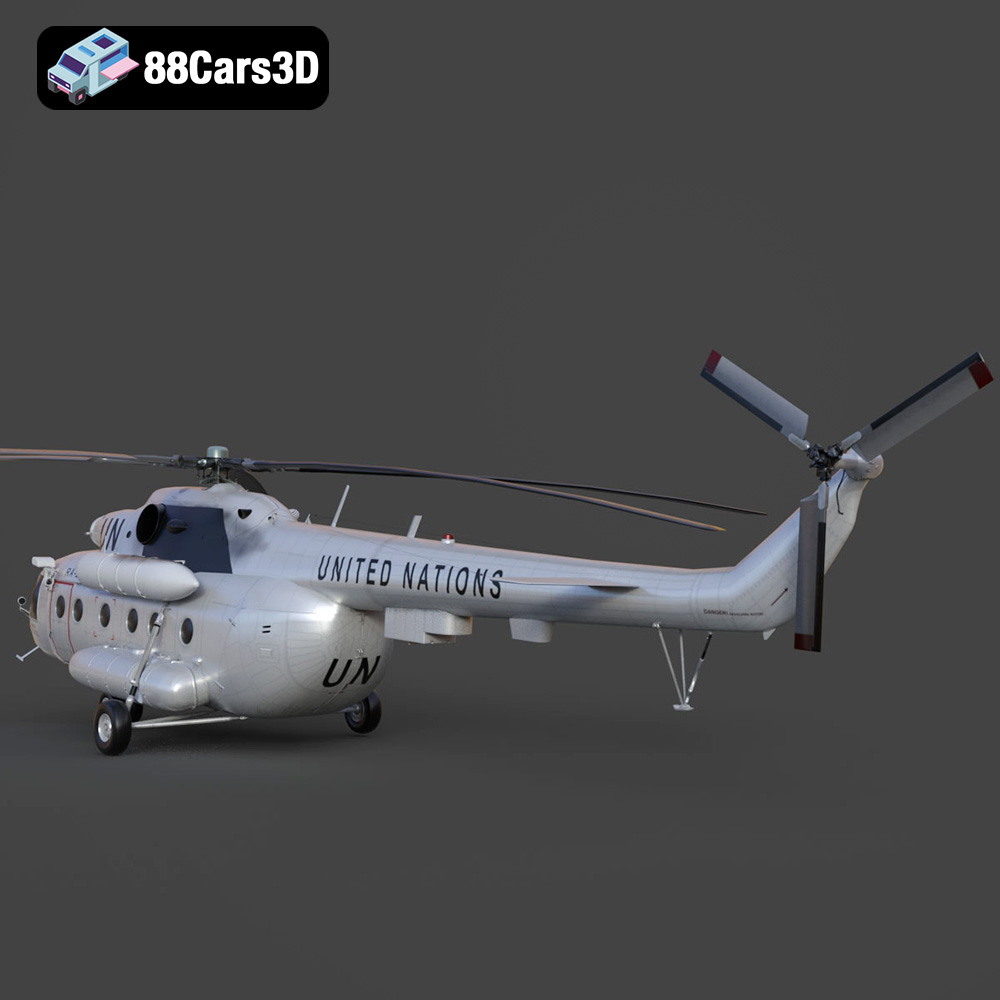
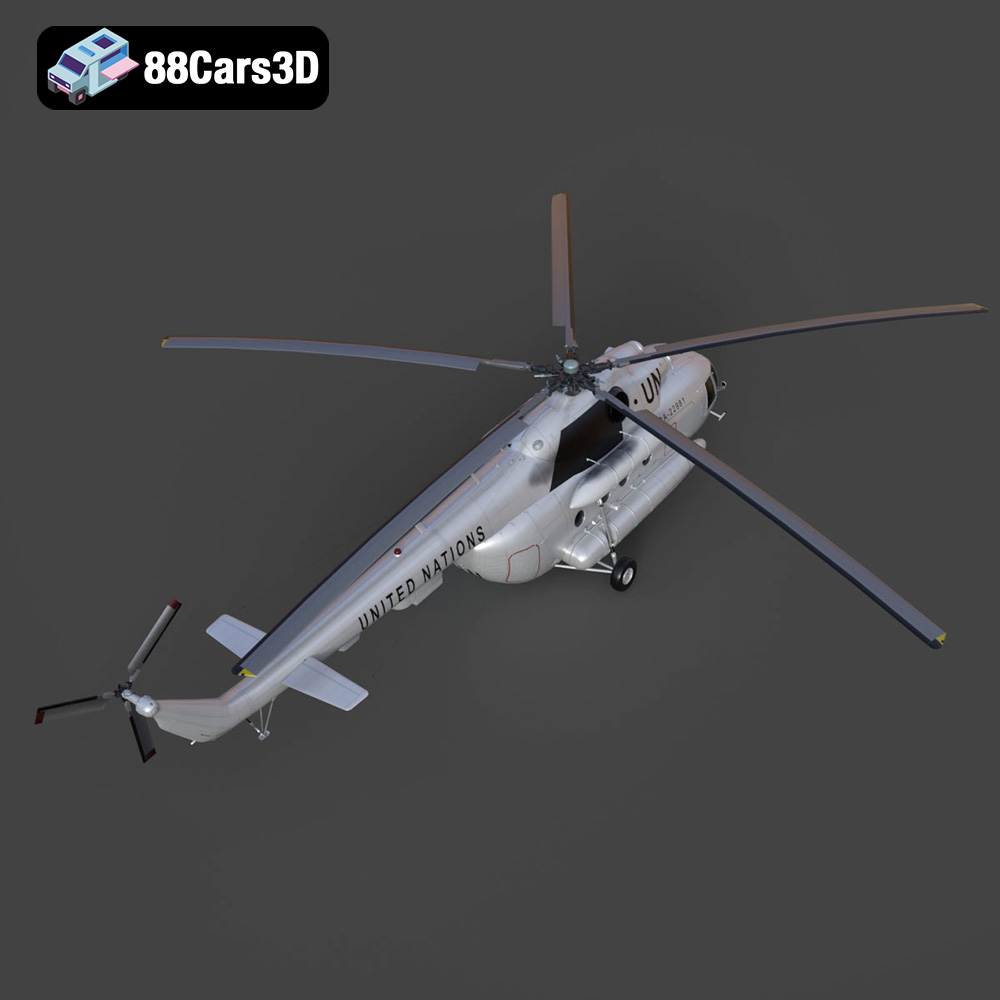
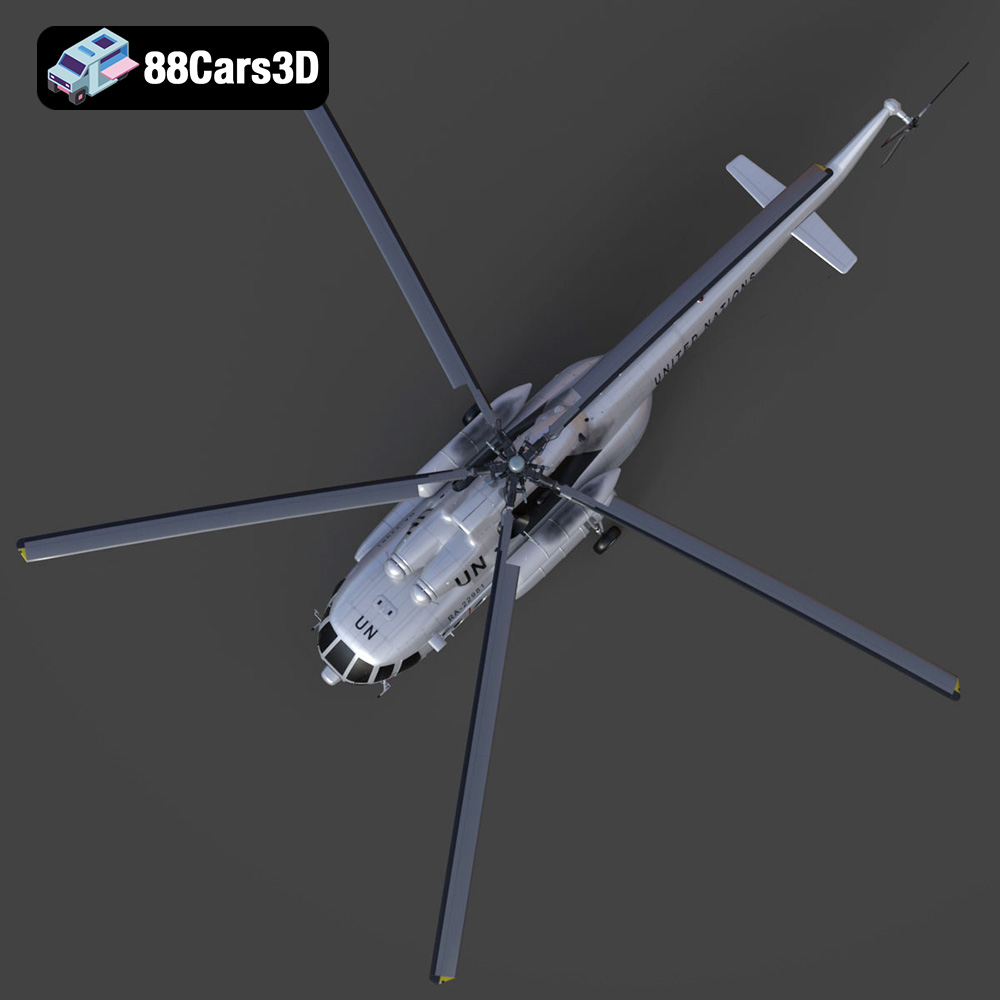
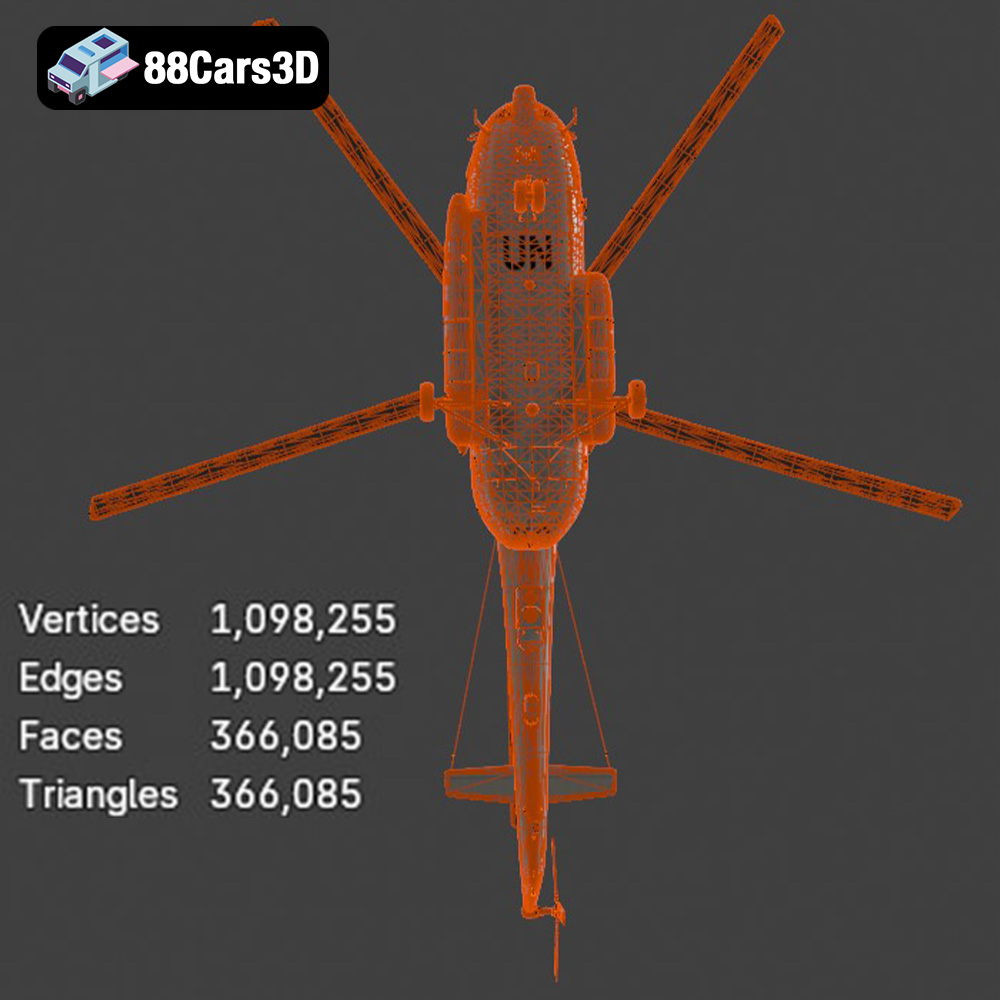
The Mil Mi-8MTV-UN is an iconic, multi-role transport helicopter, globally recognized for its extensive service in humanitarian and peacekeeping missions under the United Nations. This highly detailed 3D model captures the rugged essence of the legendary aircraft, featuring its distinctive white UN livery, prominent markings, robust twin Klimov turboshaft engines, and the signature five-blade main rotor system that has made it a workhorse of international aviation.
$39.99
.aviation
.blend
.fbx
.glb
.helicopter
.max
.obj
.ply
.rendering
.stl
.unreal
game asset
game-ready
helicopter-3d-model
low-poly
mi-8mtv-un
mil
optimized
transport-helicopter
united-nations
vehicle-3d-model
VR/AR