Get 20% OFF All Premium 3D & STL Models!

In the rapidly evolving landscape of digital content creation, the demand for realistic, high-fidelity 3D assets is paramount. From blockbuster video games and immersive virtual reality experiences to stunning architectural visualizations and compelling marketing campaigns, the quality of a 3D model can make or break a project. Automotive design, in particular, thrives on precision and visual accuracy, making high-quality 3D car models indispensable tools for professionals across various industries.
A meticulously crafted 3D car model not only serves as a visual placeholder but acts as a dynamic asset, capable of conveying speed, elegance, and technological sophistication. It empowers designers, developers, and artists to iterate rapidly, visualize concepts, and bring their creative visions to life with unparalleled realism. Consider the 2020 Peugeot 208, a vehicle that redefined its segment with bold styling and sporty proportions. Imagine needing to integrate such a distinctive car into a new urban game environment, a cutting-edge architectural visualization, or an interactive VR showroom. The availability of a production-ready 3D model, like the Peugeot 208 2020 3D Model available on 88cars3d.com, becomes a critical advantage, significantly streamlining workflows and elevating output quality.
This article delves deep into the technical intricacies and professional applications of premium 3D car models, using the Peugeot 208 2020 as a prime example. We’ll explore file formats, optimization strategies, and how such an asset integrates seamlessly into diverse production pipelines, proving its worth far beyond a simple visual prop.
One of the most crucial aspects of working with 3D models is understanding the various file formats and their specific applications. Each format is designed with particular strengths, catering to different software environments, project requirements, and output destinations. Selecting the correct format ensures compatibility, preserves data integrity, and optimizes workflow efficiency. The Peugeot 208 2020 3D Model, for instance, comes with a comprehensive suite of formats, offering maximum versatility.
The .blend format is the native file type for Blender, the powerful open-source 3D creation suite. When you acquire a .blend file, you gain access to the fully editable scene, complete with materials, textures, lighting setups, and any associated rigging or animation. This format is ideal for artists and studios that primarily use Blender, offering the most flexibility for customization, tweaking shaders, modifying geometry, or extending animations. Technical details include direct access to node-based materials (for Cycles and Eevee renderers), modifiers, and a non-destructive workflow. For the Peugeot 208 2020 3D Model, the .blend file allows for deep diving into its construction, enabling artists to fine-tune every aspect of its appearance for a bespoke render.
.fbx (Filmbox) is arguably the most widely adopted interchange format in the 3D industry, especially crucial for game development, animation, and real-time pipelines like Unreal Engine and Unity. Developed by Autodesk, FBX can store a vast array of 3D data, including mesh geometry, materials (though often simplified, requiring re-setup in the destination software), textures, bones, skinning, animation, camera data, and lights. Its robustness and ability to maintain hierarchical relationships make it excellent for complex assets like car models with separate wheels, steering, and suspension components ready for animation. An .fbx version of the Peugeot 208 2020 ensures a smooth transition into virtually any professional 3D application or game engine.
The .obj (Wavefront Object) format is a universal standard, widely supported across almost all 3D software. It primarily stores geometry (vertices, normals, UVs) and group information. While it lacks support for animation, rigging, or advanced material definitions (materials are typically referenced via an accompanying .mtl file that defines basic properties like color and texture maps), its simplicity makes it an excellent fallback for cross-software compatibility. If you need to import the Peugeot 208 2020 into an obscure renderer or a program with limited format support, .obj is a reliable choice for transferring the core mesh data accurately.
.glb (GL Transmission Format Binary) is the binary version of glTF, a royalty-free specification for the efficient transmission and loading of 3D scenes and models by engines and applications. GLB files are self-contained, including models, animations, and PBR (Physically Based Rendering) materials within a single file. This makes them incredibly efficient for web-based 3D viewers, augmented reality (AR), virtual reality (VR), and mobile applications. Their optimized nature ensures quick loading times and consistent visual quality across different platforms. The Peugeot 208 2020 in .glb format is perfect for showcasing the model interactively on a website or integrating it into an AR configurator.
The .stl (Stereolithography) format is almost exclusively used for 3D printing. It represents a 3D model as a collection of triangular facets, defining only the surface geometry without color, texture, or material information. While it can result in large file sizes for highly detailed models, its simplicity and widespread adoption make it the standard for transferring models to 3D printers. The Peugeot 208 2020 3D Model’s availability in .stl enables hobbyists and professionals to physically manifest a scale replica, requiring careful consideration of print settings like scale, layer height, and supports, as outlined in the product details.
The .ply (Polygon File Format) is another format for storing 3D data, often used for representing 3D scanned objects. It can store a wide range of properties, including color, transparency, surface normals, texture coordinates, and data confidence values, either per vertex or per face. While less common for manually created assets, its capability to hold detailed attribute data makes it valuable for scientific visualization, CAD analysis, or working with point cloud data derived from real-world scans. The inclusion of .ply for the Peugeot 208 2020 offers an alternative for specific analytical or archival purposes, though it’s less frequently used for standard rendering workflows.
The term .unreal, in the context of downloadable 3D models, typically refers to an asset package or a project file specifically prepared and optimized for Unreal Engine. Unlike other formats that are universal exports, an “.unreal” file implies direct engine integration. This means the model has likely been imported, had its materials set up using Unreal’s PBR shader system, collisions generated, and potentially LODs (Levels of Detail) configured. It often includes .uasset files bundled within a content folder or an exported Unreal project fragment. For the Peugeot 208 2020, this signifies a ready-to-use asset that can be dropped into an Unreal Engine project with minimal setup, saving significant time for game developers and real-time visualization artists.
.max is the native file format for Autodesk 3ds Max, a leading software for 3D modeling, animation, rendering, and compositing. A .max file contains the entire scene information, including geometry, lights, cameras, materials, textures, animations, and plug-in data. It offers the most comprehensive control for users of 3ds Max, allowing for deep modifications, complex rigging, advanced rendering setups with V-Ray or Corona, and intricate animation sequences. Having the Peugeot 208 2020 3D Model in .max format ensures that 3ds Max professionals can leverage all their familiar tools and workflows to integrate and customize the vehicle to their exact specifications.
Beyond file formats, the intrinsic quality of a 3D model is determined by its construction. A truly professional 3D car model, such as the Peugeot 208 2020 offered by 88cars3d.com, is a masterpiece of digital craftsmanship, balancing intricate detail with efficient performance. This involves precise geometry, optimized topology, and carefully crafted materials.
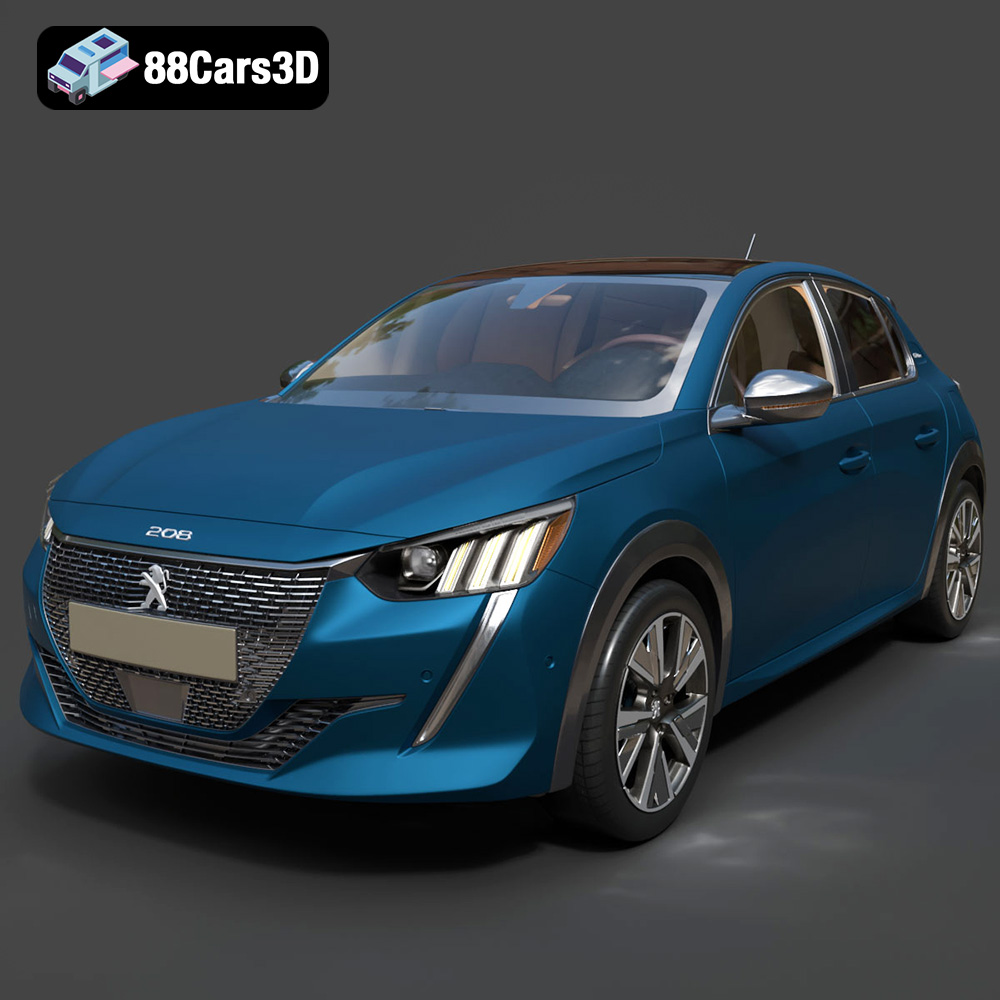
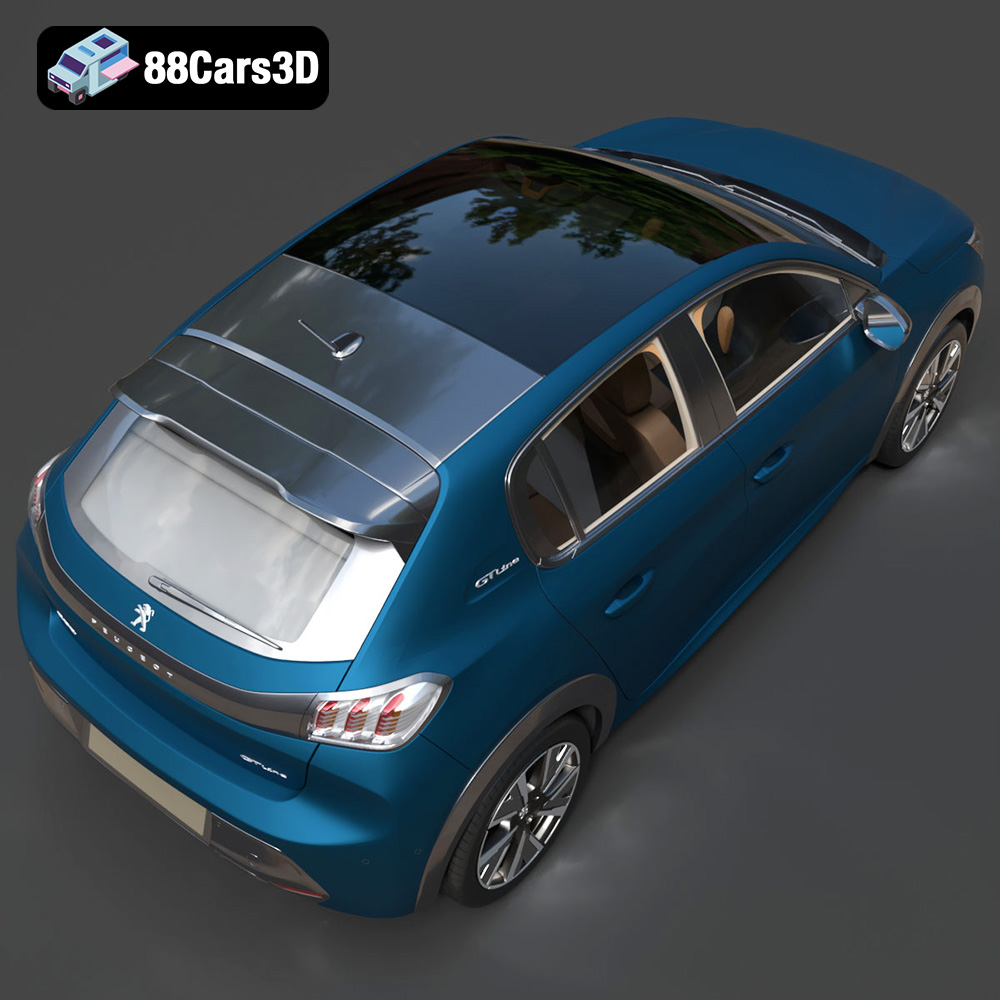
The first impression of any car model comes from its exterior. The Peugeot 208 2020 3D Model excels here, capturing the vehicle’s “bold, aggressive styling and sporty proportions.” Key details like the signature ‘saber-tooth’ LED daytime running lights (DRLs) and the elegant gloss-black rear light cluster fascia are meticulously replicated. The detailed front grille with the prominent Peugeot lion emblem and high-resolution headlight and taillight housings with realistic reflectors are critical for photorealistic renders. Furthermore, aerodynamic alloy wheels with detailed brake calipers and disc rotors, coupled with realistic tire treads, ensure accuracy even in close-up shots. These elements are not just visually accurate but are constructed with clean, optimized geometry, preventing artifacts during rendering or real-time display.
While often overlooked in external shots, a detailed interior is crucial for applications like first-person view in games, virtual showrooms, or cinematic sequences. The Peugeot 208 2020 3D Model doesn’t disappoint, featuring “detailed seating with realistic fabric/leather texture mapping” and the “ergonomic i-Cockpit layout.” The digital 3D instrument cluster and modern infotainment display details, along with an accurate central console, gear shifter, and tactile control buttons, contribute significantly to immersion. This level of interior detail is particularly challenging to optimize, as it needs to be convincing without overburdening the polycount, especially for game assets. The model’s optimized geometry ensures it remains performant.
A crucial technical advantage of this 3D car model is its “optimized topology of approximately 120k triangles.” This specific polycount is a testament to intelligent modeling practices. For high-end cinematic rendering, a higher polycount might be acceptable, but for game development and real-time engines like Unreal and Unity, striking a balance between visual fidelity and performance is critical. 120,000 triangles is often considered a sweet spot for modern game-ready vehicle assets, allowing for crisp reflections, accurate ambient occlusion, and intricate details without causing significant performance bottlenecks. This optimization ensures that the Peugeot 208 2020 3D Model can be integrated into large open-world environments or detailed simulations without demanding excessive computational resources.
The true value of a versatile 3D asset lies in its seamless integration into various professional pipelines. The Peugeot 208 2020 3D Model is engineered for this, providing solutions for multiple creative and technical challenges.
For game developers, performance is paramount. The Peugeot 208 2020 3D Model, with its ~120k triangle count and game-ready optimization, is an ideal game asset. Using the .fbx or .unreal formats, developers can quickly import the model into engines like Unreal Engine or Unity. The separate wheels, suspension, and steering components, along with proper pivot setups, mean it’s ready for advanced physics simulations and animation without extensive re-rigging. Imagine populating a virtual city with realistic traffic or creating a racing simulator where players can choose iconic modern cars; this model streamlines that process. Its balanced polycount means it can be instanced multiple times in a scene without heavily impacting frame rates, making it perfect for open-world titles, racing games, and simulators.
Architects, interior designers, and product visualization specialists often need realistic vehicles to ground their scenes in reality, providing scale and context. Whether it’s showcasing a new building design or a lifestyle product, a well-placed car enhances photorealism. The Peugeot 208 2020 3D Model, particularly in .max or .blend formats, is perfect for high-resolution automotive rendering in software like 3ds Max (with V-Ray or Corona Renderer) or Blender (with Cycles). Its detailed exterior and interior allow for studio lighting setups, brand campaigns, and commercial lifestyle renderings that demand impeccable visual quality. The ability to “change body colors” and “adjust material finishes” provides immense flexibility for matching client briefs or specific aesthetic requirements.
Augmented Reality (AR) and Virtual Reality (VR) are transforming how consumers interact with products. The Peugeot 208 2020 3D Model is “perfect for immersive virtual showrooms, configurators, and mobile AR experiences.” The .glb format is especially suited for this, offering a lightweight, self-contained model that can be easily displayed on websites or integrated into mobile AR apps. Imagine a virtual car configurator where potential buyers can explore the Peugeot 208 in 3D, changing colors and viewing the interior from any angle – the optimized nature of this model makes such interactive experiences feasible and high-performing.
The utility of a robust 3D model extends beyond digital screens. For enthusiasts, designers, or educators, the ability to bring a digital model into the physical world through 3D printing opens up new avenues for appreciation and prototyping.
The inclusion of the .stl format for the Peugeot 208 2020 3D Model directly caters to 3D printing applications. While the digital model is optimized for visual rendering, preparing it for 3D printing requires specific considerations. The recommended scales (1:12, 1:18, 1:24) are popular for display models, allowing for a good balance of detail and manageable print time. Technical parameters like “layer height” (0.04–0.12 mm) and “wall thickness” (1.2–2.0 mm) are critical for successful prints. Resin printing is often recommended for finer details, ensuring the ‘saber-tooth’ DRLs or the Peugeot emblem are reproduced accurately. Crucially, “supports are required for detailed parts like side mirrors, exhaust tips, and steering wheel” to prevent warping or breakage during the printing process. This attention to detail in the product description helps users achieve optimal physical results.
The journey from a raw 3D print to a display-worthy replica involves post-processing. Sanding, priming, and applying authentic factory colors with metallic finishes can transform a monochromatic print into a stunning miniature. This process allows hobbyists to engage with the model on a deeper level, showcasing their craftsmanship. For educational purposes, printing various components separately and assembling them can provide valuable insights into automotive engineering and design, fostering a hands-on learning experience that complements the digital asset.
A true professional asset offers room for creative interpretation. The Peugeot 208 2020 3D Model provides ample customization options, allowing artists to adapt it to specific project needs.
The ability to “change body colors (e.g., Faro Yellow, Vertigo Blue, Elixir Red)” and “adjust material finishes (matte, gloss, metallic)” is fundamental for any high-end automotive rendering. This flexibility allows the model to fit into diverse branding campaigns or stylistic requirements. Furthermore, modifying tire textures (summer vs. all-season variants) adds another layer of realism and context, ensuring the vehicle appears appropriate for any given scene or environment.
Beyond the car itself, how it interacts with its environment is crucial. The model allows for easy adaptation of lighting to different environments, from a brightly lit studio to a dynamic urban street scene at dusk. The clean topology and well-defined UVs ensure that textures and custom materials render flawlessly under various lighting conditions, making the Peugeot 208 2020 a truly versatile asset for any creative endeavor. Whether it’s integrated into a moody, rain-soaked alley or a sun-drenched coastal drive, the model retains its visual integrity and appeal.
The demand for high-quality 3D car models continues to grow as industries from gaming and film to architecture and product design increasingly rely on immersive digital content. The 2020 Peugeot 208 3D Model exemplifies what a premium asset should be: meticulously detailed, technically optimized, and versatile across multiple platforms and applications. From its striking exterior and immersive interior to its game-ready performance and print-ready geometry, it offers an invaluable tool for any professional pipeline.
Whether you’re a game developer seeking an efficient, visually stunning vehicle for a new title, an architect needing to populate a street scene with authentic modern vehicles, or a visualization artist crafting a high-impact automotive rendering, this Peugeot 208 3D Model delivers. Its comprehensive file format support, including .blend, .fbx, .obj, .glb, .stl, .ply, .unreal, and .max, ensures seamless integration into virtually any workflow. By investing in such a high-caliber asset, creators can save significant development time, maintain consistent quality, and focus on innovation.
Discover the full potential of this exceptional 3D car model and elevate your projects today. Explore the Peugeot 208 2020 3D Model and a wide array of other premium 3D assets at 88cars3d.com, your trusted source for high-quality digital vehicles.
The 2020 Peugeot 208 redefined the modern compact hatchback segment with its bold, aggressive styling and sporty proportions. Featuring the striking ‘saber-tooth’ LED daytime running lights, a muscular sculpted hood, and an elegant gloss-black rear light cluster fascia, this vehicle stands out in any urban setting. Its dynamic stance and streamlined profile perfectly capture the essence of contemporary European car design. This meticulously crafted 3D model boasts an optimized topology of approximately 120k triangles, ensuring flawless game-ready performance without compromising visual fidelity. Designed for high-end rendering and real-time engines, it delivers crisp reflections, accurate ambient occlusion, and an immaculate flow of polygons tailored for both performance and close-up cinematic shots. Perfect for modern city driving games, architectural visualization street scenes, VR automotive showrooms, and commercial lifestyle rendering.
$39.99
.2020
.208
.blend
.fbx
.glb
.hatchback
.max
.obj
.peugeot
.ply
.rendering
.stl
.unreal
car-3d-model
city-car
compact-car
game asset
game-ready
low-poly
optimized
VR/AR