Get 20% OFF All Premium 3D & STL Models!

Few vehicles embody the spirit of freedom, style, and iconic design quite like the Vespa. Among its storied lineage, the Vespa P200E stands out as a quintessential symbol of Italian ingenuity, celebrated for its robust 2-stroke engine and timeless aesthetics. Its distinctive silhouette, from the charming rounded headlamp to the unmistakable tail, evokes a sense of nostalgia while remaining perpetually cool. But what if you could bring this legend into your digital realm, ready for high-fidelity rendering, immersive game environments, or even tangible 3D prints? This is precisely what a meticulously crafted Vespa P200E 3D Model offers, providing artists, developers, and designers with an invaluable tool to elevate their projects. This article delves into the technical prowess and creative potential of such a model, demonstrating why it’s a must-have for anyone serious about automotive rendering, developing compelling game assets, or pushing the boundaries of interactive visualization. We’ll explore its detailed features, diverse applications, and how it seamlessly integrates into professional workflows, ensuring your projects stand out, much like the iconic scooter itself. A prime example of such a high-quality asset can be found at 88cars3d.com, where precision and versatility meet.
When working with 3D car models or any complex digital asset like the Vespa P200E, understanding the various file formats is paramount. Each format serves a specific purpose, offering different levels of data preservation, compatibility, and optimization for various stages of a project. The Vespa P200E 3D model, being offered in a comprehensive suite of formats, provides unparalleled flexibility for professionals across industries. Let’s break down the key formats:
The .blend file is Blender’s native format, preserving an entire scene, including mesh data, materials, textures, lighting, cameras, animations, and even modifiers. It’s ideal for artists who primarily work within Blender, offering full editability and access to all the original scene settings. For the Vespa P200E, a .blend file means you get the original creator’s setup, allowing for deep customization, re-rigging, or re-texturing within a powerful open-source environment. This format is crucial for game developers or visualization artists who want to leverage Blender’s Cycles or Eevee render engines and its robust animation tools.
Autodesk’s .fbx (Filmbox) format is arguably the most widely adopted interchange format in the 3D industry, especially for game development and animation. It efficiently stores 3D model data, including geometry, materials, textures, animations, and even rigging information. Its strength lies in its excellent compatibility with major 3D software (like 3ds Max, Maya, Blender) and, crucially, real-time engines such as Unreal Engine and Unity. For the Vespa P200E, the .fbx file ensures a smooth pipeline for importing the optimized mesh, PBR materials, and any pre-set pivots or basic rigging directly into your game or virtual environment, making it an essential format for creating high-performance game assets.
The .obj (Wavefront OBJ) format is a simple, universal geometry definition file that has been around for decades. It primarily stores vertex positions, UV coordinates, normals, and material group information, often referencing external .mtl (material) files for basic material properties. While it doesn’t support animation or complex scene data, its widespread compatibility makes it an excellent choice for straightforward mesh import into almost any 3D application. For the Vespa P200E, the .obj provides a clean, raw mesh that can be easily imported, re-materialized, and re-textured in any software, serving as a reliable backbone for cross-software projects.
The .glb (GLB Transmission Format) is the binary version of glTF (GL Transmission Format), a relatively newer, royalty-free specification for the efficient transmission and loading of 3D scenes and models by applications. It’s quickly becoming the standard for 3D content on the web, in AR/VR applications, and mobile devices due to its compact size and ability to embed textures and animations directly within a single file. For showcasing the Vespa P200E in a web-based configurator, an AR experience on a smartphone, or a lightweight VR scene, the .glb format offers unparalleled optimization and ease of deployment.
The .stl (Stereolithography) format represents 3D surfaces as a collection of unconnected triangular facets. It is the de facto standard for 3D printing, defining only the geometry of an object without color, texture, or material information. When considering 3D printing the Vespa P200E, the .stl file is what your slicer software will use to prepare the model for physical fabrication. Its simplicity ensures maximum compatibility with 3D printers and specialized software, allowing hobbyists and professionals to bring the digital icon into the physical world.
The .ply (Polygon File Format) is another format that describes a 3D object as a collection of polygons, but it can store more complex data than .obj, including color, transparency, and sometimes even scanner data. It’s often used in academic, scientific, or reverse engineering applications where precise mesh data, potentially with per-vertex attributes, is crucial. For specialized analysis or integration with CAD workflows for the Vespa P200E, the .ply format can be a valuable option, providing a robust and detailed mesh definition.
While often represented by an .fbx import, an explicit .unreal file (or specific Unreal project assets) implies a model specifically prepared and optimized for direct use within Unreal Engine. This could mean pre-configured materials, LODs (Levels of Detail), collision meshes, and even basic blueprints for interactivity. For a 3D car model like the Vespa P200E, having an “Unreal-ready” asset significantly accelerates game development workflows, allowing developers to drop the model into their scenes with minimal setup, ensuring performance and visual fidelity straight out of the box.
The .max file is the native project format for Autodesk 3ds Max, a powerhouse in architectural visualization, animation, and game development. Like .blend, it saves the entire scene, including all models, lights, cameras, materials (especially specific 3ds Max materials like V-Ray or Corona), modifiers, and animation data. For professionals using 3ds Max for high-end automotive rendering or detailed animations of the Vespa P200E, the .max file provides the highest level of control and editability, allowing them to leverage 3ds Max’s extensive toolset and rendering capabilities without any data loss during import.
The availability of the Vespa P200E 3D model in this diverse array of formats underscores its versatility and commitment to professional-grade usage across every imaginable digital pipeline. Whether you’re targeting a cinematic render, an interactive VR experience, or a physical prototype, these formats ensure you have the right tool for the job.
The digital rendition of the Vespa P200E is more than just a collection of polygons; it’s a meticulously crafted digital artifact that preserves the essence of this automotive legend. Every curve, every detail, has been recreated with an artisan’s touch, ensuring that whether viewed up close in a high-resolution render or as part of a bustling virtual city, its iconic character shines through.
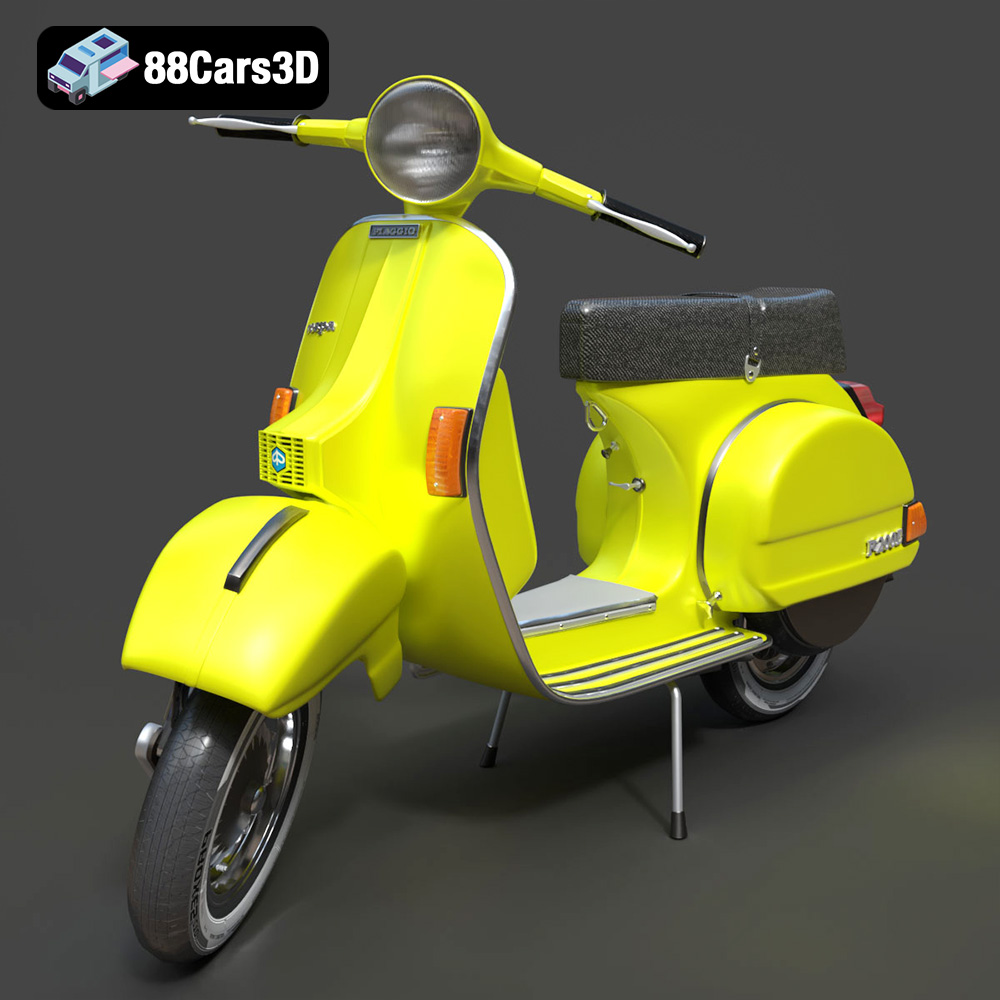
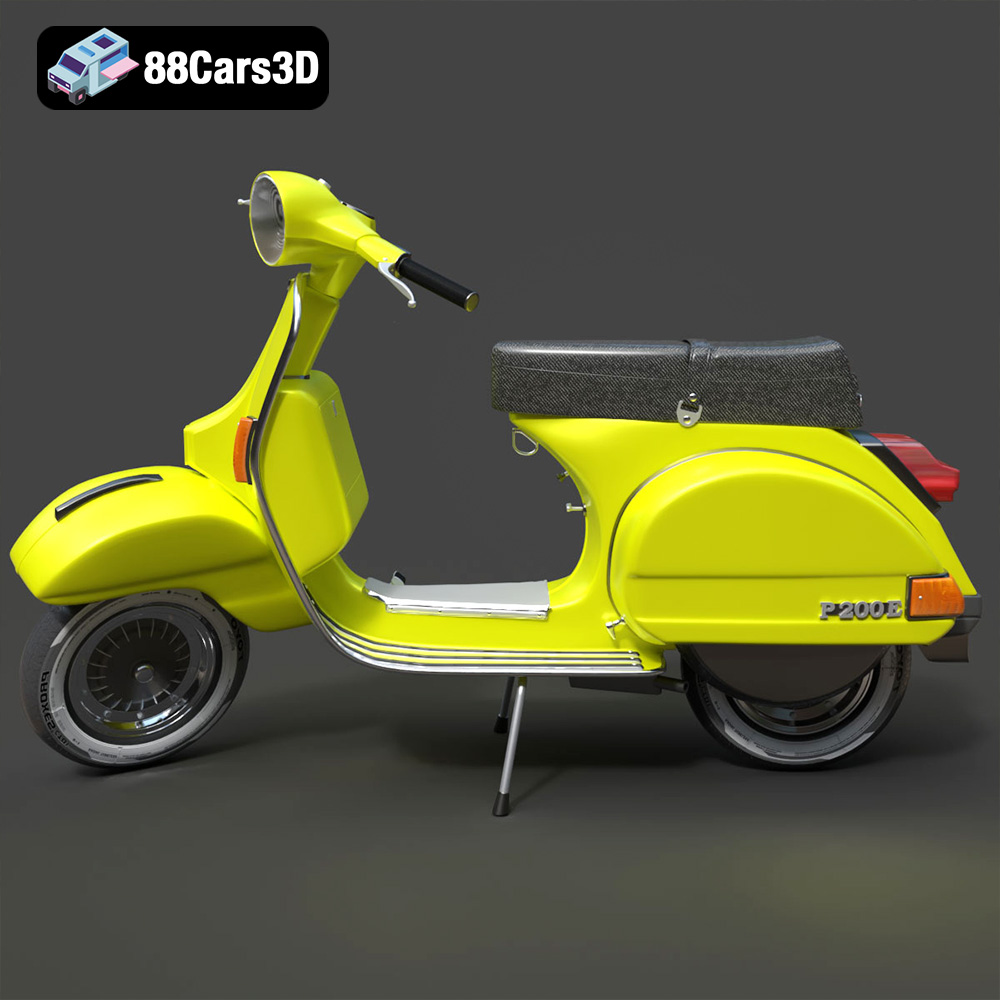
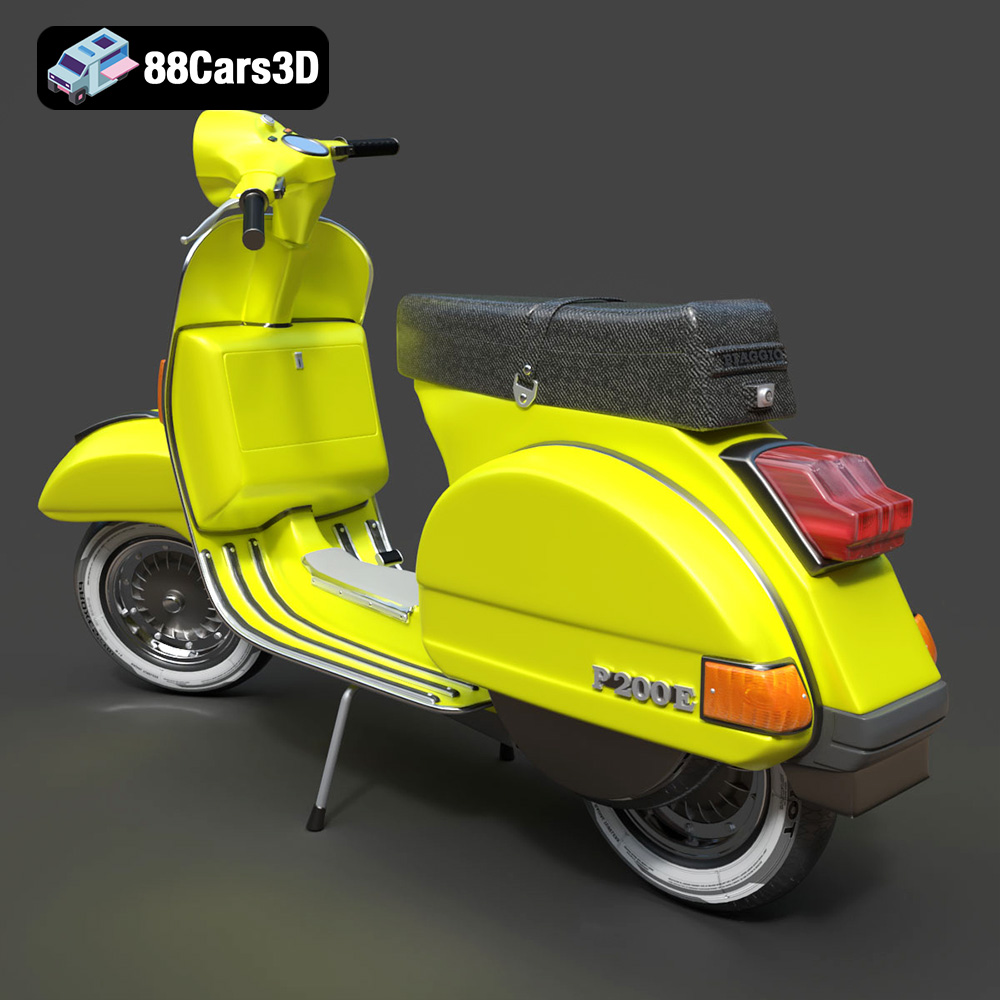
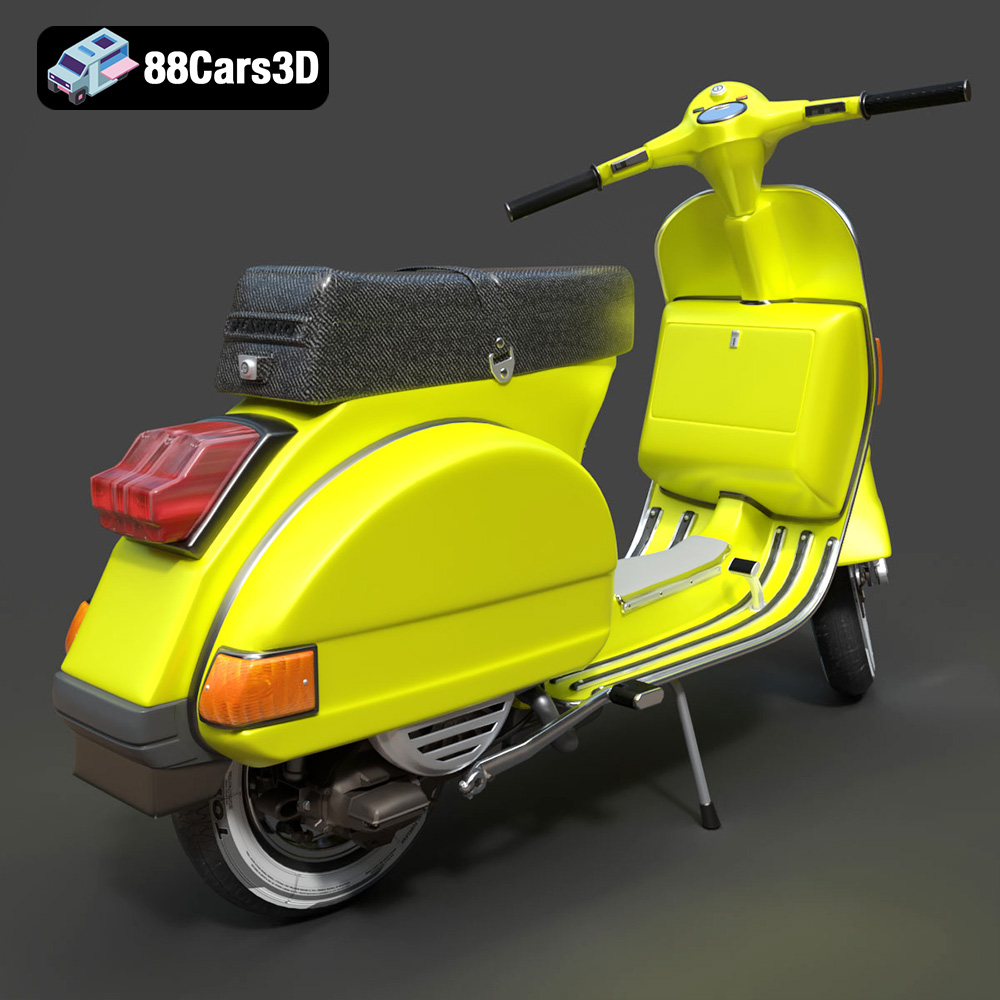
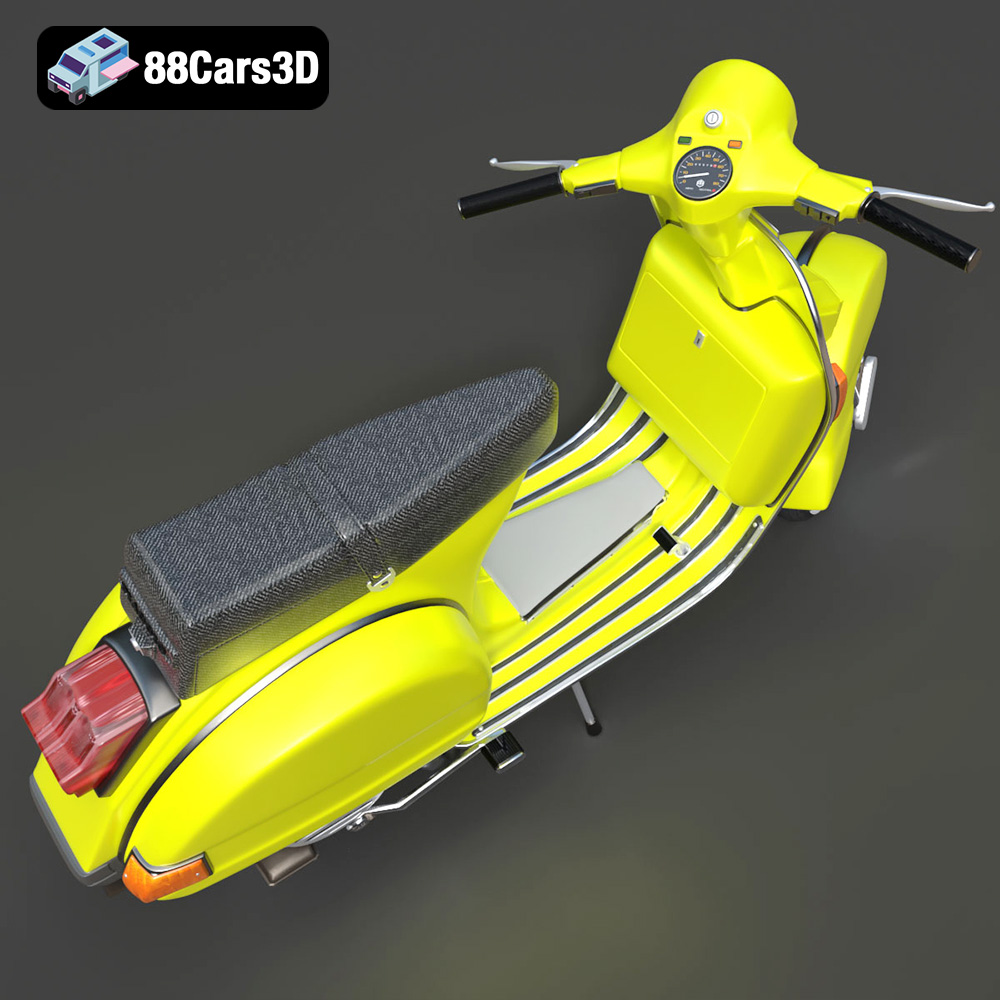
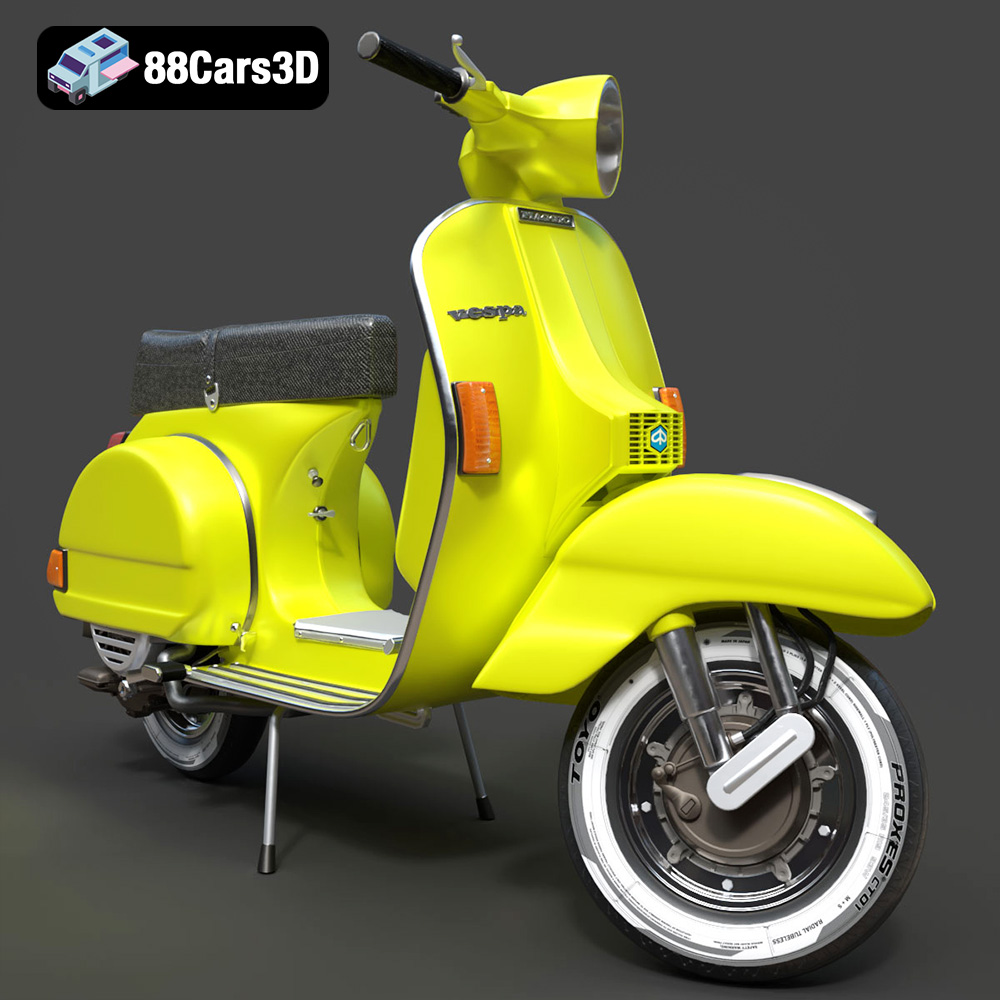
The Vespa P200E 3D Model perfectly encapsulates the scooter’s distinctive step-through frame geometry and proportions. This foundation ensures that the digital model maintains the same elegant stance and visual balance as its real-world counterpart. Key exterior features, such as the detailed 2-stroke engine housing and transmission case, are accurately represented, complete with an authentic classic exhaust box. The signature round headlight, classic indicators, and integrated taillight are all present, reflecting the P200E’s unmistakable lighting design. Furthermore, the accurate 10-inch wheels, complete with classic tread patterns, coupled with the front trailing link suspension and rear mono-shock detailing, add layers of realism. Critically, components like the wheels, suspension, and steering are separate, enabling realistic animation for dynamic scenes or interactive experiences.
Beyond its striking exterior, the 3D model offers an equally detailed cockpit and interior experience. The classic dual-seat design features textured upholstery detailing, providing visual fidelity even in close-up shots. The signature curved handlebars, integrated with realistic controls, give a sense of authenticity, inviting interaction. A vintage analog speedometer and instrument cluster, faithfully recreated, reinforce the model’s classic appeal. Even the floorboard, with its anti-slip strips and foot brake pedal, is rendered with care. This level of detail extends to its optimization for first-person POV in gaming, making it an excellent asset for immersive virtual rides or interactive simulations where the user might “sit” on the scooter.
A truly professional 3D model balances exquisite detail with technical efficiency. The Vespa P200E 3D model achieves this delicate equilibrium, making it suitable for both high-end cinematic renders and demanding real-time applications.
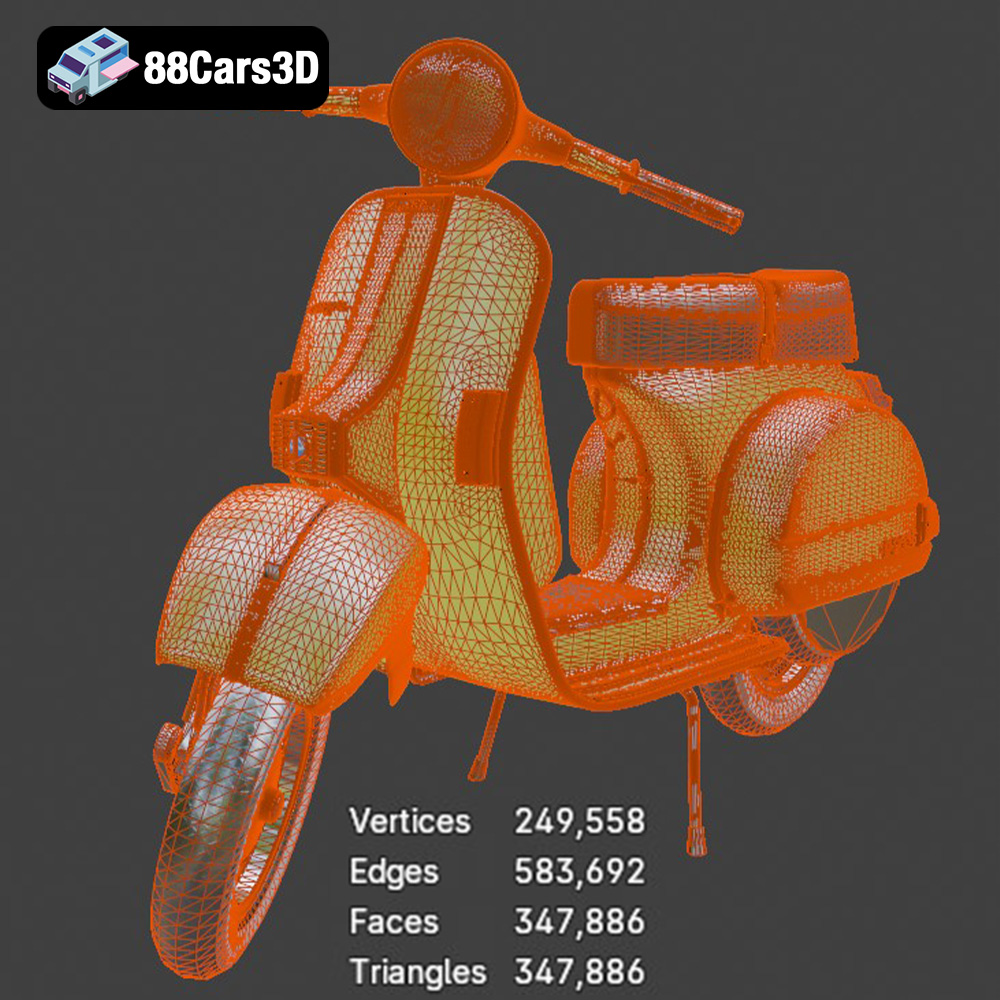
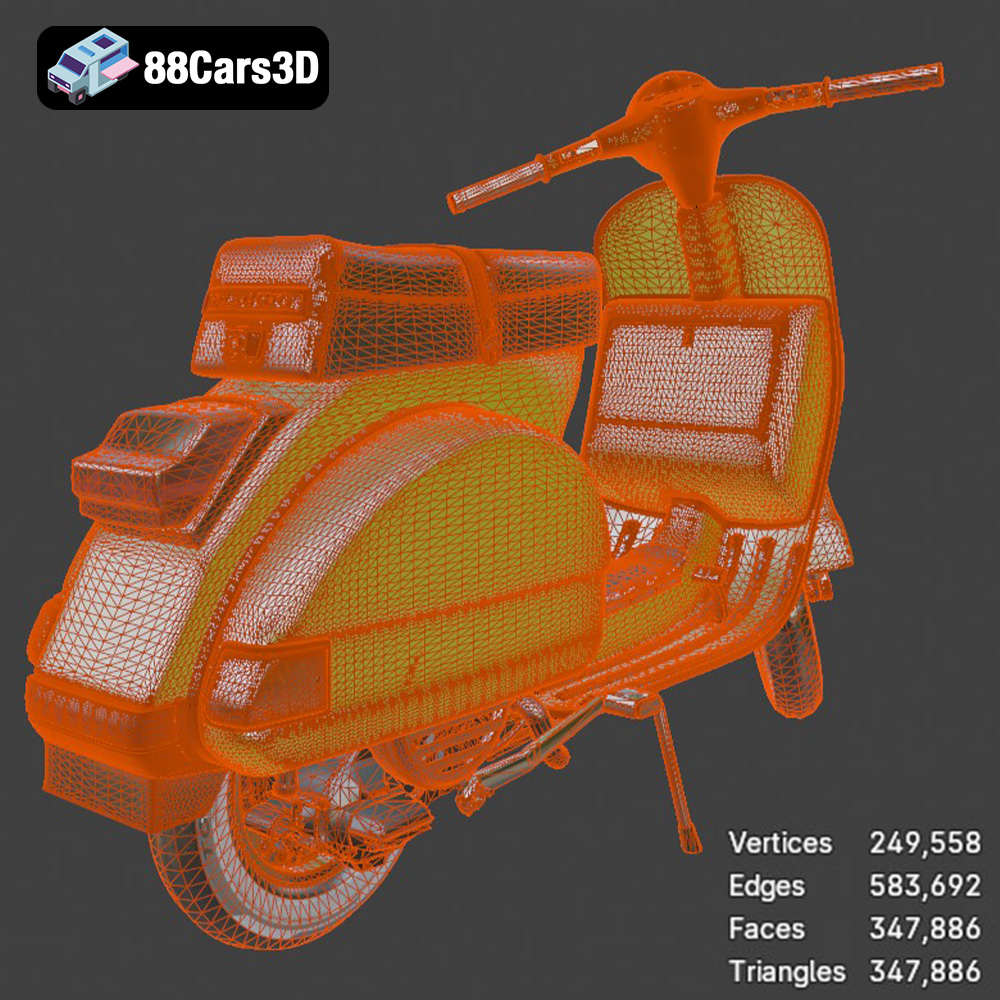
One of the standout technical advantages of this model is its “game-ready” optimization. With approximately 50,000 triangles, it strikes a perfect balance. This polycount is sufficiently high to deliver stunning visual realism, ensuring smooth curves and intricate details are preserved, yet it remains optimized enough for seamless integration into real-time engines like Unreal Engine and Unity. This careful optimization means developers can populate virtual cities or racing tracks with multiple instances of the Vespa P200E without significantly impacting performance, making it an invaluable asset for creating vibrant, dynamic game worlds.
Accuracy extends beyond visual fidelity to practical implementation. The model is built to real-world scale, based on the actual vehicle chassis, which is critical for consistent scene integration in automotive rendering and game development. Furthermore, it features a proper pivot setup for steering, wheel rotation, and suspension travel. This pre-configured articulation significantly streamlines the animation process, saving artists countless hours of rigging and setup. Whether you need to simulate realistic turning or show the scooter absorbing bumps, the model is ready to perform.
The clean geometry of the Vespa P200E model ensures smooth shading and excellent material response. This means that when PBR (Physically Based Rendering) materials are applied, the surfaces react realistically to light, showcasing accurate reflections, refractions, and diffuse properties. Such meticulous topology is crucial for achieving photorealistic results in rendering engines and for ensuring consistency across various lighting conditions within real-time environments.
The technical advantages and exquisite detail of the Vespa P200E 3D model open up a vast array of application possibilities, making it a highly versatile asset for professionals across multiple creative industries.
For game developers, the Vespa P200E is a dream asset. Its optimized polycount and game-ready status make it ideal for open-world games, racing titles, and simulators. Imagine bustling virtual streets populated with these classic scooters, or a player navigating a detailed urban environment on a Vespa. Its proper pivot setup for animation allows for easy integration with vehicle physics systems, enabling realistic driving mechanics. From background props to playable vehicles, this model accelerates the creation of immersive and believable digital worlds.
The demand for immersive experiences in Augmented Reality (AR) and Virtual Reality (VR) is constantly growing. The Vespa P200E 3D model is perfect for virtual showrooms, allowing potential customers to explore the scooter in a fully interactive 3D space. It can be integrated into AR applications, placing a virtual Vespa on your real-world street via a smartphone, perfect for marketing or educational purposes. Its optimization (especially the .glb format) ensures smooth performance on mobile devices and VR headsets, delivering compelling and engaging user experiences.
In the realm of advertising, product visualization, and architectural rendering, the Vespa P200E shines as a powerful storytelling element. It’s excellent for brand campaigns that evoke vintage charm or a sense of European style. Imagine it parked outside a chic cafe in an architectural visualization, or featured prominently in a lifestyle scene for a fashion brand. The model’s high visual fidelity allows for studio lighting setups and cinematic renders, producing photorealistic images and animations that captivate audiences. This model serves as a fantastic foundation for creating compelling visual narratives.
Beyond the digital sphere, the Vespa P200E 3D model offers the unique opportunity for physical creation through 3D printing. Convertible to .stl format, it caters to hobbyists and collectors who wish to bring a tangible representation of this iconic scooter into their homes. With recommended settings for various scales (1:12 / 1:18 / 1:24) and print considerations like supports for intricate parts (exhaust, mirrors, handlebars), users can produce detailed physical models. Resin printing is particularly recommended for capturing the fine details, ensuring a high-quality finished product that, with post-processing, can achieve authentic factory colors and metallic finishes.
The true value of a versatile 3D asset lies in its seamless integration into established professional pipelines. The Vespa P200E 3D model, available in multiple formats, provides flexibility for various scenarios, from detailed cinematic renders to interactive real-time environments.
Consider a scenario where a marketing agency needs a series of high-resolution images and a short animation of the Vespa P200E for a new campaign. Using the .max file, a 3ds Max artist can start with a fully prepared scene. They would import the model, which already has clean geometry and potentially basic material slots. The focus would then shift to setting up advanced rendering materials like V-Ray or Corona, precisely replicating chrome, painted metal, rubber, and leather. The artist can leverage 3ds Max’s robust lighting tools to create dramatic studio setups or realistic outdoor environments. Since the wheels, suspension, and steering components are separate and have proper pivots, animating a subtle lean into a corner or a gentle suspension bounce becomes straightforward, adding a dynamic quality to the render. The high detail and accurate proportions ensure the final output is photorealistic and compelling for any client, solidifying its use in high-end automotive rendering.
For a game development studio building an open-world urban environment, populating the scene with diverse vehicles is crucial. The Vespa P200E 3D Model, ideally imported via its optimized .fbx or even a pre-configured .unreal asset, slots directly into Unreal Engine. Upon import, the clean topology and optimized ~50,000 triangle count ensure it performs well, even with numerous instances. Developers can quickly set up PBR materials within Unreal’s material editor, utilizing the model’s efficient UV mapping for texture application. Collision meshes can be automatically generated or custom-created for accurate physics interaction. Furthermore, the pre-set pivots allow for easy blueprinting of interactive elements – perhaps a player can mount the Vespa, or it can be part of an AI traffic system. Unreal’s LOD system can be leveraged to create simplified versions of the model for distant views, maintaining high frame rates. This directly demonstrates how the Vespa P200E serves as a premium game asset, saving significant development time.
A freelance 3D artist specializing in product showcases might use Blender to create an engaging animation for the Vespa P200E. Starting with the .blend file provides the artist with the original project, ready for customization. They can easily modify existing materials or create new ones using Blender’s node-based shader editor, leveraging Cycles for photorealistic renders or Eevee for real-time feedback during animation. The separate components and correctly set pivots simplify the animation process: a smooth camera orbit, a gentle turn of the handlebars, or the rotation of the wheels. The artist can experiment with different lighting setups – perhaps an industrial garage or a sunny Italian street – and quickly render out high-quality video or images for a client presentation. Blender’s flexibility, combined with the model’s excellent structure, makes it an efficient choice for creative visualization.
Beyond its inherent quality, the true power of a professional 3D model lies in its adaptability. The Vespa P200E 3D model is built with customization in mind, allowing artists and designers to tailor it precisely to their project’s unique vision.
One of the most straightforward yet impactful customization options is the ability to change body and tank colors. Whether recreating authentic factory colors (e.g., vibrant blues, classic reds, or subtle creams) or applying custom finishes like matte, gloss, or metallic paints, the model’s clean topology and proper UV mapping ensure these changes look seamless and realistic. Similarly, tire textures can be modified to reflect different scenarios—from worn street tires for a gritty urban scene to pristine, new treads for a showroom presentation. This flexibility allows the Vespa to fit into any aesthetic, from vintage chic to modern utilitarian.
The model can be further adapted by modifying its material finishes, perhaps adding subtle wear and tear for a battle-scarred look in a game, or keeping it pristine for a luxury advertisement. Lighting can be adjusted to suit different environments, from the harsh midday sun to the soft glow of a streetlamp at dusk, enhancing the mood and realism. Artists can even go further by integrating custom accessories, luggage racks, or unique livery to tell a specific story or to represent a particular era or owner. This deep level of customization ensures that the Vespa P200E 3D model can be a dynamic character in any visual narrative you wish to create.
The Vespa P200E is more than just a scooter; it’s a cultural touchstone. Its 3D model counterpart faithfully translates this iconic status into the digital realm, offering a robust, highly detailed, and exceptionally versatile asset for a multitude of creative endeavors. From its game-ready optimization and precise technical specifications, including real-world scale and proper pivots, to its comprehensive suite of file formats (ranging from .blend and .max for full editability to .fbx and .unreal for real-time, and even .stl for 3D printing), this model is engineered for professional pipelines. It serves as an indispensable tool for automotive rendering, enhancing game assets, crafting immersive AR/VR experiences, and producing stunning visualizations.
This Vespa P200E 3D Model provides a solid foundation for any project, promising both uncompromised visual fidelity and efficient performance. Its potential for customization ensures it can be uniquely tailored to fit any narrative or aesthetic requirement, proving its value across the digital art spectrum. For those seeking to integrate such high-quality, iconic 3D car models into their projects, exploring offerings like the Vespa P200E 3D model at 88cars3d.com is an excellent starting point. It represents an investment in quality and versatility that will undoubtedly elevate your creative output.
The Vespa P200E is a true icon of Italian design, celebrated for its timeless styling and reliable 2-stroke engine. This 3D model perfectly captures the scooter’s distinctive step-through frame, signature rear engine cowlings, and classic vintage aesthetic that made it a cultural phenomenon. From the rounded headlamp to the unmistakable tail section, every curve has been meticulously recreated to offer an authentic representation of this legendary two-wheeler.
Crafted with a focus on optimization and visual fidelity, this model features a game-ready topology of approximately 50,000 triangles. It delivers stunning realism without sacrificing performance in real-time environments. The clean geometry ensures smooth shading and excellent material response, making it highly versatile for game development, AR/VR applications, animation, and high-end visualization.
Perfect for urban cityscapes, vintage street scenes, lifestyle brand rendering, and interactive mobile applications.
.blend, .fbx, .obj, .glb, .stl, .ply, .unreal, .max
Tags:
vespa, p200e, scooter, classic-scooter, vintage, game-ready, low-poly, optimized, motorcycle-3d-model, game-asset, rendering, vr-ar, blend, fbx, obj, glb, stl, ply, unreal, maxVespa VNB 125-B 3D Model 3D Printable STL
$39.99
.blend
.fbx
.glb
.max
.obj
.ply
.rendering
.scooter
.stl
.unreal
.vespa
.vintage
classic-scooter
game asset
game-ready
low-poly
motorcycle-3d-model
optimized
p200e
VR/AR