Get 20% OFF All Premium 3D & STL Models!

In the rapidly evolving landscape of digital visualization, the demand for hyper-realistic and technically precise 3D assets has never been higher. From breathtaking automotive renders that blur the line between virtual and reality, to immersive game environments and cutting-edge AR/VR experiences, the quality of your foundational 3D models dictates the success of your entire project. Professionals across industries – automotive design, advertising, film, gaming, and simulation – understand that a high-quality 3D car model is more than just a visual prop; it’s a meticulously engineered digital blueprint.
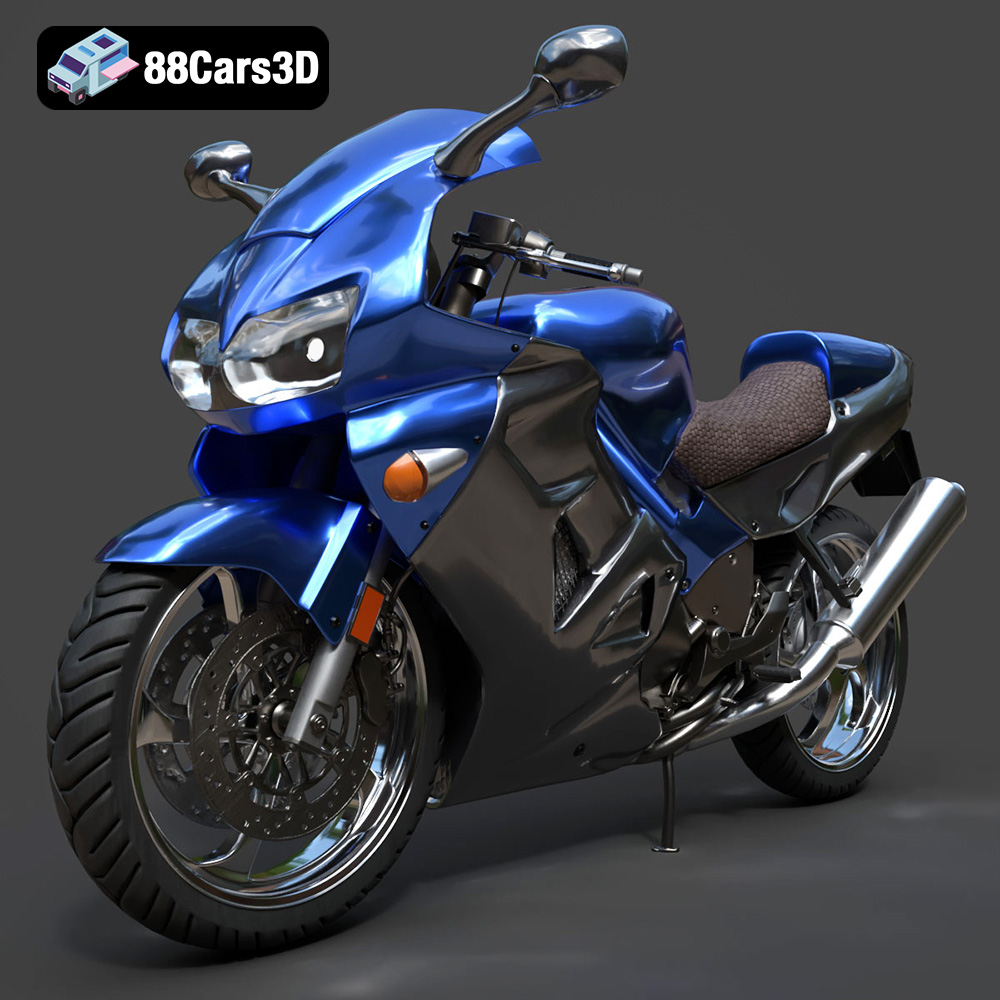
The journey from concept to a polished final product is fraught with technical challenges, requiring not only artistic vision but also a deep understanding of 3D topology, material science, and rendering pipelines. This is where investing in pre-built, professional-grade assets becomes invaluable. Imagine bringing the iconic design and engineering prowess of a Honda VFR motorcycle into your next project with unparalleled realism and technical readiness. The Honda VFR 801 3D Model exemplifies this standard, offering an asset constructed with meticulous attention to detail, clean polygon geometry, and realistic materials, ready to elevate any visual endeavor. It’s a prime example of the caliber of 3D car models and vehicle assets available at marketplaces like 88cars3d.com, designed to streamline your workflow and ensure professional-grade results from the outset.
At the core of any successful 3D project lies the quality of its assets. A poorly constructed model, rife with n-gons, improper topology, or unoptimized UVs, can lead to countless hours of corrective work, frustrating rendering artifacts, and limitations in animation or real-time performance. Conversely, a well-optimized, clean 3D model acts as a robust foundation, allowing artists and developers to focus on creative iteration rather than technical troubleshooting. This not only saves time and resources but also significantly enhances the final visual output, making projects stand out in a competitive digital space.
For automotive designers and enthusiasts, the ability to accurately represent vehicles in a digital space is paramount. Whether it’s for concept visualization, marketing campaigns, or driving simulations, capturing the nuances of a vehicle’s design – from its subtle curves to its intricate mechanical components – requires a 3D model built with precision. The Honda VFR 801-002 3D Model, with its accurate scaling and true-to-life aesthetics, provides just that. It’s not merely a visual representation but a detailed digital replica that can serve as a cornerstone for advanced simulations, detailed visualizations, and immersive interactive experiences.
Choosing the right 3D model file format is a critical decision that impacts compatibility, workflow efficiency, and the ultimate utility of your digital asset. Each format is designed with specific use cases and software ecosystems in mind, offering unique advantages. Understanding these distinctions is paramount for any professional working with 3D car models, whether for automotive rendering or game assets.
The .blend format is Blender’s native file type, offering a comprehensive package for Blender users. When you acquire a .blend file, you’re not just getting a mesh; you’re often getting a fully editable Blender scene. This typically includes the model’s geometry, materials, textures, lighting setups, cameras, animations, and even rigging. It’s ideal for artists deeply integrated into the Blender ecosystem who require full flexibility to modify the model, experiment with different render engines (Cycles, Eevee), or integrate it into their existing Blender projects. The .blend file for the Honda VFR 801-002 3D Model, for instance, comes as an editable Blender file with materials and a lighting setup, providing an excellent starting point for any visualization.
.fbx (Filmbox) stands as one of the most widely used and robust interchange formats in the 3D industry. Developed by Autodesk, it excels at transferring complex 3D data—including geometry, materials, textures (though often linked externally), animation data, skinning, and even camera information—between different 3D software applications and game engines. Its strength lies in its ability to maintain data integrity across various platforms like 3ds Max, Maya, Blender, Unreal Engine, and Unity. This makes it an ideal choice for game development, virtual production, and any pipeline requiring seamless asset transfer. For real-time applications, the .fbx version of the Honda VFR 801-002 3D Model is game-engine ready, perfectly suited for Unreal Engine and Unity projects.
The .obj (Wavefront OBJ) format is a cornerstone of 3D asset compatibility, known for its universality. It primarily stores geometry data, including vertices, normals, UV coordinates, and faces. While it can reference external material (.mtl) files, it doesn’t embed animations or complex scene data. Its widespread support across virtually all 3D software makes it an excellent fallback or starting point for cross-software compatibility. If you need a clean mesh that can be imported anywhere, from ZBrush for sculpting to Keyshot for rendering, .obj is a reliable choice. The Honda VFR 801-002 3D Model’s .obj version provides a standard 3D model format compatible with all major software.
.glb (GL Transmission Format Binary) is an increasingly vital format, especially with the rise of AR, VR, and web-based 3D experiences. It’s the binary version of glTF, designed to be a single-file asset that includes geometry, materials, textures, animations, and skeletal structures. Its key advantage is optimization for efficient transmission and loading on the web and in real-time applications. .glb files are compact and fast to parse, making them perfect for displaying 3D models directly in browsers, AR applications on mobile devices, or lightweight VR experiences. The .glb version of the Honda VFR 801-002 3D Model is specifically optimized for these modern applications, enabling immersive visualization.
.stl (STereoLithography) is the de facto standard for 3D printing. It represents a 3D model as a collection of unconnected triangular facets, without color, texture, or other CAD attributes. While simple, this format is universally accepted by 3D printers and slicing software, making it indispensable for physical prototyping and manufacturing. If your goal is to bring the Honda VFR 801-002 3D Model into the physical world, its .stl version is the go-to format, suitable for 3D printing and prototyping, allowing you to create a tangible replica.
The .ply (Polygon File Format, or Stanford Triangle Format) is a versatile format capable of storing a wide range of properties, including color, transparency, surface normals, and texture coordinates. It’s often used in scientific applications, CAD, and 3D scanning, where precise mesh data and attributes are critical for analysis and detailed visualization. While less common in general animation or game development than .fbx or .obj, it offers a robust solution for capturing and transferring detailed polygon meshes for engineering or specific visualization needs. The .ply option for the Honda VFR 801-002 3D Model provides a detailed polygon mesh for analysis and specialized visualization.
While not a standalone “file format” in the same way .fbx or .obj are, an .unreal asset typically refers to a model that has been specifically prepared, optimized, and often imported into an Unreal Engine project. This means it might come as a pre-packaged Unreal asset file (.uasset) or an .fbx file meticulously configured for Unreal’s material system, collision, LODs (Levels of Detail), and blueprint integration. This level of preparation significantly accelerates development time for Unreal Engine users, as much of the tedious setup work has already been completed. The Honda VFR 801-002 3D Model’s .unreal option offers an asset pre-configured for direct use within the Unreal Engine, ensuring immediate integration and optimal performance.
The .max format is the native file type for Autodesk 3ds Max, a powerhouse in architectural visualization, product design, and animation. Similar to .blend for Blender, a .max file stores an entire 3ds Max scene, including geometry, complex materials, V-Ray or Corona render settings, lighting, cameras, animation timelines, and modifiers. It’s the format of choice for professionals who rely on 3ds Max for its robust modeling tools, advanced rendering capabilities, and extensive plugin ecosystem. The .max file for the Honda VFR 801-002 3D Model provides an editable 3ds Max project, allowing full control over rendering, animation, and scene customization within this popular software.
Achieving true realism in 3D modeling goes far beyond simply replicating a shape. It’s an intricate dance between artistic interpretation and rigorous technical execution. The Honda VFR 801-002 3D Model exemplifies this commitment, showcasing how a deep understanding of automotive design principles, combined with meticulous 3D artistry, results in an asset of exceptional quality.
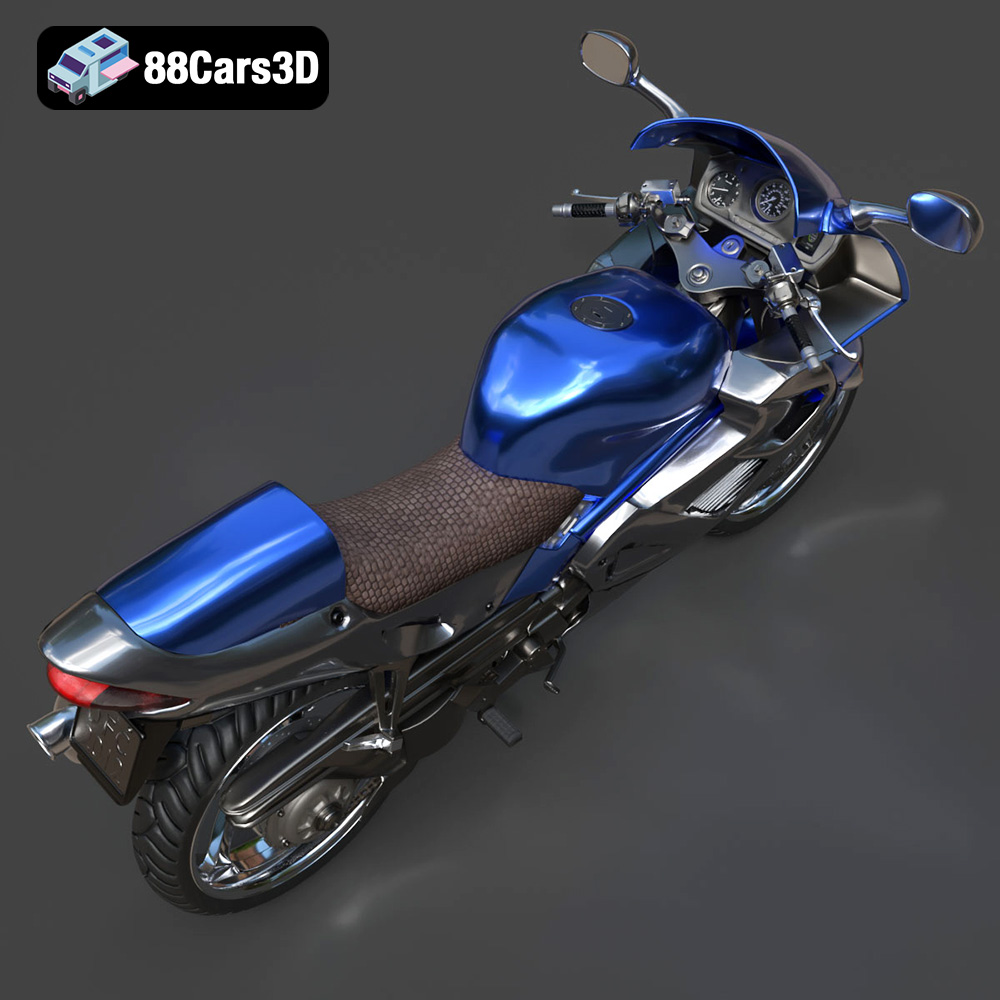
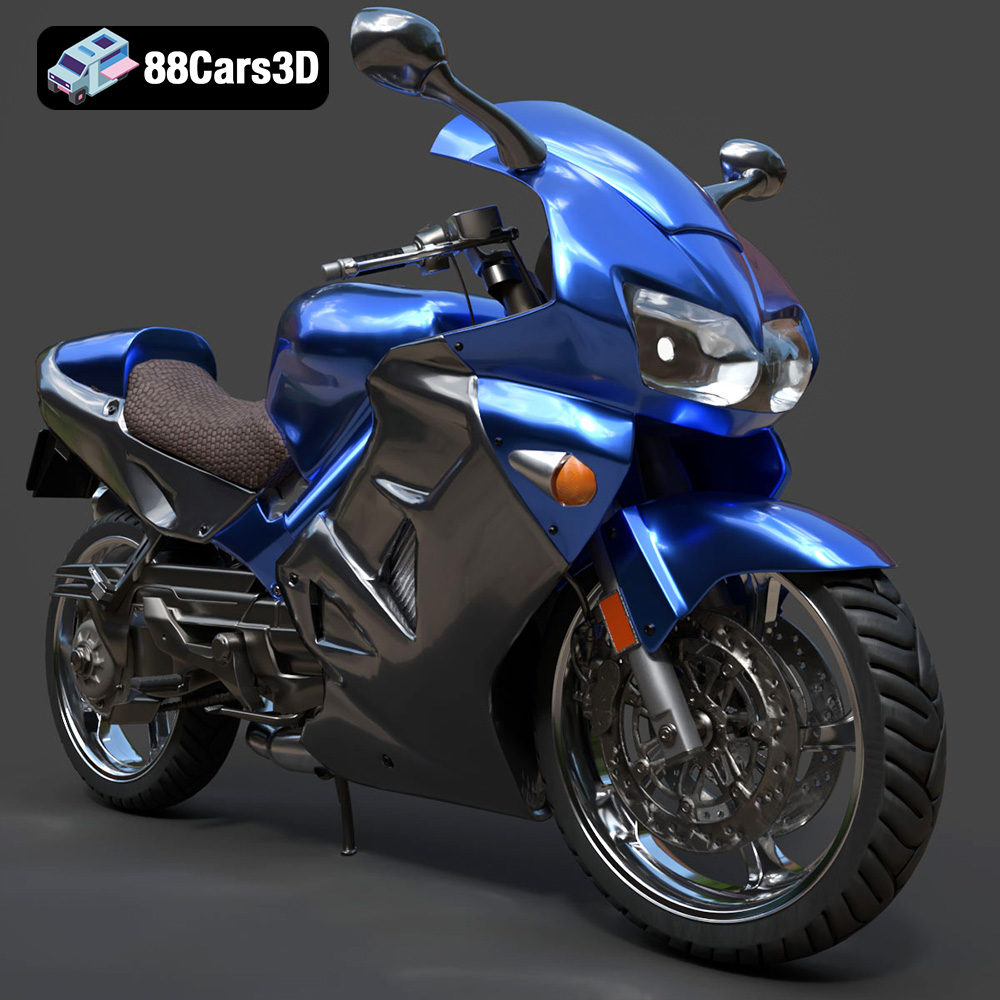
The foundation of any realistic 3D vehicle model is its fidelity to the real-world counterpart. For the Honda VFR 801-002 3D Model, this translates into obsessive attention to every curve, panel gap, and component. From the iconic VFR fairing to the intricate brake calipers and engine details, each element is crafted to precise real-world dimensions. Accurate scaling isn’t just about looking right; it’s crucial for projects requiring physical accuracy, such as engineering simulations, detailed architectural visualizations where the vehicle interacts with its environment, or augmented reality applications where the model must convincingly integrate into the real world. This level of detail ensures the model is not only visually stunning but also functionally reliable for diverse professional applications.
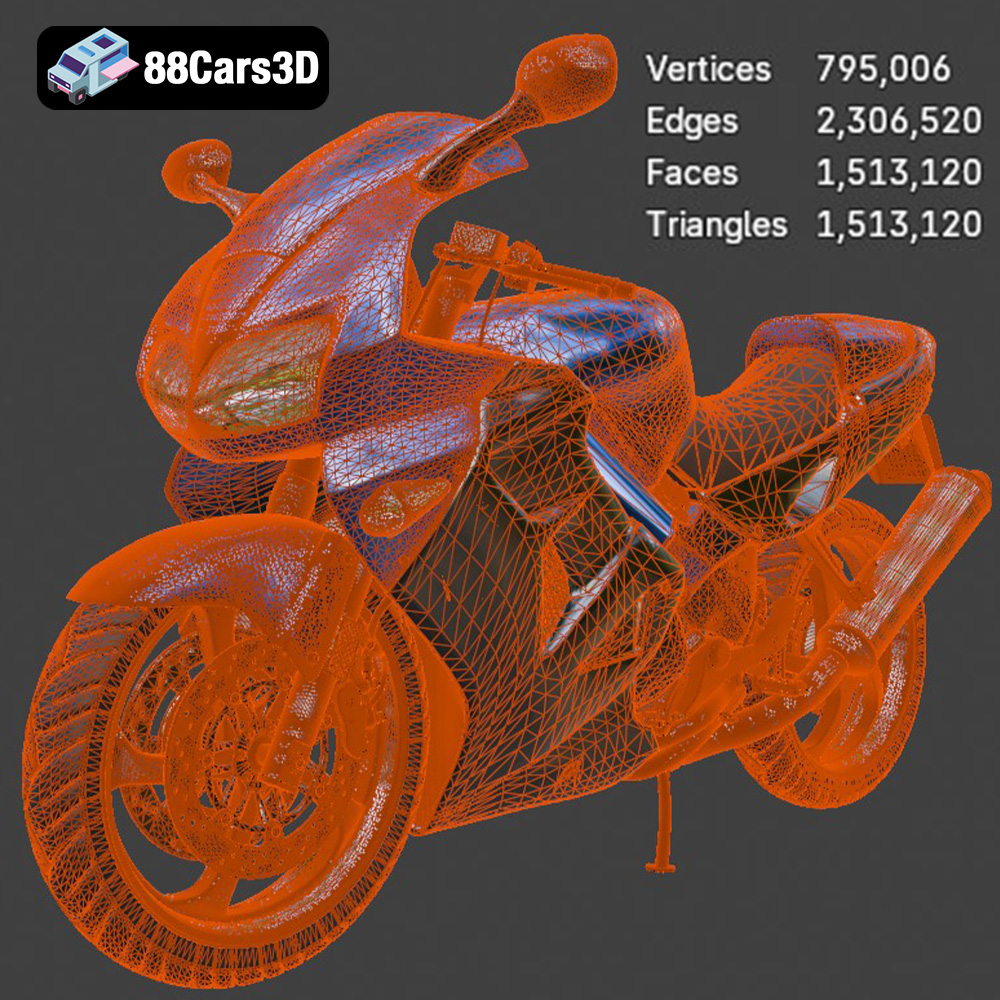
Underneath the polished surface of any high-quality 3D model lies its topology – the arrangement of vertices, edges, and faces that form the mesh. The Honda VFR 801-002 3D Model boasts clean polygon geometry, which is essential for several reasons: it ensures smooth deformations during animation, prevents shading artifacts, and allows for seamless subdivision. Subdivision surfaces are a powerful technique where a low-polygon base mesh can be smoothed into a high-resolution, detailed model during rendering, offering flexibility in detail levels without inflating file sizes unnecessarily. This optimized topology means the model can perform efficiently in real-time engines at lower poly counts while still delivering stunning visual fidelity in high-end renders when subdivided, making it a truly versatile game asset and rendering powerhouse.
The visual impact of a 3D model is heavily reliant on its materials and textures. The Honda VFR 801-002 3D Model comes equipped with realistic materials that accurately replicate the look and feel of various surfaces found on the actual motorcycle – from the metallic gleam of the frame to the matte finish of plastic components, the reflective quality of mirrors, and the intricate patterns of tire treads. These materials are often PBR (Physically Based Rendering) ready, meaning they behave realistically under various lighting conditions, ensuring consistent and believable results across different rendering engines. The inclusion of high-resolution textures further enhances this realism, providing intricate details that bring the model to life, from subtle scratches to finely replicated logos and decals.
A truly versatile 3D model is one that can seamlessly integrate into various professional workflows without extensive modification. The Honda VFR 801-002 3D Model is designed with this principle in mind, offering multiple file formats and an optimized structure to cater to a wide array of applications, from high-fidelity rendering to real-time interactive experiences.
For game developers and creators of interactive applications, the availability of game-engine-ready formats like .fbx and the specifically configured .unreal package is a significant advantage. The Honda VFR 801-002 3D Model can be directly imported into Unreal Engine or Unity, where its optimized topology and PBR-ready materials can be quickly set up for real-time rendering. This makes it an ideal 3D car model or game asset for racing simulations, open-world environments, virtual showrooms, or training modules. Developers can leverage its clean geometry for efficient LOD generation, ensuring optimal performance across different platforms and hardware specifications.
For professionals focused on high-fidelity architectural visualization, product advertising, or film-quality animations, the native .max and .blend files for the Honda VFR 801-002 3D Model offer unparalleled flexibility. In 3ds Max, artists can utilize its robust modeling and animation tools, integrating the motorcycle into complex scenes, adding advanced rigging for dynamic simulations, and rendering with powerful engines like V-Ray or Corona. Similarly, Blender users benefit from the fully editable .blend file, enabling them to leverage Blender’s comprehensive toolset for sculpting, texturing, rigging, and rendering with Cycles or Eevee, creating stunning automotive renders and cinematic sequences.
The immersive potential of augmented and virtual reality demands highly optimized assets. The .glb format, specifically designed for efficient web and real-time display, makes the Honda VFR 801-002 3D Model perfectly suited for AR/VR experiences. Imagine placing the VFR 801-002 in your living room via an AR app, or exploring its intricate details in a VR showroom. Its lightweight nature ensures smooth performance on mobile devices and VR headsets, opening new avenues for interactive marketing, product showcases, and training simulations. This focus on accessibility makes it a valuable asset for forward-thinking companies.
Achieving photorealistic automotive rendering is a nuanced art that combines technical expertise with creative vision. The quality of the underlying 3D car models, such as the Honda VFR 801-002 3D Model, provides the essential foundation, allowing artists to leverage advanced rendering techniques to create breathtaking visuals.
PBR is the cornerstone of modern photorealistic rendering. By mimicking how light interacts with real-world materials, PBR workflows ensure consistency and accuracy across different lighting conditions and rendering engines. The realistic materials included with the Honda VFR 801-002 3D Model are designed with PBR principles in mind. This means artists can quickly set up metallic paints, rubber tires, glass windshields, and chrome accents that react realistically to studio lighting, environmental HDRIs (High Dynamic Range Images), and dynamic light sources. Understanding and utilizing PBR parameters like Albedo, Metallic, Roughness, Normal, and Ambient Occlusion maps is crucial for extracting maximum visual fidelity from the model.
Beyond direct lighting, global illumination (GI) is paramount for believable automotive renders. GI simulates how light bounces and reflects off surfaces, creating subtle color bleeding, soft shadows, and realistic reflections. Combining robust GI solutions (like path tracing or irradiance caching) with high-quality environmental lighting, such as HDRI maps of real-world locations or virtual studio setups, allows the Honda VFR 801-002 3D Model to truly shine. The intricate details of the model will catch and reflect light in a way that perfectly emulates reality, making it ideal for stunning marketing visuals or detailed product showcases. Using a high-quality model like this from 88cars3d.com significantly reduces the effort required to make an image look polished and professional.
No render is truly finished without a thoughtful post-processing stage. Techniques like color grading, depth of field, motion blur, lens flares, and subtle chromatic aberration can elevate a raw render into a cinematic masterpiece. For automotive rendering, adding realistic camera effects such as a shallow depth of field to draw attention to specific details of the Honda VFR 801-002, or subtle motion blur to convey speed in an animation, can dramatically enhance the emotional impact and realism of the final image or sequence. These enhancements, when applied to an already high-quality base model, create an output that is virtually indistinguishable from photography.
While high-fidelity renders prioritize visual quality above all else, real-time environments like games and AR/VR applications demand a delicate balance between visual richness and performance. Optimizing 3D car models like the Honda VFR 801-002 3D Model for these platforms requires a specific set of techniques to ensure smooth frame rates and responsive interactions.
Every frame in a real-time application has a “polygon budget.” To stay within this, objects that are far away or less critical to the scene need fewer polygons. This is where Level of Detail (LOD) comes in. A high-quality 3D car model, with its clean topology, is perfectly suited for generating multiple LODs. The Honda VFR 801-002 can have a high-poly version for close-up shots and progressively lower-poly versions that automatically switch out as the camera moves further away. This ensures that resources are allocated efficiently, rendering complex details only when necessary, which is crucial for delivering smooth performance in demanding game assets and immersive AR/VR experiences.
Optimized UV mapping is essential for real-time performance. Clean, non-overlapping UVs ensure that textures are displayed correctly without distortion and that texture memory is used efficiently. For complex models like the Honda VFR 801-002, texture atlasing can further boost performance. This involves combining multiple smaller textures into one larger texture atlas, reducing the number of draw calls needed by the GPU. This technique, coupled with carefully planned material instancing, allows for rich visual detail without overburdening the render pipeline, making the model highly suitable for various game engine applications.
In interactive environments, vehicles need to interact realistically with their surroundings. This requires a dedicated collision model, which is a simplified version of the visual mesh used for physics calculations. While the visual mesh of the Honda VFR 801-002 3D Model captures every aesthetic detail, a much simpler collision mesh prevents performance bottlenecks. Additionally, setting up robust physics parameters—such as mass, friction, and suspension—within the game engine allows the model to behave authentically during gameplay or simulations, completing its transformation into a fully interactive 3D car model for a dynamic environment.
The utility of high-quality 3D models extends far beyond digital screens. For engineers, designers, and hobbyists, the ability to transform a digital asset into a physical object opens up a world of possibilities, from rapid prototyping to creating collectible scale models. The Honda VFR 801-002 3D Model, with its robust construction and clean geometry, is an excellent candidate for these tangible applications.
3D printing requires models to be “manifold” – meaning they must be solid, watertight, and have no open edges or flipped normals. The clean polygon geometry of the Honda VFR 801-002 3D Model makes it inherently well-suited for this. The .stl and .ply formats provided are specifically designed for 3D printing workflows. For FDM (Fused Deposition Modeling) printers, understanding layer height, infill, and support structures is key. For SLA (Stereolithography) printers, which offer higher detail, considerations around resin types and curing become important. While some cleanup or thickening might be necessary for very thin parts, a high-quality base model significantly reduces preparation time.
Imagine holding a physical prototype of the Honda VFR 801-002, examining its ergonomic design or testing assembly components. The ability to quickly 3D print portions or the entire model at various scales provides invaluable feedback in the design process. This rapid prototyping capability allows designers to identify potential flaws, test fitments, or simply appreciate the physical form before committing to expensive manufacturing. Beyond industrial applications, hobbyists can use the model to create highly detailed scale replicas, adding a unique, personalized touch to their collections, or even customizing and painting these physical models to truly bring the digital design to life.
The bridge between digital design and physical manifestation expands creative horizons. Artists can experiment with different materials, textures, and finishes that were previously confined to rendering software. Educational institutions can utilize 3D printed models for hands-on learning about vehicle mechanics and design. For individuals, it’s an opportunity to own a piece of digital artistry in a tangible form. The Honda VFR 801-002 3D Model, therefore, isn’t just a rendering tool; it’s a foundation for physical creation, illustrating the comprehensive value of professional 3D models available on platforms like 88cars3d.com.
In the demanding world of 3D visualization and content creation, the difference between a good project and a truly exceptional one often hinges on the quality of its foundational assets. As we’ve explored, a high-fidelity 3D car model is not merely a collection of polygons; it’s a carefully crafted digital product designed to meet rigorous professional standards across a multitude of applications. From the intricate demands of automotive rendering to the performance requirements of game assets and the tangible outputs of 3D printing, the right model streamlines workflows, elevates visual quality, and ultimately saves invaluable time and resources.
The Honda VFR 801-002 3D Model stands as a testament to this philosophy. Its meticulous detail, clean polygon geometry, realistic materials, and diverse file format support exemplify what a professional 3D asset should offer. Whether you’re an automotive designer seeking accurate representations, a game developer building immersive worlds, an advertiser crafting compelling visuals, or a hobbyist bringing digital creations to life, this model provides the precision and flexibility needed to achieve your vision.
Investing in such high-quality 3D car models from trusted sources like 88cars3d.com ensures that your projects begin with a strong, optimized foundation, allowing you to focus on innovation and creativity rather than battling technical deficiencies. Embrace the power of professionally crafted assets and unlock the full potential of your digital endeavors.
Experience unmatched realism with the Honda VFR 801-002 3D Model. Constructed with meticulous attention to detail, this professional 3D asset captures the dynamic essence and engineering precision of the iconic Honda VFR. It is designed to elevate your visual projects with accurate scaling and true-to-life aesthetics. Key features include clean polygon geometry, realistic materials, and exceptional detailing. The topology is fully optimized for smooth rendering and seamless subdivision, ensuring professional-grade results whether utilized for static imagery or dynamic animations. This versatile 3D model is ideal for a wide range of applications. From digital rendering and simulation to game development and immersive AR/VR experiences, it integrates seamlessly into your existing pipeline to deliver outstanding visual fidelity.
$39.99
.arvr
.blend
.car3dmodel
.fbx
.gameasset
.glb
.honda
.max
.motorcycle
.obj
.ply
.rendering
.simulation
.sportbike
.stl
.twowheeler
.unreal
.vfr