Get 20% OFF All Premium 3D & STL Models!

In the rapidly evolving landscape of digital content creation, the demand for hyper-realistic and meticulously crafted 3D models is greater than ever. From cinematic visual effects and immersive game environments to cutting-edge AR/VR experiences and detailed product visualizations, the fidelity of your assets directly impacts the quality and impact of your final output. Vehicles, especially iconic ones, represent a significant challenge and opportunity for 3D artists and developers. They embody complex forms, intricate mechanical details, and dynamic materials, all of which must be captured with absolute precision.
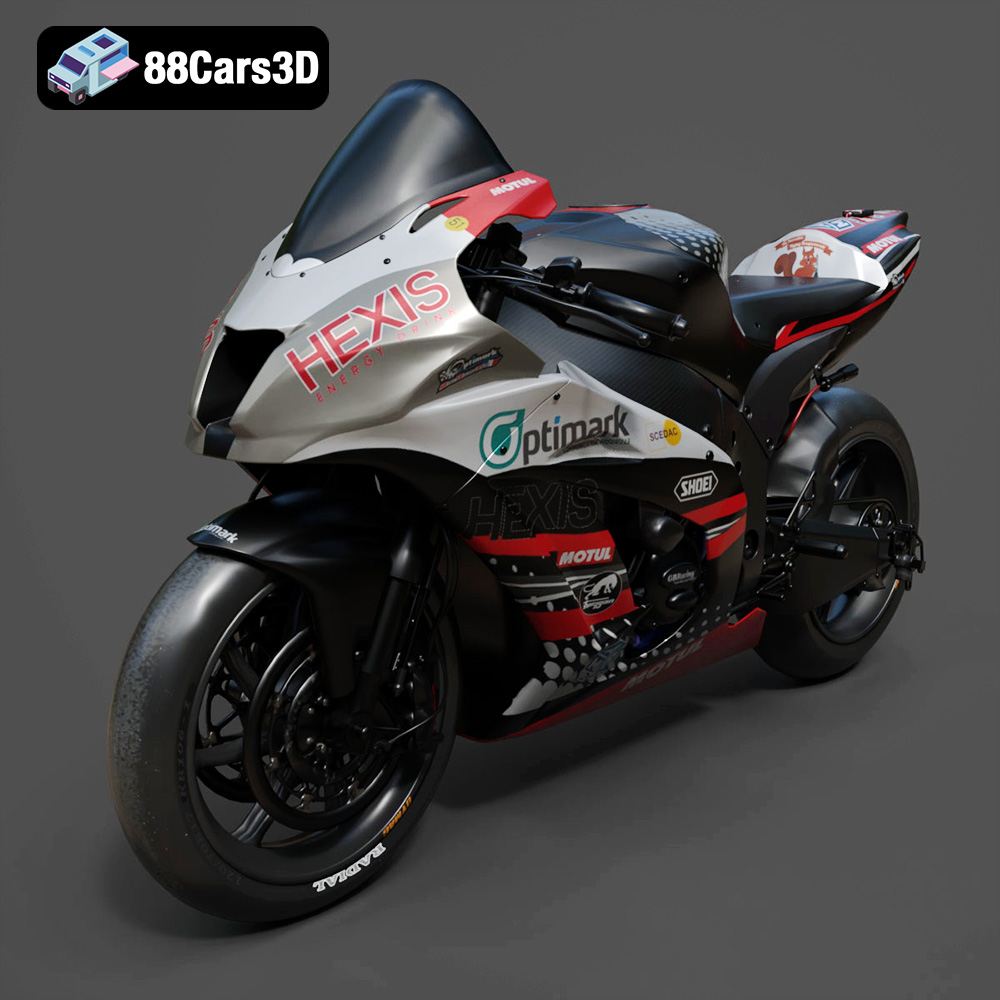
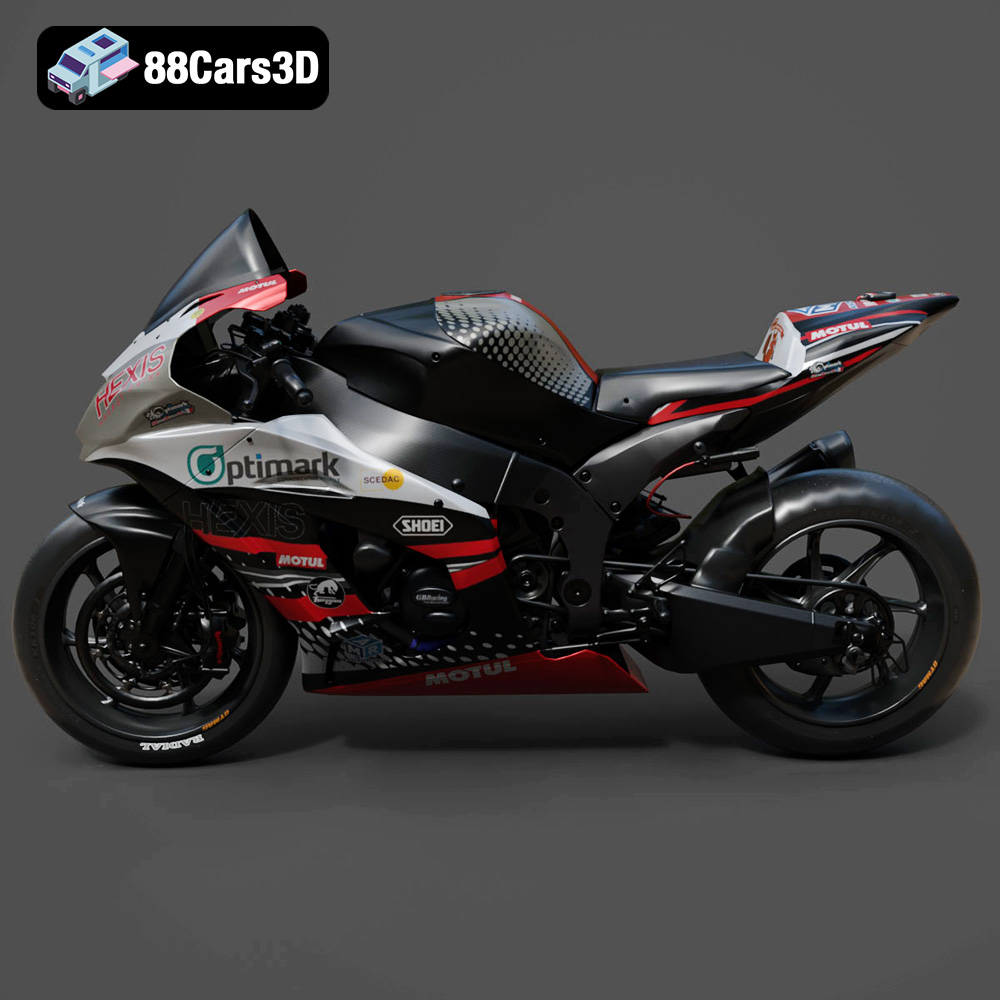
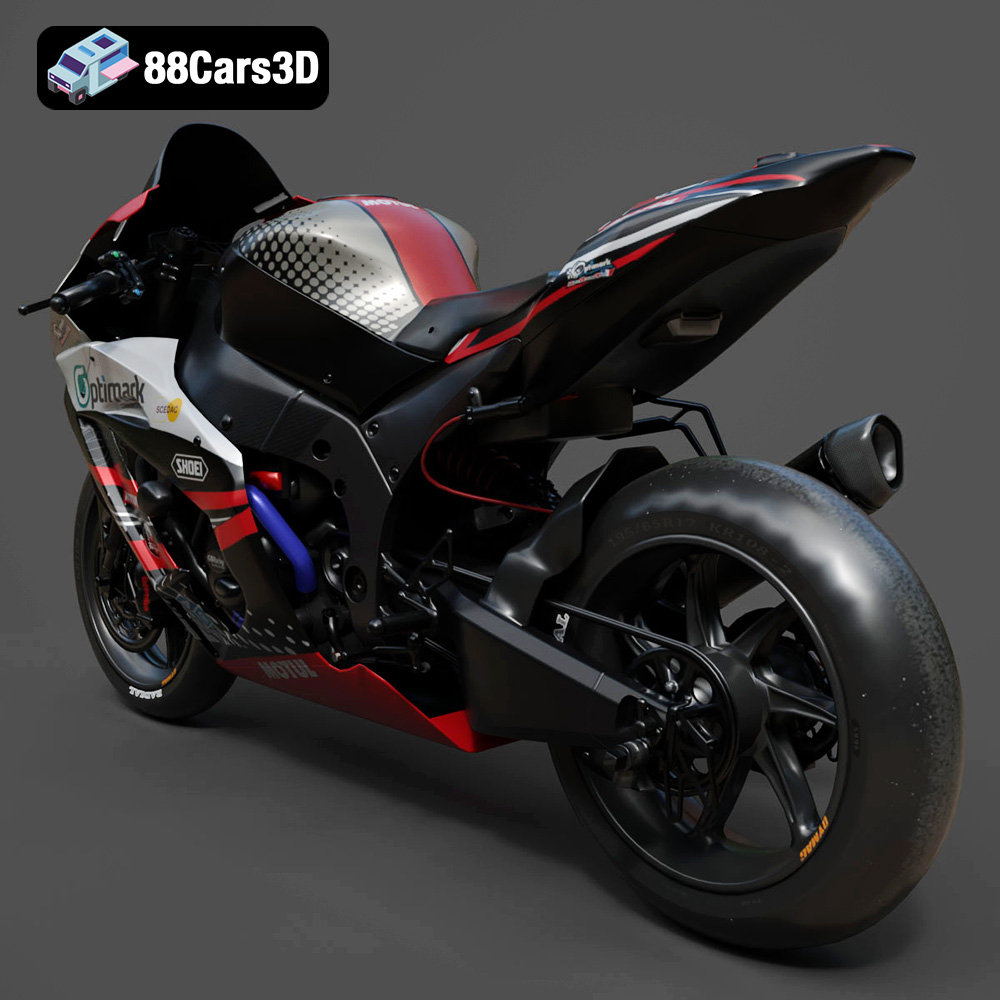
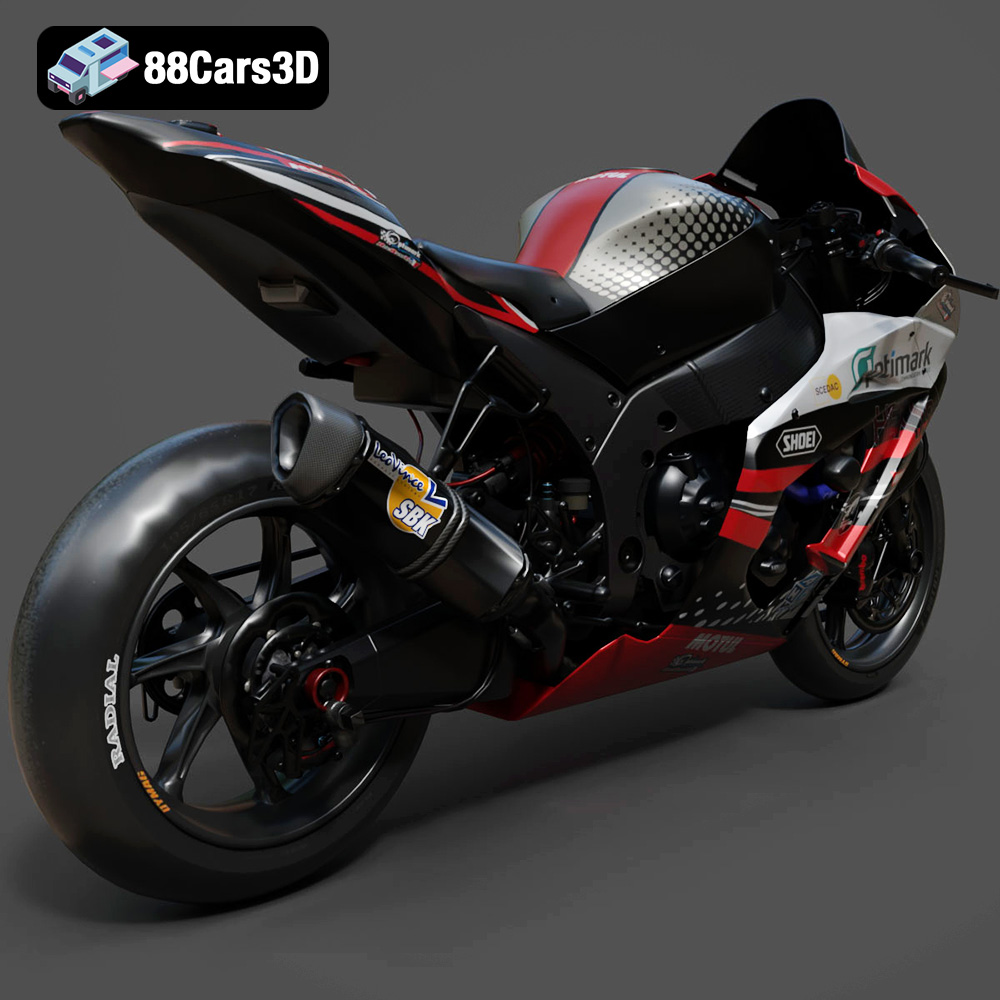
This pursuit of digital perfection is where expertly crafted assets become indispensable. Imagine bringing the raw power and sleek design of a legendary superbike into your next project. We’re talking about models that aren’t just visually appealing but are technically sound, optimized for performance, and ready for integration across various platforms. The Kawasaki ZX-10R 3D Model, available on 88cars3d.com, is a prime example of such an asset. It embodies the aggressive styling and intricate mechanics of the real-world superbike, providing a robust foundation for any project demanding exceptional realism and versatility. Throughout this article, we’ll explore the technical intricacies and professional applications that make high-quality 3D models, like this Kawasaki ZX-10R, essential tools for success.
The bedrock of any compelling digital experience, whether it’s an architectural walkthrough, an intense gaming session, or an automotive rendering, is the quality of its 3D assets. For complex subjects like vehicles, this quality isn’t just about how good it looks in a still render; it’s about the underlying mesh, the material definitions, the UV mapping, and the overall optimization for various pipelines.
For designers, engineers, and product developers, 3D models serve as crucial tools for visualization, prototyping, and analysis. A high-quality 3D model allows for comprehensive examination of a product from every angle, under various lighting conditions, and within different environments. For a model like the Kawasaki ZX-10R, this means being able to scrutinize every curve of the fairing, the articulation of the suspension, and the intricate details of the engine components. Such precision is vital for concept validation, design reviews, and even for creating accurate digital twins. The clean geometry and optimized topology of professional models ensure that designers can modify, dissect, or render the asset without encountering artifacts or performance bottlenecks. This level of detail is paramount when accuracy translates directly to design decisions or manufacturing processes.
In game development, the balance between visual fidelity and performance is a constant tightrope walk. Players expect stunning graphics and realistic environments, but these must run smoothly across a range of hardware. High-quality 3D car models and vehicle assets, optimized for real-time engines, are game-changers. The Kawasaki ZX-10R 3D Model, designed with an optimized polygon count and game-engine-ready formats, seamlessly integrates into platforms like Unreal Engine and Unity. This ensures that a superbike in a racing simulator not only looks authentic but also performs efficiently, maintaining high frame rates and responsiveness. For AR/VR experiences, where immersion is key, accurately scaled and textured models prevent the “uncanny valley” effect, making digital objects feel truly present in the user’s environment. The model’s realistic materials and textures contribute significantly to this immersion, reflecting light and interacting with the virtual world just as a real superbike would.
When it comes to cinematic animations, commercials, or promotional media, visual perfection is non-negotiable. Every pixel counts. Professional 3D models provide the raw material for breathtaking visuals that capture audience attention. Imagine the Kawasaki ZX-10R featured in a dynamic action sequence or a sleek product showcase. The detailed geometry, accurate surface reflections, and intricate material definitions allow artists to push the boundaries of photorealism. These assets are built to withstand close-up shots and high-resolution renders, offering the flexibility to create dynamic camera movements and detailed visual narratives. For marketing agencies and animation studios, purchasing a pre-built, high-quality asset like this from 88cars3d.com saves countless hours of modeling and texturing, allowing them to focus on lighting, animation, and final post-production, thereby accelerating their creative pipeline and delivering superior results.
The versatility of a 3D model often hinges on the range and quality of its supported file formats. Each format serves a specific purpose, catering to different software ecosystems, project requirements, and delivery platforms. Understanding these nuances is crucial for any professional working with 3D assets. The Kawasaki ZX-10R 3D Model offers a comprehensive suite of formats, ensuring maximum compatibility and utility across various professional workflows.
The `.blend` file is the native format for Blender, a powerful open-source 3D creation suite. When you acquire a `.blend` file, you’re not just getting the model; you’re often getting a fully editable scene. This typically includes the mesh data, materials, textures, lighting setups, camera positions, and sometimes even animations or rigging. For artists who primarily work in Blender, this format provides the most flexibility for customization, allowing full access to every parameter of the model and its environment. It’s ideal for in-depth modifications, scene integration, or leveraging Blender’s robust rendering engines like Cycles and Eevee. The `.blend` file for the Kawasaki ZX-10R 3D Model, for instance, comes with materials and a lighting setup, making it ready for immediate use or further artistic refinement.
`.fbx` (Filmbox) is arguably the most widely adopted 3D asset exchange format, developed by Autodesk. It’s an incredibly versatile format capable of storing not only geometry (meshes, polygons, vertices) but also materials, textures, rigging, animation data, and even camera and light information. Its robust support across major 3D software packages like Autodesk Maya, 3ds Max, Cinema 4D, and critically, game engines like Unreal Engine and Unity, makes it indispensable. For the Kawasaki ZX-10R, the `.fbx` file is game-engine ready, optimized for real-time performance while retaining visual fidelity. This format is the go-to for moving assets between different applications and for integrating complex animated models into interactive experiences.
`.obj` (Wavefront OBJ) is one of the oldest and most universally supported 3D file formats. While it primarily stores geometric data (vertices, normals, texture coordinates, and faces), it often references external `.mtl` (material) files for color, texture maps, and other surface properties. Its simplicity is its strength, offering high compatibility across virtually all 3D modeling, rendering, and CAD software. While it doesn’t support animation or rigging natively, it’s excellent for static model interchange and is a reliable fallback when more complex formats present compatibility issues. The `.obj` version of the Kawasaki ZX-10R 3D Model ensures that users of any 3D software can import and work with the base geometry and its associated materials.
`.glb` (GL Transmission Format Binary) is a relatively newer format, but rapidly gaining traction, particularly for web-based 3D, augmented reality (AR), and virtual reality (VR) applications. It’s a binary version of the `.gltf` format, designed to be compact, efficient, and easily loaded by browsers and AR/VR platforms. A `.glb` file encapsulates everything – geometry, materials, textures, and even animations – into a single file, making it incredibly simple to share and deploy. Its optimization for real-time rendering on diverse devices makes the Kawasaki ZX-10R’s `.glb` variant perfect for interactive product viewers on websites or for integration into mobile AR apps, where performance and file size are critical considerations.
`.stl` (Standard Tessellation Language or Stereolithography) is the de facto standard format for 3D printing and CAD software. It represents a 3D model as a series of connected triangles (a tessellated surface) without color, texture, or other advanced attributes. Its primary function is to define the surface geometry of a 3D object for manufacturing processes. While not suitable for rendering applications that require visual richness, the `.stl` file for the Kawasaki ZX-10R 3D Model allows designers to 3D print a physical prototype or a scaled-down replica, making it invaluable for tangible product visualization, rapid prototyping, or even creating custom accessories.
`.ply` (Polygon File Format or Stanford Triangle Format) is another format primarily used for storing 3D data from 3D scanners, CAD applications, and scientific visualization tools. It can store a wide range of properties beyond just geometry, including color, transparency, surface normals, texture coordinates, and even reliability information for each vertex and face. This makes it a more comprehensive format than `.stl` for detailed mesh analysis. The `.ply` file for the Kawasaki ZX-10R offers a highly detailed polygon mesh, which can be useful for detailed technical analysis, reverse engineering workflows, or specific visualization tasks where precision at the mesh level is required.
While `.fbx` is widely used for importing assets into Unreal Engine, a specific `.unreal` file (often an asset package or project file containing a pre-imported asset) can signify an even higher level of integration. This typically means the model has been specifically optimized, configured with Unreal Engine materials (using PBR workflows), appropriate collision meshes, LODs (Levels of Detail), and potentially even Blueprint functionality. This pre-configured state drastically reduces setup time for developers, as the asset is ready to be dropped into a scene and immediately function as intended within the engine’s ecosystem. The Kawasaki ZX-10R’s `.unreal` file provides an engine-ready asset for real-time environments, offering immediate plug-and-play capability.
The `.max` file is the native project format for Autodesk 3ds Max, a leading 3D modeling, animation, and rendering software. Similar to `.blend` files, a `.max` file contains an entire 3ds Max scene, including geometry, materials, textures, lighting, cameras, animation data, and any modifiers or plugins used. For users of 3ds Max, this format offers full editing capabilities and access to all parameters of the model. It is ideal for high-end rendering with V-Ray or Corona Renderer, complex animation sequences, or detailed scene assembly. The `.max` file of the Kawasaki ZX-10R 3D Model provides an editable project, granting professionals full control over the asset for their most demanding rendering and animation projects.
The true value of a premium 3D asset lies in its underlying technical quality. The Kawasaki ZX-10R 3D Model from 88cars3d.com isn’t just a pretty picture; it’s a meticulously engineered digital construct designed for performance and photorealism. Understanding these technical attributes helps professionals leverage the model to its fullest potential.
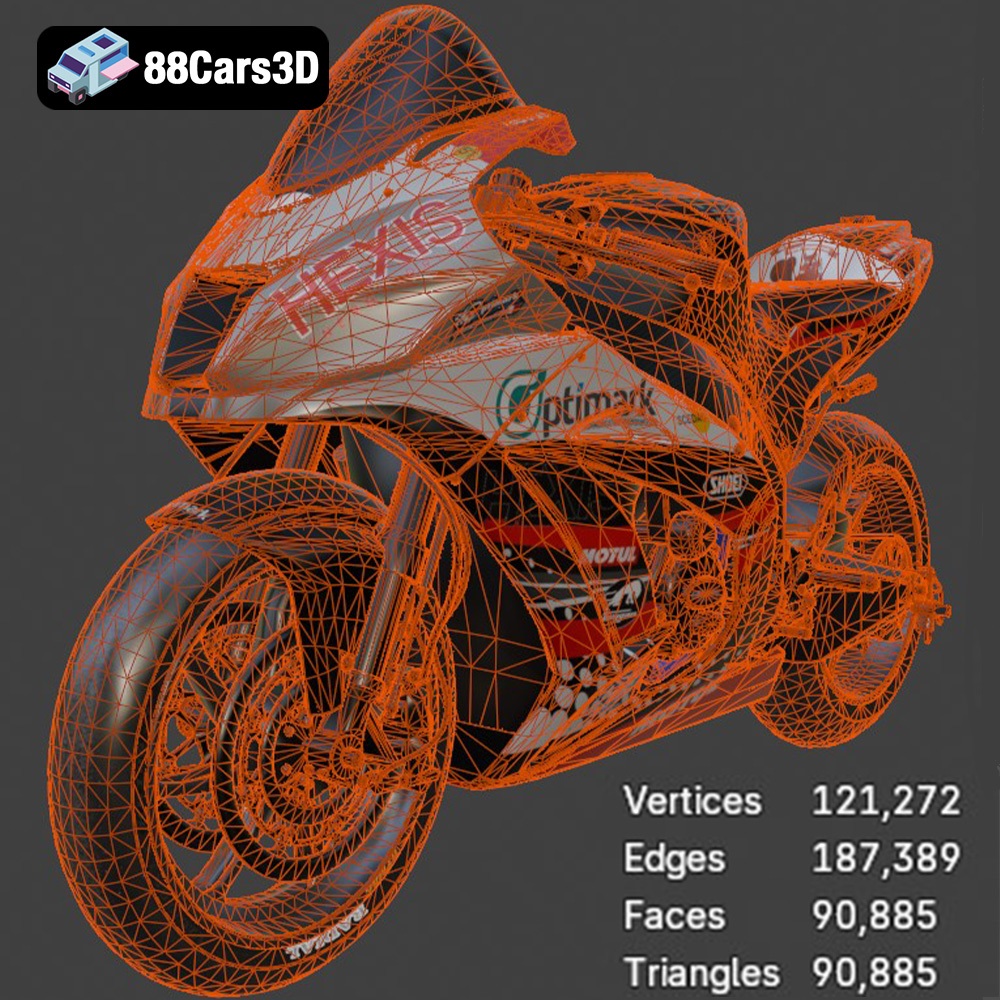
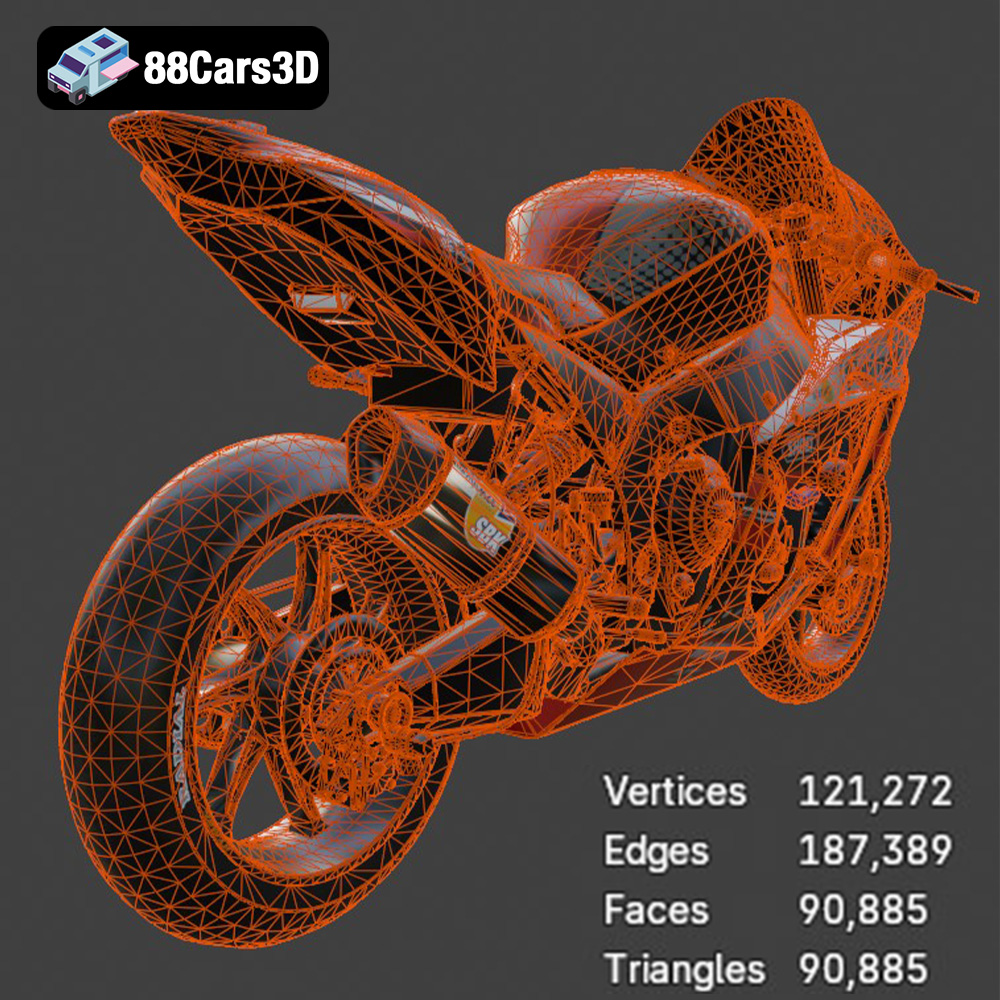
At the core of any 3D model is its geometry – the vertices, edges, and faces that define its shape. For the Kawasaki ZX-10R 3D Model, this geometry is clean and well-structured, a critical factor for professional use. Clean topology means the polygons flow logically across the surface, making it easy to unwrap UVs, apply subdivision surfaces without pinching, and facilitate smooth deformations if animation is required. The model boasts an optimized polygon count, striking a crucial balance. Too many polygons can bog down real-time engines and increase render times, while too few can result in blocky, unrealistic surfaces. An optimized count ensures that the intricate details of the superbike – from the engine fins to the brake calipers – are accurately represented without unnecessary geometric overhead. This meticulous attention to detail at the mesh level guarantees both visual fidelity and efficient performance, whether for game assets or high-end rendering.
Beyond the mesh, materials and textures are what bring a 3D model to life. The Kawasaki ZX-10R model features realistic materials expertly crafted to mimic the real-world properties of metal, paint, rubber, and plastic. This involves using Physically Based Rendering (PBR) workflows, where properties like albedo (base color), metallic, roughness, normal maps, and ambient occlusion are accurately defined. PBR materials ensure that the model reacts correctly to varying lighting conditions, delivering consistent and photorealistic results across different rendering engines. The textures are high-resolution and seamlessly applied, avoiding stretching or blurring even on close-up shots. This attention to material accuracy is what allows the digital superbike to gleam with the characteristic luster of its metallic components and exhibit the subtle matte finishes of its plastic parts, creating a truly believable appearance.
UV mapping is the process of unwrapping a 3D model’s surface onto a 2D plane, much like cutting and flattening a cardboard box. This 2D layout (the UV map) is where textures are painted or applied. Accurate and clean UV mapping is absolutely critical for high-quality models. The Kawasaki ZX-10R 3D Model features expertly crafted UVs, meaning there are no overlaps, minimal stretching, and efficient use of texture space. This ensures that textures appear crisp and uniform across the model’s surface, preventing visual artifacts. Furthermore, well-organized UV maps simplify the texturing process for artists who might want to customize the paint scheme or add specific decals, making the model highly adaptable and user-friendly for a variety of projects.
The true measure of a versatile 3D asset is its seamless integration into diverse professional pipelines. The Kawasaki ZX-10R 3D Model is engineered precisely for this, providing solutions for a spectrum of digital content creation needs.
For game developers, integrating a detailed vehicle model efficiently is paramount. The Kawasaki ZX-10R 3D Model, with its game-engine ready `.fbx` and pre-configured `.unreal` file, significantly streamlines this process. In Unreal Engine, developers can import the `.unreal` asset, which often comes with pre-set materials, collision meshes, and LODs (Levels of Detail). This allows for immediate placement in scenes, with the model already optimized for performance. Developers can then set up physics simulations, integrate it into a racing game’s vehicle blueprint, or use it as an environmental prop in an open-world setting. Similarly, for Unity, the `.fbx` file allows for straightforward import, where artists can quickly apply Unity’s PBR materials, set up colliders, and integrate it into their game logic. The optimized poly count ensures that the superbike maintains visual fidelity without causing a significant performance hit, crucial for maintaining high frame rates in fast-paced racing titles or interactive experiences. This saves developers hundreds of hours of manual optimization and material setup.
High-end automotive rendering demands precision and photorealism, and the Kawasaki ZX-10R 3D Model excels in this arena. In 3ds Max, the native `.max` file provides an editable project, giving artists full control over the scene. They can leverage powerful renderers like V-Ray or Corona Renderer, adjusting lighting setups, camera angles, and material properties to achieve breathtaking cinematic quality. This could involve complex studio lighting, dynamic outdoor environments, or even intricate animations showcasing the superbike’s features. For Blender users, the `.blend` file offers a similar level of control, complete with pre-configured materials and lighting, making it ready for Cycles or Eevee rendering. Artists can easily customize textures, create dynamic camera paths, and produce stunning visual content for marketing campaigns, product showcases, or personal portfolios. The clean topology and accurate UVs also facilitate further texture painting or customization, allowing for unique liveries or damage effects. This flexibility makes the model an ideal choice for creating compelling visual narratives around the superbike.
Augmented Reality (AR) and Virtual Reality (VR) platforms are transforming how users interact with digital content. The Kawasaki ZX-10R 3D Model is particularly well-suited for these immersive applications, thanks to its `.glb` format. Optimized for web-based and real-time display, the `.glb` file ensures quick loading times and smooth performance on mobile devices and VR headsets. For AR experiences, users can project the superbike into their real-world environment, allowing for interactive exploration from all angles, custom paint changes, or even scale adjustments. In VR, the model can populate virtual showrooms, racing simulations, or interactive training modules. Developers can integrate the `.glb` asset into platforms like WebXR, Spark AR, or Unity/Unreal-powered VR applications, providing users with a highly engaging and realistic experience. This capability allows for innovative marketing, educational tools, and truly immersive interactive product demonstrations that were once impossible.
The professional utility of the Kawasaki ZX-10R 3D Model extends across numerous industries, providing tangible benefits in various real-world scenarios. Its high fidelity and technical robustness make it an asset with broad applicability.
One of the most immediate and impactful applications for a detailed superbike model like the Kawasaki ZX-10R is in racing simulators. Modern simulators strive for unparalleled realism, not just in physics and handling, but also in visual representation. Game studios can integrate this model to create an authentic driving experience, where every curve of the bike, every decal, and every material reflects its real-world counterpart. This level of detail enhances player immersion, making the virtual race feel more visceral and exciting. Imagine seeing the detailed suspension compress, the chain accurately rendered, and the exhaust pipe gleaming under virtual sunlight – all contributing to a more believable and engaging simulation. This allows professional gamers and enthusiasts alike to experience the thrill of the ZX-10R without ever stepping onto a track.
For motorcycle manufacturers, dealerships, or marketing agencies, the Kawasaki ZX-10R 3D Model offers an exceptional tool for product visualization and promotional media. Instead of expensive physical photoshoots, a digital model can be rendered in countless environments, with various lighting setups, and even with custom paint schemes, all at a fraction of the cost and time. This allows for the creation of stunning 4K renders for brochures, dynamic animated commercials, or interactive 360-degree product configurators on websites. Imagine a customer on 88cars3d.com being able to rotate the ZX-10R model, zoom in on specific components, and even customize its color in real-time before making a purchase decision. This immersive marketing approach provides a richer, more engaging experience for potential buyers, significantly enhancing engagement and conversion rates.
Beyond digital screens, the `.stl` format of the Kawasaki ZX-10R 3D Model opens up avenues for physical prototyping and customization. Engineers and hobbyists can utilize this file to 3D print a scaled-down replica of the superbike. This is invaluable for rapid prototyping design concepts, testing ergonomics, or creating tangible models for display. For custom accessory designers, having a physical representation allows them to test fitment for things like fairings, exhaust systems, or custom seats before committing to full-scale manufacturing. This bridge between the digital and physical realms demonstrates the model’s versatility, supporting both virtual design iterations and practical, hands-on development.
In the vibrant world of 3D content creation, the availability of high-quality, technically robust assets is paramount for achieving professional-grade results. Whether your project demands photorealistic renderings, efficient game assets, or immersive AR/VR experiences, the underlying quality of your 3D models dictates success. The Kawasaki ZX-10R 3D Model stands as a testament to this principle, offering exceptional detail, optimized geometry, and versatile file formats designed to integrate seamlessly into a multitude of professional workflows.
From accelerating game development in Unreal Engine to enabling breathtaking cinematic renders in 3ds Max and Blender, and facilitating innovative AR/VR visualizations, this model provides the precision and flexibility that industry professionals require. Its comprehensive file format support ensures compatibility across virtually any software or platform, empowering artists and developers to bring their creative visions to life with unparalleled realism. By investing in such a meticulously crafted asset, you not only save valuable production time but also elevate the overall fidelity and impact of your digital projects. For those seeking premium 3D car models and vehicle assets that meet the highest standards of technical excellence and visual appeal, look no further than 88cars3d.com.
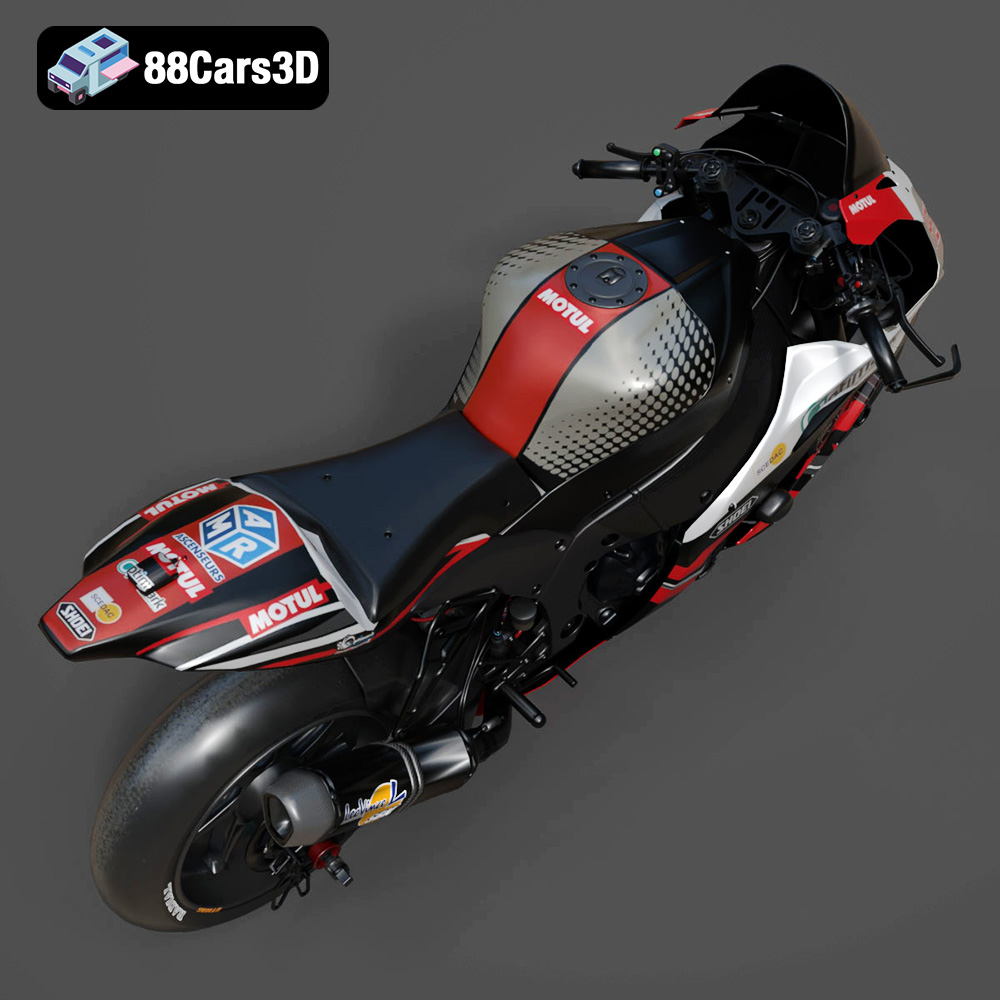
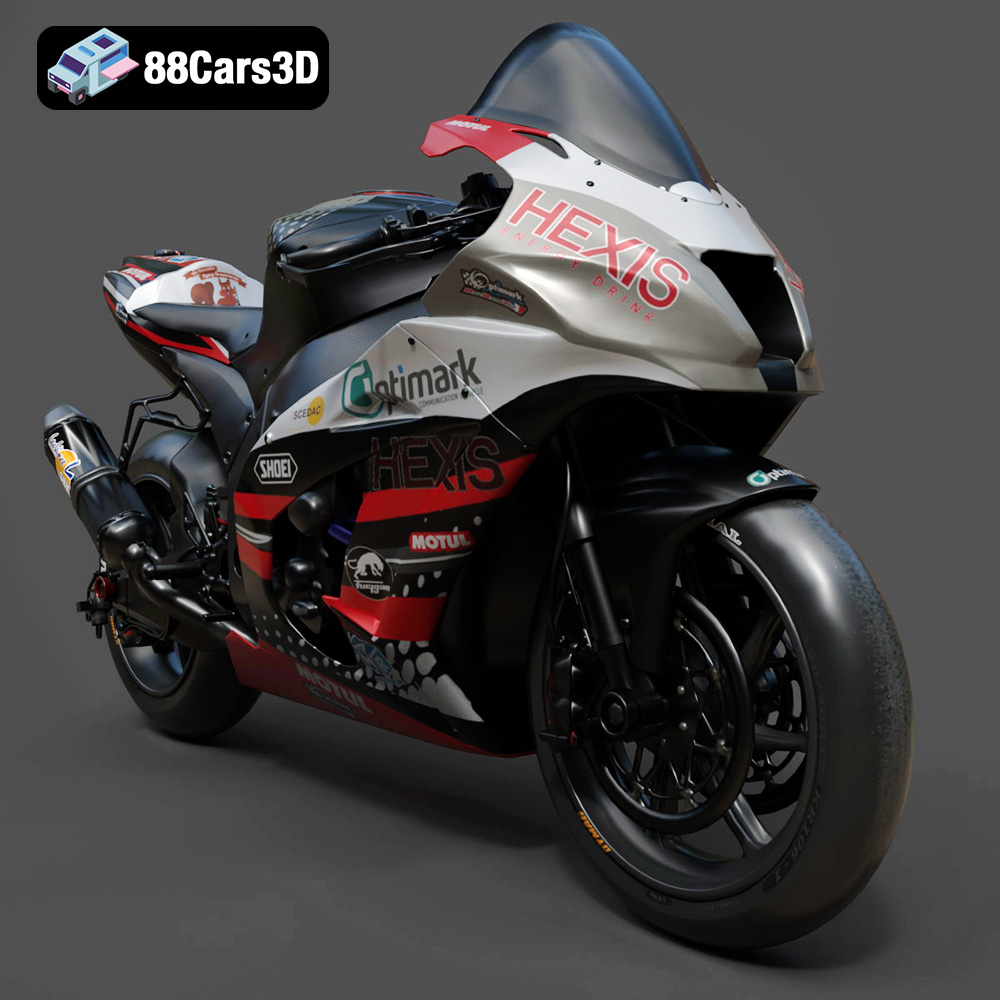
Bring dynamic realism to your digital projects with the Kawasaki ZX-10R 3D Model. This exceptionally detailed replica captures the aggressive styling, aerodynamic profile, and intricate mechanical components of the legendary superbike, making it an essential asset for digital environments requiring absolute precision.Built with professional quality in mind, this model features clean geometry, an optimized polygon count, and realistic materials. Every curve, chassis component, and texture is expertly crafted to provide a photorealistic finish, ensuring seamless integration into any scene.This versatile 3D model is perfect for a wide range of applications, including advanced game development, stunning cinematic rendering, interactive AR/VR experiences, and technical visualization. Whether used for racing simulators or promotional media, it delivers exceptional performance and visual fidelity.The package includes multiple industry-standard file formats to ensure maximum compatibility:
Tags: .kawasaki, .zx10r, .motorcycle, .superbike, .sportbike, .car3dmodel, .rendering, .simulation, .gameasset, .arvr, .blend, .fbx, .obj, .glb, .stl, .ply, .unreal, .max
$39.99
.arvr
.blend
.car3dmodel
.fbx
.gameasset
.glb
.kawasaki
.max
.motorcycle
.obj
.ply
.rendering
.simulation
.sportbike
.stl
.superbike
.unreal
zx10r