Get 20% OFF All Premium 3D & STL Models!

In the rapidly evolving world of 3D visualization, automotive design stands as a pinnacle of complexity and aesthetic appeal. From sleek concept cars to everyday city commuters, bringing vehicles to life in the digital realm requires an intricate blend of artistic vision and technical precision. The 2020 Peugeot 208 is a prime example of contemporary European automotive styling, boasting a dynamic profile and distinctive features that make it instantly recognizable. Its ‘saber-tooth’ LED daytime running lights and sculpted body lines redefine the compact hatchback segment. For 3D artists, game developers, and architectural visualization specialists, accurately capturing such a vehicle is crucial for creating believable and engaging digital experiences.
This pursuit of digital authenticity is where high-quality 3D car models become indispensable. Rather than spending hundreds of hours on modeling from scratch, professionals often turn to expertly crafted assets that are ready for immediate integration. The Peugeot 208 2020 3D Model, available for download on 88cars3d.com, is precisely such an asset. It embodies the detailed craftsmanship required for demanding projects, offering a meticulously optimized representation of the vehicle. This article will delve into the technical intricacies of utilizing such a model, exploring file formats, professional workflows, and its diverse applications across various industries, showcasing how this particular Peugeot 208 asset can elevate your next project.
The choice of a 3D model file format is far more than a simple preference; it dictates compatibility, feature support, and overall workflow efficiency. When acquiring a high-quality asset like the Peugeot 208 2020 3D Model, understanding the strengths and limitations of each included format is crucial for seamless integration into your project pipeline. This model from 88cars3d.com is provided in a comprehensive range of formats, ensuring maximum versatility.
The .blend format is Blender’s native file type, offering a complete, editable scene. For users primarily working within Blender, this is often the most desirable format. It encapsulates not just the mesh geometry, but also materials, textures, lighting setups, cameras, animations, and even physics simulations. This means a fully configured and ready-to-render scene, complete with the Peugeot 208, can be opened directly. This format is ideal for artists who wish to extensively customize the model, tweak materials, adjust lighting, or integrate it into an existing Blender scene with minimal effort. Its technical advantage lies in preserving all Blender-specific data, ensuring a “what you see is what you get” experience from the creator.
.fbx (Filmbox) is arguably the most widely adopted format for exchanging 3D data between different software applications. Developed by Autodesk, it excels at transferring geometry, materials, animations, and skeletal data. For game development, particularly with engines like Unreal Engine and Unity, FBX is the de facto standard. Its robustness and widespread support make it an excellent choice for exporting the Peugeot 208 2020 3D Model into real-time pipelines or other major DCC (Digital Content Creation) tools like Maya, 3ds Max, or Cinema 4D. While it may not retain all native software features, it is highly optimized for real-time asset delivery.
The .obj (Wavefront Object) format is a universal standard, prized for its simplicity and broad compatibility. It primarily stores geometry (vertices, normals, UVs, and faces) and can reference external material files (.mtl). While it doesn’t support animation or complex scene data, its straightforward nature ensures it can be imported into almost any 3D software package without issues. For scenarios where you need a clean mesh and plan to re-texture or re-rig the Peugeot 208 from scratch in a specific application, OBJ serves as a reliable starting point.
.glb (GL Transmission Format Binary) is the binary version of glTF, a royalty-free specification for 3D scenes and models. It’s highly optimized for efficient transmission and loading of 3D models in web browsers, AR (Augmented Reality), and VR (Virtual Reality) applications. A single .glb file can contain geometry, materials, textures, and animation, making it incredibly convenient for quick deployment. For showcasing the Peugeot 208 2020 3D Model in interactive web experiences or mobile AR apps, .glb is the format of choice due to its compact size and performance characteristics.
.stl (Stereolithography) is almost universally recognized as the standard format for 3D printing. It represents a 3D model as a series of connected triangles, defining only the surface geometry without color, texture, or other advanced attributes. The Peugeot 208 2020 3D Model, when converted to .stl, becomes a robust template for physical production. As noted in the product description, specific print settings and support structures are vital for successful output, making this format invaluable for hobbyists and professionals looking to create physical prototypes or display models.
The .ply (Polygon File Format or Stanford Triangle Format) is another format for storing 3D data, particularly useful for scanned data, CAD, and scientific applications. It supports various properties like color, transparency, and normals, making it more flexible than .obj for certain use cases, especially where precise mesh data is required for analysis or reverse engineering. While less common for everyday artistic exchange, its inclusion provides an option for highly technical applications of the Peugeot 208 model.
The inclusion of a dedicated .unreal file (often a .uasset or an optimized FBX specifically prepared for Unreal Engine) signifies an asset that has been pre-configured for the Unreal Engine environment. This means materials are likely set up, textures linked, and possibly even collision meshes generated. For game developers and real-time visualization artists working with Unreal Engine, this format offers the most direct path to integration, significantly reducing setup time for the Peugeot 208 2020 3D Model within their projects.
Similar to .blend for Blender, the .max format is the native file type for Autodesk 3ds Max. It contains all scene data specific to 3ds Max, including complex modifiers, render settings (like V-Ray or Corona), animation timelines, and custom scripts. For artists leveraging 3ds Max for high-end automotive rendering or architectural visualization, the .max file provides full access to the original scene, allowing for comprehensive customization and leveraging the powerful toolset of 3ds Max for the Peugeot 208 model.
The true value of a premium 3D car model lies in its attention to detail and technical execution. The Peugeot 208 2020 3D Model is a testament to this, meticulously crafted to represent the real-world vehicle with high fidelity, while being optimized for diverse applications. Understanding its construction reveals why it’s a superior asset for any professional project.
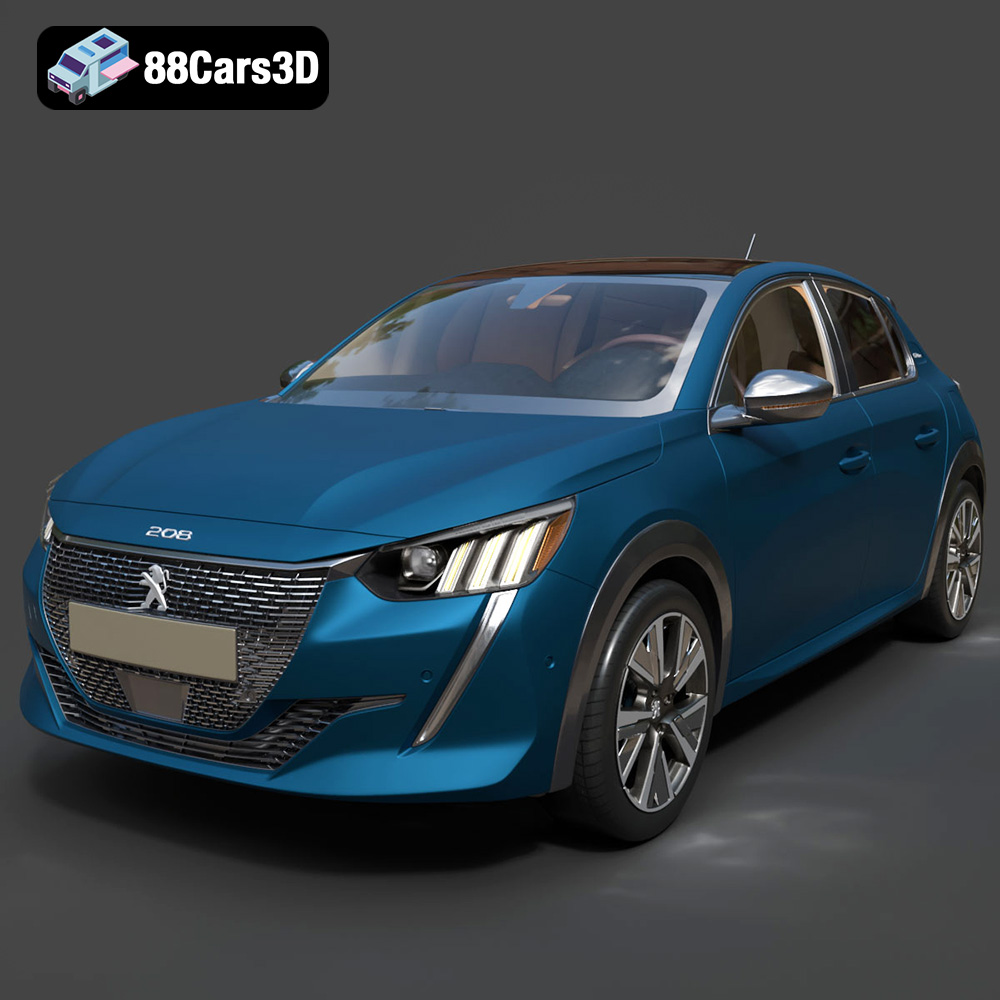
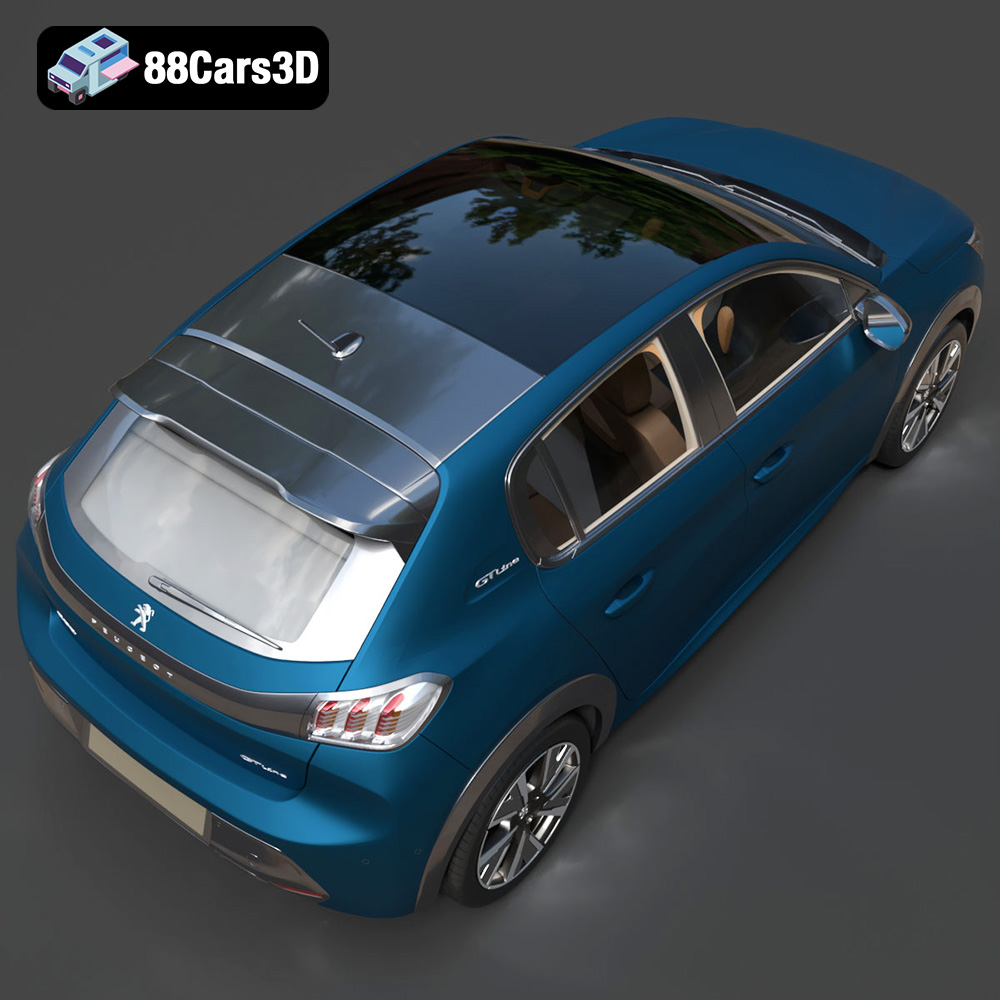
The exterior of the Peugeot 208 2020 is its most striking aspect, and the 3D model accurately reflects its aggressive styling. From the precise frame geometry and sporty hatchback proportions to the prominent Peugeot lion emblem on the grille, every detail is replicated. The signature ‘fang’ LED DRLs and 3-claw taillight integration are not just textures; they are carefully modeled elements, hinting at the potential for realistic lighting setups. High-resolution headlight and taillight housings with realistic reflectors ensure that when rendered, light scatters and bounces authentically, enhancing the overall realism. Furthermore, the aerodynamic alloy wheels, complete with detailed brake calipers and disc rotors, along with realistic tire treads, provide a level of realism crucial for close-up shots and immersive driving experiences. The separate wheels, suspension, and steering components are a critical technical advantage, facilitating easy animation for realistic movement in games or cinematic sequences.
Beyond the gleaming exterior, the interior of a car model is vital for first-person perspectives in games, VR experiences, or detailed architectural visualization scenes. The Peugeot 208 2020 3D Model excels here with a fully detailed cockpit. This includes meticulously modeled seating with realistic fabric/leather texture mapping, bringing comfort and authenticity to the virtual cabin. The ergonomic i-Cockpit layout, featuring the signature compact steering wheel and a digital 3D instrument cluster, along with a modern infotainment display, are all accurately represented. The central console, gear shifter, and tactile control buttons are not just placeholders but optimized geometry, ensuring that even in high-resolution renders or immersive VR, the interior maintains a high level of visual integrity and is suitable for first-person POV in gaming.
The balancing act between visual fidelity and performance is a cornerstone of professional 3D asset creation. The Peugeot 208 2020 3D Model achieves this with an optimized topology of approximately 120k triangles. This “game-ready” polycount strikes an excellent balance, providing enough detail for high-end visual realism in rendering and cinematic shots, while remaining efficient enough for real-time engines like Unreal and Unity. Crucially, the model boasts real-world scale accuracy, ensuring it fits seamlessly into environments without requiring extensive resizing. Proper pivot setup for steering, wheel rotation, and suspension travel is also a significant technical advantage, simplifying the animation process and allowing for dynamic, true-to-life vehicle behavior.
Integrating a new 3D asset into an existing project pipeline can be complex, but with a well-prepared model like the Peugeot 208 2020, the process becomes significantly smoother. This asset, available on 88cars3d.com, is designed for compatibility with leading 3D software and real-time engines, empowering artists and developers.
For high-end automotive rendering, 3ds Max remains a top choice. The included .max file for the Peugeot 208 2020 3D Model offers a direct entry point. Users can open the scene, which likely includes pre-configured materials, and then proceed to set up their desired lighting environment using V-Ray or Corona Renderer. The separate components (wheels, steering, suspension) make it easy to rig for animation, allowing for realistic driving sequences, turntable renders, or even intricate crash simulations. Artists can easily adjust material properties, such as paint sheen, metallic flakes, and glass reflections, to match specific branding or mood requirements. The optimized geometry ensures that even with complex global illumination calculations, render times remain manageable without sacrificing image quality.
Blender users benefit from the native .blend file, which provides a fully editable scene. Artists can import the Peugeot 208, customize textures, create additional LODs (Levels of Detail) if needed for extreme optimization, and then export it as an .fbx file specifically tailored for game engines. In Unreal Engine, this .fbx can be imported directly, or the provided .unreal file can be used for even faster setup. Once in Unreal, artists will focus on setting up realistic physically based rendering (PBR) materials, ensuring the vehicle’s paint, glass, and plastic surfaces react correctly to the engine’s lighting. The proper pivot points for wheels and steering significantly reduce the effort in blueprinting vehicle mechanics, allowing developers to quickly integrate the Peugeot 208 into a playable game environment, whether it’s an open-world city driving game or a detailed racing simulator.
The future of interactive 3D is increasingly found in AR/VR and web-based applications. The .glb format included with the Peugeot 208 2020 3D Model is specifically tailored for these environments. For AR/VR experiences, the model’s optimized triangle count of ~120k ensures smooth performance on mobile devices or standalone VR headsets. Developers can embed the .glb file into web pages using frameworks like Three.js or Babylon.js for interactive configurators or virtual showrooms. In an AR application, users could place a virtual Peugeot 208 in their driveway, examining its details from every angle. The compact and efficient nature of the .glb format means faster load times and a more fluid user experience, which is paramount in these emerging platforms.
High-quality 3D car models like the Peugeot 208 2020 are not just pretty pictures; they are versatile assets with a multitude of professional applications that drive innovation across various industries. The value proposition of such a detailed and optimized model extends far beyond simple rendering.
The primary application for a “game-ready” asset like the Peugeot 208 2020 3D Model is, naturally, in game development. Its optimized ~120k triangle count makes it ideal for open-world games where performance is critical, allowing many vehicles on screen simultaneously without bogging down the engine. For racing titles, simulators, or even police chase scenarios, the detailed exterior and interior, combined with separately animated components, provide a rich foundation for immersive gameplay. Imagine this Peugeot 208 navigating the bustling streets of a virtual city or being chosen by a player in a car customization game – its fidelity directly contributes to the player’s engagement and suspension of disbelief.
Augmented and Virtual Reality are transforming how consumers interact with products, especially in the automotive sector. The Peugeot 208 2020 3D Model is perfect for creating immersive virtual showrooms, allowing potential buyers to explore the vehicle from every angle, customize colors (e.g., Faro Yellow, Vertigo Blue, Elixir Red), and even “sit inside” the i-Cockpit. Mobile AR apps could overlay the car onto real-world environments, helping visualize its size and presence. The optimized geometry and clean topology are crucial for maintaining high frame rates and a comfortable experience in these demanding, real-time environments.
For marketing agencies and automotive brands, the Peugeot 208 2020 3D Model is an invaluable tool for brand campaigns and lifestyle rendering. High-resolution renders can be used for print ads, digital banners, or cinematic commercials, showcasing the vehicle’s dynamic stance and streamlined profile in various environments, from urban settings to scenic drives. Architectural visualization studios can integrate this detailed model into street scenes, adding realism and context to new building developments or urban planning projects. Its ability to handle studio lighting setups with crisp reflections and accurate ambient occlusion makes it a go-to for delivering visually stunning results.
The inclusion of the .stl format opens up an exciting avenue for 3D printing. Hobbyists, designers, and engineers can convert the Peugeot 208 2020 3D Model into a physical replica. While typically used for display-scale models (e.g., 1:12, 1:18, 1:24), this process allows for tangible interaction with the design. The product description provides essential 3D print settings, emphasizing the need for resin printing for fine details and supports for complex geometry. This capability allows creators to bridge the gap between digital design and physical prototyping, extending the model’s utility significantly.
The difference between a usable 3D model and a truly professional asset lies in its underlying technical quality and optimization. The Peugeot 208 2020 3D Model exemplifies this, offering specific advantages that cater to the most stringent production requirements.
The specified ~120k triangle count for the Peugeot 208 2020 3D Model is a deliberate choice. It represents an “optimized” mesh that provides excellent visual fidelity for close-up renders and cinematics, yet remains efficient enough for real-time applications where performance is paramount. This balance means artists don’t have to compromise on detail for efficiency. The clean, flowing polygons are also easier to work with, simplifying tasks like UV unwrapping (implied by realistic texture mapping), material assignments, and subdivision surface modeling if even higher detail is required for specific shots.
Accuracy is key in 3D visualization. The Peugeot 208 2020 3D Model is built to real-world scale, which is fundamental for seamless integration into architectural scenes, simulations, or other accurate digital environments. This eliminates guesswork and manual scaling, saving significant production time. Furthermore, the proper pivot setup for steering, wheel rotation, and suspension travel is a crucial technical detail often overlooked in lesser models. These correctly placed pivot points are essential for animating the vehicle realistically in game engines or rendering software, ensuring that the wheels turn on their true axis and suspension reacts authentically to terrain.
While often provided with default textures and materials, a high-quality 3D model allows for extensive customization. The Peugeot 208 2020 3D Model facilitates changes to body colors, enabling creators to switch between Faro Yellow, Vertigo Blue, Elixir Red, or any custom shade. This flexibility extends to modifying tire textures (e.g., summer vs. all-season variants) and adjusting material finishes (matte, gloss, metallic) to achieve specific aesthetic outcomes. This level of control ensures the model can be adapted to any creative vision or branding requirement, making it a truly versatile asset in a professional’s toolkit.
Investing in a well-structured and optimized 3D car model like the Peugeot 208 2020 means future-proofing your projects. Its compatibility with major 3D software platforms and real-time rendering engines ensures longevity and adaptability. Whether you’re upgrading your rendering software, migrating to a new game engine, or exploring emerging technologies like AR/VR, the foundational quality of this model from 88cars3d.com will continue to serve as a reliable and high-performing asset for years to come.
The creation of compelling digital content relies heavily on the quality of its foundational assets. The Peugeot 208 2020 3D Model stands out as a prime example of a meticulously crafted and technically optimized resource for professionals in various fields. From its aggressive styling and detailed interior to its game-ready polycount and comprehensive file format support, it offers an unparalleled balance of visual fidelity and performance.
Whether you are a game developer building an immersive open-world experience, an architect visualizing a new urban landscape, a marketer crafting a captivating automotive campaign, or an AR/VR specialist creating interactive showrooms, this 3D car model provides the versatility and quality needed to elevate your work. Understanding the nuances of file formats and leveraging the model’s technical advantages ensures a smooth workflow and stunning final results. By choosing premium assets like the Peugeot 208 2020 3D Model from 88cars3d.com, you are not just acquiring a digital car; you are investing in a powerful tool that drives innovation and pushes the boundaries of digital realism.
The 2020 Peugeot 208 redefined the modern compact hatchback segment with its bold, aggressive styling and sporty proportions. Featuring the striking ‘saber-tooth’ LED daytime running lights, a muscular sculpted hood, and an elegant gloss-black rear light cluster fascia, this vehicle stands out in any urban setting. Its dynamic stance and streamlined profile perfectly capture the essence of contemporary European car design. This meticulously crafted 3D model boasts an optimized topology of approximately 120k triangles, ensuring flawless game-ready performance without compromising visual fidelity. Designed for high-end rendering and real-time engines, it delivers crisp reflections, accurate ambient occlusion, and an immaculate flow of polygons tailored for both performance and close-up cinematic shots. Perfect for modern city driving games, architectural visualization street scenes, VR automotive showrooms, and commercial lifestyle rendering.
$39.99
.2020
.208
.blend
.fbx
.glb
.hatchback
.max
.obj
.peugeot
.ply
.rendering
.stl
.unreal
car-3d-model
city-car
compact-car
game asset
game-ready
low-poly
optimized
VR/AR