Get 20% OFF All Premium 3D & STL Models!

In the vibrant and ever-evolving landscape of 3D visualization, the demand for high-quality, meticulously crafted digital assets is paramount. From the intricate realism required for cinematic renders to the optimized precision vital for real-time game engines and immersive AR/VR experiences, the foundation of any successful project lies in its core assets. Automotive models, in particular, stand as a testament to the blend of artistic skill and technical prowess, requiring an almost obsessive attention to detail to capture the essence and engineering marvel of their real-world counterparts.
For designers, developers, and enthusiasts, sourcing 3D car models that not only look spectacular but also perform flawlessly across diverse platforms is a constant challenge. This is where specialized marketplaces like 88cars3d.com become indispensable, offering a curated selection of professional-grade assets designed to elevate any project. Today, we’re diving deep into one such exceptional model: the Porsche 718 Cayman GT4 2020 3D Model, an asset that perfectly exemplifies the pinnacle of automotive digital artistry and engineering for modern workflows.
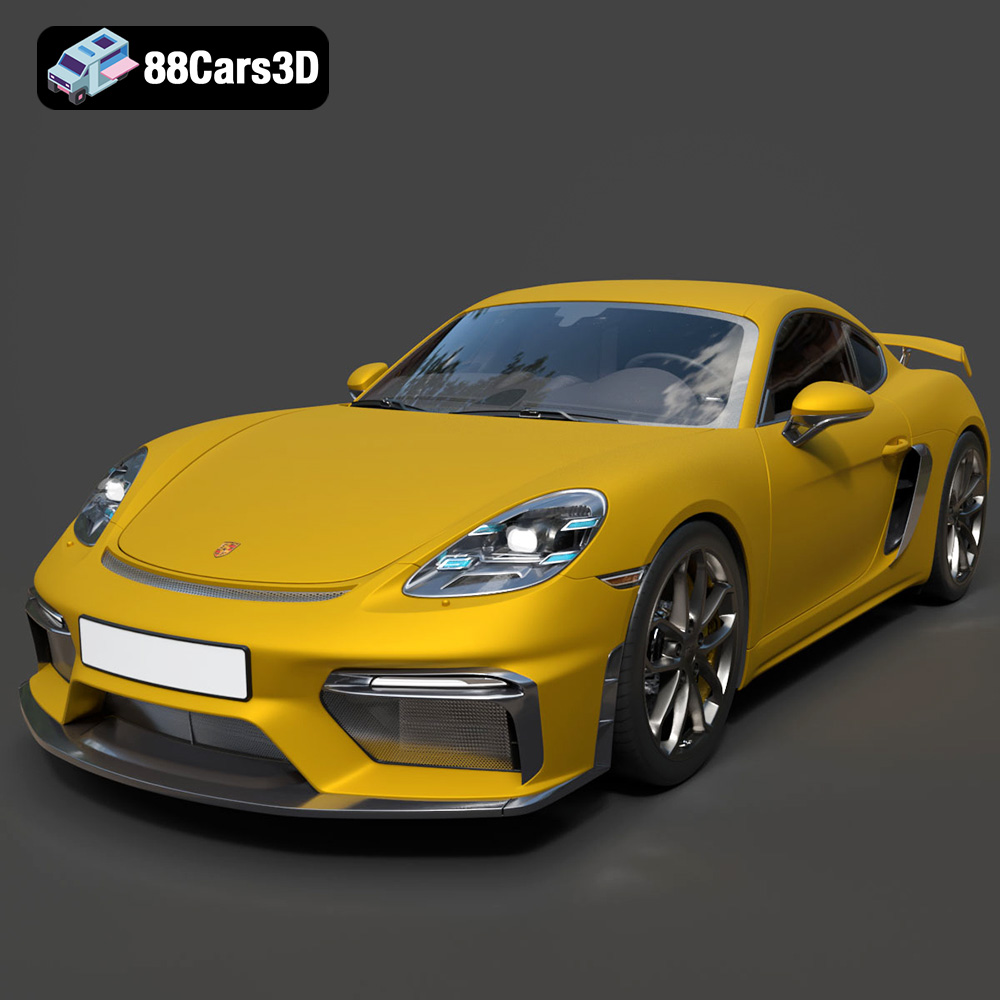
The Porsche 718 Cayman GT4 2020 is, in reality, a mid-engine track weapon, renowned for its naturally aspirated 4.0-liter flat-six engine and aggressive aerodynamics. Its digital twin must capture this essence, from the prominent fixed rear wing and large functional air intakes to its dual sport exhaust system and aggressive rear diffuser. This particular 3D model does exactly that, offering a detailed, optimized, and versatile asset that’s ready to integrate into your most demanding projects, whether you’re focused on realistic automotive rendering or developing high-performance game assets.
One of the most crucial aspects of working with 3D models, especially when collaborating or moving assets between different software and platforms, is understanding the various file formats. Each format serves a specific purpose, offering unique advantages in terms of data preservation, compatibility, and optimization. The Porsche 718 Cayman GT4 2020 model, for instance, comes with a comprehensive suite of formats, ensuring maximum flexibility for any project type.
The .blend format is Blender’s native file type. It’s an all-encompassing package, storing not just the 3D mesh data but also materials, textures, lighting, cameras, animations, physics simulations, and even the UI layout of the scene. This makes it an ideal choice if Blender is your primary 3D modeling software, as it provides a fully editable scene ready for further manipulation. For the Porsche GT4 model, having the .blend file means artists can dive directly into its construction, inspect node-based materials, modify UV maps, or even re-rig components with ease, leveraging Blender’s powerful toolset.
.fbx (Filmbox) is arguably the most widely adopted interchange format in the 3D industry, particularly for game development and animation. Developed by Autodesk, FBX is highly versatile, capable of storing not only geometry and UVs but also materials (though often in a simplified form), textures, bones, skinning, blend shapes, and animation data. Its robust support for hierarchies and animation curves makes it ideal for pipelines involving Unreal Engine, Unity, and other real-time environments. For the GT4, the .fbx ensures that all animation-ready components like wheels, steering, and suspension pivots are correctly preserved when imported into game engines or other DCC applications, facilitating quick setup of interactive elements.
The .obj (Wavefront OBJ) format is a venerable and highly compatible format known for its simplicity and universality. It primarily stores geometry data – vertices, normals, UV coordinates, and faces – along with references to external material files (.mtl). While it doesn’t support animation, rigging, or advanced material definitions, its widespread support across virtually all 3D software makes it an excellent choice for cross-software compatibility. If your primary need is to import the GT4’s clean mesh geometry into a niche rendering engine or a custom tool, .obj is often the most reliable “plain text” option.
.glb (GL Transmission Format Binary) is an increasingly popular format, especially for web-based 3D, augmented reality (AR), and virtual reality (VR) applications. It’s essentially a binary version of glTF, bundling all necessary assets (geometry, materials, textures, animations) into a single, self-contained file. This makes it incredibly efficient for streaming and display in browser-based viewers or mobile AR apps, as it minimizes loading times and simplifies asset management. The GT4 in .glb format is perfectly optimized for immediate deployment in interactive virtual showrooms or mobile configurators, offering a balance of visual quality and performance.
The .stl (Stereolithography) format is the de facto standard for 3D printing. It represents a 3D model as a series of connected triangles (a triangulated surface mesh) without color, texture, or other attributes. Its primary function is to describe the surface geometry of a 3D object for manufacturing purposes. The GT4 model’s inclusion of an .stl file means it has been prepared for physical reproduction, with considerations for wall thickness and printable detail. Hobbyists and professionals can use this file to print display-scale replicas, requiring careful attention to print settings like scale, layer height, and support structures to capture its fine details.
.ply (Polygon File Format, or Stanford Triangle Format) is another format primarily used for storing 3D scanner data, point clouds, and mesh data. It supports properties like color, transparency, normals, texture coordinates, and scalar values for each vertex or face. While not as universally used as .obj or .fbx for general 3D work, it’s often preferred in scientific visualization, CAD, and specific mesh processing applications where precision and additional per-vertex/per-face data are critical. It can be useful for integrating the GT4 model into more analytical or engineering-focused pipelines.
While not a standalone file format in the traditional sense, the term .unreal often refers to assets specifically configured and optimized for direct import into Unreal Engine. This typically means the .fbx file has been processed, materials have been set up using Unreal’s PBR workflow, textures are correctly packed and compressed, and necessary elements like LODs (Levels of Detail) and collision meshes have been generated. An “Unreal-ready” GT4 asset significantly streamlines the development process, reducing the time spent on engine integration and ensuring optimal performance within the demanding real-time environment, making it a true game asset.
Similar to .blend for Blender, .max is the native file format for Autodesk 3ds Max. It stores all scene information, including geometry, materials, lighting, cameras, animation, and scene settings. If 3ds Max is part of your professional pipeline, the .max file provides the most comprehensive and editable version of the GT4 model. Artists can leverage 3ds Max’s robust modeling, texturing, rigging, and rendering tools to further customize the car, set up complex animations, or integrate it into architectural visualizations and product presentations.
Understanding these formats empowers artists to make informed decisions about which file to use for a given task, ensuring compatibility, efficiency, and the preservation of crucial data throughout their 3D production pipeline. The Porsche 718 Cayman GT4 2020 3D Model from 88cars3d.com provides this versatility right out of the box.
Creating a truly exceptional 3D car model like the Porsche 718 Cayman GT4 2020 involves a delicate balance between artistic interpretation and rigorous technical execution. It’s not just about making something look good; it’s about making it functionally viable for various professional applications, from high-end rendering to real-time interactive experiences. This particular model stands out due to its commitment to both visual fidelity and optimization.
The first impression of any automotive model comes from its exterior, and the GT4 does not disappoint. The model features accurate Porsche 718 Cayman GT4 frame geometry, body panels, and proportions. This precision is critical for photorealistic automotive rendering, where even subtle inaccuracies can break immersion. Details such as the large cooling intakes, aerodynamic front spoiler, dual-pipe sport exhaust, and aggressive rear diffuser are faithfully recreated. Signature Porsche four-point LED headlights and tinted 3D taillights add another layer of authenticity, reflecting light realistically in a rendered scene. Furthermore, precise alloy wheels with high-performance brake calipers and slotted rotors contribute significantly to the visual weight and credibility of the asset. Even subtle elements like detailed suspension components, visible through the wheel arches, elevate the model beyond a mere shell, showcasing the depth of its creation.
Beyond the exterior, the interior of a car model is crucial for first-person views, virtual configurators, and immersive AR/VR applications. The GT4 model boasts a track-focused cockpit, featuring Alcantara sport bucket seats with detailed stitching – a small but significant detail that adds tactile realism. The GT sport steering wheel with its center top marker, the iconic analog central tachometer, and the digital instrument cluster are all precisely modeled, providing a highly believable environment. The gear shifter, center console, and sport pedal assembly are also accurately represented, all with optimized geometry suitable for first-person POV in gaming, ensuring a smooth experience without unnecessary polygon overhead.
Under the hood, so to speak, the GT4 model excels in its technical specifications, making it a true workhorse for diverse pipelines. It is specifically designed to be “Game-Ready & Optimized,” striking a perfect balance between an optimized triangle count for real-time engines (like Unreal and Unity) and maintaining high-end visual realism for cinematic renders. This means developers don’t have to sacrifice detail for performance, a common challenge in game asset creation. The model adheres to real-world scale accuracy, based on actual vehicle chassis, which is essential for consistent scene integration and realistic physics simulations. Crucially, it features proper pivot setup for steering, wheel rotation, and suspension travel. This pre-configured rigging saves countless hours for animators and game developers who can immediately integrate the model into their animation systems or vehicle blueprints, making it an invaluable game asset.
The true value of a high-quality 3D car model is realized through its seamless integration into various professional pipelines. The Porsche 718 Cayman GT4 2020 3D Model, with its diverse file formats and optimized structure, is designed for immediate utility across the industry’s leading software and engines.
For artists working with Digital Content Creation (DCC) software like 3ds Max or Blender, the included native .max and .blend files are game-changers. In 3ds Max, artists can load the .max file to access the complete scene, including proper material definitions, potentially lights, and camera setups. This allows for immediate rendering using V-Ray, Corona, or Arnold. Animators will appreciate the separate wheels, suspension, and steering components with pre-set pivots, making it straightforward to rig for vehicle dynamics. Imagine animating the GT4 cornering dynamically, with its suspension compressing and wheels turning authentically. Similarly, in Blender, the .blend file provides a fully editable scene. Artists can leverage Blender’s Eevee for fast, high-quality real-time renders or Cycles for path-traced photorealism. They can experiment with different lighting environments, adjust the car’s paint shader for metallic flakes or matte finishes, and craft compelling cinematic sequences demonstrating the car’s power and elegance.
For game developers and AR/VR creators, the GT4 model’s “game-ready” optimization and .fbx / .unreal files are invaluable. When importing the .fbx into Unreal Engine or Unity, the optimized triangle count ensures that the model runs smoothly without heavily impacting frame rates, even in complex open-world environments. The proper pivot setup for crucial components like wheels and suspension simplifies the integration with vehicle physics systems. In Unreal Engine, developers can easily create a vehicle blueprint, assign the mesh, and define collision volumes. The ability to modify material instances for body colors, tire textures, or material finishes (matte, gloss, metallic) within the engine’s material editor provides immense creative control. This makes the Porsche GT4 an outstanding game asset for racing simulators, open-world games, or even interactive automotive configurators where real-time performance is paramount.
The rise of augmented and virtual reality has created a new demand for lightweight, efficient 3D models. The .glb format of the GT4 model is perfectly suited for this. When deployed in an AR application (e.g., on a mobile device), the model can be viewed in real-world space, allowing users to walk around, inspect details, and even see it “parked” in their driveway. For VR, the optimized geometry ensures a smooth, nausea-free experience in virtual showrooms or interactive tours. Furthermore, the .glb format is ideal for web-based 3D viewers, enabling potential customers to interact with the car on a website, customize its colors, and view it from all angles without needing powerful client-side hardware. This accessibility significantly enhances engagement for marketing and sales initiatives.
The versatility and high quality of the Porsche 718 Cayman GT4 2020 3D Model mean it finds utility across a broad spectrum of professional applications. Its design caters to the specific demands of each industry, proving its value as a robust digital asset.
In the realm of game development, the GT4 model shines as a premium game asset. Its optimized polycount is crucial for maintaining stable frame rates in demanding racing titles and open-world games. Imagine the thrill of driving this meticulously recreated Porsche through a virtual track, the detailed suspension reacting realistically to every bump and curve, and the interior providing an immersive first-person perspective. Game studios can leverage the model for hero cars, AI vehicles, or even as a base for custom liveries and performance upgrades within a game. The pre-configured pivots for animation drastically cut down development time, allowing teams to focus on gameplay mechanics and overall experience rather than tedious asset preparation. This model is engineered to be a drop-in solution for a high-performance virtual driving experience.
For automotive brands and dealerships, AR/VR presents revolutionary opportunities. The GT4 model is perfect for creating immersive virtual showrooms where potential buyers can explore the car in a 3D environment, examine its features, and even customize options in real-time. In AR, the car can be superimposed onto a real-world setting, allowing customers to visualize it in their garage or driveway. Beyond sales, such models are invaluable for training. Mechanics could use a VR simulation to learn about the GT4’s engine layout or suspension components, making complex information digestible and interactive. The lightweight yet detailed nature of this model, particularly in .glb format, is a key enabler for these cutting-edge applications.
Photorealistic automotive rendering is a core application for this GT4 model. Marketing agencies and visualization studios can utilize it to create stunning brand campaigns, lifestyle scenes, and product launch materials. Imagine the GT4 parked on a scenic mountain road bathed in golden hour light, or under the stark, dramatic lighting of a virtual studio. The model’s high visual fidelity ensures that it holds up even under extreme close-up shots, allowing for the creation of breathtaking promotional content without the need for physical photography. Its customizable materials mean artists can quickly adapt the car’s appearance to fit specific brand aesthetics, from classic metallic finishes to contemporary matte wraps or even carbon fiber accents.
For hobbyists and collectors, the inclusion of an .stl file opens up a fascinating avenue: 3D printing. While digital, the Porsche 718 Cayman GT4 2020 3D Model can be transformed into a physical, display-scale replica. This is an incredible opportunity for enthusiasts to own a tangible representation of their favorite track car. The product description provides essential 3D print settings, such as recommended scales (1:12, 1:18, 1:24), layer height, wall thickness, and infill percentages. It also highlights the necessity of supports for intricate parts like the exhaust, mirrors, and side scoops, and suggests resin printing for finer details. Post-processing steps like sanding, priming, and applying authentic factory colors can turn a raw print into a stunning collectible, blurring the lines between the digital and physical worlds.
Investing in a high-quality 3D car model is not just about acquiring an asset; it’s about acquiring a versatile tool that can adapt to future project needs and creative visions. The Porsche 718 Cayman GT4 2020 3D Model excels in its inherent customizability, ensuring its longevity and utility in your digital library.
The ability to customize a 3D model is crucial for matching specific project requirements or artistic directions. This GT4 model allows for extensive modifications. You can easily change body colors, choosing from iconic Porsche shades like Miami Blue or Guards Red, or even crafting custom finishes to match a unique brand identity. Beyond paint, the model supports modifications to tire textures, allowing you to switch between track slicks for a race scenario and street variants for a more lifestyle-oriented visualization. Material finishes can be adjusted from classic gloss to stealthy matte, sophisticated metallic, or high-performance carbon fiber, giving you granular control over the car’s visual impact. This level of customization ensures that the single asset can serve multiple purposes across different projects without requiring a complete re-modeling effort.
Beyond the car itself, the model’s adaptability extends to its environment. You can effortlessly adjust lighting to suit different moods and scenes, whether it’s a bright, sunny outdoor shoot or a dramatic, moody studio setup. By leveraging the comprehensive material setups provided in formats like .blend or .max, artists can quickly modify how the car reacts to light, from subtle reflections on polished surfaces to the intricate glints off chrome details. This flexibility is vital for creating cohesive and believable scenes, allowing the GT4 to seamlessly integrate into any digital backdrop you envision. The model’s robust construction and clean topology ensure that it responds predictably and beautifully to any lighting scenario, making it a reliable foundation for any automotive rendering challenge.
Purchasing well-structured, optimized 3D car models like the Porsche 718 Cayman GT4 from reputable sources such as 88cars3d.com is an investment in your creative pipeline. Such assets are ‘future-proof’ in the sense that their clean topology, real-world scale, and optimized nature mean they can be easily updated, re-textured, or even converted to newer formats as technology evolves. They are not one-time use models but rather foundational elements that can be repurposed across numerous projects, offering long-term value whether for game development, high-fidelity rendering, or emerging AR/VR applications. This particular GT4 model is a prime example of an asset built to last and to perform, ready to meet the demands of tomorrow’s innovative projects.
In the dynamic world of 3D content creation, the difference between a good project and an outstanding one often comes down to the quality of its assets. The Porsche 718 Cayman GT4 2020 3D Model exemplifies this principle, offering an unparalleled blend of visual fidelity, technical optimization, and versatility. From its meticulously recreated exterior and interior details to its game-ready performance across various engines and its comprehensive suite of file formats, this model is designed to meet the rigorous demands of professional artists and developers.
Whether your goal is breathtaking automotive rendering for marketing campaigns, developing high-speed racing game assets, crafting immersive AR/VR experiences, or even producing a tangible 3D print, this model provides the robust foundation you need. Its careful balance of polycount and detail ensures maximum performance without sacrificing visual impact, making it a truly exceptional digital asset for any creative endeavor.
For those seeking the highest standards in 3D car models, the Porsche 718 Cayman GT4 2020 3D Model available at 88cars3d.com stands as a testament to quality and technical excellence. It’s more than just a model; it’s a powerful tool ready to drive your next project to success, offering both the artistry and the engineering precision required to bring your digital visions to life. Explore its potential today and experience the difference that truly professional-grade assets can make.
The 2020 Porsche 718 Cayman GT4 is a mid-engine track weapon that perfectly balances motorsport heritage with modern performance. Known for its naturally aspirated 4.0-liter flat-six engine, aggressive aerodynamics, and unmistakable Porsche styling, this sports car delivers a pure, unfiltered driving experience. From its prominent fixed rear wing and large functional air intakes to its dual sport exhaust system and aggressive rear diffuser, every element is meticulously designed for maximum downforce and cooling. This high-fidelity 3D model boasts exceptional topology and game-ready optimization, featuring carefully calculated triangle counts to ensure maximum performance without sacrificing detail. It maintains breathtaking visual fidelity suitable for close-up shots while remaining fully optimized for real-time rendering environments. Whether you are developing a high-speed racing simulator, crafting an immersive AR/VR showroom, or producing photorealistic cinematic animations, this digital asset provides the perfect foundation.
$39.99
.2020
.blend
.fbx
.glb
.max
.obj
.ply
.porsche
.rendering
.sports car
.stl
.unreal
718-cayman-gt4
car-3d-model
game asset
game-ready
low-poly
optimized
track-car
VR/AR