Get 20% OFF All Premium 3D & STL Models!

In today’s fast-paced digital landscape, the demand for realistic, high-performance 3D assets is skyrocketing across industries. From groundbreaking video games and immersive virtual reality experiences to photorealistic architectural visualizations and compelling marketing campaigns, 3D car models are pivotal in bringing concepts to life. These digital representations are far more than just pretty pictures; they are complex data sets engineered to perform across a myriad of platforms and applications, serving as the foundation for innovation.
The ability to accurately depict complex machinery like automobiles in a virtual space requires a deep understanding of both artistic fidelity and technical optimization. A truly exceptional 3D car model doesn’t just look good; it’s meticulously structured, properly scaled, and optimized for seamless integration into diverse workflows. It must serve the needs of game developers striving for fluid real-time performance, architects visualizing urban environments, and product designers showcasing new vehicle concepts.
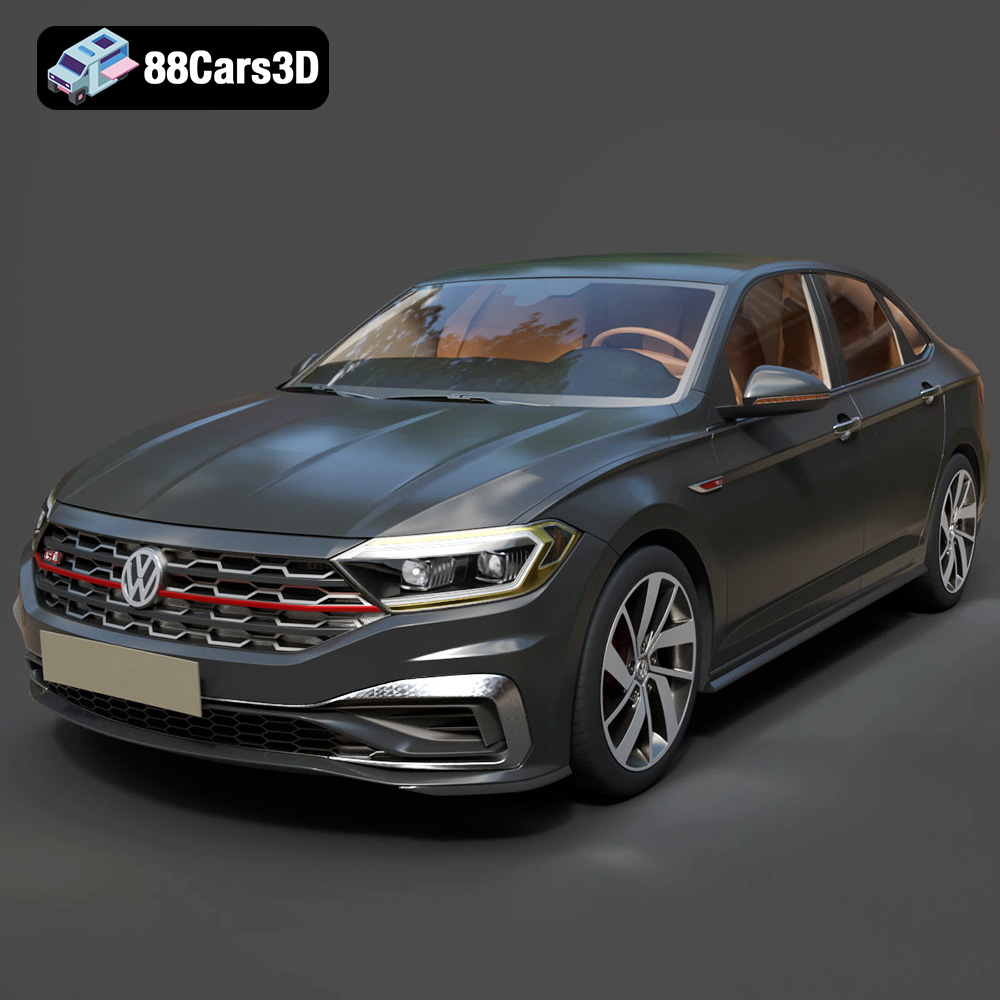
Today, we’ll dive deep into the world of professional 3D car models, exploring the technical intricacies, workflow integrations, and diverse applications that make them indispensable. We’ll specifically highlight an exemplary asset, the Volkswagen Jetta GLI 2019 3D Model from 88cars3d.com, a prime example of a meticulously crafted asset that combines aesthetic appeal with technical excellence, ready for immediate deployment in your next project.
Choosing the right file format for your 3D car model is crucial, as it dictates compatibility, feature retention, and overall workflow efficiency. Each format is designed with specific use cases and software ecosystems in mind, offering unique advantages. Understanding these distinctions is fundamental for any professional working with 3D assets, especially detailed models like the Volkswagen Jetta GLI 2019.
The .blend format is Blender’s native file type, offering a complete, fully editable scene. When you download a .blend file, you’re not just getting the mesh; you’re getting the entire Blender project. This includes all objects, cameras, lights, animation data, modifiers, custom properties, and most importantly, the native Cycles or Eevee materials with all their node setups. For artists who primarily work within Blender, this provides unparalleled flexibility. You can easily tweak the model’s topology, adjust UVs, modify materials, or even set up custom animations or renders directly within the file. It’s the ideal starting point for deep customization or integrating the asset into a Blender-centric pipeline, ensuring all original data and relationships are preserved.
Developed by Autodesk, the .fbx (Filmbox) format has become a cornerstone of 3D asset exchange, especially prevalent in game development. Its strength lies in its ability to store not just mesh data, but also complex animation, rigging, skinning, blend shapes, cameras, and lights in a single file. This makes it ideal for transferring assets between different 3D software packages (like 3ds Max, Maya, Blender) and into real-time engines such as Unreal Engine and Unity. When a model like the Jetta GLI 2019 is provided in .fbx, it often includes optimized geometry, PBR material assignments, and sometimes even pre-rigged components like wheels and suspension, ready for animation. Its robust feature set ensures a smooth hand-off, making it a go-to for complex animated scenes.
The .obj (Wavefront Object) format is one of the oldest and most universally supported 3D formats. It excels in simplicity and cross-software compatibility, making it a reliable choice when you need to ensure a model can be opened in virtually any 3D application. An .obj file typically stores mesh geometry (vertices, normals, UVs, faces) and can reference external .mtl (material) files for basic material properties. While it doesn’t support advanced features like animation, rigging, or complex PBR materials directly within the file, its widespread support makes it an excellent baseline for initial mesh transfer, especially for static models or when you plan to rebuild materials in the destination software. It’s often used as a fallback or for models intended for basic viewing or sculpting.
The .glb (GL Transmission Format Binary) is quickly gaining traction as the preferred format for 3D content in AR, VR, and web-based applications. It’s a binary version of .gltf, meaning all necessary data – mesh, materials, textures, animations – are packed into a single, self-contained file. This makes .glb extremely efficient for streaming and display in environments where file size and loading speed are critical, such as mobile AR apps or interactive browser experiences. The Volkswagen Jetta GLI 2019, optimized for real-time performance, would shine in a .glb format for virtual showrooms or online configurators, offering a smooth, high-quality interactive experience with minimal overhead.
The .stl (Stereolithography) format is the de facto standard for 3D printing. Unlike other formats that describe surfaces, .stl represents a 3D object as a collection of unconnected triangular facets. It contains only geometric data – specifically, the surface geometry of a 3D object without any color, texture, or material information. This simplicity makes it ideal for manufacturing processes where the printer simply needs to understand the shape to build. When converting a complex model like a car for 3D printing, careful attention to manifold geometry (watertight mesh), scale, and resolution is required. The Jetta GLI 2019 model’s availability in .stl format opens up possibilities for physical scale models, requiring adjustments for wall thickness and support structures.
The .ply (Polygon File Format) is another versatile format that can store 3D data, including color, transparency, normals, texture coordinates, and scalar values associated with vertices or faces. While less common in general animation or game development compared to .fbx, it’s often used in academic, scientific, and engineering applications. It’s particularly useful for storing data from 3D scanners and for CAD/CAM pipelines where precision and additional data attributes are important. For a highly detailed model like the Jetta GLI, .ply might be used for specific analysis or for transferring precise geometric data to engineering software.
The .unreal designation typically refers to assets that are packaged specifically for Unreal Engine projects. This isn’t a single file format in the traditional sense, but rather a collection of files and folder structures optimized for direct import into Unreal Engine’s content browser. This often means the .fbx file has been processed, materials have been converted to Unreal’s material system, textures are correctly imported, and static meshes are set up with proper collision, LODs (Levels of Detail), and potentially even pre-configured blueprints for interactive elements. An .unreal asset implies a streamlined workflow, saving developers significant time on setup and optimization, making the Volkswagen Jetta GLI 2019 an immediate plug-and-play solution for Unreal-based projects.
Similar to .blend for Blender, .max is the native file format for Autodesk 3ds Max. This format retains all the intricate details of a 3ds Max scene, including complex modifiers, specific render settings (e.g., V-Ray, Corona), advanced materials, animation timelines, lighting setups, and camera configurations. For professionals deeply embedded in the 3ds Max ecosystem, a .max file of the Volkswagen Jetta GLI 2019 provides maximum flexibility for further development, fine-tuning renders, or integrating it into existing 3ds Max scenes for high-end architectural visualization or product showcases.
The comprehensive availability of the Volkswagen Jetta GLI 2019 model in these diverse formats underscores its versatility and the producer’s commitment to supporting a broad spectrum of professional applications.
Creating a high-quality 3D car model is an intricate process that balances artistic skill with technical precision. It involves meticulous attention to detail, a deep understanding of vehicle design, and expert knowledge of 3D software and optimization techniques. The Volkswagen Jetta GLI 2019 3D model stands as a testament to this delicate balance, delivering both stunning visual fidelity and game-ready performance.
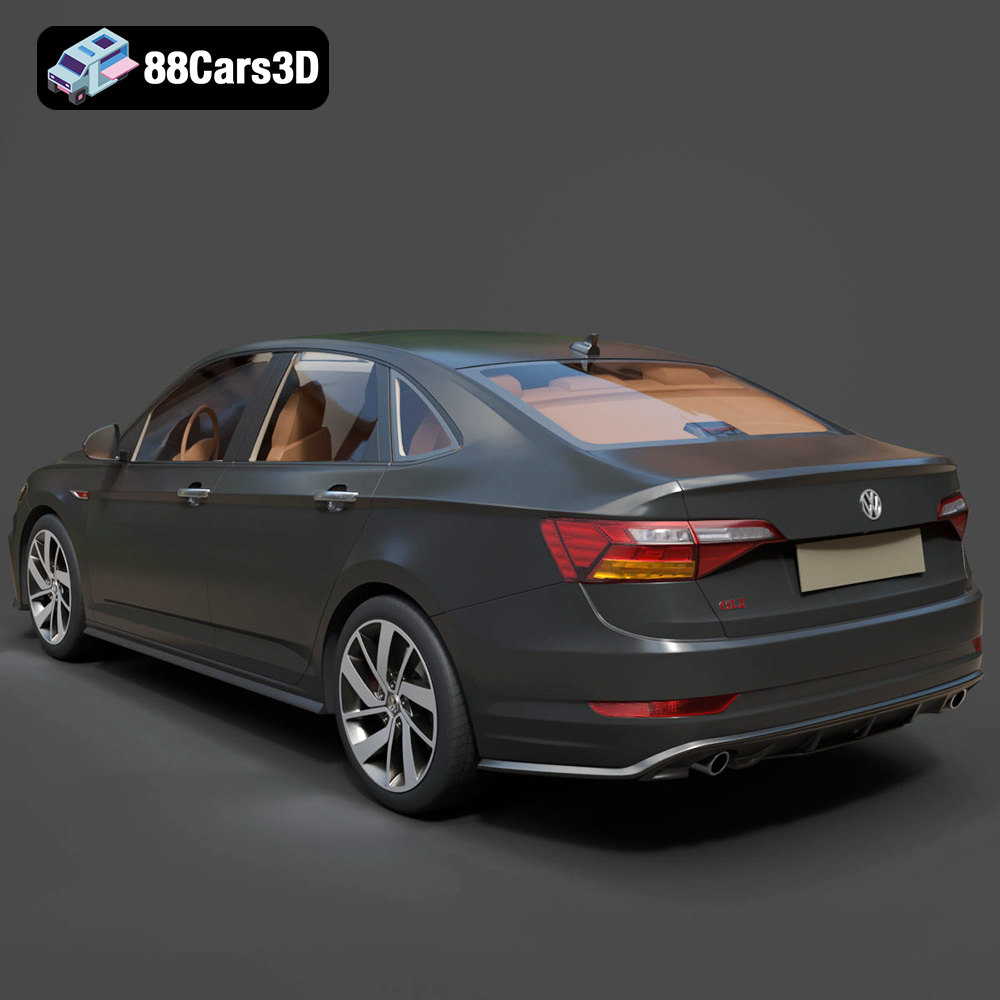
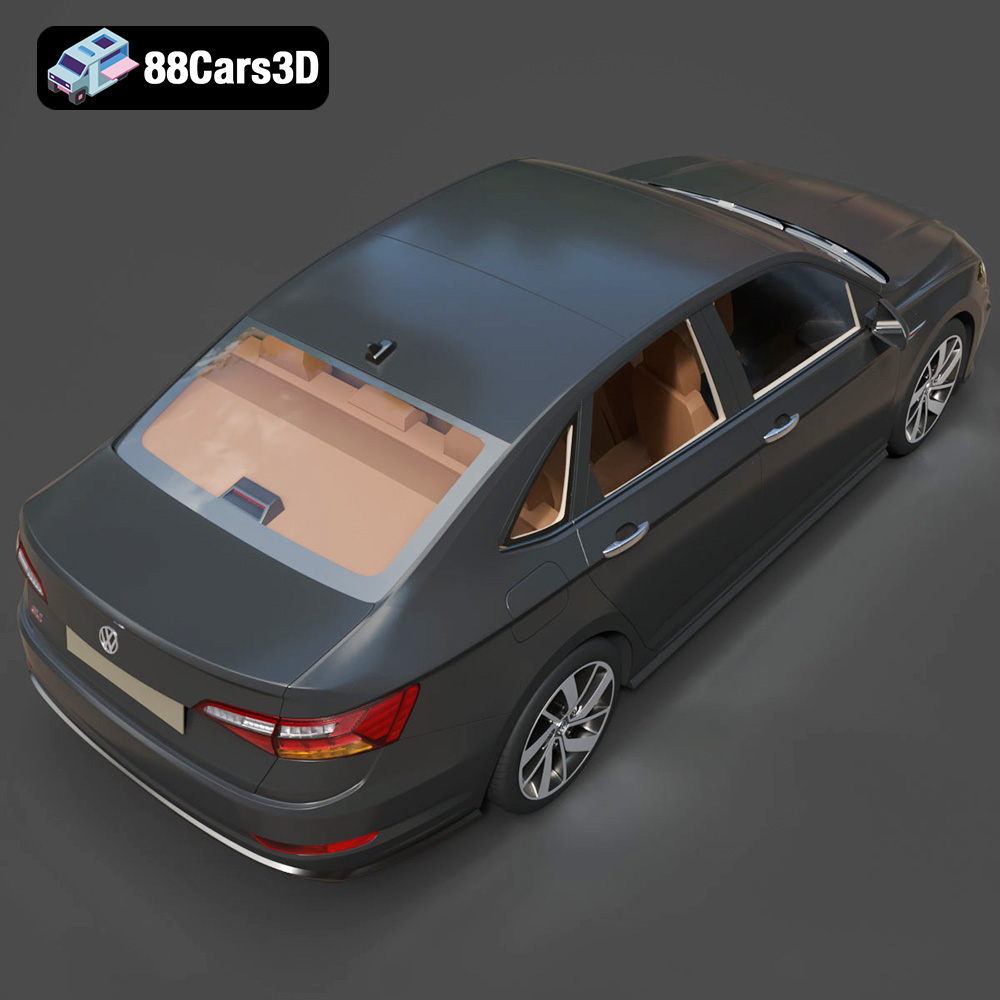
The foundation of any realistic 3D car model lies in its geometric accuracy. Capturing the precise frame geometry, proportions, and intricate design details of a real-world vehicle is paramount. For the Jetta GLI 2019, this means replicating its aggressive honeycomb grille, signature LED headlights, sport-tuned dual exhaust, and the unique contours of its aerodynamic profile. Every curve, panel gap, and ventilation slit must be meticulously modeled to match the original. Advanced modeling techniques, often starting with blueprints or CAD data, are employed to ensure real-world scale accuracy and topological integrity. This attention to detail extends to the interior, with sport seats, a flat-bottom steering wheel, and accurate dashboard instrumentation faithfully recreated, critical for first-person perspectives in games or immersive AR/VR experiences.
Beyond the mesh, it’s the materials and textures that truly breathe life into a 3D model. Physically Based Rendering (PBR) materials are the gold standard, mimicking how light interacts with surfaces in the real world. This involves creating a suite of texture maps – Base Color (Albedo), Metallic, Roughness, Normal, and Ambient Occlusion – that collectively define a surface’s visual properties. For the Jetta GLI 2019, highly detailed PBR materials ensure that paint surfaces reflect light realistically, chrome accents gleam appropriately, tire treads show nuanced grip, and interior fabrics exhibit their true texture. This PBR workflow guarantees consistent and believable rendering across different lighting conditions and rendering engines, from V-Ray in 3ds Max to Unreal Engine’s real-time renderer. The quality of these textures and the precision of their UV unwrapping (how the 2D textures are mapped onto the 3D model) are crucial for close-up shots and maintaining visual integrity.
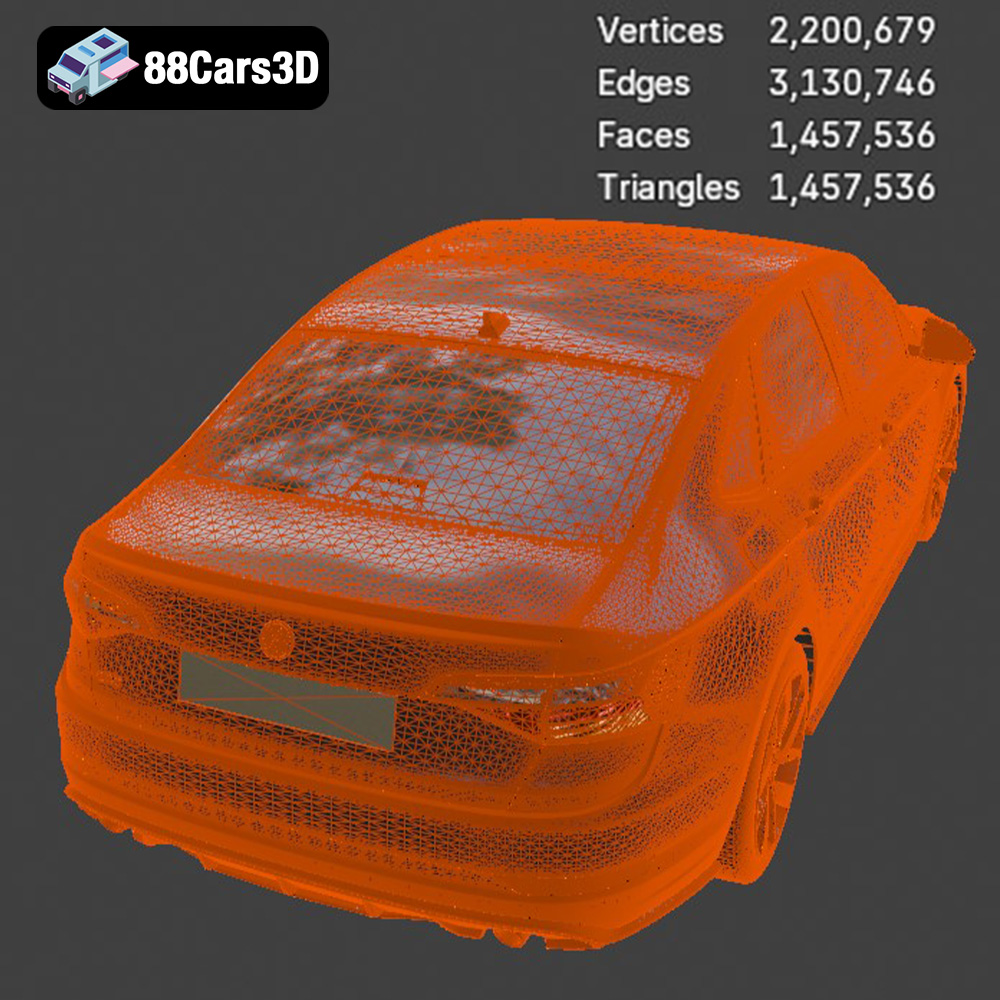
One of the greatest challenges in 3D modeling is balancing visual detail with performance, particularly for real-time applications like games or AR/VR. This balance is often dictated by polygon count. A model that is too dense will cripple performance, while one that is too sparse will lack detail. The Volkswagen Jetta GLI 2019 model strikes an optimal balance with approximately 250,000 triangles. This ‘game-ready’ optimization ensures high-end visual fidelity without compromising real-time frame rates. Techniques like efficient topology, strategic use of normal maps to simulate high-poly details, and carefully crafted Levels of Detail (LODs) are employed to achieve this. For static renders or high-end cinematics, a higher poly count might be acceptable, but for interactive experiences, an optimized model like this is essential. The model’s proper pivot setup for steering, wheel rotation, and suspension travel further enhances its utility for animation and interactive control within game engines.
The true value of a versatile 3D asset like the Volkswagen Jetta GLI 2019 lies in its seamless integration into various professional pipelines. Its multi-format availability and optimized structure make it a cornerstone for diverse creative and technical projects.
For game developers, the Volkswagen Jetta GLI 2019 3D model is a significant asset. Its game-ready optimization, featuring around 250,000 triangles, hits the sweet spot for modern game engines like Unreal Engine and Unity. This polycount allows for impressive visual realism for player-controlled vehicles or high-detail NPCs without bogging down the game’s performance. The model’s separate wheels, suspension, and steering components are crucial for accurate physics simulations and realistic animation. Developers can easily import the .fbx or .unreal format, set up vehicle blueprints in Unreal Engine, define collision meshes, and integrate custom driving mechanics. The highly detailed PBR materials translate perfectly into engine shaders, ensuring consistent visual quality. From intense racing simulators where every detail matters to expansive open-world games where realistic traffic adds immersion, this Jetta GLI model provides a robust foundation, speeding up development cycles and enhancing player experience.
In architectural visualization (ArchViz) and product rendering, realism is paramount. The Jetta GLI 2019 model, with its stunning topological accuracy and high-quality PBR materials, is ideal for bringing life to static scenes. Architects can place the vehicle within their proposed building renders to establish scale, add a sense of lifestyle, or visualize traffic flow in urban environments. Using software like 3ds Max (with the .max file) or Blender (with the .blend file), artists can quickly set up studio lighting, experiment with different camera angles, and render photorealistic images or animations for marketing and client presentations. The ability to easily change body colors and material finishes allows for bespoke customization, matching the car to the project’s aesthetic. For automotive marketing, this model enables agencies to create high-impact visuals, lifestyle scenes, and even interactive online configurators without the need for expensive photoshoots or physical prototypes, saving time and resources.
Augmented Reality (AR) and Virtual Reality (VR) are transforming how we interact with digital content, and 3D car models are at the forefront of this revolution. The Jetta GLI 2019, with its optimized geometry and availability in .glb format, is perfectly suited for immersive AR/VR applications. Imagine a virtual showroom where prospective buyers can walk around the car, inspect its interior in 360 degrees, or even “drive” it in a simulated environment. For mobile AR experiences, the .glb format ensures quick loading times and smooth performance on handheld devices, allowing users to place a virtual Jetta GLI in their driveway or living room. Education and training also benefit, with technicians able to explore detailed engine components or practice maintenance procedures in a safe, interactive virtual space. The model’s real-world scale accuracy further enhances the sense of presence and immersion in these cutting-edge applications.
The utility of a high-quality 3D model extends far beyond digital screens. With advancements in 3D printing technology, physical manifestations of digital assets are more accessible than ever, offering a tangible connection to virtual designs. The Volkswagen Jetta GLI 2019 3D model provides this unique bridge, offering conversion to .stl for hobbyists and professionals alike.
Converting a complex digital model, originally designed for rendering or real-time engines, into a printable format requires careful consideration. The .stl format, while universal for 3D printing, strips away all material and texture information, focusing solely on the object’s geometry represented by triangles. This means that features like the detailed engine block representation or the sport-tuned dual exhaust system must be geometrically robust to be accurately reproduced. Before printing, the model needs to be checked for “manifoldness” – ensuring there are no open edges, inverted normals, or self-intersecting geometry that would confuse a 3D printer. The model should also be scaled appropriately, with recommendations for the Jetta GLI including 1:12, 1:18, or 1:24 scales, allowing for various display sizes from desktop models to larger collector’s pieces. This preparation phase is critical to avoid printing errors and ensure a successful physical output.
The product description for the Jetta GLI 2019 provides specific 3D print settings, which are invaluable for achieving high-quality results. For instance, a layer height of 0.04–0.12 mm is recommended, with resin printing preferred for its ability to capture fine details like the red brake calipers, tire treads, and interior cockpit elements. Resin printers often achieve smoother surfaces and higher resolution compared to filament-based FDM printers, making them ideal for intricate automotive models. Wall thickness is also a crucial factor, with 1.2–2.0 mm suggested to ensure structural integrity without making the model excessively heavy or material-intensive. Supports are explicitly required for complex parts like exhaust systems, mirrors, and potentially even specific elements of the grille, preventing sagging during the printing process. Proper print orientation, such as printing the frame angled and wheels separately, further optimizes print success and minimizes support material. After printing, post-processing steps like sanding, priming, and painting with authentic factory colors and metallic finishes are essential to elevate the physical model to a professional display piece, truly reflecting the digital asset’s fidelity.
One of the significant advantages of working with high-quality 3D car models from resources like 88cars3d.com is the inherent flexibility they offer for customization. The Volkswagen Jetta GLI 2019 3D model is no exception, providing artists and developers extensive options to tailor its appearance and integrate it seamlessly into diverse visual contexts.
The ability to customize the aesthetic elements of a 3D car model is invaluable for matching brand guidelines, personal preferences, or specific project requirements. For the Jetta GLI 2019, this includes straightforward options like changing body and tank colors. Whether replicating authentic factory colors for a marketing campaign or experimenting with custom finishes like matte, gloss, or metallic effects for a unique game skin, the PBR material setup makes these adjustments intuitive within most 3D software. Furthermore, modifying tire textures from street variants to off-road options allows for rapid adaptation to different environmental scenarios, be it an urban street scene or a rally track. These aesthetic tweaks provide immense creative freedom without requiring complex re-modeling, significantly streamlining the design iteration process.
A 3D car model doesn’t exist in a vacuum; its visual impact is heavily influenced by the environment it inhabits. The Jetta GLI 2019 model is designed for seamless adaptation to various lighting and environmental conditions. Artists can adjust materials to react accurately to different light sources, from a sunny outdoor scene with sharp shadows to a moody, artificially lit garage interior. By fine-tuning reflections and specular highlights, the car can appear wet, dusty, freshly waxed, or worn, adding to the realism of the scene. Moreover, the model’s clean topology and optimized UVs simplify the process of applying environmental occlusion or integrating it into global illumination systems, ensuring it looks natural whether it’s parked on a busy street corner in a game or featured in a minimalist studio render. This adaptability ensures that the Jetta GLI 2019 remains a versatile asset, ready for any visual narrative.
The digital realm continues to expand its influence across every industry, and with it, the demand for high-quality 3D assets grows exponentially. As we’ve explored, a meticulously crafted 3D car model like the Volkswagen Jetta GLI 2019 is far more than just a digital replica; it’s a versatile, optimized, and technically sound foundation for innovation. From its game-ready optimization and comprehensive file format support to its suitability for photorealistic rendering, AR/VR experiences, and even tangible 3D prints, this model embodies the pinnacle of modern 3D asset creation.
Whether you’re a game developer seeking realistic vehicles, an architect enhancing visualizations, a marketer creating dynamic campaigns, or a hobbyist aspiring to 3D print a detailed scale model, the Volkswagen Jetta GLI 2019 3D model offers unparalleled flexibility and performance. It saves invaluable development time, ensures consistent visual quality across platforms, and empowers creators to realize their boldest visions.
For those in search of premium 3D car models that combine aesthetic excellence with technical rigor, exploring the curated selection at 88cars3d.com is an essential step. Assets like the Volkswagen Jetta GLI 2019 demonstrate how expert craftsmanship delivers tangible value, propelling projects forward with precision and flair. Invest in quality assets, and elevate your digital creations to new heights.
The Volkswagen Jetta GLI 2019 combines everyday practicality with thrilling performance, standing out as a premier sports sedan in its class. Known for its GTI-borrowed turbocharged engine, aggressive honeycomb grille with iconic red accents, and sleek aerodynamic profile, this vehicle strikes the perfect balance between track-ready styling and modern sophistication. From its distinctive front fascia to the dual exhaust setup, every element of this athletic sedan has been meticulously captured. This meticulously crafted 3D model features game-ready optimization with approximately 250,000 triangles, ensuring high-end visual fidelity without compromising real-time performance in modern engines. With stunning topological accuracy and highly detailed PBR materials, it provides unmatched realism for close-up shots and gameplay alike. Perfect for immersive racing simulators, urban environment open-world games, high-end architectural visualizations, and interactive automotive configurators.
$39.99
.2019
.blend
.fbx
.glb
.max
.obj
.ply
.rendering
.sedan
.stl
.unreal
.volkswagen
car-3d-model
game asset
game-ready
jetta-gli
low-poly
optimized
sports-sedan
VR/AR