Get 20% OFF All Premium 3D & STL Models!

In the dynamic worlds of game development, cinematic visualization, and immersive simulations, the demand for high-fidelity, optimized 3D assets is unwavering. From the sleek curves of advanced 3D car models to the rugged utility of military hardware, artists and developers constantly seek resources that blend intricate detail with technical efficiency. Today, we’re taking an in-depth look at an asset that perfectly embodies this blend: the Mil Mi-8MT Helicopter 3D Model. This iconic rotorcraft, known globally for its versatility and robustness in real-world scenarios, translates into a digital masterpiece, ready to elevate any project it becomes a part of.
The Mil Mi-8MT is more than just a transport helicopter; it’s a symbol of Soviet-era engineering prowess, widely deployed in both military and civilian capacities. Its distinctive profile, powerful twin-turbine engines, and formidable presence make it a compelling subject for 3D artists. The 88cars3d.com marketplace proudly offers a meticulously crafted 3D rendition of this legendary machine, designed from the ground up to meet the rigorous demands of professional production pipelines. Whether you’re building a realistic combat simulator, rendering a cinematic historical scene, or developing an interactive AR experience, this model provides the foundational quality and flexibility you need.
This article will delve into the technical specifications, artistic details, and diverse applications of the Mil Mi-8MT Helicopter 3D Model. We’ll explore its optimization for real-time engines, its potential in high-end rendering, and how its various file formats unlock possibilities across multiple software ecosystems. Join us as we uncover how this exceptional asset can streamline your workflow and bring unparalleled realism to your next digital endeavor.
The world of 3D modeling is rich with various file formats, each serving specific purposes and catering to different stages of a production pipeline. The choice of format can significantly impact compatibility, performance, and the ease of integration into your chosen software. The Mil Mi-8MT Helicopter 3D Model comes equipped with an extensive suite of formats, ensuring maximum flexibility for any professional workflow. Let’s break down these crucial file types:
The .blend file is Blender’s native format, preserving an entire scene with all its data. This includes the mesh geometry, materials, textures, lighting, camera setups, animations, modifiers, and even the software’s UI layout. For artists working primarily in Blender, this format offers the most comprehensive and editable version of the model. You can dive directly into the scene, modify topology, adjust PBR materials with full node control, re-rig components, or extend the model with additional details. It’s the ideal starting point for deep customization and iteration within the Blender ecosystem, making it invaluable for both individual artists and studios leveraging this powerful open-source platform.
.fbx (Filmbox) is arguably the most widely adopted 3D interchange format, particularly in game development and animation. Developed by Autodesk, it excels at transferring 3D model data, including geometry, materials, textures, skeletal animations, and blend shapes, between different software packages like Maya, 3ds Max, Blender, Unreal Engine, and Unity. Its robust support for animation data makes it indispensable for bringing rigged models into real-time environments or complex cinematic pipelines. For the Mil Mi-8MT model, the .fbx version is perfectly suited for direct import into Unreal or Unity, ensuring pivots are correct, and materials are prepared for PBR workflows, offering a streamlined path to a game-ready asset.
The .obj (Wavefront Object) format is a universal standard for storing 3D geometry. While it doesn’t typically store animation or advanced material properties, it’s incredibly reliable for transferring pure mesh data, UV mapping information, and references to external material files (.mtl). Its simplicity and widespread support make it an excellent choice for cross-software compatibility. If you need to import the Mi-8MT model into less common 3D applications, CAD software, or older rendering engines, .obj provides a clean, dependable mesh. It’s often used as a fallback or for simple mesh manipulation before re-exporting to a more feature-rich format.
.glb (GL Transmission Format Binary) is the binary version of glTF, a modern, royalty-free specification for 3D scenes and models. It’s designed for efficient transmission and loading of 3D models in web applications, augmented reality (AR), and virtual reality (VR) environments. A .glb file packages all necessary data—geometry, materials, textures, and even animations—into a single, compact file. This optimization makes it perfect for the Mil Mi-8MT model when deploying to mobile AR apps, browser-based configurators, or lightweight VR experiences, where performance and quick loading times are paramount.
The .stl (Stereolithography) format is the de facto standard for 3D printing. It describes only the surface geometry of a 3D object using a mesh of triangular facets. While it doesn’t contain color or texture information, its simplicity ensures near-universal compatibility with 3D printers and slicing software. The Mil Mi-8MT model, when converted to .stl, can be precisely prepared for physical fabrication, allowing hobbyists and professionals to create tangible replicas. Detailed print settings, such as recommended scales and support structures, are crucial for achieving a successful print, as outlined in the product’s description.
The .ply (Polygon File Format, or Stanford Triangle Format) is a versatile format for storing 3D data, particularly useful for scanned data and models requiring high precision. It can store not just geometry, but also properties like color, transparency, surface normals, and even texture coordinates for each vertex or face. While less common for general animation, .ply is a robust choice when the Mil Mi-8MT model might be used in scientific visualization, reverse engineering, or specific CAD applications where detailed mesh data with additional per-vertex information is beneficial.
The inclusion of an .unreal file (or a package ready for Unreal Engine) signifies an asset specifically prepared and optimized for Epic Games’ Unreal Engine. This often means the model comes with pre-configured materials, textures, collision meshes, LODs (Levels of Detail), and proper pivot points, ensuring a seamless drag-and-drop experience into an Unreal project. For the Mil Mi-8MT, this means you can expect a nearly ready-to-use asset, saving significant time on setup and configuration, allowing you to focus immediately on integration and creative deployment within your game or simulation.
Similar to .blend for Blender, the .max file is the native format for Autodesk 3ds Max. It stores the complete 3ds Max scene, including geometry, materials (with all their specific node setups and modifiers), lighting, cameras, animation data, and rendering settings. For users of 3ds Max, this format provides the highest level of editability and control over the Mi-8MT model. It’s perfect for complex animation setups, high-fidelity V-Ray or Corona renders, or further modeling refinements within a robust studio environment. This format is essential for animators and architectural visualization specialists who rely on 3ds Max for their primary workflow.
The comprehensive array of file formats provided with the Mil Mi-8MT Helicopter 3D Model underscores its versatility, ensuring that it can be effectively utilized by professionals across diverse disciplines, from game development and architectural visualization to AR/VR and 3D printing.
Creating a truly professional 3D asset requires a delicate balance between visual fidelity and technical efficiency. The Mil Mi-8MT Helicopter 3D Model exemplifies this principle, delivering a highly detailed representation of the iconic rotorcraft while maintaining game-ready optimization. This makes it an ideal choice for projects where both stunning visuals and smooth performance are critical.
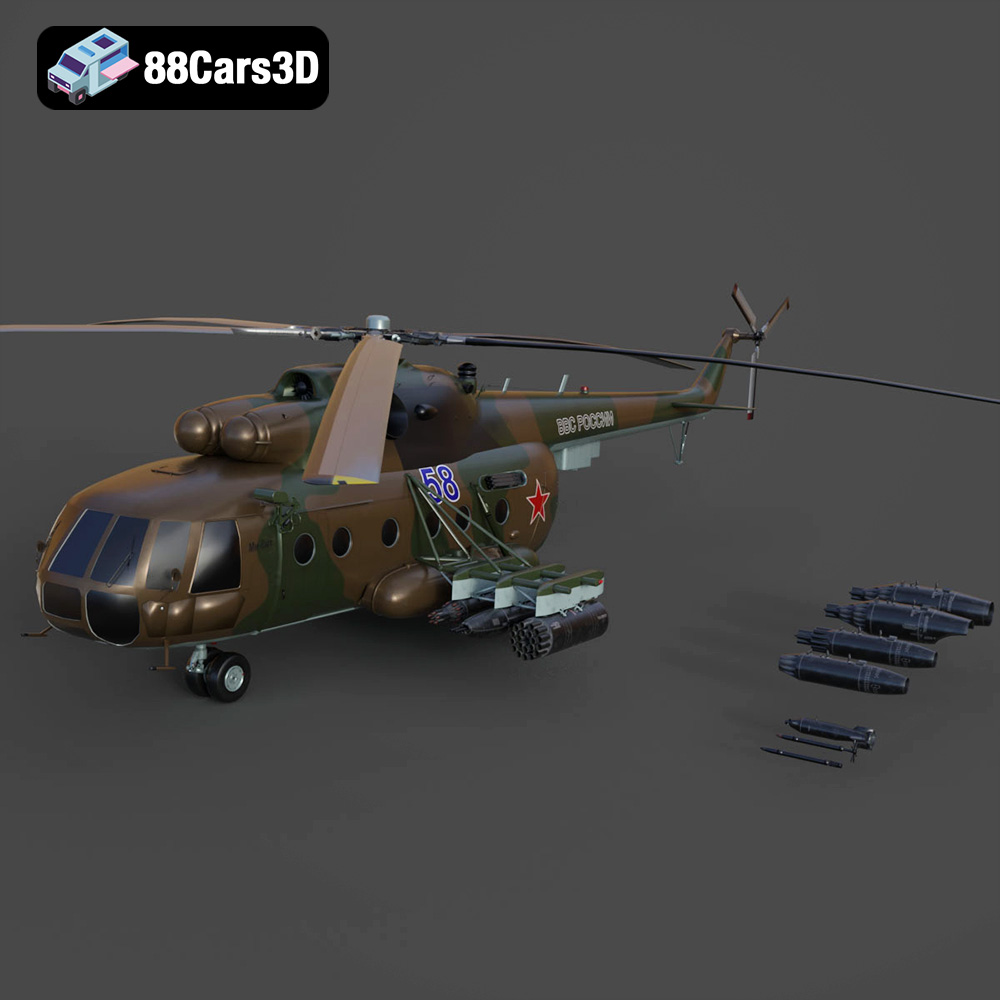
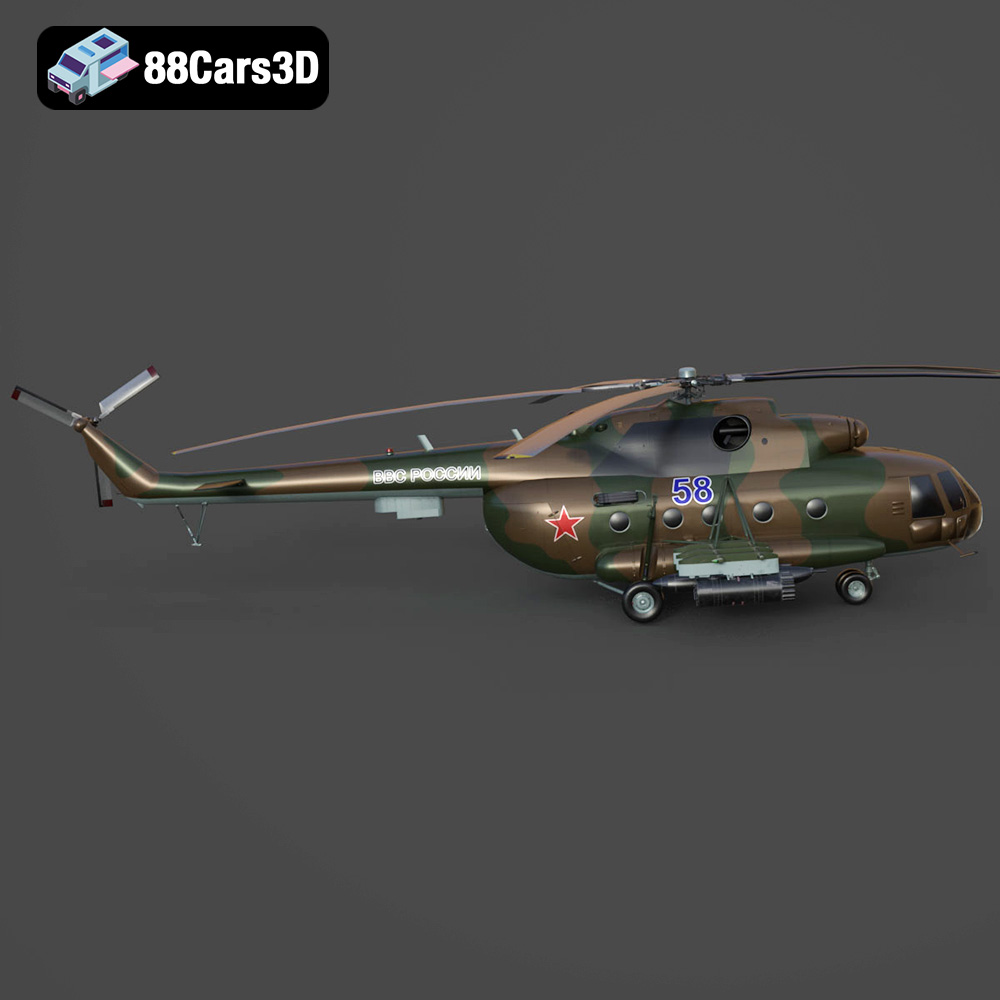
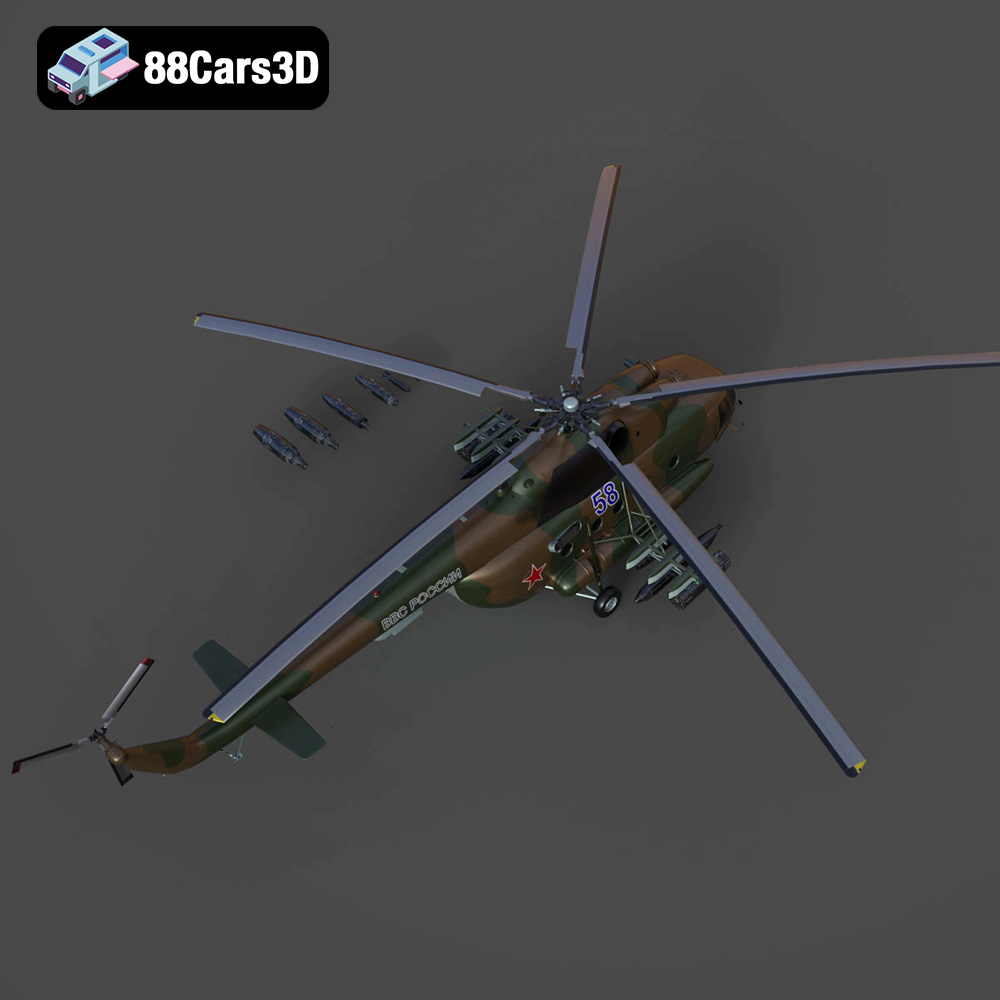
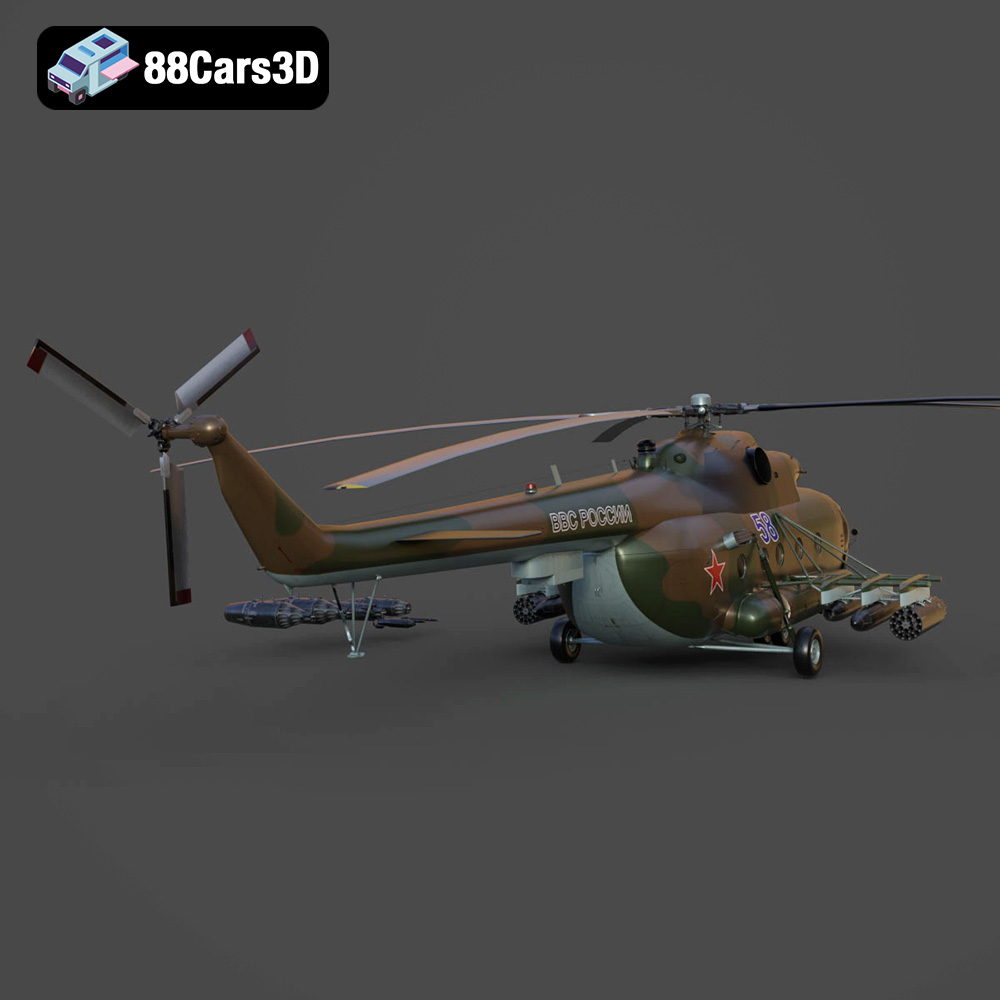
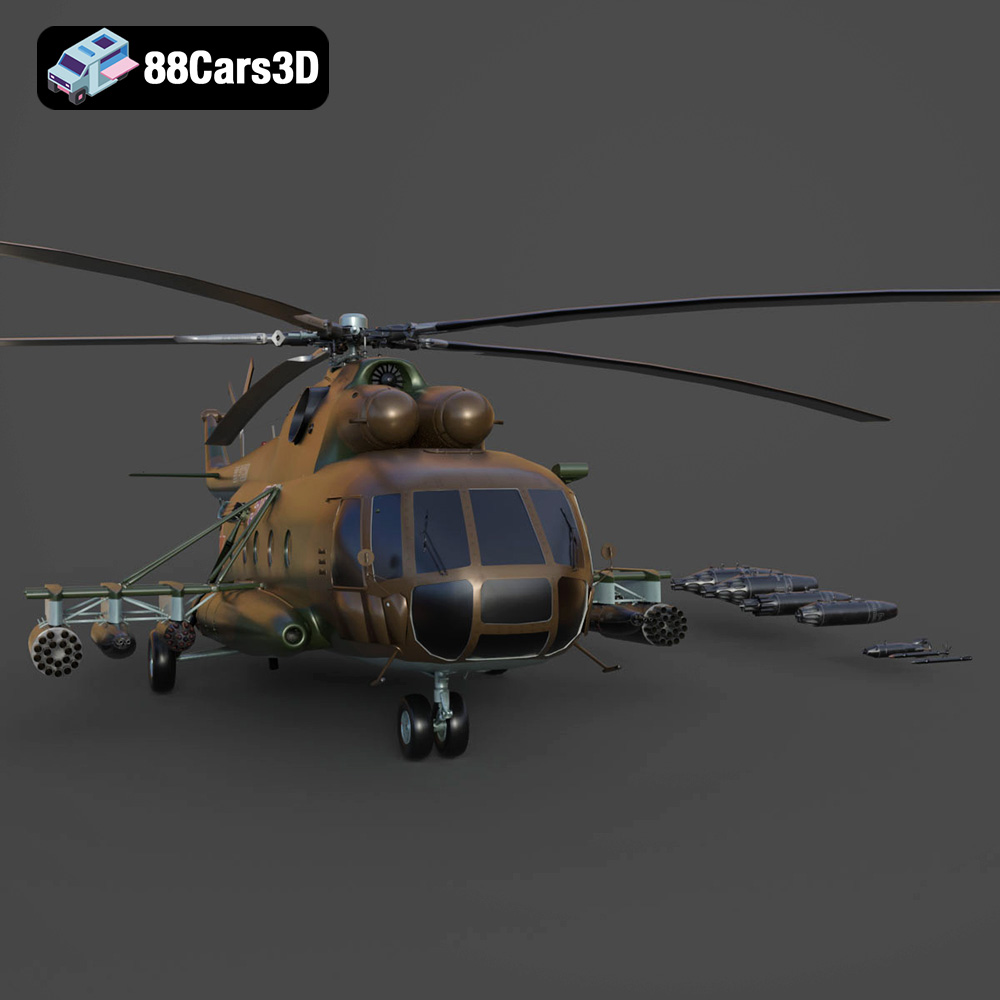
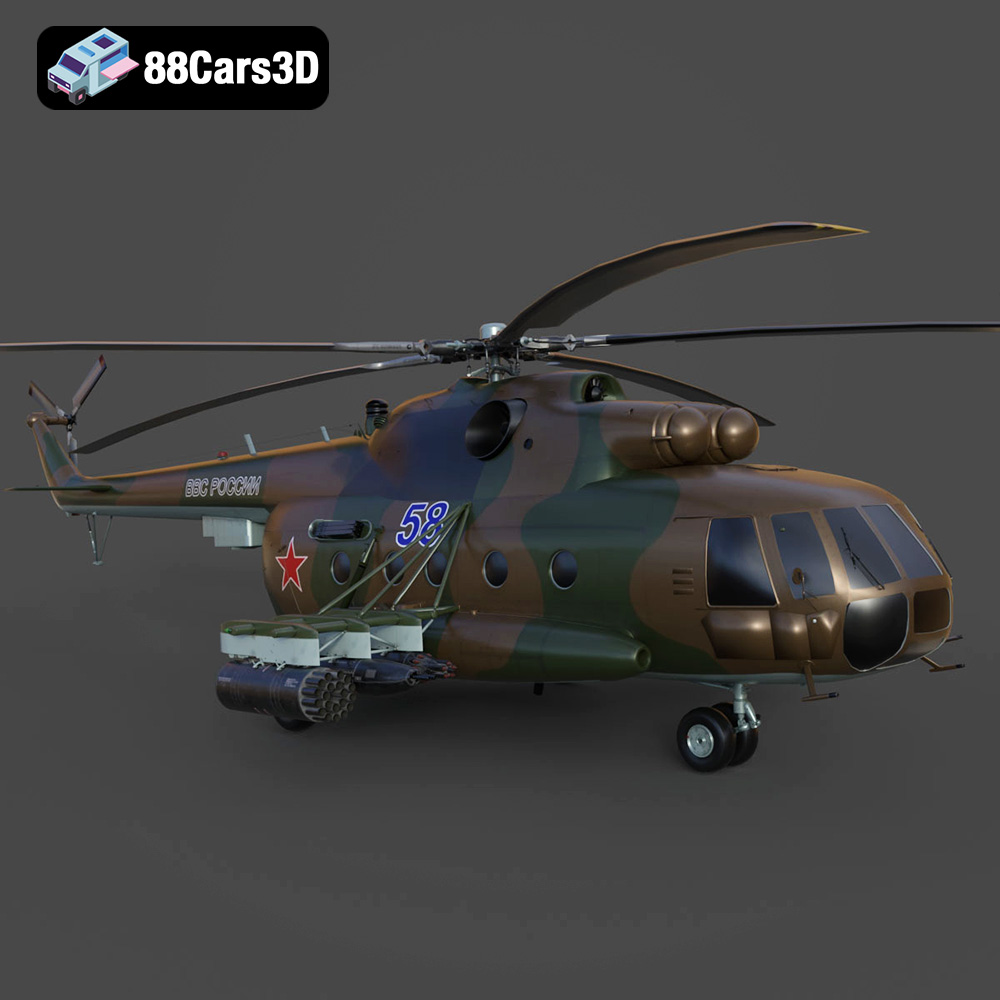
The exterior of this 3D model is a testament to meticulous craftsmanship. It accurately captures the distinctive lines and robust architecture of the Mil Mi-8MT. From the accurate fuselage geometry and proportions, faithfully reproduced from real-world blueprints, to the intricate details of the TV3-117MT turboshaft engine housings, every element has been carefully considered. The model features precise exhaust deflectors, ventilation grids, authentic navigation lights, and exterior landing beacons, all contributing to a lifelike appearance. Furthermore, the landing gear is accurately modeled with detailed tires and realistic strut compression, making it suitable for dynamic animations and close-up renders. The five-blade main rotor and three-blade tail rotor assemblies are also precisely detailed, with separate components for seamless animation and realistic physics simulations.
Beyond its impressive exterior, the Mil Mi-8MT 3D model offers a surprisingly rich interior, especially within the cockpit. Designed with first-person perspective in mind for gaming, the cockpit features detailed pilot and co-pilot seating complete with authentic harnesses. The flight control systems, including the cyclic, collective, and anti-torque pedals, are accurately represented, providing a believable environment for virtual pilots. The analog instrument cluster and overhead panels are meticulously mapped, showcasing detailed switches, levers, and avionics bays. This attention to interior detail is crucial for flight simulators and immersive VR experiences where the user will be spending significant time inside the aircraft, enhancing immersion and realism.
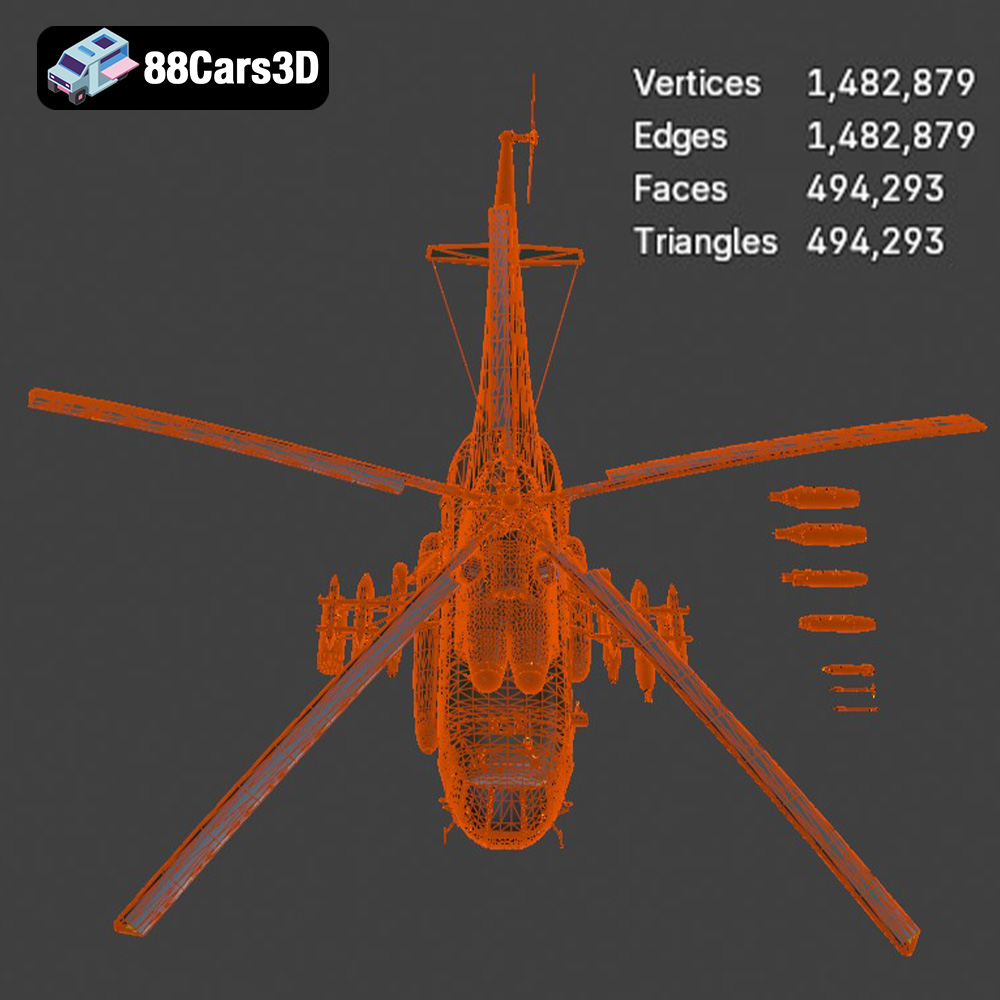
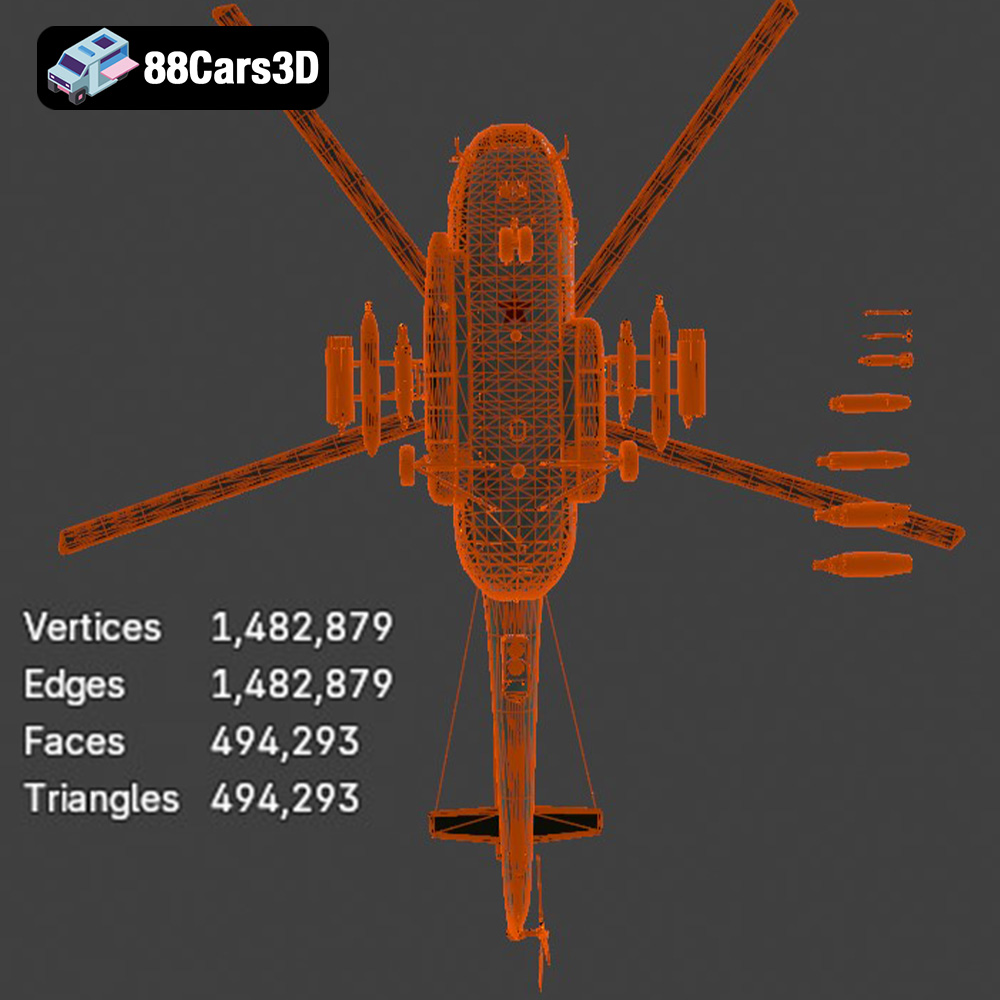
Underpinning the visual quality are solid technical specifications. The Mil Mi-8MT 3D Model boasts a balanced ~120,000 triangle count. This figure is critical for game developers, as it strikes a perfect balance: low enough for real-time engines like Unreal and Unity to render efficiently without performance bottlenecks, yet high enough to retain the high-end visual realism expected in modern titles. The model is built to real-world scale accuracy, ensuring it fits seamlessly into environments designed with precise measurements. Crucially, proper pivot setups are established for all animated components – main and tail rotor rotation, door hinges, and suspension travel – simplifying rigging and animation workflows. This level of optimization and preparation means less work for the developer and more time for creative deployment, making it a truly game-ready and production-ready asset from 88cars3d.com.
The core strength of the Mil Mi-8MT Helicopter 3D Model lies in its exceptional suitability for real-time applications, particularly in game development. Its optimized geometry and comprehensive file format support make it a powerful tool for creating immersive and high-performance interactive experiences.
For game developers, the inclusion of .fbx and dedicated .unreal files is a significant advantage. Importing the Mil Mi-8MT model into Unreal Engine or Unity is designed to be a smooth process. With .fbx, artists can expect correct scale, pivot points, and UV mapping to be preserved. Materials, often exported as basic placeholders, can then be quickly upgraded using PBR (Physically Based Rendering) texture sets within the engine’s material editor. The dedicated .unreal format goes a step further, potentially providing a fully configured asset with materials, textures, and even basic collision meshes already set up, significantly reducing integration time. This allows developers to drop the helicopter into their open-world games, combat flight simulators, or tactical shooters almost immediately, focusing on gameplay mechanics and environmental design rather than asset preparation.
The ~120,000 triangle count is a sweet spot for modern game development. While not “low-poly” in the traditional sense, it’s highly optimized for detailed real-time rendering. For demanding scenarios or large-scale environments, developers might still implement Level of Detail (LOD) systems. This involves creating simplified versions of the model that automatically swap in at greater distances from the camera, further boosting performance. The clean topology of the Mil Mi-8MT model facilitates this process, making it easy to generate lower-poly LODs without visual glitches. Proper pivot setups for rotors and doors also streamline the creation of in-game animations, from startup sequences to damage effects, ensuring dynamic realism without extensive manual rigging efforts.
While the product description highlights the model’s geometry, a game-ready asset implicitly suggests it’s designed to accept PBR textures. This means artists can apply high-resolution texture maps for albedo (color), normal (surface detail), roughness (specularity), metallic (reflectivity), and ambient occlusion. These textures, when combined with engine-specific material setups, allow for incredibly realistic material rendering – from the dull, weathered paint of a military workhorse to the subtle reflections on its glass surfaces. Customization options, such as changing fuselage livery or adjusting wear and tear, are primarily achieved through these texture sets, giving developers immense creative control over the helicopter’s appearance to fit various in-game scenarios.
While the Mil Mi-8MT Helicopter 3D Model is game-ready, its exceptional detail and clean topology make it equally suitable for high-fidelity offline rendering and cinematic visualization. For projects demanding photorealistic stills or breathtaking animations, this model provides an excellent foundation.
The inclusion of .max and .blend native files unlocks the full potential of the model for high-end rendering in Autodesk 3ds Max and Blender. In 3ds Max, artists can leverage powerful renderers like V-Ray or Corona Renderer. The clean quad-based topology of the Mi-8MT makes it easy to apply subdivision surfaces (e.g., Turbosmooth modifier) for even smoother, more detailed renders, though the base mesh is already excellent. Materials can be completely re-created using complex shader networks, incorporating advanced PBR maps, procedural textures, and detailed layered materials to simulate dirt, grime, and wear with incredible realism. Lighting can be precisely controlled with advanced HDRI (High Dynamic Range Image) environments, physically accurate light sources, and volumetric effects to create dramatic military campaign art, atmospheric flyovers, or studio-lit product renders.
Similarly, Blender users can harness Cycles or Eevee (for real-time PBR preview) to achieve stunning results. The .blend file provides the artist with full access to the model’s structure, allowing for complete material overhauls, the addition of intricate decals, and the setup of complex node-based materials. Features like micro-displacement can be utilized to add minute surface imperfections, making the helicopter appear even more tangible. The flexibility offered by these native formats ensures that the Mil Mi-8MT model can be pushed to its absolute visual limit for cinematic sequences, advertising, or high-resolution imagery.
Achieving photorealism extends beyond just a detailed mesh; it heavily relies on sophisticated material and lighting setups. For the Mil Mi-8MT, artists can experiment with various material finishes – from the matte, anti-reflective paint typical of military aircraft to subtly glossy or metallic elements on engine components. Leveraging texture maps for color variation, specular control, and micro-surface details is paramount. For example, a battle-damaged aesthetic would involve painting chipped paint, rust, and oil streaks onto the texture maps, which then react realistically to light. Lighting plays an equally crucial role. Whether simulating harsh daylight on a desert landing strip or the subtle glint of moonlight during a night operation, carefully placed lights, combined with atmospheric effects, can dramatically alter the mood and realism of a render. The model’s accurate proportions and detail ensure that these lighting scenarios interact credibly with its surfaces, enhancing the overall visual impact.
After rendering, the work often moves into post-production and compositing software like Adobe Photoshop, Nuke, or After Effects. Here, the rendered images of the Mil Mi-8MT can be further enhanced with color grading, depth of field effects, lens flares, and integration into photographic backplates or live-action footage. Multi-pass rendering, where different elements like diffuse, specular, reflections, and alpha channels are rendered separately, provides maximum flexibility during this stage. The high quality of the initial 3D render ensures that the model holds up under intense scrutiny and can be seamlessly integrated into complex composite shots, making it invaluable for film, television, and high-end advertising projects.
The versatility of the Mil Mi-8MT Helicopter 3D Model extends far beyond traditional screens, opening doors to immersive AR/VR experiences and even tangible physical reproductions through 3D printing.
Augmented Reality (AR) and Virtual Reality (VR) represent the forefront of immersive digital experiences. The Mi-8MT model, with its optimized polycount and detailed interior, is an excellent candidate for these platforms. For AR, the compact and efficient .glb format is ideal. This single-file solution allows for quick loading on mobile devices, enabling users to place a virtual Mil Mi-8MT into their real-world environment via their smartphone or tablet. Imagine a historical aviation app where users can walk around a life-size Mi-8MT in their backyard, examining its detailed features up close.
In VR, the model shines in training simulations, virtual hangars, or interactive historical tours. Its optimized geometry ensures smooth frame rates, critical for preventing motion sickness in VR. The detailed cockpit, with accurately mapped instruments, provides an authentic environment for virtual flight training. Developers can build scenarios where users interact with the helicopter’s controls, learn about its systems, or even participate in simulated missions. The model’s real-world scale accuracy further enhances the sense of presence in these virtual environments, making for truly compelling and educational experiences.
For hobbyists, collectors, and educators, the ability to physically hold a detailed replica of the Mil Mi-8MT is a unique offering. The inclusion of the .stl format, coupled with specific 3D print settings, transforms the digital asset into a tangible object. The recommended scales (1:35, 1:48, 1:72) cater to common modeling preferences, allowing for desk display pieces or components for larger dioramas. Resin printing is specifically recommended for its ability to capture the fine details of the helicopter’s airframe, rotors, and intricate components, ensuring a high-quality physical output.
The provided print settings are crucial for success: layer heights of 0.04–0.12 mm for detail, wall thickness of 1.2–2.0 mm for structural integrity, and 20–30% infill for a balance of strength and material usage. Critical advice includes the necessity of supports for delicate parts like rotors and antennas, and print orientation (e.g., fuselage angled) to maximize strength. Post-processing, including sanding and priming, is key to preparing the model for authentic military camouflage or civilian livery finishes, turning a printed object into a true scale model. This blend of digital precision and physical craftsmanship makes the Mi-8MT 3D Model a standout asset for versatile applications.
Purchasing a high-quality 3D model like the Mil Mi-8MT from 88cars3d.com is not just about acquiring an asset; it’s an investment in a versatile foundation that can be adapted and evolved for countless projects. The model’s design inherently supports extensive customization, ensuring its long-term utility.
The detailed and well-structured nature of the Mil Mi-8MT model provides a robust canvas for creative expression. One of the most immediate customization options is altering the fuselage livery. Imagine the helicopter in authentic military camouflage for a combat simulation, pristine UN white for a humanitarian aid scenario, or a vibrant civilian transport paint scheme for a rescue operation game. These changes are typically achieved through texture map modifications, allowing artists to create a diverse fleet from a single base model. Furthermore, the ability to modify texture wear and tear is crucial for realism. Whether you need a battle-damaged, weathered veteran of countless missions, or a factory-fresh machine straight off the assembly line, these effects can be painted onto texture maps, adding layers of storytelling to your visuals.
Beyond livery and wear, adjusting material finishes provides subtle yet impactful customization. Shifting from a matte military paint to a semi-gloss or even metallic finish can drastically change the helicopter’s perceived age, environment, and purpose. The model’s clean UV mapping and high-quality base mesh make these texture-based customizations straightforward and effective, ensuring that every iteration maintains visual integrity. For advanced users, separating parts like doors and rotors allows for custom rigging and animation, such as opening cargo bays or implementing dynamic rotor blur effects, further extending the model’s functionality.
Investing in a meticulously crafted asset like the Mil Mi-8MT from 88cars3d.com offers significant future-proofing advantages. Its optimized geometry and clean topology ensure compatibility with current-generation game engines and rendering software, and it’s well-positioned for future advancements. As real-time technology evolves, demanding more detail while maintaining performance, this model’s balanced polycount means it won’t become obsolete quickly. Its modular components, such as separate rotor heads, doors, and landing gear, facilitate easy integration into complex animation systems or destruction physics simulations. Should you need to add more detail in the future, its clean base mesh is suitable for subdivision or sculpt-based detailing workflows.
The comprehensive range of included file formats (.blend, .fbx, .obj, .glb, .stl, .ply, .unreal, .max) is a critical aspect of its future-proofing. This ensures that regardless of how your software ecosystem or project requirements evolve, you’ll always have a compatible version of the model. This eliminates the need to repurchase or extensively re-prepare the asset for different pipelines, saving both time and resources in the long run. By choosing a versatile, high-quality asset from 88cars3d.com, you are not just buying a 3D model; you are acquiring a flexible and enduring component for your creative toolkit.
The Mil Mi-8MT Helicopter 3D Model stands as a prime example of what a truly versatile and high-quality digital asset should be. It successfully bridges the gap between intricate, realistic detail and the technical optimization required for modern production pipelines. From its authentic exterior geometry and detailed cockpit to its game-ready ~120,000 triangle count, every aspect of this model has been engineered for professional use.
Whether your project demands the high performance of real-time game engines like Unreal and Unity, the visual fidelity of cinematic rendering in 3ds Max or Blender, the immersive possibilities of AR/VR, or the tangible output of 3D printing, this model is equipped to deliver. The extensive range of included file formats – .blend, .fbx, .obj, .glb, .stl, .ply, .unreal, and .max – ensures unparalleled compatibility and flexibility, making it a valuable addition to any artist’s or developer’s toolkit. Furthermore, its inherent customizability allows for diverse applications, from varied liveries and material finishes to adapting it for specific narrative needs.
In a landscape where time is precious and quality is paramount, investing in a robust asset like the Mil Mi-8MT Helicopter 3D Model from 88cars3d.com is a smart strategic move. It empowers creators to focus on their vision, confident that their foundational assets are technically sound and visually stunning. Explore this exceptional model today and elevate your next project to new heights of realism and immersion.
The Mil Mi-8MT is a legendary medium twin-turbine transport helicopter, renowned for its ruggedness, versatility, and widespread military and civilian use across the globe. This iconic rotorcraft features distinctive top-mounted TV3-117MT turboshaft engines, a robust airframe, an intricate exhaust system, and its recognizable five-blade main rotor. This high-quality 3D model boasts exceptional topological flow and a balanced ~120,000 triangle count, ensuring game-ready optimization without sacrificing visual fidelity. Engineered for diverse real-time and offline applications, it is built to deliver top-tier performance for game development, AR/VR simulations, animation, and high-end cinematic visualization.
$39.99
.blend
.fbx
.glb
.helicopter
.max
.obj
.ply
.rendering
.stl
.unreal
game asset
game-ready
helicopter-3d-model
low-poly
mi-8mt
mil
military-helicopter
optimized
transport-helicopter
VR/AR