Get 20% OFF All Premium 3D & STL Models!

In the high-octane world of automotive design, game development, and cinematic rendering, precision and performance are paramount. Enthusiasts and professionals alike are constantly seeking the perfect fusion of aesthetic fidelity and technical optimization. Few vehicles embody this spirit quite like the Porsche 718 Cayman GT4. A mid-engine track weapon known for its naturally aspirated 4.0-liter flat-six engine, aggressive aerodynamics, and unmistakable Porsche styling, the GT4 delivers a pure, unfiltered driving experience that resonates deeply with car lovers.
Translating such a revered machine into a high-fidelity digital asset requires meticulous attention to detail and a deep understanding of 3D modeling principles. Whether you’re a game developer crafting the next-generation racing simulator, an architect visualizing a lifestyle scene, an AR/VR innovator building immersive showrooms, or an animator producing breathtaking cinematic sequences, the quality of your 3D car models directly impacts the final product. This is where a truly exceptional asset, like the Porsche 718 Cayman GT4 2020 3D Model available on 88cars3d.com, becomes an invaluable tool. It’s not just a model; it’s a foundational element designed to elevate your projects to new levels of realism and performance.
Navigating the diverse landscape of 3D software and engines requires a thorough understanding of various file formats. Each format serves specific purposes, offering unique advantages for different stages of the 3D pipeline, from initial modeling to final deployment. The Porsche 718 Cayman GT4 2020 3D Model, for instance, provides a comprehensive suite of formats, ensuring maximum compatibility and utility across professional workflows. Let’s delve into the technical nuances of these essential file types.
The .blend format is the native file type for Blender, a powerful open-source 3D creation suite. When you download the GT4 model in .blend format, you gain access to a fully editable Blender scene. This means not only the mesh data but also all materials, textures, lighting setups, camera positions, and even animation data (if present) are preserved within a single file. For artists working primarily in Blender, this offers unparalleled flexibility for customization, rigging, animation, or integration into existing Blender projects. It’s ideal for those who want to dive deep into the model’s structure and make significant modifications or render directly within Blender’s Eevee or Cycles engines.
.fbx (Filmbox) is arguably the most widely adopted interchange format in the 3D industry, particularly favored for game development and animation pipelines. Developed by Autodesk, FBX excels at preserving a wide range of data, including geometry, materials, textures, skinning, bones, and animation. Its robust nature makes it the go-to choice for transferring assets between different applications like Maya, 3ds Max, Blender, and crucially, game engines such as Unreal Engine and Unity. For the Porsche 718 Cayman GT4, the .fbx file ensures that the optimized mesh, proper pivot setups, and material assignments translate seamlessly, making it ideal for immediate integration into real-time environments.
The .obj (Wavefront OBJ) format is a venerable and universally supported file type primarily known for its ability to store 3D geometry data—vertices, normals, texture coordinates, and faces. While it doesn’t typically store advanced features like animation or rigging, it is incredibly reliable for transferring pure mesh information between almost any 3D software. Its simplicity ensures broad compatibility, making it an excellent fallback or starting point for projects where only the geometric structure of the GT4 model is needed, perhaps for retopology, sculpting, or import into less common 3D applications.
.glb (GL Transmission Format Binary) is an increasingly important format, especially in the realms of Augmented Reality (AR), Virtual Reality (VR), and browser-based 3D applications. It’s the binary version of glTF, designed for efficient transmission and loading of 3D scenes and models. A single .glb file can contain the model’s geometry, materials, textures, and animation in a compact, self-contained package. For the GT4 model, this means it’s perfectly optimized for embedding directly into websites, mobile AR experiences, or virtual showrooms, delivering rich 3D visuals with minimal load times.
The .stl (Stereolithography) format is the undisputed standard for 3D printing. It represents a 3D model as a collection of unconnected triangles (facets) that define its surface geometry. While it doesn’t contain color or texture information, its simplicity makes it universally compatible with 3D printers and slicing software. The GT4 model in .stl format allows hobbyists and professionals to physically manifest the digital design, creating display-scale replicas or prototypes with ease, provided recommended print settings are followed for optimal results.
.ply (Polygon File Format) is often used in applications requiring high-precision mesh data, such as CAD (Computer-Aided Design), 3D scanning, and scientific visualization. It can store a wider range of data than OBJ, including color per vertex, normal information, and other properties. While less common for typical asset pipelines, its inclusion ensures that the GT4 model can be used in specialized engineering or analytical software where detailed geometric and property information is crucial for simulations or precise measurements.
The .unreal format, or more accurately, assets pre-prepared and organized for direct import into Unreal Engine, signifies a significant time-saver for developers. This isn’t a single file type but rather a collection of assets (like .fbx, textures, material instances) configured and potentially packaged in a way that minimizes setup time within the Unreal Editor. For the GT4 model, this means materials are likely pre-assigned, texture maps correctly linked, and potentially even LODs (Levels of Detail) or collision meshes are ready to go, accelerating deployment into a high-fidelity real-time environment like a racing game or architectural visualization.
Finally, the .max format is the native file type for Autodesk 3ds Max, another cornerstone of 3D modeling, animation, and rendering. Similar to .blend, a .max file preserves the entire scene, including geometry, materials, textures, lights, cameras, and animation data. For professionals entrenched in the 3ds Max ecosystem, this provides a fully editable project file, allowing for advanced rendering with V-Ray or Corona, complex animation sequences, or integration into large-scale visualization projects that leverage 3ds Max’s robust toolset.
The availability of such a diverse array of formats for the Porsche 718 Cayman GT4 2020 3D Model underscores its versatility, ensuring that regardless of your preferred software or project requirements, you have the right tool for the job. This thoughtful inclusion of formats significantly enhances the value proposition of 3D car models from 88cars3d.com, making them truly professional-grade assets.
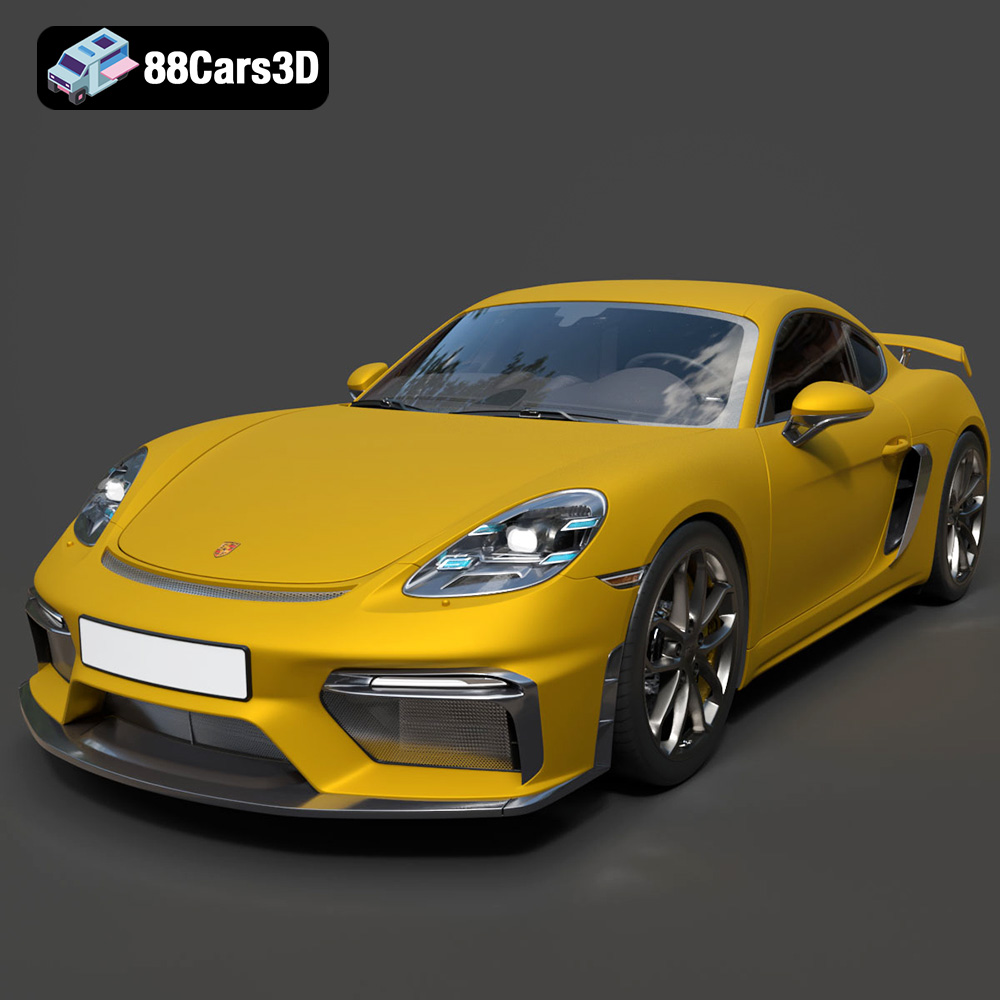
At the heart of any compelling 3D project lies the quality of its assets. The Porsche 718 Cayman GT4 2020 3D Model is engineered to meet the stringent demands of professional production, offering an exquisite balance of visual fidelity and technical optimization. Every curve, vent, and panel has been meticulously recreated to ensure an authentic digital representation of this iconic sports car.
The exterior of the GT4 model is a testament to precision modeling. It features accurate Porsche 718 Cayman GT4 frame geometry, body panels, and proportions that capture the car’s aggressive stance and aerodynamic purpose. From the detailed front fascia with its large cooling intakes and aerodynamic front spoiler to the dual-pipe sport exhaust system integrated into the aggressive rear diffuser, no detail has been overlooked. Signature Porsche four-point LED headlights and tinted 3D taillights add to the realism, while precise alloy wheels, high-performance brake calipers, and slotted rotors are faithfully reproduced. Even the suspension components are detailed enough to be visible through the wheel arches, a crucial element for close-up renders and detailed animations. The separation of wheels, suspension, and steering components further enables realistic animation, essential for dynamic scenes.
Beyond the stunning exterior, the GT4 model’s interior is a masterpiece of digital craftsmanship. It boasts track-focused Alcantara sport bucket seats with detailed stitching, a GT sport steering wheel with a center top marker, and the iconic analog central tachometer complemented by a digital instrument cluster. Precise gear shifter, center console, and sport pedal assembly complete the cockpit, providing a highly immersive experience. For game developers, this level of interior detail, coupled with optimized geometry, is perfect for first-person POV in gaming, allowing players to truly feel like they are inside the GT4, driving it on the track or cruising through virtual landscapes.
The true power of a high-quality 3D model lies in its adaptability across diverse professional applications. The Porsche 718 Cayman GT4 2020 3D Model is built from the ground up to seamlessly integrate into various pipelines, delivering exceptional results whether you’re working on a real-time game, an AR/VR experience, or a photorealistic marketing campaign.
For game developers, the GT4 model is a dream asset. Its “Game-Ready & Optimized” status means it features a carefully calculated triangle count that strikes the perfect balance for real-time engines like Unreal Engine and Unity, without sacrificing high-end visual realism. This optimization is crucial for maintaining high frame rates in demanding open-world games, racing titles, and simulators. The real-world scale accuracy ensures correct physics interactions, while the proper pivot setup for steering, wheel rotation, and suspension travel is a massive time-saver for animators, allowing for immediate rigging and dynamic vehicle behavior. Imagine the thrill of driving this meticulously crafted GT4 through a virtual track, its suspension reacting realistically to every bump and turn—this model makes it possible.
Augmented Reality (AR) and Virtual Reality (VR) are revolutionizing how consumers interact with products, and automotive brands are at the forefront. The GT4 model is perfectly suited for creating immersive virtual showrooms, interactive configurators, and engaging mobile AR experiences. With optimized geometry and materials that render beautifully in real-time AR/VR environments, users can explore the car from every angle, customize colors and finishes, and even place it in their own physical space through AR. This level of engagement significantly enhances the user experience, providing a powerful tool for marketing and sales.
When it comes to creating stunning marketing visuals, architectural visualizations, or lifestyle scenes, photorealism is key. The Porsche 718 Cayman GT4 3D Model offers breathtaking visual fidelity suitable for close-up shots, making it an excellent foundation for brand campaigns and studio lighting setups. Professionals using software like 3ds Max with V-Ray or Corona, or Blender with Cycles, can leverage the model’s detailed topology and PBR (Physically Based Rendering) ready materials to produce images and animations indistinguishable from real-life photography. From showcasing the car against a dramatic urban backdrop to highlighting its interior craftsmanship in a studio setting, this model provides the raw quality needed for top-tier visualization.
Beyond aesthetic appeal, the underlying technical specifications and advantages of a 3D car model dictate its usability and performance in complex projects. The Porsche 718 Cayman GT4 2020 3D Model from 88cars3d.com stands out due to its thoughtful engineering and optimization strategies.
One of the most critical aspects for game development and real-time rendering is polygon budget management. The GT4 model boasts an optimized triangle count, carefully balanced to ensure maximum performance in engines like Unreal and Unity without sacrificing visual detail. This means developers can integrate the model with confidence, knowing it won’t unduly burden the rendering pipeline, even in scenes with multiple vehicles or complex environments. The focus on efficiency allows for smoother gameplay, faster load times, and more responsive AR/VR experiences, all while maintaining a high level of visual realism for both close-up and distant views.
Accuracy extends beyond visual aesthetics to encompass real-world scale and functionality. The model is built with precise real-world scale accuracy based on actual vehicle chassis dimensions. This is vital for maintaining physical accuracy in simulations and ensuring proper interaction with other assets or environments. Furthermore, the inclusion of proper pivot setups for steering, wheel rotation, and suspension travel significantly streamlines the animation process. Animators can quickly rig the vehicle for realistic movement, saving countless hours of manual adjustment and ensuring that the car behaves authentically in dynamic scenarios.
A superior 3D model offers more than just a static representation; it provides a flexible foundation for boundless creativity. The Porsche 718 Cayman GT4 2020 3D Model is designed with customization in mind, empowering artists and developers to tailor its appearance to specific project needs and artistic visions.
The ability to easily modify key visual attributes is a tremendous advantage. Users can effortlessly change body colors, experimenting with iconic Porsche hues like Miami Blue and Guards Red, or exploring custom metallic and matte finishes to match unique branding or artistic styles. The flexibility extends to tire textures, allowing for a quick swap between track slicks for a race scenario and street variants for a more civilian look. Adjusting material finishes—from matte to gloss to carbon fiber—enables a wide range of aesthetic possibilities, making the GT4 model adaptable to virtually any scene or narrative. Lighting can also be adapted for different environments, from bright sunny exteriors to dramatic night scenes, ensuring the car always looks its best.
Professional rendering hinges on sophisticated material control. The GT4 model’s structure allows for deep customization of its materials. This means artists can not only change colors but also fine-tune reflections, refractions, bump maps, and normal maps to achieve hyper-realistic surfaces. Whether it’s the subtle gleam of the paintwork, the texture of the Alcantara seats, or the precise reflections on the chrome accents, every material can be meticulously adjusted. This level of control ensures that the model can be seamlessly integrated into diverse lighting conditions and rendering styles, from photorealistic V-Ray renders to stylized game engine visuals.
The versatility of the Porsche 718 Cayman GT4 2020 3D Model extends beyond digital realms, offering a tangible connection for enthusiasts through 3D printing. This capability transforms the virtual asset into a physical object, allowing for display-scale replicas and custom models.
The inclusion of the .stl format, specifically tailored for 3D printing, opens up new avenues for engagement. While digital visualization provides immersion, a physical model offers a tactile connection to the exquisite design of the GT4. For optimal results, specific 3D print settings are recommended: a scale of 1:12, 1:18, or 1:24, and a layer height of 0.04–0.12 mm, with resin printing often recommended for capturing the fine details. Wall thickness between 1.2–2.0 mm and an infill of 20–30% ensure structural integrity without excessive material usage.
To achieve a museum-quality replica, post-processing is key. Supports will be required for intricate parts like the exhaust, mirrors, and side scoops, and careful removal is essential. Print orientation, such as printing the frame angled for structural integrity and wheels separately, ensures the best possible outcome. After printing, sanding, priming, and applying authentic factory colors with metallic finishes can elevate the model to a truly professional standard. This allows automotive enthusiasts to not only admire the GT4 digitally but also to hold a meticulously crafted physical representation of their favorite track machine.
In the dynamic landscape of 3D content creation, the demand for high-quality, technically robust, and versatile assets is ever-present. The Porsche 718 Cayman GT4 2020 3D Model exemplifies what a premium automotive asset should be: a perfect blend of breathtaking visual fidelity and uncompromising technical optimization. From its meticulous exterior and interior detailing to its game-ready optimization and broad file format compatibility, this model is designed to empower professionals across game development, AR/VR, rendering, and even 3D printing.
It’s more than just a digital car; it’s a foundational tool that streamlines workflows, unlocks creative potential, and ensures your projects stand out with unparalleled realism. Whether you’re animating a cinematic sequence in 3ds Max, integrating a high-performance vehicle into an Unreal Engine game, or creating an immersive virtual showroom, the GT4 model provides the quality and flexibility needed to succeed. Discover this exceptional 3D car model and many more high-quality 3D car models at 88cars3d.com, where professional-grade assets are just a click away, ready to elevate your next project.
The 2020 Porsche 718 Cayman GT4 is a mid-engine track weapon that perfectly balances motorsport heritage with modern performance. Known for its naturally aspirated 4.0-liter flat-six engine, aggressive aerodynamics, and unmistakable Porsche styling, this sports car delivers a pure, unfiltered driving experience. From its prominent fixed rear wing and large functional air intakes to its dual sport exhaust system and aggressive rear diffuser, every element is meticulously designed for maximum downforce and cooling. This high-fidelity 3D model boasts exceptional topology and game-ready optimization, featuring carefully calculated triangle counts to ensure maximum performance without sacrificing detail. It maintains breathtaking visual fidelity suitable for close-up shots while remaining fully optimized for real-time rendering environments. Whether you are developing a high-speed racing simulator, crafting an immersive AR/VR showroom, or producing photorealistic cinematic animations, this digital asset provides the perfect foundation.
$39.99
.2020
.blend
.fbx
.glb
.max
.obj
.ply
.porsche
.rendering
.sports car
.stl
.unreal
718-cayman-gt4
car-3d-model
game asset
game-ready
low-poly
optimized
track-car
VR/AR