Get 20% OFF All Premium 3D & STL Models!

There’s an undeniable allure to classic automobiles, a blend of timeless design, engineering artistry, and a rich history that captures the imagination. For designers, game developers, architects, and visualization artists, recreating this heritage in the digital world presents both a challenge and an opportunity. A meticulously crafted 3D model can breathe new life into an iconic vehicle, allowing it to grace virtual showrooms, populate immersive game worlds, or even be brought to life through 3D printing. Today, we delve into the world of high-fidelity automotive 3D assets, specifically focusing on a digital rendition of one of history’s most beloved two-wheelers: the Vespa GS 150. This exceptional model, available at 88cars3d.com, encapsulates the elegance and spirit of the original, offering unparalleled versatility for a myriad of professional applications.
The Vespa GS 150 (Gran Sport) holds a special place in automotive history. It wasn’t just a scooter; it was a cultural phenomenon, a symbol of Italian dolce vita, and a pioneer in performance scooters. Its sleek, aerodynamic lines, coupled with its innovative engineering, made it an instant classic. Translating such an iconic piece of design into a digital asset requires not only technical skill but also a deep appreciation for its heritage. The Vespa GS 150 3D Model delivers precisely this, providing artists and developers with an asset that is both visually stunning and technically robust, ready to integrate seamlessly into any project.
In the vast landscape of 3D content creation, choosing the right file format is as crucial as the model itself. Different applications, engines, and pipelines demand specific optimizations and capabilities. A professional 3D car model, such as the Vespa GS 150, must be provided in a variety of formats to ensure maximum compatibility and utility. At 88cars3d.com, we understand this necessity, which is why our premium models come with a comprehensive suite of file types, each serving a unique purpose.
The .blend format is the native file type for Blender, the powerful open-source 3D creation suite. When you receive a .blend file, you’re getting a fully editable Blender scene, complete with the original modeling data, materials, textures, lighting setups, and even animation rigs. This format is ideal for artists who primarily work in Blender, offering the flexibility to dive deep into the model’s construction, modify its topology, adjust materials at a granular level, or extend its functionality with custom scripts and modifiers. For the Vespa GS 150, the .blend file provides a fantastic starting point for any Blender user looking to render stunning cinematics or further optimize the model for specific project needs.
.fbx (Filmbox) is a proprietary file format developed by Autodesk, widely regarded as the industry standard for exchanging 3D data between different software applications. Its strength lies in its ability to store a comprehensive range of 3D data, including geometry, materials, textures, animations, and skeletal systems, while maintaining a high degree of fidelity. This makes .fbx ideal for pipelines involving Unreal Engine, Unity, 3ds Max, Maya, and other major 3D packages. For real-time applications, the .fbx version of the Vespa GS 150 ensures that all components, animations, and material assignments transfer cleanly, making it a go-to choice for game developers and real-time visualization specialists.
The .obj (Wavefront OBJ) format is one of the oldest and most universally supported 3D file formats. It’s a simple, text-based format primarily used for storing geometric data (vertices, normals, texture coordinates) and references to material files (.mtl). While it doesn’t support animation or advanced scene data, its widespread compatibility makes it a foundational format for cross-software integration. If you need a clean mesh that can be imported into virtually any 3D software for further processing, texturing, or rendering, the .obj version of the Vespa GS 150 is an excellent choice.
.glb (GL Transmission Format Binary) is a modern, compact, and efficient file format designed specifically for the transmission and loading of 3D scenes and models in web and AR/VR applications. It packages all necessary data—geometry, materials, textures, animations—into a single binary file, making it incredibly easy to share and display. Its optimization for real-time rendering and smaller file sizes makes the .glb version of the Vespa GS 150 perfect for interactive web experiences, virtual showrooms, or augmented reality apps on mobile devices.
.stl (Stereolithography) is the de facto standard file format for 3D printing. It represents a 3D model as a series of connected triangles (a tessellated surface). While it doesn’t carry color or texture information, its simplicity and ubiquitous support across all 3D printers make it indispensable for physical fabrication. The Vespa GS 150 model’s availability in .stl format means enthusiasts and hobbyists can effortlessly prepare it for 3D printing, bringing this digital classic into the tangible world.
The .ply (Polygon File Format) is another common format for storing 3D data, often used for scanned data, CAD models, and scientific applications where precision and detail are paramount. It can store not only geometry but also color, transparency, and other properties per vertex or face. While less common for general asset exchange than FBX or OBJ, the .ply format offers a robust option for those requiring a highly detailed and precise mesh of the Vespa GS 150 for analysis, reverse engineering, or niche CAD workflows.
The .unreal format signifies an asset specifically prepared and optimized for direct import into the Unreal Engine. This often means pre-configured materials, collision meshes, LODs (Levels of Detail), and sometimes even basic blueprints. While .fbx is the common import method, a dedicated .unreal asset streamlines the workflow significantly, reducing setup time and ensuring optimal performance within the engine. For game developers leveraging Unreal, the .unreal version of the Vespa GS 150 is tailored for immediate integration into their virtual environments, minimizing friction and maximizing efficiency.
Similar to .blend for Blender, the .max file is the native project file for Autodesk 3ds Max, a leading software for 3D modeling, animation, and rendering. This format provides the most complete access to the model within the 3ds Max environment, including modifiers, scene hierarchies, lighting, camera setups, and animation curves. For professionals using 3ds Max for architectural visualization, product design, or complex animation sequences, the .max file of the Vespa GS 150 offers the highest degree of editability and control.
The provision of these diverse formats by 88cars3d.com ensures that regardless of your preferred software or project requirements, the Vespa GS 150 3D model can be effortlessly integrated into your workflow.
The essence of a truly great 3D model lies not just in its technical proficiency but in its ability to evoke the spirit of the real-world object it represents. The Vespa GS 150 3D model is a prime example of this philosophy, meticulously designed to honor its legendary status while being perfectly suited for contemporary digital applications.
Before diving into the digital recreation, it’s vital to appreciate the original. The Vespa GS 150, introduced in 1955, was a groundbreaking scooter. It was the first mass-market sports Vespa, combining exquisite Italian styling with a more powerful 150cc engine. Its elegant aerodynamic curves, signature swept-back leg shield, and distinctive rounded side panels made it an icon of post-war European design. It represented freedom, style, and a new way of life. This historical and aesthetic significance forms the bedrock upon which its digital counterpart is built.
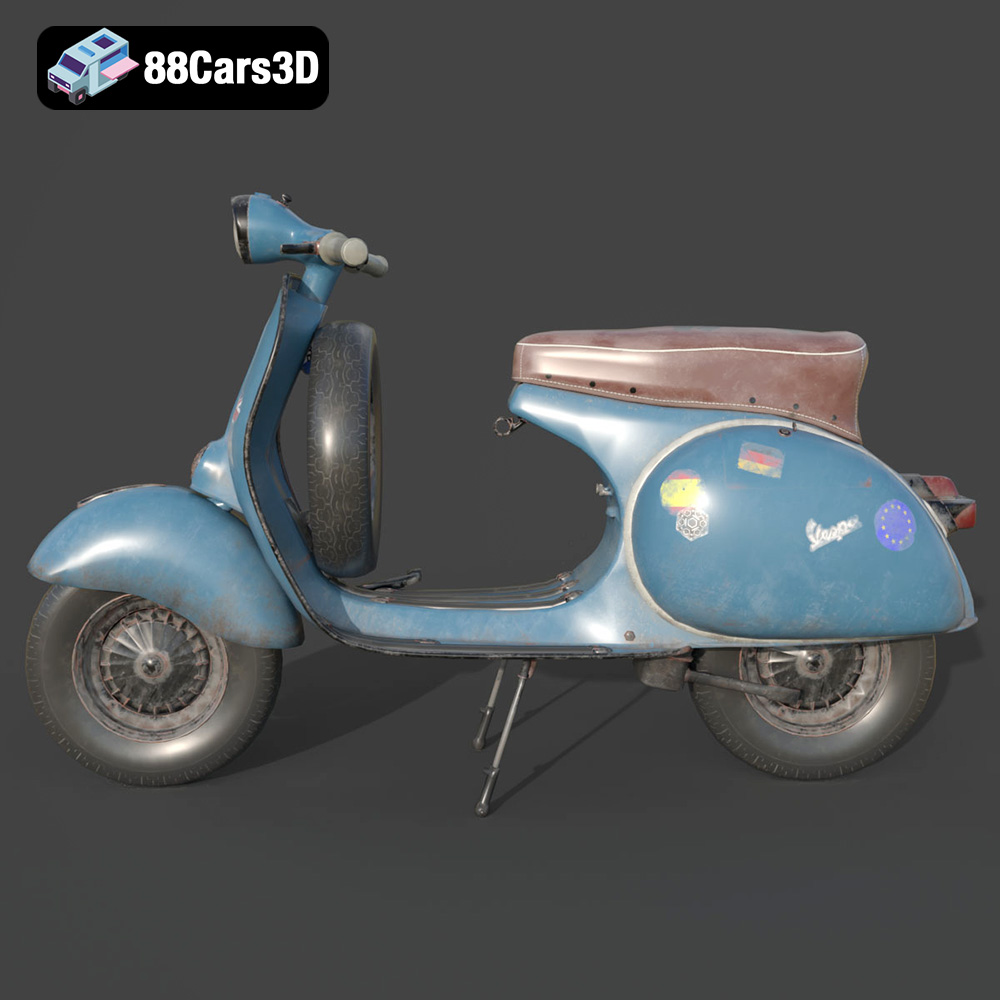
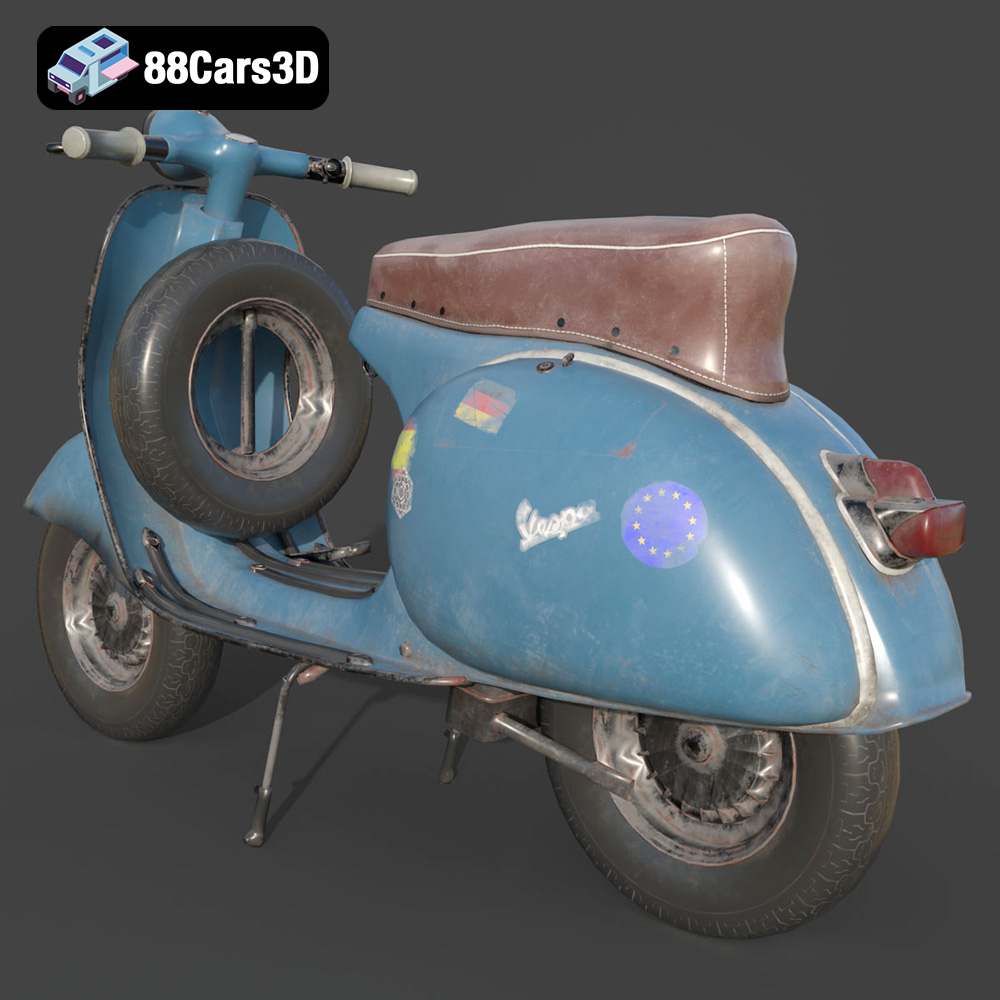
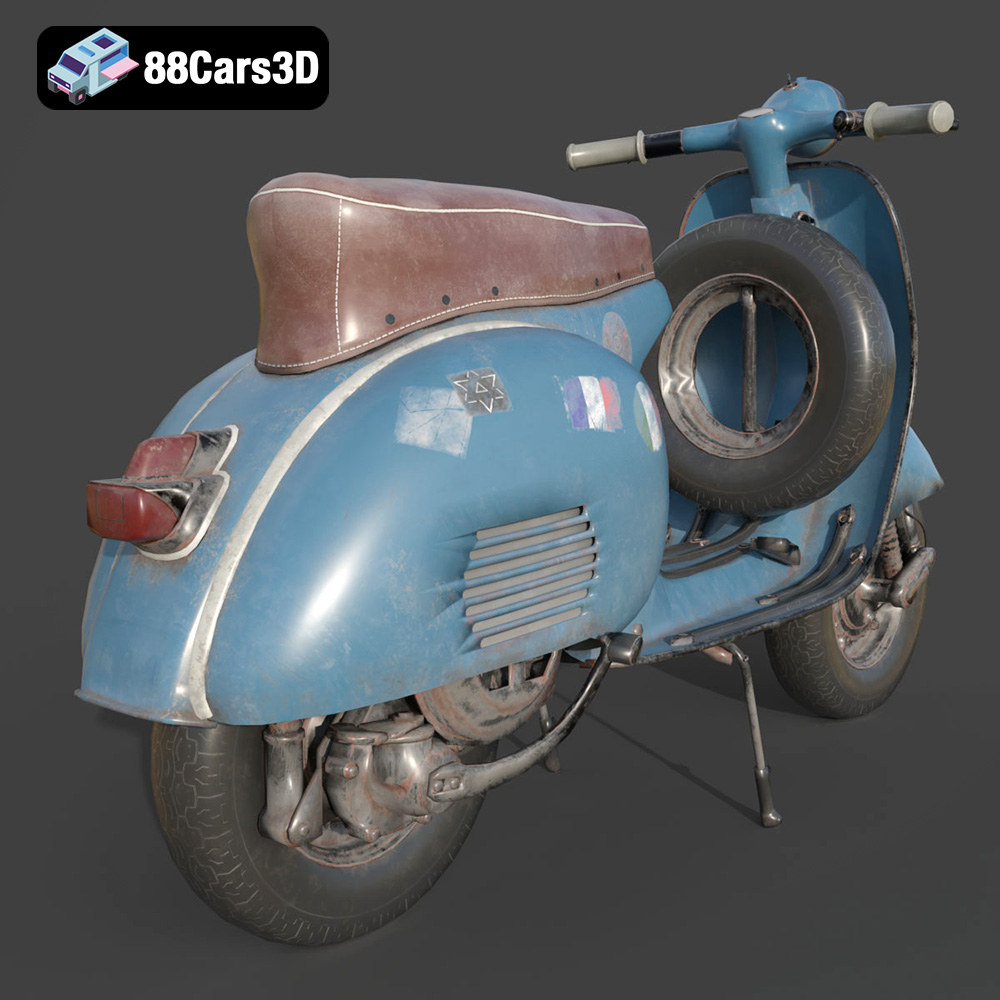
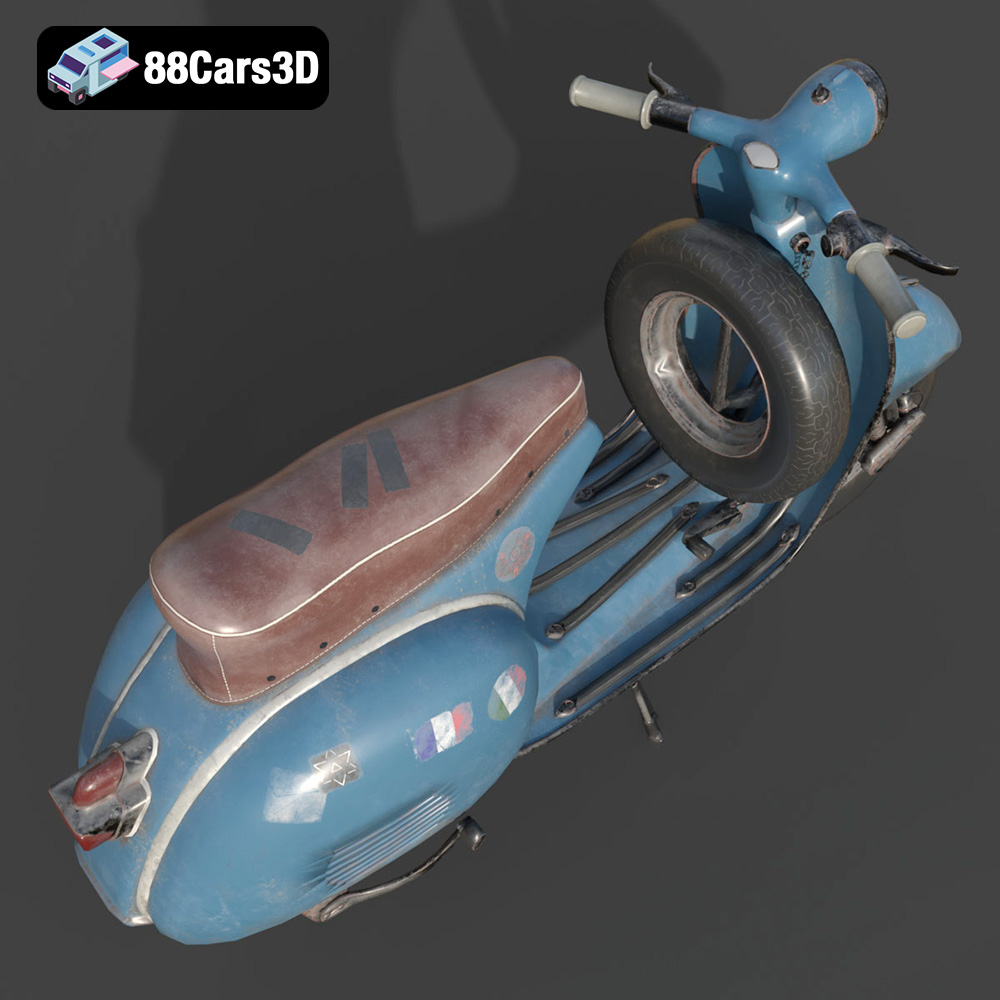
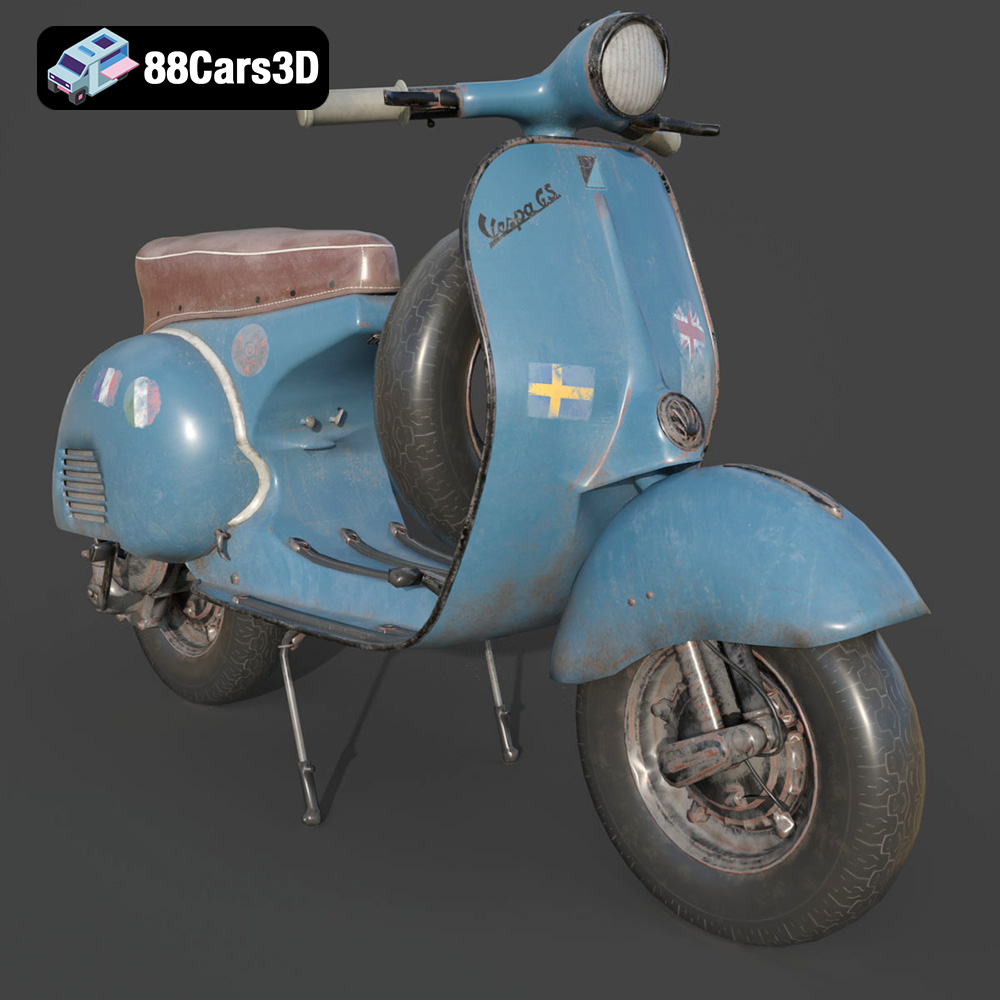
The 3D model of the Vespa GS 150 faithfully reproduces every aspect of this classic. The exterior boasts accurate unibody frame geometry and proportions, capturing the distinctive silhouette that made the original so famous. Crucial details like the detailed engine block with its 150cc 2-stroke casing and cooling fins, the classic sweeping exhaust system, authentic round headlamp, and sleek teardrop taillight are all present and accounted for. The 10-inch wheels with classic tread patterns and hubcaps, along with the signature front trailing-link suspension, contribute to an overall sense of realism and historical accuracy. Critically for animation, separate components for wheels, suspension, and steering are included, allowing for dynamic movement and interaction.
The attention to detail extends to the cockpit and interior features. Artists will find classic dual saddle or long bench seat details with rich texturing, reflecting the era’s craftsmanship. The tubular handlebars with an integrated speedometer, original Piaggio-style instrument cluster, accurate hand grips, and authentic clutch/brake levers and floorboard footbrakes are all modeled with precision. This level of detail ensures the model is not only suitable for exterior shots but also optimized geometry for first-person POV in gaming or close-up interior renders.
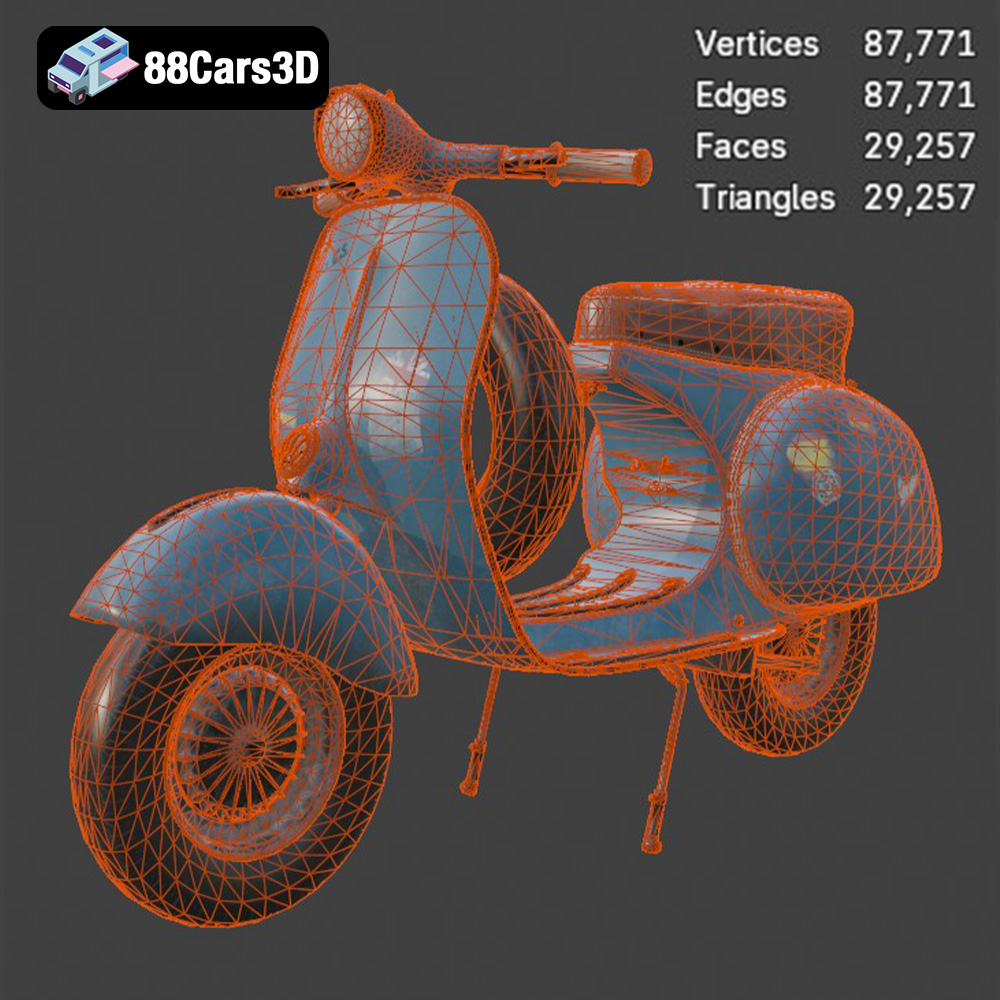
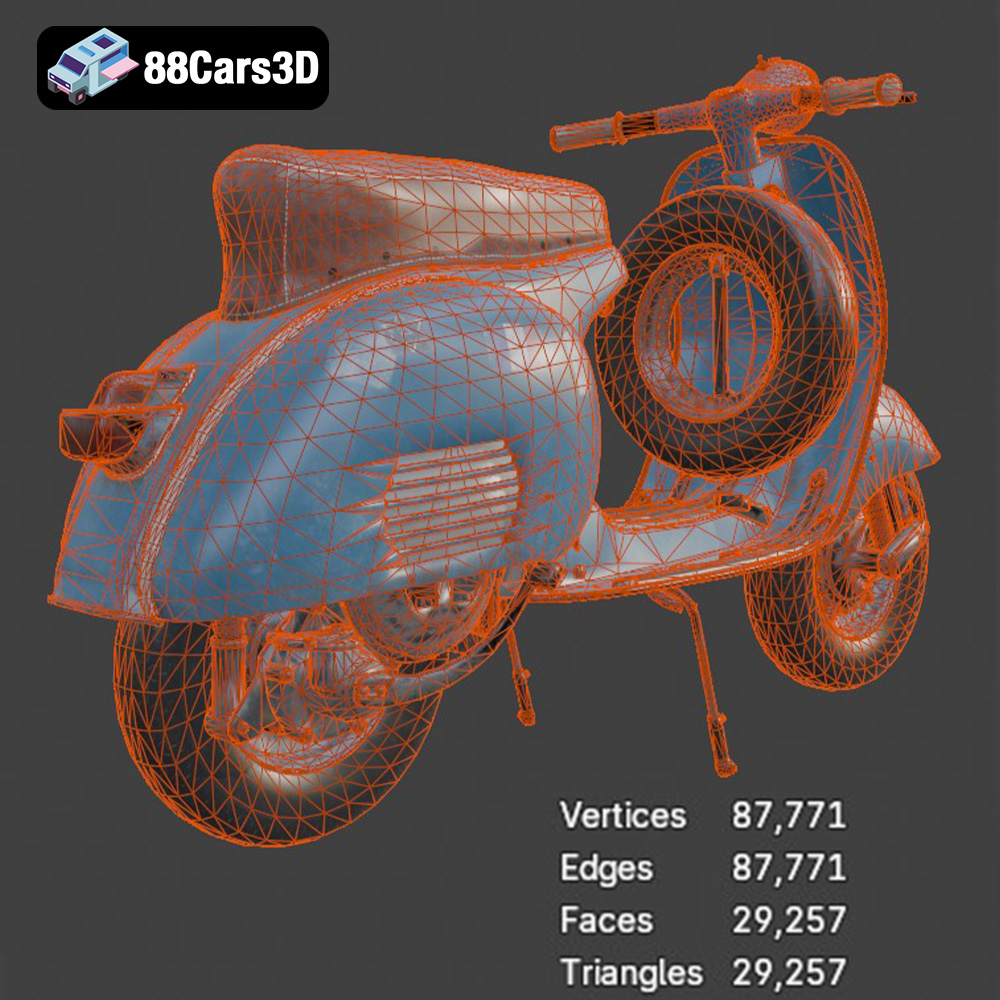
Beyond visual accuracy, technical specifications are paramount for professional deployment. The Vespa GS 150 3D model is game-ready and optimized with approximately 200,000 triangles. This polycount strikes a perfect balance, offering exceptional visual fidelity for close-up renders while maintaining excellent performance in real-time engines like Unreal and Unity. Furthermore, the model adheres to real-world scale accuracy, based on actual vehicle chassis dimensions, ensuring seamless integration into architectural visualization or simulation projects. Proper pivot setup for steering, wheel rotation, and suspension travel simplifies animation workflows, saving countless hours for animators. Its compatibility with major 3D software platforms and real-time rendering engines underscores its versatility and professional-grade quality.
The versatility of a premium 3D asset is defined by its adaptability across various creative industries. The Vespa GS 150 3D model is engineered to be a flexible foundation for a multitude of professional applications, from interactive experiences to stunning visualizations.
For game developers, performance and visual quality must go hand-in-hand. The Vespa GS 150 is designed as a game asset from the ground up, with an optimized polycount (~200,000 triangles) that ensures it performs efficiently in demanding real-time environments without sacrificing detail. Its ‘game-ready’ status means it is ideal for open-world games, racing titles, and simulators. When working with engines like Unreal Engine, the included .fbx and dedicated .unreal formats are invaluable. Developers can effortlessly import the model, leverage Unreal’s robust material editor to apply PBR (Physically Based Rendering) textures, and implement collision meshes. The separate, animatable parts for wheels, steering, and suspension enable dynamic gameplay, allowing players to ride the scooter with realistic physics and animations. Furthermore, the model can be easily integrated with a custom skeletal rig or existing vehicle systems within the engine, making it a powerful addition to any virtual street scene or historic racing challenge.
In the realms of advertising, architectural visualization, and product design, the demand for photorealistic imagery is constant. The Vespa GS 150 3D model excels in these scenarios. Using software like Autodesk 3ds Max or Blender, artists can take full advantage of the model’s high-quality geometry and detailed components. With the provided .max and .blend files, users have complete control over every aspect. Photorealistic rendering engines such as V-Ray, Corona Renderer (for 3ds Max), or Cycles and Eevee (for Blender) can be used to create stunning studio shots, lifestyle scenes, or integrate the Vespa into complex architectural visualizations. Artists can fine-tune materials, experiment with various lighting setups – from golden hour street scenes to crisp, clean studio lighting – and even create elaborate animations for brand campaigns. The ability to customize body colors, material finishes (matte, gloss, metallic), and adapt lighting makes it an incredibly flexible asset for high-end cinematic rendering.
The future of digital interaction increasingly involves immersive technologies like AR and VR, as well as emerging platforms in Web3. The Vespa GS 150 3D model is perfectly suited for these cutting-edge applications. Its optimized geometry and the inclusion of the .glb format are key. The .glb file is specifically designed for efficient loading and rendering in AR/VR applications and browser-based experiences. Imagine a virtual showroom where potential buyers can explore the Vespa GS 150 in 3D directly in their web browser, or an AR app that places the scooter realistically in a user’s driveway. For VR, the model can be incorporated into immersive historical tours or interactive configurators, allowing users to experience the classic vehicle up close in a fully virtual environment. This opens up new possibilities for marketing, education, and interactive engagement with automotive heritage.
While 3D models are primarily enjoyed on screens, the advent of accessible 3D printing technology offers a unique opportunity to bridge the digital and physical worlds. The Vespa GS 150 3D model provides this exciting capability, allowing enthusiasts to hold a tangible piece of automotive history.
For model collectors, hobbyists, or those simply wanting a unique desk ornament, 3D printing a classic vehicle like the Vespa GS 150 offers immense satisfaction. It transforms a virtual asset into a physical object, providing a deeper connection to the design and engineering. The process of preparing, printing, and post-processing the model can be a rewarding creative endeavor in itself, culminating in a personalized miniature replica of an automotive icon. This also serves as a fantastic educational tool, allowing students and designers to study the form and structure in a tactile way.
The Vespa GS 150 3D model is provided in .stl and .ply formats, which are ideal for 3D printing. To achieve the best results, specific settings and considerations are recommended. For scale, popular choices like 1:12, 1:18, or 1:24 offer a good balance of detail and printability. When it comes to resolution, a layer height of 0.04–0.12 mm is suggested, with resin printing highly recommended for capturing the fine details and smooth curves of the Vespa. A wall thickness of 1.2–2.0 mm ensures structural integrity for the printed parts, and an infill of 20–30% provides strength without excessive material usage.
Supports will be required for intricate parts such as the exhaust system, mirrors, and handlebars, due to their overhangs. Proper print orientation is also crucial; printing the main frame angled can improve structural integrity and reduce the need for excessive supports, while wheels are best printed separately to ensure their roundness and detail. Post-processing is where the model truly comes to life. Sanding, priming, and applying authentic factory colors with metallic finishes can transform a raw print into a stunning, display-worthy replica. This fusion of digital design from 88cars3d.com and physical craftsmanship brings the Vespa GS 150 into a new dimension.
A truly professional 3D asset provides not just a finished product, but also a foundation for endless creative exploration. The Vespa GS 150 3D model offers extensive customization options, empowering artists to tailor it precisely to their vision and project requirements.
The inherent structure and material setup of the Vespa GS 150 model allow for straightforward aesthetic modifications. Artists can easily change body and tank colors, experimenting with factory-accurate palettes, custom finishes, or even experimental artistic interpretations. The ability to modify tire textures means you can swap between classic street variants and conceptual off-road patterns, subtly altering the scooter’s character. Adjusting material finishes—from a pristine gloss to a weathered matte or a sleek metallic—can dramatically change the model’s visual impact, allowing it to fit diverse scenes, from a showroom new condition to a vintage barn find. This level of control ensures the Vespa can be integrated into narratives that demand specific visual cues and moods.
Beyond the scooter itself, its integration into various environments is key. The model’s optimized geometry and separate, animatable components make it highly adaptable. It can be dynamically lit for different environments, whether it’s bathed in the warm glow of a Mediterranean sunset, sitting under harsh streetlights in a bustling city, or highlighted in a controlled studio setup. These environmental adjustments can profoundly affect the perception of the model, allowing it to seamlessly blend into classic European street scenes, retro lifestyle visualizations, or even futuristic urban landscapes. This adaptability extends to its use in virtual showrooms where different configurations and lighting scenarios can be showcased interactively.
In the competitive world of 3D content, the difference between a project’s success and struggle often lies in the quality of its assets. Investing in premium 3D car models, like the Vespa GS 150 available at 88cars3d.com, is a strategic decision that pays dividends in saved time, superior visual fidelity, and broader creative possibilities.
Our commitment to delivering high-quality, meticulously optimized 3D models ensures that professionals across game development, architectural visualization, rendering, and AR/VR fields have access to assets that meet industry standards. Every model is crafted with an eye for detail, real-world accuracy, and technical robustness. The comprehensive suite of included file formats—from .blend for native editing to .fbx for universal compatibility and .stl for 3D printing—guarantees that you have the right tool for any job. When you choose an asset from 88cars3d.com, you’re not just buying a model; you’re investing in a versatile, game-ready, and render-ready foundation for your most ambitious projects, backed by a dedication to automotive passion and digital excellence.
The Vespa GS 150 is more than just a scooter; it’s a piece of history, an icon of design, and a symbol of an era. Bringing such a revered vehicle into the digital realm with the fidelity and versatility seen in this 3D model opens up a world of creative possibilities. From populating immersive game environments and crafting photorealistic renders for advertising campaigns to building interactive AR/VR experiences and even producing physical replicas through 3D printing, this asset is designed to excel.
Its optimized topology, meticulous detailing, real-world scale, and broad file format support make it an invaluable tool for any professional working with 3D content. Whether you’re developing the next big racing game, designing a virtual showroom, or simply appreciating the beauty of automotive art, the Vespa GS 150 3D model provides the quality and flexibility you need. Explore this and many other premium 3D car models at 88cars3d.com, and elevate your digital projects with assets that truly stand out.
The Vespa GS 150 (Gran Sport) is widely regarded as one of the most beautiful and iconic scooters ever produced. Known for its elegant aerodynamic curves, historical significance as the first mass-market sports Vespa, and unparalleled Italian styling, this classic masterpiece defined a generation. It features the signature swept-back leg shield, rounded side panels, and the distinctive 150cc two-stroke engine layout.
This high-quality 3D model features a well-optimized topology (~200,000 triangles), ensuring exceptional visual fidelity while maintaining game-ready performance. The model is meticulously crafted to capture the essence of the classic scooter, making it a perfect asset for close-up renders, real-time engines, and detailed environment populating.
Perfect for classic European street scenes, retro lifestyle visualizations, virtual showrooms, and historic racing games.
.blend, .fbx, .obj, .glb, .stl, .ply, .unreal, .max
Tags:
vespa, gs-150, scooter, classic-scooter, retro-scooter, game-ready, low-poly, optimized, scooter-3d-model, motorcycle-3d-model, game-asset, rendering, vr-ar, blend, fbx, obj, glb, stl, ply, unreal, maxVespa VNB 125-B 3D Model 3D Printable STL
$39.99
.blend
.fbx
.glb
.max
.obj
.ply
.rendering
.scooter
.stl
.unreal
.vespa
classic-scooter
game asset
game-ready
gs-150
low-poly
motorcycle-3d-model
optimized
retro-scooter
scooter-3d-model
VR/AR