Get 20% OFF All Premium 3D & STL Models!

In the vibrant world of 3D visualization, from cinematic automotive rendering to immersive game development, the foundation of any compelling project lies in the quality of its 3D assets. Professionals across industries continually seek models that combine historical accuracy with technical optimization, ready to perform flawlessly in diverse environments. Whether it’s crafting a realistic historical simulation, a high-octane racing game, or a detailed architectural visualization, the demand for meticulously engineered 3D car models is constant.
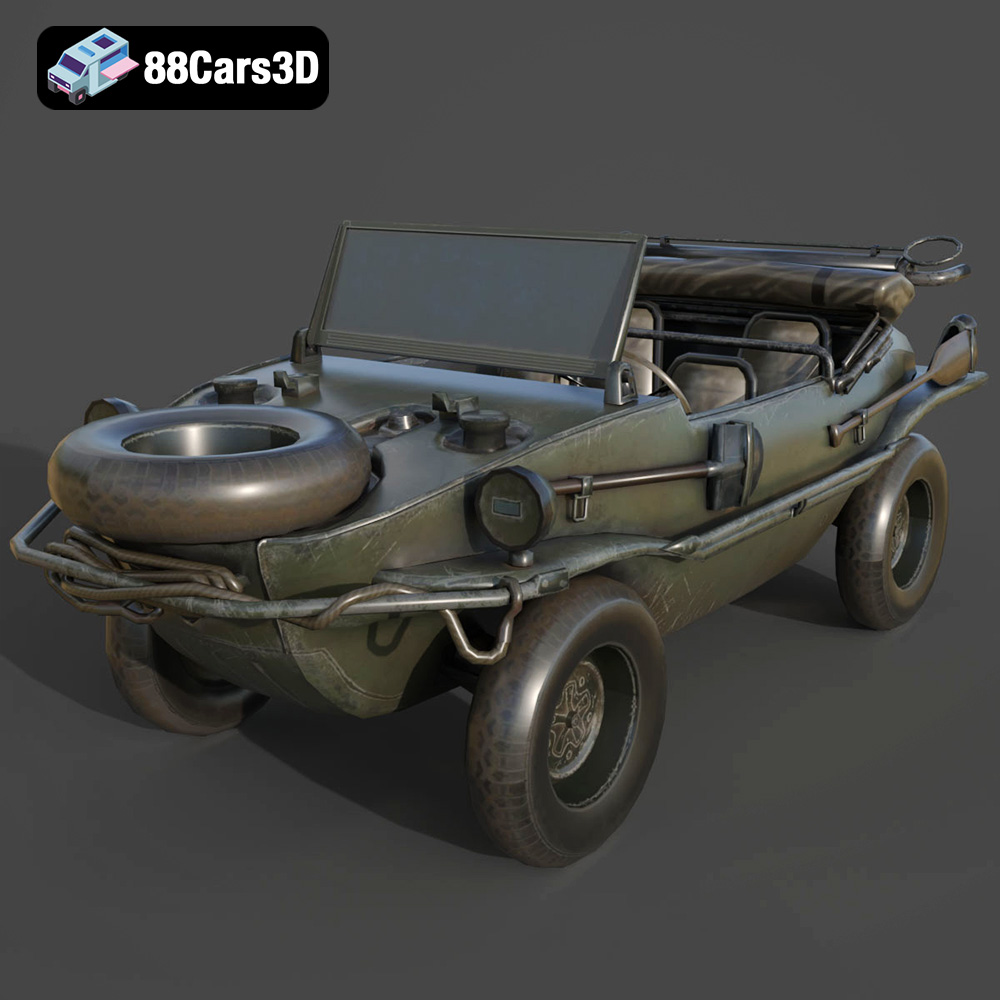
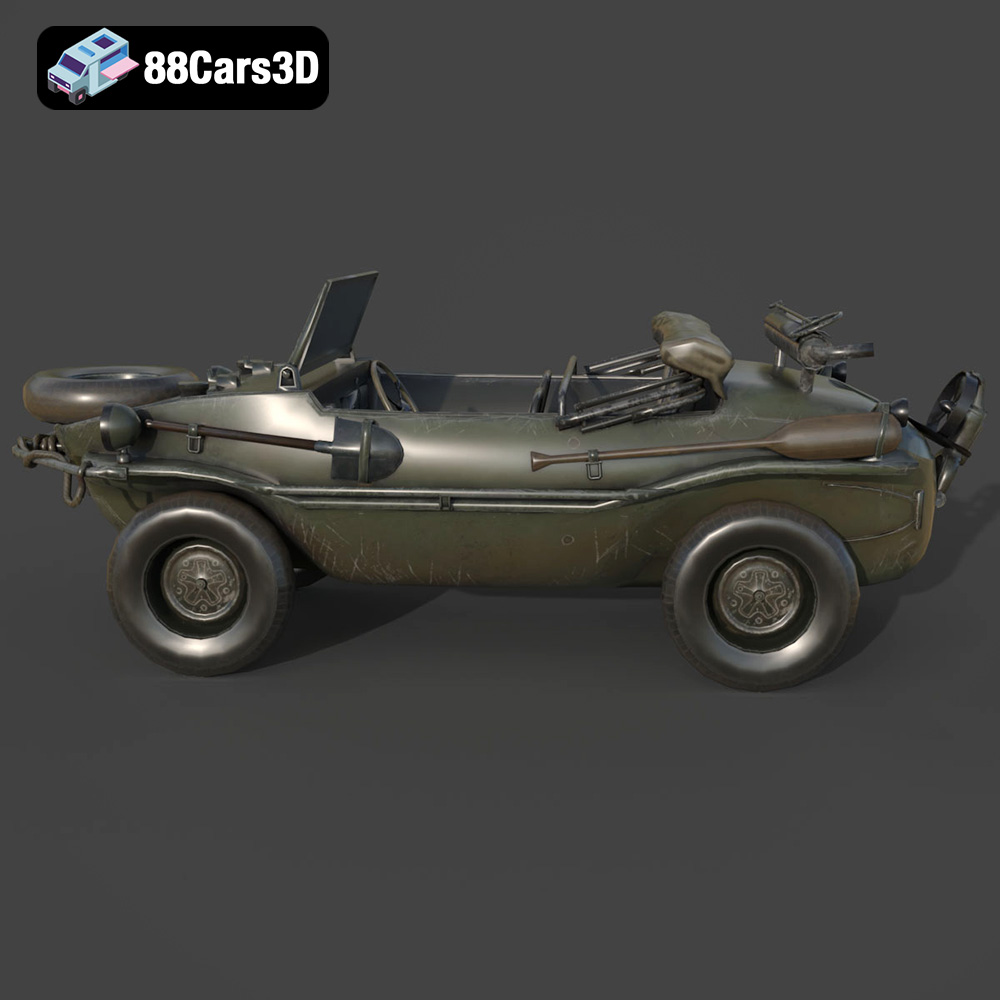
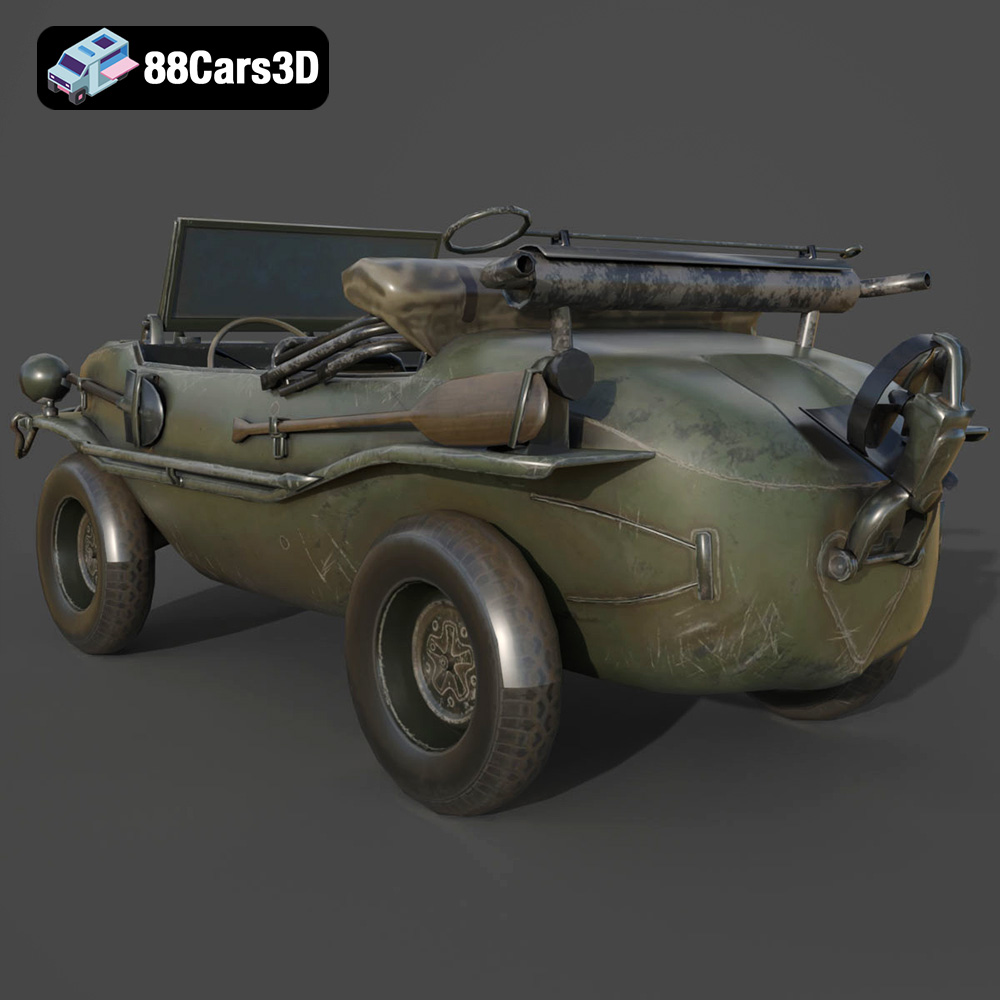
Today, we delve into the intricate process of creating such assets, focusing on a particularly iconic example: the Volkswagen Schwimmwagen Typ 166. This legendary World War II amphibious vehicle, renowned for its rugged design and versatility, presents a unique challenge and opportunity for 3D artists. A high-quality digital representation of the Schwimmwagen, like the one available at 88cars3d.com, is not merely a static object; it’s a dynamic asset designed for immediate integration into cutting-edge workflows, from real-time engines to high-fidelity renders.
We’ll explore the technical considerations, file formats, and application potential that define a truly professional 3D car model, illustrating how the Volkswagen Schwimmwagen Typ 166 3D Model stands as a testament to precision engineering in the digital realm.The Art and Science of Crafting Game-Ready 3D Car Models
Creating professional-grade 3D car models involves a delicate balance between artistic fidelity and technical pragmatism. For assets destined for demanding applications like game development or AR/VR, every polygon, texture map, and material attribute must be carefully considered to ensure both visual realism and optimal performance.
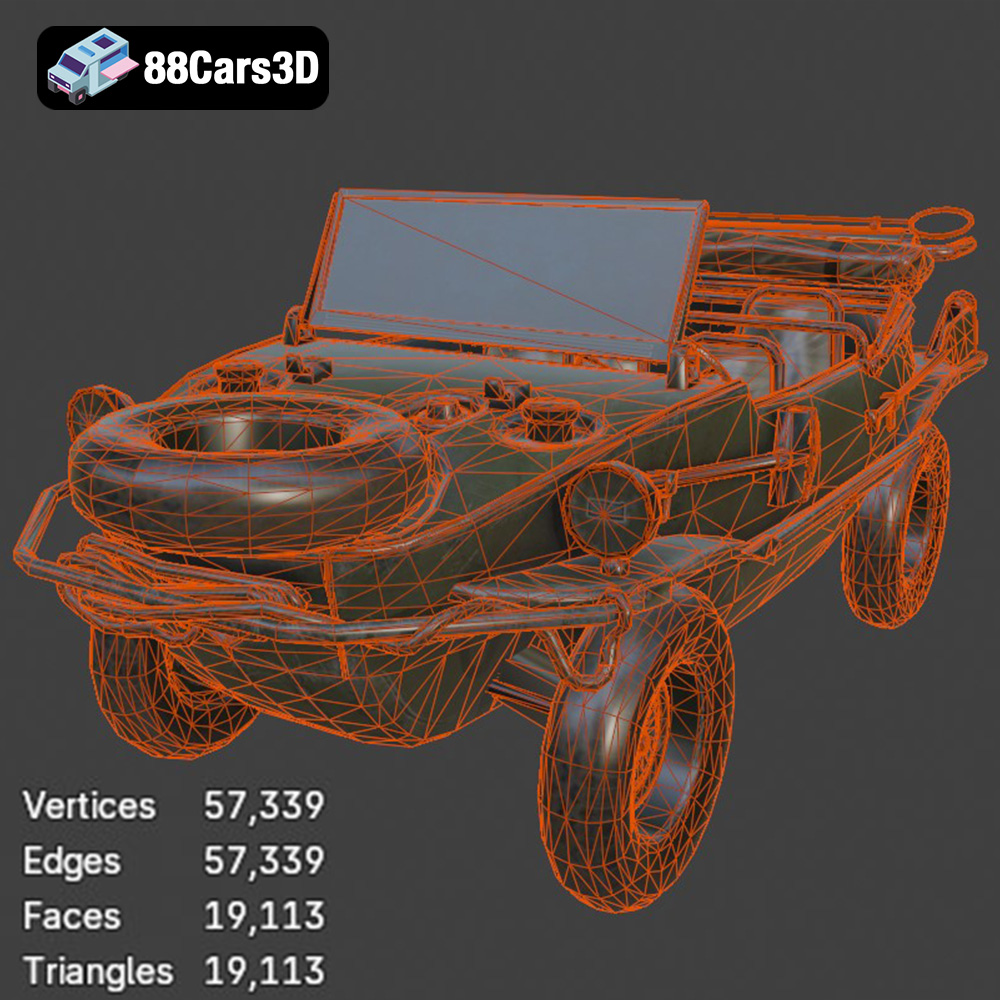
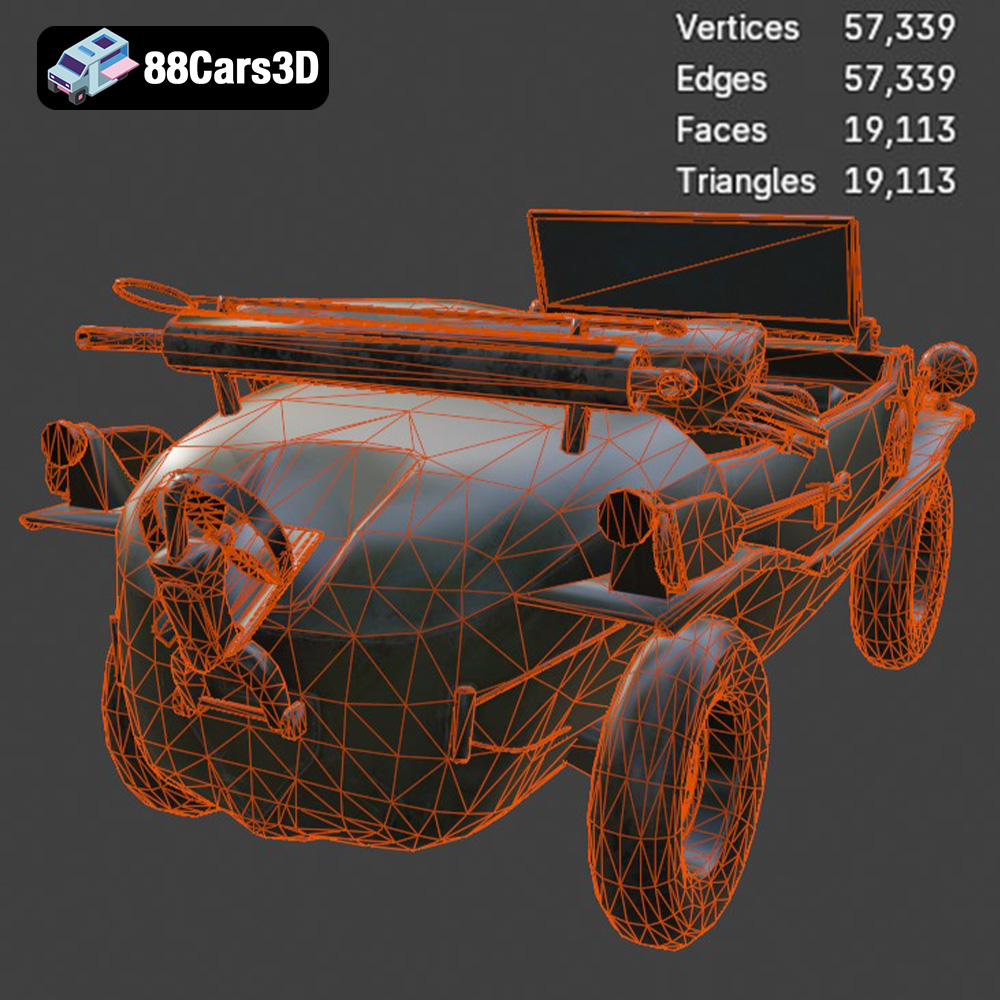
At the heart of any high-quality 3D model lies its topology – the arrangement of vertices, edges, and faces that form the mesh. For game-ready assets, efficient topology is paramount. This means minimizing poly counts without sacrificing crucial details, often achieved through careful polygon reduction, baking high-detail normal maps onto lower-poly meshes, and strategic edge looping. The Volkswagen Schwimmwagen Typ 166 3D Model, for instance, boasts approximately 150,000 triangles. This figure represents a sweet spot, providing sufficient detail for close-up renders and first-person views while remaining lightweight enough for real-time engines like Unreal and Unity. Complex areas like the fold-down propeller mechanism, suspension components, and the distinctive riveted hull require careful mesh construction to look authentic without overburdening the rendering pipeline.
Physical Based Rendering (PBR) has become the industry standard for achieving realistic materials and lighting. A professional 3D car model must come with a well-defined PBR workflow, typically including diffuse/albedo, normal, roughness, metallic, and ambient occlusion maps. These textures dictate how light interacts with the model’s surface, simulating everything from the weathered military paint to the metallic sheen of its engine components. Ensuring textures are properly unwrapped with clean UVs is critical for avoiding distortions and maximizing texture resolution. For a model like the Schwimmwagen, the PBR materials would meticulously replicate the dull, matte finish of military-grade steel, the worn rubber of its tires, and the subtle reflections off its glass components, all contributing to an immersive experience.
Accuracy in automotive rendering and game environments extends beyond visual appearance to physical dimensions and articulation. A 3D car model built to real-world scale ensures correct spatial relationships and interactions within an environment, which is crucial for physics simulations in games or accurate scene composition in visualizations. Furthermore, proper pivot setups for animated parts – such as wheels, steering, suspension, and unique features like the Schwimmwagen’s deployable propeller – are indispensable. This allows animators and game developers to effortlessly bring the vehicle to life, accurately simulating its movement and functionality without extensive re-rigging.
The versatility of a professional 3D car model is often defined by the range of file formats it supports. Each format serves a specific purpose, catering to different software ecosystems, project requirements, and target platforms. Understanding these formats is crucial for any developer or artist looking to integrate assets seamlessly into their workflow. The Volkswagen Schwimmwagen Typ 166 3D Model exemplifies this versatility by offering a comprehensive suite of formats.
The .blend file format is Blender’s native project file. It encapsulates an entire Blender scene, including mesh data, materials, textures, lighting, cameras, animations, and even physics simulations. This format is ideal for users working primarily within Blender, offering full editability and preserving all scene data as created by the artist. When you download the Schwimmwagen as a .blend file from 88cars3d.com, you get the complete, editable scene, allowing you to easily dissect its construction, modify materials, adjust lighting, or build upon the existing setup for highly customized renders or animations within Blender.
.fbx (Filmbox) is a proprietary file format owned by Autodesk and is widely considered the industry standard for exchanging 3D data between different software applications. It supports geometry, materials, textures, animations, and skeletal data, making it incredibly versatile. For game development, .fbx is often the go-to choice due as it integrates seamlessly with game engines like Unreal and Unity. Its robust support for animation and scene hierarchy ensures that articulated models like the Schwimmwagen, with its movable wheels, steering, and propeller, retain their functional pivots and relationships when imported.
.obj (Wavefront OBJ) is another highly universal and widely supported format, primarily known for storing 3D geometry (vertices, normals, texture coordinates, and faces). While it supports basic material definitions (.mtl file), it does not carry animation or complex scene information. Its strength lies in its simplicity and broad compatibility across almost all 3D software. The .obj format is excellent for static models or when you need a clean mesh to start a new project in a different software without any extraneous data. For the Schwimmwagen, an .obj file would provide a solid base mesh, ready for texturing and rigging in your preferred application.
This comprehensive range of formats for the Volkswagen Schwimmwagen Typ 166 3D Model ensures that users from every discipline can access and utilize this exceptional asset with minimal friction, cementing its value as a truly professional digital product on 88cars3d.com.
The Volkswagen Schwimmwagen Typ 166 stands as an icon of World War II engineering, a testament to robust design and amphibious capability. Translating such a distinctive vehicle into a high-fidelity 3D car model requires meticulous attention to every rivet, curve, and mechanical component. The Schwimmwagen model available on 88cars3d.com delivers precisely this level of detail and technical excellence.
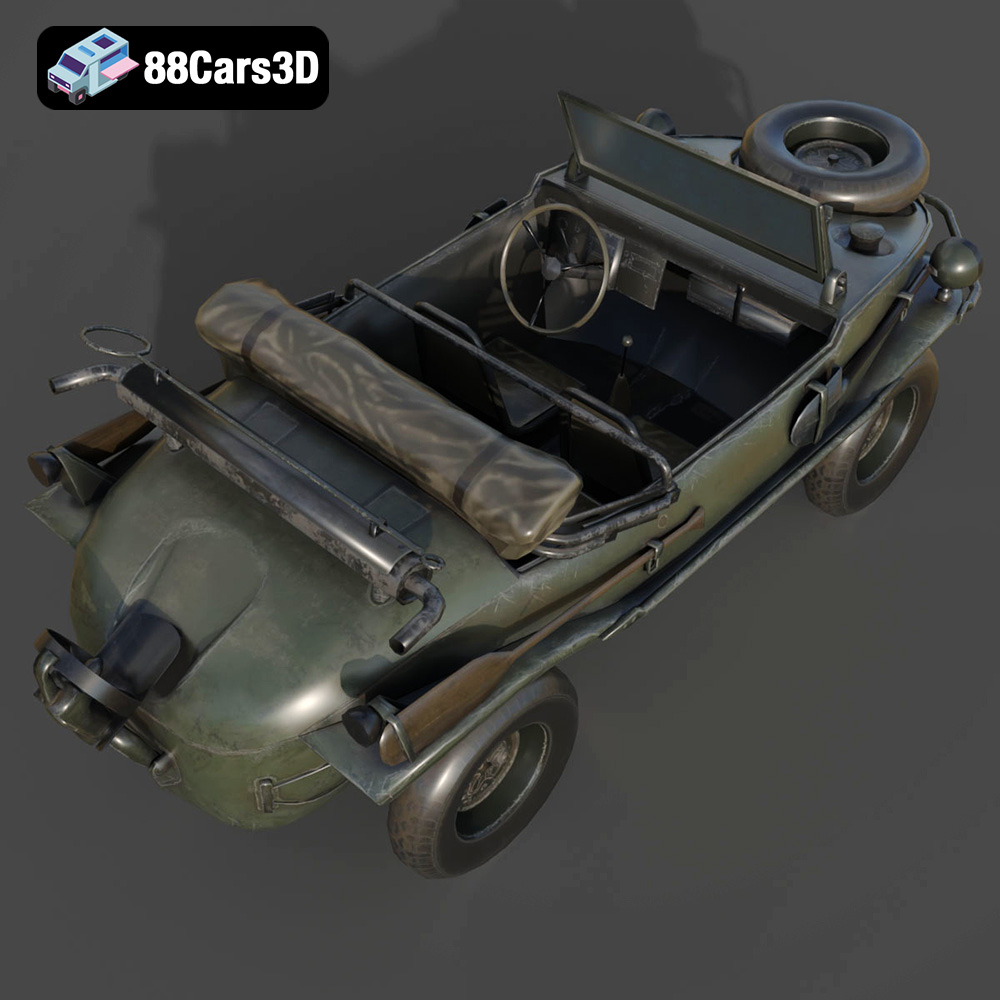
The model’s exterior captures the essence of the Schwimmwagen with remarkable accuracy. From its distinctive boat-like, riveted watertight hull geometry to the precise proportions, every feature reflects its real-world counterpart. Details like the rear-mounted air-cooled flat-four engine housing, the authentic fold-down rear propeller mechanism, and the period-accurate military lighting with blackout headlamps are all faithfully recreated. The high-tread off-road tires and stamped steel wheels are not just visually correct but also accurately represent the robust nature of the original. Crucially for animators and game developers, components such as the wheels, propeller, suspension, and steering are separate objects with proper pivot setups, ensuring they are instantly ready for dynamic animation without additional rigging effort. This level of preparation is invaluable for creating realistic vehicle physics and cinematics.
While the Schwimmwagen’s interior was known for its utilitarian simplicity, the 3D model doesn’t overlook these crucial details. The sparse military-spec instrument cluster, the minimalist three-spoke steering wheel, and the authentic column provide a genuine cockpit experience. The detailed floor-mounted gear shifter and 4WD engagement levers are modeled for accuracy. This attention to interior detail is particularly important for first-person POV in gaming or immersive AR/VR experiences, where players or users expect to interact with or observe the internal environment closely. Optimized geometry ensures that even with these details, the interior remains performance-friendly for real-time applications.
Beyond visual fidelity, the Volkswagen Schwimmwagen Typ 166 3D Model boasts technical specifications designed for professional use. With approximately 150,000 triangles, it achieves an optimal balance between visual realism and real-time engine performance. This polycount is perfectly suited for modern game engines like Unreal and Unity, allowing for multiple instances or complex scenes without significant performance drops. The real-world scale accuracy, based on the actual vehicle chassis, guarantees correct proportions and seamless integration into virtual environments. Furthermore, the proper pivot setup for steering, wheel rotation, propeller deployment, and suspension travel minimizes setup time, allowing artists and developers to focus on creative tasks rather than technical adjustments. This makes it an ideal game asset for any project requiring historical accuracy and technical efficiency.
The true value of a high-quality 3D car model like the Volkswagen Schwimmwagen Typ 166 lies in its ability to seamlessly integrate into diverse professional workflows. Its multi-format availability and optimized structure ensure it can be a cornerstone asset for various projects, from cinematic renders to interactive simulations.
For game developers, the Schwimmwagen model is a ready-to-use game asset. Its optimized polycount (~150,000 triangles) and proper pivot setups make it ideal for immediate import into Unreal Engine or Unity. The inclusion of the .unreal file (often an optimized FBX package) specifically targets Unreal users, potentially saving hours of setup time on materials and textures. In a historical open-world game, players could drive this amphibious vehicle through varied terrains and water bodies, leveraging its fully animated components. For a military simulator, the detailed exterior and interior provide an authentic backdrop for training scenarios or combat situations. The model’s real-world scale ensures accurate physics simulation, crucial for realistic driving mechanics and vehicle interactions within the game world.
For cinematic sequences, promotional imagery, or architectural visualizations, the .max and .blend formats offer unparalleled flexibility. In 3ds Max, artists can leverage V-Ray or Corona Renderer to achieve photorealistic automotive rendering. The Schwimmwagen’s detailed geometry and PBR-ready materials allow for intricate lighting setups, showcasing the weathered metal, rugged tires, and subtle reflections. Animators can easily create complex camera movements and vehicle sequences, highlighting the fold-down propeller or the working suspension. Similarly, Blender users benefit from the full native scene, enabling them to utilize Cycles or Eevee for stunning visuals, experimenting with different environment lighting and material modifications to create bespoke scenes, perhaps depicting the Schwimmwagen in a dynamic historical diorama or an artistic stylized scene.
The versatility extends beyond traditional rendering and gaming. For Augmented Reality (AR) and Virtual Reality (VR) experiences, the .glb format is particularly beneficial. Its optimization for web and mobile platforms ensures smooth performance in immersive virtual showrooms or educational VR tours. Imagine a museum-quality interactive exhibit where visitors can virtually walk around, inspect, and even “enter” the Schwimmwagen, learning about its history and mechanics in an engaging way. Furthermore, the .stl format opens the door to physical creation through 3D printing. Hobbyists and model makers can print the Schwimmwagen at various scales (e.g., 1:16, 1:35) for display, dioramas, or as a base for custom builds. The recommended print settings provided, such as layer height and support requirements, ensure successful and detailed prints, allowing for tangible interaction with this digital masterpiece.
A truly professional 3D car model is not just accurate but also adaptable. The Volkswagen Schwimmwagen Typ 166 3D Model offers robust customization options, allowing artists and developers to tailor its appearance to fit a wide array of project requirements and aesthetic visions.
The underlying PBR material setup of the Schwimmwagen model is designed for easy modification. This means that while it comes with authentic military-grade textures, artists can effortlessly change body colors to, for instance, a more pristine factory finish, a specific historical camouflage pattern, or even a custom, anachronistic design for a fantasy project. Tire textures can be swapped between clean variants and those depicting off-road mud, instantly changing the vehicle’s context. Material finishes can be adjusted from matte to gloss, metallic, or even heavily weathered, simulating years of wear and tear or specific environmental conditions. This flexibility is crucial for designers who need to integrate the model into a wide range of scenes, from pristine studio renders to gritty, post-apocalyptic settings.
Beyond surface appearance, the model’s construction allows for deeper customization. Lighting can be adapted for different environments, such as a sunny outdoor scene, a moody night-time render, or an interior studio setup, with the model reacting realistically to each. The modularity of its components – separate wheels, suspension, propeller – means that custom animations or unique environmental interactions are easily achieved. For instance, in an immersive AR/VR experience, users could interactively fold down the propeller or adjust the steering wheel. This level of adaptability transforms the Schwimmwagen from a static asset into a versatile tool, capable of fulfilling the creative demands of nearly any project in automotive rendering, game development, or interactive visualization.
In the dynamic landscape of 3D content creation, the value of a meticulously crafted 3D car model cannot be overstated. From the historical fidelity of the Volkswagen Schwimmwagen Typ 166 to its game-ready optimization and comprehensive file format support, such assets represent an investment in efficiency, quality, and creative potential. Whether you’re a game developer seeking an authentic game asset, an animator pursuing photorealistic automotive rendering, or an AR/VR designer building immersive experiences, the technical precision and artistic detail embedded in models like the Schwimmwagen significantly streamline workflows and elevate final output.
The ability to access models with correct topology, PBR materials, real-world scale, and articulated components in a multitude of formats (.blend, .fbx, .obj, .glb, .stl, .ply, .unreal, .max) ensures compatibility across the industry’s leading software and engines. This eliminates the tedious process of rebuilding or re-optimizing, allowing professionals to focus on innovation and storytelling. The Volkswagen Schwimmwagen Typ 166 3D Model, available at 88cars3d.com, is a prime example of a premium asset that delivers on all these fronts, offering both historical accuracy and modern technical excellence. Investing in such high-quality resources from trusted marketplaces like 88cars3d.com empowers creators to achieve unparalleled realism and performance in their digital projects, solidifying their commitment to excellence in every detail.
The Volkswagen Schwimmwagen Typ 166 is an iconic World War II amphibious off-road vehicle, celebrated for its rugged durability and unique boat-like hull design. Serving as one of the most mass-produced amphibious cars in history, it features a distinctive rear-mounted air-cooled flat-four engine, a fold-down propeller system, and four-wheel drive capability. This highly accurate 3D model meticulously captures its utilitarian military aesthetics, from the riveted watertight chassis to the spare tire mounted on the sloping front hood. Engineered with exceptional attention to detail, this 3D model boasts optimized topology and an efficient triangle count, ensuring it is fully game-ready without compromising on visual fidelity. Whether you are developing a historic military simulator, creating an immersive AR/VR educational experience, or producing high-end cinematic renders, this model delivers unparalleled realism and performance across all major real-time engines and 3D software.
$39.99
.blend
.fbx
.glb
.max
.obj
.ply
.rendering
.stl
.unreal
.volkswagen
amphibious-vehicle
car-3d-model
classic-car
game asset
game-ready
low-poly
military-vehicle
off-road
optimized
schwimmwagen-typ-166
VR/AR
ww2-vehicle